Vitae Arete · Figures and Data
One Word
A close reading of the seven-part petition asking CMS to recognise a physician nutrition specialty, the single edit that changed what it was asking for, and the comment period that closes 14 September 2026.
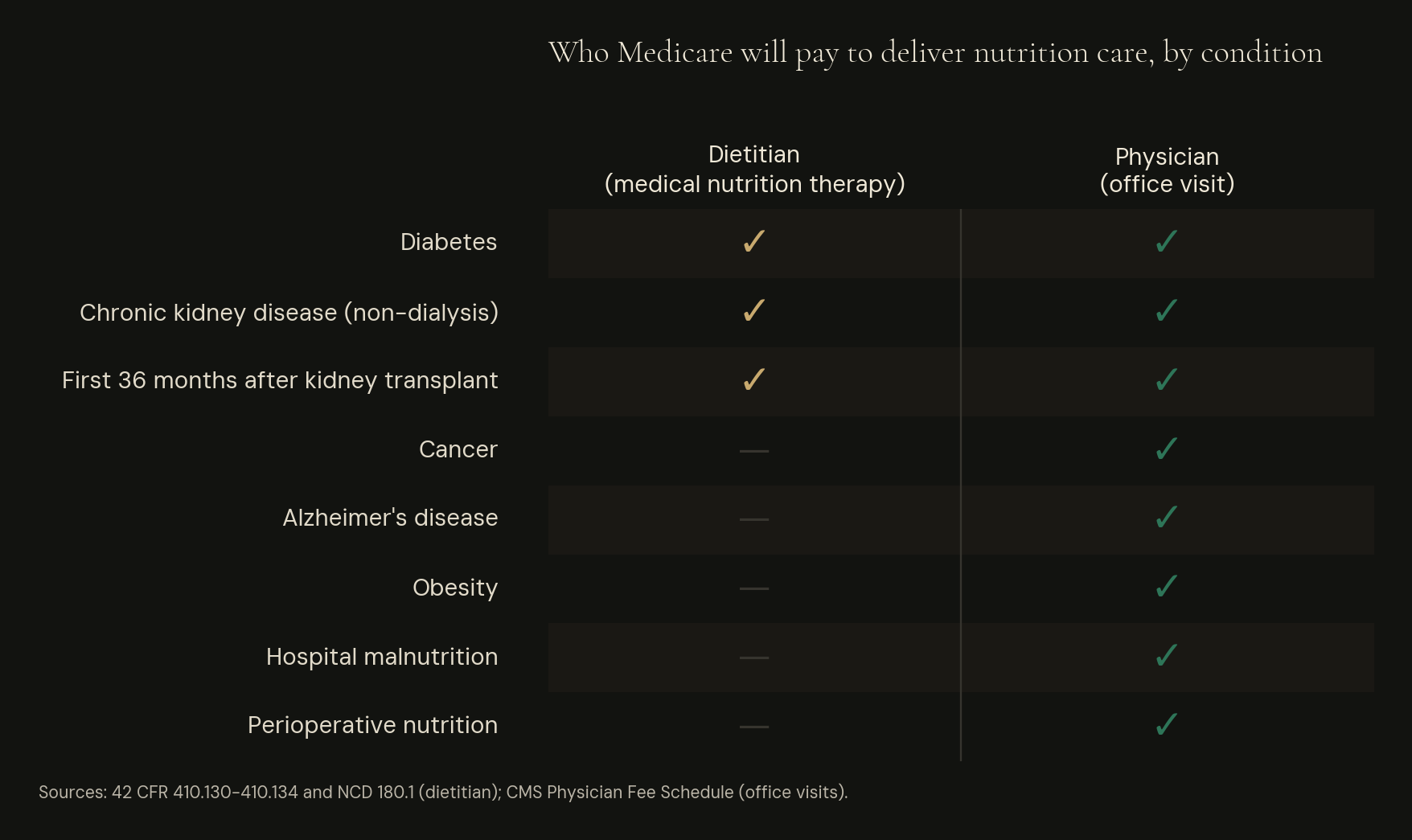
Sources: 42 CFR 410.130-410.134 and NCD 180.1 (dietitian); CMS Physician Fee Schedule (office visits).
Show the underlying data
| — | Dietitian (medical nutrition therapy) | Physician (office visit) |
|---|---|---|
| Diabetes | 1 | 1 |
| Chronic kidney disease (non-dialysis) | 1 | 1 |
| First 36 months after kidney transplant | 1 | 1 |
| Cancer | 0 | 1 |
| Alzheimer's disease | 0 | 1 |
| Obesity | 0 | 1 |
| Hospital malnutrition | 0 | 1 |
| Perioperative nutrition | 0 | 1 |
Obesity is a common point of confusion. It is not a covered medical nutrition therapy diagnosis. Medicare covers it under a separate benefit, intensive behavioural therapy for obesity (NCD 210.12), which must be furnished by a primary care practitioner in a primary care setting, so a dietitian cannot bill that benefit independently either. The last five rows are conditions the PNS taxonomy descriptor and the CMS letter both name as territory of the specialty.
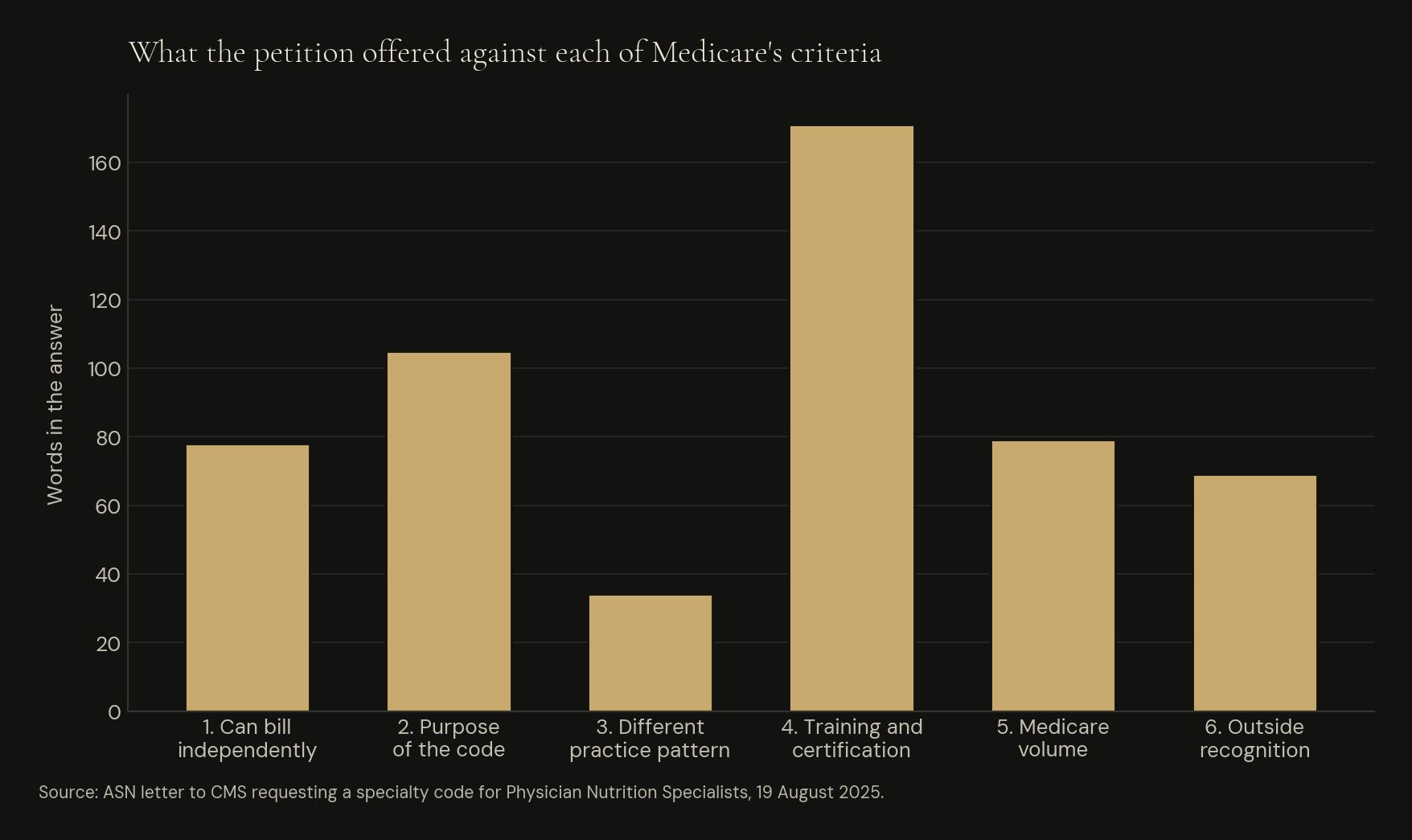
Source: ASN letter to CMS requesting a specialty code for Physician Nutrition Specialists, 19 August 2025.
Show the underlying data
| Category | Value |
|---|---|
| 1. Can bill independently | 78 |
| 2. Purpose of the code | 105 |
| 3. Different practice pattern | 34 |
| 4. Training and certification | 171 |
| 5. Medicare volume | 79 |
| 6. Outside recognition | 69 |
Word counts measured from the letter text, excluding headings, footnotes and URLs. The seventh consideration is omitted because its answer is largely a table of taxonomy codes rather than prose.
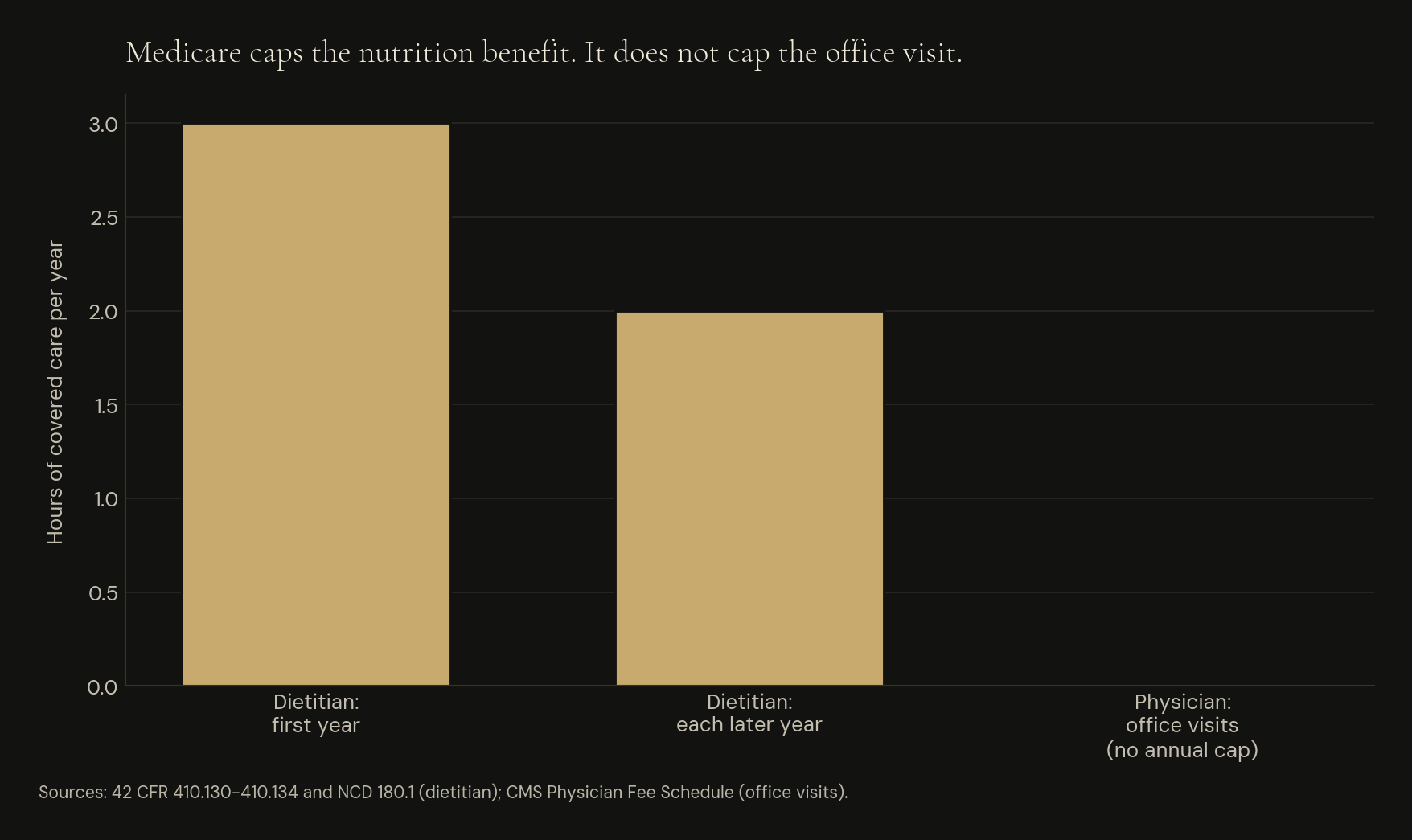
Sources: 42 CFR 410.130-410.134 and NCD 180.1 (dietitian); CMS Physician Fee Schedule (office visits).
Show the underlying data
| Category | Value |
|---|---|
| Dietitian: first year | 3 |
| Dietitian: each later year | 2 |
| Physician: office visits (no annual cap) | 0 |
The physician bar is shown at zero because no annual hour ceiling exists for office visits, not because the coverage is zero. Dietitian hours are the statutory maximums at 42 CFR 410.130-134. For scale, a fifteen-minute unit of medical nutrition therapy paid the dietitian $18.36 in the 2026 hospital setting after the 85 percent non-physician reduction and the 2 percent sequestration, against $21.98 for an initial unit. National amounts; localities vary.
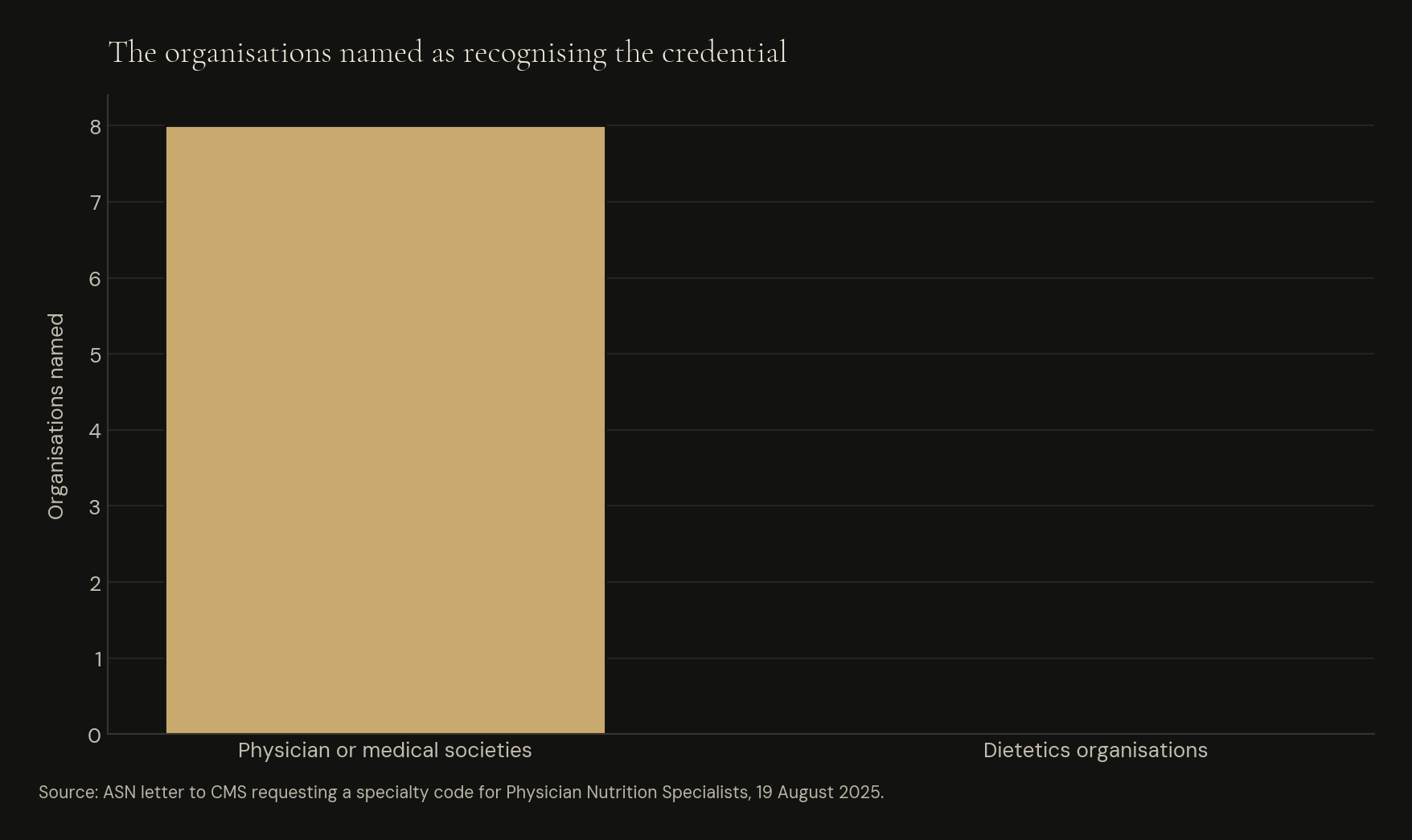
Source: ASN letter to CMS requesting a specialty code for Physician Nutrition Specialists, 19 August 2025.
Show the underlying data
| Category | Value |
|---|---|
| Physician or medical societies | 8 |
| Dietetics organisations | 0 |
Named: AACE, American College of Nutrition, AGA, ASN, ASPEN, NASPGHAN, The Obesity Society, and the Society of Critical Care Medicine.
References
- American Society for Nutrition. CMS Specialty Code Request for Physician Nutrition Specialists, letter to CMS, 19 August 2025. — source
- National Uniform Claim Committee. Health Care Provider Taxonomy Code Set (PNS codes 207LP4000X, 207QP0002X, 207RP1002X, 2080P1004X, 2086P0122X; effective 1 April 2025). — source
- CMS. CY 2027 Payment Policies Under the Physician Fee Schedule (CMS-1848-P), Federal Register, 16 July 2026. Comments close 14 September 2026. — source
- Regulations.gov. Docket CMS-2026-2377, document CMS-2026-2377-0002 — the comment form for this rule. Comments close 14 September 2026. — source
- 42 CFR 410.132, Medical nutrition therapy. — source
- 42 CFR 410.134, Provider qualifications for medical nutrition therapy. — source
- National Board of Physician Nutrition Specialists. — source
- CMS. CY 2027 PFS proposed rule fact sheet (includes the request for information on the CPT code set and payment valuation). — source
- American Medical Association. RUC Health Care Professionals Advisory Committee (HCPAC) Review Board — the 13 seated non-physician organizations. — source
- Uhl S, et al. Malnutrition in Hospitalized Adults: A Systematic Review. AHRQ Comparative Effectiveness Review No. 249, October 2021 (cited by the petition). — source
Download the PDF appendix — methods notes and the full reference list.
This page is general education, not individual medical advice. Confirm personal targets with your own clinical team.