Summary
Since July 2026, a temporary Medicare program has offered some patients obesity drugs for a $50 monthly copay if the prescriber attests that structured nutrition and physical activity come with them. Medicare does not pay a dietitian to give that care for obesity. I propose a trade: makers of GLP-1 drugs, used for obesity and diabetes, pay a fee of 5 to 10 percent of their United States sales of them into a nutrition care fund, and the same bill makes Medicare coverage permanent.
- There is precedent. Drug makers have paid an annual fee since 2011, now $2.8 billion a year. A tax on vaccines funds a federal injury compensation fund.
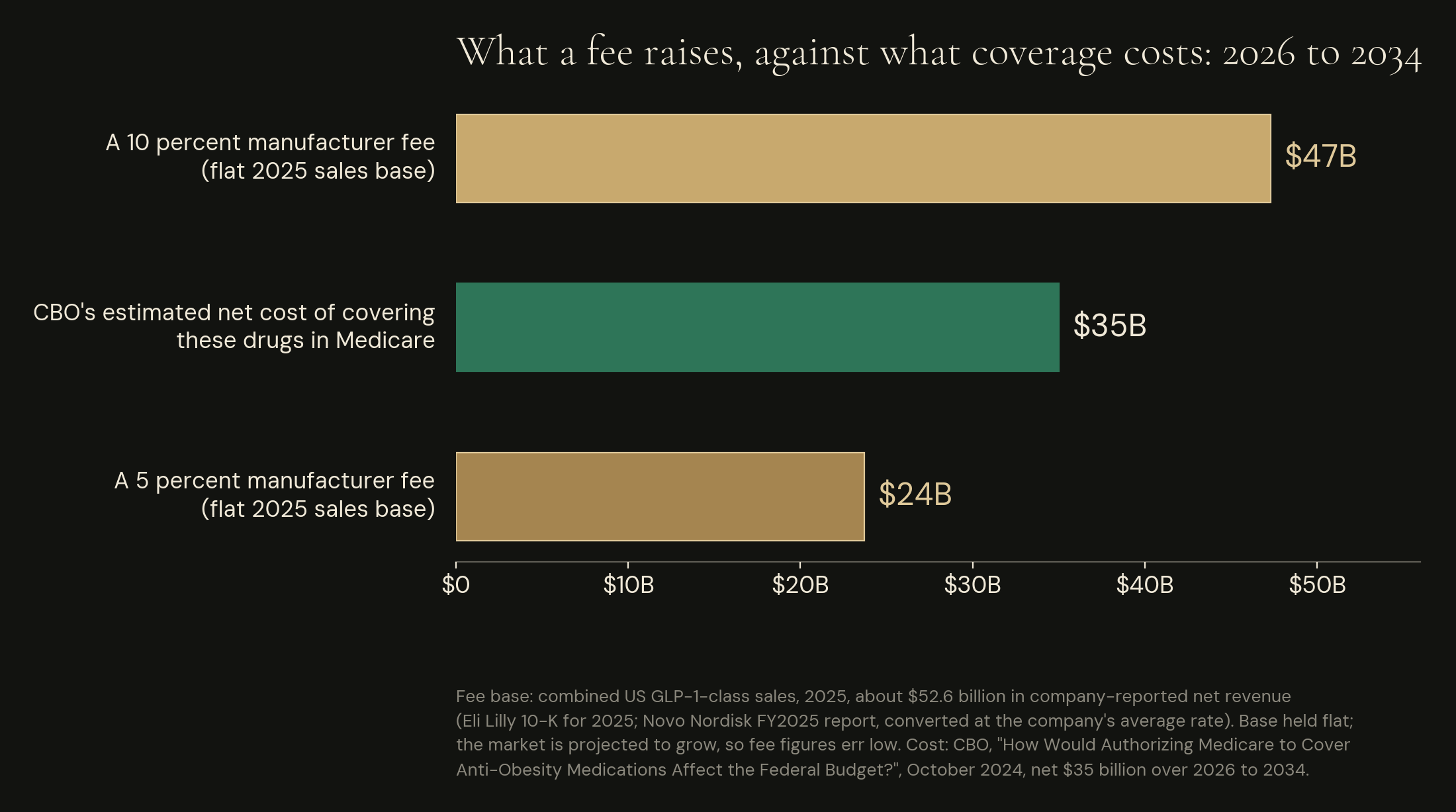
- At flat 2025 United States sales of about $52.6 billion, a 10 percent fee would raise about $47 billion from 2026 through 2034, against a Congressional Budget Office estimate (October 2024) of about $35 billion for Medicare coverage. A 5 percent fee would cover about two thirds.
- Guidelines call for nutrition monitoring. In a trial of one of these drugs that measured body makeup directly, about a quarter of the weight lost was lean mass, the same share as in the placebo group.
- As of August 2026, I found no completed randomized trial with posted results testing whether adding a dietitian helps. The fund would pay for that research.
- I sell GLP-1 nutrition services and materials, so this would enlarge my market. No drug maker funded or reviewed this piece.
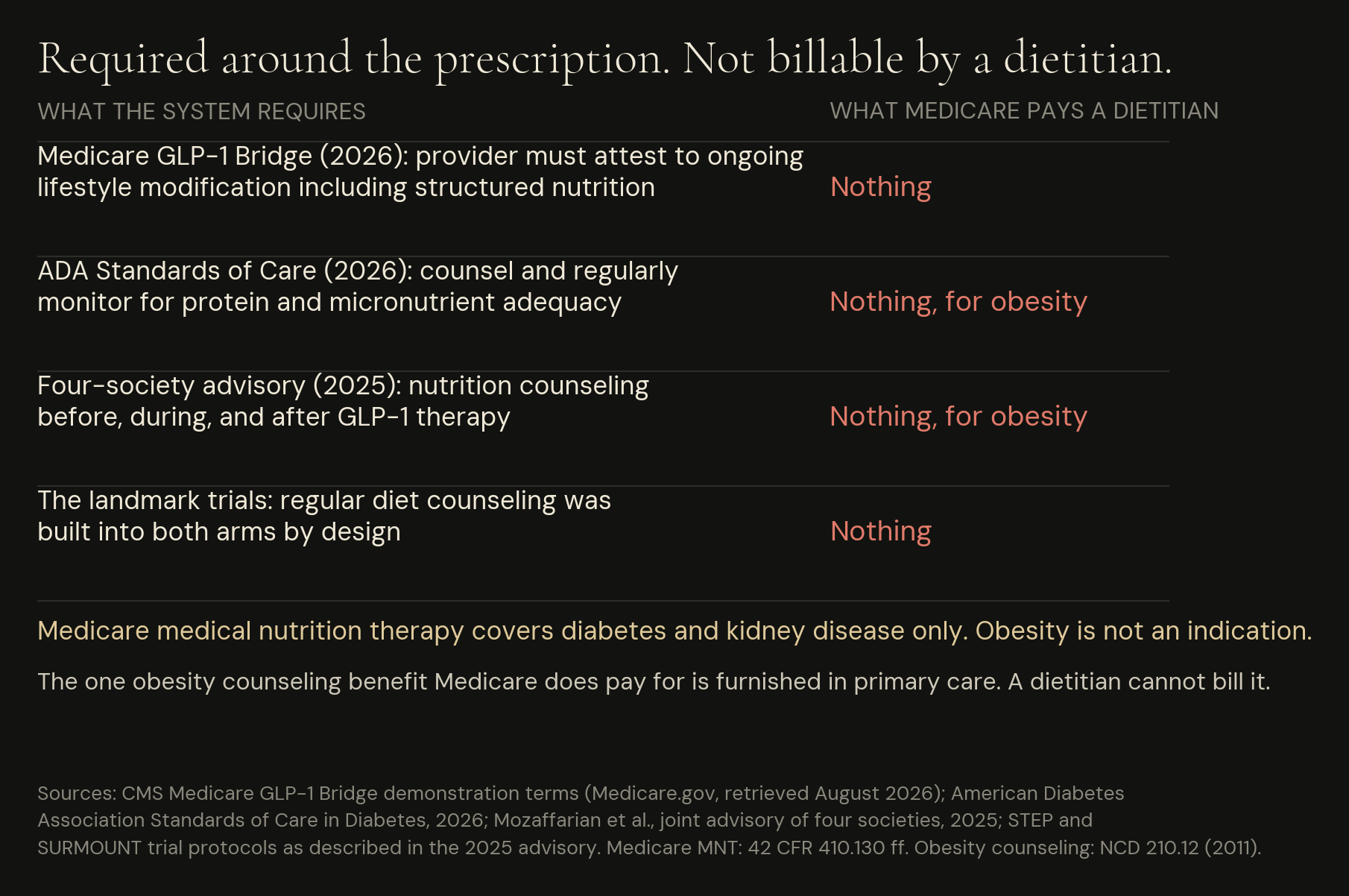
Buried in the fine print of Medicare’s newest experiment is a sentence my profession should frame and hang on the wall. Since July 2026, a demonstration called the Medicare GLP-1 Bridge has let certain beneficiaries get obesity medications for a $50 monthly copay. To prescribe under it, a clinician must attest that the drug is being used “in combination with current and ongoing lifestyle modification including structured nutrition and physical activity.”
Read that again. The federal government will not hand you the most powerful appetite drug ever made unless somebody attests that structured nutrition is wrapped around it. And then it pays the wrong profession to deliver it. Medicare’s nutrition therapy benefit stops at diabetes and kidney disease; obesity is not an indication. The one obesity counseling benefit Medicare does pay for is a series of brief primary care visits that a dietitian cannot bill. The profession trained to deliver the wrapper is the one the payment system leaves out. And the Bridge itself expires at the end of 2027.
By now you know where I stand, and if you don’t: I am a registered dietitian, and my interest here is not abstract. I offer GLP-1 nutrition care in a private-pay practice, I sell a GLP-1 nutrition guide, and I offer GLP-1 nutrition materials for license to clinics. This piece proposes that pharmaceutical revenue fund covered nutrition visits, which is a market I sell into. I have no financial relationship with any drug manufacturer, and nobody funded, commissioned, or reviewed this piece. The interest could not be more direct. Hold it against every sentence that follows.
The proposal
The manufacturers of GLP-1-class medicines pay a fee, call it 5 to 10 percent of their US sales of those medicines, into a clinical nutrition trust: covered nutrition visits, loan repayment for clinicians in shortage areas, and the outcomes research that has not been funded on the nutrition care these drugs assume. In the same bill, Medicare covers obesity medications. Permanently, not as a demonstration with an expiration date.
Not a tax on patients at the pharmacy counter. A fee on two of the highest-grossing franchises in pharmaceutical history, paid in exchange for the thing those franchises want most in the world. Congress has run this exact play before, and the receipts are worth reading.
The precedent is already collecting $2.8 billion a year
Since 2011, under a provision of the Affordable Care Act, pharmaceutical manufacturers have paid an annual fee — $2.8 billion a year at its current statutory level — apportioned among companies by their share of branded drug sales to government programs, and deposited by statute into the Medicare trust fund that pays for outpatient care. It is still in force; the IRS proposed updated regulations for it in a rule published in January 2026. You have never heard of it because it works quietly, which is what durable policy sounds like.
But the closest relative is the vaccine bargain, because it shows the whole shape of the trade. Each vaccine on the federal taxable list carries a 75-cent excise per disease component, paid by the manufacturer or importer, and every dollar of it funds the federal vaccine injury compensation trust, which held about $4.66 billion as of September 2025. The industry did not accept that fee out of civic feeling. It accepted it because the deal came with something it wanted badly: a shield from ruinous litigation. Note the sequence, because it is the argument of this piece in miniature. The compensation program and its liability protections became law in 1986. The excise that pays for them followed a year later. The benefit came first, and the fee was its price.
The same structure funds drug review itself, where manufacturers pay $4.7 million for a new drug application with clinical data in fiscal 2026 in exchange for a decision on a clock. Fee for benefit. It is how American health policy actually gets built.
The cautionary tale is instructive too. The 2010 health law also put a 2.3 percent excise on medical devices, a fee the device industry opposed from the outset and consistently argued bought it nothing. The industry campaigned against it continuously, and Congress suspended it starting in 2016 and repealed it in 2019. The lesson is not that health-sector fees die. It is that a fee the payer never consented to dies, and a fee that is the price of a deal survives for decades.
The honest arithmetic
The numbers here are the best I have ever worked with, and the reason is that somebody else already audited them. Last week I wrote about the supplement market, where the only available figures are the industry’s own market research. This market files with regulators and reports to shareholders, and you can check every number below against a document the companies signed.
In 2025, Eli Lilly’s US revenue from Mounjaro and Zepbound was $27.14 billion. Novo Nordisk’s US revenue from its GLP-1 and obesity products was $22.52 billion, converted at the company’s own stated 2025 average rate. Lilly’s older Trulicity added $2.91 billion. Combined US sales were about $52.6 billion, and that is net revenue, after every rebate and discount. It also includes roughly $400 million of one-time accounting adjustments that Novo itself strips out of its adjusted sales. Strip them out here too and the base is still above $52 billion, which is the direction every estimate in this piece leans. A 5 percent fee on that base raises about $2.6 billion a year, or about $24 billion across CBO’s nine-year window. A 10 percent fee raises about $5.3 billion a year.
Now the other side of the ledger. When the Congressional Budget Office priced Medicare coverage of anti-obesity medications in October 2024, it estimated a net federal cost of about $35 billion from 2026 through 2034, at an average direct federal cost of roughly $5,600 per treated beneficiary in the first year, before small offsetting health savings. Hold the fee’s base flat at 2025 sales, with no growth at all, and the 10 percent fee raises about $47 billion over that same window. The flat base is a deliberate handicap: Goldman Sachs Research’s last publicly published forecast, from May 2025, put the global anti-obesity market alone at $95 billion by 2030.
So here is the range, stated honestly. At 10 percent, the fee covers the score outright. At 5 percent, it covers about two thirds of it. I would rather give you both ends than the flattering one, and I will say which way the uncertainty runs: the base is held flat in a market every forecast expects to grow, which is the assumption here most likely to be wrong in the proposal’s favor.
I will not pretend to precision the numbers don’t have. CBO’s estimate predates the price cuts and the negotiated prices that take effect in 2027, and a real score would move. But the shape is not close. This is not a program begging for an offset. It is an offset in search of a signature.
Why the dietitian belongs in the deal
Because the prescription, on its own, is a half-finished intervention, and the bodies that have looked closely say so.
Appetite falls so far on these drugs that the 2025 four-society advisory puts the measured drop in caloric intake at 16 to 39 percent against placebo, and some patients may eat under 800 calories a day early in treatment. At that intake, getting enough protein, iron, calcium and a half-dozen vitamins stops being automatic and becomes a clinical project. Of the weight lost, a substantial fraction is lean mass rather than fat. In the tirzepatide trial that measured body composition directly, it was about a quarter, the same proportion the placebo group lost. That has more to do with how much and how fast weight falls than with the drug itself, which is precisely why the answer to it is nutritional: protein targets and resistance training, monitored by someone trained to monitor them.
The clinical establishment has already said this, formally. The American Diabetes Association’s 2026 Standards of Care recommend counseling and regularly monitoring anyone pursuing intentional weight loss for protein insufficiency and micronutrient deficiencies, and the guidance names referral to a registered dietitian nutritionist. A 2025 joint advisory from four societies — the American College of Lifestyle Medicine, the American Society for Nutrition, the Obesity Medicine Association and The Obesity Society — says every clinician prescribing GLP-1s for obesity should build a care plan with nutritional and lifestyle counseling before, during and after the weight-loss period. And the trials that made these drugs famous embedded regular diet counseling in both arms as a matter of design.
The stakes of skipping it show up in the real world, where that support is the exception rather than the design. In a 2025 study of 125,474 US adults, nearly two-thirds of patients without type 2 diabetes stopped their GLP-1 within a year. In the 2022 extension of the STEP 1 trial, patients who stopped semaglutide regained two-thirds of their lost weight over the following year, with the caveat that the trial withdrew the drug and the lifestyle support at the same time, so the regain cannot be laid at the door of either one alone. A drug this expensive, abandoned this often, with this much riding on what happens at the kitchen table, is exactly the drug that needs a clinician attached.
Here is the most honest sentence in this piece. As of August 2026 I could find no completed randomized trial, with results posted, testing whether adding a dietitian to GLP-1 therapy improves its outcomes. One registered trial comes close: an Israeli study, NCT06431308, assigning a hundred and twenty people starting semaglutide or tirzepatide to nutrition guidance from a registered dietitian or to usual nutrition care, with treatment discontinuation and body composition among its secondary outcomes. Its primary endpoint is gastrointestinal side effects rather than weight, and it has posted no results. I searched ClinicalTrials.gov and the published literature, and the societies that wrote the advisory say so themselves: the direct evidence is limited. That absence is not evidence the care doesn’t work. The likeliest explanation is that nobody has paid for the trial that would tell us. The trust this piece proposes would fund the services and the science, and I would rather have the answer than the assumption.
The design choices that make it serious
Fee the class, at the manufacturer, on net US sales. The revenue base is already audited and already reported, and the companies already run this kind of market-share computation every year for the existing ACA fee. Yes, the class includes the diabetes franchises, and it has to: the obesity drug and the diabetes drug are the same molecule under two labels, semaglutide being both Ozempic and Wegovy, tirzepatide both Mounjaro and Zepbound, and a fee that stops at the label invites every sale to migrate to the untaxed one. Nor is the unfunded wrapper an obesity-only problem. The monitoring recommendation this piece leans on sits in the American Diabetes Association’s own standards of care.
Fund services and science, never salaries, and never one profession. The money flows to covered nutrition visits at published rates, loan repayment in shortage areas, public programs and the outcomes research. Not to a wage line for my profession, and not to a set-aside that any organization within it gets to steer. A benefit written around a credential is a guild, and a guild is what a skeptic is right to discount. Write it around the service, let the evidence set the scope, and accept that this is a worse deal for dietitians than a self-interested version of this piece would have proposed.
Make it a bargain, not a punishment. The fee is enacted in the same bill that covers the drugs. That is the vaccine model and the user-fee model, and it is the reason those survived while the device excise died. None of this is new to Congress, either: legislation to lift the Part D exclusion has been introduced session after session, most recently as the Treat and Reduce Obesity Act, and none of the introduced texts I read, in the 118th and 119th Congresses, carried an offset that pays for it. That is the missing half, and it is the half this proposal supplies. Meanwhile the manufacturers’ own Medicare pathway has stalled. The government proposed covering these drugs in December 2024, then declined to finalize it in April 2025. It announced a negotiated-price model whose Medicare launch has been postponed indefinitely, with no replacement date. What it is running instead is a temporary bridge that ends in 2027. Two companies with more than $52 billion in US sales of these medicines are one durable statute away from the largest customer available to them. That statute has a price, and the price funds the care that makes their drugs work.
The objections I owe you
“It will raise drug prices.” Where it could, the design has to stop it, and the easy version of this answer is not good enough. Medicare’s negotiated price for the semaglutide group is $274 for a thirty-day supply effective January 2027, against a 2024 list price of $959, a 71 percent reduction. Two caveats belong with that figure: net prices after existing rebates were already well below list, and Wegovy, the weight-management form, carries a maximum fair price of $385.63 per package rather than $274. The relevant fact is that the companies took those prices rather than leave the market.
But Medicare is not the base. Most US sales of this class move through commercial plans and through the companies’ own direct channels, where the manufacturer sets the price by itself and no payer negotiates on the patient’s behalf. Those are the buyers a careless fee would reach, and a good many of them are paying cash. So put the answer in the statute rather than in the rhetoric: condition the fee on the manufacturer holding its published cash price flat for the life of the deal. A fee that raised the cash price of a weight-loss drug would defeat the purpose of collecting it, and the bill should say so on its face.
“Pharma will never accept it.” Not as a levy, no, and not at 10 percent on day one either. Ten is an opening position, and I would expect a real negotiation to land nearer the bottom of the range. But the direction of the deal is the industry’s own playbook. This industry pays $4.7 million per new drug application with clinical data in fiscal 2026 and negotiates the terms every five years rather than campaigning to repeal them, because the fee buys review on a clock. It has paid an annual industry fee since 2011, $2.8 billion a year at its current statutory level, because that fee came bundled with the ACA’s expansion of its customer base. And what this fee buys is permanent Part D coverage: the thing the industry has lobbied for since Part D launched with the exclusion written in, two decades ago; the thing CBO projects will reach about 1.6 million treated patients in 2034; the thing no demonstration, bridge or stalled model has yet delivered. The manufacturers’ return is not the nine-year budget window. It is the durable market on the other side of it.
The reverse objection is fair and has the same answer. A levy on the class does reduce the return on the next drug in it, including the compounds now being designed to spare lean mass. A permanent Medicare benefit raises that return by far more than a single-digit fee lowers it.
“Why dietitians, and not nurses, health coaches, exercise physiologists or primary care?” They should be in it, and the statute should not name a profession at all. The lean-mass problem has two halves and only one of them is mine: protein targets are nutrition, resistance training is not. The counseling in the pivotal trials came from dietitians or, in the four societies’ own words, “other qualified healthcare professionals.” So fund the benefit, not the guild. A covered obesity nutrition and lifestyle service, with a scope written by the evidence and open to anyone who meets it, is the version I would rather defend.
“You would profit from this.” More directly than “my profession would” concedes, so let me be specific. I run a private-pay GLP-1 nutrition practice and I offer GLP-1 nutrition materials to clinics. A Medicare benefit for obesity nutrition care would enlarge the market I work in. I said so in the third paragraph, and the structural answer is the one above: a benefit at published rates, steered by nobody, including me. I will add one thing. Wegovy’s own prescribing information instructs that the drug be administered “in combination with a reduced-calorie diet and increased physical activity.” I am proposing they fund what their own labels require.
“The evidence for dietitian care on GLP-1s is thin.” Conceded, above and plainly. The guidelines require the care, the trials embedded the care, and the direct trial does not appear to have been run. I would attribute that to funding rather than to disinterest. If the skeptics are right, a funded trial will say so, and I will publish that result too.
The routing problem
America does not have a nutrition apathy problem. It has a routing problem: the money is enormous and almost none of it reaches the people accountable for getting nutrition right. Last week I followed the supplement money, and it went everywhere except the clinic.
The GLP-1 era is that same problem arriving at a much larger scale, with one difference that matters. These manufacturers want something from Congress, and the thing they want has a price. That is the opening, and it will not stay open long: the Bridge expires at the end of 2027, and whatever replaces it will be written by whoever shows up with a proposal.
The drugs work. That was never the question. The question is whether America builds the clinical infrastructure the drugs assume, the monitoring the guidelines demand, the counseling the trials embedded, the structured nutrition Medicare already requires without paying the profession trained to deliver it. The manufacturers need a statute. The statute should have a price, and the price should be paid to nutrition instead of extracted from it.
The author is a registered dietitian nutritionist and the founder of Vitae Arete LLC, which publishes this newsletter and sells nutrition services and materials, including for GLP-1 care. He writes here independently. Nothing in this piece represents the views of any employer, client or organization with which he is affiliated, and no employer, client or manufacturer funded, commissioned or reviewed it. Sales figures are the companies’ own audited annual reports (Eli Lilly Form 10-K for 2025, filed February 2026; Novo Nordisk financial report for 2025, converted at the company’s stated 2025 average rate of 6.62 Danish kroner to the dollar), and are net revenue. The fee arithmetic holds the base flat at 2025 sales. The Medicare cost estimate is the Congressional Budget Office’s (October 2024); the Bridge demonstration terms and the quoted prior-authorization attestation are from CMS and the Medicare beneficiary site (retrieved August 2026); the negotiated semaglutide prices are CMS’s (November 2025, effective January 2027). Medicare’s obesity counseling benefit is National Coverage Determination 210.12 (2011), furnished by primary care practitioners in primary care settings, and the Medicare Claims Processing Manual’s specialty-code list for the counseling code does not include registered dietitians; medical nutrition therapy indications are 42 CFR 410.130 and following. The administration instruction quoted is the Wegovy prescribing information (revised June 2026). The ACA manufacturer fee is Public Law 111-148 section 9008 as amended ($2.8 billion annually, 2019 and thereafter); the vaccine excise is 26 USC 4131, enacted by Public Law 100-203 section 9201(a), and its trust fund balance is Treasury’s (September 2025). The medical device excise was 26 USC 4191, added by Public Law 111-152 section 1405 and repealed by Public Law 116-94. Clinical figures: caloric-intake reduction and nutrient guidance from the 2025 four-society joint advisory (Mozaffarian et al., American Journal of Clinical Nutrition and Obesity); the sub-800-calorie observation is Al-Najim et al. (Nutrients, 2025); the lean-mass share from the SURMOUNT-1 body-composition substudy (Look et al., Diabetes, Obesity and Metabolism, 2025), which Eli Lilly funded and on which six of the eight authors list Eli Lilly as their affiliation, as the paper discloses; discontinuation from Rodriguez et al. (JAMA Network Open, 2025); regain from the STEP 1 extension (Wilding et al., Diabetes, Obesity and Metabolism, 2022); ADA Standards of Care in Diabetes, 2026 edition. The pairing of a manufacturer fee with permanent coverage is the author’s; a search of introduced legislation in the 118th and 119th Congresses, in August 2026, found no bill containing it.
This article is general nutrition education, not individualized medical or nutrition advice, and it does not create a dietitian–client relationship. Medications and their side effects should be managed with your prescribing clinician. See the full disclaimer.