Almost everyone who knows anything about this topic knows the same story: Linus Pauling, a genuine giant, two Nobel Prizes, went a little strange late in life and decided vitamin C cured cancer. The Mayo Clinic ran proper trials. He was wrong. The end.
I have told a version of that story myself. It is the tidy one, and it is what most clinicians believe.
It is also wrong in a way that turns out to matter, and the correction does not come from an advocate. It comes from the National Institutes of Health.
What Pauling and Cameron actually claimed
In the 1970s, the Scottish surgeon Ewan Cameron reported that ascorbate, given both orally and intravenously at doses up to 10 grams a day, was effective in treating cancer patients (Parrow, Antioxidants and Redox Signaling, 2013).
Note the phrase orally and intravenously. Hold onto it.
The claims were based on uncontrolled case series with historical comparison groups, which is a study design that produces optimistic answers with great reliability. The skepticism was earned.
The trials that ended the conversation
The Mayo Clinic ran two double-blind, placebo-controlled trials. Neither found a survival advantage. That was the end of it — vitamin C was abandoned by conventional oncology and continued only in alternative practice, where it has been used ever since (Ma, Science Translational Medicine, 2014).
For about twenty-five years that was a closed question.
The thing the Mayo trials could not have known
In 2004, Padayatty and colleagues at the NIH published a pharmacokinetic study in Annals of Internal Medicine — a paper that has since been cited more than 900 times (Padayatty, Annals of Internal Medicine, 2004). They gave seventeen healthy volunteers vitamin C by mouth and by vein, measured plasma and urine concentrations, and modeled what happens at higher doses.
Here is what they found.
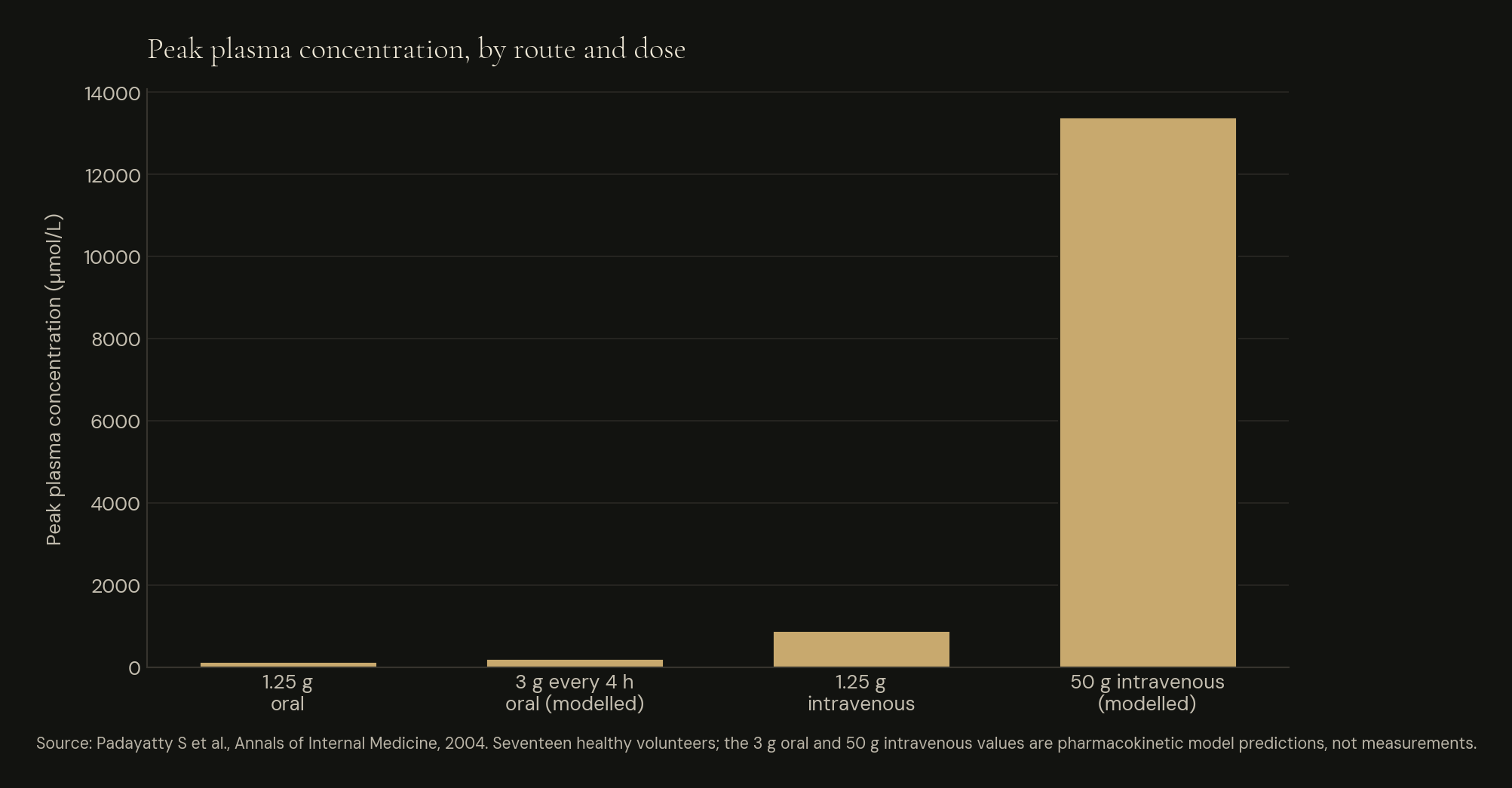
A 1.25 gram dose taken orally produced a mean peak plasma concentration of 134.8 μmol/L. The identical dose given intravenously produced 885 μmol/L.
Then they modeled the extremes. The maximum tolerated oral dose — 3 grams every four hours, which is about as much as a human can absorb — was predicted to peak at 220 μmol/L. A 50 gram intravenous dose was predicted to reach 13,400 μmol/L.
That is roughly a sixty-fold difference, and it is not a matter of effort or commitment. Oral vitamin C is tightly capped by intestinal absorption and renal clearance. Your body regulates it. You physically cannot reach millimolar blood concentrations by swallowing vitamin C, no matter how much you swallow.
And millimolar concentrations are exactly what the laboratory work says are required to kill cancer cells.
The authors' conclusion was blunt: because the efficacy of vitamin C cannot be judged from trials using only oral dosing, its role in cancer treatment should be reevaluated.
The Mayo trials, in other words, were well conducted, correctly analyzed, and answered a question adjacent to the one people now argue about. A later review put it plainly — the pharmacokinetics provide a plausible scientific rationale for why those trials found nothing (Parrow, 2013).
I want to be exact about what this does and does not establish. It does not show that intravenous vitamin C works. It shows that the most famous refutation of the idea did not test the version of the idea being defended. Those are very different claims, and almost everyone in this argument collapses them in whichever direction suits them.
So what happened when they tested the intravenous version?
This is where it gets less satisfying for everyone.
The mechanism held up in the laboratory. At millimolar concentrations, ascorbate acts as a pro-oxidant rather than an antioxidant, generating hydrogen peroxide in the fluid around tumor cells. In ovarian cancer models this caused DNA damage, depleted cellular ATP, and killed cancer cells while sparing normal tissue. Combined with carboplatin and paclitaxel it inhibited tumors synergistically in mice, and in a small group of patients it appeared to reduce chemotherapy-associated toxicity (Ma, Science Translational Medicine, 2014).
That is a serious paper in a serious journal, and it is a real result.
Then came human trials. A phase I–II study combined high-dose intravenous vitamin C with chemotherapy in patients whose oncologists judged their odds of meaningful response to be under one in three (Hoffer, PLoS ONE, 2015). It enrolled fourteen patients. The treatment was safe and generally well tolerated. Three patients experienced unexpected transient stable disease with more energy and better function.
The authors were unusually honest about what they had: the study "neither proves nor disproves" the value of intravenous vitamin C. Fourteen patients cannot.
And a 2021 narrative review that looked specifically at advanced-stage patients reached a colder conclusion. The positive effects seen in cell and animal work were not found in human studies of advanced cancer, and the reviewers found no rationale for using intravenous vitamin C either to increase the effectiveness of chemotherapy or to reduce its toxicity in that population (Zasowska-Nowak, Nutrients, 2021).
They did leave one door open. In palliative care, high-dose intravenous vitamin C might be considered for quality of life and for symptoms including fatigue and bone pain — while noting that without placebo-controlled randomized trials, a placebo effect cannot be excluded.
A comprehensive 2021 review of the whole field reached the same place from the other direction: the mechanisms are real and multiple, early-phase trials confirm safety, and strong clinical data and phase III studies are lacking (Böttger, Journal of Experimental and Clinical Cancer Research, 2021).
That is the honest state of it. Nearly fifty years after Cameron, with a plausible mechanism, a good safety record, and a legitimate explanation for why the original refutation missed, there is still no phase III trial.
The safety picture, which is specific and worth knowing
Vitamin C's reputation for harmlessness is mostly deserved and it has four specific exceptions.
A scoping review in Critical Care Medicine searched five databases, screened 8,149 records, and analyzed 74 eligible studies covering 2,801 patients who received high-dose intravenous vitamin C at a median dose of 22.5 grams per day (Yanase, Critical Care Medicine, 2020). Across nine double-blind randomized trials there was no consistent evidence that it caused more harm than placebo.
But the review catalogued specific events that did occur:
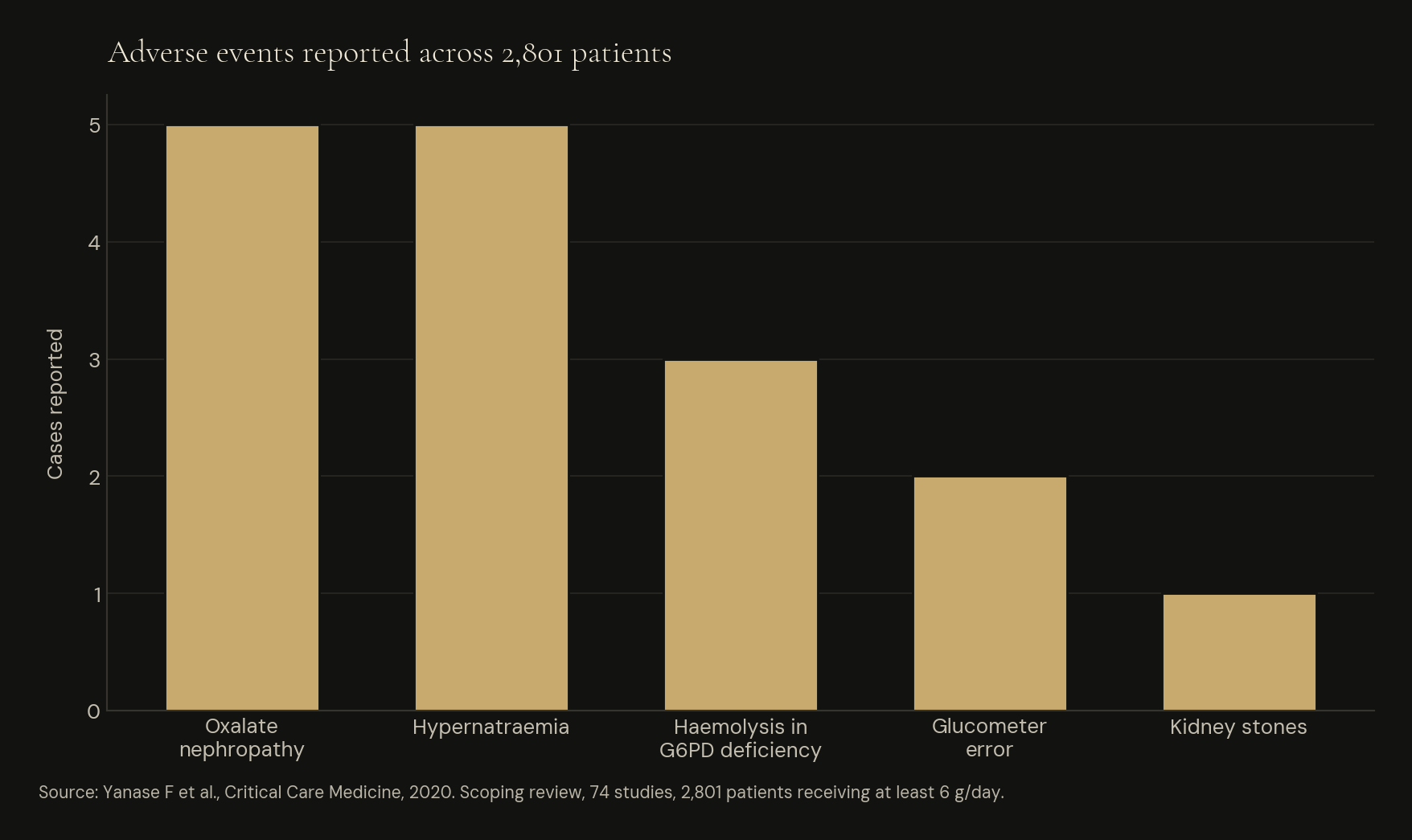
Five cases of oxalate nephropathy. Vitamin C is metabolized to oxalate, and at these doses that becomes a kidney problem. This is the harm most worth taking seriously.
Three cases of hemolysis in patients with G6PD deficiency. This one is preventable. G6PD deficiency is common in people of African, Mediterranean, Middle Eastern and South Asian ancestry, and it can be tested for beforehand. Anyone considering intravenous vitamin C should be screened first.
Five cases of hypernatremia, and one case of kidney stones.
Two cases of glucometer error.
That last one deserves its own paragraph, because it is the sort of thing that sounds trivial and is not. High-dose vitamin C interferes with many glucose meters and makes them read falsely high. If you have diabetes and you dose insulin off a fingerstick, a falsely high reading leads to too much insulin, and hypoglycemia is a genuine emergency. Nobody selling infusions mentions this.
None of these are reasons to panic. They are reasons your team needs to know, and reasons that "it is just a vitamin" is the wrong mental model at 25 grams a day.
What this evidence cannot tell us
The pharmacokinetic work was done in seventeen healthy volunteers, and the authors flagged the limitation themselves: they had no patient data confirming the model at high doses in people with cancer.
The clinical trials are small, mostly single-arm, and concentrated in patients with advanced disease who had already exhausted standard options — the hardest possible setting in which to show benefit. A therapy can fail there and still work earlier, and we would not know.
The 2021 review that found nothing in advanced cancer was a narrative review, not a meta-analysis, which means no pooled estimate and more room for selection in what got discussed.
And the palliative quality-of-life signal is the weakest kind of evidence for the most subjective kind of outcome, in patients receiving an infusion in a clinic. That is close to an ideal setup for a placebo effect, and the reviewers said so.
What would change my answer
A phase III randomized trial of intravenous vitamin C added to standard chemotherapy, with survival as the endpoint, in a defined cancer at a defined stage.
That is not an unreasonable ask. The safety data exist, the mechanism is characterized, the dosing is established, and pilot trials have been run. What is missing is funding — ascorbate is unpatentable, which means no company recoups the cost of the study, which is the same structural problem I described with fenbendazole.
That is a real failure of how research gets paid for. It is still not evidence of benefit.
What I would do
If someone is offering you intravenous vitamin C, these are the questions worth asking. Have I been tested for G6PD deficiency? What is my kidney function, and will it be monitored? Do I use a glucose meter, and does this clinic know it will read falsely high? What does this cost, and what is the evidence you are basing the recommendation on?
A clinic that answers those well is a different proposition from one that does not.
If you are taking oral vitamin C in large doses hoping for an anticancer effect, the pharmacokinetics say plainly that you are not achieving the concentrations in question. You are producing expensive urine, and above a few grams a day you are also increasing your oxalate load. That is the one clear practical conclusion in this entire article.
And tell your oncology team either way. This is not a supplement they will wave off — the kidney and glucose-monitoring issues are things they actively need in the chart.
This is education, not medical advice. Nothing here is a recommendation to start or stop any treatment. If you are in treatment, those decisions belong with your oncology team, and if something is urgent, call them. In an emergency, call 911.
Next Wednesday: turmeric and curcumin, and the distance between a mechanism and an outcome.
I wrote two books on nutrition during cancer treatment before I wrote any of these articles, one for patients and one for caregivers, in English and in Spanish.
References
Padayatty S, et al. Vitamin C Pharmacokinetics: Implications for Oral and Intravenous Use. Annals of Internal Medicine. 2004. https://consensus.app/papers/details/4a3f4b307845542e9f7dddcf7fe0bda8/
Parrow N, et al. Parenteral Ascorbate As a Cancer Therapeutic: A Reassessment Based on Pharmacokinetics. Antioxidants and Redox Signaling. 2013. https://consensus.app/papers/details/70869a843eb951bcb386772e512c330b/
Ma Y, et al. High-Dose Parenteral Ascorbate Enhanced Chemosensitivity of Ovarian Cancer and Reduced Toxicity of Chemotherapy. Science Translational Medicine. 2014. https://consensus.app/papers/details/e99e485d04fb5f8fb453e3f03757fd9e/
Hoffer L, et al. High-Dose Intravenous Vitamin C Combined with Cytotoxic Chemotherapy in Patients with Advanced Cancer: A Phase I-II Clinical Trial. PLoS ONE. 2015. https://consensus.app/papers/details/19b1d9a8c76b58048cf088ca9a938186/
Zasowska-Nowak A, et al. High-Dose Vitamin C in Advanced-Stage Cancer Patients. Nutrients. 2021. https://consensus.app/papers/details/5de8a050335f54d7a23602c600a9145d/
Böttger F, et al. High-dose intravenous vitamin C, a promising multi-targeting agent in the treatment of cancer. Journal of Experimental and Clinical Cancer Research. 2021. https://consensus.app/papers/details/9bf7f16106525654be45fa83855fec0c/
Yanase F, et al. Harm of IV High-Dose Vitamin C Therapy in Adult Patients: A Scoping Review. Critical Care Medicine. 2020. https://consensus.app/papers/details/e2f0fe699c1853bc81f1b7191eb5021d/
Doseděl M, et al. Vitamin C — Sources, Physiological Role, Kinetics, Deficiency, Use, Toxicity, and Determination. Nutrients. 2021. https://consensus.app/papers/details/aa264ea59f935a84b97bcebe45f76951/
Vitae Arete provides nutrition education and does not diagnose, treat, or manage cancer, nor prescribe or manage medication. This article is general information, not individualized medical or nutrition advice, and does not create a dietitian–client relationship. See the full disclaimer.