A colleague sent me two links this week. They describe the quietest of the three squeezes on the registered dietitian — and the one almost no one is talking about.
Over the last two weeks I have written about a profession under pressure from two directions. From the training side, where a new federal loan cap prices the dietetics credential out of reach for the people who would earn it. From the practice side, where venture-funded telehealth platforms bill insurance for our work and pay us the thin end of the spread. A dietitian who has watched both fights up close sent me a message this week with two links and a single sentence: I can't imagine how this wouldn't affect clinical RDs if the physician has this credential and is able to bill.
She was right to send them. Because the two links describe a third front, and it is the one I had missed. While we were arguing about loan caps and platform contracts, physicians quietly acquired a Medicare billing pathway of their own for nutrition — a credential built out across 2025, hitched explicitly to the political moment, and advanced by a scientific society funded, for years and by its own disclosures, by the makers of the food that causes the disease. The credential's own application letter to the federal government claims that physicians uniquely provide medical nutrition therapy. That is not a phrase chosen at random. It is the single billable service registered dietitians spent decades fighting to secure.
Let me take the disclosure first, because I run an independent practice and my perspective is not neutral: I have a stake in who gets to bill for nutrition care. Everything below is sourced to primary documents so you can weigh it without weighing me. Where a claim is not yet confirmed, I say so plainly.
A machine assembled in the open
The credential is called the Physician Nutrition Specialist, or PNS. It is granted by the National Board of Physician Nutrition Specialists, which describes itself, in the letter I am about to quote, as "a community within the American Society for Nutrition." The board has existed since 1997. What is new is not the credential. What is new is the plumbing that turns a credential into a bill.
January 1, 2025The National Uniform Claim Committee publishes five new provider taxonomy codes for Physician Nutrition Specialists — one each for the anesthesiology, family medicine, internal medicine, pediatrics, and surgery pathways.
April 1, 2025Those taxonomy codes take effect and enter the national code set.
August 19, 2025The CEO of the American Society for Nutrition writes formally to CMS, requesting a dedicated Medicare specialty code for Physician Nutrition Specialists. This is the step that operationalizes billing.
RecentlyThe American Society for Nutrition announces on its own official Instagram account that "CMS has officially announced a specialty code F7 for Physician Nutrition Specialists."
Read that sequence slowly, because the shape of it is the point. This is not a proposal floated at a conference. It is a machine assembled part by part, in public, while the profession most affected by it was looking the other way. The taxonomy codes are real and verifiable. The August letter is a real document I have read in full. Each piece clicks into the next.
The one thing I cannot yet confirm. The claim that CMS has granted specialty code "F7" rests, right now, on the American Society for Nutrition's own announcement on its Instagram account. That is a strong primary source for the organization's own news, but I could not find F7 in CMS's published specialty-type lists — the current 2026 physician list stops at F6, and F7 is simply the next unused code, which is consistent with a brand-new assignment but is not proof of one. So I state it as the society announced, not as established fact, until it appears in a CMS document. The rest of what follows does not depend on the F7 grant. The taxonomy codes and the formal CMS request are enough.
The word in the letter
The August 19 letter is a careful document. It walks through the seven considerations CMS uses to grant a new specialty code and argues that the Physician Nutrition Specialist meets each. Most of it is unremarkable credential-advocacy. One sentence is not. Under the heading of services the specialty uniquely provides, the letter lists — and I am quoting — "adjunctive nutritional therapeutics (e.g., medical nutrition therapy or support for disease states with a metabolic component)," framed as part of what "only a Physician Nutrition Specialist can provide."
Medical nutrition therapy is not a generic term. It is the specific, reimbursable clinical service — assessment, diagnosis, and treatment — that registered dietitians fought for decades to have recognized and paid, and that Medicare still covers, for us, in only two diagnoses.
To see that phrase claimed as physician-exclusive, in a federal billing request, is the whole story in miniature. The letter goes on to describe the conditions these physicians will treat: diabetes, cancer, Alzheimer's, hospital malnutrition, perioperative nutrition, undernutrition, obesity. That is not an adjacent territory. That is the registered dietitian's clinical map, redrawn with someone else's name on it and a higher reimbursement rate attached.
What the code is actually worth
To see why a billing code matters this much, you have to translate it into dollars, and the translation is stark. Begin with the thing the letter never mentions: the specialty code itself sets no price. It is a provider-type label, a way for Medicare to know who is submitting the claim. The money is decided one level down, by which service codes each provider is allowed to bill. And there the dietitian and the physician are pointed at two entirely different, unequal families of codes.
A registered dietitian who delivers medical nutrition therapy bills the MNT codes, 97802 and 97803, in fifteen-minute units. In the hospital outpatient setting where most dietitians actually work, a follow-up unit is worth $22.04 on the fee schedule, and because we are not physicians Medicare pays eighty-five percent of it, and then a further two percent comes off for sequestration, so $18.36 is what reaches the dietitian. A thirty-five-minute session — a full, careful nutrition visit — comes to about thirty-seven dollars. It is covered for exactly three diagnoses, diabetes, chronic kidney disease and a recent kidney transplant, and only with a physician's referral in hand.
A physician treating the same patient for the same condition does not touch the MNT benefit. The physician bills an ordinary office visit — the evaluation-and-management codes 99213 through 99215 — at the full fee schedule, for any diagnosis, with no referral required. A standard thirty-five-minute visit, coded 99214, pays about a hundred and two dollars in that same setting. The same clinical half hour. Roughly two and a half times the money.
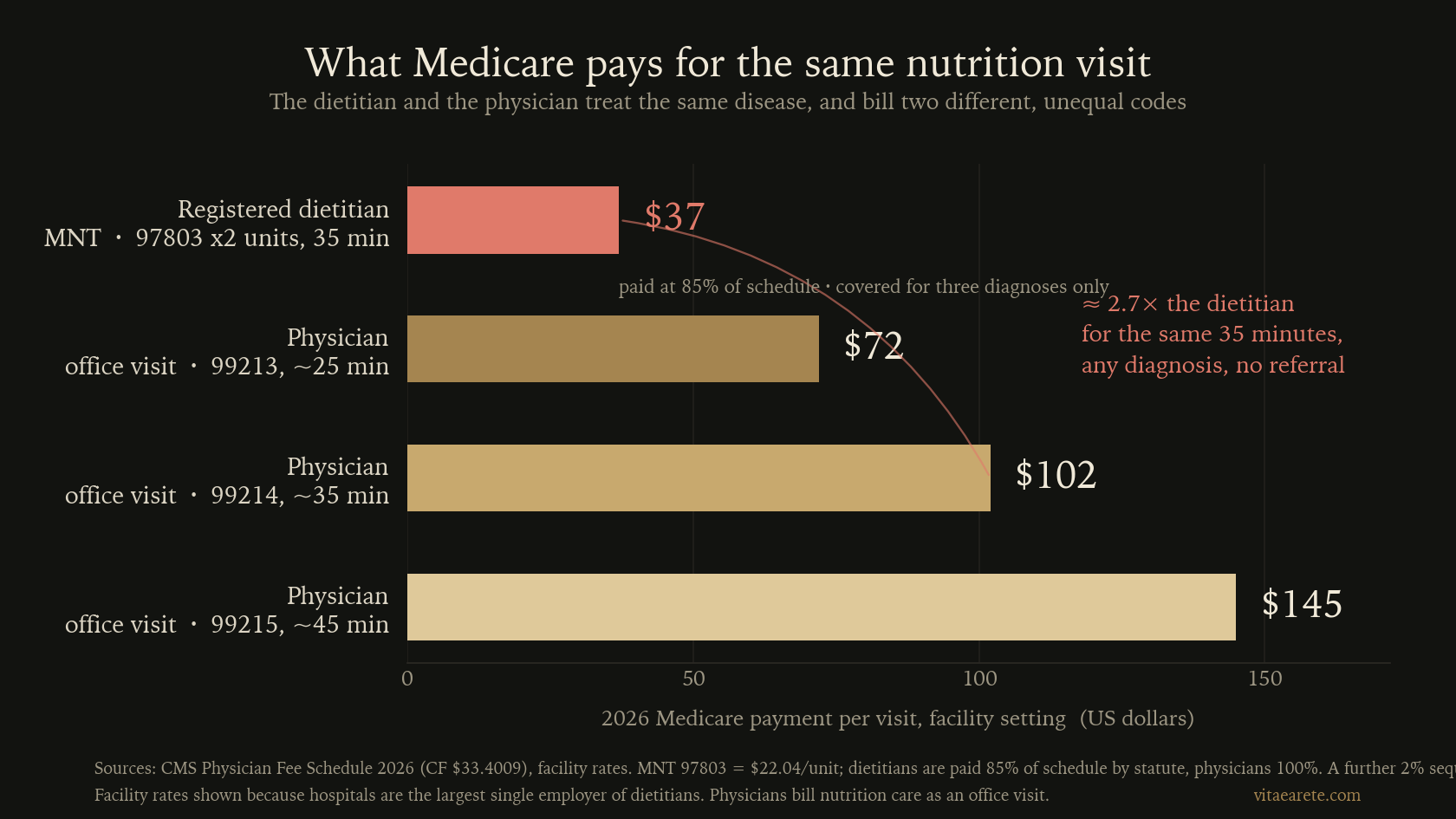
Line the two up and the asymmetry is not subtle. Three separate penalties stack on the dietitian and none of them on the physician: a lower-value code to begin with, a fifteen-percent cut for the offense of not being a physician, and a wall that limits us to two covered diagnoses. The physician's new nutrition credential clears all three at once — not by demonstrating superior nutrition training, but by routing the identical work through the physician's own higher-paying codes.
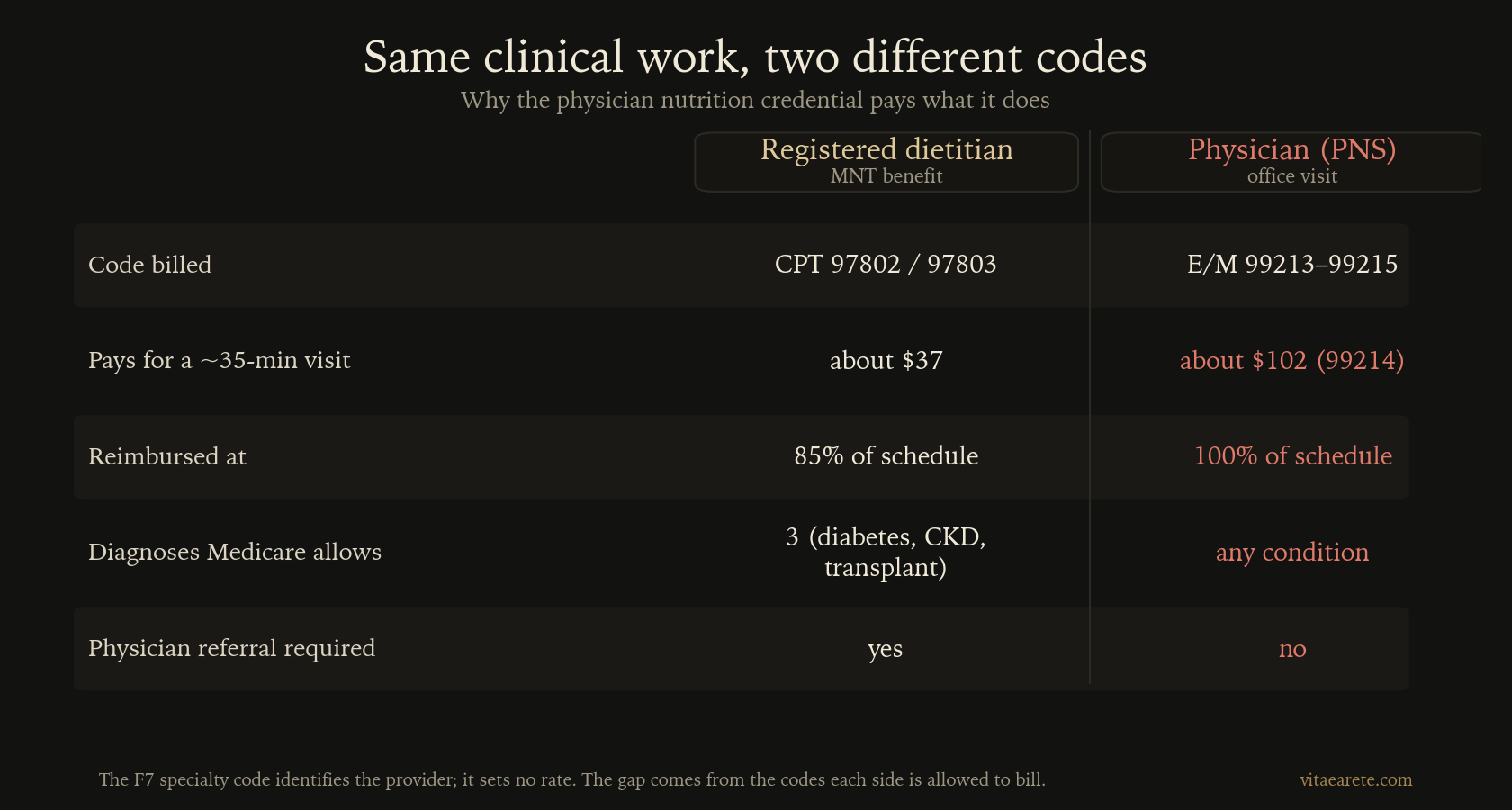
This is the mechanism the coverage keeps missing. No one has to lower the dietitian's rate or repeal our benefit. The system simply offers the higher-paying door to the physician and leaves us standing at the lower one, then calls the outcome a matter of choice. The specialty code does not create the gap. It formalizes who gets to walk through the door that pays.
Whose moment this rides
The letter does not argue its case on the merits of nutrition alone. It argues on politics. It names the Secretary of Health and Human Services and the Administrator of CMS by name as supporters of nutrition's role in health. It cites the current administration's "Make America Healthy Again" executive order as its policy hook, quoting the order's instruction that CMS "ensure the availability of expanded treatment options." A credential that has existed since 1997 is being operationalized now, in 2025, because the political weather is finally right for it.
There is nothing improper about timing an advocacy push to a receptive administration; everyone does it. I point it out because it tells you the credential is not being driven by a sudden scientific advance in physician nutrition training. It is being driven by an opening. And openings, in health care, are worth money.
The money behind the society
There is one more fact about the organization advancing this credential that belongs on the table, stated plainly. The American Society for Nutrition is, by its own disclosures, among the most heavily industry-funded scientific societies in American nutrition. The food-policy scholar Marion Nestle has documented the relationships for more than a decade: the society's sustaining and corporate partners have included Coca-Cola, PepsiCo, Nestlé, Mars, Unilever, and the Sugar Association, among others. I am not characterizing what that money buys. I am reporting that it exists, because a reader weighing who should hold a Medicare nutrition credential is entitled to know who funds the body building it.
Set two documented facts beside each other and draw your own conclusion. The society now credentialing physicians to bill Medicare for diet-related disease is funded, in part, by the makers of ultra-processed food and sugar. And the letter advancing that credential invokes Make America Healthy Again, a movement whose stated target is ultra-processed food. I am not alleging coordination between the funders and the credential, and I have no evidence of any. I am pointing out that the incentives sit in plain sight, and that so far no one in the profession most affected has said so out loud.
The standard of care no one will pay for
To understand why this lands so hard on registered dietitians specifically, you have to hold it next to something I documented earlier this year in Health Affairs. On January 1, 2026, CMS expanded its Hospital Malnutrition Care Score to all adult admissions — roughly thirty million discharges a year — and that measure names the registered dietitian's nutrition assessment as the measured standard of care. It names us. And it attaches no money to us. There is no financing mechanism, no billing pathway, no staffing requirement that pays for the RD work the measure requires.
Now read the physician credential's justification letter, which leans on the same malnutrition crisis — "thirty percent of all hospitalized patients are malnourished," "one in every two older adults is at risk" — to argue that physicians should get a billing code for it. Put the two documents side by side and the sequence is unmistakable. The registered dietitian is named as the standard of care, unfunded. The physician is offered the billing code, funded. We are assigned the work and the accountability. Someone else is handed the reimbursement. If you wanted to design a system that extracts a profession's expertise while starving the profession itself, you could not do much better than this.
Who is in the room, and who is not
The letter lists the organizations that recognize the credential: the American Association of Clinical Endocrinologists, the American College of Nutrition, the American Gastroenterological Association, the American Society for Nutrition, the American Society for Parenteral and Enteral Nutrition, the pediatric gastroenterology society, the Obesity Society, the Society of Critical Care Medicine. Eight organizations. Every one of them is a physician or medical society.
No dietetics organization is on that list. The clinicians whose defining service is being claimed are not represented in the coalition making the claim. And in the letter's final lines, the staff contact listed for the whole request is herself a registered dietitian, working for the society advancing the physician credential.
This is the part my colleague felt in her gut, and she is right to feel it. We are not being fought. We are being processed. No physician group, no nursing organization, no allied-health body has stood up to say that the profession Medicare already recognizes for medical nutrition therapy deserves a place in a decision about who bills for medical nutrition therapy. And the credential was assembled through a sequence of technical steps, a set of taxonomy codes and a specialty-code request, that generate no headlines and appear in no clinical newsletter. A thing can be entirely public and still go almost entirely unnoticed. That combination is the reason I am writing it down.
One thing I want to be careful about. This is not an indictment of anyone's inattention. Everything I have seen suggests this credential is genuinely not yet on the radar of most of the profession it affects, which is exactly what you would expect of something built through taxonomy codes and a specialty-code request rather than through anything that resembles news. I am also not suggesting the physicians earning it are acting against dietitians. The point of writing this down is to move it out of the category of things that are technically public and into the category of things people actually know.
Where this goes
Follow the three fronts to where they meet. On the training side, the loan cap thins the pipeline of new dietitians. On the practice side, the venture platforms rent our labor back to us and pay per completed visit. And now, on the reimbursement side, a physician credential offers a dedicated Medicare specialty for the exact conditions we treat — billable, when physicians provide it, through the physician office-visit codes that pay several times the dietitian's rate for the same clinical hour.
These are not three separate problems. They are one machine with three intakes. Picture the obvious convergence: a venture-funded telehealth platform, already expert at billing insurance for nutrition, employs a handful of Physician Nutrition Specialists and bills the same nutrition care at the physician rate instead of the dietitian rate. The dietitians still do the volume. The platform captures a wider spread. The credential makes it legal, the MAHA moment makes it fashionable, and the malnutrition measure makes it look like quality. Every incentive points the same way, and none of them points at us.
What I am not saying, and what I am
I am not saying physicians should know nothing about nutrition. They should know far more than most are taught; medical education's neglect of nutrition is real and this credential is, in part, an honest response to it. I am not saying every physician who earns a PNS is acting against dietitians. Most will never think about us at all, which is rather the point. And I am not alleging that anyone broke a law. Every step in this sequence is legal and most of it is public.
What I am saying is narrower and harder to dismiss. A billing pathway for physician nutrition care is being assembled while the profession Medicare already recognizes for that care is squeezed on two other sides and defended by no one — advanced by an industry-funded society, wrapped in a political movement that opposes its own funders, and justified with the same malnutrition crisis for which dietitians have been named the standard of care and denied the means to deliver it. You do not need a villain for that to end badly for us. You only need the incentives to run unopposed. Right now, they are.
So the question I will leave with my own profession is the one I keep arriving at from every direction. We generate the value in nutrition care — the assessments, the outcomes, the standard of care with our name on it. The open question, the only one that matters, is whether we will also hold any of it, or keep handing it, quietly and without a fight, to whoever shows up with more capital, more credential, and a better seat at the table. Naming what is happening is not disloyalty to the field. Refusing to name it is.
Jason Fee, MS, RDN, LDN is a clinical dietitian and the founder of Vitae Arete. This piece was prepared independently and represents his own views. It follows "The Slow Collapse of the U.S.'s Clinical Nutrition Workforce" in Health Affairs Forefront and the two-part "Middleman" series on this Substack.
Sources
ASN letter to CMS requesting a Physician Nutrition Specialist specialty code, August 19, 2025 (primary document) · National Board of Physician Nutrition Specialists, nbpns.org · American Society for Nutrition industry funding: Marion Nestle, Food Politics (multi-year conflict-of-interest series) · CMS Acceptable Physician Specialty Types, 2026 payment year (list ends at F6) · NUCC provider taxonomy code set (five PNS codes, effective April 1, 2025) · Reimbursement figures: CMS Physician Fee Schedule 2025 (office-visit E/M codes 99213–99215); medical nutrition therapy per AAPC (CPT 97802/97803, 0.46 RVU per 15 minutes, dietitian paid at 85 percent of schedule) · Fee, "The Slow Collapse of the U.S.'s Clinical Nutrition Workforce," Health Affairs Forefront, 2026.
Correction and addendum, 2 August 2026
Michael A., MD, an internist in Kansas, checked the reimbursement figures in this piece against his own locality and found them low. He was right. I have corrected the numbers above and rebuilt the charts.
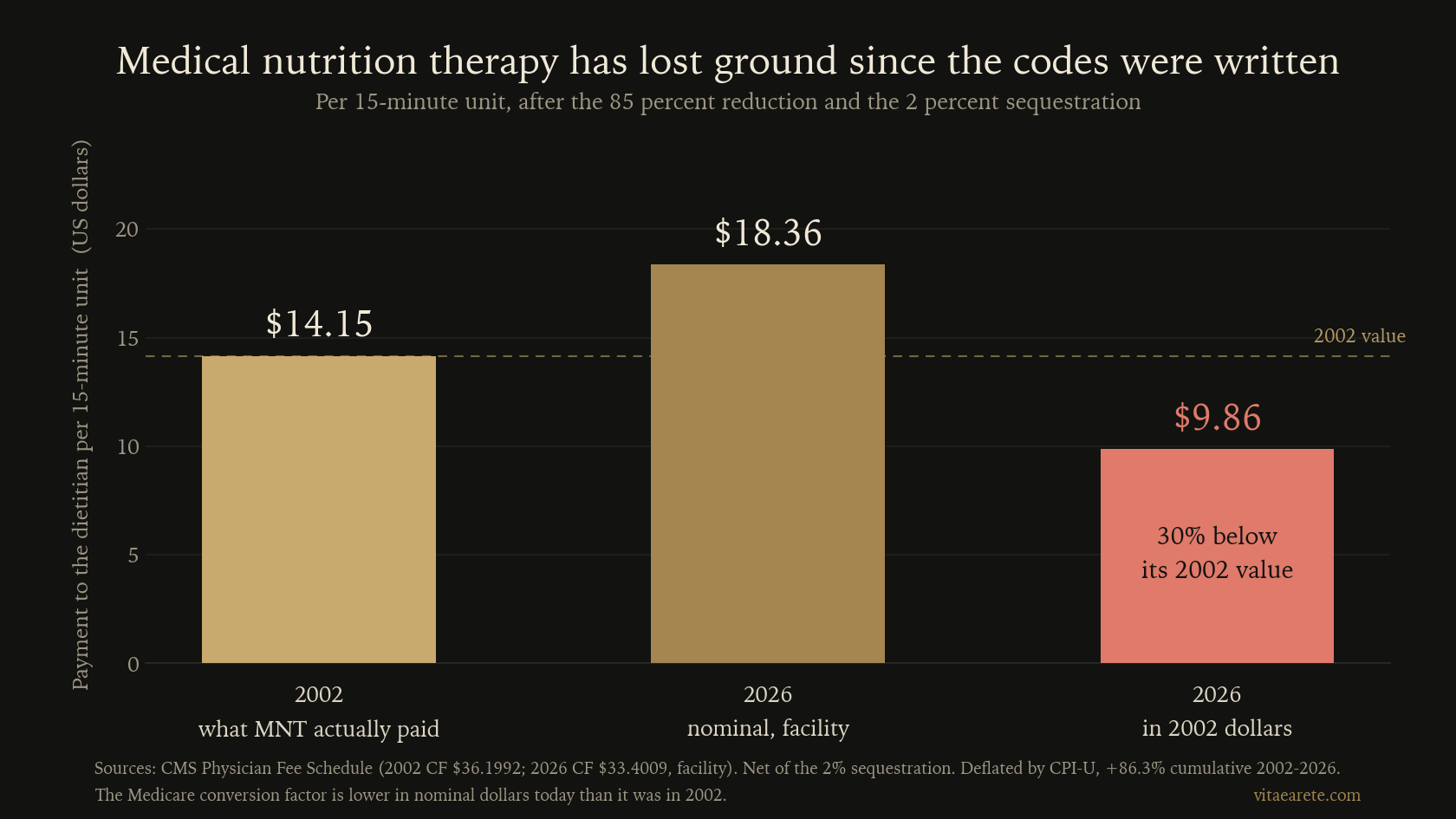
The error: I priced medical nutrition therapy at about $14.15 per fifteen-minute unit. That figure traces to a 2002 article written when the MNT codes were new — 0.46 relative value units multiplied by the 2002 conversion factor and the eighty-five percent non-physician reduction, exact to the penny. It has been circulating in dietetics materials ever since. I inherited it without repricing it, and that is mine to own.
The correct 2026 figures, at the facility rates that apply in the hospital settings where most dietitians work: an initial fifteen-minute unit pays the dietitian $21.98 and a follow-up unit $18.36, after the eighty-five percent reduction and the two percent sequestration. A thirty-five-minute session is about $37, not $33. The physician comparison carried a second error — I had compared a dietitian facility rate against a physician non-facility rate, which inflated it. Matched properly, the gap is roughly two and a half times, not four.
Here is why I am not treating this as a retreat.
Run the stale number forward and it makes the point better than my original did. That $14.15 was in 2002 dollars. To have merely held its value it would pay $26.36 today. The hospital-based payment is $18.36, which is $9.86 in those same 2002 dollars — so the figure I was wrong to use is worth forty-four percent more than what a hospital dietitian is actually paid. Cumulative inflation across those twenty-four years was eighty-six percent. The payment grew thirty. That is a thirty percent real cut, and in private practice the figure lands at $14.19 against $14.15, which is twenty-four years of no real movement at all.
The Medicare conversion factor itself is nominally lower today than it was in 2002, $36.1992 down to $33.4009, which is squeezing physicians alongside us. The part that is only ours is being held to eighty-five percent of it, for three diagnoses, with a referral.
So the ratio in this piece was too high, and the erosion underneath it is worse than I originally described. I would rather publish that than leave a number standing that a physician can disprove in thirty seconds.