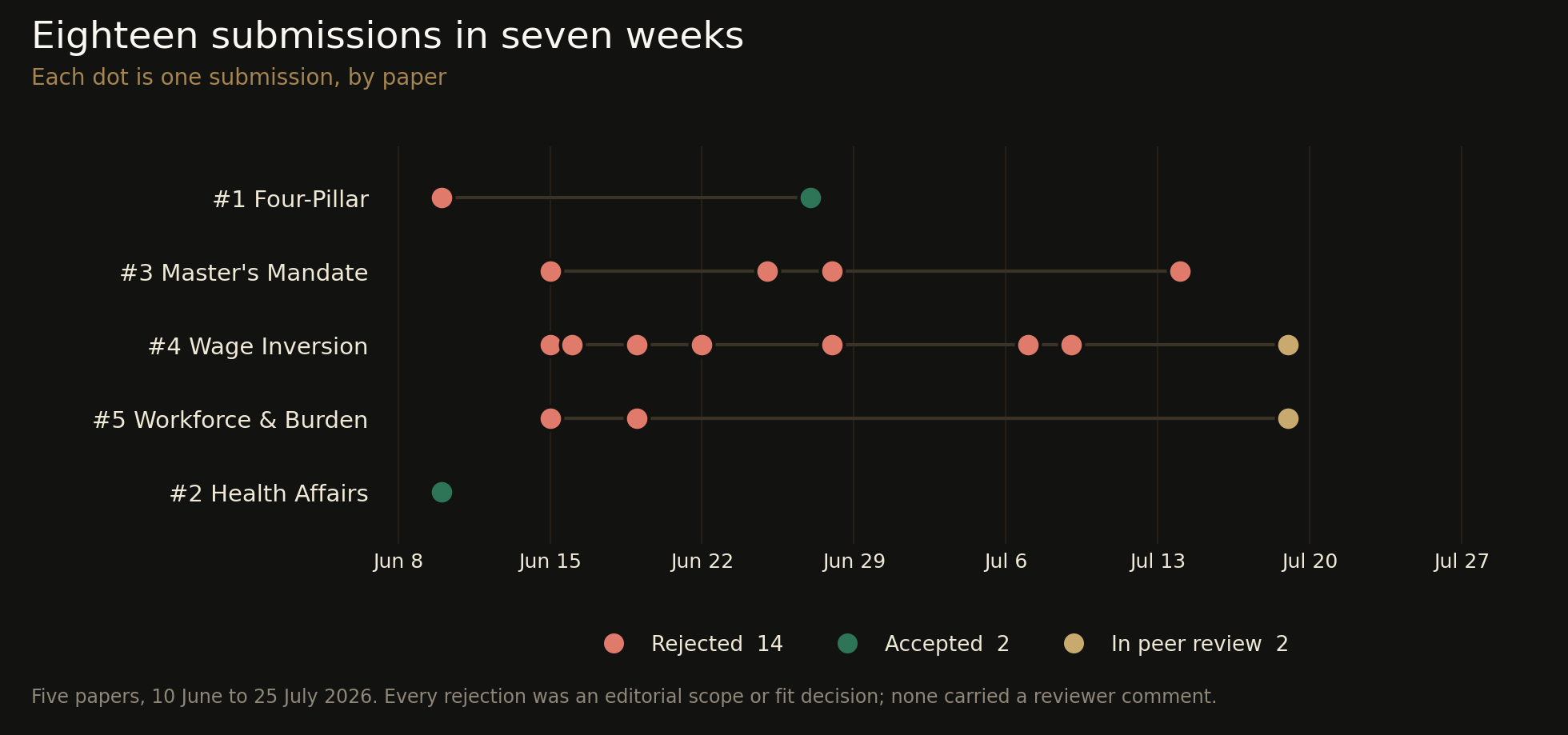
Between 10 June and 19 July of this year I made eighteen submissions across five papers, seventeen of them to peer-reviewed journals and one to a health-policy commentary section. As of publication, two were accepted, two are still out, and fourteen were rejected.
I want to be clear about what I am not saying, because it would be easy to misread this and I would deserve it.
Rejection is not the problem. Rejection is the job. Anyone who submits to journals and expects otherwise has misunderstood the arrangement, and the ability to absorb it and send the thing out again the next morning is not a burden of the system, it is a requirement of the work. I would not remove it if I could. The grit is the point, and I intend to keep needing it.
The problem is narrower and duller than rejection, and it is this: thirteen of those fourteen decisions told me nothing I could act on. The fourteenth is the reason I am writing this, and I will come back to it.
What a desk rejection actually contains
Here is my own tracking file, which I keep specifically so that I cannot revise my memory of how this went:
All desk-rejections to date were editorial scope/fit decisions — no peer review, no quality critique.
Not one of the fourteen came back with a reviewer comment, and none of them reached a reviewer at all. Every one of these decisions was made in an editorial office before the manuscript went anywhere. They were returned by editors in anywhere from the same day to a month, a median of about six days, with a version of the same sentence: not a fit for our readership. One said the work was "narrow for our broad audience, among other concerns." One said fit, and stopped.
I want to defend the editors before I say anything else, because they are not the villains here and the practice is not irrational.
Desk triage exists because journals receive vastly more than they can review, and reviewers are volunteers whose time is the scarcest resource in the whole system. An editor who returns a paper in nine days has done the author a genuine kindness compared with one who holds it for six months and then declines. Every editor who passed on this work was making a defensible call about their own readership, and several of them were simply right that it was not their subject. Health Affairs Forefront, which is the journal's commentary arm and editorially rather than peer reviewed, and Nutrition Today, which is peer reviewed, both said yes, and that is the part of the system working exactly as designed.
One rejection did not work that way. The first journal I sent anything to told me which of its own written standards the manuscript failed, quoted the standard, and gave an example of where I had missed it, and it named an article-type problem rather than delivering a verdict on the work. That took the editor a paragraph. I rebuilt the paper against that paragraph, sent it somewhere else, and it was accepted inside a month and is in production now. One editor's paragraph turned a dead manuscript into a published one, which is the whole of what I am asking for, and I am asking for it from the one case where the system already did it.
None of that changes the fact that "not a fit" is unfalsifiable.
One of the fourteen told me its own rate in the letter: it desk-rejects about sixty-five percent of what it receives. Fourteen rejections out of eighteen is not a remarkable outcome against numbers like that, and I am not claiming it is. The claim is about what those decisions contained, not how many there were.
It does not tell you whether you aimed at the wrong journal, framed the argument wrong for the right journal, or wrote something that is not good enough for any journal. Those three failures require completely different responses — pick a new venue, rewrite the framing, or go back and do more work — and the message gives you no way to tell which one you are in.
So you guess. You reformat to a new house style, rewrite the cover letter, reframe the argument for a different readership, and wait another one to three weeks to find out whether this guess was better. Thirteen times.
The obvious objection is that I could have asked first. Most of these journals take a presubmission inquiry and answer it in days, and I did not send one. That was my error, and it cost me some of these weeks. It does not dissolve the problem, because an inquiry returns the same undifferentiated answer about fit without the reasoning behind it, but I am not going to pretend the doorbell was not there.
The cost is the search, not the rejection
This is the part I did not understand a year ago.
The expensive thing about publishing without an institution is not being told no. It is the search cost of finding the venue, paid entirely in your own time, with no signal to navigate by.
A researcher inside a department does not do this alone. They have a mentor who has published in six of the journals on the list and can say don't bother with that one, they've never taken a workforce paper. They have colleagues who know which editor took over last year and what they are looking for. They have a departmental sense of the field's map that took decades to accumulate and that nobody writes down, because inside an institution nobody needs to.
Outside one, you have the journal's own scope statement, which is written to be capacious, and thirteen near-identical sentences telling you that you were wrong without telling you how.
Two of the fourteen did offer a destination: a transfer to a sister journal, three offers between them, which is a reason and a venue and a mechanism at once, and strictly more than the clause I am asking for. I declined all three, because each routed to an open-access title with an article processing charge I cannot pay. The system does produce guidance about where a paper belongs. It produces it as a sales channel, and the authors it is priced out of reach for are exactly the ones with nobody behind them.
Each wrong guess costs a reformat, a new cover letter, a reframing, and weeks of latency. Only one of the eighteen charged me anything to submit, twenty-five dollars, and that is the one submission that reached reviewers. But the fee that decides where I send things is not the submission fee. It is the article processing charge, which open-access journals bill on acceptance. The journal whose scope fit this work better than any other I found is one I never submitted to at all: its charge on acceptance is $3,390, listed on its own fees page and checked again in August 2026. Three more are on that list for the same reason. An author without a grant line does not choose from the whole map. He chooses from the part of it where being accepted does not cost him money he does not have. All of it happens on evenings and days off, on top of a full-time clinical schedule, unpaid.
And the whole apparatus around it is unpaid too. The national workforce analysis was unfunded. The briefing I built and delivered to a national professional body's leadership this summer was unpaid. Pulling federal data into one place so that professional bodies have something to point at is unpaid.
It is what advancing a profession has always looked like, and people have always done it in the evenings.
One sentence would change the arithmetic
Here is the fix, and it is unglamorous.
A single line of stated reasoning in a desk rejection would save a researcher weeks. Not a review. Not a critique. One clause distinguishing between this is outside our scope, this is in scope but framed for the wrong reader, this has a methodological problem, and this is fine and we have no room for it.
That is information the editor already has — they made the decision on some basis — and it costs one sentence to transmit. What it buys the author is the difference between redirecting in a week and guessing for two months.
An editor would tell me that the reason is not sitting there waiting to be typed, that a desk decision is a ranking against everything else that arrived that week rather than a diagnosis of my paper, and that turning a comparative judgment into a stated reason about my manuscript manufactures information instead of transmitting it. That is fair, and it kills the version of my ask that wants prose. It does not kill the version that wants a category. We have no room for this right now is itself a category, and it is one I could act on.
I should also say that the one decision that did point somewhere did not shorten the search. It sent me toward a different kind of journal, and the best-fit journal of that kind returned the paper in two days, and what eventually cleared a desk was a discipline nobody had suggested. So the clause is not a map. What it is, is the difference between a wrong guess I can rule out in a week and one I discover in two months, and for most authors, whose problem is simpler than mine was, that is most of the distance.
I recognize why it does not happen. A stated reason is a reason that can be argued with, and editors who write them get emails back. Ambiguity is armor, and at the volume they are handling, armor is rational.
But the cost of that armor is not evenly distributed. An author with a mentor absorbs it easily, because the mentor supplies the missing signal for free. An author without one pays for it in months, and pays in their own time, at whatever they happen to earn.
Why this compounds
The argument I published in Health Affairs Forefront in July is that since January 2024 entry to this field has required a graduate degree, while the wage it leads to does not service the debt required to earn it.
I did not set out to be an illustration of my own paper.
It is an uncomfortable position to write from, and I want to be precise about why it is not a boast. Being an example of your own findings is not evidence that the findings are right. It is evidence of a selection effect, and the selection effect is the finding. The person best positioned to document a problem like this one is, definitionally, someone inside it: someone earning the wage in question, absorbing whatever the search costs, spending their own evenings on it, and donating the finished analysis to the institutions that would otherwise have to commission it. Which means the literature on a profession's own working conditions gets written disproportionately by whoever can still afford to write it, and that is a narrower group than the profession, and it narrows every year.
So the awkwardness is not incidental to the argument. It is the argument. If the only people who can document this are the people it is happening to, then the evidence base for every applied profession is quietly rate-limited by how much unpaid time its members have left.
That is not a complaint about my situation. It is an observation about supply. The number of people who can afford to do this work unfunded is small, and it is shrinking for exactly the reasons the research documents, and nobody is counting it. Every additional month of latency in the publication path, and every desk rejection that transmits no information, quietly narrows that pool further, because grit was never the constraint, and what is scarce is time that somebody else is not already paying for.
Why this should matter if you are not a dietitian
Nothing in this is about nutrition. The screen I have been describing runs in front of every applied field where the people with the best view of a problem are the ones least equipped to publish about it.
A respiratory therapist who has watched the same staffing failure on nights for eleven years has data nobody in a department has. A school psychologist who can document what a caseload cap does to referral times has it too. So does a rural pharmacist watching a reimbursement rule close counters one town at a time. None of them has a mentor who knows which of forty journals has ever taken a workforce paper, and each of them will get the same sentence I got, and will guess the same way, on the same evenings, at the same wage.
The result is not that those papers get written badly. It is that they do not get written at all, and the literature on applied practice ends up disproportionately authored by people with the institutional cover to survive the search. That is a selection effect on the evidence base itself, and it is invisible, because the missing papers leave no trace.
What I am asking
Two things, and neither is money.
If you edit a journal: consider whether your desk rejections could carry one clause of stated reasoning. Not a review. One clause. It is close to the highest-leverage sentence in the publication system, and it is almost never written, though one of the fourteen wrote it and I acted on it inside a week.
If you are doing this work without an institution: write down where you submitted, when, and exactly what they said. I did, and it is the only reason I can tell you that thirteen of fourteen decisions contained no actionable information — rather than merely feeling that they did. A record you kept in advance is the difference between an argument and a mood.
None of this is a reason to stop submitting and I am not going to, but the next person who does this without a department behind them will spend the same weeks I did guessing at a sentence the editor already had in front of them.
This article is general nutrition education, not individualized medical or nutrition advice, and it does not create a dietitian–client relationship. Medications and their side effects should be managed with your prescribing clinician. See the full disclaimer.