Summary
In June 2026 my profession’s journal, the Journal of the Academy of Nutrition and Dietetics, turned down a paper of mine while calling the topic of interest to readers. In August it turned down another, using the same sentence to say the topic would not interest them. I asked the editor to explain, and I summarize her reply here. I make no claim about anyone’s motives.
- The August paper compared degree completions in thirteen health fields, 2014 to 2024. Only two fell by thirty percent or more. Dietetics fell 30.4 percent. Athletic training fell 32.4 percent. In both, a new graduate degree requirement took hold in many programs. Wider nutrition counts fall less or rise, and I explain my choice.
- The letter said the journal “does not publish program evaluations or the like.” The paper is not one. On 27 August 2026 the editor, Dr. Linda Snetselaar, wrote that the label was not precise.
- She wrote that readership interest is an editorial judgment, not based on a readership survey, download analysis or citation threshold. The journal currently gives priority to research on nutrition and dietary assessment. I did not find that in its scope statement.
- The June letter named the standard the earlier paper missed. I rebuilt it, and another journal published it on 14 August.
- I searched and found no peer-reviewed study of what the requirement did to the flow of new dietitians.
Here are two sentences. The same journal wrote both, about my work, nine weeks apart.
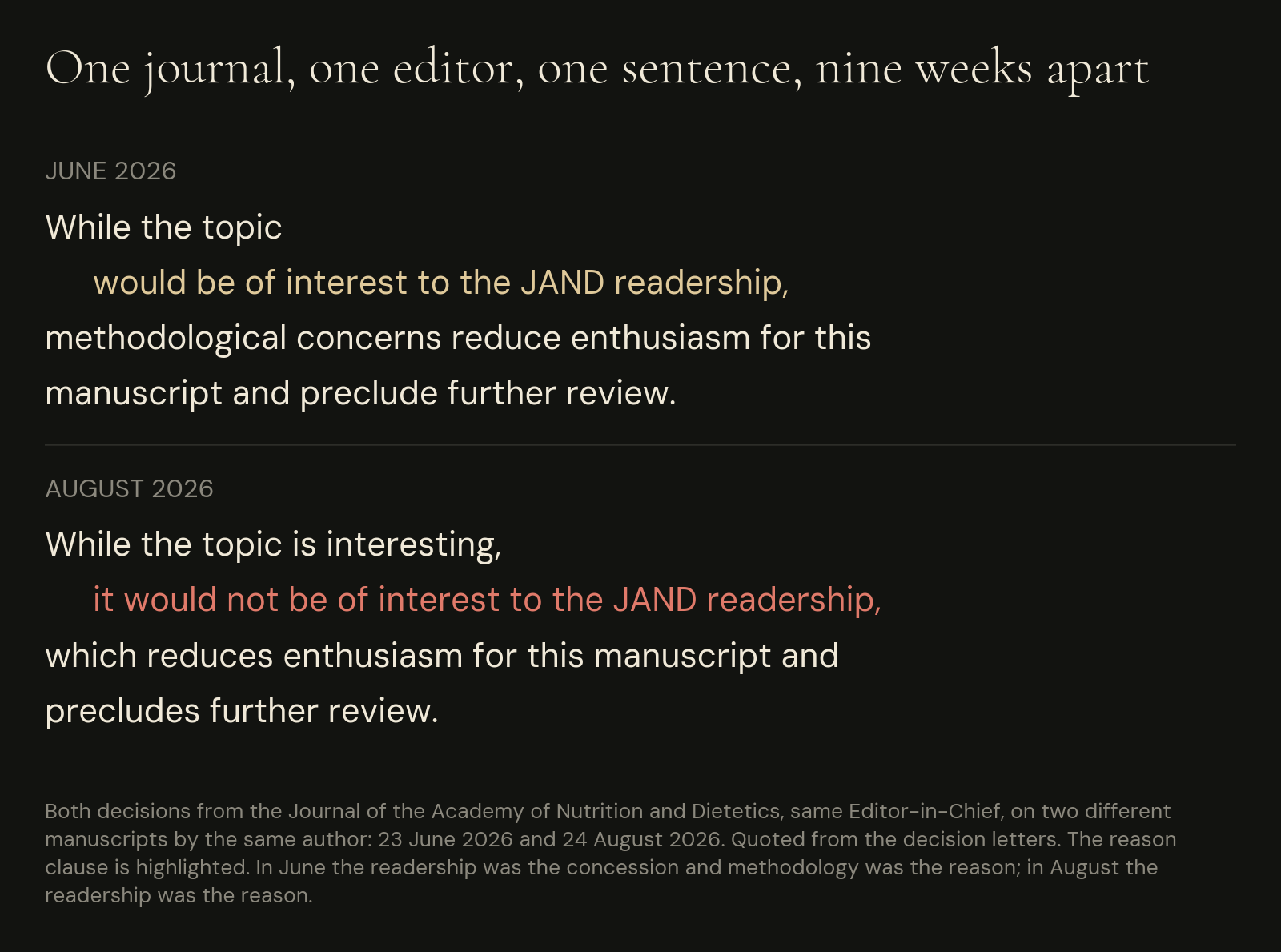
June 2026:
“While the topic would be of interest to the JAND readership, methodological concerns reduce enthusiasm for this manuscript and preclude further review.”
August 2026:
“While the topic is interesting, it would not be of interest to the JAND readership which reduces enthusiasm for this manuscript and precludes further review.”
Same journal. Same Editor-in-Chief. Same sentence, down to reduce enthusiasm for this manuscript and preclude further review. One variable changed, and it changed to its own opposite.
I am not going to tell you what that means about anybody’s motives, because I do not know and neither do you. I am going to tell you what it means about the sentence.
And then I am going to do the thing I should have done years ago, which is write back and ask. I did that on 25 August. The Editor-in-Chief answered two days later, at length, and she answered every question. Her reply is at the end of this piece, summarized, with her own words quoted where they matter. It is more useful to me than the acceptance would have been, and it contains one concession I did not expect and one piece of information that exists nowhere public.
If you read only one part of this, read that part.
What the letter said
On 24 August a paper of mine came back from the Journal of the Academy of Nutrition and Dietetics, the flagship journal of my own profession, ten days after I sent it. It was not sent to reviewers. Around the usual courtesies, the substantive note read, in full:
“While the topic is interesting, it would not be of interest to the JAND readership which reduces enthusiasm for this manuscript and precludes further review. JAND does not publish program evaluations or the like.”
The paper compares degree completions across thirteen allied health credentials, all built identically from the same federal source, and asks one question: when a profession raises its entry requirement to a graduate degree, what happens to the number of people who finish the degree?
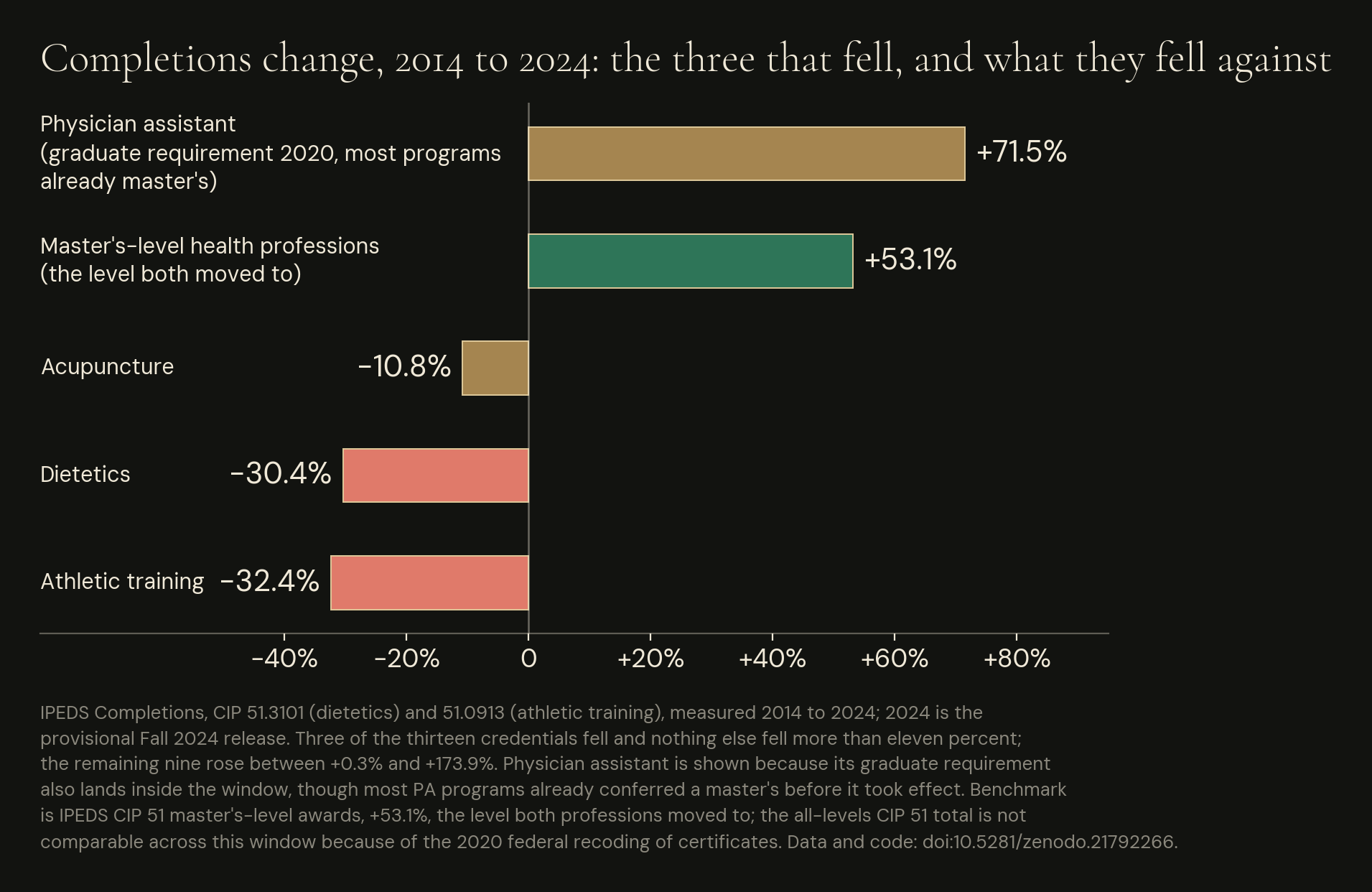
Between 2014 and 2024, completions fell by thirty percent or more in exactly two of the thirteen. Dietetics, down 30.4 percent, and athletic training, down 32.4 percent. One other credential fell at all, acupuncture, and it fell 10.8 percent. Nothing else fell more than eleven percent.
Those two are also the two whose transition to graduate-level entry bound a substantial share of programs inside the window. I need to be careful here, because a looser version of that sentence is wrong and I would rather correct it myself. Physician assistant sits in the same table, and its accreditor did require a graduate degree of everyone matriculating after 2020. But most PA programs were already conferring a master’s long before that deadline, so the requirement bound almost nothing, and PA completions grew 71.5 percent across the window. Physical therapy and nurse anaesthesia also raised requirements in these years, and both were doctoral upgrades of credentials that were already graduate-entry, which is a different treatment again. The comparison I am making is between professions where the requirement actually moved people, and on effective dates rather than announcement dates.
The benchmark matters too, and it is the number I would lead with now. Completions across the health professions as a whole grew 3.1 percent over the same decade, but that figure cannot carry a decade-long comparison. The federal category for awards of less than one academic year reports 178,485 completions in 2014 and exactly zero in 2024, while two credit-hour-based certificate categories that did not exist in 2014 report about 151,000 between them. A category does not empty itself. That is the 2020 federal recoding of certificates, and it makes the all-levels total non-comparable across this window. At the master’s level, the level both dietetics and athletic training moved to, health professions completions grew 53.1 percent.
One more caution I will put in myself. The dietetics figure is CIP code 51.3101 exactly. Widen it to the whole 51.31 family and the fall is 11.7 percent; add Nutrition Sciences, a different code that nearly doubled, and the combined number rises. So a reader can reasonably ask whether dietetics shrank or migrated. Nutrition Sciences did grow, by 84.8 percent, gaining 2,468 completions where dietetics lost 1,310. I think the credentialed pipeline is still the right thing to measure, for two reasons: a Nutrition Sciences degree does not confer eligibility to sit the registration examination, so those graduates are outside the pipeline being counted; and the accreditor’s own program series, which involves no federal course coding at any point, fell 32.3 percent over the same years. No recoding between code families produces that. But the question is fair and the data are public, so ask it.
There are two claims in the decision note and they are different in kind, which matters more than anything else here.
The second is a misclassification. A program evaluation assesses a named program against its own stated objectives, with an implementing organization and a local unit of analysis. This has none of those. The design line in the abstract says “repeated cross-sectional, ecological time-series analysis.” You can check the underlying work: the data extracts and analysis scripts are deposited publicly under my name at doi:10.5281/zenodo.21792266.
I will also say what an honest critic would say back. Two of my three figures show enrollment in accredited programs and internship placement, and one Discussion section weighs the mandate’s stated grounds. An editor skimming that can reach “program evaluation or the like” without malice. The label is wrong. It is not unreachable.
The first claim is not wrong, because it is not the kind of thing that can be wrong. Whether a journal’s readers want a particular subject is the editor’s call, and it is the one judgment an editor genuinely holds better than the author. I keep the two separate deliberately. Bundled, the weak one drags down the strong one.
The June letter was the most useful rejection I have ever received
In June the same journal, under the same Editor-in-Chief, rejected a different paper of mine.
That letter did something almost no rejection does. It named the guidelines the manuscript failed, restated the standard, and gave an example: that my aim appeared to be proposing a four-pillar advocacy agenda, which is not publishable as a Commentary, because Commentaries are expected to be “balanced, unbiased, and well documented.”
That took a paragraph. I rebuilt the paper against that paragraph, sent it elsewhere, and it was accepted inside a month. It published on 14 August.
So I cannot tell you a story about an editor who will not help authors. I have the counter-evidence in my own inbox, from the same desk, over the same signature. One paragraph from that office turned a dead manuscript into a published one, and I am in her debt for it.
It also means I have to correct something I have said in public. That June letter cites “methodological concerns.” So it is not true, as I have put it before, that none of my rejections contained a criticism of the analysis. One did. It is the same one that helped.
Reading the sentence
Put the two letters next to each other and the useful thing is not the contradiction. It is the frame.
While [concession], [reason] reduce enthusiasm for this manuscript and preclude further review.
The same slot, filled with opposite values, over the same author writing about the same profession’s workforce. Here is what each part is doing.
“While the topic is interesting” is a courtesy. It carries no information and is not meant to. It is the concessive opening of a great many decline letters, and an author who builds anything on it has misread the genre. I mention it only because I did briefly build something on it.
“would not be of interest to the JAND readership” is the load-bearing clause, and this is where I want to be precise, because I got it slightly wrong for a while. The clause reads as a claim about the world. Readers either are or are not interested in a subject; that sounds like a fact with a truth value, and I spent a week treating it as one. It is not. It functions as a claim about priority — what this journal has decided to spend its review capacity on. That distinction is the whole problem, because a priority is perfectly legitimate and completely invisible from outside. You cannot check it, argue with it, or plan around it. You can only be told it, and only if someone tells you.
“which reduces enthusiasm” is the strangest part, and I did not notice it for days. Reduces enthusiasm is peer-review vocabulary. It is what a referee writes in a recommendation, where enthusiasm is a dial that can move a manuscript between major revision and rejection. In a desk letter there is no dial. There is a switch, and it has already been thrown. The sentence describes a gradient while performing a binary, which is exactly why authors read these letters as evasive and editors are puzzled that they do.
“and precludes further review” is the only clause doing administrative work. It means the file is closed. An author reads it as it was close. It means do not write back.
“JAND does not publish program evaluations or the like.” The first four words are checkable and wrong as applied. The last three, or the like, convert a specific classification into an unbounded one. I can prove the paper is not a program evaluation. Nobody can prove it is not the like. That phrase is a door left open, and I expected any defence of this decision to retreat into it.
I wrote that before I asked. When I did ask, the answer did not retreat into it at all, and I will come back to that, because it is the part of this essay I am gladdest to have been wrong about.
None of this is sinister. It is what happens when a busy office writes many letters from a small stock of sentences. But it is worth naming precisely, because the profession is being told something by these letters, and it is worth knowing exactly how little is being said.
What the journal actually publishes
I could have stopped guessing at any point and simply looked, so I did. All of this is in PubMed and anyone can pull it in fifteen minutes.
The Academy of Nutrition and Dietetics, together with the Commission on Dietetic Registration, commissioned a Lewin Group model of this exact workforce, and JAND published it as a 2012 supplement (doi:10.1016/j.jand.2011.12.024). A time-limited Dietetics Workforce Demand Study Task Force, operating 2011 to 2012, produced scenario planning that ran in the same issue, written by Marsha Rhea and Craig Bettles (doi:10.1016/j.jand.2011.12.007), including what they called a feared future of low supply and low demand. The profession’s salary survey appears in the journal on a recurring cycle. In February 2024 the journal published an editorial arguing the graduate degree requirement was welcome and necessary, and then published a letter from DeBiasse and Burt arguing it was unclear whether it was necessary at all. Two years before my paper arrived, the same journal published peer-reviewed research measuring structural disadvantage inside the profession.
There is a defence of all that and it deserves stating. Those are different acquisition channels. Supplements are commissioned. Editorials and member reports are society content and do not pass through the unsolicited research queue. None of it obliges an editor to take any particular paper.
The defence holds for the channels. It does not hold for the premise. A journal that publishes an editorial advocating a policy has, by its own conduct, declared that policy a matter of readership interest. It cannot then hold that evidence about the same policy’s effects is not.
And hold my own claim to the same standard. I said the topic plainly interests this readership. My evidence is the journal’s own back catalogue, which is a reasonable proxy for what an editor believes readers want, and not the same thing as readership data. If JAND held download figures, citation analysis or member survey evidence showing the opposite, that would settle it against me. I asked. The answer is at the end, and it is not what I expected.
The part I got wrong
For a week I believed the explanation was capacity. I read the masthead, went looking for someone whose work would make them an obvious referee for a national labour-supply analysis, did not find one, and concluded that “not of interest” probably meant “nobody here could review this.”
That was wrong twice, and the second way is worse.
It was wrong in its logic, because a desk rejection happens before the search for reviewers begins. No editor tried to find a referee and failed. That step never ran. I had explained a stage that did not occur, by inventing an exculpation the journal never offered. That is not fairness. It is fairness-shaped.
It was wrong on the facts, which I found by checking properly instead of skimming a roster. Annalynn Skipper sits on this journal’s editorial board. She co-authored “Framework for analyzing supply and demand for specialist and advanced practice registered dietitians” (doi:10.1016/j.jand.2011.12.009) in the same 2012 workforce supplement as the Lewin model, indexed under Workforce and Salaries and Fringe Benefits. She is a former Chair of the Commission on Dietetic Registration, the body that set the graduate degree requirement this paper measures. She is not the only one. The board also carries researchers from Mathematica, Abt Associates and the Urban Institute, people whose working lives are quantitative policy evaluation.
So the honest sentence is not that nobody there could referee this. It is sharper and it is worse. A board member who published a dietetics workforce supply-and-demand framework in this journal was three clicks from the desk, and the paper did not reach a single reviewer.
That is not a criticism of anyone’s judgment. It is arithmetic, and it is the same arithmetic everywhere. The editorial staff block lists eight named positions, several of them clustered at the Editor-in-Chief’s own institution, which is simply where editorial offices live and means nothing sinister. The board is ninety-one people across ten countries, and it is a serious board. A paper that stops at the desk is decided by the eight. The ninety-one never see it. That is how desks work, and it is why what the desk says matters so much.
Fifteen decisions, three of which told me something
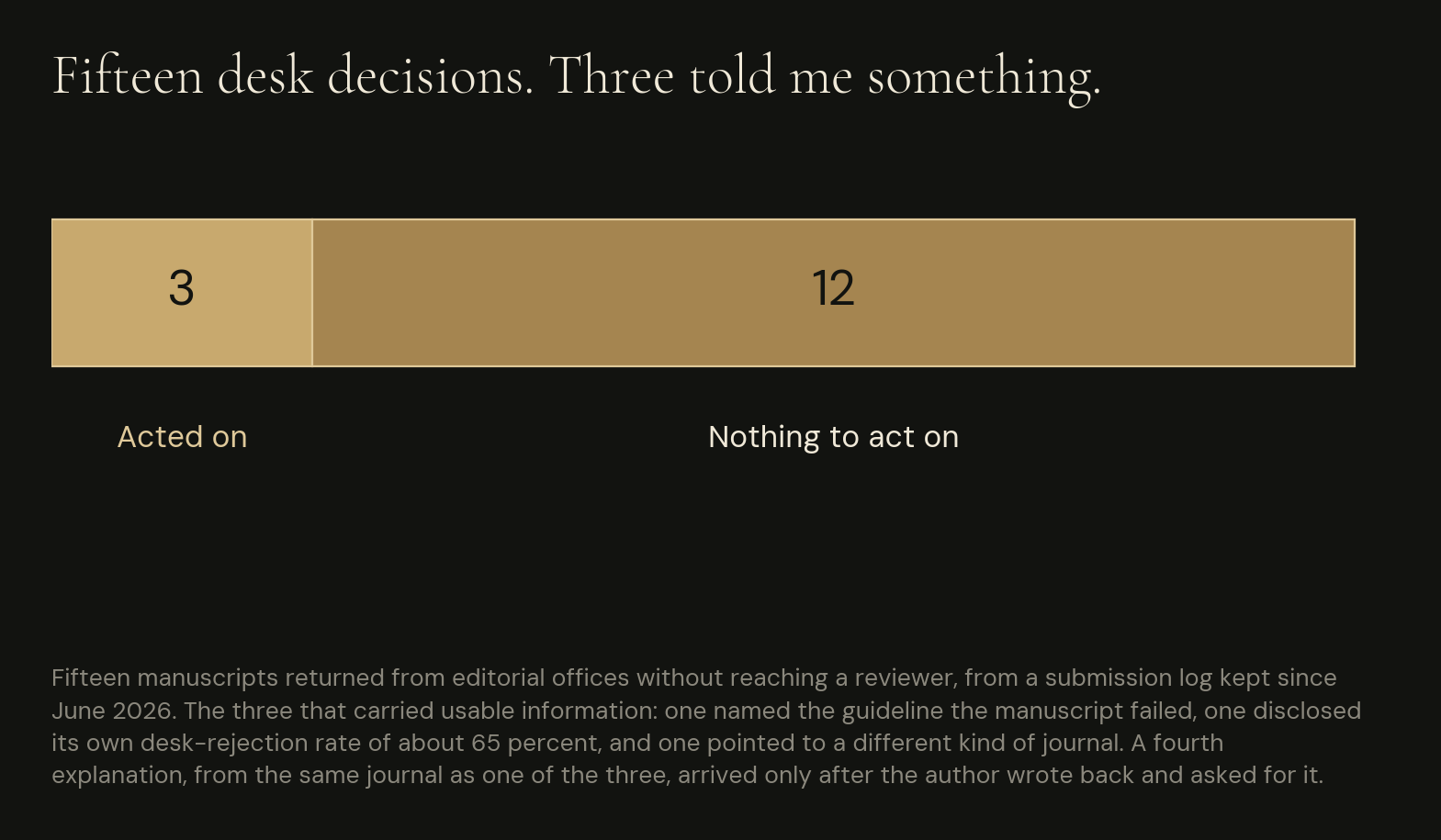
Since June I have made twenty-two submissions. Two have published. Fifteen came back, every one decided in an editorial office before the manuscript reached a reviewer. Two are still out with reviewers as I write.
I want to be exact, because a looser version would be easier to write and would not survive my own files. Three of the fifteen carried something I could use. The June letter named a standard. One disclosed its own desk-rejection rate, about sixty-five percent, which is the “we have no room” category stated plainly. One steered me toward a different kind of journal entirely. Twelve carried nothing specific to my manuscript.
Desk triage is not the villain and I want to defend it before going further. Journals receive vastly more than they can review, and reviewers are volunteers whose time is the scarcest resource in the system. An editor who returns a paper in ten days has done the author a kindness compared with one who holds it six months. Against a desk-rejection rate like sixty-five percent, fifteen is unremarkable. My claim is about what the decisions contained.
Three of them did better than a formula and offered a destination: four transfer offers between them, to sister journals. I declined all four, because each routed to an open-access title with a processing charge I cannot pay. The system does produce guidance about where a paper belongs. It produces it as a sales channel, and the authors it is priced out of reach for are the ones with nobody behind them.
I could also have asked first. Most of these journals answer a presubmission inquiry in days and I sent none. That was my error, it cost me weeks, and it partly answers my own complaint.
What the absence costs, and who pays it
Here is the part that matters more than my manuscript.
I searched for a peer-reviewed study of what the graduate degree requirement did to the dietetics pipeline, and I did not find one. Not mine, which has not been reviewed. The most recent commissioned analysis of this workforce I can find in the profession’s own journal is from 2012 — one year before the Commission on Dietetic Registration adopted the requirement in April 2013, and twelve years before it took effect in January 2024. Everything published since is either descriptive, produced by one of the profession’s own bodies, or opinion.
That absence is not abstract, and 2026 is exactly the year it bites.
This summer the federal government rewrote which programs count as “professional degree” for graduate borrowing, and the RISE final rule published on 1 May excluded physical therapy, occupational therapy, speech-language pathology, audiology, athletic training, physician assistant and nursing from the category. On 24 June a federal district court stayed part of that definition, and the Department published a broader interim list on 29 June, updated on 10 July, that puts those seven back, for as long as the stay holds, and the Department says so on the page. Dietetics is on neither list. A dietetics graduate student now faces roughly fifty-nine thousand dollars less federal credit over a two-year sequence than a peer in a qualifying programme, and the whole arrangement could change again when the litigation resolves.
If someone wanted to argue that exclusion was wrong, the natural move would be to point at peer-reviewed evidence of what happened to the dietetics pipeline. I looked for it and could not find it.
The same is true of every payment argument the profession is currently making, and there is one open right now with a comment deadline of 14 September. It is true of every conversation about whether the graduate requirement is working. It is true of the Academy’s own task force on strengthening the production of registered dietitians, which is asking, in 2026, a question I could find no peer-reviewed paper in this field that answers.
Compare that with the professions on the other side of that borrowing line. Physical therapy has a supply-and-demand microsimulation in its own association’s journal. Pharmacy has a recurring national workforce study. When those professions are asked to justify themselves, they open a folder. Dietetics opens a fourteen-year-old commissioned supplement and a salary survey.
The journal is not hostile to this profession. It publishes a great deal about it, including work that is unflattering — in September 2024 it published the Dietetics Profession Privilege Scale, a validated instrument measuring unearned structural advantage inside dietetics, whose lead author is the same Kate Gardner Burt who co-signed the letter questioning the graduate mandate. A journal that refuses to hear hard things about itself does not publish that paper. What it does not appear to do is referee independent analytic work on this profession’s own labour market.
Dr. Burt has since complicated that picture for me, and gave me permission to say so. She has nearly fifty publications, and she tells me most of the ones she sent to this journal were turned down. I asked whether I could print that precisely because she was the strongest counter-example I had, and an honest counter-example has to include the part that weakens it. Both things are true at once: the journal published the instrument, and the person who built it says the door is usually closed. She examines the institutional dynamics of publication across this profession’s formal channels in a forthcoming book, Healthiest: Whiteness, Bias, and the Myth of Healthy Eating.
And I will put the fact that cuts against me here rather than let someone else put it in a comment. I searched this journal’s full run, and its predecessor’s, for a study using federal degree-completion data on the dietetics pipeline, and I did not find one. Mine would have been a first for them. That supports a plain judgment about scope at least as well as it supports my complaint.
The journal answered
I sent my questions on 25 August. Dr. Snetselaar replied on the morning of 27 August, two days later, before this essay ran. Here is what she wrote, in summary, including the parts that make me look wrong.
She called readership interest an editorial judgment. It concerns a manuscript’s relevance, fit and priority for the journal’s readers. It is made at the first screening, given the volume of submissions. It is not based on a readership survey, download analysis or citation threshold. The journal’s range of topics is broad. Its editorial team currently gives particular priority to research on nutrition and dietary assessment and what it means for practice and public health. It did not consider the workforce-policy focus of my manuscript “of sufficient priority for the Journal to warrant external review.” Article type was not the reason. She agreed that “program evaluation” did not precisely describe my study design. The phrase, she wrote, was “intended more broadly” to cover educational and programmatic work the journal does not generally prioritize. She thanked me for raising the wording of the letter. She hoped the clarification was useful.
Four things in that reply, and I want to take them in the order that costs me most.
She conceded the label. “We recognize that ‘program evaluation’ is not a precise description of the study design you submitted.” That was the checkable claim in the decision letter, it was the one I was most confident about, and I predicted a few thousand words ago that any defence would retreat into the ambiguity of or the like. It did not. The Editor-in-Chief of my profession’s flagship journal read a complaint from a rejected author, agreed with the part that was right, and put it in writing within two days. I have been on the other side of enough correspondence to know how rare that is, and an essay that took the concession and kept swinging would deserve to be ignored.
She answered the question this whole essay is built on, and more candidly than I was braced for. Readership interest is “an editorial judgment” and “not based on a specific readership survey, download analysis, or citation threshold.” I argued above that the clause reads like a claim about readers while functioning as a claim about priority. That is now not my inference. It is the journal’s own description of its process, and I would rather have it stated than keep guessing.
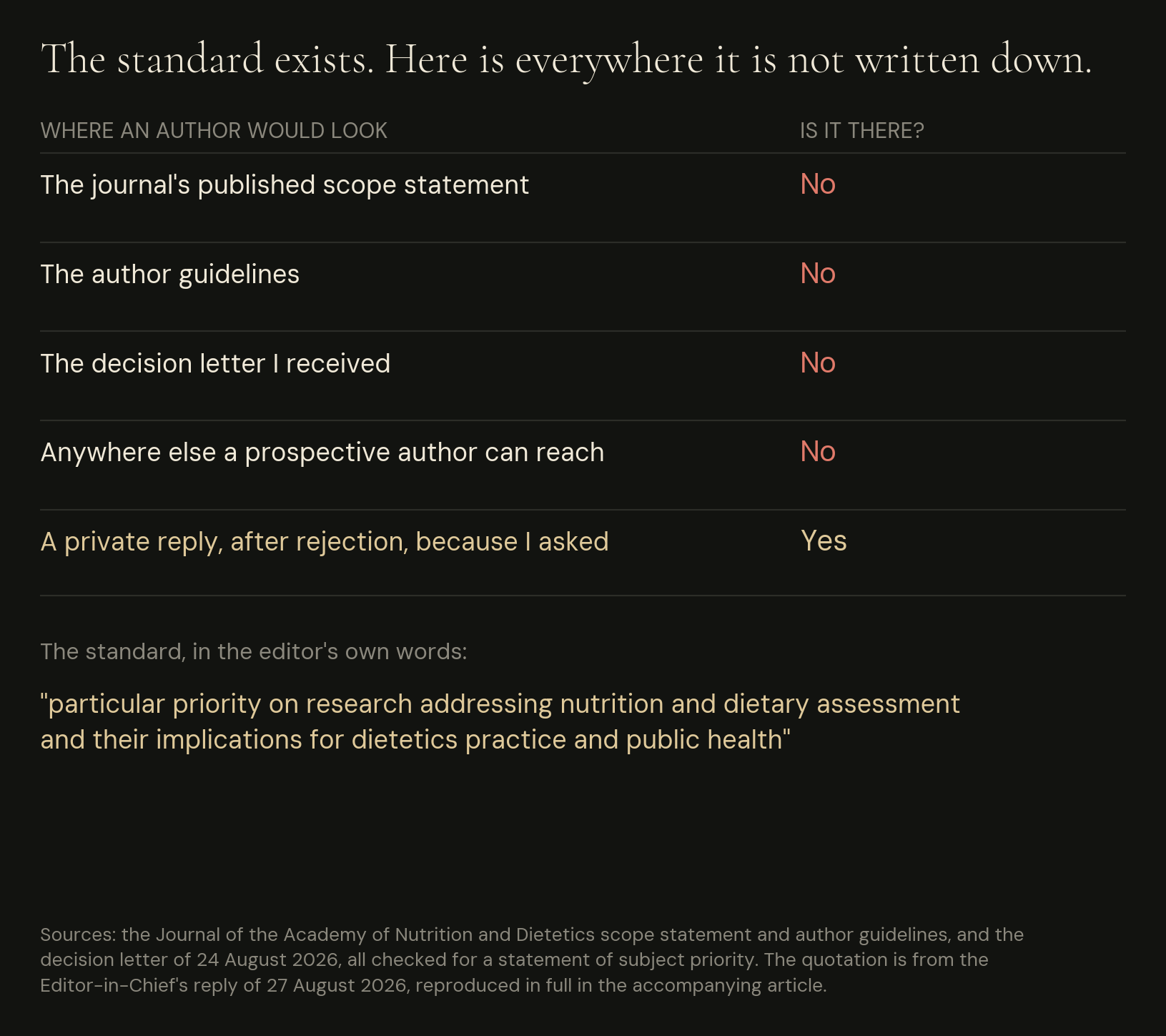
She told me something I could not have found anywhere. The editorial team “currently places particular priority on research addressing nutrition and dietary assessment and their implications for dietetics practice and public health.” That is a real answer to what does this journal want. It is more specific than any scope statement I could read from outside, and it tells me, and any other unaffiliated author, not to send macro workforce analysis there. That is worth more to me than the acceptance would have been, because it is reusable. It is exactly the one clause I spent this essay asking for.
And she closed a door I had propped open for myself. “We are not suggesting that the manuscript would have been appropriate for a different JAND article type.” I had been holding on to the idea that this was a packaging problem I could solve by relabelling — that what I had run into was an article-type boundary rather than a subject boundary. It was not. The answer is no, cleanly, and knowing that is better than a year of resubmitting into the same desk in different clothes.
What survives, and what does not
What does not survive is the sharpest version of my own complaint. I cannot say this office will not explain itself, because it did, twice, and both times the explanation was useful. The June letter rebuilt a dead manuscript. This one told me what the journal is actually prioritizing and retired a label that did not fit. Two for two is not a pattern of stonewalling. It is a pattern of answering, and I should say so as loudly as I said the rest.
What survives is the structural point, and her reply is the clearest evidence for it in this essay. The priority is real, it is reasonable, and it was invisible until I was rejected and then asked. It is not in the scope statement. It was not in the decision letter. It arrived in private correspondence with one author who had already spent the months.
Every other unaffiliated researcher weighing whether to send workforce analysis to this journal is still where I was in July, and the only reason you now know is that I published her answer.
One more thing about the priority, and I want to put it as an argument rather than a complaint, because it is the strongest version of my case. The priority she named is research on nutrition and dietary assessment and its implications for dietetics practice. I have no quarrel with that. It is the core of the field. But implications for dietetics practice require a dietetics practice, and the pipeline that produces the practitioners is the thing my paper measured contracting. Workforce evidence is not a competing priority. It sits upstream of the one the journal named, because everything on that list depends on there being a profession left to do it. That is why I thought the paper fitted. It is the one part of the decision I would still argue with, and I would rather argue it in public, with her answer set out above it, than complain about it privately.
That is not a complaint about Dr. Snetselaar, who answered a question she was under no obligation to answer, and answered it well. It is the whole argument of this essay in one paragraph: the information exists, it is not secret, it is not even contested, and it is simply not written down anywhere a person outside the institution can reach before spending the time.
Why this should matter if you are not a dietitian
Nothing here is about nutrition. Every applied profession has a journal built, reasonably, for the questions its field has historically asked, and staffed accordingly. Respiratory therapy journals were built for clinical respiratory care. Pharmacy journals were built for pharmacotherapy. Nutrition journals were built for what people eat. Those were the right questions for a long time. They are not the only questions now, and boards turn over slowly.
Which means that in field after field, the people with the closest view of a workforce problem are the ones least equipped to publish about it, and the journal closest to that problem is the one least equipped to referee it. The result is not that those papers get written badly. It is that they do not get written, and the literature on applied practice ends up authored by whoever has the institutional cover to survive the search. That is a selection effect on the evidence base, and it is invisible, because the missing papers leave no trace.
Being an example of your own findings is not evidence the findings are right. It is evidence of a selection effect, and the selection effect is the finding. If the only people who can document a profession’s working conditions are the people living them, then the evidence base for every applied profession is rate-limited by how much unpaid time its members have left.
What I am asking
If you edit a journal: consider whether your desk rejections could carry one clause of stated reasoning. Not a review. One clause, distinguishing outside our scope from in scope, framed for the wrong reader from methodological problem from fine, and we have no room. I know the objection: a desk decision ranks a paper against everything else that arrived that week rather than diagnosing it, and converting a comparative judgment into a stated reason manufactures information. That is fair, and it kills the version of my ask that wants prose. It does not kill the version that wants a category. We have no room for this right now is a category. So is this is outside what we prioritize. Neither requires the editor to have read closely enough to be wrong.
I know why it does not happen. A stated reason can be argued with, and editors who write them get email back. Ambiguity is armor, and at that volume armor is rational. But the cost of the armor is not evenly distributed. An author with a mentor absorbs it, because the mentor supplies the missing signal free. An author without one pays in months.
Two editors at this journal wrote the clause anyway. Both times it took a paragraph. Both times it changed what I did next.
If you sit on an editorial board for an applied profession: ask a narrower question than whether you could referee such a paper, because you probably could. Ask when your journal last published independent analytic work about your own profession’s labour market, refereed like any other research, written by someone who does not work for one of your own bodies. If the answer is more than a decade, that is not a scandal and nobody is at fault. It is a gap, it is fixable, and while it stays open your profession will keep arguing about itself without evidence, in rooms where everyone else brought some.
And if you publish a scope statement: put the priority in it. Dr. Snetselaar’s sentence about nutrition and dietary assessment took her one line to write and would have saved me a summer. It is now public only because a rejected author asked and then reported the answer. That is a poor distribution mechanism for something so cheap to say.
Disclosure, in the body rather than a footnote. I am the rejected author, and a registered dietitian, so the wages and pipeline this work measures are my own profession’s. I also build and sell products in this space, including books and practice guides for dietitians and a compensation-intelligence tool for the profession, so I have a commercial interest in dietetics compensation data being better documented. Readers should weigh that.* *On the Academy: the Journal of the Academy of Nutrition and Dietetics is published by the Academy of Nutrition and Dietetics, my profession’s membership body. That ownership is context a reader outside dietetics needs in order to know what kind of institution this is. It is not an allegation: a journal’s editorial operation and an association’s programme work are separate arms, and I have no reason to think they consulted each other about my manuscript, nor am I suggesting it. I hold no position, appointment or paid role with the Academy or with any journal named here. I have corresponded with Academy leadership about workforce research and gave them an unpaid briefing this summer at their invitation, and I am presenting at the Academy’s annual conference in October.* *Sourcing: all three letters, including Dr. Snetselaar’s reply of 27 August 2026, are quoted from the originals in my files, and her reply is summarized, with her own words in quotation marks. Editorial board composition was read from the journal’s published board roster; the live page should be checked against this, as it changes. Submission and rejection counts are from a tracking file I have kept since June, precisely so that I could not revise my memory of how this went. The completions figures are the author’s own, measured 2014 to 2024 from IPEDS extracts spanning 2010 to 2024; the 2024 file is the provisional Fall 2024 release. The underlying data extracts and analysis scripts are deposited publicly at doi:10.5281/zenodo.21792266, and anyone who wants to check them can.
This article is general nutrition education, not individualized medical or nutrition advice, and it does not create a dietitian–client relationship. Medications and their side effects should be managed with your prescribing clinician. See the full disclaimer.