Summary
This piece reads four parts of Medicare’s proposed 2027 payment rule for doctors and other clinicians. The rule was published on 16 July 2026, and public comments ran until 14 September 2026. The four parts sit close together in the rule, and they make sense only read together. I urged readers to file comments. Some outcomes I argue for would help my own profession, and I say so.
- Today a dietitian who helps run a group medical visit can bill Medicare separately for group nutrition therapy. One page later, the rule proposes folding that work into the doctor’s payment. The work would stay. The separate payment would go.
- Two pages on, it proposes paying for health and well-being coaching by staff who need a certification but not a state license.
- It also proposes something I support: letting rural health clinics bill nutrition therapy and diabetes education as visits of their own, though only under direct supervision by the clinic’s practitioner.
- It asks the public what could replace the process, run through the American Medical Association, whose price recommendations Medicare largely adopts.
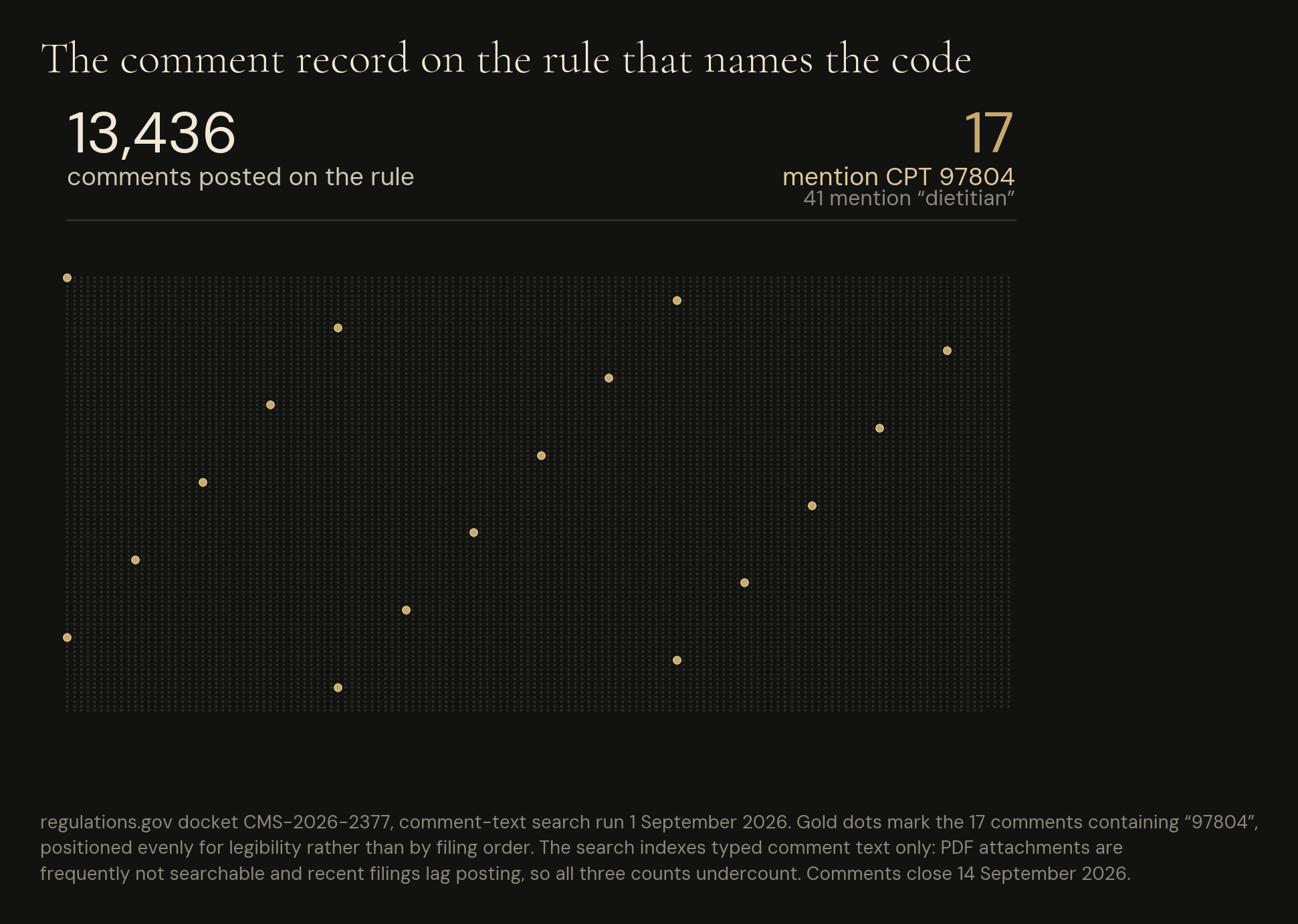
- On 1 September 2026 the public record held 13,436 comments. A text search found 17 that mention the group nutrition billing code. The search misses many attachments. The real number is higher, but not by much.
Two sentences from the same federal rule, one page apart.
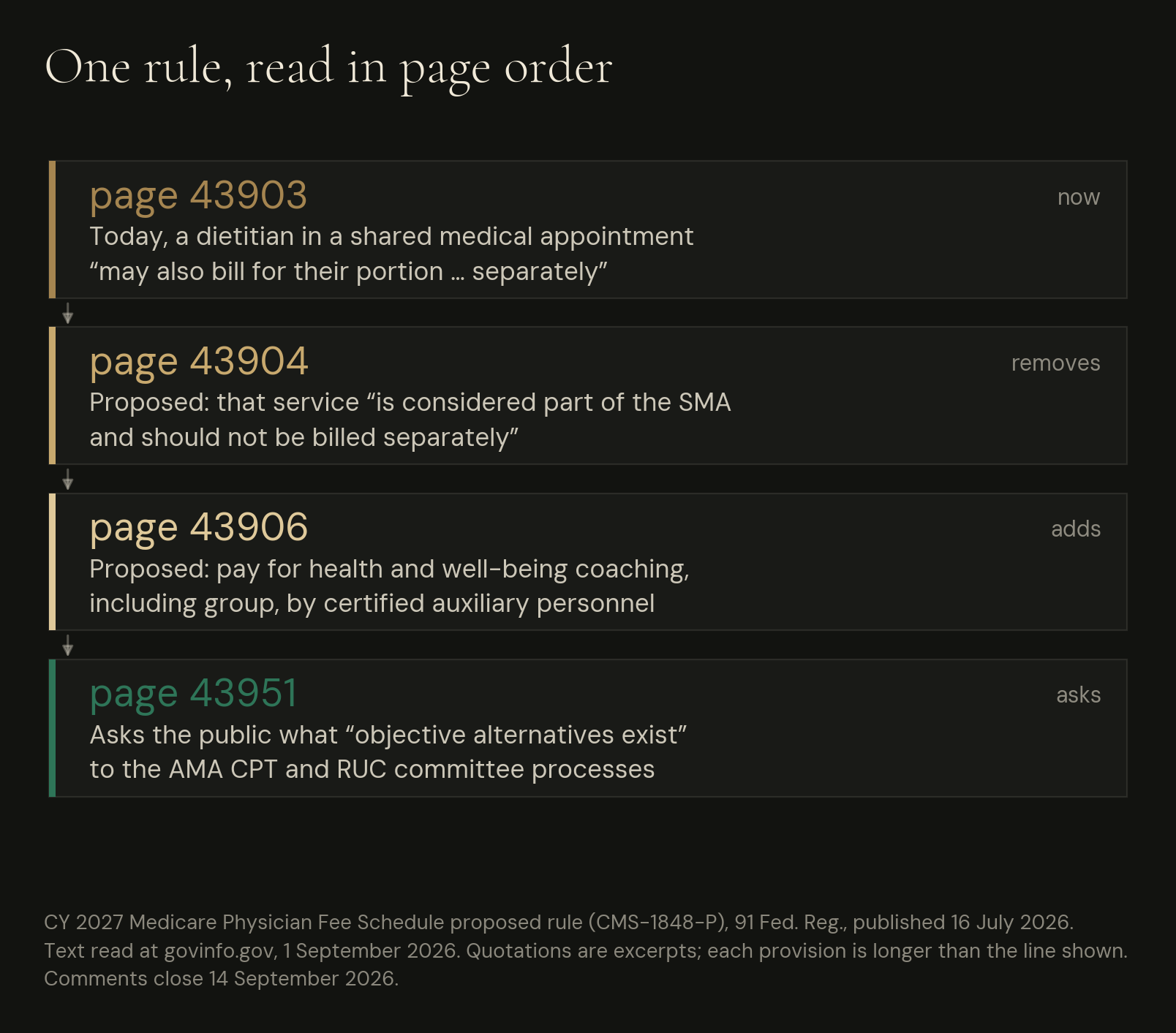
The first, on page 43903, describes how Medicare works today:
“if another billable clinician such as a registered dietician assists with the SMA, the registered dietician may also bill for their portion of the SMA separately (for example, CPT code 97804 (Medical nutrition therapy; group (2 or more individual(s)), each 30 minutes))”
The second, on page 43904, proposes how it should work next year:
“In instances where another qualified healthcare professional, such as a registered dietitian, provides a service during the SMA session, such as CPT code 97804 (Medical nutrition therapy; group (2 or more individual(s)), each 30 minutes), that service is considered part of the SMA and should not be billed separately, in addition to the physician or qualified nonphysician practitioner billing for the SMA.”
That is the whole change. One page apart, in the CY 2027 Medicare Physician Fee Schedule proposed rule, published 16 July 2026. The public can comment on it until Monday 14 September.
I want to walk through four provisions of that rule, because they sit within sixty pages of each other and they only make sense read together.
What an SMA is, for anyone who does not live in this
A shared medical appointment is a group visit. A physician sees several patients with the same condition in one room, delivering the individual medical care each of them needs while the group format handles the education and the questions that are common to all of them. Diabetes, heart failure, and weight management are the usual settings.
The rule notes that there is currently no billing code specifically for these visits, so practices bill them using standard office-visit codes. CMS proposes to create a dedicated code, GSMAS, billed once per patient per session by the physician or qualified nonphysician practitioner leading it.
That part is unremarkable. Building a code for a visit type that already exists is ordinary housekeeping.
The consequence is the sentence on 43904. In these visits, a dietitian is frequently the person delivering the nutrition portion, and today that portion can be billed on its own. Under the proposal it would be absorbed into the physician’s payment for the session.
Nothing about the work changes. The patient still gets the nutrition care. The dietitian still delivers it. What changes is whether it is a separately paid service, and therefore whether an employer counts it as revenue or as overhead.
I have watched what happens to services that move from the first column to the second.
Two pages later
On page 43906, the same rule proposes something else. CMS would adopt payment for three new codes: 0591T, 0592T and 0593T, health and well-being coaching, individual, follow-up, and group.
The rule proposes that these services may be furnished under direct supervision of the billing practitioner, and that where auxiliary personnel perform them, those personnel must have “received appropriate certification.” The rule names what would satisfy that: the National Board for Health and Wellness Coaching national standards, eligibility as a Certified Health Education Specialist through the National Commission for Health Education Credentialing, or the American Holistic Nurses Credentialing standards for Certified Nurse Coaches. It also proposes that training from an evidence-based program funded under the Older Americans Act and overseen by the Administration for Community Living would qualify.
I want to be careful here, because there is a version of this observation that is just guild complaint, and it is not the one I am making.
I am not arguing that health coaching does not help people. It does, and the behavioral-change literature underneath these codes is real. I am not arguing anything about the people who hold those certifications, most of whom I would guess are conscientious and some of whom are excellent.
The observation is narrower and it is about architecture. In one rule, a payment system proposes to stop separately paying a licensed clinical service delivered by someone holding a state license they can lose, and to start paying an adjacent service that requires certification but not licensure. Those are two decisions about what a payment system chooses to recognize, and they are being made two pages apart, in the same document, by the same agency, in the same year.
Whether that is the right pair of decisions is a legitimate question, and it is one the comment record should hear, which I will come to.
The same rule, pointing the other way
Fifty-five pages further on, at 43959, the rule proposes something I think is straightforwardly good.
Rural health clinics are paid an all-inclusive rate per visit, and the definition of what counts as a visit determines what a clinic can afford to offer. CMS proposes to recognize diabetes self-management training and medical nutrition therapy as qualified visits, “covered and paid as stand-alone billable visits under the RHC benefit,” amending 42 CFR 405.2463 to say so.
For a rural clinic, that is the difference between a service that pays for itself and a service that has to be justified out of margin.
There is a condition attached, and I would rather name it myself than have someone else point it out. The new regulatory text at 405.2463(a)(1)(iii) requires that the encounter be “furnished under the direct supervision of the RHC practitioner.” Direct supervision has a specific meaning, and in a rural clinic with one practitioner covering a wide area it is not a trivial requirement. It is worth commenting on, and the comment is “finalize this, and clarify how the supervision requirement applies where the qualified provider is not physically alongside the practitioner.”
I am saying this partly because it is true and partly because of what it does to everything else I am arguing. A comment record in which one profession objects to every provision that touches it is a record that can be discounted as reflex. A record in which the same profession opposes one provision, supports another, and explains the difference is harder to set aside.
The provision almost nobody is going to comment on
At page 43951, section II.H, the rule contains a Request for Information about the Current Procedural Terminology coding system.
This is the part I would ask you to read even if you skip everything else, because I do not think a document like this has appeared before and I do not expect it to appear again soon.
Medicare pays for a service by multiplying a relative value by a conversion factor. The relative values come from a process run outside the government: codes are created by an editorial panel convened by the American Medical Association, and valued by a committee, the RUC, whose recommendations the agency largely adopts. Thirteen organizations representing non-physician professions sit on an advisory committee inside that structure. Mine is one of them.
Here is what CMS wrote about its own arrangement:
“There has also been longstanding concern expressed over the Federal reliance on a private organization with such an obvious conflict of interest as providing information on the time and resource requirements to conduct physician services when this information may influence their own payment.”
It then cites the Medicare Payment Advisory Commission, which has said for nearly twenty years that the agency has “over-relied on specialty societies with a financial stake in the process,” and a 2025 National Academies report recommending alternatives for valuation.
And then it asks five questions. The fourth is the one that matters here:
“(4) What objective alternatives exist, or could be developed, to maintain a more objective process to the current AMA CPT and RUC committee processes? How would these alternatives support or inhibit innovation?”
Read that as a clinician in any of the thirteen professions. The agency that sets your rate is asking, in an open docket, whether the body that recommends those rates should be replaced, and what should replace it. That question is open for eleven more days.
The part of this I do not want you to find out from someone else
The RFI is introduced as part of a Secretarial priority called Make America Healthy Again, and the rule says so twice.
I have been publicly critical of a good deal of what travels under that banner, and I am not going to pretend otherwise in order to make this paragraph easier. If you have read me before, you know where I sit.
Here is why I am still telling you to answer it. The RFI’s own supporting text does not rest on that framing. It rests on MedPAC and on the National Academies, which are the two most conventional sources in American health policy, and it asks a question that health economists have been asking since the RUC was created in 1992. A comment can be written entirely to that evidence. Nothing in the question requires you to endorse anything else, and a docket does not become someone’s property because of the sentence a question was introduced with.
You can think the framing is bad and the question is worth answering. I do.
What the record actually looks like
On 1 September I searched the docket.
There were 13,436 comments posted on the CY 2027 rule. A text search returned 41 containing the word “dietitian,” one more containing the common misspelling, and 17 containing “97804” — the code that the sentence on page 43904 would fold into someone else’s payment.
Seventeen.
That number needs its caveat, and the caveat travels with it every time I use it: the search indexes typed comment text, PDF attachments are frequently not searchable, and recent filings lag posting. The real number is higher than seventeen. It is not higher by much.
I have written before about this profession’s structural problems, and I have generally been able to point at someone else’s decision as the cause. This is not that. This is a public record, open to anyone, free, taking about twenty minutes, on a provision that names our code in the text, and it has seventeen mentions in thirteen thousand comments.
I filed mine on 6 August. That is one.
If you are one person
You can file. You do not need to be a member of anything, you do not need permission, and you do not need to be a dietitian. The form is at regulations.gov, docket CMS-2026-2377, and it closes on 14 September.
The only part that matters is the middle. Rule writers act on specific operational consequences, described concretely, and they already have every national statistic. What they do not have is your census.
How many group sessions does your site run in a month. How many patients are in them. What your employer has done, historically, with services that stopped being separately billable. Who stops getting seen, and where they go instead.
If you do not bill Medicare — if you are a student, an intern, an educator, a program director — you have a different argument and it is barely represented at all. Write about what it costs to enter this profession right now and what a narrowing of billable scope does to that calculation. The agency has heard from providers. It has heard very little from the people deciding whether to become one.
One warning, in CMS’s own words from this rule: “CMS continues to encourage individuals not to submit duplicative comments.” Rulemaking answers distinct arguments, not volume. A filing that is entirely someone else’s template does no work and spends credibility the next one will need. Use a structure if it helps. Write the middle yourself.
If you are an organization
The conversion factor in this rule falls for everyone. CMS projects the CY 2027 qualifying alternative-payment-model conversion factor down forty cents, a decrease of 1.19 percent from $33.4009, and the nonqualifying factor down fifty-six cents, 1.68 percent from $33.5875. Every service billed by every one of the thirteen professions is a relative value multiplied by one of those two numbers.
The efficiency adjustment reaches across the schedule too — 2.5 percent, applied to work relative values and intraservice time every three years, with time-based codes, telehealth-list codes and new codes exempted.
This rule does not reach each profession through its own provision. It reaches all of them through machinery they share, and the question about that machinery is on page 43951.
A joint filing from thirteen organizations on one valuation question is worth more than thirteen separate ones, and it costs a signature rather than a calendar. It would also be the least ceremonial way imaginable to start a coalition, which is that you file something together before you hold a meeting about holding a meeting.
What I have built for this
I have put together an action plan: the sequence, the deadlines that actually govern, a decision tree that routes you to your entry point in one question, and comment blocks with the openings and closings written and a hole in the middle where your paragraph goes. There is a card built specifically to be forwarded to colleagues in the other twelve professions, because the most useful thing any dietitian can do after filing is make sure the next filing is not another dietitian’s.
Every payment mechanism in it is quoted from the statute or the Code of Federal Regulations rather than from anyone’s summary, including my earlier ones.
If you hold a leadership, director or chair role at state or national level — an affiliate board, a licensing board, a committee chair, a program directorship — and you want it, message me and I will send it. I would rather it be used than admired.
And if you are not in one of those seats but you know somebody who is, forward this to them. Most of what is in here can only be acted on from those chairs, and most of the people sitting in them do not know these deadlines exist.
If you are not in any of those roles, everything you need is in the paragraphs above, and the deadline is the same.
The next door
The comment period is not the only thing open this month, and it is not the one closing first for the people who set the numbers.
The AMA’s own published process calendar sets a level-of-interest deadline of 30 September 2026 for codes referred at the editorial panel meeting on 17 to 19 September, feeding the valuation meeting in January. That is a society action rather than an individual one. The individual action is to ask, in writing, whether your own society has filed one, and to ask before the date rather than after.
I will write about that room next, and I will write about it before the thirtieth.
A note on who pays for this
No outside institution does.
There is no grant behind this work and no outside organization underwriting the time, the document fees, or the research. I am a working clinical dietitian, and the pulling of statutes and fee schedules and comment dockets happens around my day job.
This piece is free to read. If it is useful to you and you can afford it, a paid subscription is what funds the next one and the advocacy that goes with it. If you cannot, that is genuinely fine, and forwarding this to one person who is in a position to act on it is worth more to me than the subscription is.
The CY 2027 Medicare Physician Fee Schedule proposed rule is CMS-1848-P, published in the Federal Register on 16 July 2026, docket CMS-2026-2377; comments close 14 September 2026. Page citations are to volume 91 of the Federal Register: shared medical appointments at 43903 and 43904, health and well-being coaching codes at 43906 and 43907, the Request for Information at 43951 through 43953, the rural health clinic provision at 43957 through 43959, with the proposal itself at 43959 and regulatory text at 44277, and the conversion factor at 43844. Docket counts searched 1 September 2026. All Federal Register text read at govinfo.gov. I am a registered dietitian, and several of the outcomes argued for here would improve the economics of my own profession and my own practice; weigh that against everything above.
This article is general nutrition education, not individualized medical or nutrition advice, and it does not create a dietitian–client relationship. Medications and their side effects should be managed with your prescribing clinician. See the full disclaimer.