Summary
On 12 August 2026 I searched every grant the federal government had posted on its central grants website for the word “dietitian.” There was one. It was open only to health centers already holding a federal health center award, and no individual could apply. The barrier I found is not a degree: research grants are built so that the applicant is an organization, not a person.
- The same day, filtering for grants open to individuals returned fourteen results. None was in health, nutrition or workforce.
- A search for “nutrition” returned forty-eight. The applicant was always an organization.
- The National Institutes of Health does not require a doctorate to lead a project. Its standard is skills, knowledge and resources. But the person works with an organization, and the organization applies.
- Over two weeks of searching, I found no program that was funded, remote, open without a doctorate and open without an institution all at once.
- The morning I wrote this, Emergent Ventures, a philanthropic grant program, turned down my $91,000 application with a form letter. The argument does not rest on that. Institutions also exist for good reasons, such as financial accountability and protecting research subjects. My ask is narrow: if you work somewhere with a research office, ask whether it will name you lead investigator on a grant you write.
Summary added 2 October 2026.
On August 12, 2026, I searched every grant the federal government currently has posted on grants.gov, its central grants portal, for the word dietitian.
There is one.
It is HRSA-27-099, Fiscal Year 2027 Expanding Nutrition Services, and it closes on September 9. Its eligibility section reads: "You can apply if you are a Health Center Program award recipient with an active H80 award… Individuals are not eligible applicants under this NOFO."
Search nutritionist and you get the same one. Search dietetics and you get a different single result: a Department of Veterans Affairs construction grant for building state veterans' homes, where the word appears because the buildings have kitchens.
So the complete inventory of federal grants currently posted that mention my profession in any form is one health center program that excludes individuals, and a construction contract. The number a dietitian can apply to is zero. In four weeks the first one closes.
I want to be careful about what I am claiming, because the interesting part is not the number. The interesting part is the shape of the wall behind it, and the fact that the wall is not made of the thing everyone assumes it is made of.
First, the disclosure
Eleven days ago I applied to Emergent Ventures for $91,000 to build a public observatory for clinical nutrition workforce data. This morning I was turned down. The entire message read:
We thank you for the interest in Emergent Ventures, and wish you the best of luck in what you are doing. The Mercatus Center
That is a form letter, and I am not going to pretend it was anything else or that it was aimed at me personally. Emergent Ventures is a philanthropic grant program at the Mercatus Center at George Mason University — not a venture fund, despite the name — and it receives far more applications than it can read closely. High-volume programs send form letters. That is a fact about volume, not about how anyone there feels about nutrition.
I am telling you this in the first two hundred words because you are going to suspect it anyway, and because if this piece only worked when its author had just been rejected then it would not be worth writing. So here is the test I will hold myself to: everything that follows is true whether or not I ever applied to anything. The rejection is one data point. The argument rests on the other forty, most of which I never applied to, because I was categorically ineligible before I started.
The fourteen doors
Grants.gov lets you filter every posted federal opportunity by who is allowed to apply. One of the categories is Individuals.
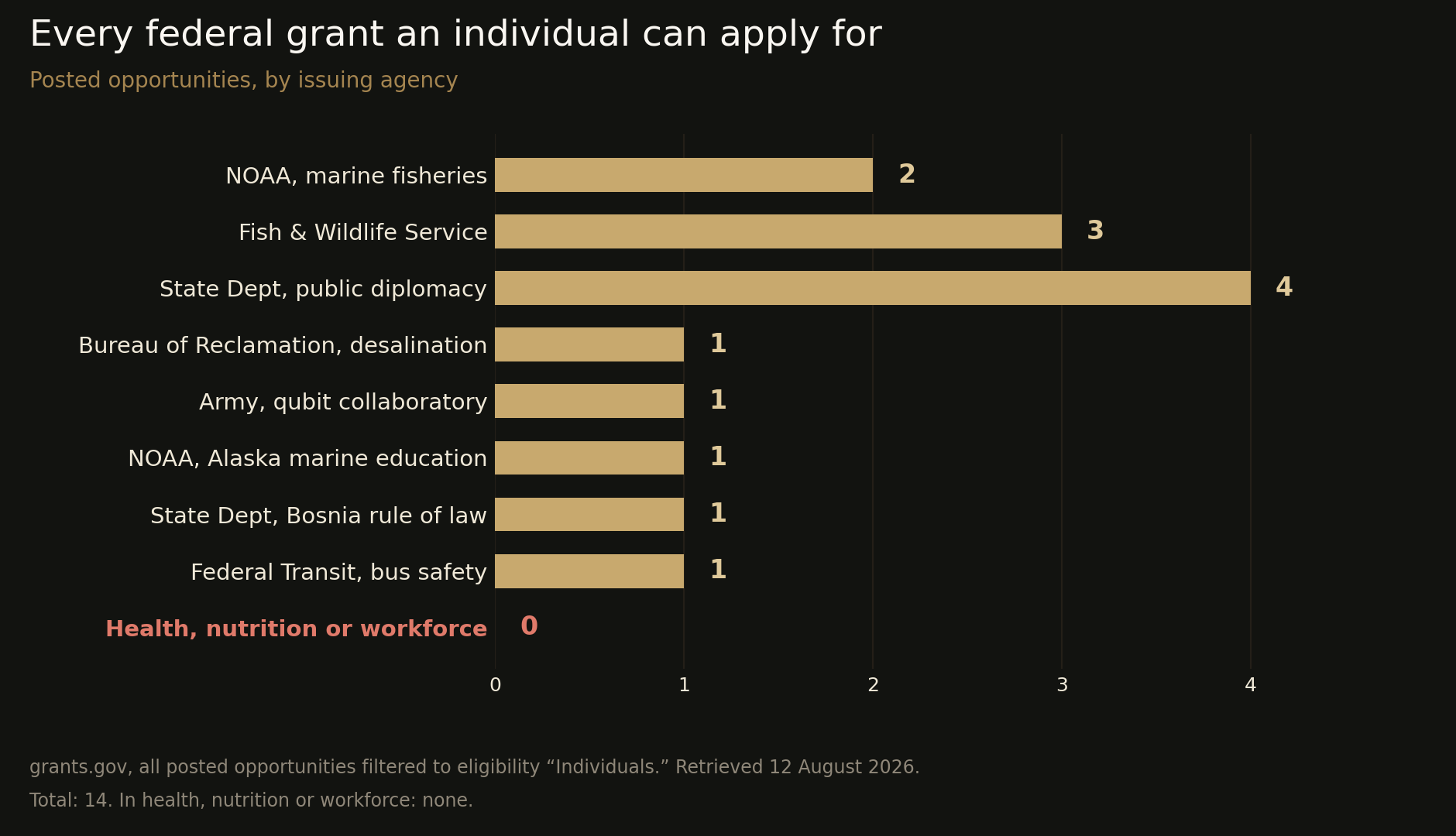
Today that filter returns fourteen results. Here they are, all of them:
Two broad agency announcements from NOAA's National Marine Fisheries Service. Three Fish and Wildlife Service programs — Cooperative Agriculture, Partners for Fish and Wildlife, and the Coastal Program. An Army qubit collaboratory. Four State Department public diplomacy programs, in Paris, Oman, Jakarta and Ghana. A program strengthening organized crime prosecution in Bosnia and Herzegovina. A marine education mini-grant in Alaska. Desalination and water purification research at the Bureau of Reclamation. And bus safety at the Federal Transit Administration.
That is the complete list of grants posted on grants.gov that an individual could apply for that day without an institution standing behind them.
Not one is health. Not one is nutrition. Not one is workforce.
Search nutrition instead of filtering by applicant, and you get forty-eight opportunities, which sounds much better until you look at what they are: NIH center grants, HRSA programs for existing grantees, USDA cooperative agreements with state agencies. The money is real and substantial. The applicant is always an organization.
(Both figures were pulled on August 12, 2026 from the grants.gov search API — the website itself returns nothing to an automated query. Postings change daily. The query was `eligibilities: 21`, which is the code for Individuals, and you can re-run it.)
The sentence
Here is where it stops being about dietitians.
Every NIH parent announcement — the R01, the R21, the R03, the ones that fund most investigator-initiated biomedical research in this country — carries the same eligibility language. Here it is from PA-25-301, the current Parent R01, which was posted in December 2024 and does not expire until January 2028:
Any individual(s) with the skills, knowledge, and resources necessary to carry out the proposed research as the Program Director(s)/Principal Investigator(s) (PD(s)/PI(s)) is invited to work with their organization to develop an application for support.
And on grants.gov, the same announcement lists who may actually apply. The list includes public and private universities, minority-serving institutions and tribal colleges, nonprofits, small businesses and other for-profit companies, state, county, city and tribal governments, school districts, housing authorities, faith-based and community organizations, federal agencies, U.S. territories and foreign organizations. Every entry on it is an entity. There is no line for a person.
Read that twice, because both halves matter and they point in opposite directions.
NIH does not require a doctorate to lead a federally funded research project. It does not require a faculty appointment, or a tenure track, or a particular credential at all. The standard is skills, knowledge, and resources. I have spent a year assuming the barrier in front of me was the letters after my name, and it is not, and that is written into the boilerplate of the largest biomedical funder on earth.
And then the same sentence closes the door it just opened: work with their organization.
The invitation is universal. The mechanism is institutional. You are welcome to lead the work and you cannot submit the application, because the applicant is not a person, it is an entity with a Unique Entity ID from SAM.gov and an indirect cost rate and a sponsored programs office. The individual is the investigator. The organization is the applicant. Those are different roles and only one of them can send the form.
What this actually is
For the past two weeks I have been running the same search every few days: federal challenges, foundation awards, professional society grants, prizes, domestic and international. Each hit gets tested against one profile — a credentialed clinician, employed full time, holding a master's rather than a doctorate, with a published national analysis and no institutional research appointment. If any single requirement fails, it dies, and the reason gets written down so nobody looks at it twice.
The file of dead ones is now the longest document in the project. Here is the pattern, and it took me a while to see because each rejection has its own perfectly reasonable explanation.
Some require a doctorate. Some require a faculty position. Some require an active award from the same agency, which means you must already have been funded to become fundable. Some require enrollment in a degree program. Some require a 501(c)(3). Some require a state agency. Some pay real money and are remote and have no degree requirement, and then require the funds to be administered by an institution you do not work for in a research capacity.
No program I found is simultaneously funded, remote, doctorate-free, and institution-free. Every one of them waives at most three of the four.
That is the wall. It is not a wall against nutrition, or against master's degrees, or against clinicians. It is a wall against individuals, and it is load-bearing rather than incidental — the whole apparatus of federal and foundation research funding is built on the assumption that serious work happens inside institutions, because for most of the last century it did.
The objection
The strongest version of the case against this piece is: a man who was turned down is explaining that the system is broken. I would think that too.
So let me give you the three places where I think the system is right, because they are real.
Institutions exist in this arrangement for good reasons. They carry financial accountability, so that public money has somebody to claw it back from. They house compliance and human subjects protection, which is not bureaucracy, it is the reason research does not hurt people. And they provide a first filter on quality that funders cannot possibly perform at the volume of applications they receive. Strip all that out and you get a worse system, not a fairer one.
There is also a real objection to the evidence itself, and it is the one I would lead with if I were arguing against this piece. Grants are one instrument among several. Prizes exist, and fellowships, and contracts, and philanthropy, and ordinary employment. Grants.gov is a slice, not the whole system — the NCI prize I entered nine days ago is not on it, because prizes are administered separately.
That objection is correct, and narrowing to survive it is worth doing, because what is left is still the thing that matters. Prizes are episodic and small. Grants are where the sustained money lives, the kind that funds a person for three years rather than paying them once. And the grant system specifically is built so that a person cannot be the applicant. I would rather defend that sentence than a bigger one.
I also cannot claim I was owed anything. Emergent Ventures funds a small number of people and I was not one of them, and that is not an injustice, it is arithmetic.
And there is a version of my complaint that is simply entitlement: I did good work, therefore money. The world does not owe that and never has.
Here is what survives all three of those, and it is narrower than what I started with.
The mechanism for repairing a professional collapse is institutional. A profession in collapse produces fewer institutions and more stranded individuals — that is what collapse means. Programs close, departments consolidate, positions go unfilled, and the people who remain are increasingly practitioners without research infrastructure attached to them. So the repair mechanism becomes least reachable at precisely the moment it is most needed, and it becomes least reachable to the people closest to the problem.
That is not unfairness. It is a design flaw, and it is invisible from inside an institution, because from in there the door has always been open.
Why this should matter if you are not a dietitian
Because the same structure decides who gets to describe any shrinking profession.
The people with the clearest view of an institution failing are the ones inside it, and they are almost never the ones with a sponsored programs office behind them. Rural pharmacists. School psychologists. Respiratory therapists. Medical interpreters. Community health workers. When those fields contract, the person best positioned to document it is a practitioner, and practitioners cannot apply.
So the account we get of a workforce collapse is written by people who study it from institutions that are not collapsing. That account is not wrong. It is late, and it is thin in exactly the places where firsthand knowledge would have helped.
I do not think anyone designed this. I think it is what you get when the funding architecture assumes an employment structure that has been dissolving for thirty years.
What I am actually asking
Not for money, and not from you.
If you work anywhere that has a research office, ask it one question: will you name me as principal investigator on a grant I write?
That is the whole ask. It is free. It takes one email. And it is the question I have had drafted for eleven days and have not sent, which I am disclosing because it would be absurd to ask you to do something I have been avoiding.
Here is why it is the right question. NIH does not impose the credential barrier — the language above proves that. Your employer decides who it will sponsor. As far as I can tell, most hospitals and health systems have not been asked whether a master's-prepared clinician can be a PD/PI, because I do not know of anyone in that position who has asked. The policy in most places is not no. It is unwritten, and unwritten policies are decided by whoever asks first.
If the answer is yes, an entire tier of funding opens that afternoon — the foundations that require a tax-exempt applicant, the federal awards that require an institution to hold the money, the whole $25,000-to-$100,000 band that is currently invisible to me and to you.
If the answer is no, that is worth knowing too, and worth writing down, because I do not know of anyone who has counted how many of these answers are no. I would genuinely like to know. If you ask and get an answer either way, tell me.
This is not a complaint
I want to be exact about what changed today, because it is smaller than it might sound.
I did not lose access to anything. I never had it. A rejection from a program that funds a handful of people out of thousands is not evidence of a broken system, and if this piece rested on that it would deserve the eye-roll it got from you two paragraphs in.
What I did is spend two weeks mapping the terrain carefully enough to be sure of the shape, and the shape is this: the barrier was never the credential. It is a signature, and it belongs to an employer, and almost nobody has asked for it.
That is a much better problem than the one I thought I had. Credentials take years. Signatures take an email.
I am going to send mine this week.
Correction, 2 October 2026. This piece gave a short version of who may apply for the National Institutes of Health parent R01 on grants.gov. The full list also includes nonprofits, small businesses and other for-profit companies, state and local governments, school districts and housing authorities. Every entry is still an organization. So the narrow point survives: a person cannot be the applicant. But the full list weakens the larger point more than the wording change suggests. A person can form a company and apply through it. I own one, Vitae Arete LLC. The piece said the barrier is a signature that belongs to an employer. For this grant it can also be the signature of the applicant’s own company. Whether a company that small can meet the rest of the requirements is a question the piece did not test. Three smaller fixes were also made: one quotation now matches the announcement, the retired DUNS number is now the Unique Entity ID, and the fourteen results are now described as the grants on grants.gov open to individuals that day, since federal prizes, including one I entered, are run separately.
This article is general nutrition education, not individualized medical or nutrition advice, and it does not create a dietitian–client relationship. Medications and their side effects should be managed with your prescribing clinician. See the full disclaimer.