Summary
Americans now spend far more on supplements than they did in 1994. Over the same years, the pay of registered dietitians, the clinicians licensed to give nutrition care, barely moved after inflation. I set federal wage data beside the industry’s own sales figures. My argument is that the money could not lift dietitian pay, because that pay is tied to Medicare payment rules written into law, not to a market. I am a dietitian. My pay is part of this argument.
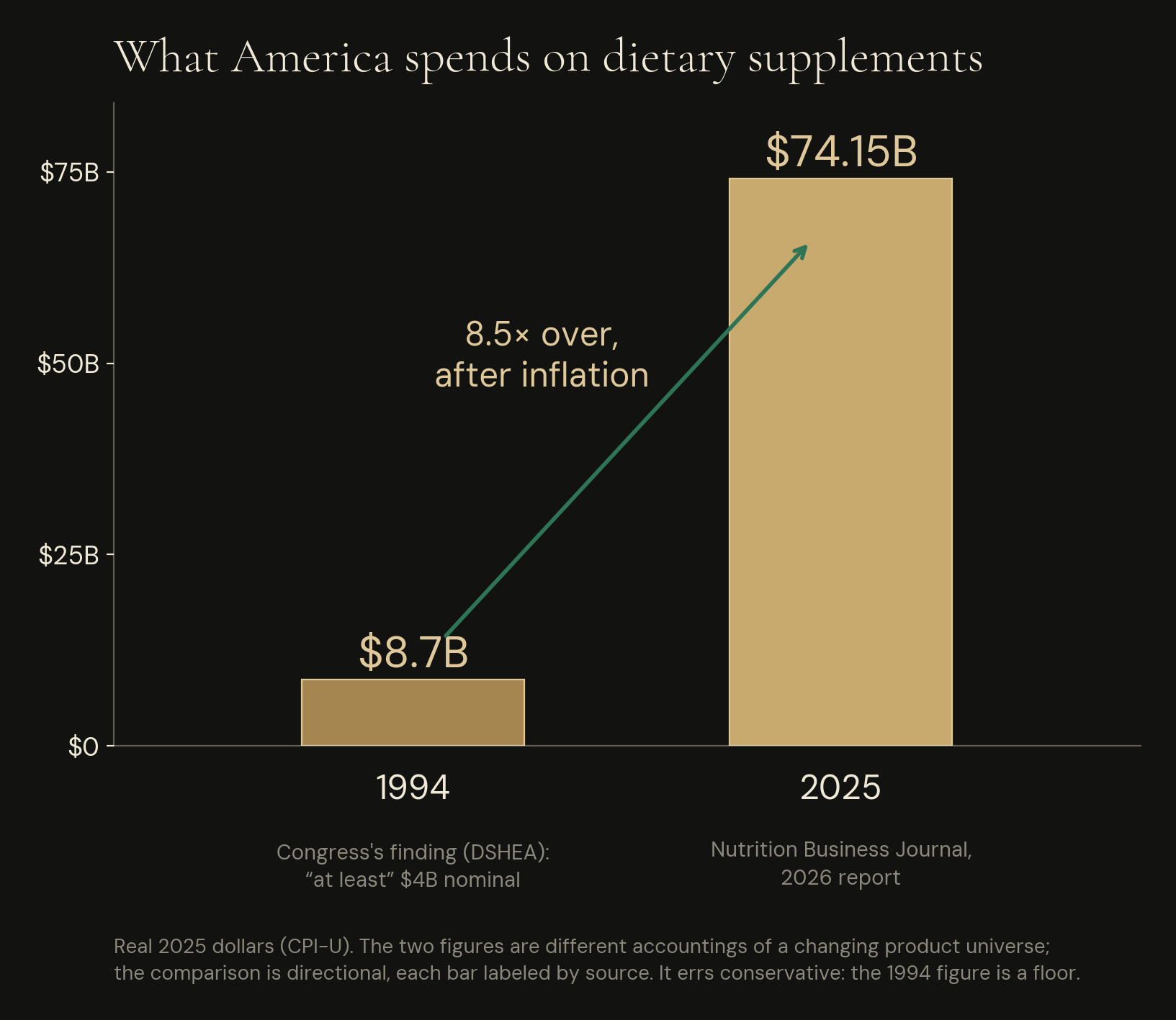
- In 1994, Congress put supplement sales at “at least” $4 billion a year, about $8.7 billion in 2025 dollars. Industry research on a broader range of products puts 2025 sales at $74 billion, roughly eight and a half times more after inflation.
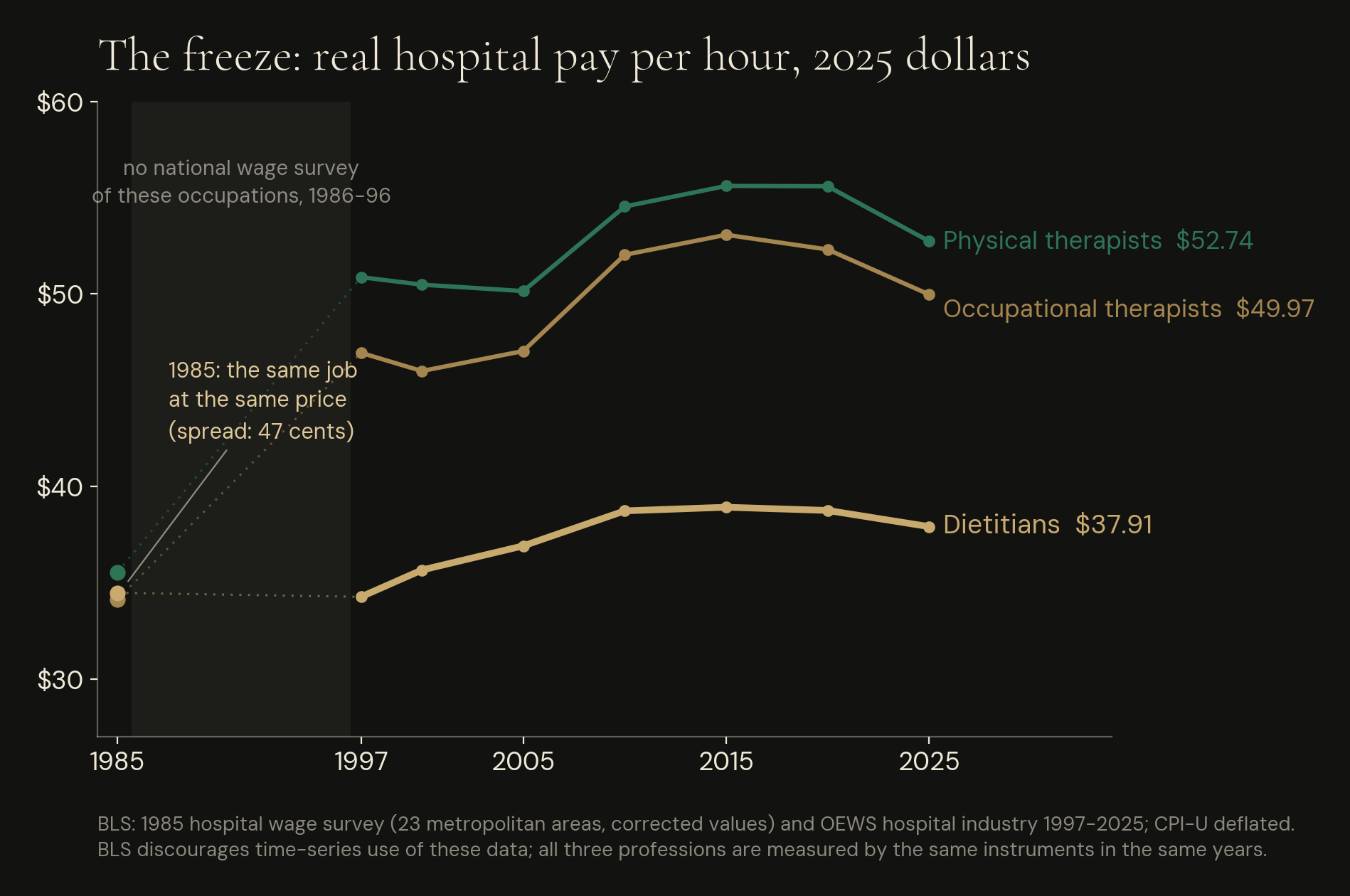
- In 1985, hospital dietitians and physical and occupational therapists earned within 47 cents an hour of each other. Since then, hospital dietitian pay has risen about 10 percent in total after inflation. From 2015 to 2025 the national average fell 2.8 percent after inflation.
- As of May 2025, the average dietitian salary was $77,130. A respiratory therapist, whose entry credential is an associate degree, earns about $10,000 more. Since 2024, new dietitians have needed a graduate degree to qualify for the registration exam.
- Medicare pays dietitians 85 percent of the physician rate, only for diabetes and kidney disease. Those terms are essentially unchanged since 2002.
- The spending figures are industry estimates, not federal data. A federal household survey puts spending on vitamins and supplements much lower, at about $18 billion in 2024 by my arithmetic.
Summary added 2 October 2026.
In October 1994, Congress passed the Dietary Supplement Health and Education Act, and wrote its justification directly into the statute. Among the findings, the law says, the estimated 600 dietary supplement manufacturers in the United States produce approximately 4,000 products, “with total annual sales of such products alone reaching at least $4,000,000,000.”
At least four billion dollars. Congress thought that number was impressive enough to legislate around.
Last year the supplement market, by the industry’s own flagship accounting of a broader product universe than the statute described, reached $74 billion — Nutrition Business Journal’s 2026 report puts 2025 sales at $74.15 billion, growing 7 percent a year, approaching $100 billion by 2029. Run the 1994 figure through the CPI and Congress’s four billion is about $8.7 billion in 2025 dollars. In real terms, American supplement spending has multiplied roughly eight and a half times over.
Over the same era, the real hospital wage of the profession trained and licensed to practice nutrition — the registered dietitian — went essentially nowhere. From 1997, when the modern federal wage series began, to 2025: up 10.7 percent. Across the full forty years since 1985: up about 10 percent. Not per year. Total.
By now, you probably already know where I stand. I am a registered dietitian. My paycheck sits inside this argument, and if this is your first piece of mine, you should read everything that follows knowing that. I also have a practitioner store on Fullscript, the supplement dispensing platform, and it would pay me a margin on supplements sold through it. As of 30 September 2026 the store has made no sales.
Two kinds of evidence, and I’ll label them
One honesty note up front, because it is the spine of this piece. The wage side of what follows is federal data: Bureau of Labor Statistics wage surveys, the same instrument measuring the same professions in the same years. The spending side is not. I went looking for a federal series on what Americans spend on nutrition advice and products — the Bureau of Economic Analysis publishes personal consumption by detailed type of product, and there is no line for vitamins, supplements, or nutrition. The Bureau of Labor Statistics household spending survey does have one, vitamins and supplements, at $134.37 per consumer unit (roughly, per household) in 2024, but it counts what households report buying, which is not the same thing as industry sales. The spending numbers below are the industry’s own market research, and I will treat them that way: not as measurements, but as the industry’s own testimony about itself.
Here is that testimony. The Global Wellness Institute values the US “wellness economy” at $2.1 trillion for 2024 — the largest in the world, growing 7.9 percent a year since 2019, $6,293 per American per year. That is the widest possible definition: eleven sectors, including wellness tourism, wellness real estate, and beauty. McKinsey’s narrower consumer-survey estimate says US consumers spend more than $500 billion a year on wellness (its 2025 report) across six dimensions — health, fitness, sleep, mindfulness, appearance, and nutrition — growing 4 to 5 percent annually. The two firms measure different universes and their numbers should never be blended. But notice what you do not need to resolve: pick either definition, pick the widest or the narrowest, and the direction is identical. The money is enormous and the growth has run ahead of the economy for a decade.
And the one corner of this market where a primary source exists — the supplement aisle, anchored by Congress’s own 1994 finding — is the corner we can measure hardest: at least $4 billion then, $74 billion now, eight and a half times over after inflation. In 1994, the statute noted, almost half of Americans regularly used supplements. The Council for Responsible Nutrition’s 2024 survey says three in four.
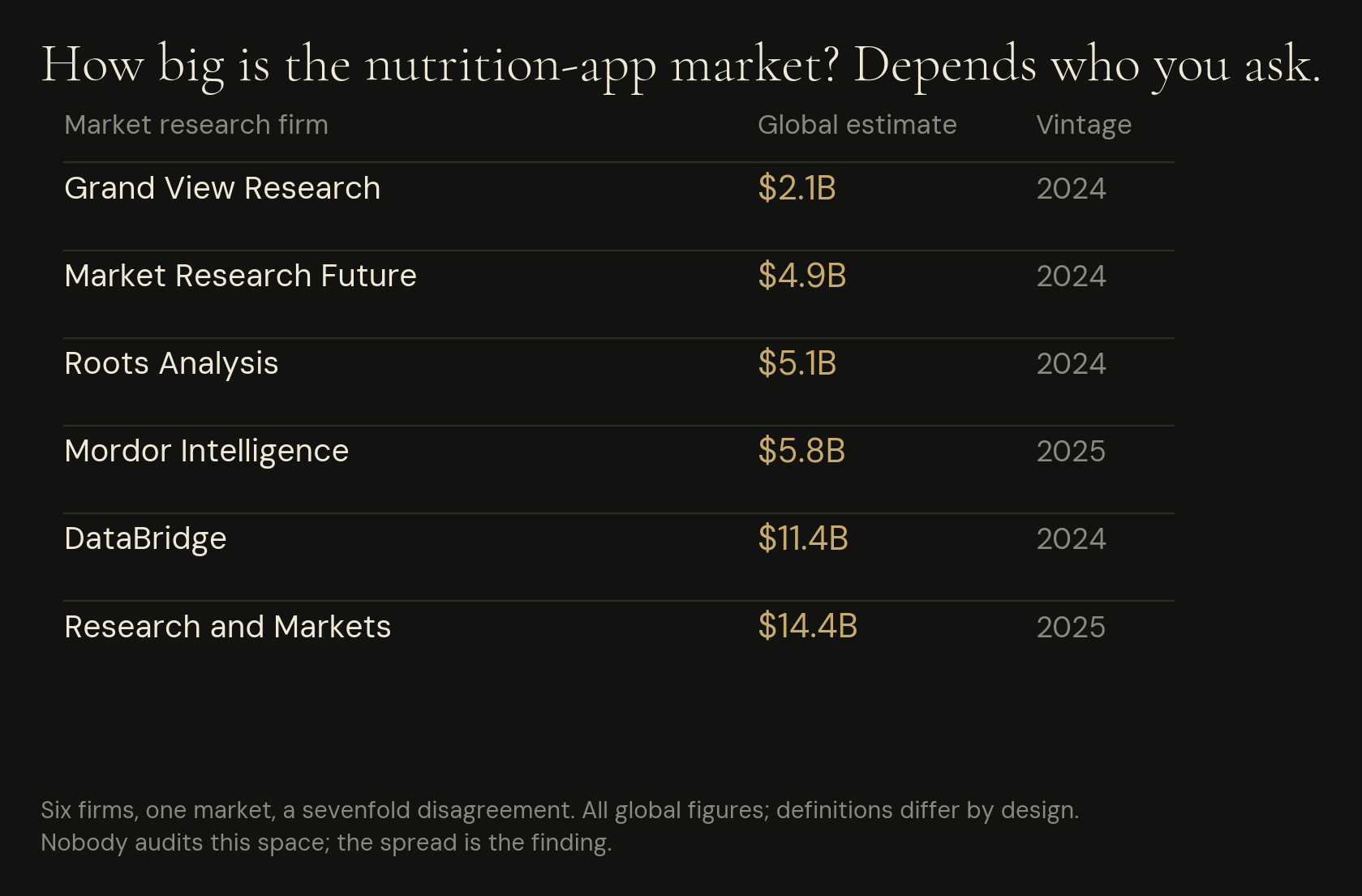
What about nutrition apps, the newest wing? Here the honest answer is a shrug that proves the point: depending on whose market research you buy, diet and nutrition apps are worth somewhere between $2 billion and $14 billion globally. A sevenfold disagreement about the size of a market is itself a fact about that market. Each of those figures is a firm’s own estimate.
The other line on the chart
Now the federal side, the side that can be re-derived by any stranger with a laptop.
In August 1985, the Bureau of Labor Statistics surveyed hospital pay across twenty-three metropolitan areas and found staff dietitians, occupational therapists, and physical therapists earning within 47 cents an hour of one another — the same job at the same price. By 1997 the therapists had pulled 37 to 48 percent ahead, and that gap has been frozen ever since. Across the full forty years, a hospital dietitian’s real pay rose about 10 percent — roughly a quarter of one percent a year. In the most recent decade it went backward: the profession’s national mean wage rose 32.0 percent from 2015 to 2025 while prices rose 35.8 percent, a real decline of 2.8 percent. As of May 2025, the mean dietitian salary in America is $77,130 — about $10,000 less than a respiratory therapist, a profession whose entry credential is an associate degree, while dietetics has required a graduate degree since 2024.
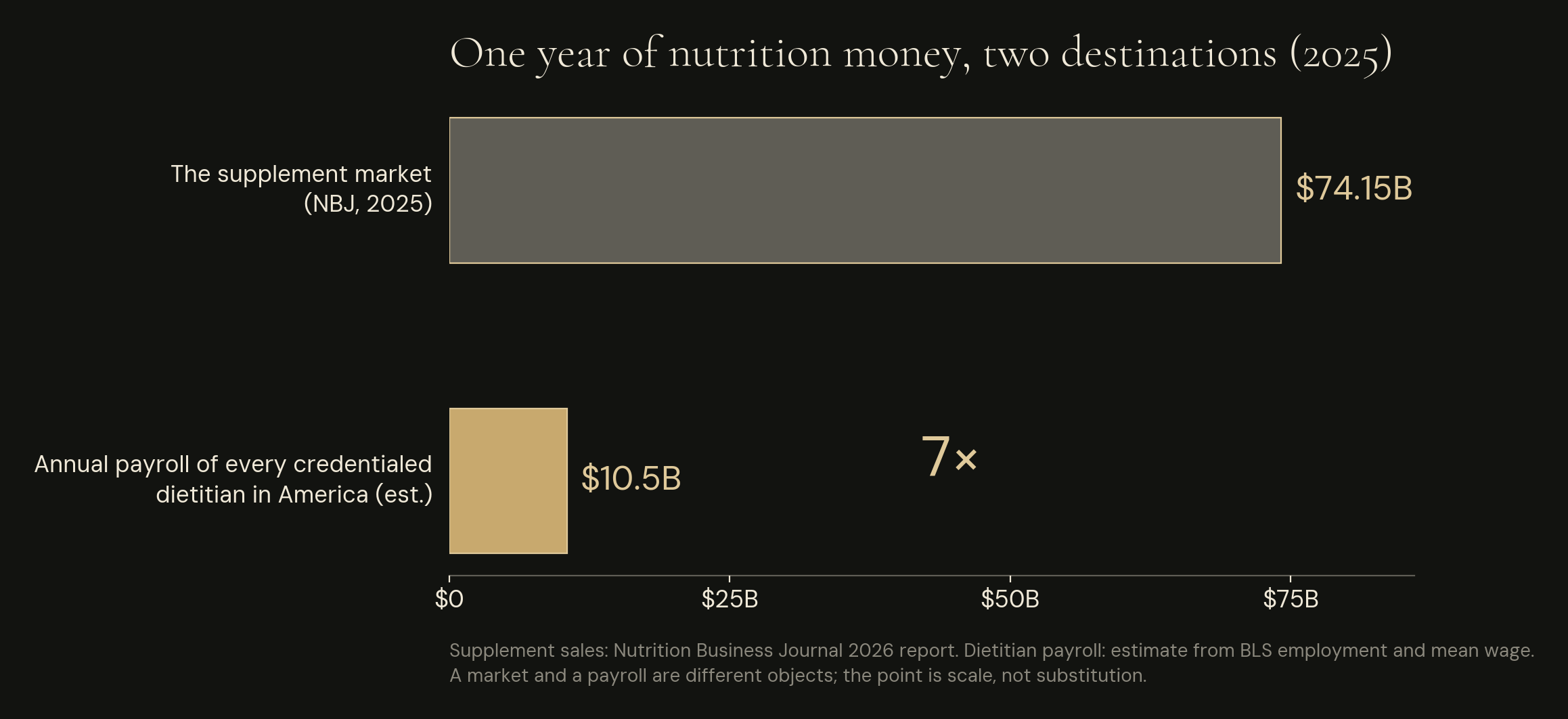
Put the two lines side by side. Total annual payroll for every credentialed dietitian in the United States is roughly $10.5 billion. The supplement market alone is seven times that. The gap between what Americans spend on nutrition and what America pays the people trained to practice it is not a gap. It is a canyon, and it has been widening for thirty years.
America never stopped paying for nutrition. It just never paid the people licensed to practice it.
The objections, because they are good ones
”You are comparing a market to a payroll.” Yes — deliberately, and never on one chart. I am not claiming supplement dollars should have flowed to dietitians, and I built no time series across those different measurements. The claim is narrower: demand for help with food and health did not stagnate. It exploded, by every measure anyone offers, including the industry’s own. Whatever froze dietitian pay, it was not an absence of American appetite for nutrition.
”Market growth is not wage money.” Correct, and this is the actual finding. The clinical profession’s prices are administered: Medicare pays a dietitian 85 percent of the physician fee schedule, for diabetes and kidney disease only, in capped hours, on a physician’s referral. The terms have been essentially unchanged since 2002. A market this hungry could not bid up the wage because the wage does not live in a market. It lives in a statute. The supplement aisle has no statute. That is the whole story of the two lines.
”Dietitians could just go where the money is.” Some do, carefully. But this misunderstands what the credential is. A registered dietitian practices under a code of ethics and an evidence standard: we recommend what the labs, the diagnosis, and the literature support, and we answer to a licensing board when we do not. The supplement economy runs on the opposite logic, products sold by the millions to people who have had no testing that says they need them. A supplement has a legitimate place when a deficiency or a diagnosis warrants it; that determination is precisely the step the aisle skips. So “go where the money is” is not a career move for a clinician. It is an invitation to leave the evidence standard at the door, and the market has made that invitation very well paid. The wellness market does not pay for rigor; it pays for reach. A 2024 study checked the accuracy of 510 nutrition posts from popular Australian Instagram accounts against Australia’s dietary guidelines and other reference sources. The posts went up between September 2020 and September 2021. Almost half, 44.7 percent, contained inaccuracies. Posts about supplements were the least accurate. Supplements send an estimated 23,000 Americans a year to emergency departments, a New England Journal of Medicine estimate built on federal surveillance data. The market that grew eight and a half times over is, by construction, the market with no gatekeeper — and a licensed clinician who enters it competes against people unbound by evidence, scope, or a board.
Why you should care, even if you have never met a dietitian
Because the routing of this money decides who answers your nutrition questions. A country that spends more than five hundred billion dollars a year on wellness and pays its clinical dietitians a mean wage at which the standard loan payment on their own required credential cannot be met has not chosen less nutrition advice. It has chosen advice from the aisle and the algorithm instead of from a clinician — and it pays for that choice in emergency visits, in confusion, and occasionally in harm.
So retire, permanently, the idea that Americans do not care about nutrition. Half a trillion dollars a year of caring says otherwise. And retire, with it, the idea that this caring is being met. The loudest voices in American nutrition right now are the ones no board can discipline, no license constrains, and no evidence standard binds: voices that can promise the outcome, sell the product, and collect the commission in a single post, and answer to no one when it fails. That is not public health. It is monetization wearing its costume, and the people it costs most are the ones with the least room for error.
The fix is not mysterious, and I have written about it at length elsewhere: the payment rules are where the freeze lives, and the payment rules are where it can end. A bill to modernize Medicare’s nutrition benefit, the Medical Nutrition Therapy Act, has sat in committee in both chambers since it was introduced (H.R. 6199 in November 2025, S. 3934 in February 2026), with no further action as of 2 October 2026. The money already exists. It went somewhere. It has been going somewhere, eight and a half times harder, for thirty years.
America does not have a nutrition apathy problem. It has a nutrition routing problem: a country that pays more than ever for nutrition advice while asking less than ever of the people giving it. You do not fix that by handing preventive medicine to whoever is loudest. You fix it by paying the people who are accountable when the advice is wrong, because they are the only ones who ever are.
The author is a registered dietitian nutritionist in clinical practice; this piece was prepared independently of his employer and represents only his views. Wage figures are Bureau of Labor Statistics data, with survey vintages in the text. Congress’s 1994 finding is primary statute text (Dietary Supplement Health and Education Act, Pub. L. 103-417, section 2(12)(C), 108 Stat. 4326). Market figures are industry market research and are labeled as such throughout (Global Wellness Institute, 2024 data; McKinsey Future of Wellness, 2025 edition; Nutrition Business Journal, 2026 report). The emergency-department estimate is peer-reviewed research (Geller et al., New England Journal of Medicine, 2015, built on 2004-2013 surveillance data), as is the Instagram audit (Denniss et al., International Journal of Behavioral Nutrition and Physical Activity, 2024, built on posts from September 2020 to September 2021).
Updated 1 October 2026: this note now describes the author’s day job in more general terms.
Correction, 2 October 2026. This piece said that no federal series exists on what Americans spend on nutrition products. That was wrong. A review of past posts caught it. The Bureau of Economic Analysis consumer spending tables have no line for vitamins or supplements, as the piece said. The Bureau of Labor Statistics Consumer Expenditure Surveys do. They put spending on vitamins and supplements at $134.37 per consumer unit in 2024. A consumer unit is roughly a household. Across the 135.8 million units the survey counts, that is about $18 billion by my arithmetic. The industry’s own figure, for its own definition of the market, is $74 billion. A household survey and industry sales do not measure the same thing. The growth figures here still rest on the industry’s own numbers, labeled as such. But the federal figure is much lower, so the size of the market is less certain than the piece made it sound. On the federal figure, household spending on vitamins and supplements is less than twice the dietitian payroll this piece gives, not seven times. That side of the argument is weaker. The argument about dietitian pay rests on federal wage data and is unchanged. Separately, the summary now gives the federal figure and says that the graduate degree rule applies to new dietitians, and a disclosure was added.
Later the same day, a check of the sources this piece cites found a second error. The piece said peer-reviewed audits put the accuracy of popular social media nutrition content between one in seven posts and one in three. Each study cited for that range was read in full. None reports that range. It came from my own research notes. Its two ends came from two other studies that measured different things, and the notes had attached the range to the wrong papers. One cited study did rate post accuracy. That 2024 audit of 510 posts from popular Australian Instagram accounts found inaccuracies in 44.7 percent of them and rated 55.3 percent completely accurate. So the piece made the problem sound worse than the evidence it cited shows. The point it supported still stands, on a smaller figure: in that study, almost half of the posts it could check contained an inaccuracy. The passage and its source line now give that study’s findings.
This article is general nutrition education, not individualized medical or nutrition advice, and it does not create a dietitian–client relationship. Medications and their side effects should be managed with your prescribing clinician. See the full disclaimer.