There is a sentence that appears twice in the public record, once in a federal code set and once in a letter to Medicare, and between the two appearances somebody changed one word.
The word is “medical.”
I want to spend this piece on that edit, and on the document it lives in, because after writing three parts about pressure on this profession I have finally found the thing I would put in front of a regulator. Not an inference. Not a trend. A petition, in the public record, asking the federal government to recognize a physician nutrition specialty, in which the description of what that specialty does was quietly broadened at exactly the point where it touches the one service registered dietitians are statutorily recognized to provide.
Everything below comes from two primary documents I retrieved and read in full during the writing of this piece: the National Uniform Claim Committee taxonomy code set, and the August 19, 2025 letter from the American Society for Nutrition to the Centers for Medicare and Medicaid Services. Both are public. Both are linked at the end. Where I am inferring rather than quoting, I say so.
One note before this starts, because it belongs to the same subject. In Part Three I priced medical nutrition therapy using a figure that turned out to be from 2002. A physician reading the piece checked it against his own locality and told me so, and he was right. I have corrected that piece and rebuilt its charts, and the corrected figures appear below.
The short version is that the gap I described is narrower than I said and the erosion underneath it is worse, which is the part I did not see until I went back through it. That is the whole argument for reading the primary document yourself, made at my own expense.
Two versions of one sentence
Start with the code set, because that is the neutral document. When the NUCC created five Physician Nutrition Specialist taxonomy codes, effective April 1, 2025, it published a definition for them. The NUCC attributes the source of that definition to the National Board of Physician Nutrition Specialists itself. It reads:
“A physician who specializes in the diagnosis and treatment of primary nutritional diseases (e.g., undernutrition, overnutrition, and genetic or acquired errors of metabolism) and adjunctive nutritional therapeutics (e.g., nutritional therapy or support of diseases states with a metabolic component). Physician Nutrition Specialists also provide services for nutritional disease prevention, including diabetes, cancer, Alzheimer’s, hospital malnutrition screening, and perioperative nutrition.”
Now the letter to CMS, four months later, reproducing what is recognizably the same sentence:
“Services that only a Physician Nutrition Specialist can provide include the diagnosis and treatment of primary nutritional diseases (e.g., undernutrition, overnutrition, and genetic or acquired errors of metabolism) and adjunctive nutritional therapeutics (e.g., medical nutrition therapy or support for disease states with a metabolic component). Physician Nutrition Specialists also provide services for chronic disease prevention, including diabetes, cancer, Alzheimer’s, and hospital malnutrition screening, and perioperative nutrition.”
Three changes, all in the same direction.
“Nutritional therapy” became “medical nutrition therapy.” A generic description of clinical activity became the proper name of a defined Medicare benefit, the one authorized under section 1861(s)(2)(V) of the Social Security Act and implemented at 42 CFR 410.130 through 410.134, which Medicare pays for only when a registered dietitian or qualifying nutrition professional provides it.
“Nutritional disease prevention” became “chronic disease prevention.” A narrow category became most of American medicine.
And a descriptive sentence became a claim of exclusivity. The code set says this is what these physicians do. The letter says these are “services that only a Physician Nutrition Specialist can provide.”
I have gone back and forth on how hard to lean on this, because it is possible to overread a drafting choice. So let me be careful about what I am and am not saying. I am not saying anyone acted in bad faith. Documents get edited, phrases get tightened, and advocacy letters are written to persuade. What I am saying is narrower and I think undeniable: in the version written for the public code set, the phrase was generic, and in the version written for the agency that controls the money, the phrase became the name of our benefit and the framing became exclusive. That is the edit. Whatever the intent, that is what the regulator received.
Why the letter has seven parts
The letter is not a manifesto. It is a form, and understanding that makes it far more revealing.
CMS specifies what a request for a new specialty code must address. The letter says so directly: the request is made in accordance with the Medicare Claims Processing Manual, Publication 100-04, Chapter 26, section 10.8, Requirements for Specialty Codes, which sets out seven considerations. The letter walks through all seven in order and answers each.
That structure is a gift to anyone trying to evaluate the case, because it tells you exactly what CMS thinks matters, and it lets you see what was offered against each requirement. So I read it that way, criterion by criterion. Three of the answers are worth your attention.
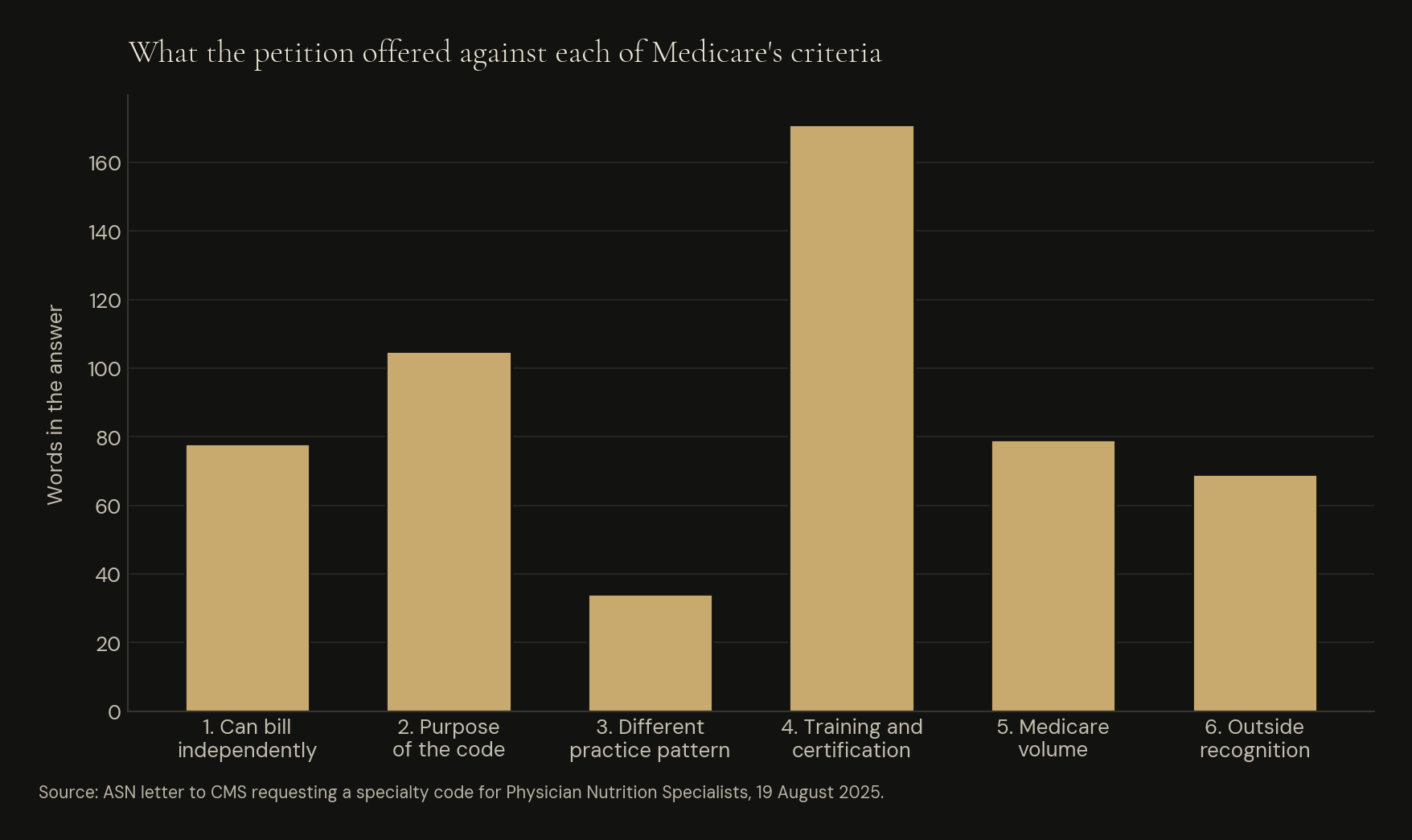
What the petition offered against each of Medicare’s seven criteria. The third consideration, which asks for evidence, received the shortest answer in the document.
Criterion two, where the edit lives
The second consideration asks for “the requester’s stated reason or purpose for the code.” This is where the sentence above appears, and it is where the letter is most explicit about what the credential is for.
It closes with this, which I am quoting exactly:
“The ability to bill for PNS services further distinguishes this credential as offering something more than the traditional internist.”
Read that slowly, because it settles a question I had been circling for two pieces. The distinguishing feature of the credential, according to the organization requesting recognition for it, is the ability to bill. Not a training standard, not an outcome, not a patient safety rationale. Billing is offered as what makes the credential worth more than being an internist.
I do not think that is a slip. It is responsive to the criterion, which asks for the purpose of the code. And it is honest. But it means nobody has to speculate about whether this is about reimbursement. The letter says it is.
Criterion four, where the tools are ours
The fourth consideration asks for “evidence of any specialized training and/or certification required,” and it received the longest answer in the document, about 171 words. Most of it describes the NBPNS examination, which appears to be a serious credential with real requirements, and I want to say plainly that I have no reason to doubt the rigor of that exam.
But look at how the letter establishes that these physicians are specialized. It says they “utilize specialized clinical tools such as the nutrition focused physical exam (NFPE), metabolic cart, body composition analyzer, nitrogen balance, metabolite and micronutrient levels.”
The nutrition focused physical exam is a dietitian’s instrument. It is a standardized technique for identifying muscle and fat wasting and micronutrient deficiency, it sits at the center of the malnutrition assessment framework that dietetics and nutrition support societies built, and it is taught in dietetics training as core practice. Nitrogen balance and body composition assessment are the same story. These are the everyday tools of clinical nutrition as dietitians practice it.
So the argument in criterion four, reduced to its structure, is that these physicians are distinguishable from other physicians because they do the things dietitians do. That may well be true. It is even a reasonable thing to claim. But it is worth noticing that the evidence of distinctiveness is drawn from another profession’s toolkit, and offered in support of a claim that these services are ones “only” this specialty can provide.
Criterion three, where the evidence was supposed to be
The third consideration is the one I would have expected to carry the most weight. It asks for “evidence that the practice pattern of the specialty is markedly different from that of the dominant parent specialty.” That is the question of whether this is genuinely a distinct kind of practice or a subset of internal medicine and family medicine with an interest.
It received thirty-one words. In full:
“Physician Nutrition Specialists are separate and distinct from all other medical specialists. Their expertise in both nutrition and medicine allows them to incorporate nutritional approaches into existing pharmaceutical and surgical treatments.”
That is the entire answer. It is the shortest response in the letter, it is under a fifth the length of the answer about training, and it contains no data, no utilization comparison, and no citation. A criterion that begins with the word “evidence” was answered with an assertion that the specialty is separate because it is distinct.
I want to be fair here, because a short answer is not automatically a bad one and CMS may well have other sources. But of the seven things the agency asked to be shown, the one that goes most directly to whether this specialty is real as a practice pattern is the one that received the least.
Criterion five, where the number should be
The fifth consideration asks “whether the specialty treats a significant volume of the Medicare population.”
The answer runs 79 words. It says nutritional medicine spans infancy to geriatrics, that 30 percent of hospitalized patients are malnourished, citing an Agency for Healthcare Research and Quality systematic review, and that one in two older adults is at risk of malnutrition, citing the Administration for Community Living. Then it concludes: “Physician Nutrition Specialists already treat a significant volume of the Medicare population.”
There is no number.
The criterion asks about the volume this specialty treats, and the answer supplies the prevalence of the underlying problem, which is a different quantity. How many Physician Nutrition Specialists exist, and how many Medicare beneficiaries they see, does not appear.
I went looking for that figure independently, in the letter, on the credentialing board’s site, on the sponsoring society’s materials, and in the industry-published explainers about the new codes. I could not find it anywhere. That is the single most important missing number in this entire story, because it is the difference between a paper credential and a workforce, and I cannot tell you which this is. Neither, apparently, could the petition.
Criterion six, and who counts as a nutrition society
The sixth consideration asks whether the specialty is recognized by another organization, and when CMS asks it, the agency names one: the American Board of Medical Specialties. The answer states that the credential “is recognized by all of the major nutrition professional societies,” and then lists eight: the American Association of Clinical Endocrinologists, the American College of Nutrition, the American Gastroenterological Association, the American Society for Nutrition, the American Society for Parenteral and Enteral Nutrition, the pediatric gastroenterology society, The Obesity Society, and the Society of Critical Care Medicine.
Every one is a physician or medical society. Not one dietetics organization appears on a list described as comprising all of the major nutrition professional societies.
And the organization CMS actually named is not on the list either. The American Board of Medical Specialties has twenty-four member boards. Nutrition is not one of them, the National Board of Physician Nutrition Specialists is not one of them, and the letter never says otherwise. It answers a question about board recognition with a list of professional societies, which is a different thing, and it does so without acknowledging that the specific body the question named is absent.
I am not going to turn that into an accusation, because I have come to think the more likely explanation is the one this whole series keeps running into: this was assembled through technical channels, among the organizations already in the room, and the people it most affects were not in that room and largely still do not know the room exists. But the sentence is worth reading twice, because the definition of “all the major nutrition professional societies” it implies is the assumption underneath everything else in the document.
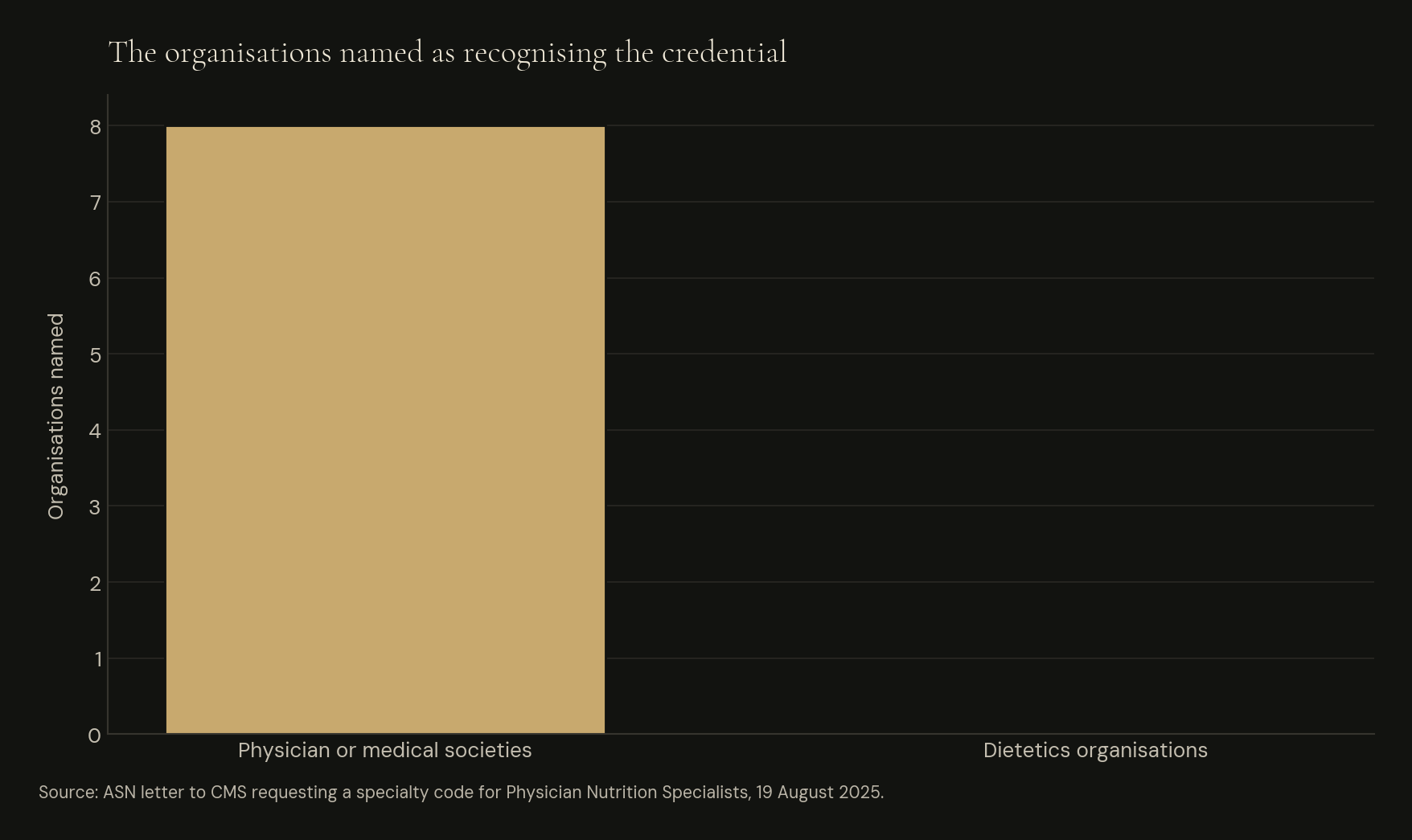
The eight organisations the petition names as recognising the credential. Every one is a physician or medical society.
What the code does, and what it does not
Since the last piece I have been asked a version of the same question several times, and it deserves a direct answer: if physicians could already bill for nutrition care, what does any of this change?
They could, and it does not change that. A physician does not bill 97802 or 97803. Those are the medical nutrition therapy codes, and Medicare pays them only to a registered dietitian or qualifying nutrition professional. A physician bills an evaluation and management office visit instead, and those codes carry no diagnosis restriction, no referral requirement, and no reduction for not being a physician. The credential does not grant billing rights that were missing.
Obesity is worth pausing on, because it is the condition people most often assume we are covered for. We are not. It is not a medical nutrition therapy diagnosis. Medicare covers obesity counselling under a separate benefit, intensive behavioural therapy, and that one has to be furnished by a primary care practitioner in a primary care setting, so a dietitian cannot bill it independently either. The profession whose entire training is dietary and behavioural counselling sits outside both doors.
Sit with the shape of that, because it is the argument in one line. A physician's billing authority is general. Ours is enumerated. A physician bills an office visit for anything a licence permits, with no list of conditions, no annual ceiling and no order from anybody. We can be paid for a named service, for named diagnoses, in named quantities, on another professional's referral. Those are not two versions of the same permission at different rates. They are two different kinds of permission.
Which is why our codes are the fence and not the key. 97802 and 97803 exist because dietitians had no general billing authority, and Congress had to write an exception into statute, at section 1861(s)(2)(V) of the Act, effective January 1, 2002, before Medicare would pay us for anything at all. A physician has no nutrition code because a physician was never excluded, and having no code means having no ceiling. So when the letter lists cancer and Alzheimer's and disease states with a metabolic component, it is not asking for those conditions. Nothing was ever stopping them. It is describing what a physician could already do, in language that reads as though it were being granted.
I do not want that to land as a complaint about the benefit itself. Before 2002 Medicare paid dietitians nothing, and the people who won medical nutrition therapy won something real and hard. The point is narrower and it is structural. An enumerated exception is a ceiling by construction. Ours still names three conditions, and the profession it describes now works in oncology, critical care, transplant, gastroenterology and metabolic surgery.
Every other route to payment has the same shape. Diabetes self-management training has to run through an accredited program, and in the agency's own words in this year's proposed rule, a dietitian may not be the sole practitioner of it. Incident-to billing pays the physician, at a hundred percent, and calls us auxiliary personnel. Intensive behavioural therapy for obesity has to be furnished by a primary care practitioner in a primary care setting. In a rural health clinic our work is bundled into the clinic's rate and generates no billable visit at all. Five different rules, one pattern. A dietitian's work becomes payable when a physician is standing next to it.
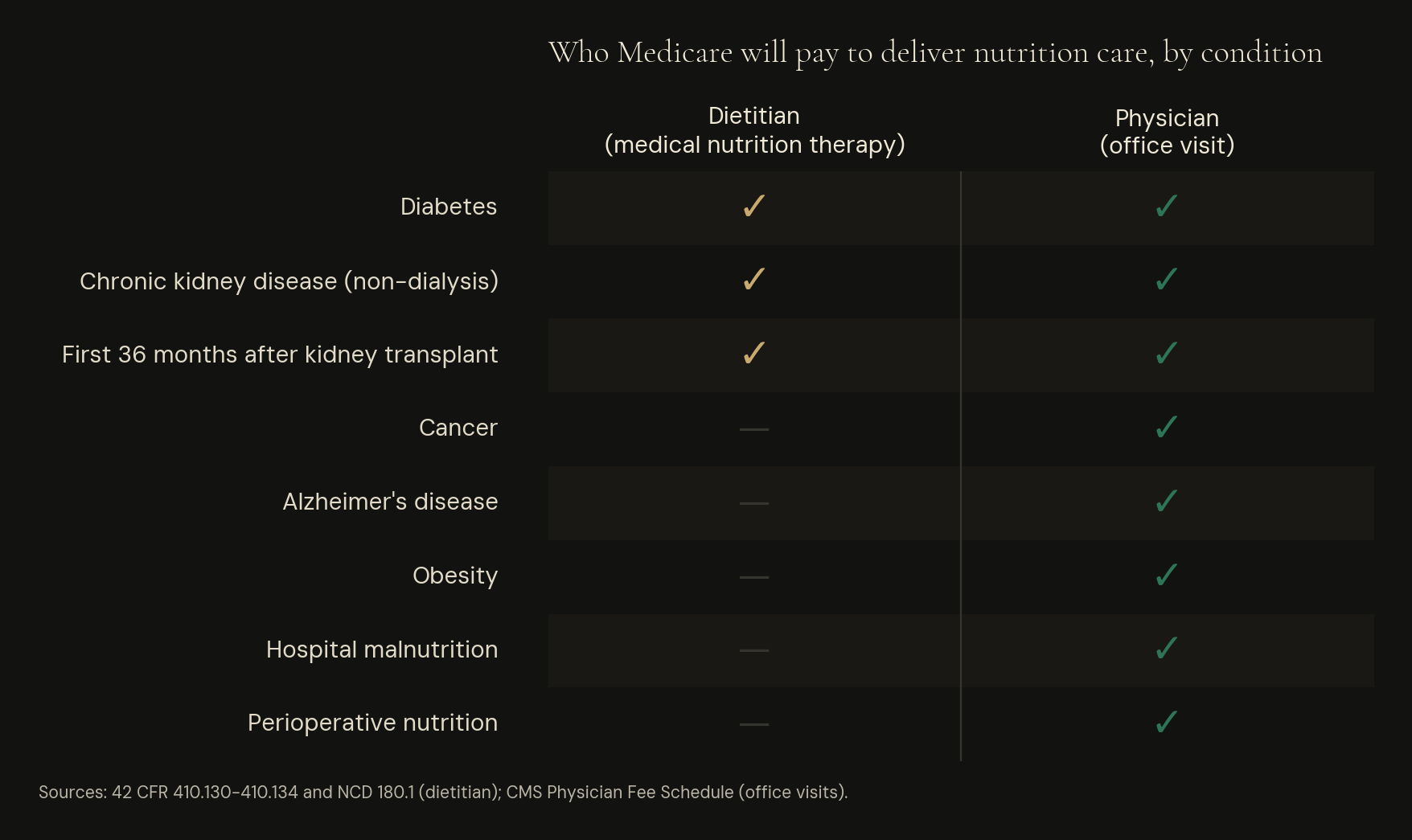
Who Medicare will pay to deliver nutrition care, by condition. The dietitian benefit reaches three situations. The office visit reaches all of them.
What it grants is administrative existence. Before 2025 there was no way for a physician to be identified as a nutrition specialist on a claim or in an enrollment record. Now there is a taxonomy code, and since this spring a CMS specialty code as well. That converts a diffuse activity into a countable category, and categories are what payment policy is written about. You cannot design a benefit, a bundle, a demonstration, or a carve out around a provider type the agency cannot identify. This is the step that has to come first.
CMS granted it on May 27, 2026. Transmittal 13765, Change Request 14466, issued against two manuals on the same day, the Medicare Claims Processing Manual and the Medicare Financial Management Manual. The code is F7, Physician Nutrition Specialist, and it now sits at the bottom of the physician specialty list directly beneath F6, Epileptologists. It takes effect October 1, 2026, contractors implement it October 5, and because enrollment applications may be filed up to sixty days ahead of the effective date, the window for a physician to file under it opened on August 2, 2026, which is to say it is already open.
The change request is more specific than the announcement was. Contractors have to recognize F7 as a valid primary or secondary specialty. They have to wire the five taxonomy codes into the Part B claims processing tables by number. They have to accept the specialty as a valid provider type for ordering, referring and certifying, for critical access hospital attending and rendering, and for hospice certification, and to add it to the home health physician parameter. And until the enrollment forms themselves are updated, contractors are instructed to accept applications that select Undefined Physician Type and write in Physician Nutrition Specialist by hand. Nowhere in the document does CMS verify that the applicant holds the credential. The specialty is self designated on the enrollment form, the way every physician specialty is.
Two things have to be said plainly about that, and the first one cuts against me. A specialty code sets no price. Nobody bills F7. It is a label identifying who submitted the claim, and the change request contains no rate, no new procedure code and no new covered service. Anyone who tells you physicians have just been paid for nutrition is overstating it, and the overstatement is exactly what will be used to wave the whole subject away.
The second is that we have had one of these since 2002. Specialty code 71, Registered Dietitian or Nutrition Professional. Twenty-four years of claims filed under it, and the service it identifies still pays $18.36 a unit, for three diagnoses, capped at three hours in the first year. So the code is not the prize. The code is the door, and what matters is who walks through it afterward and what they ask for once they are counted. We have been standing in that doorway since 2002 and have never converted it into a rate.
It is worth holding that grant next to the form. The consideration that asked for evidence of a markedly different practice pattern received thirty-one words and no data. The consideration that asked about recognition by another organization, and named the American Board of Medical Specialties when it asked, received a list of eight societies that does not include the American Board of Medical Specialties. Those were two of the seven things the agency said it wanted to see. The code was granted on May 27, 2026. CMS does not publish reasons with a transmittal, so I cannot tell you those answers were found sufficient and I cannot tell you they were not. I can tell you what was filed and what came back.
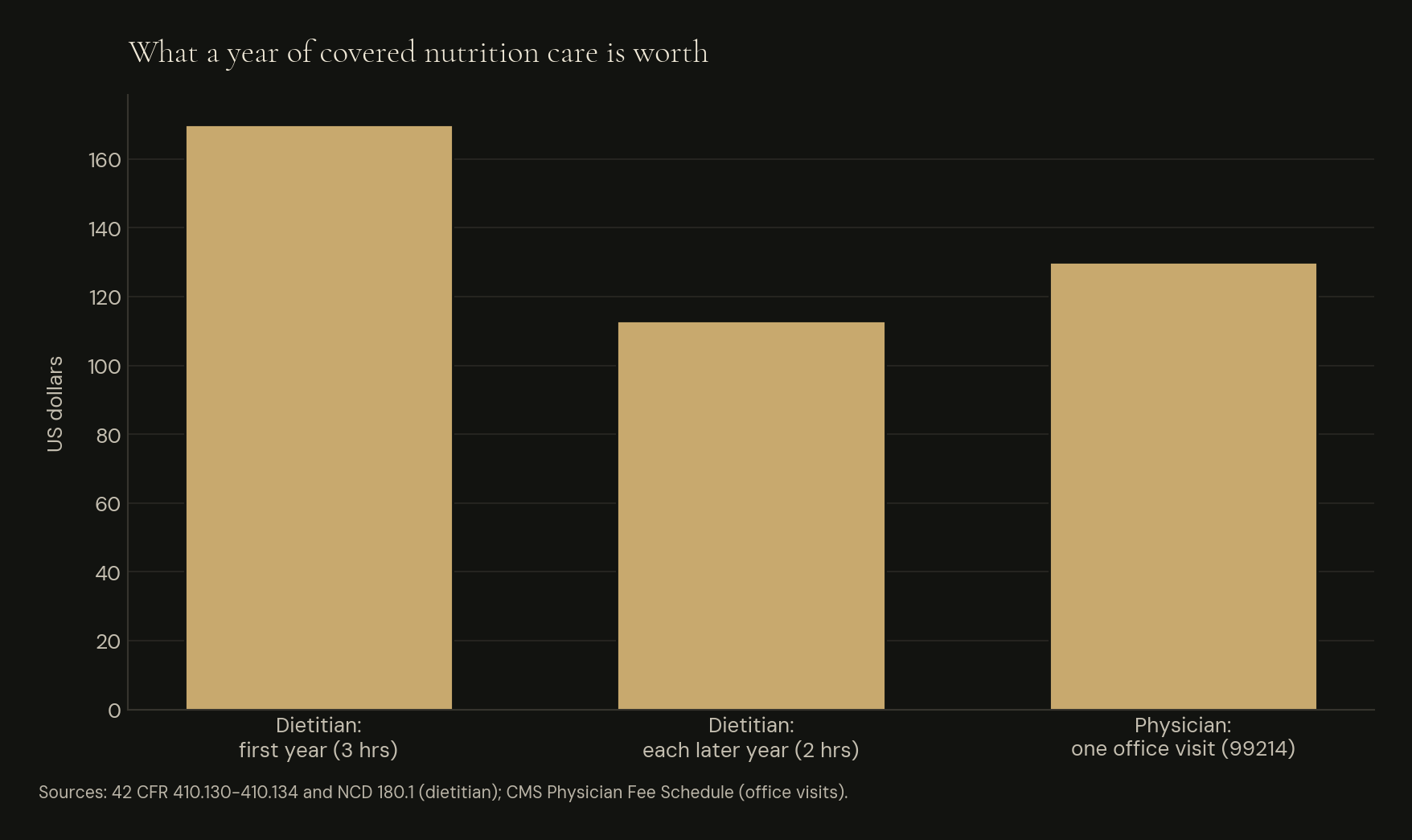
What a year of covered nutrition care is worth. An entire later year of a beneficiary’s dietitian coverage prices below a single mid-level physician office visit.
Which is why the scope language matters more than it would in an ordinary advocacy letter. The identity is being established at the same moment as the claim about what that identity encompasses, and the claim now names our benefit.
What I could not verify
More than I would like, and the gaps are load bearing.
I could not find how many physicians hold this credential, as described above.
I could not find any statement of reasons from CMS. The change request grants the code and says nothing about why, which is ordinary for a transmittal and unhelpful if you want to know which of the seven considerations the agency found persuasive, or whether anyone was asked to respond to the scope language before it was granted.
And I could not establish that the change from “nutritional therapy” to “medical nutrition therapy” was deliberate. I can show you both documents and the four months between them. I cannot show you intent, and I am not claiming to.
What happens next, and when
Here is the part that turns this from a story into a deadline.
CMS published the calendar year 2027 Medicare Physician Fee Schedule proposed rule, file code CMS-1848-P, in the Federal Register on July 16, 2026. The comment period closes on September 14, 2026. Anyone may file. Comments become part of the public record the agency is required to consider.
Here is the actual door, because I should not make you go looking for it. The docket is CMS-2026-2377 and the comment form is regulations.gov/commenton/CMS-2026-2377-0002. It asks for a name, an email and a text box, and it takes about as long as writing a short email. As of the morning this published, 1,851 comments had already been filed on this rule, which should tell you both that the process is real and that nobody needs permission to use it.
That is the venue where scope questions about who provides medical nutrition therapy under Medicare are properly raised, and it is open right now, for about six more weeks as I write this.
I am not going to tell you that one comment from one dietitian changes a payment rule. It does not. But the record is built out of what gets filed, and right now the only document in that record describing what a Physician Nutrition Specialist uniquely provides is the one that says it includes medical nutrition therapy. A record with nothing on the other side of it is not a debate. It is a submission.
The appendix that ships with this piece is a practical guide to filing a comment, including what the agency will and will not find useful, because a comment that reads as a turf complaint gets weighted accordingly and a comment that describes a specific operational consequence does not.
The second door in the same room
There is a part of this I did not see until I read the proposed rule itself, and it is the reason I think this comment period matters more than any single scope question.
The same rule that is open for comment right now contains a request for information about the coding and valuation system underneath all of it. CMS is asking whether building physician payment on the CPT code set produces contradictory incentives, and it has proposed creating its own codes in places rather than relying on the existing process. For an agency that has historically adopted most of what the American Medical Association’s Relative Value Scale Update Committee recommends, that is an unusual thing to put in writing.
One of those proposed codes is worth reading closely, because it does something to us directly, and it does not contain the word dietitian in its title. CMS proposes a code called GSMAS, for shared medical appointments: group visits of between two and ten patients, billed and led by a physician or qualified nonphysician practitioner, integrating group education, counselling and peer support with individual clinical assessment. The agency describes today's arrangement first. As things stand, it writes, if a dietitian assists with one of these sessions, the dietitian “may also bill for their portion of the SMA separately,” and it offers 97804, group medical nutrition therapy, as the example. Under the proposal that stops. Where a dietitian provides a service during the session, the rule says, “that service is considered part of the SMA and should not be billed separately, in addition to the physician or qualified nonphysician practitioner billing for the SMA.”
Read those two sentences next to each other. A service a dietitian bills today becomes a component of a physician's payment tomorrow. Not through a scope fight, not through any document that mentions nutrition specialists, and not anywhere a dietitian would think to look. It is a coding decision on two pages of a rule that runs to several hundred, at 91 FR 43903 through 43904. And the same rule proposes adding the new code to the Medicare telehealth list, which is where the platforms are.
The honest thing to say next is that the same rule does something good for us in a different section, and I would rather be the person who tells you that than the person who gets caught omitting it. CMS proposes to recognize medical nutrition therapy and diabetes self-management training as stand-alone billable visits in rural health clinics, paid at the clinic's all-inclusive rate, where today they are folded into a cost report and generate no visit. That is a real expansion of where our work is payable. It is in the same docket, under the same deadline, and it deserves support in a comment as plainly as the other proposal deserves objection. A comment period is not a side to pick. It is a record to build, and a record is more persuasive when the person building it can be seen reading the whole document.
Sit with what that means for us specifically. A follow-up unit of medical nutrition therapy, fifteen minutes of it, carries 0.66 relative value units in the hospital setting, and dietitians are then paid eighty-five percent of that schedule for not being physicians, and then a further two percent comes off for sequestration. The value has been revised since the codes were written in 2002, so I am not going to claim it was frozen. I am going to claim something worse. In 2002 that unit paid a dietitian $14.15. Today it pays $18.36, which sounds like a raise until you deflate it: in 2002 dollars it is $9.86, against the $14.15 that was actually paid then. Cumulative inflation over those twenty-four years was eighty-six percent. The payment grew thirty. That is a thirty percent real cut, administered through a valuation process the profession does not sit at the center of, and the agency is now asking, in an open docket, whether that whole arrangement should work differently.
There is a detail here that I think is the most useful thing in this entire series, and almost nobody talks about it.
That committee is not purely physicians. It has a Health Care Professionals Advisory Committee, and thirteen organizations hold seats on it: audiologists, chiropractors, marriage and family therapists, advanced practice registered nurses, occupational therapists, optometrists, physical therapists, physician assistants, podiatrists, psychologists, social workers, speech pathologists, and registered dietitians.
Thirteen professions. Every one of them is paid a reduced percentage of a physician fee schedule. Every one of them has watched its codes valued by a process it sits at the edge of. Every one of them could describe, from its own practice, what that does to access. They are, on paper, already a coalition. They have essentially never behaved like one.
I keep coming back to something I have said in the earlier parts of this series: awareness inside your own profession changes nothing. Dietitians telling dietitians about this produces agreement and no movement. What moves an agency is a record, and what makes a record persuasive is independent voices arriving at the same operational conclusion from different practices.
A joint filing from several of those thirteen, describing the same structural problem from thirteen different clinical vantage points, would be the strongest comment any of them could file. It would also be the first time that group acted as what it already technically is. I have no authority to convene anything. But the door is open until September 14, and it is the same door.
What I tell colleagues
Three things.
First, read the letter. It is nine pages, it is public, and it is not written in code. You will form your own view, and your view will be better than mine because you will bring your own practice setting to it. I have linked it below.
Second, the sentence to remember is not the one about medical nutrition therapy. It is “the ability to bill for PNS services further distinguishes this credential.” When a document tells you plainly what it is for, believe it, and stop arguing about whether the concern is overblown.
Third, if you have ever had a referral for medical nutrition therapy denied, delayed, or never written, or watched a patient run out of covered hours in March, that experience is data and the comment period is where it counts as data. The gap between what the benefit covers on paper and what reaches a patient is exactly the kind of operational detail an agency can act on, and it is the thing none of the eight organizations on that recognition list are positioned to describe.
This is general education about a public regulatory process and a reading of public documents. It is not legal advice, it is not individual medical advice, and nothing here is a claim that any physician or organization has broken a rule.
If you file something, I would like to know. Reply in the comments or write to me directly, and if enough people do it I will write about what got filed.
References
American Society for Nutrition. Letter to Lindsey Baldwin, Director, Division of Practitioner Services, Center for Medicare Management, CMS: CMS Specialty Code Request for Physician Nutrition Specialists. August 19, 2025. https://nutrition.org/wp-content/uploads/2025/10/ASN-Letter-to-CMS-to-Request-Speciality-Code-for-Physician-Nutrition-Specialists.pdf
National Uniform Claim Committee. Health Care Provider Taxonomy Code Set, version 25.0. Codes 207LP4000X, 207QP0002X, 207RP1002X, 2080P1004X, 2086P0122X. Effective April 1, 2025. https://nucc.org/index.php/code-sets-mainmenu-41/provider-taxonomy-mainmenu-40
National Board of Physician Nutrition Specialists. https://nbpns.org/
Centers for Medicare and Medicaid Services. Medicare and Medicaid Programs; CY 2027 Payment Policies Under the Physician Fee Schedule, CMS-1848-P. Federal Register, July 16, 2026. Comments close September 14, 2026. https://www.federalregister.gov/documents/2026/07/16/2026-14327/medicare-and-medicaid-programs-cy-2027-payment-policies-under-the-physician-fee-schedule-and-other
Regulations.gov. Docket CMS-2026-2377, document CMS-2026-2377-0002, comment form: https://www.regulations.gov/commenton/CMS-2026-2377-0002. Comments close September 14, 2026.
Centers for Medicare and Medicaid Services. CMS-1848-P. https://www.cms.gov/medicare/payment/fee-schedules/physician/federal-regulation-notices/cms-1848-p
Shared medical appointments and proposed HCPCS code GSMAS, including the treatment of CPT 97804 furnished during a session: CMS-1848-P, 91 FR 43903–43904.
Medical nutrition therapy and diabetes self-management training as stand-alone billable visits in rural health clinics, and the proposed amendment to 42 CFR 405.2463: CMS-1848-P, section III.B.2, 91 FR 43958.
American Board of Medical Specialties. Member Boards. https://www.abms.org/member-boards/
Centers for Medicare and Medicaid Services. Calendar Year (CY) 2027 Medicare Physician Fee Schedule Proposed Rule, fact sheet (includes the request for information on the CPT code set and payment valuation). https://www.cms.gov/newsroom/fact-sheets/calendar-year-cy-2027-medicare-physician-fee-schedule-proposed-rule
American Medical Association. RUC Health Care Professionals Advisory Committee (HCPAC) Review Board. https://www.ama-assn.org/about/rvs-update-committee-ruc/ruc-health-care-professionals-advisory-committee-hcpac-review-board
42 CFR 410.130, Definitions. https://www.govinfo.gov/app/details/CFR-2024-title42-vol2/CFR-2024-title42-vol2-sec410-130
42 CFR 410.132, Medical nutrition therapy. https://www.govinfo.gov/app/details/CFR-2024-title42-vol2/CFR-2024-title42-vol2-sec410-132
42 CFR 410.134, Provider qualifications. https://www.govinfo.gov/app/details/CFR-2024-title42-vol2/CFR-2024-title42-vol2-sec410-134
Uhl S, Siddique SM, McKeever L, et al. Malnutrition in Hospitalized Adults: A Systematic Review. Comparative Effectiveness Review No. 249. Agency for Healthcare Research and Quality, October 2021. https://doi.org/10.23970/AHRQEPCCER249
Fee J. The Third Front: Physicians Just Got a Medicare Nutrition Billing Code. Vitae Arete, July 2026. /insights/medicare-physician-nutrition-code.html
The four figures for this piece, with the underlying numbers shown as data tables: https://vitaearete.com/figures/pns-petition.html
The PDF appendix, with the same figures, a methods note, and a practical guide to filing a comment before the September 14 deadline: https://vitaearete.com/downloads/pns-petition-appendix.pdf
Centers for Medicare and Medicaid Services. CMS Manual System, Transmittal 13765, Change Request 14466, “New Physician Specialty Code for Physician Nutrition Specialist (F7),” issued May 27, 2026. Pub. 100-04 Medicare Claims Processing Manual, chapter 26, section 10.8.2, and Pub. 100-06 Medicare Financial Management Manual, chapter 6, sections 400.4 and 420. Effective October 1, 2026; implementation October 5, 2026. https://www.cms.gov/files/document/r13765cp.pdf