I started assembling this analysis in the spring, before I opened my own practice in May, because what I was finding became part of the reason I opened it. Then the workforce research took over my desk. The compensation and pipeline work that became my Health Affairs piece, and the studies now moving through peer review, pushed this file to the back burner, where it has been growing quietly for months: pay reports, funding rounds, plan documents, coverage policies.
Last week a colleague asked me the question that made me finally finish writing it up. Dietitians on social media are worried about the flood of insurance claims coming out of the telehealth nutrition boom, and about what insurance companies will do when they decide they have had enough. Is it real? What does it mean for the profession, and for patients?
It is a personal story as well as a reported one. When I built my practice, I chose not to join any of the platforms I am about to describe, and this piece explains why. Take my perspective with that disclosure attached: I run an independent practice, and independent practice competes with these companies. Every factual claim below is cited so you can weigh it yourself. That is the standard here, whatever the topic.
The gold rush
Start with the money, because the money explains everything downstream.
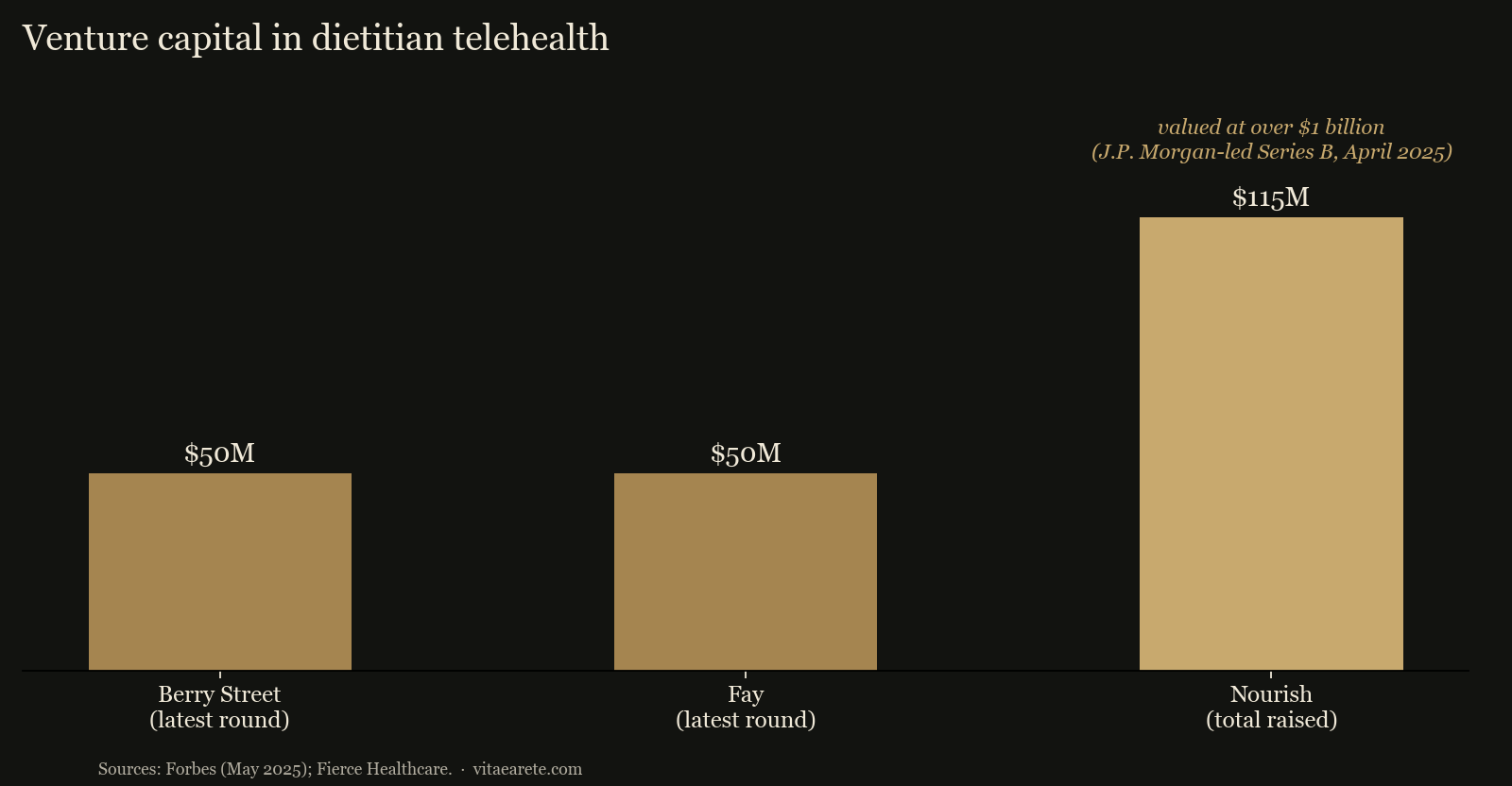
In April 2025, the nutrition telehealth company Nourish raised a 70 million dollar Series B led by J.P. Morgan's growth equity arm, bringing its total funding to 115 million dollars at a valuation above one billion dollars. Its competitors Fay and Berry Street have each banked 50 million dollar rounds of their own. Between them, these companies now route thousands of registered dietitians to patients across all fifty states.
Understand what the pitch to those investors is, because it is not complicated. Under the Affordable Care Act, most insurance plans must cover preventive services, and nutrition counseling frequently qualifies. Roughly 70 percent of ACA-compliant plans cover some form of nutrition counseling, in many cases with no visit limit and no copay. Nourish itself advertises that about 95 percent of its patients pay nothing out of pocket. The platform connects the patient to a dietitian, bills the insurer for every session, pays the dietitian a per-visit rate, and keeps the difference. The spread between what insurance pays and what the clinician costs is the product. A billion-dollar valuation is that spread, capitalized.
Venture capital did not fall in love with nutrition. It fell in love with a reimbursable benefit and a workforce in no position to negotiate.
What the clinician actually gets
That last clause matters, so let me show you the numbers. The Dietitian Success Center has been collecting first-person compensation reports from dietitians working on these platforms. Here is what the people delivering the care report being paid.
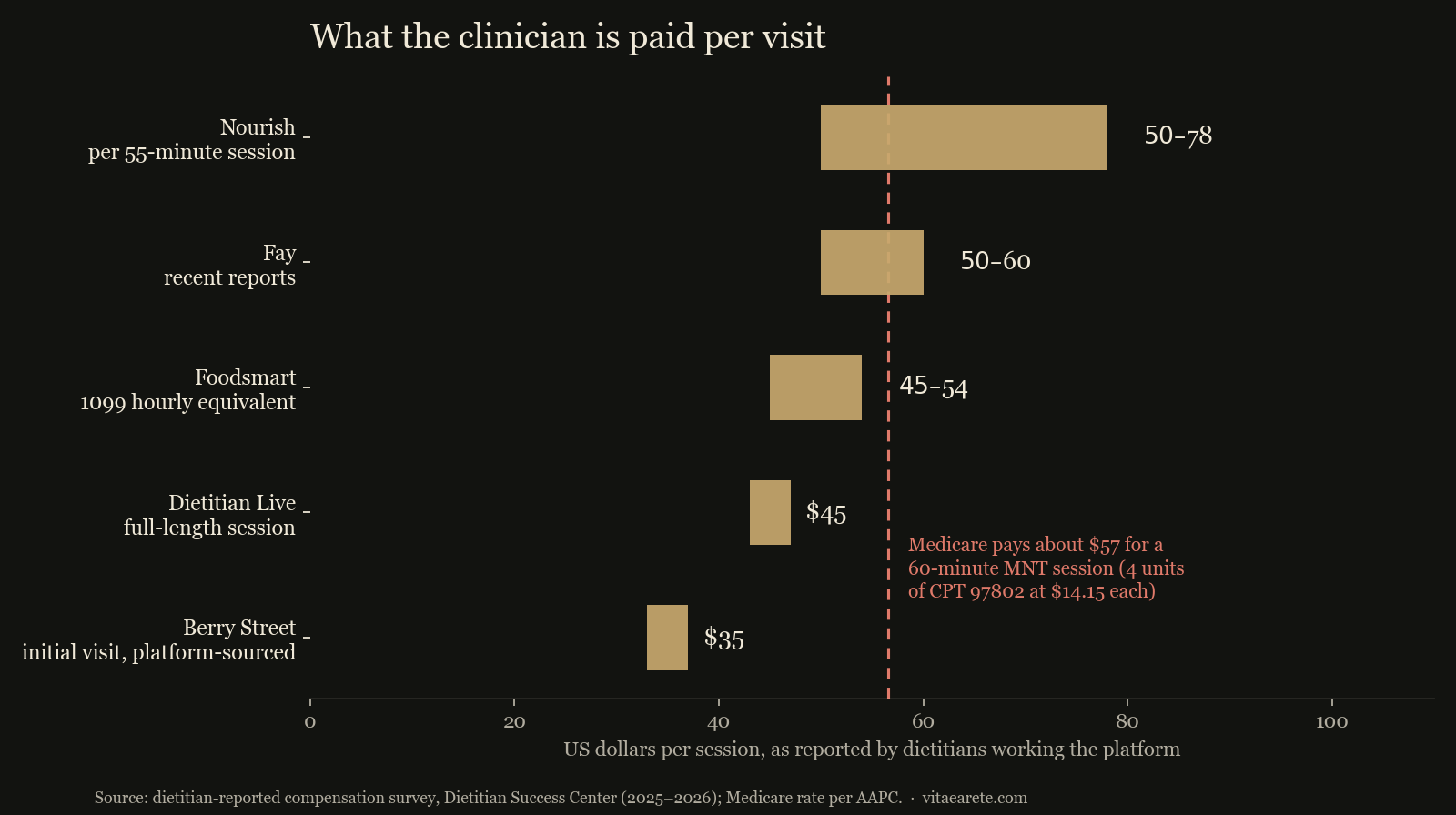
Berry Street contractors report 35 dollars for an initial visit when the platform sources the client, down from roughly 50 when many of them signed. Nourish dietitians, who are W-2 employees, report 50 to 78 dollars per 55-minute session. Fay contractors report recent rates of 50 to 60 dollars, with some initial visits reportedly done unpaid, to "boost" a new dietitian's profile, and rates that were not disclosed until after the session was complete. Foodsmart contractors are paid 12 dollars per 15-minute billable unit. One platform, Dietitian Live, sets an explicit production quota: 28 completed sessions or 35 clinical hours per week, with turnover that respondents put at 60 to 70 percent a year.
Almost none of them are paid for charting. Documentation, the legally required clinical record of every visit, is done on the dietitian's own time. For Medicaid visits, dietitians report that unpaid documentation can approach a second unpaid hour per session.
For scale: Medicare, the payer every clinician complains about, reimburses medical nutrition therapy at about 14 dollars per 15-minute unit, which is roughly 57 dollars for an hour. Several of these platforms pay their clinicians less per hour than the federal government's famously conservative rate, while billing commercial insurers whose contracted rates are typically higher than Medicare's. The difference between those two numbers is what J.P. Morgan bought.
The cadence machine
Here is the part that connects clinician exploitation to the insurance question, and it is the part I most want patients to understand.
A platform that earns money per completed session, billing against benefits that renew week after week, does not need a memo instructing anyone to over-schedule. The incentive writes the schedule by itself. When the benefit is marketed as unlimited and free, when the dietitian only eats what she kills, and when the company's growth chart is denominated in completed visits, the natural resting state of the system is the weekly follow-up, for everyone, indefinitely, whether or not the patient's condition calls for it.
Let me be precise about what I am claiming. Weekly follow-up is sometimes exactly right; I use it myself for patients in active treatment phases. The problem is not any single schedule. The problem is who sets it. In this model, visit cadence is a revenue parameter tuned by a growth team, not a clinical judgment made by the person who examined you. Some platform quotas make the logic explicit: hit 28 sessions this week or your standing suffers. Care plans built under that constraint are built for the constraint.
The payer's countermove
My colleague's question was whether insurers are starting to push back. The honest answer is that the pushback was always coming, and you can already read it in the plan documents.
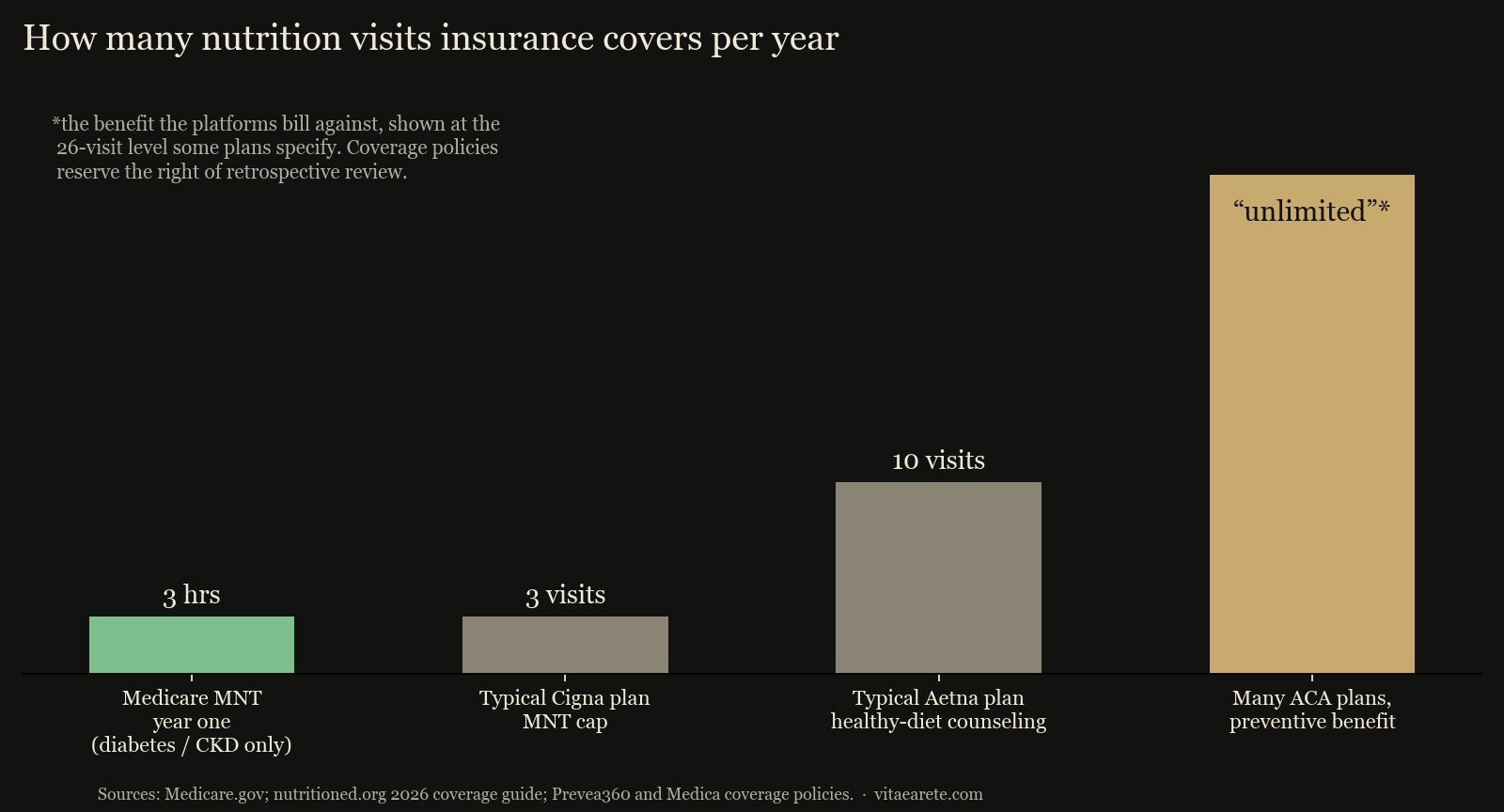
Medicare covers MNT for exactly two diagnoses, diabetes and chronic kidney disease, at three hours in year one and two hours a year after that. Cigna plans commonly cap MNT at three visits a year. Aetna plans commonly allow about ten. The generous, sometimes unlimited coverage lives in the ACA preventive benefit, and that is precisely the benefit the platform model bills against. Commercial coverage policies, like Medica's and Prevea360's, already reserve the right to review claims retrospectively against coverage criteria, and prior authorization requirements for visits beyond an initial allotment are spreading through plan documents.
What follows is my read of the trajectory, clearly labeled as such: insurers are actuarial organisms. When a benefit's utilization curve bends upward fast enough to notice, they respond the way they always respond, with visit caps, prior authorization, documentation audits, and narrower definitions of medical necessity. They will not distinguish between the platform-generated weekly visit and the clinically necessary one, because claims data does not carry intent. The benefit tightens for everyone: the solo practitioner who never over-billed a session in her life, the hospital outpatient clinic, and the patient whose coverage quietly acquires a prior-auth wall.
The timing could hardly be worse. The Medical Nutrition Therapy Act, pending in this Congress, asks Medicare to expand MNT coverage from two conditions to roughly a dozen. The evidence case for that expansion is strong; medically tailored nutrition interventions have shown 16 percent lower monthly medical costs and 49 percent fewer inpatient admissions in published research. Every unnecessary claim the arbitrage machine generates hands the opponents of that expansion a fresh exhibit. We are asking Congress to widen the benefit at the exact moment a venture-funded business model is demonstrating how a wide benefit gets strip-mined.
The pipeline connection
You might reasonably ask why thousands of credentialed clinicians accept 35-dollar sessions and unpaid documentation. I published the answer in Health Affairs this month, and it is not a mystery. It is arithmetic.
The dietetics credential now requires a master's degree, and as of July 1, federal law caps graduate borrowing at 100,000 dollars for our field while excluding dietetics from the professional-degree list that gets 200,000. The realistic cost of the credential runs around 161,000 dollars. The gap lands in private loans at 9 to 11 percent. The national mean wage waiting on the other side is 77,130 dollars, against comparably credentialed allied health peers averaging around 116,700 dollars. Enrollment has already fallen 42 percent since 2014, and in 2024, unfilled internship positions outnumbered filled ones for the first time on record.
A new graduate carrying that loan at that interest rate does not have the luxury of turning down flexible, credentialed work she can do from her apartment, at whatever per-session rate is on offer, with whatever quota attached. The platforms did not create the desperation. They price against it. A workforce squeezed at the training pipe by loan policy arrives at the practice market with no leverage, and the market behaves accordingly: rates that drop after signing, opaque payout tables, unpaid initial visits framed as marketing. Each of those is a symptom of the same underlying fact. The clinician has nowhere else to go, and everyone involved knows it.
What it does to the profession, and to you
Pull the threads together and the picture is coherent. The platform owns the patient relationship; the dietitian is an interchangeable input behind a matching algorithm. The platform owns the brand; a decade of your clinician's expertise becomes a profile card. The platform increasingly owns the documentation layer too, with AI note-taking systems trained on clinicians' work. High turnover is not a bug in this design. A clinician who leaves takes nothing with her, and a fresh graduate is always arriving to take the seat, because the debt clock is always running.
For patients, the costs are quieter but real. Continuity of care suffers when your dietitian's economics push her out the door within a year or two. Session length and follow-up cadence get set by billing logic rather than by your chart. And the insurance benefit you currently enjoy, the one that makes nutrition care free or nearly free, is being consumed at a rate that invites exactly the payer response that will someday put a wall between you and it.
To be fair to the other side of the ledger: these platforms have put medical nutrition therapy in front of hundreds of thousands of people who would never have found a dietitian otherwise, in a country where most people have never met one. Access is not nothing. It is the genuine good that makes the rest of the machine defensible in a pitch deck. My argument is not that telehealth nutrition should not exist. It is that a care model whose economics are set by the spread will always, eventually, spend its clinicians and its benefit to feed the spread.
Why I built it differently
This is the part where I tell you my bias plainly. I opened Vitae Arete because I wanted three decisions to belong to the clinical relationship and nowhere else: how long a visit lasts, how often we meet, and what we work on. In my practice a first conversation runs as long as it needs to. Follow-up cadence is a clinical decision we make together, and it changes as your situation changes. Nobody above me has a dashboard that turns red when I schedule you monthly instead of weekly.
I do not say that to claim virtue. I say it because the structure is the product. Whoever controls the schedule controls the care, and you deserve to know who is holding the pen.
If you are a dietitian reading this
Before you sign a platform contract, get three answers in writing. First, the exact per-session rate for every payer, including no-shows and late cancellations, and whether charting time is compensated. Second, what mechanism allows your rate to change after you have built a caseload, because the reported pattern is that it changes downward. Third, who owns the patient relationship if you leave. If any answer is vague, the vagueness is the answer.
If you are a patient reading this
Three questions for you as well. Ask your dietitian, wherever you see one, how your visit frequency was decided, and listen for whether the answer is about you. Ask whether they will still be there in six months, because continuity is where nutrition care compounds. And if your visits feel like a subscription rather than a treatment plan that evolves, trust that instinct. Good care has a direction. A billing schedule only has a rhythm.
The claims flood is real. The crackdown, when it arrives in force, will not land on the companies that caused it. They are diversified, and their investors will rotate to the next reimbursable code. It will land on the dietitian whose rate gets cut a second time, and on you, when the benefit you did not know you were spending gets a cap and a prior-auth form. The people with the least leverage in this story are, as usual, the ones holding the bill.
Jason Fee, MS, RDN, LDN is a clinical dietitian and the founder of Vitae Arete, an independent nutrition practice. This piece was prepared independently and represents his own views. His related analysis of the dietetics workforce, "The Slow Collapse of the U.S.'s Clinical Nutrition Workforce," was published in Health Affairs Forefront in July 2026.
Sources
Forbes: Nourish secures 70 million dollars, valuation above 1 billion (May 2025)
Fierce Healthcare: Nourish Series B and Fay and Berry Street each bank 50 million
Nourish Series B announcement (95 percent of patients pay 0 dollars)
Dietitian Success Center: dietitian-reported pay and working conditions across platforms
AAPC: MNT reimbursement, 0.46 RVU / approximately 14 dollars per 15-minute unit — superseded: that value derives from a 2002 conversion factor. At 2026 facility rates the unit pays the dietitian about $22 initial / $18 follow-up after the 85% reduction. See the dated correction.
NutritionEd 2026 insurance coverage guide (ACA preventive coverage, Cigna and Aetna visit limits)
Medica coverage policy (retrospective review) and Prevea360 coverage policy