Summary
This piece looks at the evidence for three mushroom supplements in cancer: turkey tail, reishi and maitake. One turkey tail extract, called PSK, has better evidence than anything else this series covers. But PSK is a regulated drug in Japan, made to a set standard. The capsule on a store shelf is a different product.
- A 2006 analysis pooled three trials with 1,094 patients whose colorectal cancer had been removed by surgery. Adding PSK to chemotherapy improved survival, and the result was statistically clear. Two studies outside Japan point the same way. They do not repeat that result.
- A 2012 trial of turkey tail from a United States supplement maker was built to find a dose people could tolerate. Nine women finished it. It did not test whether the product helped.
- Two label studies of other mushrooms found most products did not match their labels. When I searched in August 2026, I found no published label test of turkey tail.
- A 2012 review of five small, poorly reported reishi trials could not tell a real effect on tumors from no effect. Maitake has less human evidence still.
- All the treatment evidence is for mushrooms added to standard cancer care, never used in place of it. Tell your oncology team, and be wary of blends. This is education, not medical advice.
When I started this series I said that at least one of these supplements would get a more generous hearing than most readers expect, and that I wanted to say so early rather than have you assume the conclusions were written before the reading.
This is that one. Sort of.
The evidence behind one specific mushroom preparation is better than anything else I am going to cover here — meta-analyses, thousands of patients, real survival numbers. And the twist is that it is almost certainly not evidence for the product you can buy.
Both halves of that matter, so let me do them in order.
What turkey tail actually is
Trametes versicolor, formerly Coriolus versicolor, is a bracket fungus that grows on dead hardwood in most of the temperate world. You have walked past it. The banded, fan-shaped shelves on a fallen log — that is it.
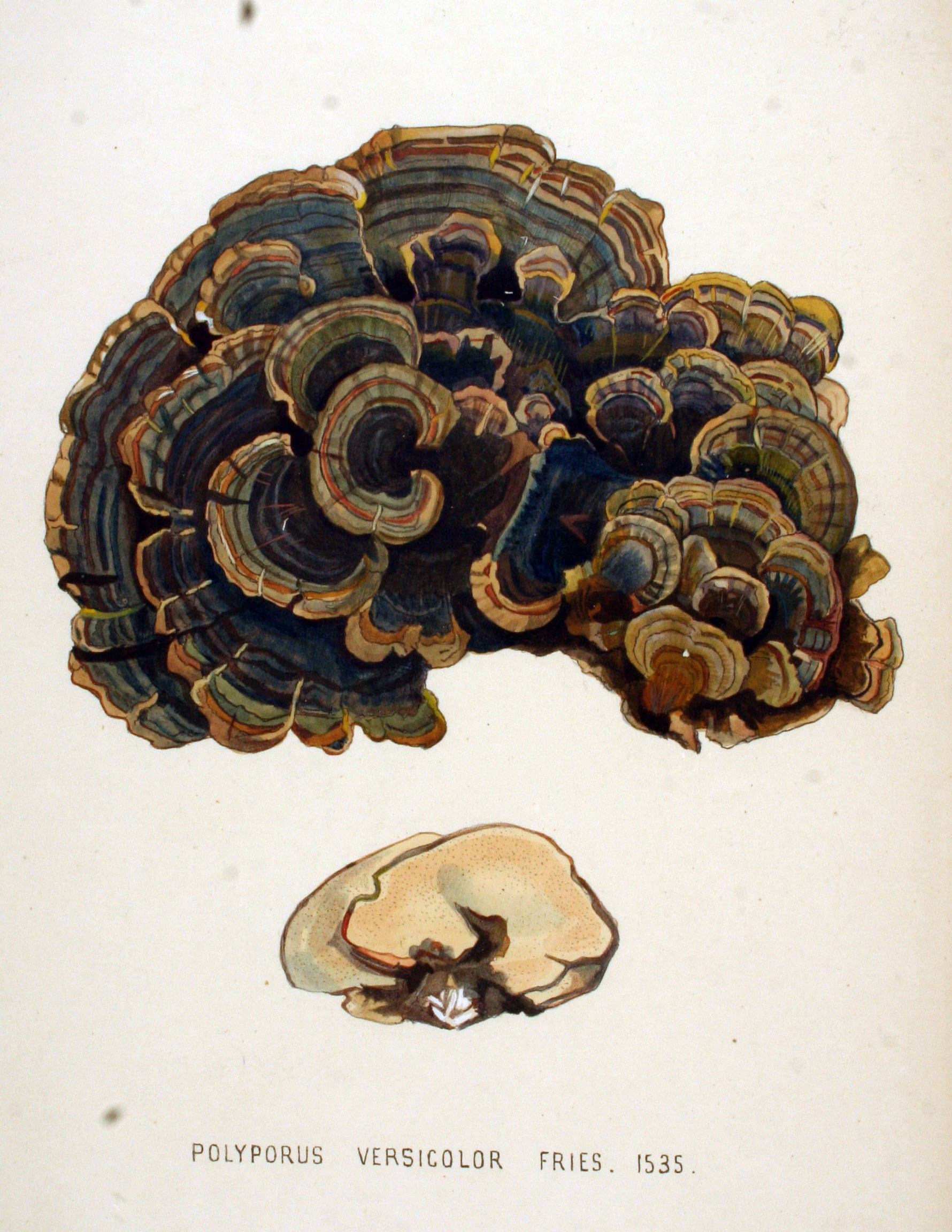
Polyporus versicolor, now Trametes versicolor, from Flora Batava. Jan Kops, public domain, via Wikimedia Commons.
Two preparations were developed from it. Polysaccharide-K, or PSK, was isolated in Japan and is sold there as Krestin. PSP, polysaccharopeptide, is a second extract from the same fungus, produced in China.
PSK is a protein-bound polysaccharide, isolated and purified from cultured mycelium, with a defined molecular weight and a defined protein content. It was approved in Japan in 1976, in clinical use there from 1977, and after a re-evaluation in 1989 it was approved for use alongside chemotherapy in resected gastric cancer and curatively resected colorectal cancer, and to prolong remission in small-cell lung carcinoma.
PSP is where I have to be careful. The National Cancer Institute calls it an extract, not a drug, and I could not find an agency source establishing that it is an approved pharmaceutical anywhere. So I will call it an extract too.
That paragraph about PSK is doing a lot of work, and I will come back to it.
The evidence, which is genuinely good
Start with the tightest analysis.
In 2006, Sakamoto and colleagues published a meta-analysis of three clinical trials in patients with curatively resected colorectal cancer — 1,094 patients, all with center randomization, all followed for at least five years, analyzed by intention to treat with no patient exclusions (Sakamoto, Cancer Immunology Immunotherapy, 2006). Standard chemotherapy was compared against the same chemotherapy plus PSK.
Overall survival risk ratio 0.71 (95% CI 0.55 to 0.90, P = 0.006). Disease-free survival risk ratio 0.72 (95% CI 0.58 to 0.90, P = 0.003).
Look at those confidence intervals. They do not cross 1. That is a real result, from randomized data, analyzed the honest way.
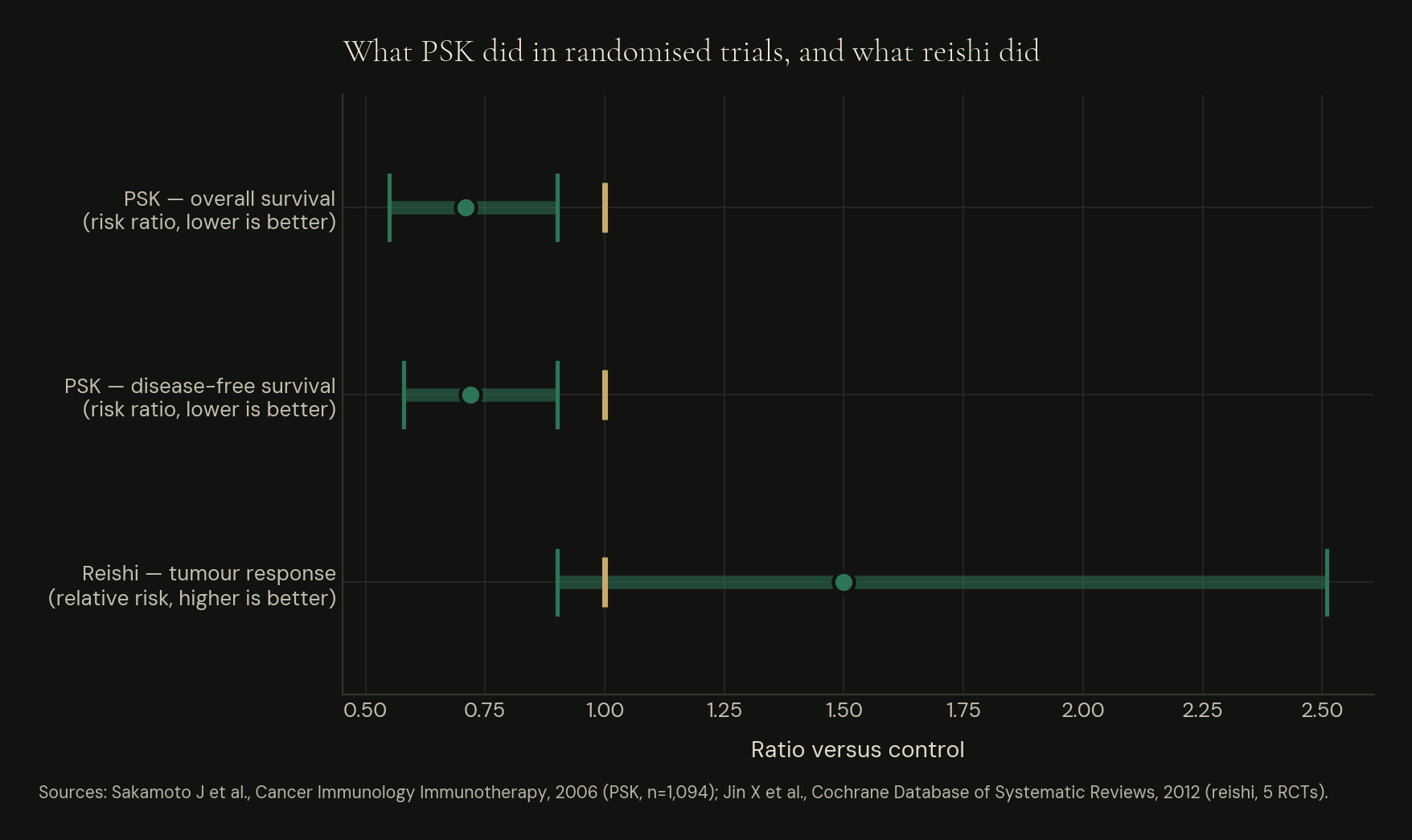
That 2006 analysis is the one carrying the weight in this article, and I want to say so before I add anything to it.
A much larger systematic review and network meta-analysis came in 2017: 23 trials, 10,684 patients, 13 intervention arms, in gastrointestinal cancer, registered with PROSPERO (Ma, Oncotarget, 2017). PSK significantly increased one- through five-year overall survival and one- through seven-year disease-free survival. The benefit was clearest in colorectal and gastric cancer, and clearest when PSK was combined with chemotherapy rather than used alone.
And this is the part I want to sit on: no increase in side effects was observed.
Now a caveat I would rather raise myself than have raised at me. That 2017 analysis appeared in Oncotarget, and the National Library of Medicine removed Oncotarget from MEDLINE indexing in 2017. The last indexed volume was volume 8, issue 30. This paper is volume 8, issue 51, so it published after the delisting. The journal was re-accepted for indexing in 2022, and the paper is in PubMed and PMC, where anyone can read it.
That does not make the pooled result wrong, and I am not going to pretend it does. It does mean I would not want the argument to rest on it. The 2006 meta-analysis stands on its own: centrally randomized, intention to treat, five years of follow-up, indexed the whole time. Treat the 2017 work as consistent with it rather than as the foundation.
There is also evidence from outside Japan, which matters because “it only ever works in Japanese trials” is a fair thing to wonder. It amounts to two studies. Both are worth knowing about and neither is a second Sakamoto, so let me name what each one actually is.
The first is a population-based historical cohort study using Taiwan’s national health insurance database, covering 10,617 gastric cancer patients who had gastrectomy plus adjuvant chemotherapy between 1999 and 2008 (Wang, Medicine, 2022). After one-to-four propensity matching, 1,295 PSK users were compared against 5,180 never-users. Median overall survival was 6.49 years with PSK against 3.59 years without, and after adjustment the hazard ratio was 0.76 (P < 0.0001).
I will temper that one immediately: it is a retrospective database cohort, not a randomized trial. Propensity matching reduces confounding, it does not eliminate it, and people who take an extra adjuvant medication may differ from people who do not in ways no database captures.
The second is a randomized trial, and it tested PSP, the Chinese extract, not PSK. It was double-blind and placebo-controlled, in advanced non-small-cell lung cancer after conventional treatment, over 28 days (Tsang, Respiratory Medicine, 2003). Thirty-four patients were recruited into each arm, so sixty-eight in total. Significantly fewer patients on PSP withdrew because their disease progressed. Their lung-cancer symptoms did not improve, and no adverse reaction was attributed to the trial medications. It is indexed as a pilot project, which is the right word for sixty-eight patients.
So the honest summary of the non-Japanese evidence is this: one retrospective database study and one sixty-eight-patient pilot trial of a different extract. That is not replication. It points the same way, from two other countries, and that is worth something, but I would be overselling it if I said the Japanese result had been reproduced elsewhere.
Why I am treating this differently from the rest of the series
Compare this to what I have written about so far.
Fenbendazole: mechanism, mice, no human trial. Laetrile: one large human trial, negative, plus cyanide.
PSK: randomized trials, intention-to-treat analysis, five-year-plus follow-up, thousands of patients, benefit clearest in two cancer types, and a signal that is at least consistent in two non-Japanese studies, with the limits I just put on them. Used as an adjuvant — added to real treatment, never instead of it — in patients who had already had curative surgery.
That is not a fringe evidence base. If PSK were a new molecule from a pharmaceutical company, I doubt we would be arguing about whether it counts.
So when somebody tells you there is real evidence for medicinal mushrooms in cancer, they are not making it up. There is. I am not going to pretend otherwise because it is inconvenient for a tidy article.
And now the part that undoes most of it
Here is the problem. PSK is a regulated pharmaceutical product in Japan. What is sold to you is not.
The trials above did not test a bottle of ground-up mushroom. They tested a standardized preparation, manufactured to pharmaceutical specification, with a known quantity of a defined protein-bound polysaccharide, given at a set dose alongside a specific chemotherapy protocol, in patients at a specific point in their treatment.
A turkey tail capsule from a shelf shares a species name with that. It does not share the manufacturing, the standardization, the dose, or the context.
I want to be careful here, though, because the easy version of that paragraph implies nobody has ever put a retail-type product into a cancer trial. Somebody has. In 2012 a group published a phase 1 study of freeze-dried Trametes versicolor mycelium obtained from a US mushroom supplement manufacturer, encapsulated and swallowed, run under an FDA investigational new drug application granted in 2007 (Torkelson, ISRN Oncology, 2012). Eleven women were recruited after breast radiotherapy and nine completed the six weeks.
So a sourced fact beats my rhetorical absence, and I would rather give you the fact. But look at what it measured. The primary endpoint was the maximum tolerated dose. It was built to find out whether people could take the stuff, not whether it helped them. There were nine adverse events, seven of them mild, and there were trends toward faster recovery of lymphocytes and natural killer cell activity. Nine women is not a safety database, and a dose-finding study is not an efficacy result. It is a real trial that answered a different question.
I am not naming the manufacturer. Their material was used properly, in a properly INDed study, and printing the name in an article read by people with cancer would function as a recommendation whether I meant it that way or not.
And “shares a species name” turns out to be generous.
In 2017, researchers analyzed 19 batches of Ganoderma lucidum — reishi — dietary supplements purchased in the United States, measuring the triterpenes and polysaccharides that are supposed to be the active components. Only 5 of the 19, or 26.3 percent, were consistent with their own labels (Wu, Scientific Reports, 2017).
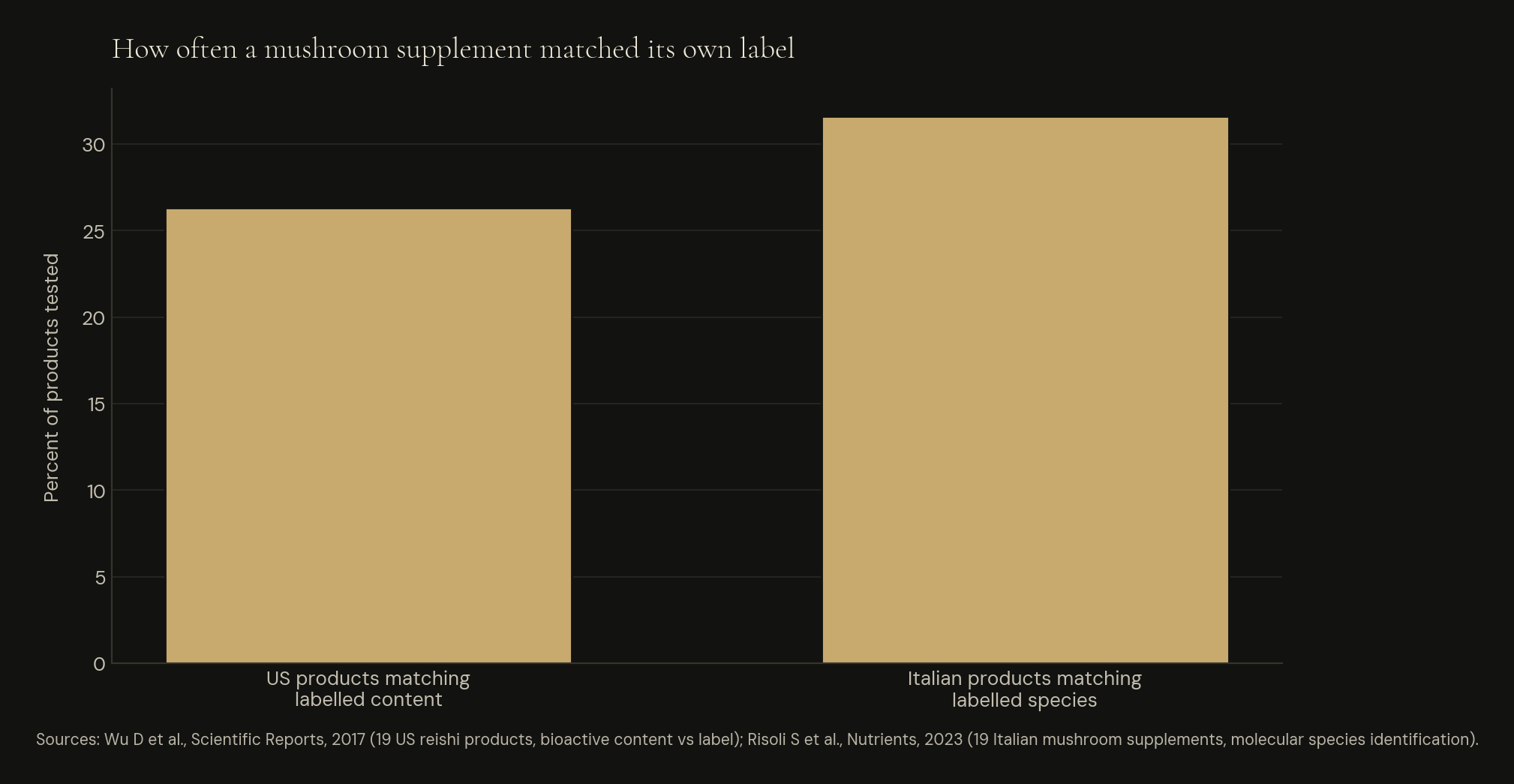
A 2023 Italian study went further and sequenced the DNA. Of 19 mushroom supplements sold in Italy, molecular identification matched the labeled species in 6. Products sold as Ganoderma lucidum came back as Ganoderma resinaceum and Ganoderma sichuanense, related organisms, different organisms (Risoli, Nutrients, 2023).
Now the part I have to say plainly, because it is what I would want said to me. Neither of those studies contained a turkey tail sample. The 2017 American work tested reishi, and only reishi. The nineteen Italian products were labelled as exactly three species, shiitake, reishi and Agaricus blazei, and turkey tail was not among them. When I searched in August 2026 for a published test of whether retail turkey tail products match their labels, by species identity or by content, I did not find one.
So what the label evidence shows is that in two studies, of other mushrooms, in two countries, most products did not match their labels. I found no published test of whether the same is true of turkey tail products. I read that as a reason for caution rather than for reassurance, because nothing about how turkey tail supplements are grown and packed is obviously different, but I am not going to dress an untested question up as a finding.
So the practical situation is this. There is decent evidence for a standardized preparation made to pharmaceutical specification in Japan, which is not what is sold to you. And the retail mushroom supplement market, in the parts of it that have been checked, has a poor record of containing what the label says, sometimes down to the species. I found no published check of the turkey tail shelf.
That is not a reason to sneer at anyone taking them. It is a reason to understand that the study you read about and the bottle in your hand are two different things wearing the same name.
Reishi, and a lesson in reading a confidence interval
Reishi gets talked about in the same breath as turkey tail. Its evidence is considerably thinner.
A Cochrane review found five randomized trials of Ganoderma lucidum in cancer (Jin, Cochrane Database of Systematic Reviews, 2012). The reviewers described the methodological quality of the primary studies as generally unsatisfying and the reporting as inadequate in many respects, and could not obtain additional information from the original investigators.
For tumour response with chemotherapy or radiotherapy, the pooled result was a relative risk of 1.50, with a 95% confidence interval of 0.90 to 2.51.
That interval includes 1. An interval that includes 1 includes “no effect,” and that is true regardless of what p-value sits beside it. Read the interval, not the adjective. The honest summary is that reishi might improve tumour response by half again, or might do nothing, and five small studies of unsatisfying quality cannot tell the difference.
The immune markers did move — CD3 up 3.91 percent, CD4 up 3.05 percent, CD8 up 2.02 percent — and four studies reported better quality of life. But no trial recorded long-term survival at all, which is the outcome anyone actually cares about.
Cochrane’s conclusion was that there is not sufficient evidence to justify reishi as a first-line cancer treatment, that it remains uncertain whether it prolongs survival, and that it could reasonably be used as an adjunct to conventional treatment. It was well tolerated, with scattered minor effects including nausea and insomnia, and no significant blood or liver toxicity across the studies.
That is a much weaker statement than the one PSK earns, and the two get sold in the same blend.
Maitake, Grifola frondosa, has less human evidence still. I am not going to inflate a paragraph out of it.
What this evidence cannot tell us
The PSK trials were overwhelmingly conducted in Japan, in Japanese patients, using chemotherapy regimens that in several cases are no longer standard of care. Whether the benefit holds on top of modern regimens is genuinely unknown.
Most of that literature is also decades old, from an era with looser reporting standards than we would now demand. The Sakamoto meta-analysis is unusually clean for its time, which is why I leaned on it.
The Taiwanese study is retrospective, and I would not want anyone reading a 6.49-versus-3.59-year median survival difference as though it came from a randomized trial. It did not.
And none of this speaks to using mushroom preparations instead of treatment. Every result above is an adjuvant result, in people receiving conventional care, most of them after curative surgery. There is no evidence here for mushrooms as a treatment on their own, and nothing in this article should be read that way.
What would change my answer
A randomized trial of a standardized turkey tail preparation added to current-era chemotherapy, run outside Japan, with overall survival as the endpoint. That study is entirely feasible and the existing data arguably justify it.
For the retail products, something simpler: independent verification that a given product contains the species and the quantity it claims. That is a testing problem, not a science problem. In the mushroom supplements that have been tested, most fail it. For turkey tail products, I found no published test as of August 2026, and running one would be neither hard nor expensive.
What I would do
Tell your oncology team. That has been the refrain in every one of these articles and it does not change just because the evidence here is better — it matters more, because a product with real biological activity is exactly the kind of thing that belongs in your chart.
If you or someone caring for you wants to pursue this, the useful question is not “are mushrooms good for cancer.” It is: is there a standardized preparation, with a verified content, that my team is comfortable adding to what I am already on? That is a question an oncologist or an oncology dietitian can actually engage with. A disclosure: I have a practitioner store on Fullscript, the supplement dispensing platform, and it would pay me a margin on supplements sold through it. As of 30 September 2026 the store has made no sales.
And be skeptical of blends. A capsule combining turkey tail, reishi, maitake, chaga and lion’s mane is not the sum of five evidence bases. What is actually in one of those capsules I cannot tell you, because I could find no published analysis of the composition of a multi-mushroom supplement, and I am not going to guess at it. The absence is its own kind of answer.
The thing worth taking from this article is narrower than “mushrooms work” and more useful. One preparation, studied properly, as an addition to real treatment, produced a real result. That is what it looks like when this goes right — and it is a fair standard to hold the next bottle to.
This is education, not medical advice. Nothing here is a recommendation to start or stop any treatment. If you are in treatment, those decisions belong with your oncology team, and if something is urgent, call them. In an emergency, call 911.
Next in the series: high-dose vitamin C, oral and intravenous — which the laetrile article already showed can matter more than people assume.
I wrote two books on nutrition during cancer treatment before I wrote any of these articles, one for patients and one for caregivers, in English and in Spanish.
References
Sakamoto J, et al. Efficacy of adjuvant immunochemotherapy with polysaccharide K for patients with curatively resected colorectal cancer: a meta-analysis of centrally randomized controlled clinical trials. Cancer Immunology, Immunotherapy. 2006. https://consensus.app/papers/details/af894dfdf0b6598fb7dbc658261399b1/
Ma Y, et al. Can polysaccharide K improve therapeutic efficacy and safety in gastrointestinal cancer? A systematic review and network meta-analysis. Oncotarget. 2017. https://consensus.app/papers/details/9f8d73591c6b53098b4e66b649c96c12/
Wang T-Y, et al. Protein-bound polysaccharide K prolonged overall survival in gastric cancer patients from a non-Japanese Asian country who received gastrectomy and adjuvant chemotherapy. Medicine. 2022. https://consensus.app/papers/details/80e9a14c37505e01b8ed1f6e4adcb30b/
Tsang KW, et al. Coriolus versicolor polysaccharide peptide slows progression of advanced non-small cell lung cancer. Respiratory Medicine. 2003;97(6):618-24. https://doi.org/10.1053/rmed.2003.1490
Torkelson CJ, et al. Phase 1 clinical trial of Trametes versicolor in women with breast cancer. ISRN Oncology. 2012;2012:251632. https://doi.org/10.5402/2012/251632
Jin X, et al. Ganoderma lucidum (Reishi mushroom) for cancer treatment. The Cochrane Database of Systematic Reviews. 2012. https://consensus.app/papers/details/a8805db024785b43ac243ae057e1eaf4/
Wu D, et al. Evaluation on quality consistency of Ganoderma lucidum dietary supplements collected in the United States. Scientific Reports. 2017. https://consensus.app/papers/details/3913ac110595586db79174c3f4bf8605/
Risoli S, et al. Mushroom-Based Supplements in Italy: Let’s Open Pandora’s Box. Nutrients. 2023. https://consensus.app/papers/details/9bfc846eb8cb5151bf8af68dbcdd6a8d/
You H, et al. Label compliance for ingredient verification: regulations, approaches, and trends for testing botanical products marketed for “immune health” in the United States. Critical Reviews in Food Science and Nutrition. 2022. https://consensus.app/papers/details/d4b97e4eb0e553c8a97abd86e1479cfb/
Vitae Arete provides nutrition education and does not diagnose, treat, or manage cancer, nor prescribe or manage medication. This article is general information, not individualized medical or nutrition advice, and does not create a dietitian–client relationship. See the full disclaimer.