Almost every patient I see on a GLP-1 arrives with a number in their head, and the number is a weight. It is what their prescriber records, what their family asks about, and what the bathroom scale hands them every morning without being asked. I understand why it dominates: it is free, it is instant, and it moves.
It is also the measurement least able to answer the question people actually care about, which is whether the body they end up with works better than the one they started with. It reports the sum of everything you are. It cannot tell you which part left.
What the body composition studies actually measured
The honest version starts with how little has been measured well. In a substudy of the SURMOUNT-1 tirzepatide trial, 160 of the trial’s 2,539 participants had dual-energy X-ray absorptiometry scans at baseline and again around week seventy-two (Look, Diabetes, Obesity and Metabolism, 2025). That is what people quote about what these drugs do to the body: a subgroup of a hundred and sixty, only thirty-six on placebo. It was funded by Eli Lilly, which makes tirzepatide, and six of its eight authors are Lilly employees and shareholders. That does not make it wrong, but I read a manufacturer’s reassuring analysis of its own product carefully.
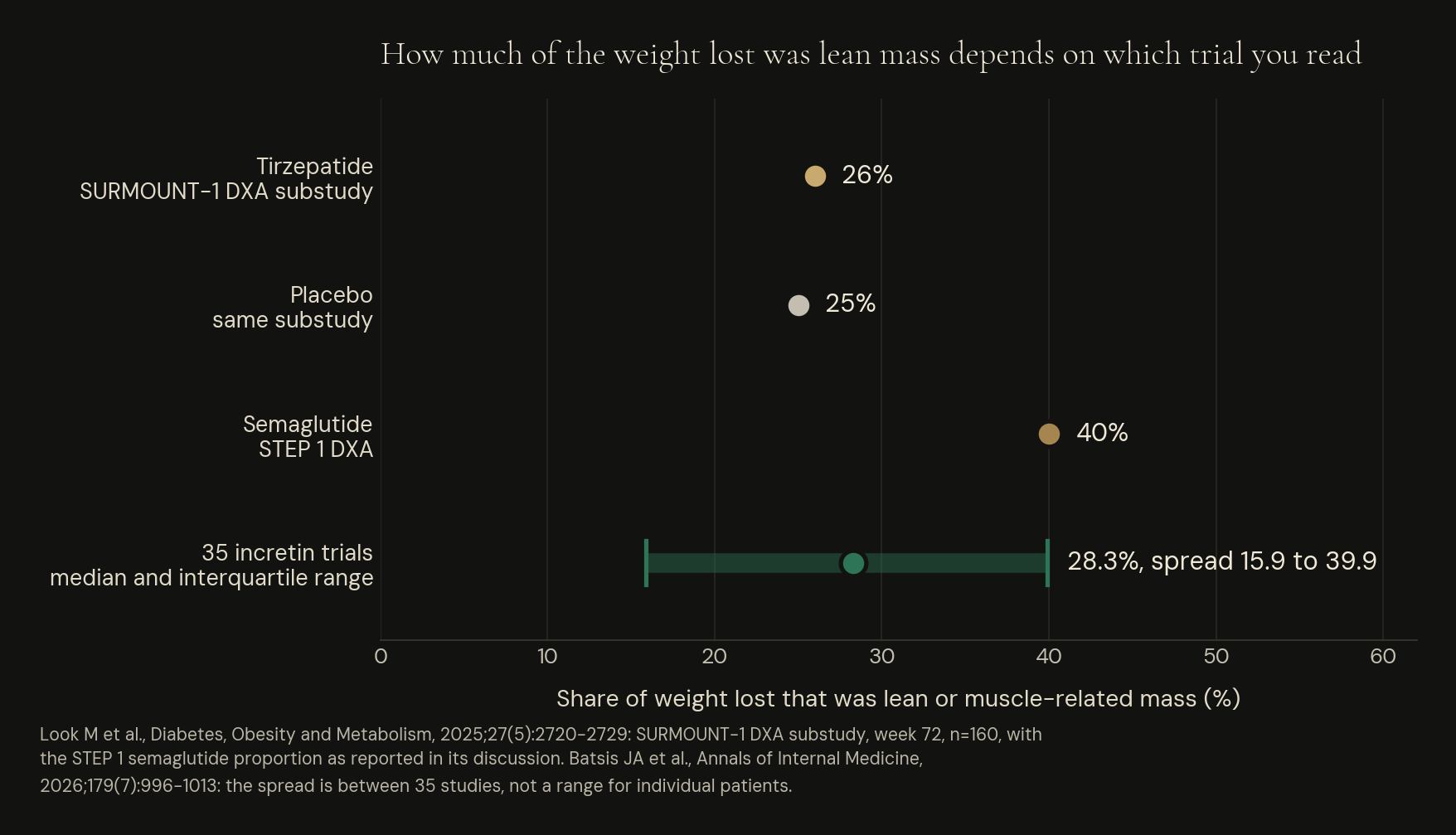
Participants on tirzepatide lost 21.3 percent of their body weight, with fat mass down 33.9 percent and lean mass down 10.9 percent. Of the weight that came off, 74 percent was fat mass and 26 percent lean. The placebo group, losing 5.3 percent, came in at 75 and 25. Two caveats: the proportion analysis was post hoc rather than a planned endpoint, and the paper’s own word for the two arms is “similar”, not identical. With thirty-six people on placebo, similar is as much as the data will carry.
Still, that is the interesting part: in this trial the proportion did not look meaningfully different between people losing a fifth of their body weight on a drug and people losing a twentieth without one.
The number that keeps getting mangled
You will also see a much larger figure in circulation, usually attached to the word muscle, putting the lean share closer to forty percent. I used to call that unsourced. That was wrong, and the source sits in the same paper I just cited: Look’s discussion reports that the DXA substudy of STEP 1, the semaglutide trial, found roughly 60 percent fat mass and 40 percent lean. So the larger figure is real. What it is not is a general fact about GLP-1s. It is a different drug in a different trial, and the range people repeat is less invented than it is two trials stapled together and presented as one spread.
The best synthesis available is a systematic review of thirty-five randomised trials of incretin therapies, screening more than eight thousand records through February 2026 (Batsis, Annals of Internal Medicine, 2026). Across the incretin groups, the median proportion of weight loss attributable to muscle-related measures was 28.3 percent, interquartile range 15.9 to 39.9. That spread is the finding: the studies ran a median of twenty-six weeks with a median of seventy-eight participants, used different instruments, and were too heterogeneous to pool at all.
That review also complicates the reassuring story above. The reviewers set benchmarks for expected loss, and roughly 65 percent of the incretin groups exceeded whichever applied to them, against 38 percent of the thirteen groups with a lifestyle or placebo comparator. That looks like the drug making things worse, and it might be. But those comparator groups lost a median of only 2.5 percent of body weight, so the two sets describe very different amounts of change. Whether incretin weight loss is compositionally worse than the same amount lost another way is not settled, and anyone telling you it is settled in either direction is ahead of the evidence.
Lean mass is not the same thing as muscle
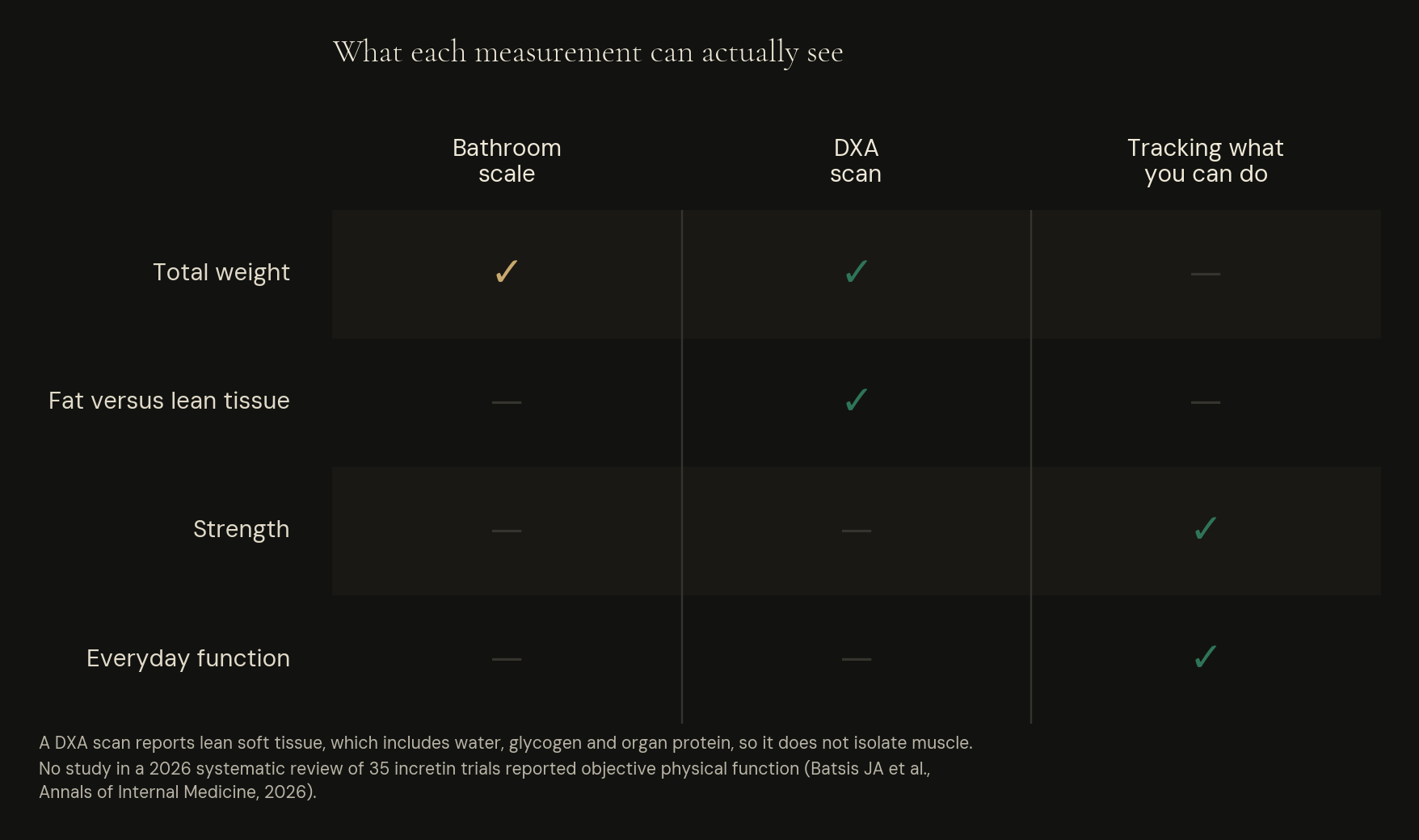
A DXA scan does not measure muscle. It measures lean soft tissue, which includes muscle but also water, glycogen and the protein in your organs. When someone loses weight quickly, some of what registers as lost lean mass is fluid and stored carbohydrate and some is contractile tissue, and the scan cannot tell you the ratio.
That is why I flinch when a headline reports a percentage of the loss as muscle: the instrument cannot support the word. It is also why the most important sentence in the Batsis review is one nobody quotes. Across all thirty-five trials, no study made grip strength, walking speed or rising from a chair an outcome. The tirzepatide trial did report that patients said their physical functioning improved, but asking people how they feel is a different measurement from testing what they can do, and only the first has been done. So the honest position is narrower than either camp wants: losing lean mass alongside a large fat loss is not obviously the same problem as losing it while weight is stable, and we do not have the functional data to say what it costs.
What actually protects it
The two levers with the best support are unglamorous, and they are the same whether or not a medication is involved. The first is protein. The general adult reference intake of about 0.8 grams per kilogram per day comes from the 2005 Institute of Medicine dietary reference intakes, derived from nitrogen balance studies in healthy adults of normal weight, so it was never designed for someone in a large energy deficit. During active weight loss I work toward roughly double it, in the region of 1.6 grams per kilogram, spread as twenty-five to forty grams per meal rather than concentrated at dinner. Two honest caveats. Which kilogram is rarely stated and matters enormously: at actual body weight that is a very different target for someone carrying a lot of fat mass than at an adjusted weight, and it is worth settling with a dietitian rather than reading off a chart. And no trial has shown that this target preserves lean mass on a GLP-1; it is extrapolated from energy-restriction work in other populations, which is a weaker footing than the confidence with which it is usually given.
Now the carve-out, and please read its direction rather than assuming, because the assumption is usually wrong. All of the above assumes ordinary kidney and liver function. In chronic kidney disease before dialysis, protein is generally restricted well below the ordinary reference intake. On dialysis it goes the other way, because the treatment itself removes protein, so the target is set higher rather than lower. In cirrhosis it is also higher, and current European guidance is explicit that protein should not be restricted even in people who have had hepatic encephalopathy, reversing what was taught for years. The safe rule is not a direction, it is an owner: if you have kidney or liver disease, that number belongs to the clinical team who knows your labs, and you should not move it either way on the strength of an essay.
The second lever is resistance training. Two sessions a week that actually load the major movements will do more for what you keep than any supplement marketed for the purpose. I am deliberately not quoting an effect size, because the honest ones are more modest and more variable than the confidence with which the advice is given, and that deserves a proper deep dive.
What I watch instead
This does not mean throw the scale away. It means demote it, and put things beside it that carry what it cannot.
I ask patients to track four things. Strength: what you can lift for a given number of repetitions, or how many times you can stand from a chair without using your arms. Function: stairs, groceries, whether you are winded by something that did not wind you last month. Circumferences, because a tape measure at the waist says more about what kind of weight has gone than the scale does. And protein actually eaten, honestly recorded for one ordinary week, because almost everyone overestimates it and that is usually where the problem lives.
If the scale is falling and those four are holding, the loss is going the way you want. If strength and function are falling with it, that is worth a conversation with your clinician, and you can only have it if you were measuring something other than weight.
The scale answers a question nobody asked. It tells you how much of you there is. What you wanted to know was what you are made of, and whether it still works.
This is general education rather than individual medical advice, and your own targets belong with the clinical team who knows your labs and your medications.
I publish twice a week, a free essay on Tuesday and a paid research deep dive on Friday. The archive is at https://vitaearete.substack.com/archive.
And when you want a plan built around your own labs, medications, and life: https://vitaearete.com
This article is general nutrition education, not individualized medical or nutrition advice, and it does not create a dietitian–client relationship. Medications and their side effects should be managed with your prescribing clinician. See the full disclaimer.