There is an assumption underneath almost every piece of nutrition advice a cancer patient receives, and it is usually never said out loud: chemotherapy is a poison, and natural things are gentle.
I want to start this series by taking that assumption apart, using the actual history of three drugs. Not because the people offering the advice are foolish, but because the history is genuinely surprising, and once you know it, a great deal of what you will be told becomes easier to evaluate on your own.
The one that really was a weapon
In the early 1940s there was no effective drug treatment for Hodgkin’s lymphoma or for any other human cancer (Joensuu, Lancet Oncology, 2008).
The first one came out of chemical warfare.
Mustard gas was introduced in 1917 as a weapon. It caused severe skin blistering and ulceration, blindness, laryngeal swelling and lung injury, and it killed slowly and painfully. There is no version of this story where that is softened.
What followed is one of the strangest turns in medicine. In the late 1920s, Adair and Bagg dissolved mustard gas in alcohol and applied it to superficial tumors, and observed that the tumors regressed. Then, on December 2, 1943, an attack on Allied ships in the Italian port of Bari spilled mustard chemicals into oily water that sailors were swimming through. Many died. The investigation that followed, by Lieutenant Colonel Stewart Francis Alexander, found that these compounds were not only blistering agents but had destructive effects on the lymphoid and blood-forming systems (Hait, Cancer Research, 2021).
That is the observation everything else hangs on. A chemical that specifically damaged the tissues that produce blood cells might do something to a cancer of those same tissues.
At Yale, Milton Winternitz shared Alexander’s findings with two assistant professors, Alfred Gilman and Louis Goodman, who ran secret studies on nitrogen mustard, a more stable relative of the sulfur compound. Goodman and his colleagues went on to treat 67 patients with Hodgkin’s disease, lymphosarcoma, leukemia and other cancers.
The first patient received a nitrogen mustard intravenously at 0.1 mg per kilogram every other day. The response was dramatic: her fever and cyanosis resolved, the swelling in her face and neck went down completely, and her lymph node masses shrank by 60 to 70 percent.
She died four weeks later of sudden pulmonary edema.
Both halves of that are the story. The drug did something no drug had done before, and it was not gentle, and the people giving it knew exactly what it was. In 1949 mechlorethamine became the first chemotherapy drug approved by the FDA.
The one that came from a flower
Now the opposite starting point.
Catharanthus roseus is the Madagascar periwinkle, an ornamental plant in the Apocynaceae family. It has a long history in traditional medicine, including use for inflammation, skin conditions, respiratory symptoms and elevated blood sugar (Goswami, Pharmacological Research Modern Chinese Medicine, 2024).
The plant produces more than two hundred alkaloid compounds. Two of them, vincristine and vinblastine, became central drugs in the treatment of Hodgkin’s disease and leukemia, including childhood acute lymphoblastic leukemia (Taub, Pediatric Blood and Cancer, 2024).
So here is a plant with a genuine traditional pedigree, which turned out to contain something genuinely powerful.
And vincristine is one of the more dangerous drugs in the pharmacy. It causes peripheral neuropathy. It is so toxic by the wrong route of administration that hospitals build specific physical safeguards to make that error impossible.
The periwinkle did not become medicine because it was traditional, and it did not become medicine because it was natural. It became medicine because somebody isolated the specific compounds, worked out what they did, tested them in a way that could have failed, and reported the results including the harms.
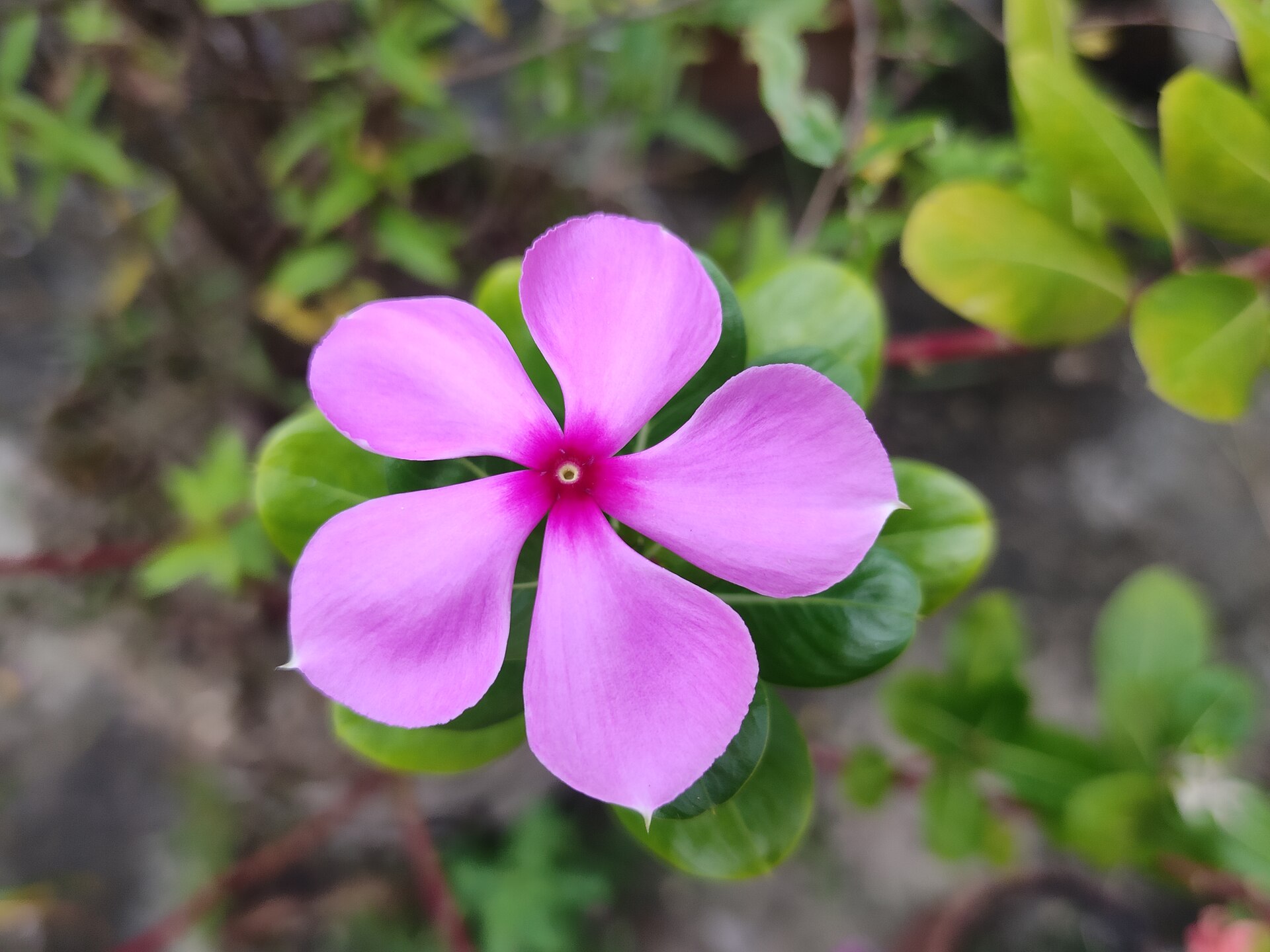
Catharanthus roseus, the Madagascar periwinkle. An ordinary bedding plant, and the source of vincristine. Photograph by Kryesmin, CC0, via Wikimedia Commons.
The plant was always potent. What changed was that somebody measured it.
The one that nearly ran out
Paclitaxel was first isolated from the bark of the Pacific yew, Taxus brevifolia. It is now on the World Health Organization’s Model List of Essential Medicines, it treats breast cancer among others, and it represents more than two billion dollars a year globally (Dell’Amore, C&EN, 2026).
It also created a problem that says something about the word natural.
You get paclitaxel out of yew bark, and taking the bark is not something a tree survives. The supply was the central obstacle to using the drug at all, and limited access remained the major challenge even as the clinical results came in (Sabzehzari, Biotechnology Advances, 2020). The eventual answer was to stop relying on the original source: the needles of the English yew, Taxus baccata, contain baccatin III, a precursor that can be converted into paclitaxel without killing anything.
A wholly natural product, in other words, whose natural source could not sustain the people who needed it. It became widely available only when chemists found a way around the plant.
What the three stories have in common
One drug came from a weapon. One came from a flower with a traditional reputation. One came from a tree that could not supply it.
None of those origins tells you whether the drug works, and none of them tells you whether it is safe. The weapon-derived compound became a treatment. The traditional plant produced a drug so hazardous that hospitals engineer around the risk of giving it wrongly. The natural product had to be made semi-synthetically to exist in useful quantities.
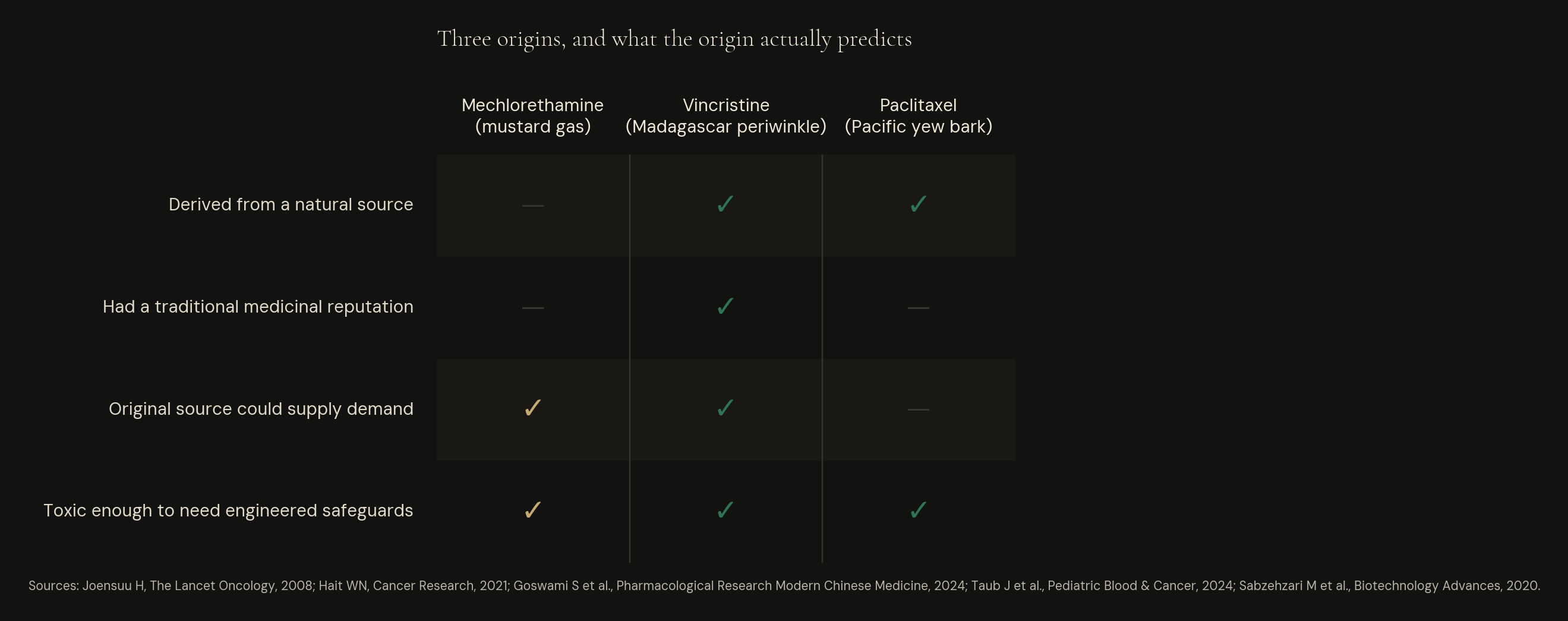
Natural is a statement about where a molecule came from. It is not a statement about what the molecule does to you.
This matters because a very large industry depends on you believing otherwise. When somebody tells you that a compound is safe because it is natural, or dangerous because it is synthetic, they are making a claim about origin and asking you to hear it as a claim about safety. Those are different claims, and only one of them can be tested.
The line that actually separates them
If natural versus synthetic is not the distinction, what is?
It is not the plant. It is not the laboratory. It is whether anybody ran the test in a way that could have produced a bad answer, and then said what happened.
That is what Goodman and Gilman did, and it is why we know both that nitrogen mustard shrank those lymph nodes and that the first patient died four weeks later. Both facts survived. Nobody edited out the second one.
A supplement sold for cancer is almost never accompanied by that second kind of fact. Not because the seller is necessarily lying, but because the study that could have produced an inconvenient result was frequently never run. What you get instead is a mechanism, a testimonial, and an invitation to infer the rest.
Over the coming weeks I am going to go through those products one at a time, because a single article waving at supplements in general is useless to somebody standing in a kitchen holding a specific bottle. Apricot seeds. Fenbendazole. Mushroom blends. High-dose vitamin C. Turmeric. Mistletoe. Moringa. Soursop. And more.
Some of them will get a firm answer, because the evidence supports one. At least one of them is going to get a more generous hearing than most readers expect, and I would rather tell you that now than have you assume the conclusions were written before the reading.
The practical part
If you are in treatment, the single most useful thing in this entire article is this: tell your oncology team everything you are taking. Every supplement, every tea, every capsule somebody mailed you, including the ones you expect them to dismiss and especially the ones you have been told not to mention.
The strongest argument against most of these products is not that they do nothing. It is that they can interfere with something that does work. Your team cannot account for what they do not know about.
This is education, not medical advice, and it is not a substitute for your oncology team or a dietitian who knows your case. If something in your situation is urgent, call your care team. If it is an emergency, call 911.
Next Wednesday: fenbendazole, the dog dewormer moving through cancer communities right now. The mechanism people cite for it is real, and it belongs to the same family you just read about.
---
*I wrote two books before I wrote any of these articles, one for patients and one for caregivers, in English and in Spanish. They exist because I kept having the same conversations and wanted people to have something to take home.*
References
Joensuu H. Systemic chemotherapy for cancer: from weapon to treatment. The Lancet Oncology. 2008. https://consensus.app/papers/details/85ee1761d4b757429f68c346a6ac687d/
Hait WN. Joseph R. Bertino: In Memoriam (1930-2021). Cancer Research. 2021. https://consensus.app/papers/details/b1601c4ea5b0588590e164b7436d864d/
Goswami S, et al. Pharmacological Significance of Catharanthus roseus in Cancer Management: A Review. Pharmacological Research - Modern Chinese Medicine. 2024. https://consensus.app/papers/details/45ebe2ddb1d35becab7dba4aa7e52683/
Taub J, et al. The evolution and history of Vinca alkaloids: From the Big Bang to the treatment of pediatric acute leukemia. Pediatric Blood & Cancer. 2024. https://consensus.app/papers/details/607c61c9a2d95f269c0f74dec6a2c9d8/
Dell’Amore C. Paclitaxel saved my life. New discoveries could boost supply. C&EN Global Enterprise. 2026. https://consensus.app/papers/details/ba5271057bd95c5d8ba8e8c4bc472283/
Sabzehzari M, et al. Alternative sources and metabolic engineering of Taxol: Advances and future perspectives. Biotechnology Advances. 2020. https://consensus.app/papers/details/9be0fedf3fc15aed912c4c3bbf41011b/
Vitae Arete provides nutrition education and does not diagnose, treat, or manage cancer, nor prescribe or manage medication. This article is general information, not individualized medical or nutrition advice, and does not create a dietitian–client relationship. See the full disclaimer.