Last week I published The Middleman Will See You Now, an argument that the venture-funded telehealth nutrition boom is being paid for by the two people with the least power in it: the dietitian and the patient. It found more of a nerve than anything I have written. Thousands of clinicians read it. Dozens wrote back. And the replies did something the piece could not do on its own: they filled in the parts I had left out.
So this is part two, built from what the profession told me. It is longer, it is more documented, and it goes to the places the first piece only pointed at: who actually owns these companies, the exact legal structure that separates the money from the risk, the four professions where this same playbook has already run, and the endgame that the contracts are quietly building toward. Every number is sourced. Where I am inferring rather than proving, I will say so plainly.
Let me start with the reply that mattered most, because it was a disagreement.
The most valuable thing anyone said
A dietitian who works for Nourish wrote in to push back, and I want to honor her argument because it is the honest one. She said Nourish has made her feel more valued than any inpatient or outpatient clinic she worked for. Better pay. Full control of her schedule, caseload, and specialties. Reimbursement for CDR fees, state licenses, office supplies, and continuing education. Weekly case-review sessions with colleagues. Monthly meetups so a telehealth job does not feel so isolating.
I believe every word of it, and none of it is a small thing. She is also right that Nourish is not Fay or Berry Street. In the compensation data dietitians themselves have filed, Nourish is the strongest-run platform in the category: W-2 employment, benefits, and per-session rates well above the 1099 platforms charging out $35 initial visits. If you are going to work for one of these companies, hers is the argument for choosing the best of them.
But she wrote two other sentences, and I want to set them next to each other, because together they are the entire thesis of both pieces:
"The pay system caps way too early." … "Flooding insurance billing might cause tightening of reimbursements."
Those are not caveats. They are the two ends of the spread I wrote about, named out loud by someone inside the best-run company in the category. The pay caps early because the clinician is the cost line, and a cost line is something you minimize. The billing floods because the model is paid per completed visit, and volume is the product. She is describing the machine accurately from inside it. Feeling valued is real, and it matters. It is also the cheapest thing a venture-funded company can offer, and the first thing that gets repriced when the growth math changes or the investors want their return.
Which brings us to the investors, and to a question another dietitian asked that I could not stop thinking about: how many of these companies were actually built by us?
Who built them
I looked up the founders of the three largest platforms. Here is what I found.
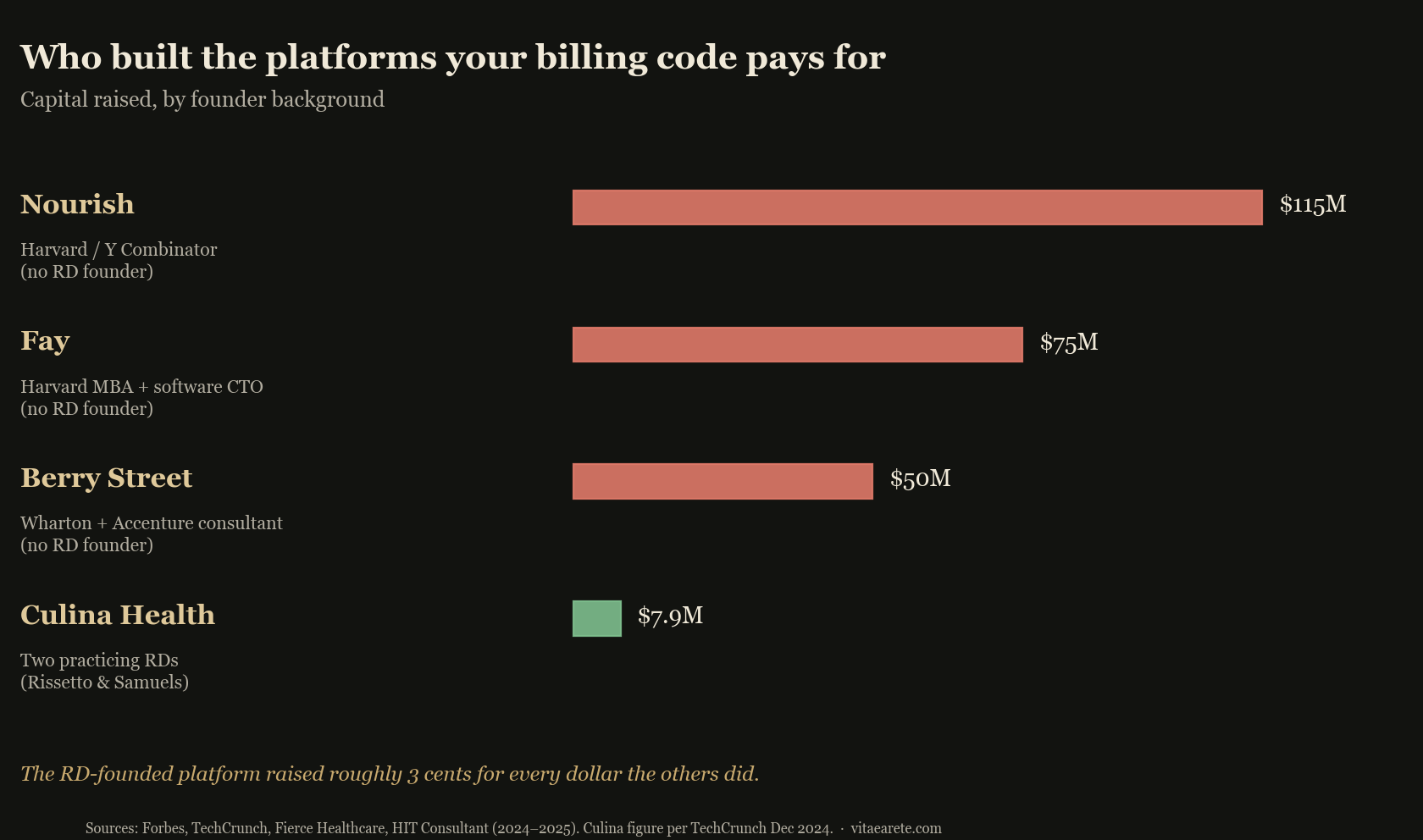
Nourish was co-founded by a Harvard-educated team out of Y Combinator; it has raised roughly $115 million at a valuation over $1 billion. Fay was founded by a Harvard MBA and a software engineer; it built the platform first for the founder's own mother and sister, both registered dietitians, and has raised on the order of $75 million. Berry Street was co-founded by a former Accenture innovation consultant and a career product executive; it raised $50 million in a single round.
Zero of the three were founded by practicing dietitians. The Fay detail is the one that stays with me: even when the family at the center of the founding story were RDs, the company was not theirs. It was built around them, and it belongs to the MBA and the engineer.
There is a counter-example, and it is instructive. Culina Health was founded by two working dietitians, Vanessa Rissetto and Tamar Samuels. It is also, per the same compensation survey, one of the platforms that pays W-2 with real benefits. And it raised $7.9 million — roughly three cents for every dollar the non-RD platforms raised. Read that gap in either direction. Capital did not find the dietitians who built a company. It found the operators who built a company around the dietitians. Venture capital did not fund our field. It funded access to our billing codes.
The structure, translated
To see why that ownership matters, you have to see the machine. It is not new, and it is not a nutrition invention. It is the same legal architecture private equity has used for two decades to own doctors, dentists, and veterinarians in states where corporations are not allowed to own a medical practice. Lawyers call it the "friendly PC" or management-services organization model. It works by splitting one business into two entities joined by a contract.
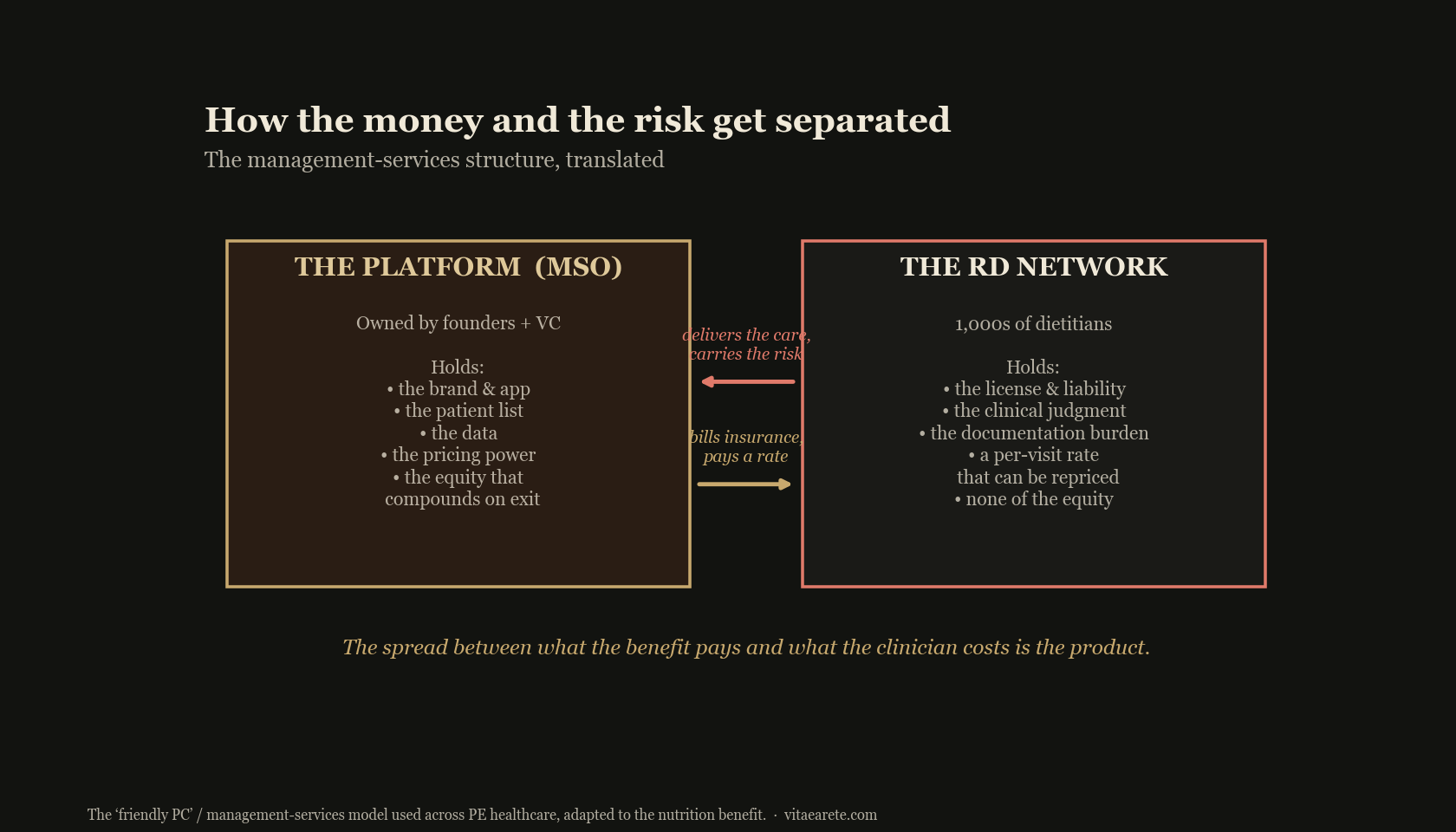
On one side sits the company: the brand, the app, the patient list, the data, the pricing power, and the equity that compounds when the company is sold. On the other side sits the clinician: the license, the liability, the clinical judgment, the documentation, and a per-visit rate that the company can change. The patient relationship is legally the clinician's and functionally the platform's. When the company is acquired or goes public, the equity holders are made whole. The clinician holds a rate that has, on several platforms, already been cut. As the legal literature on these structures makes plain, the entire point of the design is to let non-clinician capital capture the economics of clinical work without holding the license or the liability.
This is worth saying slowly, because it is the heart of it. The structure is not a byproduct of scale. The structure is the business. Everything the first piece documented — the rate cuts after a caseload is built, the unpaid charting, the quotas, the intellectual-property clauses one dietitian described as claiming anything she creates that "relates to" the business — is not a set of bad decisions by bad people. It is what this architecture produces by design, regardless of anyone's intentions. I do not need to call anyone a bad actor. The terms speak clearly enough on their own.
This playbook has run before
Here is the part that should end the "you are being alarmist" objection, because we are not the first profession to be found. Outside capital has run this exact play in one clinical field after another, and the results are not a matter of opinion. They are in bankruptcy filings and peer-reviewed journals.
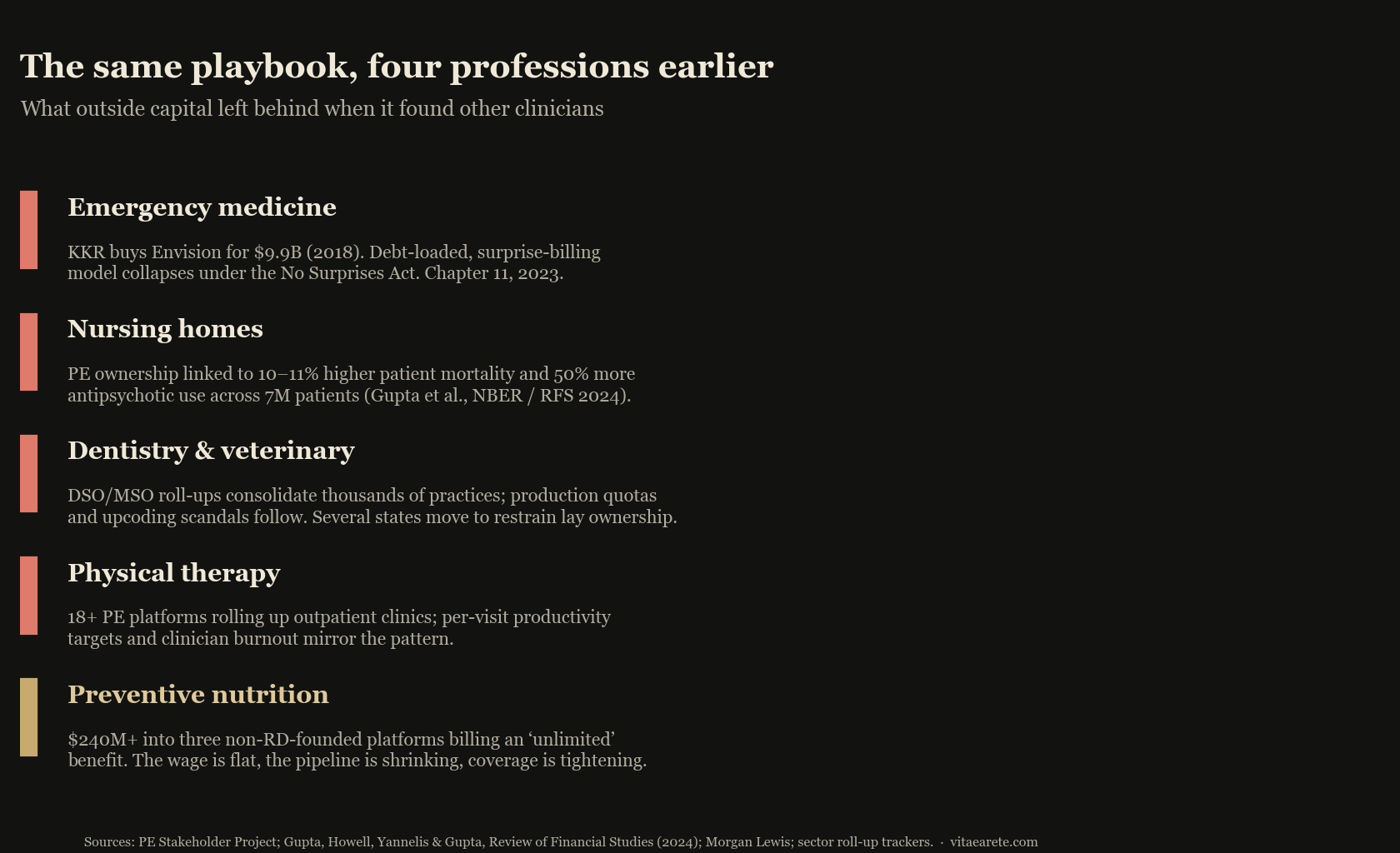
Emergency medicine. KKR took the physician-staffing giant Envision private in 2018 in a deal valued at $9.9 billion, loaded it with debt, and built its economics on out-of-network surprise billing. When the bipartisan No Surprises Act closed that loophole, the model could not survive the debt. Envision filed for Chapter 11 in May 2023, wiping out billions in investor equity. The emergency physicians who staffed 540 facilities across 45 states did not get a vote in any of it.
Nursing homes. This is the one every clinician should read twice. In the most rigorous study we have — Gupta, Howell, Yannelis, and Gupta, published in the Review of Financial Studies and covering more than seven million patients — private equity ownership of a nursing home was associated with roughly a 10 to 11 percent increase in patient mortality and a 50 percent increase in the use of antipsychotic drugs, alongside cuts to nurse staffing. When the owner's incentive is the spread, the spread is found in the staffing, and the staffing is the care.
Dentistry and veterinary medicine. Dental and veterinary service organizations rolled up thousands of independent practices using the same friendly-PC structure, and the pattern followed: production quotas, upcoding investigations, and enough concern about lay ownership that several states moved to restrain it. Physical therapy is mid-consolidation now, with more than a dozen PE-backed platforms and the same per-visit productivity targets and clinician burnout.
Five professions. One script. Consolidation, quotas, burnout, and eventually a payer or regulatory crackdown that punishes everyone in the field, including the independents who never took the money. Now the script has reached the preventive nutrition benefit — the one we spent decades fighting to have covered at all.
The tide check
One reply to the first piece made the optimistic case cleanly: these platforms expand access, and a rising tide lifts all boats. It is the best argument for the industry, and it deserves a real answer, because it is a testable claim. If outside capital were lifting our profession, we would see it in the numbers by now. The capital has been here for years.
So here is the tide, measured. There are roughly 113,000 credentialed RDNs in the United States, about nine in ten of them women. Against that workforce, more than $240 million has flowed into the three largest platforms, and hundreds of thousands of platform visits have been billed. And the profession's own vital signs, over the same window:
Measure Where it stands National mean RDN wage$77,130 — below every master's-credentialed allied-health peer Dietetics enrollment, 2014 to 2024Down 42 percent Dietetic internship seats, 2024Unfilled seats outnumbered filled ones, first time on record Medicare MNT coverageTightening, not expanding; still only two covered diagnoses
The wage is flat. The pipeline is shrinking. The benefit is narrowing. If scale were going to lift this profession, it would be visible by now, and it is not. The boats are not rising. The water is being pumped out of the harbor. (The wage and pipeline figures are drawn from my Health Affairs analysis of the dietetics workforce; the sourcing is there in full.)
The endgame nobody signed up for
A dietitian asked me the question that turns this from a labor story into an existential one: these companies are using AI, and having their dietitians use it. Is there anything stopping a platform from harvesting the clinical work of thousands of RDs, training an AI nutrition coach on it, and then selling that coach directly — no dietitians, no insurance, just a monthly fee?
I looked hard at the law, and the answer is more precise, and more unsettling, than a simple yes or no.
There is exactly one protection, and it is narrow. An AI cannot bill your insurance for medical nutrition therapy. The reimbursement codes, CPT 97802 and 97803, legally require a credentialed, licensed dietitian, and the AMA's 2026 framework treats AI as assistive to a human professional, not as an independent provider who can bill. So the insurance-reimbursed lane has a real moat, and that moat is our license.
But the moat has an open gate, and it is exactly the one the question describes. The protection exists only because the service is billed as medical nutrition therapy. Drop the insurance billing, charge a cash membership, and call the product "nutrition coaching" or "wellness" instead — and the licensure requirement disappears. Most states have only title protection, which stops an AI from calling itself a "dietitian," not practice protection, which would stop it from giving diet advice at all. An AI nutrition coach at a monthly fee, trained on the notes of the thousands of RDs who worked the platform, is very close to unregulated in most of the country, as long as it does not claim the title or claim to treat disease.
And there is no federal legislation protecting dietitians from AI replacement. None specific to our field. The only guardrails are the billing-license requirement, which the cash model sidesteps by design, and state practice acts, which mostly protect the title, not the work.
So trace the flywheel, because every step of it is legal:
The dietitians deliver the care. The IP and confidentiality clauses assign their clinical notes to the company as work product. Those notes become the training data. The model learns the patterns. The company launches a cash-membership AI coach. And it competes in the one lane where the dietitian's license was never required.
This is the sharpest possible point on the intellectual-property concern that a dietitian raised in the comments last week, and I did not fully appreciate it until she did. Those clauses are not about your worksheets and handouts. They are about your clinical reasoning — the accumulated judgment of your whole career — becoming someone else's model weights. Read that way, the broad "anything that relates to our business" IP clause is not boilerplate. It is the mechanism by which a workforce trains its own replacement, and signs away the right to object.
I want to be careful here, because this is the part where it would be easy to overreach. No platform has announced this product. I am describing an incentive and a legal pathway, not a press release. But the incentive is powerful, the pathway is open, and the data-harvesting groundwork is being laid right now, one documented visit at a time. When a structure makes something both profitable and legal, the honest question is not whether someone will do it. It is what protects us when they do. Today, in the cash lane, the answer is almost nothing.
What actually protects us
I did not write either of these pieces to tell dietitians to quit these platforms. Some of them, like the one who wrote to me, have found real value and real colleagues there, and the access these companies have created for patients is genuine. I wrote them because a profession that does not understand the structure it is entering cannot negotiate with it, and cannot build the alternative to it. So here is where I land, constructively.
Ownership is the whole game. The single clearest finding in all of this is that the one platform built and owned by dietitians pays better and treats its clinicians better — and had to do it on a fraction of the capital. RD-owned group practices, cooperatives, and partnerships are not a nostalgic alternative to the platforms. They are the version where the majority who do the work also hold the equity, the pricing power, and the patient relationship. Every dietitian who builds one, or joins one, keeps that much of the field in our hands.
Contract transparency, now. The advocacy channels — the Academy, payer negotiation, the push to expand Medicare MNT through the Medical Nutrition Therapy Act — matter, and I am fully behind them. But they move in years, and the contracts are being signed this week. So before you sign one, get four answers in writing:
1The exact rate for every payer, including no-shows and charting time — and the mechanism by which that rate can change after you build a caseload. 2Who owns the patient relationship if you leave. 3Who owns what you create — your notes, your protocols, your materials — and whether the IP clause carves out work built on your own time and knowledge. 4Whether your work is being used to train models, and whether you have any right to say no.
If any answer is vague, the vagueness is the answer.
The dietitian who pushed back on me said we are the majority of these companies, and she is right. That is the whole point. The majority does the clinical work, holds the licenses, carries the liability, and generates the value. The open question — the only one that matters — is whether the majority also owns any of it, or is renting its own labor back from the people who raised the money. Naming the terms out loud is not what divides a profession. Signing them in silence is.
Jason Fee, MS, RDN, LDN is a clinical dietitian and the founder of Vitae Arete, an independent nutrition practice. This piece was prepared independently and represents his own views. It is a follow-up to "The Middleman Will See You Now" and to his workforce analysis in Health Affairs Forefront, "The Slow Collapse of the U.S.'s Clinical Nutrition Workforce."
Sources
Founders and funding: Forbes (Nourish); HIT Consultant (Fay); TechCrunch (Fay, Berry Street); TechCrunch (Culina Health)
The friendly-PC / MSO structure: Morgan Lewis, "A Friendly Guide to Private Equity Acquisitions of Physician Practices"
Envision / emergency medicine: Private Equity Stakeholder Project; Healthcare Dive
Nursing home mortality: Gupta, Howell, Yannelis & Gupta, "Owner Incentives and Performance in Healthcare: Private Equity Investment in Nursing Homes," NBER Working Paper 28474, published in the Review of Financial Studies (2024)
AI billing and scope: AMA on CPT codes for AI-enabled services; MNT codes require a credentialed dietitian (CPT 97802/97803)
Workforce data: Fee, J., "The Slow Collapse of the U.S.'s Clinical Nutrition Workforce," Health Affairs Forefront (2026); CDR Registry Statistics
Platform compensation and working conditions: Dietitian Success Center platform survey