Summary
Several online companies that sell GLP-1 weight-loss drugs publish what they pay people who send them customers. I followed that money to the vial. At each step I asked who is paid, and which rule, if any, says you must be told. I do not claim any arrangement here is illegal, or that any payment led anyone to a prescription.
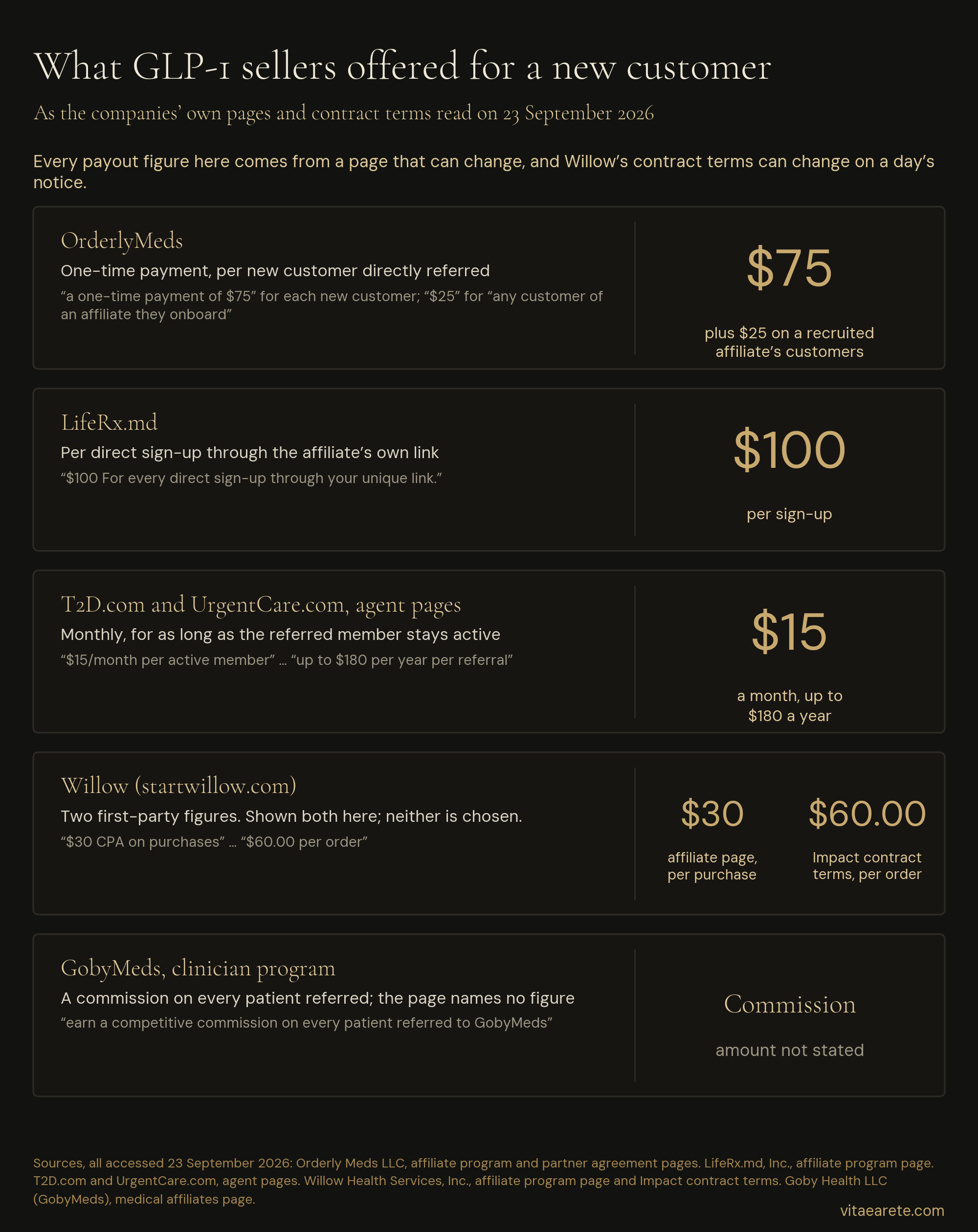
As their pages read on 23 September 2026, OrderlyMeds offered $75 per new customer and LifeRx.md $100 per sign-up. T2D.com and UrgentCare.com offered $15 a month per active member. GobyMeds offered licensed clinicians a commission per patient referred, amount unstated.
Federal Trade Commission guidance says a paid endorser must clearly disclose the payment when the audience would not expect it. The OrderlyMeds agreement requires it. On four other programs’ public pages that day, I found no such instruction. Their contracts may say more.
Willow’s and GobyMeds’ patient terms, searched that day, did not mention that whoever sent you might be paid. The guidance puts that duty on the endorser.
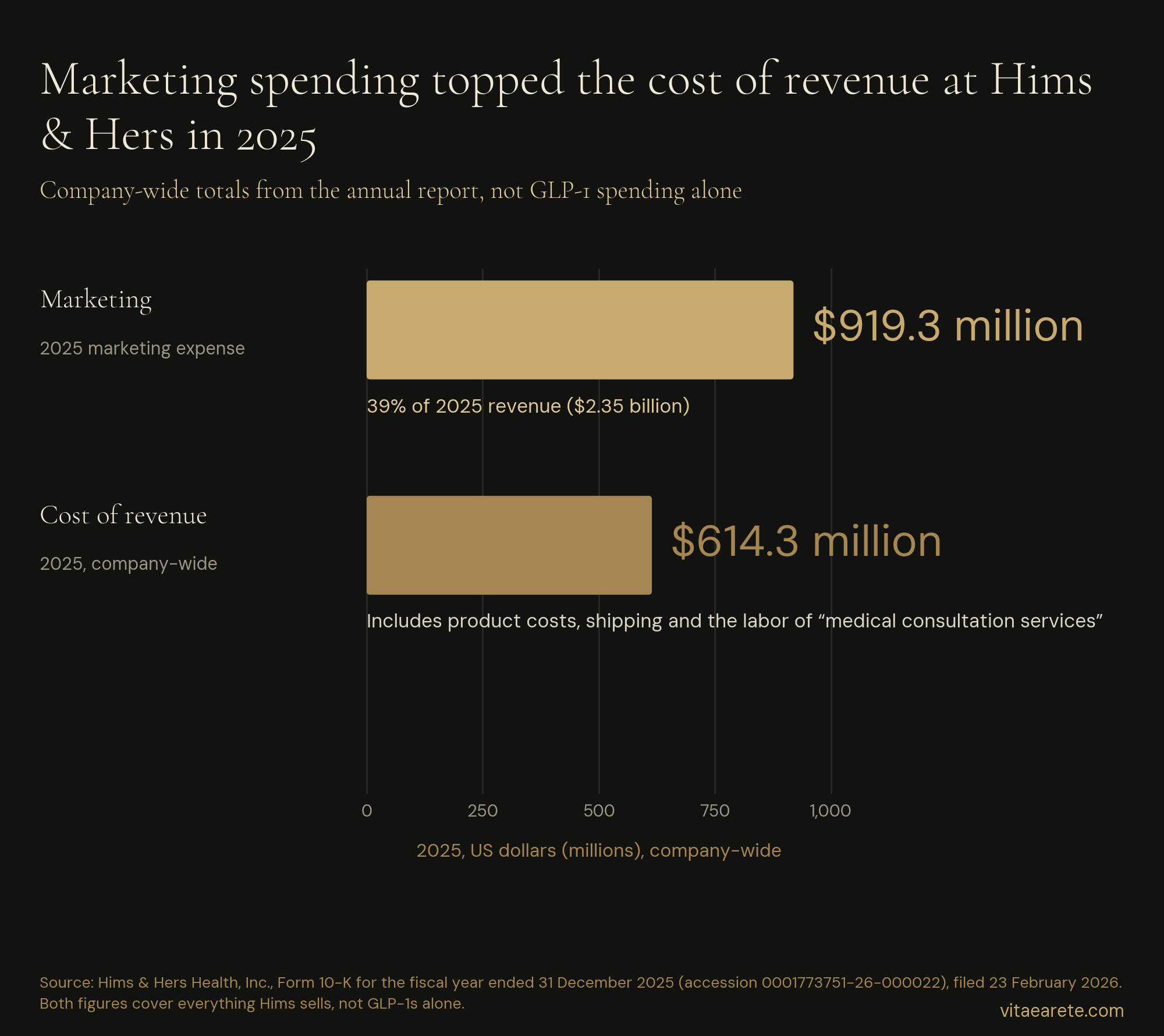
Hims & Hers spent $919.3 million on marketing in 2025. That was more than its entire $614.3 million cost of revenue (products, shipping, consultations). Both figures are company-wide. Its annual report warns that state kickback laws (rules against paying for referrals) can in some cases apply even when customers pay cash. That is a warning to investors, not an admission.
Several online companies that offer GLP-1 drugs publish what they will pay for a new customer. The figures are not hidden. They sit on pages written for the people these companies want to recruit. Those people include influencers, personal trainers, dietitians and licensed clinicians. Two websites call their recruits agents.
As those pages read on 23 September 2026, one program paid $75 for each new customer an affiliate referred. Another paid $100 a sign-up. A third offered $15 a month for every month a referred customer stayed active. A fourth listed $30 a purchase on its affiliate page and $60 an order in the contract behind that page’s sign-up button. A fifth offered licensed clinicians a commission on every patient referred. It did not say how much.
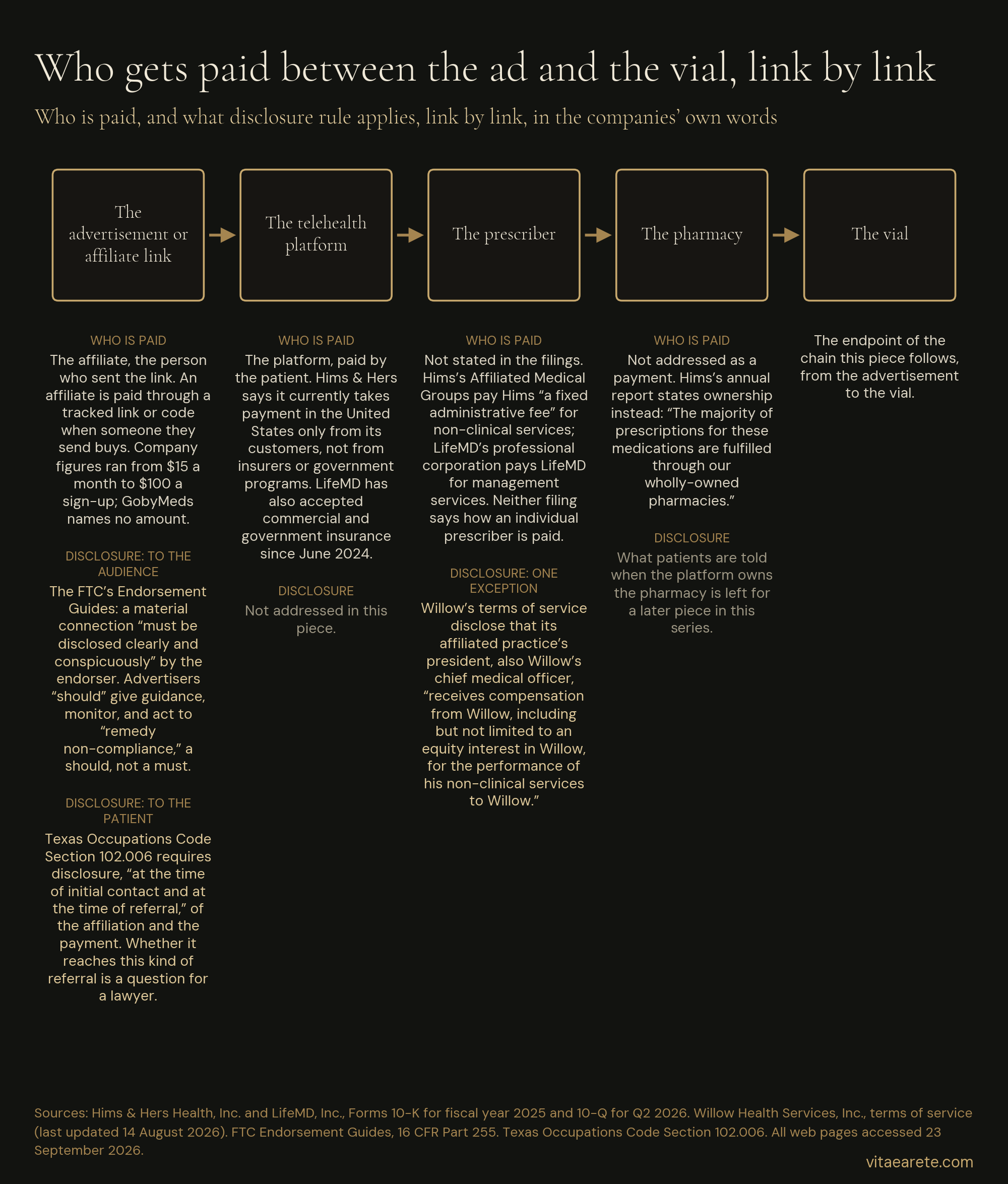
This piece follows that money from the advertisement to the vial. At each link it asks who is paid, for what, on whose document, and which rule, if any, says you have to be told. It does not claim that any of these arrangements is illegal. It does not claim that any payment led anyone to be prescribed anything. The documents cannot carry those claims, and I will say where they stop.
Before I name anyone
I am a registered dietitian, and I have commercial interests near this market, so they come first. My practice, Vitae Arete, is private pay, and its services include GLP-1 and weight-loss care. That puts me in the same market as some companies below. I offer GLP-1 practice guides to clinics, including practices that prescribe these drugs, and a $29 GLP-1 guide to consumers. None of the clinic guides has sold as of 2 October 2026. I also have a practitioner store on Fullscript, the supplement dispensing platform, and it would pay me a margin on supplements sold through it. As of 30 September 2026 the store has made no sales. Of everything in my own business, that margin is the closest thing to what this piece describes. Read what follows with it in mind.
Apart from book royalties from Amazon, which runs One Medical and Amazon Pharmacy, I have no commercial relationship with any GLP-1 telehealth company. No affiliate program, no referral fees. Setting aside broad index funds, I hold no shares directly in Hims & Hers, LifeMD, Medifast, Amazon, Novo Nordisk or Eli Lilly.
The person who sent you
Start with whoever sent you the link. In this market that person is usually called an affiliate. An affiliate is paid through a tracked link or code when someone they send buys. Unless I say otherwise, each figure below is from the company’s own page or contract terms, as they read on 23 September 2026.
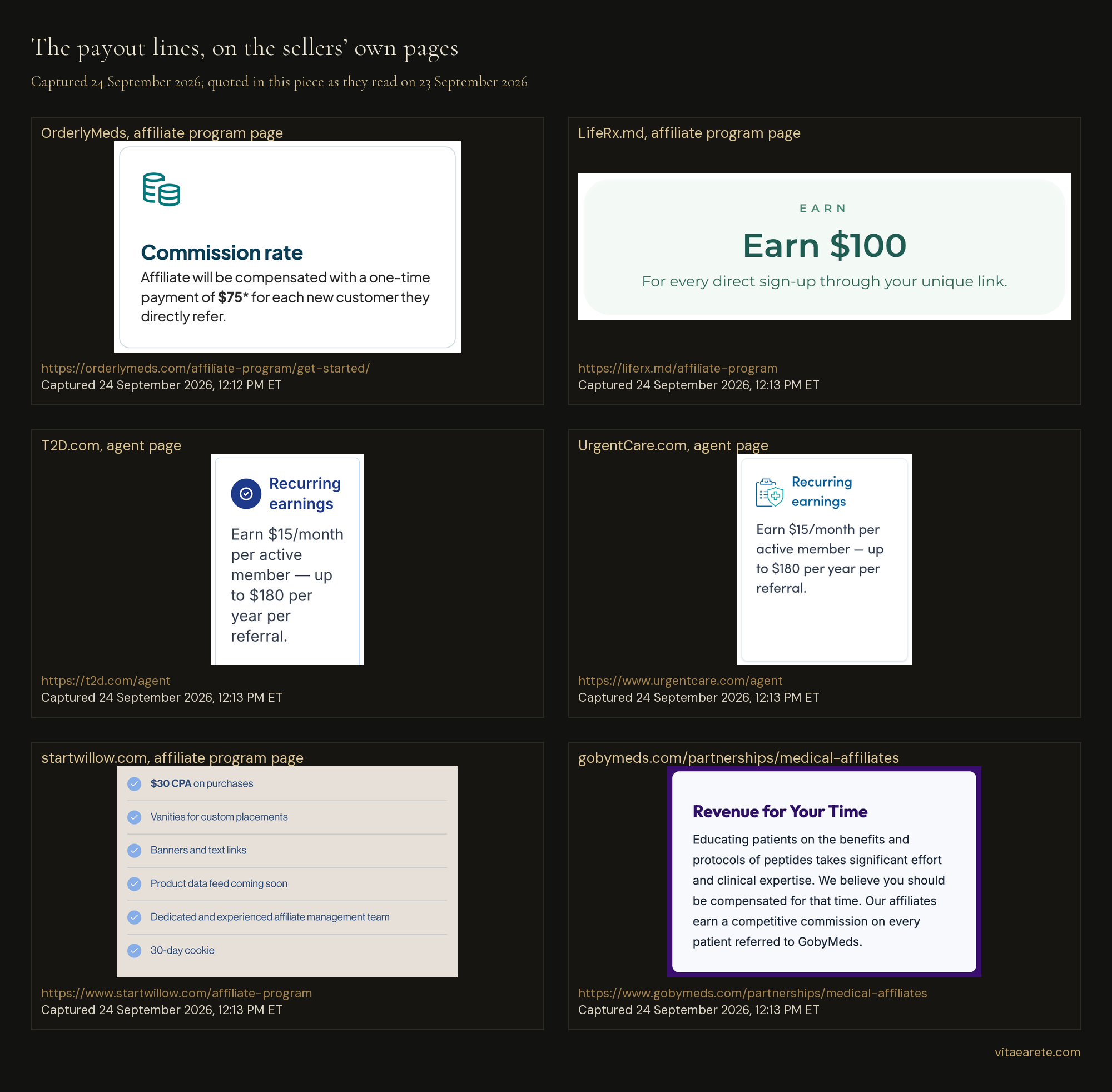
OrderlyMeds offered affiliates “a one-time payment of $75” for each new customer. It also offered “$25” for “any customer of an affiliate they onboard,” so an affiliate who recruits another affiliate earns on that recruit’s customers as well. The page lists the audiences it looks for. Two are “Fitness (personal trainers)” and “Dietitians/meal planning.” The second is my profession.
LifeRx.md offered “$100 For every direct sign-up through your unique link.” Its separate advocates site offered “$100 For every customer close” and “$50 Off for your followers.” LifeRx.md is based in Cherry Hill, New Jersey. It is not LifeMD.
T2D.com and UrgentCare.com run agent pages built on one template. Both offered “$15/month per active member,” or “up to $180 per year per referral.” Both told recruits that GLP-1 users “typically remain in treatment” for six to twelve months or more, “providing reliable recurring income.” Neither page says what license an agent holds. Nor could I identify who runs them.
Willow Health Services, Inc., which operates startwillow.com, published two figures. Its affiliate page offered “$30 CPA on purchases,” a flat payment per purchase. The contract terms behind that page’s sign-up button, on the affiliate network Impact, listed “$60.00 per order.” Those terms “can be changed or cancelled with 1 day(s) notification.” I do not know which figure applies. I could not tell from the contract whether the $60 is paid only on a first order.
GobyMeds ran two programs. The consumer program offered commissions that are “flat-rate for each first-time customer.” The other, under the heading “Expand Your Practice. Monetize Your Expertise,” is for “Nurse Practitioners, MDs, DOs, PAs, Physical Therapists, and other licensed healthcare providers.” Its affiliates, it says, “earn a competitive commission on every patient referred to GobyMeds.” Recurring pay for return customers can be discussed “on a case-by-case basis.” The company supplies links and materials. “There is no software to install,” the page says, and “you simply pass them to the patient during or after their consultation.” Neither page states an amount.
Eden, whose trainer program I wrote about on 24 September, offered trainers “$50 for each qualifying new-client order” when I captured its page on 17 September.
None of this is secret. The public companies say less. Hims & Hers and LifeMD describe affiliate or influencer marketing in their filings, but neither filing gives a rate per customer. When I searched on 23 September 2026, I found no first-party affiliate page for either. Third-party directories list figures for both. I have not used them, because I could not trace them to the companies.
What the FTC’s Endorsement Guides say about telling you
The federal guidance here is the FTC’s Endorsement Guides, last revised in July 2023. They are not a rule. They are the Commission’s reading of Section 5 of the FTC Act, the law against unfair and deceptive practices. Practices that do not match them “may result in corrective action by the Commission.”
For the person being paid, the duty is a must. When a connection between endorser and seller “might materially affect the weight or credibility of the endorsement,” and the audience would not expect it, “such connection must be disclosed clearly and conspicuously.” Online, “the disclosure should be unavoidable.” The bar is low. A material connection “needs to be disclosed when a significant minority of the audience” does not understand or expect it.
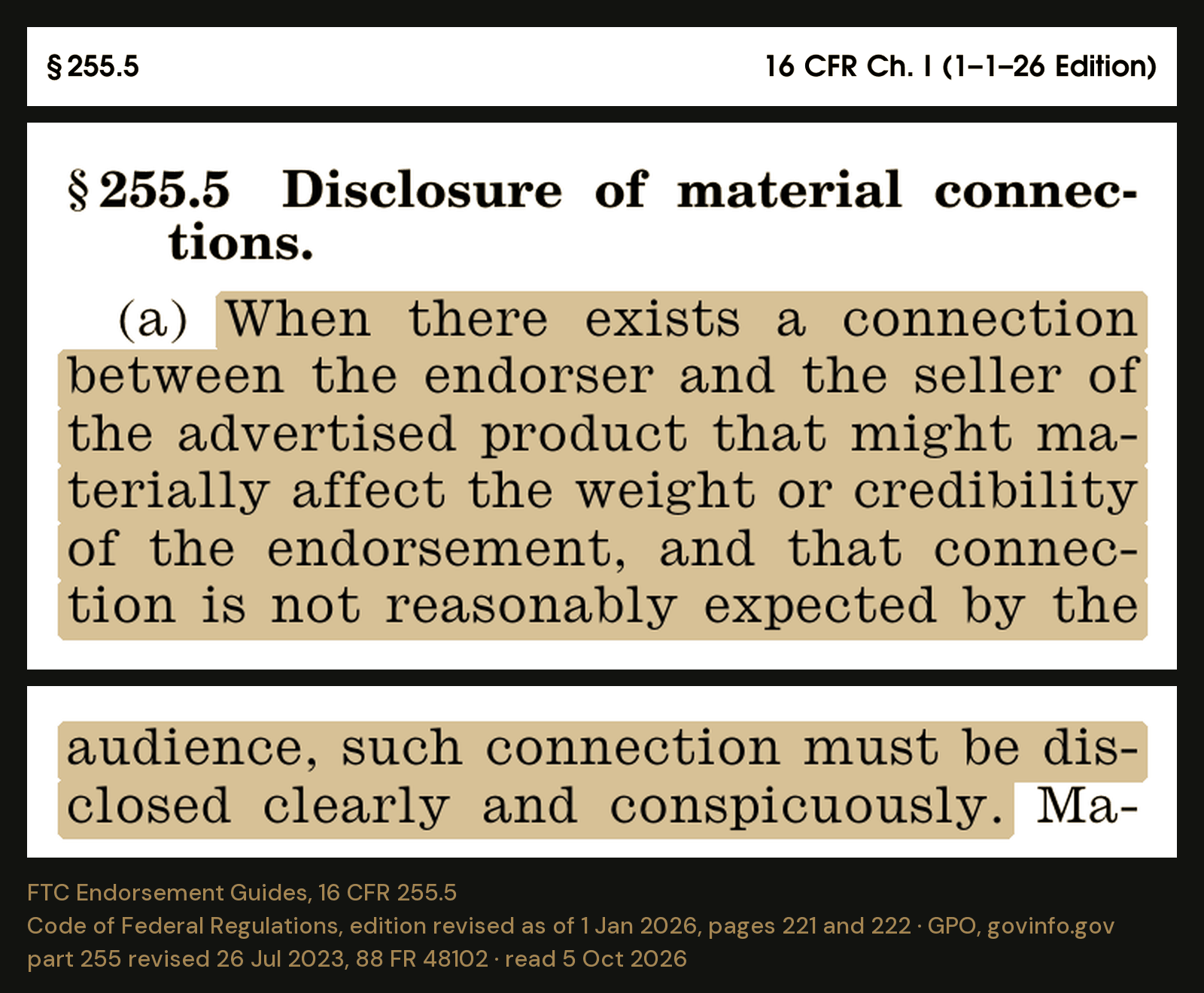
For the company paying, the verb changes. Advertisers “should” give their endorsers guidance on the need “to disclose unexpected material connections,” monitor them, and act to “remedy non-compliance.” That is a should, not a must. The same section adds that an advertiser “may be liable for a deceptive endorsement even when the endorser is not liable.”
Two worked examples in the Guides fit this market. In one, about a physician, the Guides say consumers “are unlikely, however, to expect that an expert endorser like the physician receives a percentage of gross product sales.” In the other, a review site takes no money for its rankings but earns money from affiliate links. It “should clearly and conspicuously disclose that it receives such payments.” If you picked a telehealth company from a list of best GLP-1 providers, that example is about the list. GobyMeds says it sometimes approves GLP-1 “comparison sites” as affiliates, if they “have appropriate disclaimers.”
So what do these programs tell the people they pay?
Of the documents I read, the OrderlyMeds Partner Agreement says the most. It cites the Guides by number and tells affiliates: “you must clearly and conspicuously disclose your material connection with the Company.” The disclosure must be “visible to the reader before any Link is clicked.” The agreement even supplies a sentence: “I may earn a fee if you purchase through this link.” Eden, as I reported in September, wrote a disclosure into the messages it gives trainers. Hims & Hers says it contracts with and monitors its influencers’ posts. It also warns investors that they “may fail to comply with our content-related requirements.”
I searched the other programs’ public pages on 23 September 2026 for any instruction to disclose, using terms that included disclose, FTC, endorse and sponsored. That meant Willow’s affiliate page and its Impact contract terms, both GobyMeds pages, the T2D.com agent page and both LifeRx.md pages. I found none. That finding is narrow. The agreements a new affiliate signs may say more, and apart from Willow’s contract terms, I have not seen them.
The OrderlyMeds agreement also addresses the word referral. The company’s public page describes the $75 as payment “for each new customer they directly refer.” The agreement calls what it pays affiliates a “marketing services fee.” It also has a clause headed “No Referrals,” which says the fees “are not meant to encourage, persuade, prompt, or induce anyone to seek any medical consultation or prescription.” Both texts are the company’s own. I am setting them side by side and leaving them there. I asked OrderlyMeds about them.
The patient is a separate audience. I read two sets of patient terms, Willow’s and GobyMeds’, and searched both on 23 September 2026 for any sign that someone who sent the patient might be paid. I used nine search terms, among them referral, commission and affiliate in their root forms, and read every hit. Neither document mentions it. Hims’s patient terms, searched the same day for influencer, endorse and sponsor, have none of that language either. That is not where the Guides put the duty, which travels with the endorsement. And I searched only those three documents, not checkout pages or consent forms.
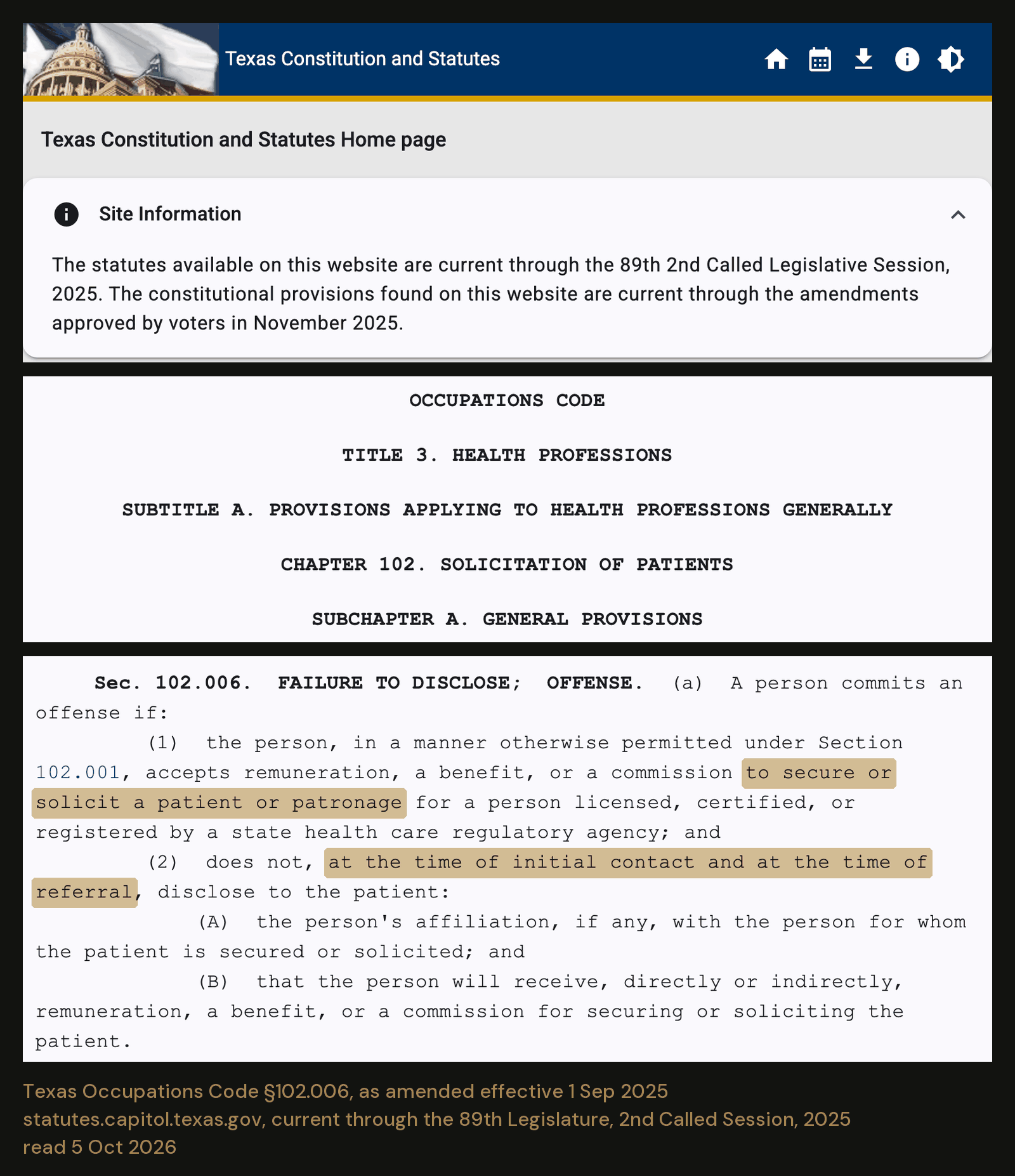
Texas does write a duty to the patient into law. Its Occupations Code, at §102.006, covers someone paid “to secure or solicit a patient or patronage” for anyone licensed, certified or registered by a state health care regulatory agency. Where the law otherwise allows the arrangement, it is an offense not to tell the patient. The disclosure must come “at the time of initial contact and at the time of referral.” It covers any affiliation and the payment itself. Whether that reaches a person paid to send a customer to a telehealth company depends on who, legally, the customer is being secured for. It could be the licensed prescriber or pharmacy. Or it could be a platform that is not itself licensed. That is a question for a lawyer. I have not asked one. Nothing here applies the statute to any company named.
The FTC has applied this logic in the GLP-1 market. In its case against the telehealth company NextMed, it alleged that the company “used fake and false testimonials” and “failed to disclose material connections with testimonialists.” One before-and-after testimonial, the complaint alleged, showed the mother of a company officer. Another, it alleged, showed an officer himself. The respondents neither admitted nor denied the allegations. On 3 December 2025 the Commission approved a final order with a $150,000 payment, expected to fund refunds. The order also requires any “Unexpected Material Connection” with an endorser to be disclosed clearly, conspicuously and close to the claim.
What the platforms spend to find you
Hims & Hers, listed on the New York Stock Exchange, spent $919.3 million on marketing in 2025, according to its annual report. That was 39 percent of its $2.35 billion in revenue. It was also more than the $614.3 million it booked as its entire cost of revenue. By the company’s own definition, that line includes product costs, shipping and the labor of “medical consultation services.” Both figures cover everything Hims sells, not GLP-1s alone. Its annual report and its mid-2026 quarterly report both name affiliate marketing among the drivers of its rising customer acquisition costs. Neither says how much went to affiliates. I searched both on 23 September 2026 for a separate figure and found none.
LifeMD, listed on Nasdaq, spent $86.1 million on selling and marketing in 2025. That was about 44 percent of its $194.1 million in telehealth revenue. It lists “influencers” among its channels. Its figures also cover the whole company. Unlike Hims, LifeMD has accepted commercial and government insurance for its virtual primary care since June 2024.
Both companies say they have moved toward branded drugs. Since March 2026, Hims says, it has offered access to compounded GLP-1 products “through the platform on a limited scale.” LifeMD says it moved its weight-management program toward “branded medications through insurance navigation.” The branded half of the market has payments of its own. I have not traced them. Nothing here maps that half.
The prescriber and the pharmacy
Between the platform and the vial sit a prescriber and a pharmacy. Here the money is hardest to see.
Hims’s annual report says the clinicians on its platform are employed by or contracted to “Affiliated Medical Groups” that “were incorporated and established with our assistance.” Each group pays Hims “a fixed administrative fee” for non-clinical services, including “access to a line of credit.” Hims is their “exclusive” administrator, on initial terms that generally run ten years. It consolidates the groups in its accounts because, “for accounting purposes,” it is their “primary beneficiary.” The same filing says Hims “determines which Affiliated Medical Group and Provider provides the consultation” and “sets all listed prices.” It also says the groups “retain sole control of clinical decision-making and the practice of medicine.” Both halves are in the filing. I am quoting both.
LifeMD describes a similar structure: a physician-owned professional corporation that pays LifeMD for management services and is “solely responsible for practicing medicine and all clinical decision-making.”
Neither filing says how an individual prescriber is paid. I searched both annual reports on 23 September 2026 for phrases such as “per consult,” “per visit” and “per prescription,” and found nothing. So I say nothing about prescriber pay.
One patient-facing document does disclose a payment on this link. Willow’s terms of service, last updated 14 August 2026, say that the president of its affiliated medical practice is Willow’s chief medical officer. They say he “receives compensation from Willow, including but not limited to an equity interest in Willow, for the performance of his non-clinical services to Willow.” The same terms say Willow “does not own the Medical Practice.”
Then the pharmacy. Hims’s annual report says that “The majority of prescriptions for these medications are fulfilled through our wholly-owned pharmacies.” What changes when the platform owns the pharmacy, and how plainly patients are told, is for a later piece in this series.
What Hims & Hers told its shareholders
Hims & Hers says that in the United States it currently takes payment only from its customers, not from insurers or government programs. Given that, its annual report says, the federal anti-kickback law and other laws “tied to federal health care programs or commercial insurer reimbursement should not apply to our business.”
Its risk factors, repeated word for word in its quarterly report for mid-2026, then say this:
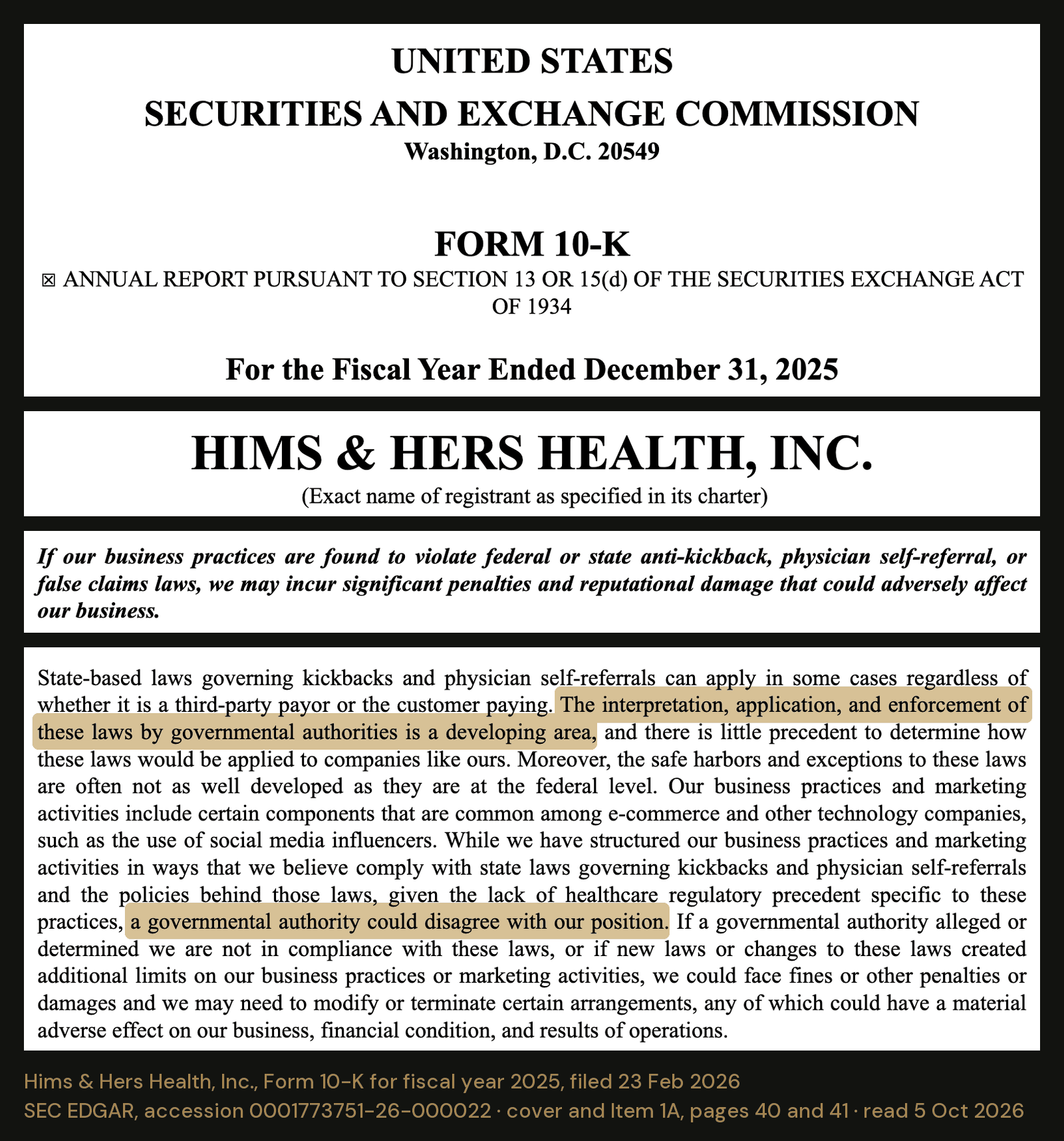
“State-based laws governing kickbacks and physician self-referrals can apply in some cases regardless of whether it is a third-party payor or the customer paying. The interpretation, application, and enforcement of these laws by governmental authorities is a developing area, and there is little precedent to determine how these laws would be applied to companies like ours. ... Our business practices and marketing activities include certain components that are common among e-commerce and other technology companies, such as the use of social media influencers. While we have structured our business practices and marketing activities in ways that we believe comply with state laws governing kickbacks and physician self-referrals and the policies behind those laws, given the lack of healthcare regulatory precedent specific to these practices, a governmental authority could disagree with our position.”
That is a risk factor. Companies write them to warn investors about what could go wrong. A risk factor is not an admission. Hims says it believes it complies. But look at what the passage puts in writing. State kickback laws can, in some cases, reach a customer who pays cash. There is little precedent for how they apply to a company like this one. And social media influencers sit inside that question.
Hims is not alone in saying so. LifeMD, which does take insurance, writes in its own annual report that “The majority of states also have anti-kickback laws.” Those laws, it says, “in some cases may apply to items or services reimbursed by any third-party payor, including commercial insurers and self-pay patients.” The count of states is LifeMD’s.
The same Hims passage holds the best case for the other side. Paying people to recommend a product is ordinary commerce, and Hims is right that it is common across e-commerce. A licensed clinician still has to write every prescription, and nothing here says any clinician’s judgment was moved by a payment. The open question is whether state laws on paying for patients treat a patient who pays cash like any other online customer. I covered Florida’s patient brokering statute in the Eden piece. On 23 September 2026 I searched the CourtListener case law database for any court reading of that statute in cash-pay telehealth. I found none. CourtListener is not complete, and I did not search the paid databases.
The FTC’s current case against Hims is about something else. On 29 July 2026 the FTC, joined by Utah and by California through Los Angeles County Counsel, sued Hims & Hers in federal court. The FTC says the suit alleges that Hims shared consumers’ health information with advertising platforms despite promising privacy, and misled users about billing and cancellation. Those are allegations. The case is pending. It is not an endorsement case, and the influencer post the complaint reproduces carries an ad label. But the complaint describes the channel. “Since at least 2019, Hims has solicited and paid influencers to promote Hims’ products and services,” it says. It says Hims “reviewed, edited,” and had “final approval over the advertisements published by influencers.” The complaint treats those posts as advertising that Hims publishes.
What I cannot tell you
I cannot tell you that any affiliate, agent, trainer or clinician in these programs failed to disclose a payment. I did not look at their posts or their conversations. I have no evidence either way.
I cannot tell you that any payment here led anyone to a prescription, or that any arrangement here breaks a law. No lawyer has read this piece.
Apart from the monthly payment at T2D.com and UrgentCare.com, I cannot tell you whether any of these programs pays again when a customer refills. That is the difference between a one-time fee and an income stream, and I asked.
Every payout figure here comes from a page that can change, and Willow’s contract terms can change on a day’s notice. The pages were captured and dated on 23 September 2026 and checked again before publication. The captures are kept.
I asked them
On 24 September I wrote to OrderlyMeds, GobyMeds, Willow and LifeRx.md, and to Hims & Hers and LifeMD. I also wrote to the addresses UrgentCare.com publishes and to the support address on T2D.com’s contact page. I quoted each company the language and figures this piece takes from its own documents, with the date I captured them. I asked whether each figure was current and whether it is paid on renewals as well as first orders. I asked what each company requires its affiliates to disclose, and where, and whether anything I had was wrong. I asked the two public companies whether they wanted to add to what I quote from their filings. I set a deadline of 5 p.m. Eastern on 2 October and offered to print each answer in full or in summary. On 4 October GobyMeds wrote back that it would answer by the next day. By the evening of 5 October no answer had arrived. None of the others had answered.
What comes next
The next piece looks at what changes when the platform owns the pharmacy. After it come three more. One asks who has the power to act on any of this, and one adds up what a month costs once every fee is counted. The last reads the federal court rulings on whether a prescriber’s decision breaks the chain between a telehealth company’s advertising and a drugmaker’s lost sale.
This is general education and a reading of public documents. It is not legal advice or individual medical advice, and nothing here is a claim that any company or person named has broken a law. Decisions about your own treatment belong with your own clinician.
References
Federal Trade Commission. Guides Concerning the Use of Endorsements and Testimonials in Advertising, 16 CFR Part 255 (§§255.0, 255.1, 255.4, 255.5). Electronic Code of Federal Regulations. Revised effective 26 July 2023. https://www.ecfr.gov/current/title-16/part-255 (accessed 23 September 2026)
Federal Trade Commission. Guides Concerning the Use of Endorsements and Testimonials in Advertising (final revised Guides). Federal Register, 88 FR 48092. 26 July 2023. https://www.federalregister.gov/documents/2023/07/26/2023-14795/guides-concerning-the-use-of-endorsements-and-testimonials-in-advertising (accessed 23 September 2026)
Federal Trade Commission. In the Matter of Southern Health Solutions, Inc., d/b/a NextMed: Complaint and Decision and Order. FTC case page. Final order approved 3 December 2025. https://www.ftc.gov/legal-library/browse/cases-proceedings/nextmed (accessed 23 September 2026)
Federal Trade Commission. FTC Approves Final Order against Telehealth Provider NextMed Over Charges It Used Deceptive Advertising Claims to Sell GLP-1 Weight-Loss Programs. Press release. 3 December 2025. https://www.ftc.gov/news-events/news/press-releases/2025/12/ftc-approves-final-order-against-telehealth-provider-nextmed-over-charges-it-used-deceptive (accessed 23 September 2026)
Federal Trade Commission, et al. v. Hims & Hers Health, Inc., No. 3:26-cv-07871-VC (N.D. Cal.). Complaint, filed 29 July 2026 (Doc. 1), and complaint filed 18 August 2026 (Doc. 28). FTC case page. https://www.ftc.gov/legal-library/browse/cases-proceedings/hims-hers (accessed 23 September 2026)
Hims & Hers Health, Inc. Annual Report on Form 10-K for the fiscal year ended 31 December 2025. U.S. Securities and Exchange Commission, accession 0001773751-26-000022. Filed 23 February 2026. https://www.sec.gov/Archives/edgar/data/1773751/000177375126000022/hims-20251231.htm (accessed 23 September 2026)
Hims & Hers Health, Inc. Quarterly Report on Form 10-Q for the quarter ended 30 June 2026. U.S. Securities and Exchange Commission, accession 0001773751-26-000163. Filed 10 August 2026. https://www.sec.gov/Archives/edgar/data/1773751/000177375126000163/hims-20260630.htm (accessed 23 September 2026)
Hims & Hers. Terms and Conditions. Last updated 31 August 2026. https://www.hims.com/terms-and-conditions (accessed 23 September 2026)
LifeMD, Inc. Annual Report on Form 10-K for the fiscal year ended 31 December 2025. U.S. Securities and Exchange Commission, accession 0001493152-26-009549. Filed 10 March 2026. https://www.sec.gov/Archives/edgar/data/948320/000149315226009549/form10-k.htm (accessed 23 September 2026)
Orderly Meds LLC. Join the Affiliate Program at Orderly Meds. Undated web page. https://orderlymeds.com/affiliate-program/get-started/ (accessed 23 September 2026)
Orderly Meds LLC. Affiliate Program Terms and Conditions (Partner Agreement). Undated web page. https://orderlymeds.com/affiliate-program-terms-conditions/ (accessed 23 September 2026)
Goby Health LLC (GobyMeds). GobyMeds Affiliate Program for Medical Professionals. Undated web page. https://www.gobymeds.com/partnerships/medical-affiliates (accessed 23 September 2026)
Goby Health LLC (GobyMeds). GobyMeds Affiliate Program. Undated web page. https://www.gobymeds.com/partnerships/affiliates (accessed 23 September 2026)
Goby Health LLC (GobyMeds). Terms of Service. Last updated 17 June 2026. https://www.gobymeds.com/legal/terms-of-service (accessed 23 September 2026)
Willow Health Services, Inc. Willow Affiliate Program. Undated web page. https://www.startwillow.com/affiliate-program (accessed 23 September 2026)
Willow Health Services, Inc. Contract Terms for Willow (partner sign-up terms on Impact). Undated. https://app.impact.com/campaign-promo-signup/Willow.brand (accessed 23 September 2026)
Willow Health Services, Inc. Terms of Service. Last updated 14 August 2026. https://www.startwillow.com/terms-of-service (accessed 23 September 2026)
T2D.com. GLP-1 Affiliate Program for Agents. Undated web page. https://t2d.com/agent (accessed 23 September 2026)
UrgentCare.com. GLP-1 Affiliate Program for Agents. Undated web page. https://www.urgentcare.com/agent (accessed 23 September 2026)
LifeRx.md, Inc. LifeRx.md Affiliate Program. Undated web page. https://liferx.md/affiliate-program (accessed 23 September 2026)
LifeRx.md. LifeRx Advocates Program. Undated web page. https://www.liferxadvocates.com/ (accessed 23 September 2026)
Texas Legislature. Texas Occupations Code, chapter 102, §§102.001 to 102.010. Current through the 89th Legislature, 2nd Called Session, 2025. https://statutes.capitol.texas.gov/Docs/OC/htm/OC.102.htm (accessed 23 September 2026)
Florida Legislature. The 2026 Florida Statutes, §817.505, Patient brokering prohibited. https://www.flsenate.gov/Laws/Statutes/2026/817.505 (accessed 23 September 2026)
Free Law Project. CourtListener case law search for §817.505 and telehealth or cash pay (four queries). https://www.courtlistener.com/ (searched 23 September 2026)
Fee J. Your Trainer May Get $50 If You Start a GLP-1. Vitae Arete (Substack). 24 September 2026. https://vitaearete.substack.com/p/your-trainer-may-get-50-if-you-start
This article is general nutrition education, not individualized medical or nutrition advice, and it does not create a dietitian–client relationship. Medications and their side effects should be managed with your prescribing clinician. See the full disclaimer.