Summary
On 16 September 2026 the American Council on Exercise, which certifies personal trainers, sent the people it certifies a newsletter listing a new $149 course on coaching clients who take obesity medicines. The course page ends with an invitation to partner with Eden Health, an online telehealth company. Eden offered trainers $50 for each qualifying new client order. The tracked link went to its page for compounded semaglutide and tirzepatide, pharmacy-made versions of the weight-loss drugs, not the brand-name products.
- Eden’s own homepage says compounded medicines are not approved by the Food and Drug Administration and have not been reviewed for safety, effectiveness or quality. The agency sent Eden a warning letter dated 8 June 2026.
- On 22 September 2026 the advertised $99 a month required a membership. That made it $138 in the first month and $198 a month after. The page then changed.
- Under Florida law this is not a pyramid scheme. It is paid referral marketing. Florida’s ban on paying for patient referrals fits better, but whether it reaches care paid in cash is unsettled. A health care lawyer should say whether it applies.
- The council’s own policy puts recommending or selling supplements outside a trainer’s scope of practice.
- I asked both companies questions. Neither had answered by 24 September 2026. I do not know whether the council is paid by Eden.
Summary added 2 October 2026.
On 16 September the American Council on Exercise sent its certified professionals a newsletter. Among the new courses was one called "Coaching Clients on Obesity Medications." It costs $149 and carries half a continuing education credit.
The course description reads well. It calls obesity a chronic, multifactorial disease. It promises to cover how these medications change physiology, how to program exercise to protect muscle, how to coach behavior change, and how to collaborate with healthcare providers. It tells the reader, more than once, to remain within their scope of practice. If you stopped reading there you would think the fitness industry was taking this seriously, and in fairness, the people who wrote the curriculum may well have been.
Then there is the last line on the page.
"Upon successful completion of this course, you can apply to partner with Eden Health. You will be given access to the tools and resources to help support clients on obesity medications."
I want to be careful here, because everything above that line is unobjectionable, and that line is the reason I am writing. So follow the link.

I should say plainly, before going further, that I am a registered dietitian. I run a cash-pay practice. The argument in this piece, if anyone acted on it, would route work toward the profession I belong to. You should read everything that follows with that in mind. I would rather you weigh it than discover it later.
What is on the other side of that link
The page it opens is headed "Eden × ACE trainer partner pilot." Eden, at eden.health, is a direct-to-consumer telehealth company, and it is not the unrelated primary care company of the same name, which Centivo acquired in 2024.
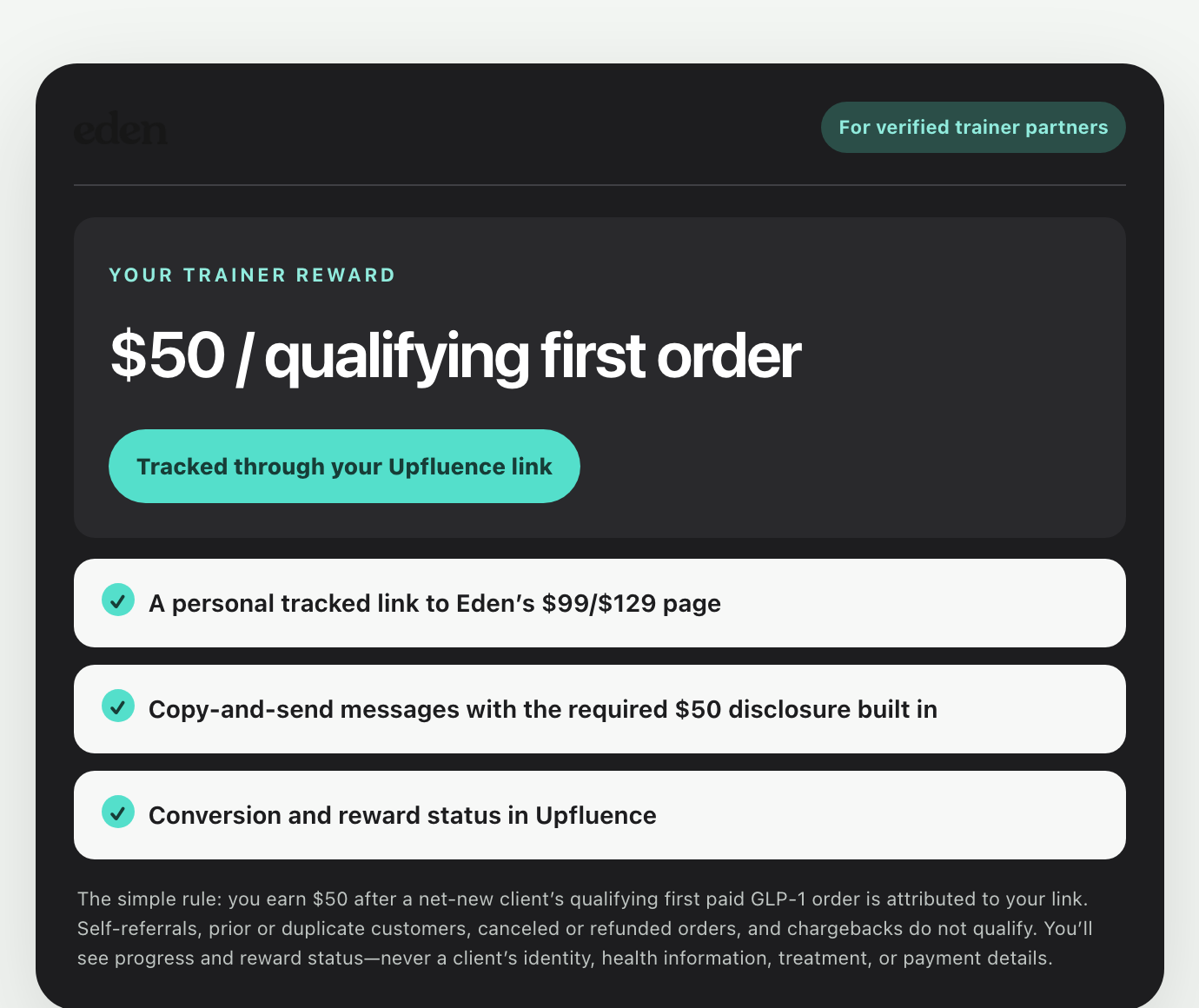
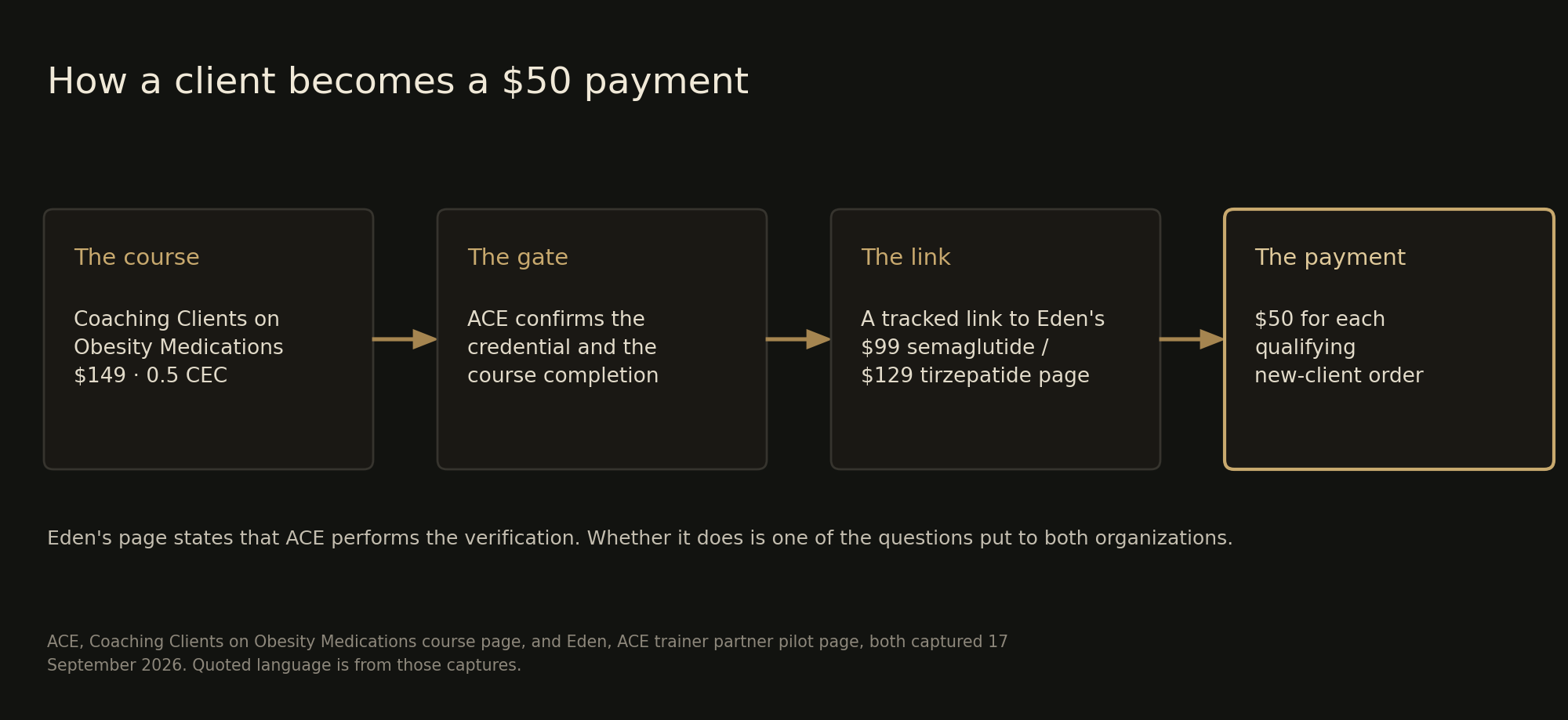
The sequence, in Eden's own words as the page read on 17 September 2026, runs like this. You complete the ACE course and apply. ACE confirms your credential and your course completion. You accept the program terms and receive a personal tracked link to what the page calls Eden's "$99/$129 GLP-1 page." You are given copy-and-send messages to use when a client asks about these drugs. And then:
"Earn $50 for each qualifying new-client order."
The page is not coy about the mechanics. It offers "a personal tracked link to Eden's $99/$129 page," and "copy-and-send messages with the required $50 disclosure built in," and it says that trainers who "consistently create useful education" may be considered for future creator or influencer opportunities. It also tells you to stay in your role: "You guide movement, strength, and habits. Eden's licensed providers handle medical questions and treatment decisions."
Note the word required. The FTC's Endorsement Guides say that someone paid to recommend a product has to disclose the connection clearly and conspicuously. They also say the company paying them should guide its endorsers, monitor their compliance, and act when they fall short. Eden wrote the disclosure into the script, which tells you somebody there has read the rule. Whether it survives the trip into a text message from a person you trust and pay is a different question, and it is not one a dashboard can answer.
One more detail, because it is the one that made me sit up. The application asks for your primary role, and the menu offers personal trainer, health coach, group fitness instructor, strength coach, facility lead, and dietitian or nutritionist. My own profession is on that list.
I also did not find this. Elizabeth R. Bain did. She holds two ACE credentials, has held them since 2011 and 2012, she is board certified through the National Board for Health and Wellness Coaching by a route that has nothing to do with ACE, and she practices law full time. She got the newsletter, followed the same link, and sent it to a group of dietitians because she was, in her word, gobsmacked. I checked every page myself before writing a sentence of this.
Two things about how she went about it. She never bought the ACE course and never applied to the Eden program, so nothing she describes about this arrangement required buying anything. And no part of her income depends on those credentials, which is the reason she was willing to be named. Her renewal comes up in November. She is aware of what that means and said to use her name anyway.
What is actually being sold at the end of the funnel
The trainer page calls the destination "Eden's dedicated $99 semaglutide / $129 tirzepatide page." I went and priced it. On 22 September 2026 that page listed compounded semaglutide at $99 a month and compounded tirzepatide at $199 a month, seventy dollars above the figure the trainer-facing page quotes. Neither number was the price. The asterisk on both read: "Price includes medication only, if prescribed. An active Eden Membership is required ($39 for the first month, auto-renews at $99/month thereafter)." On those terms the advertised $99 was $138 in the first month and $198 a month after that. Then the page changed. By the evening of 23 September it had been redesigned, and it now lists tirzepatide at $129, matching the trainer page, with no membership fees. These are compounded versions, not the branded products, and Eden's own homepage says so in a line I would encourage everyone to read twice:
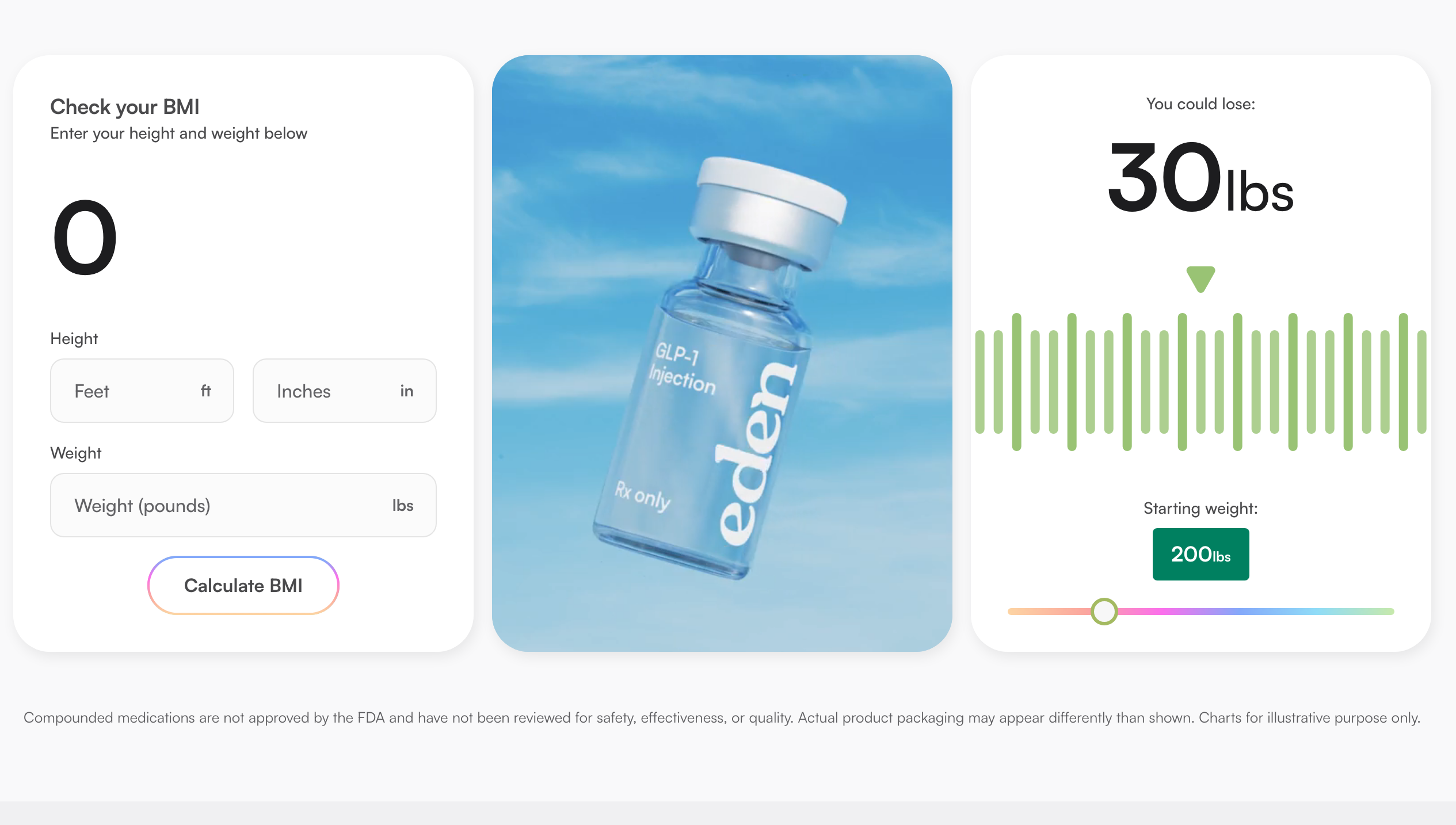
"Compounded medications are not approved by the FDA and have not been reviewed for safety, effectiveness, or quality."
That is not a critic's characterization. That is the seller's own disclaimer, sitting underneath its own marketing.
The same homepage sells the outcome. As of 17 September 2026 it advertised an average weight loss of 29.3 pounds in the first six months, with a footnote attributing the figure to self-reported data from 111 members. Eden's weight-loss page now runs the same claim at 29 pounds. Beside it sits a BMI calculator, and every result routes to the same button: "Check your options." A BMI the page itself places in the healthy range returns an invitation to "explore weight management options that can support a long-term plan." So is a BMI below the healthy range. Every band ends at the same button. The calculator's own footnote says it "does not determine eligibility for weight loss treatments." The FTC's guidance on health products says claims like that require substantiation in the form of competent and reliable scientific evidence, and that as a general matter this means randomized, controlled human clinical testing. Self-reported recall from 111 customers is not that.
The regulatory backdrop matters here, and it has a clock on it. The FDA declared the tirzepatide shortage resolved on 19 December 2024 and the semaglutide shortage resolved on 21 February 2025, with wind-down deadlines for compounders running from February through May 2025. After that, compounding something that is essentially a copy of an approved drug is permitted only where a prescriber documents a significant difference from the commercially available product for an identified individual patient. Then, on 1 May 2026, the FDA proposed excluding semaglutide, tirzepatide and liraglutide from the list of bulk substances that outsourcing facilities may compound at all, having found no clinical need for it. Comments on that proposal closed on 30 July 2026.
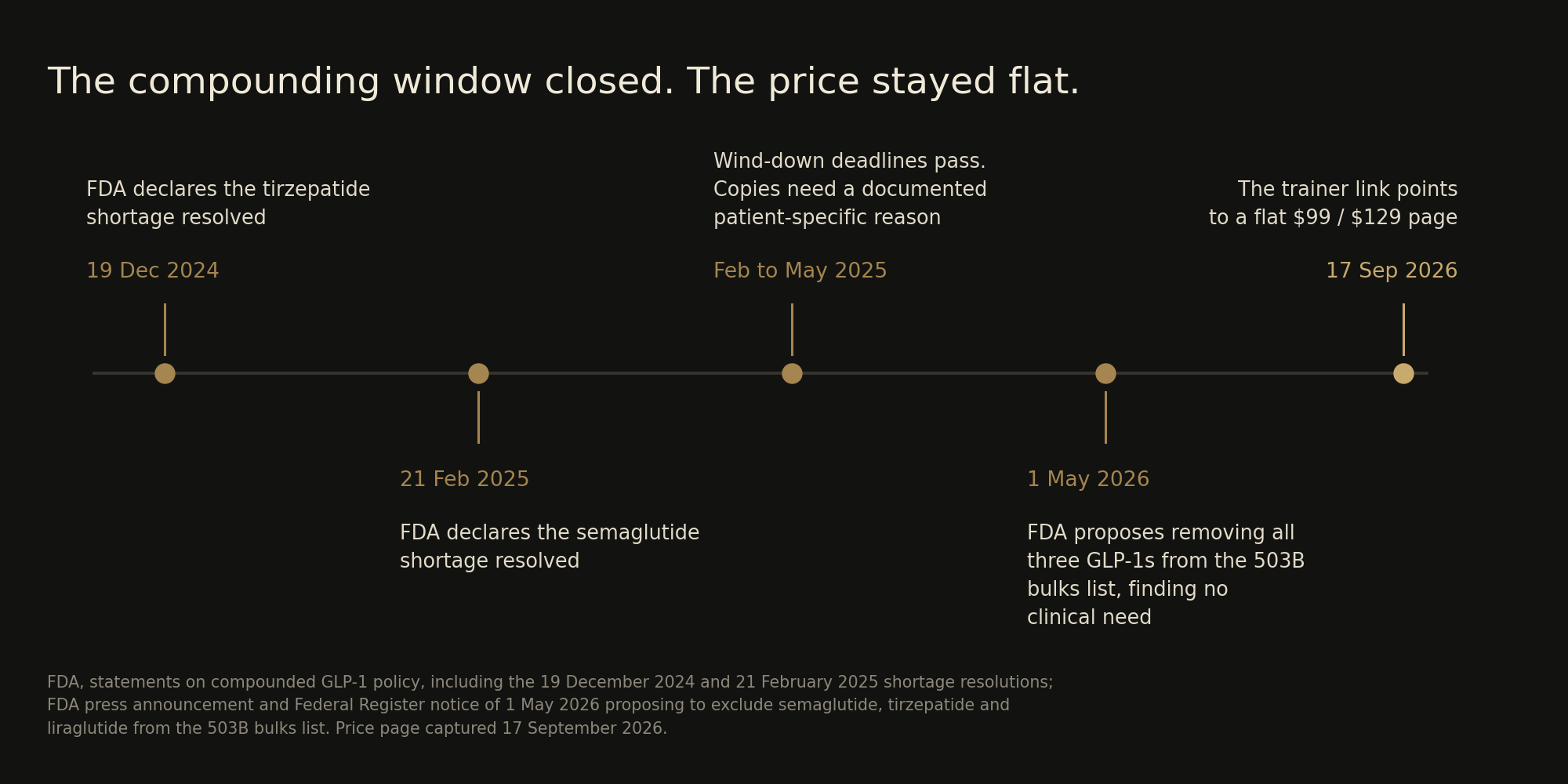
Hold those two facts next to each other. A compounded copy is supposed to exist because an individual patient needs something the approved drug cannot give them. And the product at the end of this particular funnel has a flat price, a marketing page, and an affiliate link.
The FDA has already written to Eden. Its warning letter, dated 8 June 2026, went to Eden Health International, the company behind both eden.health and tryeden.com. It said the compounded semaglutide and tirzepatide pictured on Eden's website carried Eden's name on the label, "suggesting Eden is the compounder of those drugs when in fact it is not." It also objected to the site's claim that its compounded drugs are sourced from "FDA-licensed 503(a) outsourcing facilities." I did not ask Eden about the letter, because I found it after my questions went out.
It is not a pyramid scheme, and the reason matters
When this landed in my inbox, the first phrase attached to it was "pyramid scheme." I understand the instinct. I want to explain why the label is wrong, because getting it wrong is how a real problem gets waved away.
Florida defines this precisely. A pyramid sales scheme is a plan where a person pays more than $100, and gets the chance at a benefit that is "not primarily contingent on the volume or quantity of goods, services, or other property sold in bona fide sales to consumers," and that is tied to "the inducement of additional persons" to join the same plan.
Run the facts against it. The $149 course clears the consideration threshold with room to spare. But the $50 is paid on an actual client's actual order, so the benefit is contingent on a real sale to a real consumer. And nobody is paid for recruiting another trainer. Two of the three elements fail.
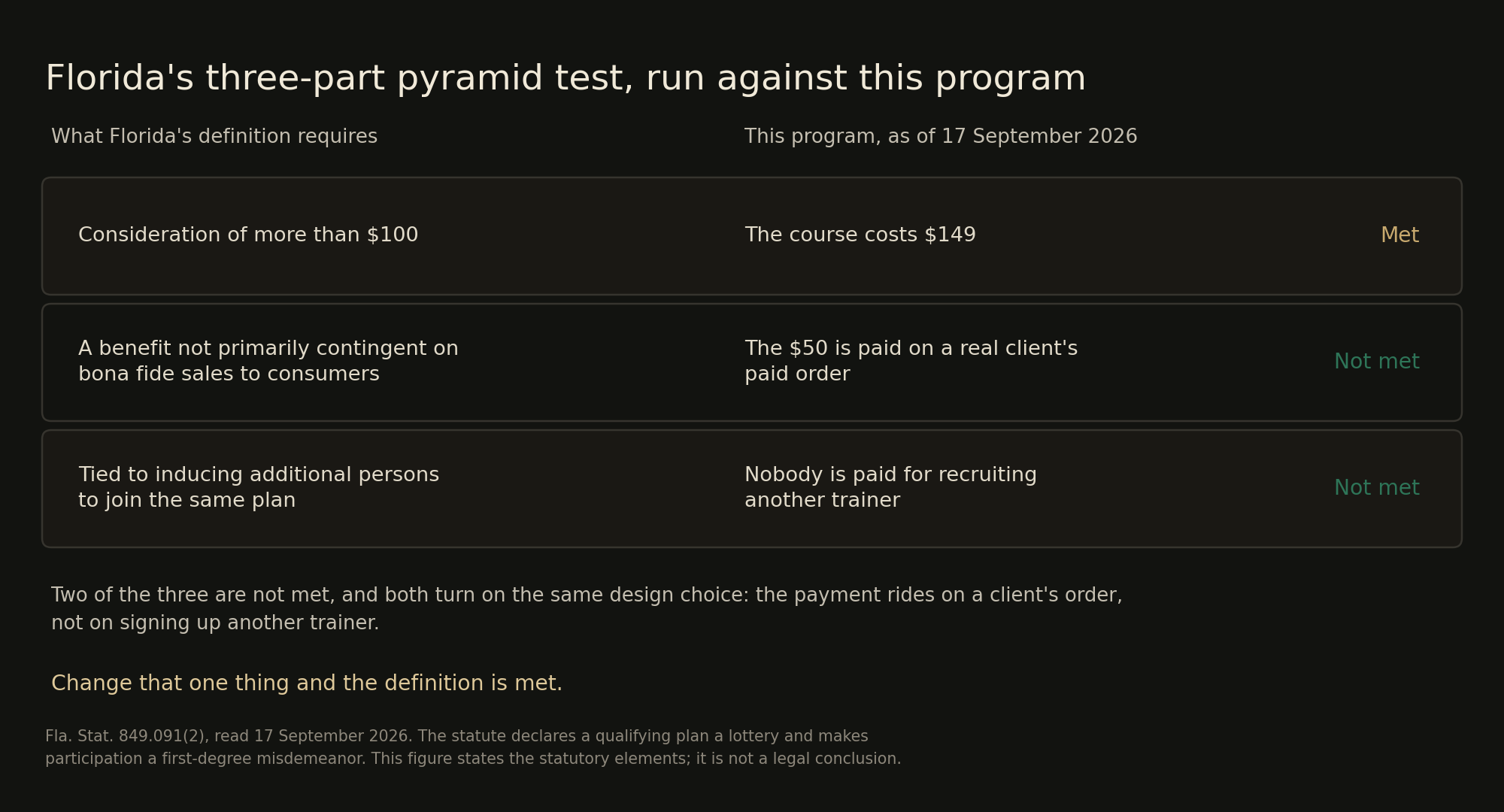
So it is not a pyramid scheme. It is single-tier affiliate marketing, the same mechanic as a promo code on a podcast, pointed at a prescription drug.
What I would say instead is this: it is one compensation change away from the statutory definition. The consideration threshold is already met. If anyone ever gets paid for bringing another trainer into the program, or paid a cut of course sales, the other elements start falling into place. That is a sentence nobody can correct, and it is worse than the label.
The law that does fit
Florida's patient brokering statute makes it unlawful to "offer or pay a commission, benefit, bonus, rebate, kickback, or bribe, directly or indirectly, in cash or in kind" to induce the referral of a patient to a health care provider, and equally unlawful to solicit or receive one. It also reaches anyone who "aids, abets, advises, or otherwise participates" in that conduct. The lowest tier is a third-degree felony carrying a mandatory $50,000 fine, and the penalties escalate with the number of patients involved. The Attorney General can seek an injunction.
Two features of that statute are worth understanding, and one of them cuts against me. Unlike the federal anti-kickback statute, Florida's is not built around Medicare and Medicaid. But whether it reaches a cash-pay arrangement is genuinely unsettled, because the exception at subsection (3)(a) covers any practice "not prohibited by" the federal statute, and the federal statute reaches only federally funded care. That language has been argued to exempt private pay. Two Florida appellate decisions point the other way: one describes the prohibition as "not limited to situations involving Medicaid or federal programs" (State v. Rubio, Fifth District, 2005), and the other reads the exception as covering, at best, only the practices the federal statute expressly exempts (State v. Kigar, Fourth District, 2019). Neither case was about cash pay. The Legislature narrowed it in 2019 and put it back in 2020. The second feature is that the prohibition attaches to the conduct rather than to a credential, so it does not matter whether the person taking the payment holds a license. It does matter, on the other side, whether the referral runs to a health care provider as the statute defines one, which turns on Florida licensure or registration.
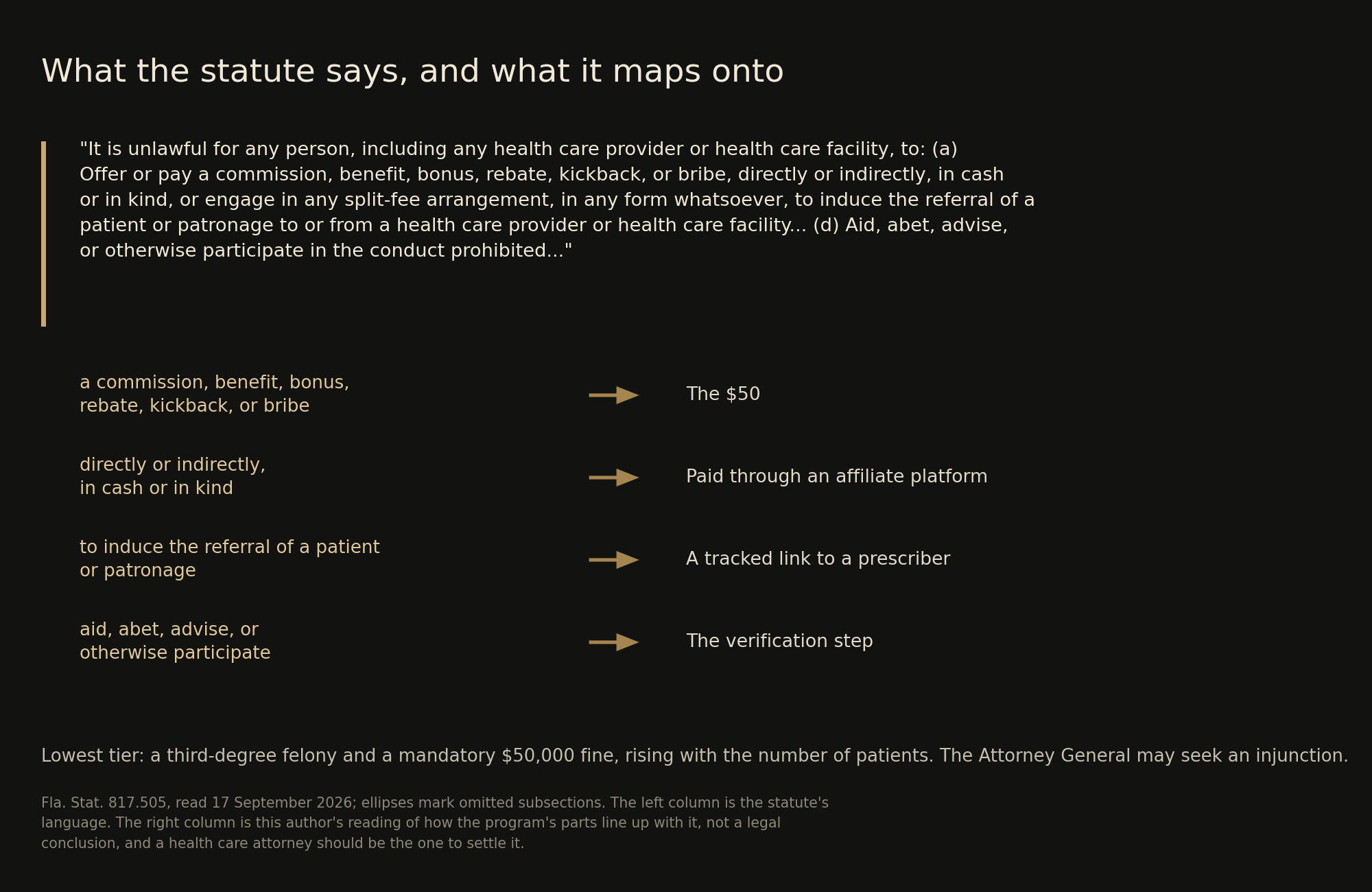
Other states have comparable statutes, and Florida is the one I live under. I am reading a statute here, not practicing law, and a health care attorney should be the one to say whether it reaches this arrangement. But it is the question I would want answered before I built a referral program around a prescription drug, and it is one of the questions I put to both companies.
Underneath all of this is a scope problem that predates the $50
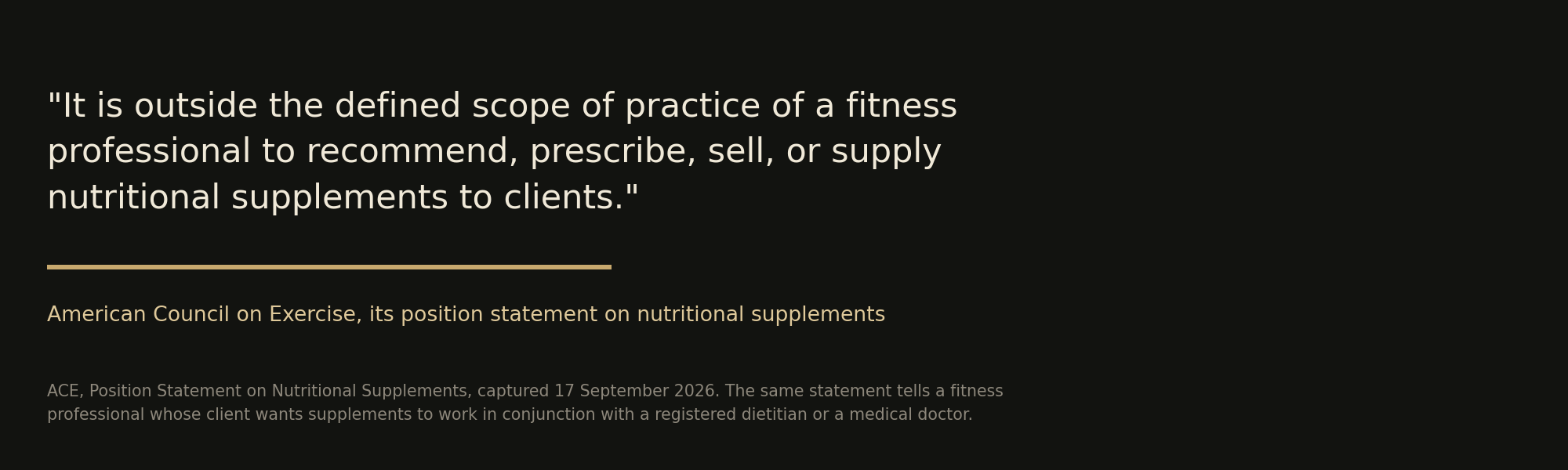
ACE publishes a position statement on nutritional supplements. In its words, it is outside the defined scope of practice of a fitness professional to "recommend, prescribe, sell, or supply nutritional supplements to clients," and a professional whose client wants supplements should "work in conjunction with a qualified registered dietician or medical doctor." ACE's Code of Ethics separately asks professionals to "refer clients to more qualified health or medical professionals when appropriate."
Now put that next to a program that hands the same professionals a tracked link to a prescription medication and $50 an order. If a protein powder is out of bounds, this is not a close call.
There is a further wrinkle, and it is ACE's own. Since 13 September 2023, ACE has required that one of the twenty hours of continuing education in each two-year renewal cycle be in professional conduct and ethics. Most certifying bodies set a number of hours and let you choose the subjects. ACE names this one. Its stated reasons for the requirement include keeping professionals current on "scopes of practice and professional boundaries" and on "ethical and legal business practices." The obesity medications course carries half a continuing education credit and ends at the affiliate link. The same organization sets both.
The law in my state says something similar in less polite language. Florida permits an unlicensed person to provide weight control services where the program has been reviewed by, consultation is available from, and no change can be initiated without the prior approval of a licensed dietitian or nutritionist, a dietitian licensed in another state, or a registered dietitian. That is the arrangement the statute contemplates. Whether this particular program has that review I do not know. I did not find it advertised, and it was not one of the questions I put to either company. It should have been.
How common is the gap between the rule and the practice? It has been measured, though not here. In a 2015 survey of 286 registered exercise professionals in Australia, 88 percent were working outside their scope of practice, giving individual nutrition advice across fitness and medical issues, and 40 percent had done no further nutrition training since qualifying. A 2016 audit of fitness business websites in two Australian federal electorates found that half advertised nutrition services beyond that scope, and among those classified as staying within it, not one mentioned referring a client to a dietitian. On the client side, in a 2021 Australian survey of 455 people, of the 56 percent who had worked with an exercise professional, about half reported receiving clinical nutrition advice.
Two more findings, from two different studies. In 2016, 142 Australian personal trainers rated their own nutrition competence at a mean of 76 percent, which the researchers classify as very confident. Separately, in 2019, on diet-disease relationships specifically, 161 exercise professionals scored 65.4 out of 100 against community members at 68.6 and dietitians at 91.4. The authors tested the dietitians against the other two groups and found a difference. They did not report a test between the exercise professionals and the community members, so the fair way to put it is that on the one domain that matters for a person taking a drug for a chronic disease, the exercise professionals did not separate themselves from the general public. Different people, different years, and neither study is American.
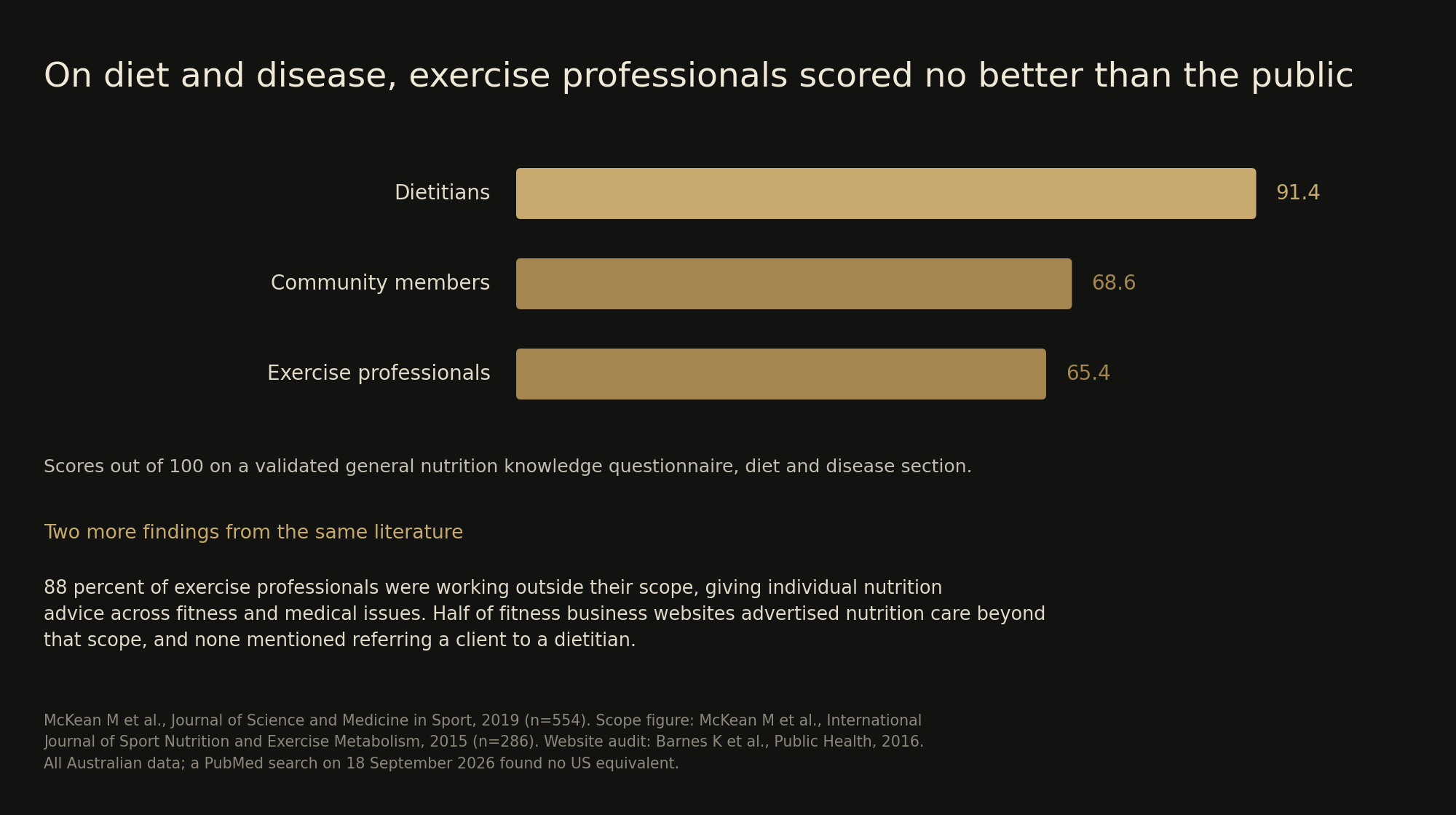
I looked for an American version of these studies and could not find one. That absence is its own finding, and if someone can point me to the study, I will correct this.
What I cannot tell you
I do not know whether ACE receives any money from Eden. I asked.
I do not know whether the verification actually happens. Eden's page says ACE confirms the credential and the course completion, and that a trainer can apply before finishing the course because activation waits for verification. The application asks for your credential and course status rather than proof of either, and whether anyone runs the check is not visible from outside. If it is not run, the $149 course is a storefront rather than a gate. I asked about that too.
I do not know that anyone else is doing this. Bain holds an NASM credential as well, and NASM now owns AFAA. NASM's weight-loss-medication course carries no referral offer on its public page, and she went further than that. Logged in as a credentialed professional, she compared the course page against the public one and found them identical. Then she went through the deals section that only NASM professionals can see, because that is where a branded fitness license she holds puts its partnership offers, and where Yoga Alliance puts them too. What is in there is personal-use discounts on shoes, supplements, software and equipment. There was no offer to partner with a GLP-1 provider and no GLP-1 discount of any kind. ISSA has a GLP-1 course with nothing similar on what is publicly visible. So this is searched and not found, and it was searched in the place where it would have been hiding, which is still not proof that ACE is alone.
I do not know whether any trainer has actually promoted one of these links to a client. That is the difference between a policy problem and a documented practice, and I have not been able to close it. ACE runs no public forum beyond a job board, so there is no obvious place to look, and the program is new enough that few people may hold a link yet. If you have seen one in the wild, send it to me.
And the course does not appear to carry continuing education approval from the Commission on Dietetic Registration. I checked that specifically, because if it did, dietitians would be earning credit from a course that ends at an affiliate link.
I asked them
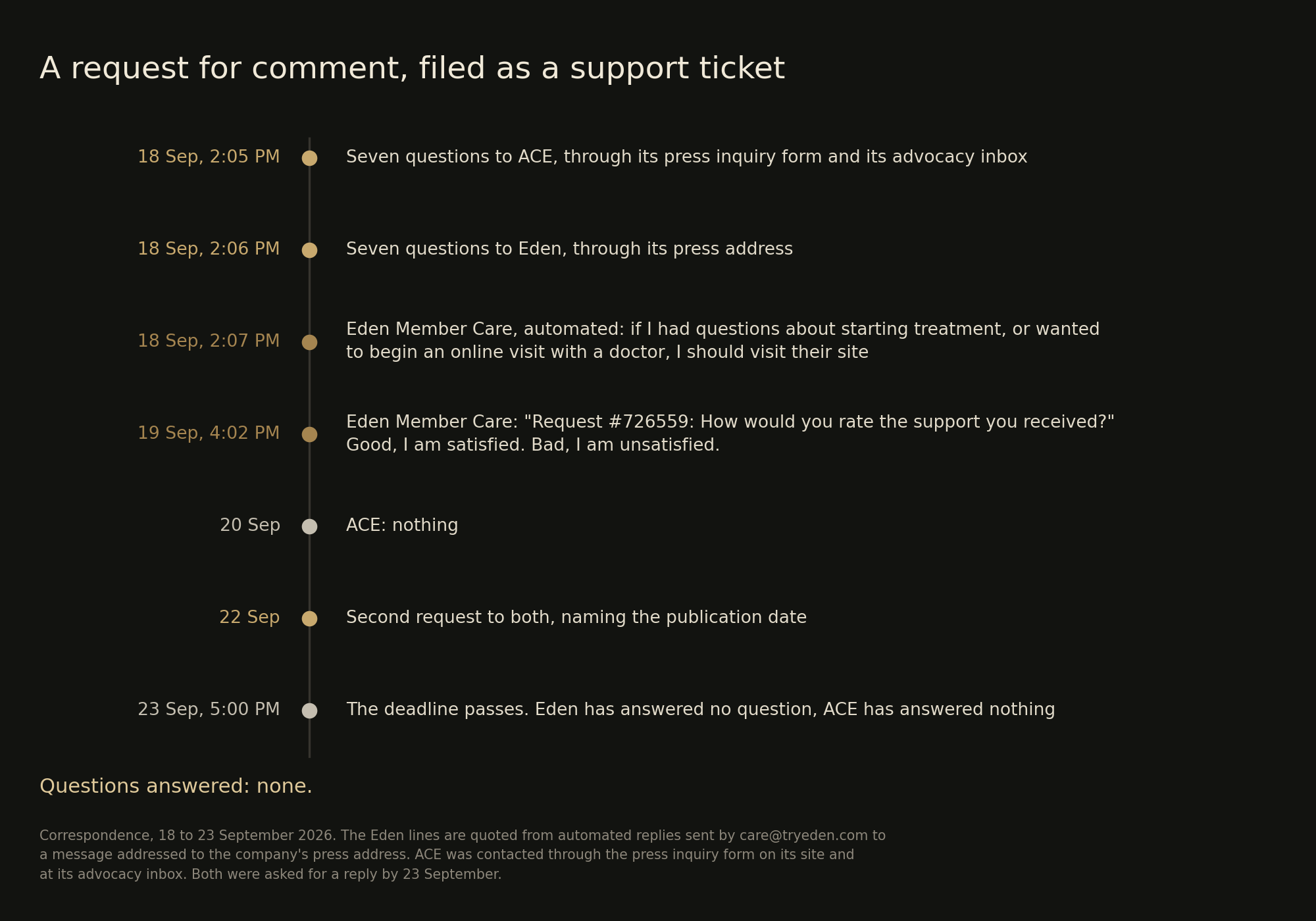
On 18 September I sent questions to ACE, through their press inquiry form and their advocacy inbox, and to Eden at their press address. I asked whether ACE receives compensation, what its verification role actually is, how the program squares with ACE's own scope statement, whether either organization evaluated state patient brokering law, and what the basis is for Eden's advertised average weight loss. I asked for answers by five o'clock on 23 September. On 22 September I wrote to both again, told them the piece would run on the twenty-fourth, and said that anything arriving before then would go in, in full or in summary, whichever they preferred.
Bain tried before I did, and found out something I would not have. She hit reply on the newsletter itself, which is the channel ACE put in front of its certified professionals, and the message bounced. The address does not accept replies. She plans to write to them on paper instead, to the only address she could find, and she had not sent it as of publication.
Eden replied in one minute. Not to the questions. The press address routes into Eden Member Care. An automated note came back explaining that if I had questions about starting treatment, or wanted to begin an online visit with a doctor, I should visit their site. A Care Specialist would get to me, typically within a few hours. The next afternoon a third message arrived asking me to rate the support I had received, good or bad, with my seven questions about compounded semaglutide and per-referral payments quoted underneath as a refresher on what the conversation had been about. It closed by thanking me for being part of the Eden community. The deadline passed on 23 September. As of 24 September, no one at Eden has answered a question, and ACE has not answered either letter, through either address.
What this is really about
Here is the asymmetry that explains why this keeps happening, and why it will keep happening after this particular program is quietly retired.
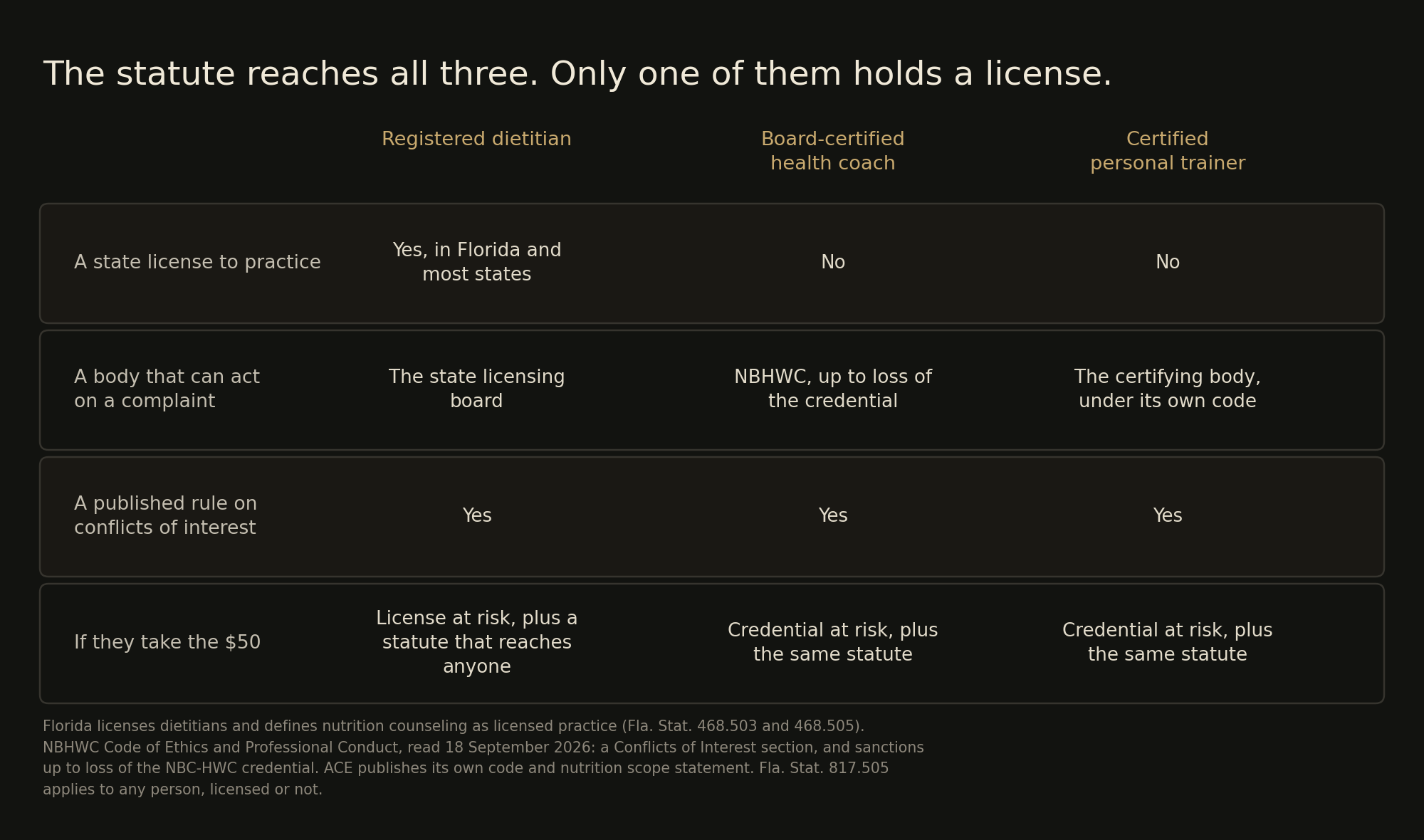
A registered dietitian who took $50 per head to route patients to a drug seller would face a licensing board, a professional code, and in Florida a criminal statute. A personal trainer who does exactly the same thing faces no state board and no license to lose. What they face instead is a private disciplinary process run by the certifying body, which can revoke a certification. That body is ACE. The program is ACE's. The accountability structures that the licensed professions carry are the reason we are slower, more expensive, and more careful, and their absence is a commercial advantage in a market that pays for speed.
A board-certified health coach sits in between. That credential does come with a published code, and the code speaks to exactly this. Under conflicts of interest, the National Board for Health and Wellness Coaching requires the coach to "disclose to clients and sponsors all anticipated compensation from third parties that I may receive for referrals of clients or pay to receive clients," and to see that the quality and quantity of coaching "is not be dependent in any way upon the purchase of any additional products or services by the client." The wording is the board's, typo and all.
So the coach has a body to answer to. The trainer does not.
What is new here is not that somebody built a referral program. It is that the body whose entire product is professional legitimacy put itself inside the funnel, as the step that confirms who qualifies for the payment. Whatever else that is, it is not the same thing as a trainer making a recommendation.
If you are the person on the other end of this
If you work with a trainer or a coach and they suggest a telehealth provider for a weight loss medication, ask one question: do you get paid if I sign up? The disclosure exists. Eden built it into the scripts. But a disclosure you have to notice, in a text message, from someone you trust and pay, is a thin protection.
If you are a clinician, ask it out loud in your next visit, because your patient will not volunteer it.
If you are a dietitian and you have one of these links, take it down today. You have more to lose than anyone else in this chain, and you are the one person in it whose credential is supposed to mean this cannot happen.
The medications work. That is not in dispute here and I have written plenty about how to use them well. What I am describing is the distribution layer that has assembled itself around them, and the sentence that is going to start showing up in gyms, which is: my trainer got me a GLP-1.
Updated 2 October 2026: one sentence in the disclosure was reworded. None of this changes the argument.
Elizabeth R. Bain is named here with her permission. Page contents were captured on 17 September 2026 and the quoted language is from those captures; if the pages change, the record does not.
This article is general nutrition education, not individualized medical or nutrition advice, and it does not create a dietitian–client relationship. Medications and their side effects should be managed with your prescribing clinician. See the full disclaimer.