Summary
A federal list decides which graduate students may borrow $200,000 in federal loans, rather than $100,000. After a court order in June 2026 it names twenty-nine programs, chiropractic among them. Dietetics is not on it, and was not on the original list of eleven. Drawing on the history of other professions, I argue that such fights are settled in law and public opinion, and that winning at the bedside does not carry over on its own.
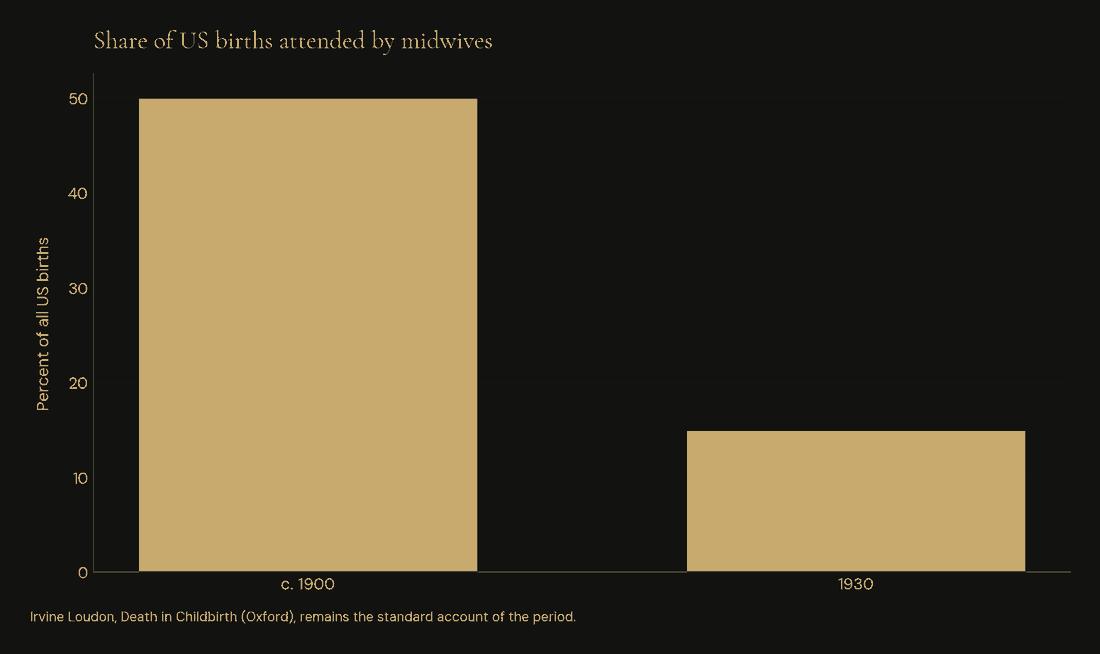
- At the start of the twentieth century, roughly half of births in the United States were attended by midwives. By 1930 it was fifteen percent. Research at the time indicated their births had fewer maternal deaths than those of general practitioners. They lost anyway.
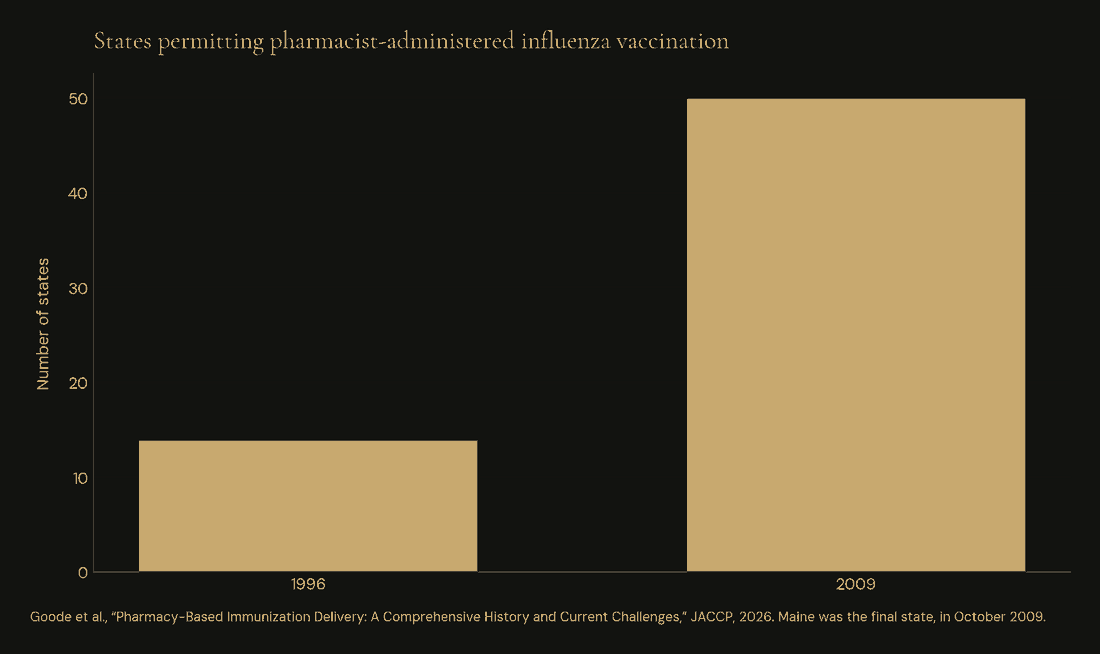
- Pharmacists could give flu shots in fourteen states in 1996. By October 2009 it was all fifty.
- Federal law names registered dietitians among the providers of a Medicare nutrition therapy benefit. The credential now requires a graduate degree. The Department of Education declined to call that degree professional, and gave its reasons in its May 2026 rule.
- I am not urging students to borrow $200,000. The court order is preliminary, and the Department of Education can change the list by announcement.
- My ask: send my July 2026 article in Health Affairs Forefront, the commentary section of the journal Health Affairs, to one person who is not a dietitian.
Summary added 2 October 2026.
Chiropractic is number thirteen on the federal list of degrees that decide whether a graduate student can borrow $100,000 or $200,000 to enter a field. Dietetics is on neither the original list nor the expanded one, and the order that set the current version is temporary.
I will get to how that happened. But it has happened before, to other professions, and the clearest case in American medicine is childbirth.
At the start of the twentieth century, roughly half of all births in the United States were attended by midwives. By 1930 it was fifteen percent.
That collapse was not demographic drift and it was not a response to new evidence that midwives were dangerous. It was organized. And the part that should stop you cold is that the research available at the time indicated midwife-attended births produced fewer maternal deaths than births attended by general practitioners, who in that period often received a few weeks of obstetric instruction and then went out and practiced on women (Irvine Loudon, Death in Childbirth, remains the standard account).
So the midwives had the better outcomes and they lost anyway.
A great deal of the campaign against them was nativist and racial, aimed at immigrant midwives in northern cities and at the Black granny midwives of the South, and the destruction of that second tradition belongs to the history of American racial power and is not a metaphor for anything of mine. Some of the campaign was a genuine professionalizing impulse in a field that badly needed one. And hospital birth did eventually become safer than it had been. But the sequence matters, because the midwives were pushed out first and the safety arrived later, and it arrived on the back of sulfa drugs and blood banking and antibiotics rather than from the change in who was standing in the room.
What actually finished them was where the fight happened. McClure's and Good Housekeeping ran pieces telling American women that a modern woman sees a physician. Thirty state legislatures passed licensing statutes putting midwives under physician supervision, with requirements that were ambiguous by design and, for a rural Black midwife in Alabama, functionally impossible to satisfy. The argument was settled in magazines and in statehouses.
The midwives were not in either room. They were in the room where the births were.
They were also not permanently erased, and that is the part of the story I actually want. Nurse-midwifery came back, and it came back the only way anything comes back, which is by winning statutory authority state by state and then getting paid under it. That took decades and it took an organization. It did not take being right, because they had always been right.
That is the story, and I am telling it in August of 2026 because the thing I opened with is live right now and the order behind it is preliminary. At the end of this I am going to ask you for one thing, it takes about ninety seconds, and it is not a favor. It is the first step of something I have actually thought through.
Abbott's three arenas
There is a book that explains this better than anything else I have read and it is not a book about medicine. Andrew Abbott's The System of Professions, published in 1988, argues that professions do not exist in isolation, they exist in an ecology, competing for jurisdiction, which is the right to control a body of work and to say who is competent to do it. When one profession gains jurisdiction another loses it. The territory does not expand to accommodate everybody.
Abbott's central observation is that this competition gets settled in three arenas: the legal system, public opinion, and the workplace. And he flags a contradiction that has been sitting in the literature for almost forty years, which is that the workplace is where the work actually gets done and where practitioners spend their lives building competence and trust, and it is also the arena where jurisdictional victories are least durable, because what you win at the bedside has no formal existence anywhere else until somebody converts it into one.
It can be converted. Nurse practitioners turned thirty years of doing the work into scope-of-practice statutes in state after state. But it does not convert on its own, and it cannot convert at all if nobody outside the unit knows it happened.
The legal arena writes it into statute. The public arena decides whether anyone would notice or care if you disappeared. The workplace decides who does the task today. You can dominate the third one completely and still be erased, because the first two are where erasure gets authorized.
That is what happened to the midwives. They won every day, in every room they were in, and it bought them nothing that survived contact with a statehouse, because the people deciding their future had never been in one of those rooms and were reading Good Housekeeping.
The profession that dissolved without anyone deciding to kill it
Dietetics did not appear out of nowhere. It came out of home economics, which was a serious scientific field with laboratories and journals and a research base, and which no longer exists in the form its founders built.
Home economics was not killed. It dissolved. American Home Economics Association membership fell to around 25,000 by the 1990s. In 1994 the field renamed itself Family and Consumer Sciences, largely to shed the gendered baggage of the old name, and membership kept falling anyway. Cornell renamed its college. Secondary enrollment went from about 5.5 million students and 37,500 teachers in 2003 to roughly 3.4 million and 28,000 a decade later — and those last two figures are secondary-school Family and Consumer Sciences, which is a different institution from the university departments. I put them beside each other because both fell, not because they are the same thing.
Historians of the field give several causes at once: a discipline built around a gendered domestic role that second-wave feminism had no use for, vocational funding that moved elsewhere, and the fact that its strongest pieces professionalized upward and left. Nutrition science was one of the pieces that left, which means dietetics survived home economics partly because we helped take it apart. What did not happen, in any account I have found, is anybody outside the field arguing that it should continue to exist.
Every time dietetics gets into trouble somebody proposes that we rebrand. New title, new credential name, fresh language about being nutrition experts rather than dietitians. Home economics ran that exact experiment, at scale, with institutional backing, and it changed nothing, because the problem was never the name on the door. It was that nobody outside the building was arguing for the building.
What winning looks like
Start with the smaller case, because it is the one anybody could copy.
In 1996 pharmacists could administer influenza vaccine in fourteen states. By October 2009 they could do it in all fifty, with Maine last through the door. They managed that while organized medicine opposed them and while their own employment was being absorbed by retail chains — the same consolidation that is happening to us right now. Their national association built a certificate training program in 1996 so there was a defined competency to point at, then went state by state amending practice acts, then spent a decade turning "your pharmacist can vaccinate you" into something the public simply knows. Competency, statute, public. Three arenas, in order, on purpose.
Nursing is the larger case, and the one that matters for what comes next. Nurses have been rated the most honest and ethical profession in Gallup's polling for twenty-four consecutive years, with seventy-five percent of Americans rating them high or very high in the December 2025 survey. There are more than five million licensed registered nurses in this country. And nursing built machinery for the other two arenas at a scale dietetics has never approached: an advocacy institute, political action committees, campaign schools that train nurses to run for office and win.
Dietetics is not absent from advocacy and I am not going to pretend it is. The Academy has a political action committee, it has policy staff, it has a Hill day, and the people who do that work are not the problem. Nursing's version of it runs at a different order of magnitude, nursing has members sitting in Congress and in statehouses, and a general-interest editor knows what a nurse is. That last one is not a small thing. Advocacy without a public is lobbying without leverage, because you can file the comment letter on time and still lose when nobody outside the room notices which way it went.
The nursing literature is honest about the limits of this comparison. Most nurses are not politically engaged, and nurses remain badly underrepresented in elected office relative to their numbers. The profession did not win because every nurse became an activist. It won because it built a public identity and a political apparatus, and those two things showed up in the legal arena when it counted.
Here is where it counted.
The list
The One Big Beautiful Bill Act capped federal graduate borrowing at $20,500 a year and $100,000 in a lifetime — except for students in a program the Department of Education designates a "professional degree," who may borrow $50,000 a year and $200,000 in a lifetime.
The RISE Final Rule, published 1 May 2026, defined that category narrowly, at eleven fields. On 24 June 2026, a week before the rule was to take effect, the US District Court for the District of Columbia preliminarily stayed part of that definition in consolidated cases 26-1780 and 26-1941, and the stay widened the list to twenty-nine. (Department of Education, Federal Student Aid electronic announcement, "Update to List of Professional Degree Programs Due to Court Order," posted 29 June 2026, updated 10 July 2026.)
Twenty-nine programs. Audiology is on it. Speech-language pathology is on it. Physician associate, athletic training, occupational therapy, physical therapy. Nursing appears three separate times — master's, nurse anesthesia, doctor of nursing practice.
Chiropractic is number thirteen, and the court did not put it there. Chiropractic has sat inside the federal professional-degree definition at 34 CFR 668.2 for years, alongside medicine, law, dentistry, pharmacy, optometry, podiatry, veterinary medicine, osteopathic medicine and theology. It was in the Department's own original eleven.
Dietetics and nutrition appear nowhere. Not on the court's twenty-nine, and not on the Department's original eleven. This was not a close call that went the wrong way. Dietetics program directors and faculty, individual commenters and the Academy of Nutrition and Dietetics asked the Department to add it, in comments on the proposed rule, and the Department said no in writing.
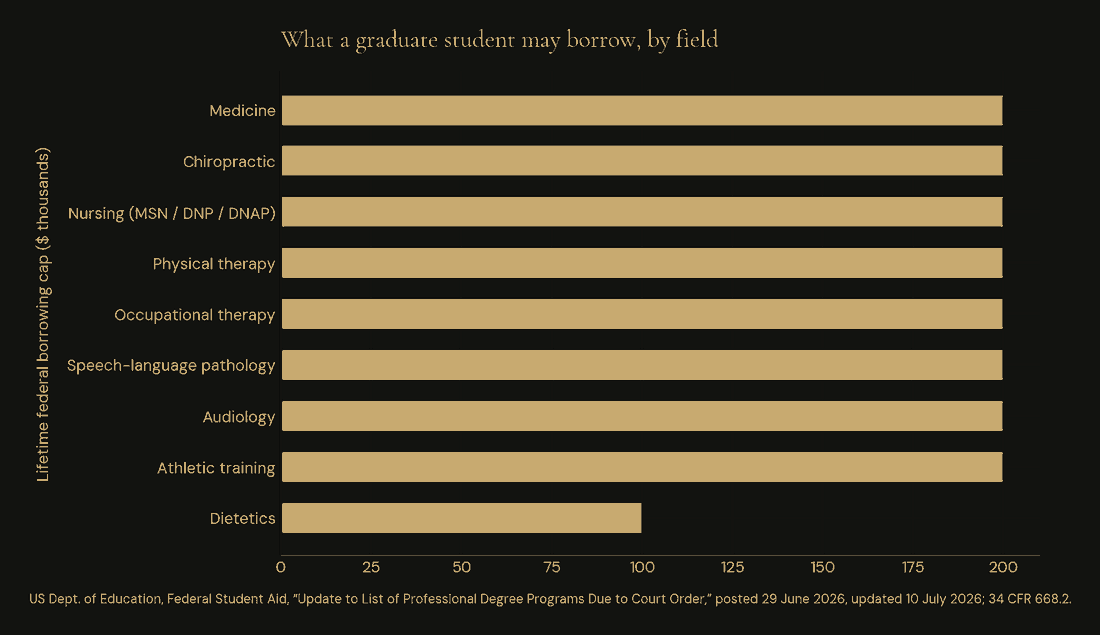
A profession that requires a master's degree to sit its credentialing exam, that is licensed or certified in most states, that bills Medicare directly for medical nutrition therapy, and that is named in a CMS hospital quality measure, was not classified as a professional degree program — while chiropractic was, at number thirteen. The Department gave its reasons in the final rule. The graduate degree is not the basis for entry into the broader nutrition or dietetics field as a whole. A student can finish the education needed to sit the registered dietitian exam in as few as five years of postsecondary education, short of the six its definition requires. And the degree is a master's, not a doctorate. What follows from that is the consequence: a hundred thousand dollar difference in what a student can borrow to enter the field, which is the same hundred thousand dollars a physical therapy student, an occupational therapy student, a speech-language pathology student, an audiology student and an athletic training student all still have.
I should say plainly what I am not arguing, because the obvious reading of that number is that I want students borrowing two hundred thousand dollars against a seventy-seven thousand dollar wage, and I do not. That would be terrible advice and I would not give it to a student sitting in my own office. The borrowing capacity is not the point. The point is that one arm of the federal government names the registered dietitian as a provider of a Medicare benefit — a credential nobody can sit for without a graduate degree — and another arm has declined to call that same graduate degree professional. Both of those cannot be right. Classify the degree, or stop requiring it. What I will not accept is the arrangement we have now, which imposes the entire cost of professional training and withholds the classification, and which is, if you look at it directly, a machine for manufacturing a debt trap.
I should also be honest about what that list does and does not prove. Chiropractic being on it and us being off it is not a referendum on public esteem. The list moved because of a lawsuit, and what it tracks is degree structure and classification, not affection. That is the whole point. It is an administrative category, decided by an agency and, for now, by a court's preliminary order, and it is worth a hundred thousand dollars a student.
The stay is preliminary, which is the entire reason I am writing this in August rather than complaining about it in a year. The Department revised this list once already by electronic announcement, on 10 July, and it can revise it again the same way.
Three different machines
If the list were the only thing, it would be a grievance and I would not be asking anybody to spend social capital on it.
Enrollment in accredited dietetics programs fell about forty-two percent between 2014 and 2024, from 24,423 to 14,170, and part of that reflects reclassification as programs moved to the Future Education Model rather than pure attrition, so I will not pretend the number is cleaner than it is. The 2024 dietetic internship match was the last one ever held, because the computerized match was retired after that cycle. In its first round 56 percent of positions went unfilled, the second year running that empty seats outnumbered full ones. Seats had gone unfilled for years. In the results the profession's accreditor, the Accreditation Council for Education in Nutrition and Dietetics, posts for 2019 to 2024, the first year the empty ones outnumbered the full ones was 2023, at 53 percent. Some of that is the match dying rather than the field: by 2023 only thirty-eight percent of internship positions were being filled through the computerized match at all rather than outside it, down from about seventy percent in 2019. Respiratory therapists, who require an associate degree, out-earn dietitians and nutritionists by $10,170 a year against a mean wage of $77,130 (Bureau of Labor Statistics, May 2025).
In September 2025 the Dietitian Success Center surveyed 115 registered dietitians working on these platforms and published the results by company. The picture is not uniform and I am not going to flatten it. At Nourish, which employs its dietitians as W-2 staff, respondents reported $50 to $78 for a fifty-five-minute session — and reported no pay at all for charting, pre-charting, case review or meetings. At Berry Street, where dietitians are 1099 contractors, respondents reported $35 for an initial visit and $70 for a follow-up, with several noting the initial rate had fallen from around $50. At Fay, also 1099, reported rates ranged widely and recent payouts clustered around $50 to $60 a session. A fourth platform, Dietitian Live, was where respondents described an expectation of twenty-eight completed sessions a week and turnover of sixty to seventy percent.
Some of those subsamples are small — thirteen responses for Berry Street, six for Dietitian Live — and I would rather flag that than bury it. None of it is an allegation that anybody broke a law or a contract, and per-visit contractor pay is lawful and ordinary. My argument is about what the structure does to clinical judgment, not about anyone's compliance with anything.
Before I name companies, my own position: I run a private nutrition practice, which makes these platforms competitors of mine in a small way, and this newsletter has paid tiers, though this piece is free and will stay free. I would rather you know that going in than find it out afterwards.
More than a third of a billion dollars in venture capital has gone into telehealth platforms that employ dietitians at scale. Nourish has raised $215 million, including a $100 million Series C in May 2026 at a $1.75 billion valuation, as reported by Axios Pro. Fay has raised around $75 million, Berry Street north of $50 million. All three were founded between 2021 and 2023, and as far as I can determine from public records, not one of the founders across those three companies is a registered dietitian. There are RD-founded platforms in this market. They are not the ones with the capital.
I am not going to allege that anybody did anything improper, and I want this piece to be safe for you to forward. What I will say is structural. Emergency medicine ran a version of this, and the instrument there was private equity rather than venture capital, which is a real distinction worth holding onto: venture money buys equity in young companies and needs them to grow, private equity buys control of mature ones, usually with debt, and needs them to produce cash. Envision, a physician-staffing firm under private-equity ownership, filed for bankruptcy in 2023. In nursing homes, private-equity acquisition has been associated with roughly a ten percent increase in short-stay mortality. I raise them because venture money is not permanent money. Somebody buys at the exit, and that is the moment the terms of clinical work get rewritten, by people who have never met a patient, in a room where nobody thought to invite a dietitian.
Those are three different machines. The list is a classification decision made by an agency. The platforms are capital reorganizing a labor market. The certificate seller with an affiliate link is what fills a space where no title is protected. What they have in common is not the cause. It is that every one of them was settled in a room where dietitians were absent or outweighed, and that what we have built for getting into those rooms is not remotely the size of the rooms. That is the part Abbott explains. We have been defending ourselves in the workplace arena for thirty years, proving our value in outcomes data and length-of-stay reductions and readmission rates and every metric a hospital finance department has ever asked us for, and the workplace is the one arena where winning does not transfer on its own.
The two objections
The first one is that professions decline when they stop being necessary, and that if dietetics is shrinking, maybe the market has rendered a verdict.
I would take that seriously if the demand were falling. Three in four American adults live with at least one chronic condition and more than half live with two or more. Roughly ninety percent of the nearly $5.3 trillion this country spends on health care each year goes to people living with chronic and mental health conditions — and I am phrasing that the way the CDC phrases it, because the sloppier version of this statistic, the one that says chronic disease causes ninety percent of health spending, got fact-checked into the ground earlier this year and I am not interested in borrowing anybody's bad number. The demand is not the problem. The demand is enormous and it is growing and it is being met, increasingly, by people with a weekend certificate, a supplement affiliate link, and no obligation to anybody.
The second objection is better than the first. We did this to ourselves. The graduate-degree requirement was the profession's own decision, nobody in Washington imposed it on us, and it is fair to ask whether we ever produced the evidence that it makes patients safer. I am not going to defend that decision here and I would listen to an argument that it was wrong. But it is a separate argument. What cannot stand is the combination — a field required to hold a master's degree and simultaneously classified as though it were not one, carrying the cost structure of a professional program and the borrowing ceiling of a non-professional one. That is not a judgment that we are not worth it. It is a classification the Department chose for stated reasons, and stated reasons can be answered.
And this is not the scope fight you are thinking of. Optometry, psychology, advanced practice nursing — those campaigns ask permission to do more than they currently do. I am not asking for one additional task, one additional privilege, or one inch of anybody else's territory. Medical nutrition therapy is already a Medicare Part B benefit, and federal law names the registered dietitian among its authorized providers. Congress settled that decades ago. All I am asking is that one arm of the government classify the degree consistently with work another arm already authorized us to do. That is not scope expansion. It is asking the government to agree with itself.
Why this should matter to someone who is not a dietitian
Let me state the claim I am actually defending, because it is narrower than the word nutrition suggests. When disease or its treatment changes what a body can do with food — cancer cachexia, renal failure, short bowel, refeeding risk, an eighty-year-old on six agents losing weight nobody ordered — the assessment and the therapy are a clinical task with a standard of care and a real capacity to harm. That is the territory. Almost everything else people mean by nutrition sits outside it and I am not trying to claim any of it. What I am saying is that the territory has a standard, and a standard requires somebody who can be held to it.
A registered dietitian can be reported to a state board, investigated, sanctioned, stripped of the credential, held to a standard of care and sued for falling below it — and for the entire time that system is working correctly you will never once notice it, which is exactly why it is so easy to mistake for paperwork. In most of this country, anyone at all can call themselves a nutritionist and tell a woman on carboplatin what she should be eating, or hand the parent of a type 1 diabetic a supplement protocol, or restrict the diet of an eighty-year-old on six medications, and there is no board to report them to, no standard they can be said to have failed, and no consequence available to anybody, ever.
Remove the accountable practitioner and you do not get less nutrition advice. You get the same volume of advice with nothing behind it, sold at scale, to people in the worst week of their lives.
That happened to the midwives when it happened, and the women who lost most were the poor and rural ones who had nowhere else to go. It happened to home economics, and what went with it was the last place in the American curriculum where a teenager learned how to feed themselves. This is the pattern. The profession's collapse is the visible event, and the public cost lands later, on whoever was relying on the thing that quietly stopped existing.
What I am actually asking
I published the analysis behind this in Health Affairs Forefront on 16 July, under the title "The Slow Collapse Of The US's Clinical Nutrition Workforce." It went through the journal's editorial review and every figure in it is sourced.
I am not asking you to share this post. I am not asking you to endorse me. If you have read this far you are probably a dietitian, and I know what it costs to be the person in your feed who is always angry about the profession.
I am asking you to share that article, and the reason it is that one and not this one is that passing along a Health Affairs piece is a citation. It carries the institution rather than the author. Nobody has to agree with me, nobody has to vouch for me, and nobody has to have an opinion about dietetics at all.
I want it to leave our silo, because inside the silo it does nothing. Dietitians already know. We have known in a diffuse, demoralized way for years, which is exactly why the article exists — not to tell dietitians something new but to put it in one place, in a venue a congressional staffer or a hospital executive or a journalist will actually read.
This is not a complaint, it is a first step
I have spent a lot of words describing a problem, so let me be concrete about the plan, because I am not interested in being one more person in your feed who is angry and has nothing to propose.
There are two live fights right now and they are separate proceedings, which matters, because conflating them is the fastest way to look like you do not understand the process. The first is the professional degree list. That one has no comment docket at all — the Department revises it by electronic announcement, which means the only way to move it is public pressure and congressional offices. The second is money. CMS published the CY2027 Physician Fee Schedule proposed rule on 16 July, file code CMS-1848-P, and the comment period closed on 14 September 2026 at regulations.gov, on docket CMS-2026-2377. The form asks for a name, an email and a text box. That is the rule the payment for medical nutrition therapy runs through, and the comment period was open to anybody, including you.
Behind both of those sit the slower pieces: the MNT Act in this Congress, the revaluation of our codes going on this year, state-level scope and licensure. I am working on those, and other people are working on them harder and longer than I have been.
Here is why the thing I am asking you for comes first. Every one of those fights happens in the legal arena, and every one of them goes better if the people in the room have already encountered us somewhere that was not us asking them for something. Abbott's whole point is that the legal arena follows the public one. A comment letter filed by a profession nobody has heard of is a piece of paper. The same letter filed by a profession a staffer read about in a policy journal last month is an argument. That is the sequence, and the part of it you can do this week is the cheapest part.
So think of one person who is not a dietitian. The physician who sends you the most referrals. The nurse manager on your unit. The PT you eat lunch with. The reporter who covered your hospital last year. One person, one link — and if you would rather not write anything yourself, here is the whole message:
Thought this would land for you. Health Affairs Forefront, July. The Department of Education's professional degree list decides which graduate students can borrow $200,000 in federal loans to enter a field instead of $100,000. A court order in June widened it to twenty-nine programs — audiology, speech-language pathology, occupational therapy, physical therapy, athletic training, physician associate, nursing three separate times (Education Department announcement, 10 July 2026). Dietetics is on neither the original list nor the expanded one, and it is not final.
https://www.healthaffairs.org/content/forefront/slow-collapse-us-s-clinical-nutrition-workforce
There is nothing in that paragraph you have to defend.
And then there is the version of this that matters more than everything else I have written here combined. If you know a dietitian with a real public platform — an audience outside this profession, on Instagram or a podcast or a column or wherever they built it — ask them directly to share that article. Not my post. The article.
I want to be straight about why I am asking you to do that instead of doing it myself. I have already tried. I have sent it to people in this profession with very large followings and mostly heard nothing back, and I do not think that is because they do not care. An unsolicited message from a stranger about a federal loan list is the easiest thing in the world to leave unopened. A message from a colleague they actually know is not the same object. If you are that colleague, you can do in one message what I have not managed in a month.
The people with the reach are the ones who can move this out of our silo in a single afternoon. Most of us cannot reach them. Some of you can.
The midwives did not lose because they were wrong, and home economics did not dissolve because it was useless. They lost because the arguments that determined their future happened in rooms they were not in, and because, in the accounts I have read, few people outside their own membership were making the case for them. The stay in 26-1780 is preliminary, the Department can revise that list by announcement without a hearing, and the only part of this any of us actually controls is whether one person who is not a dietitian has read that article by the end of the month.
So pick your person and send it.
Correction, 2 October 2026. This piece said dietetics "was never in the room" when the professional degree list was set. It later said each of the three machines it describes was settled in a room with no dietitian in it. It said I had looked for the Department of Education's reasoning and not found it, and it called the exclusion an accident. All of that was wrong. The Department's final rule of 1 May 2026 answers comments asking it to treat dietetics programs that lead to the registered dietitian credential as professional degrees. Those comments came from dietetics program directors and faculty, from individual commenters and from the Academy of Nutrition and Dietetics. The Department declined, and it gave reasons. It said the graduate degree is not the basis for entry into the broader nutrition or dietetics field as a whole. It said a student can finish the education needed to sit the registered dietitian exam in as few as five years of postsecondary education, short of the six years its definition requires. And it said the degree is a master's, not a doctorate (91 FR 23805 to 23807). I missed that section of the rule. I found it in a review of past posts on 2 October. Those passages, and the summary line on the Department's reasoning, have been corrected. The core argument survives. One part of the federal government names the registered dietitian as a Medicare provider, and another declines to call the required degree professional. But the case is harder than I made it. This was a considered decision with published reasons, and the profession's arguments were heard and answered. It will not be fixed by someone noticing it. It would take the Department changing its position, a ruling in the court case or an act of Congress. Separately, a line on who decides the list now names the agency and the court, in the accreditor's posted results for 2019 to 2024 unfilled internship positions first outnumbered filled ones in the April 2023 match rather than 2024, nurses have led Gallup's honesty ranking for twenty-four consecutive years rather than twenty-five, and the wage comparison now names the Bureau of Labor Statistics category and year.
Jason Fee, MS, RDN, LDN, is a clinical dietitian and the founder of Vitae Arete. "The Slow Collapse Of The US's Clinical Nutrition Workforce" appeared in Health Affairs Forefront on 16 July 2026.
This article is general nutrition education, not individualized medical or nutrition advice, and it does not create a dietitian–client relationship. Medications and their side effects should be managed with your prescribing clinician. See the full disclaimer.