Summary
Medicare pays for each clinical service by multiplying a score for that service, called a relative value, by one dollar figure set in federal rules. The scores come from outside the government: a committee in a process run by the American Medical Association recommends them, and the agency that runs Medicare largely adopts them. I show that most of the outcome is settled months before anyone sees a rate, by a survey of people who perform the service.
- The association says these surveys draw ninety responses on average. Common services draw more than a hundred. If no professional society runs a survey, the sample is zero.
- A survey happens only if a society files a form saying its members provide the service. Only a society can file it. For the cycle in this piece it was due 30 September 2026. The next comparable deadline is 17 February 2027.
- Doctors’ specialties each hold their own seat. Thirteen other professions, dietitians among them, share one advisory committee. Its recommendations go straight to the agency.
- In its proposed 2027 Medicare payment rule, the agency asked what should replace its reliance on this private committee. The association calls it an expert panel.
- Ask your society in writing whether it filed. If a survey reaches you, count the whole service: record review, labs, the care plan, paperwork and coordination.
Summary added 2 October 2026.
There is a number attached to every clinical service you provide, and you have almost certainly never met anyone who helped set it.
I want to show you how it is actually set, because the process is public, it runs on a calendar anyone can read, and there is a deadline eight days from now, on 30 September, that I did not know existed until I read that calendar properly.
The short version
Medicare pays for a service by multiplying a relative value by a conversion factor. The conversion factor is a single number set in rulemaking. The relative value is specific to your code, and it is where the real decision lives.
Those relative values come from outside the government. Codes are created by an editorial panel convened by the American Medical Association. They are then valued by a committee, the RVS Update Committee, universally called the RUC, whose recommendations the agency largely adopts.
The sequence, in the AMA’s own diagram, is short: a code is referred, societies declare a level of interest, a survey goes out, a specialty committee reviews it, the RUC votes, and the number goes to CMS.
Everything that matters happens in the middle two steps, months before anyone sees a rate.
The number that decides the number
Here is the part I think is genuinely not understood inside my profession.
The value of a service is set by the survey data the professions bring. Not by argument at the meeting. Not by advocacy afterward. By a survey instrument, fielded by a society to its own members, asking practitioners how long a service takes and how demanding it is relative to other services they already perform.
The AMA publishes the typical size of that sample. Its own process overview states that the average number of respondents to a RUC survey is ninety, and that surveys for high-volume services draw more than a hundred.
Ninety people.
I do not say that to be dismissive of the method. A well-constructed survey of ninety practicing clinicians who actually perform a service is a defensible instrument, and it is far better evidence than the alternative, which is a committee guessing. I say it because ninety is a number a profession can influence, and because the failure mode is not losing a vote. The failure mode is not fielding a survey at all, in which case the relevant sample size is zero and the code gets valued on whatever else is available.
Three things decide what comes out, and all three are settled before the meeting:
Whether a society declares a level of interest. This is a form. It says: our members furnish this service and we intend to develop a recommendation. If nobody declares, nobody surveys.
What the survey captures. A nutrition therapy visit is not the minutes in the room. It is the record review beforehand, the interpretation of labs, the care plan, the documentation, the coordination with the referring clinician, the call with the family. A survey that asks only about face-to-face time will faithfully measure a smaller service than the one being delivered.
What the service is compared against. RUC surveys ask respondents to rank a service against a reference list of codes they already know. The reference set is the frame, and the frame does much of the work before anyone answers a question.
Who is in the room
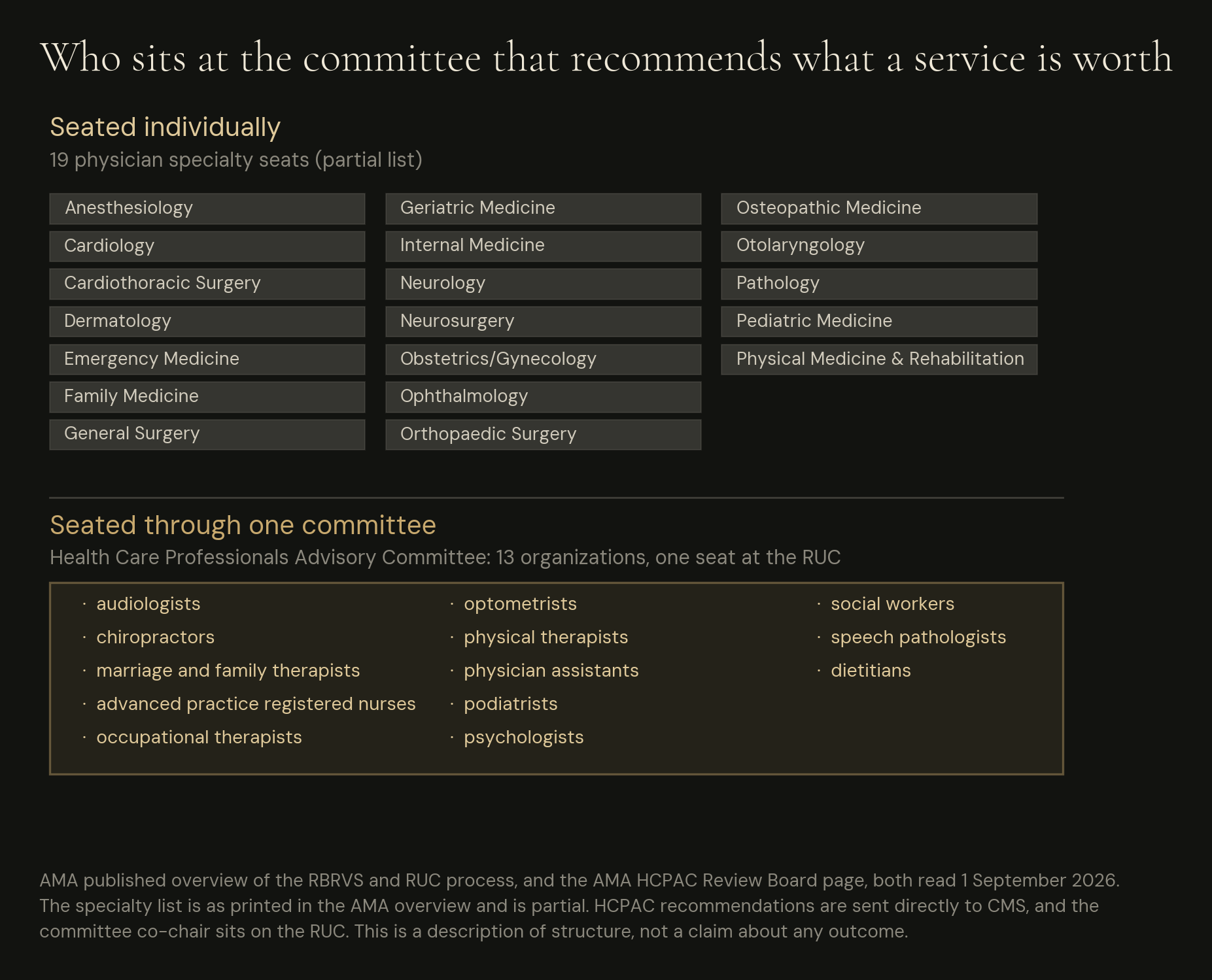
The RUC seats the physician specialties individually. Anesthesiology, cardiology, dermatology, emergency medicine, family medicine, general surgery, internal medicine, neurology, neurosurgery, obstetrics and gynecology, ophthalmology, orthopaedic surgery, pathology, pediatrics, and so on down a long list.
The non-physician professions are seated differently. They participate through the Health Care Professionals Advisory Committee, which the AMA describes as allowing “the participation of limited license practitioners and allied health professionals in the RUC process.” Thirteen organizations sit on it, representing audiologists, chiropractors, marriage and family therapists, advanced practice registered nurses, occupational therapists, optometrists, physical therapists, physician assistants, podiatrists, psychologists, social workers, speech pathologists and dietitians.
Thirteen professions. One committee. The committee’s co-chair sits on the RUC.
I want to be careful about what I am doing with that sentence, because it would be easy to turn it into a grievance and I do not think grievance is the useful reading. It is a description of structure. The professions on that committee use the same code set and are paid off the same schedule as the specialties seated individually, and the arrangement for how they are represented is different. That is a fact about design, and it is worth knowing before you form a view about the outputs.
Two details cut the other way and belong in the same breath. HCPAC recommendations go directly to CMS, which is a real channel rather than a courtesy. And the meetings are not closed: the AMA states that RUC meetings “are open to anyone who registers to attend,” that more than three hundred people attend each one, and that the dates, the recommendations, the minutes and the vote total for each individual code are all published.
You can watch this. Very few of us do.
The thing CMS said about it this year
I wrote three weeks ago about a request for information buried at page 43951 of the CY 2027 payment rule. It belongs here too, because the timing is the strangest part of this whole story.
In that document CMS wrote about “longstanding concern expressed over the Federal reliance on a private organization with such an obvious conflict of interest as providing information on the time and resource requirements to conduct physician services when this information may influence their own payment.” It cited the Medicare Payment Advisory Commission, which has made that point for close to twenty years, and a 2025 National Academies report recommending alternatives. Then it asked what should replace the arrangement.
The AMA’s own description of the committee is that it “is an expert panel,” and that “individuals exercise their independent judgment and are not advocates for their specialty.”
Both of those statements are on the public record this year. I am not going to adjudicate between them in a newsletter. I will only point out that the agency asked the question in an open docket, that the answer window closed on 14 September, and that the process it asked about is running on schedule this month regardless.
The deadline, and what an individual can actually do
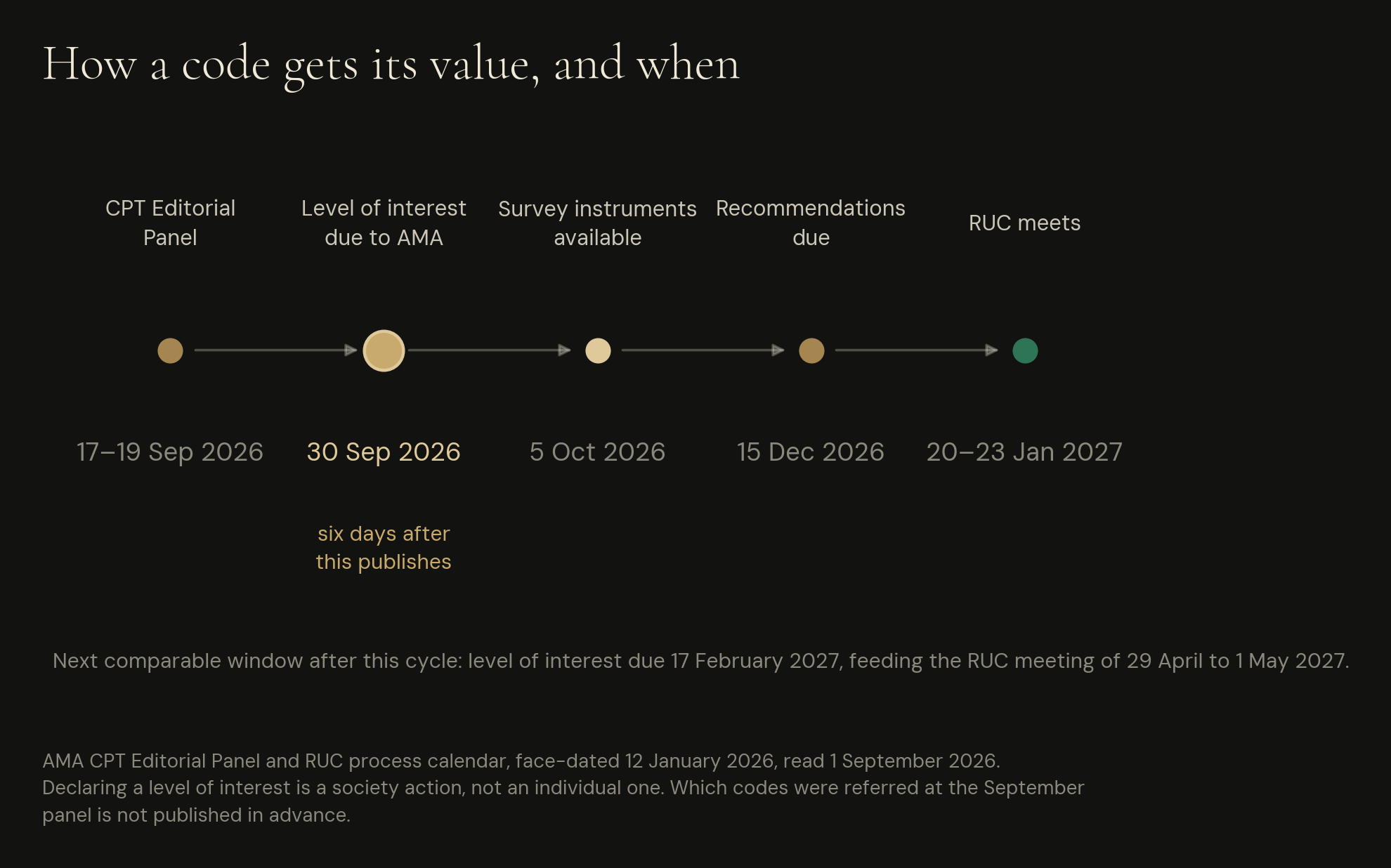
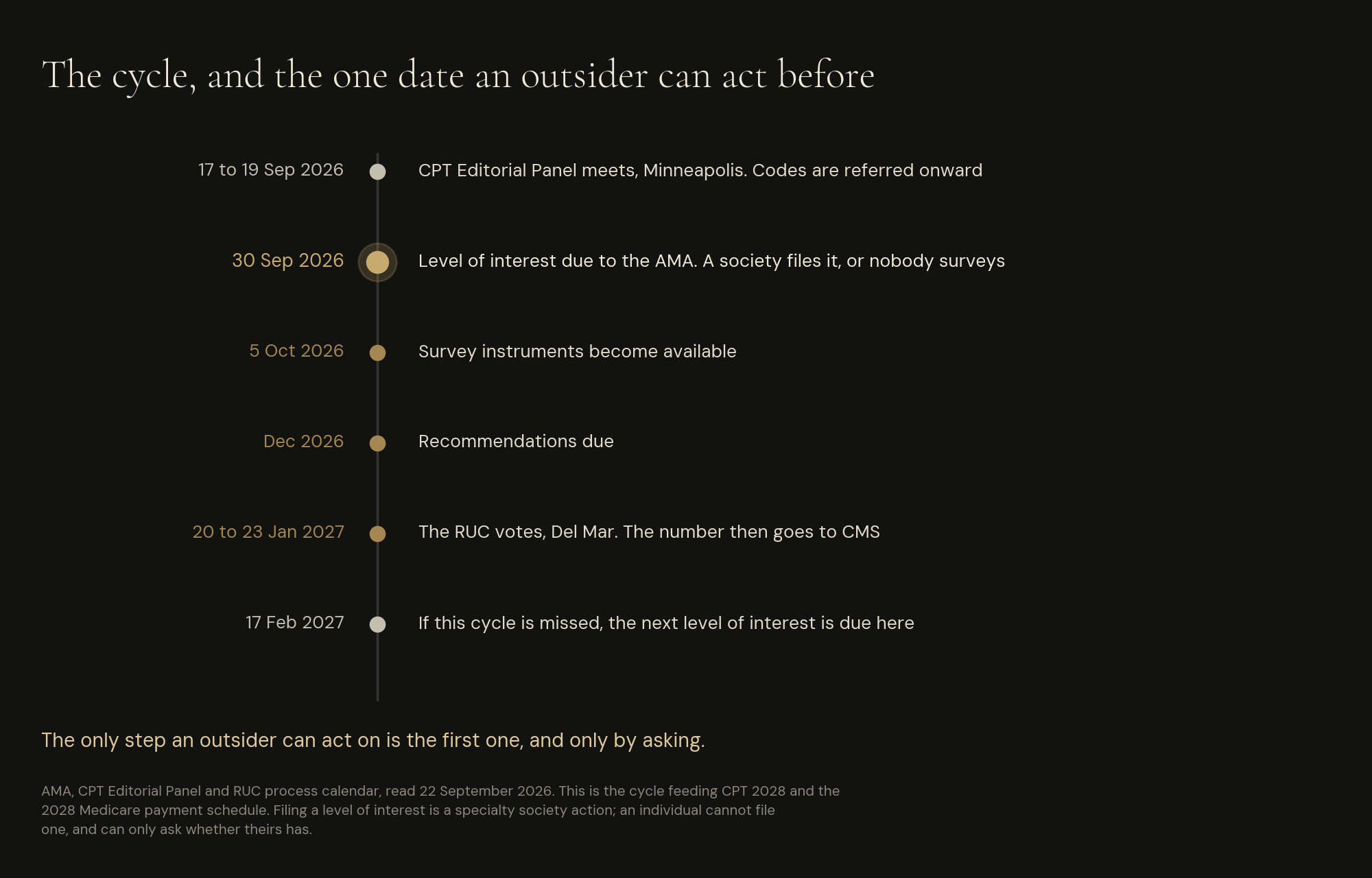
The CPT Editorial Panel met on 17 to 19 September in Minneapolis. Codes referred at that meeting move to the next stage, and the level of interest is due to the AMA on Wednesday 30 September. Surveys for that cycle become available on 5 October, recommendations are due in December, and the RUC takes them up at its meeting on 20 to 23 January 2027 in Del Mar.
If that window is missed, the next comparable one is 17 February 2027, feeding the meeting at the end of April.
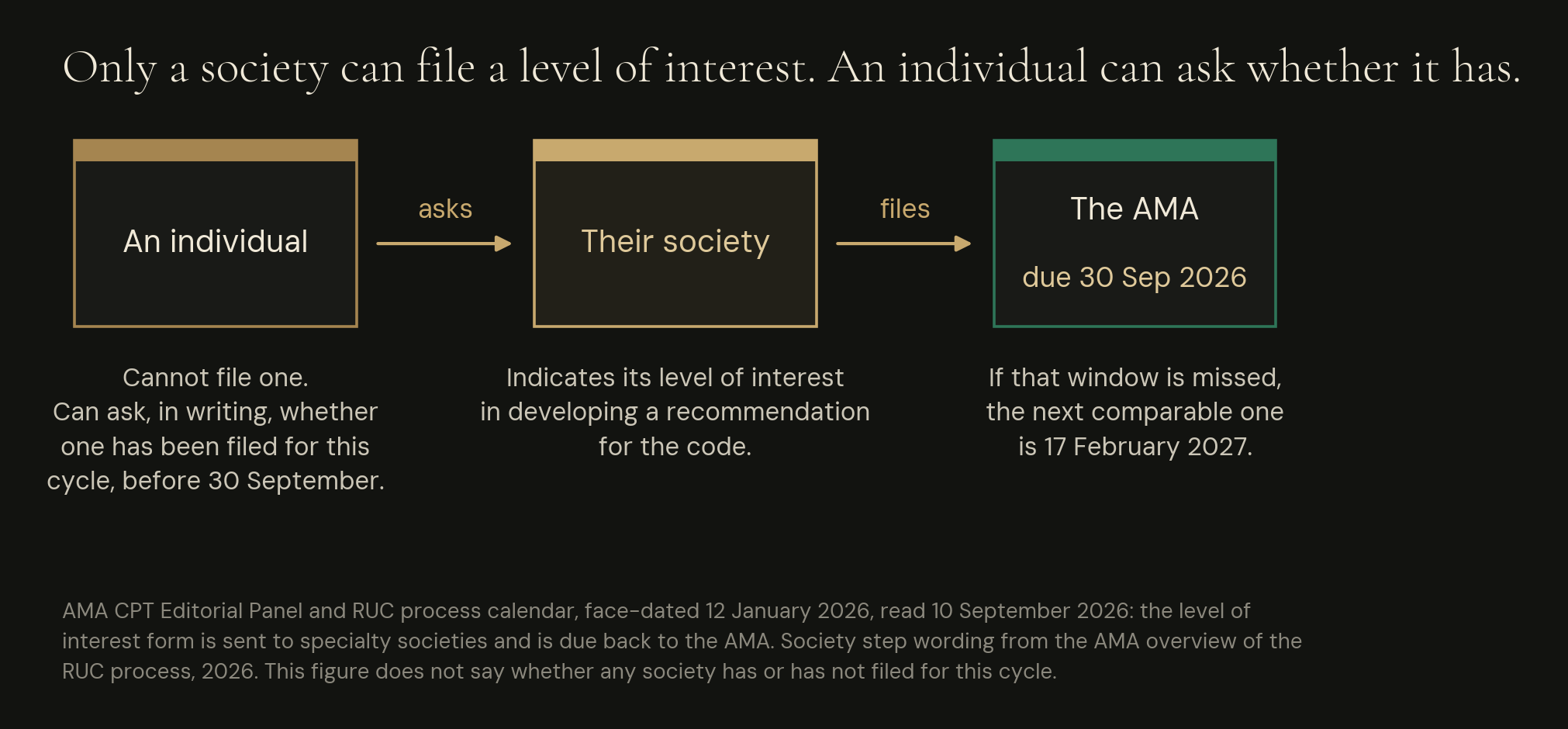
Filing a level of interest is a society action. It is not something an individual can do, and I am not going to pretend otherwise.
What an individual can do is ask, in writing, whether their society has filed one for the current cycle, and ask before the thirtieth rather than after.
I want to be exact about why I am framing it as a question rather than an accusation. I do not know the answer. Which codes were referred at the September panel is not something I can see from outside, and what any society has filed is not published. A question asked in good faith before a deadline is a useful act. An assumption asserted after one is not, and it would be the kind of thing I would have to correct later.
If a survey does reach you, complete it, and answer for the whole service. The record review. The labs. The plan. The documentation. The coordination. Not the minutes in the room.
If you are the person who would have to file it
If you sit on an affiliate board, chair a committee, direct a program, or hold a seat where a level of interest is something you could actually cause to happen, I have written the sequence down: which deadline governs which action, who has to move first, and what the filing needs to contain. Message me and I will send it.
And if you are not in one of those seats but you know somebody who is, forward this to them. The thirtieth is a date almost nobody outside the valuation process knows exists, and the people who most need it on their calendar are the least likely to be reading a dietitian’s Substack.
Two footnotes I could not talk myself out of
The AMA’s published list of professions on that committee spells my own as “Dieticians.” So does page 43903 of the Medicare rule, one page before it spells it correctly. I mention it only because it is a small, consistent signal about how closely the profession is being read by the systems that price it, and because it costs nothing to notice.
And the number to hold onto is still ninety. Not because ninety is too few, but because ninety is reachable. Almost nothing else in this series is.
Next
Everything so far has been about a payment system: what it pays for, and who decides. Next month I want to write about the other number, the one an employer sets rather than a committee, and about why I think the figure my profession keeps asking for is smaller than almost anyone realizes.
A note on who pays for this
No outside institution does.
There is no grant behind this work and no outside organization underwriting the time, the document fees, or the research. I am a working clinical dietitian, and the pulling of statutes and fee schedules and comment dockets happens around my day job.
This piece is free to read. If it is useful to you and you can afford it, a paid subscription is what funds the next one and the advocacy that goes with it. If you cannot, that is genuinely fine, and forwarding this to one person who is in a position to act on it is worth more to me than the subscription is.
The AMA CPT Editorial Panel and RUC process calendar, face-dated 12 January 2026, sets the dates cited here: CPT Editorial Panel 17 to 19 September 2026, level of interest due to the AMA 30 September 2026, survey instruments available 5 October 2026, RUC recommendations due 15 December 2026, RUC meeting 20 to 23 January 2027, and the next level-of-interest deadline 17 February 2027. Survey respondent averages, RUC and HCPAC composition, the process sequence and the meeting-transparency statements are from the AMA’s published overview of the RBRVS and RUC process. The Request for Information appears at 91 FR 43951 through 43953 in the CY 2027 Medicare Physician Fee Schedule proposed rule, CMS-1848-P, published 16 July 2026. All read at their issuing sources. I am a registered dietitian, and the valuation of the codes described here bears directly on my own profession and my own practice; weigh that against everything above.
Correction, 1 October 2026. The note at the end of this piece said that nobody pays for this work and that everything I publish stays free. Paid subscriptions help fund it, and some pieces are for paid subscribers only. The note now says that no outside institution pays for this work and that this piece is free to read. It also describes my day job in more general terms.
This article is general nutrition education, not individualized medical or nutrition advice, and it does not create a dietitian–client relationship. Medications and their side effects should be managed with your prescribing clinician. See the full disclaimer.