Summary
Most organizations budget staff in full-time equivalents, usually 2,080 hours a year. That unit counts hours. It misses what a veteran specialist knows. I tested the claim that organizations undervalue specialized people, and in my reading, what matters most to a particular employer shows up in its performance data more reliably than in its pay.
- A federal nuclear weapons program had to remake a material called Fogbank. Few records had been kept. Almost all its experts had retired or left. In March 2009 the Government Accountability Office tied a $69 million cost overrun to it.
- Salary surveys price what any employer would buy, such as a degree. They miss what matters only inside one workplace.
- I am a hospital dietitian, so I have a stake. Since 1 January 2024, new registered dietitian candidates need a graduate degree. In May 2025 the median hospital dietitian earned $78,180. Respiratory therapists, whose usual entry degree is an associate’s, earned $82,730. The dietitian figure also counts nutritionists who are not registered dietitians. The gap does not prove underpayment.
- The claim that replacing a worker costs 50 to 200 percent of salary is hard to trace to a study. Measured estimates are smaller. One review of thirty case studies found a median of 21 percent outside executive and physician jobs.
- A better pay review asks what would be lost if a person left, and how long rebuilding would take.
Summary added 2 October 2026.
In 2000 the National Nuclear Security Administration began a program to refurbish one of the country’s nuclear warheads, the W76. One of the highest risks it identified was making a material called Fogbank. The government had made Fogbank before, in the 1980s. Making it again turned out to be the hard part. When the Government Accountability Office reviewed the program in March 2009, it explained why in one sentence:
NNSA had lost knowledge of how to manufacture the material because it had kept few records of the process when the material was made in the 1980s and almost all staff with expertise on production had retired or left the agency.

The first refurbished warhead, planned for September 2007, slipped to September 2008. GAO put the cost overrun tied to Fogbank at $69 million. The knowledge had left with the people who retired or moved on, and few records had been kept.
Organizations that employ specialists carry a smaller version of that risk. The unit they budget in cannot see it.
The unit is the full-time equivalent, which usually comes to 2,080 hours a year. One GAO survey spelled out the arithmetic: “40 hours x 52 weeks.” A specialist hired last year and one who has spent twenty years building the work around the role are the same line in that budget. When the veteran leaves, the job posting asks for the same credentials it asked for the first time, and the organization finds out afterward what they did not include.
For many specialist roles, hospitals set the barrier to entry at a bachelor’s degree, a master’s degree, a license and years of experience, alongside additional specialized credentials, then budget that person at the standard 2,080 hours. What is the contradiction, or what is the issue? Why does this irritate me? And why is it important that we test and assess this rather than just complain?
What an FTE counts
GAO’s budget glossary defines an FTE as “the total number of regular straight-time hours” worked, divided by the compensable hours in the fiscal year. It counts hours. Nothing in it asks what happened during them.
The Bureau of Labor Statistics does not treat hours that way when it measures productivity. It weights them by who works them:
Labor input is an aggregation of hours worked of the different types of workers with different skills and experience.
The agency that publishes the country’s productivity figures does not treat an hour as an hour. Most budgets do. An organization employs people and then counts them in FTEs, and the budget sees only the count.
Pay built around positions has real defenders, and they have a point. Federal classification rests on “equal pay for substantially equal work.” Peter Doeringer and Michael Piore, studying internal labor markets for the Department of Labor in 1970, found that wage rates were based, “in principle, upon the characteristics of jobs,” with “all incumbents in a given job classification” sharing “the same basic rate.” That design limits favoritism and keeps budgets predictable. It also protects people. After Canadian provinces began publishing the salaries of public employees above set thresholds, university faculty among them, the gender pay gap among professors narrowed by roughly 20 to 40 percent (Baker and colleagues, American Economic Journal: Applied Economics, 2023). When Wisconsin let school districts move teachers off fixed salary schedules, flexible pay lowered women’s salaries relative to men with the same credentials (Biasi and Sarsons, Quarterly Journal of Economics, 2022).
Bands also bend more than the claim assumes. In twenty years of personnel records from one firm, George Baker, Michael Gibbs and Bengt Holmström found “substantial individual variation in pay within levels” (Quarterly Journal of Economics, 1994).
What I did not expect was to find the problem already named inside the federal government’s own position-based pay system. The Office of Personnel Management’s introduction to its classification standards has a section titled “Impact of the Person on the Job”:
While it is the position which is classified, the relationship of the employee to the position can be recognized when the performance of the incumbent broadens the nature or scope and effect of the work being performed.
The government’s own guidance says a person can change the job they hold. A budget built on positions has no line for that.
What the market can price
The band is not really the problem. What it is benchmarked to is.
Most organizations price a specialist by looking outward. Salary surveys. What the competitor down the road pays for the same title. That works fine for the part of a person that any employer would buy. Gary Becker, who built the economics of human capital, called that part general: training “useful in many firms besides those providing it.” A clinical credential is general. So is most of a graduate program.
Becker’s other category was specific training, which in its pure form has “no effect on the productivity of trainees that would be useful in other firms.” Knowing which protocols already failed, and why. Knowing which physician actually reads your recommendation. Knowing whom to call when the supply chain breaks. None of that transfers at full value. None of it fits on a résumé.
A market benchmark can only price what the market can buy. No outside employer bids on what only matters inside your building, so a range built from outside bids leaves it out. Every time. Nobody has to plan it that way.
The evidence that firm-specific value is real comes from performance, not paychecks. Boris Groysberg, Linda-Eling Lee and Ashish Nanda followed star Wall Street analysts who changed firms and found “an immediate decline in performance that persisted for at least five years” (Management Science, 2008), unless the analysts moved with their teams or to stronger firms. Robert Huckman and Gary Pisano found that cardiac surgeons got better with their recent volume at a given hospital, but not with their volume elsewhere (Management Science, 2006). Part of a surgeon does not travel. Ann Bartel and colleagues, using panel data from a large hospital system, found that nurses’ experience on their own unit improved patient outcomes, and that the departure of experienced nurses went with lower productivity beyond anything changes in skill and experience explained (American Economic Journal: Applied Economics, 2014).
Pay tells a different story. When Gueorgui Kambourov and Iourii Manovskii separated time in an occupation from time with one employer, five years in an occupation went with wages 12 to 20 percent higher. Tenure with one employer or industry mattered relatively little (International Economic Review, 2009). Economists still fight about this. Robert Topel put the value of ten years of seniority at more than 25 percent of a typical male worker’s wage (Journal of Political Economy, 1991).
So the person is not invisible to payroll. Becker’s own model predicts that employers will share some of the return on specific training by paying more than a worker could get elsewhere, and seniority raises do some of that. But they pay for years. Within grade levels at two large companies, James Medoff and Katharine Abraham found pay climbing with experience while rated performance did not (Quarterly Journal of Economics, 1980). Years are easy to count. What you built is not.
There is a substantial amount that standard pay misses in a job. What exactly can a salary survey not see? What someone who has been somewhere for years actually knows. The market pays based on very surface data and misses the rest. Is the job using the full capacity of that person’s expertise? And if not, are those organizations failing themselves?
Read the studies together and this is where I land, and it is my reading, not theirs: what matters most to a particular employer shows up in its performance data more reliably than in its payroll. Pay follows the outside option. The outside option cannot see anything you cannot take with you.
The tax code gives the game away. When one business buys another’s assets, the tax code lets the buyer count part of the price as paying for the “workforce in place” and deduct it over fifteen years. Section 197 of the Internal Revenue Code lists it right after goodwill and going concern value:

So for tax purposes, a workforce is an asset the moment someone pays for it. The rest of the time it is an expense counted in FTEs. International accounting standards explain why a company cannot book its own people: it usually has “insufficient control over the expected future economic benefits arising from a team of skilled staff” (IAS 38, paragraph 15). An IFRS Interpretations Committee agenda decision in March 2020 said it more plainly: “employees can leave the entity’s employment.” Read that again. The reason accountants give for keeping people off the balance sheet is that they can walk out. A budget counted in FTEs has no line for that risk.
The credential paradox, tested
In my own field, the entry bar went up in 2024. Since 1 January 2024, new candidates for the registered dietitian exam need a graduate degree; the Commission on Dietetic Registration moved the minimum “from a bachelor’s degree to a graduate degree.” Employers did not raise that bar. The profession’s own accreditation and credentialing bodies did, and employers hire against it. Add supervised practice, the national exam and, in most states, a license. The Bureau of Labor Statistics put the median annual wage for dietitians and nutritionists across all industries at $76,400 in May 2025.
It would be easy to call that the credential paradox and walk away angry. The research does not let me.
Credentials and years on the job are weak predictors of how well a person does a job. In a 2016 review of a century of personnel research, Frank Schmidt and colleagues put the predictive validity of years of education at about .10 and of job experience at about .16. Experience mattered most in the first five years. Then the curve went flat (a working paper updating Schmidt and Hunter, Psychological Bulletin, 1998). Teaching shows the same thing: economists find wide differences in effectiveness that observable teacher characteristics, degrees among them, do not explain well (Jackson, Rockoff and Staiger, Annual Review of Economics, 2014).
So more letters after a name is not the fix. Neither is paying for years alone. The real problem, in my reading, is lazier than that. A credential is cheap to verify, so organizations check it at the door. Then they often stop looking.
My own field fits. In a 2021 survey, 143 neonatal intensive care dietitians from 127 U.S. hospitals reported a median of $33.24 an hour. Specialty certification and order-writing privileges each tracked with higher pay on their own. Neither survived the final adjusted model, which turned on cost of living, years in neonatal nutrition and NICU beds per dietitian (Hand and colleagues, Journal of Human Nutrition and Dietetics, 2024). Once the model adjusted for those, the extra credential was not independently tied to pay.
The comparison with other hospital professions is harder to wave away. In May 2025 the median dietitian working in a hospital earned $78,180. Respiratory therapists, whose typical entry education BLS lists as an associate’s degree, earned $82,730. Registered nurses earned $100,220. Occupational therapists, $102,820.
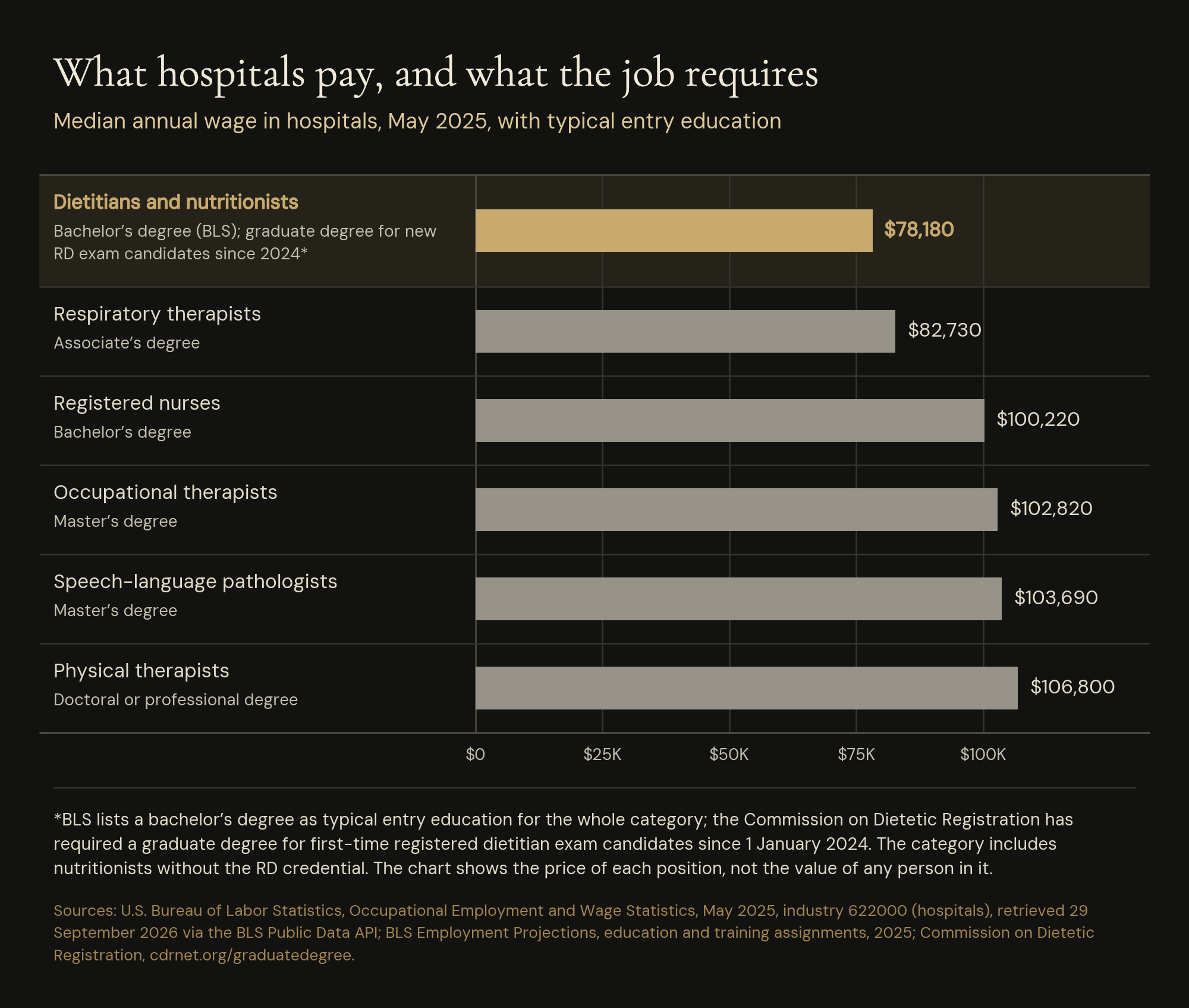
Two cautions. The BLS category includes nutritionists who are not registered dietitians, and BLS still lists a bachelor’s degree as the typical entry for the whole category. And the gap does not prove dietitians are paid less than they are worth; I searched PubMed on 29 September 2026 for a study linking dietitian pay to patient outcomes and found none. What it does show is where the price attaches. It attaches to the position.
Who keeps what the expert builds
Suppose an engineer notices a recurring failure that nobody assigned anyone to fix. The engineer designs the fix, builds it, trains others on it and measures what changed. The company adopts it. It becomes the department’s initiative. Then the company’s. The engineer who built it may see no change in pay, title, authority or staffing.
Start with what is legitimate. Employers generally own what employees produce on the job. For copyright, the statute is explicit:
In the case of a work made for hire, the employer or other person for whom the work was prepared is considered the author for purposes of this title, and, unless the parties have expressly agreed otherwise in a written instrument signed by them, owns all of the rights comprised in the copyright.
That is 17 U.S.C. 201(b). Employment agreements say much the same about inventions. The organization supplies the salary, the setting, the data and the risk. It keeps the output. Nobody is stealing anything.
The real question is whether anything flows back. Germany answered it in law. Its Employee Inventions Act, in force since 1957, gives an employee a claim to reasonable compensation once the employer claims an invention made on the job. Section 9 reads, in my translation:
(1) The employee has a claim against the employer to reasonable compensation as soon as the employer has claimed the service invention. (2) The compensation is to be assessed in particular by the invention’s commercial usability, the employee’s duties and position in the business, and the share the business contributed to the invention.
The second paragraph sets the terms. The employee is owed something. The company’s own contribution counts too.
American firms share value too. Unevenly. Patrick Kline, Neviana Petkova, Heidi Williams and Owen Zidar linked patent applications to tax records and found that workers captured “roughly 30 cents of every dollar of patent-induced surplus” (Quarterly Journal of Economics, 2019). The share was about twice as high for workers present since the application, and it went mostly to men and to the top half of earners. The authors read it as rent capture by senior workers “who are most costly for innovative firms to replace.” Translation: sharing happens where the organization already knows it cannot afford to lose you.
The price of a replacement
“Everyone is replaceable.” True, at the level of the vacancy. Someone will fill the line. Even an essay on SHRM’s Executive Network site said, in January 2025, that “HR leaders need to stop hiding behind the idea that everyone is replaceable.” What replacing someone costs is a separate question, and here I have to report something inconvenient for my own side.
A figure often quoted, that replacing an employee costs 50 to 200 percent of salary, is hard to trace to a study. A 2019 Gallup article put it at “one-half to two times the employee’s annual salary” without citing one. A 2025 essay on SHRM’s Executive Network site said the cost “can range from 50% to 200% of their annual salary,” attributed the range to SHRM and cited no study either. The furthest back I could trace it is a working paper first issued in 2019 that credits compensation consultants and cites two sources from 1997, which I have not been able to read.
Studies that measured something found smaller numbers. A Center for American Progress review of thirty case studies found that for all positions except executives and physicians, “the typical (median) cost of turnover was 21 percent of an employee’s annual salary,” with a full range of 5.8 to 213 percent (Boushey and Glynn, 2012). Surveys of California establishments in 2003 and 2008 put average replacement costs at about 9 percent of the average annual wage (Dube, Freeman and Reich, 2010). A nurse staffing firm’s 2026 hospital survey put the average cost of losing one bedside registered nurse at $60,090 (NSI Nursing Solutions, 2026).
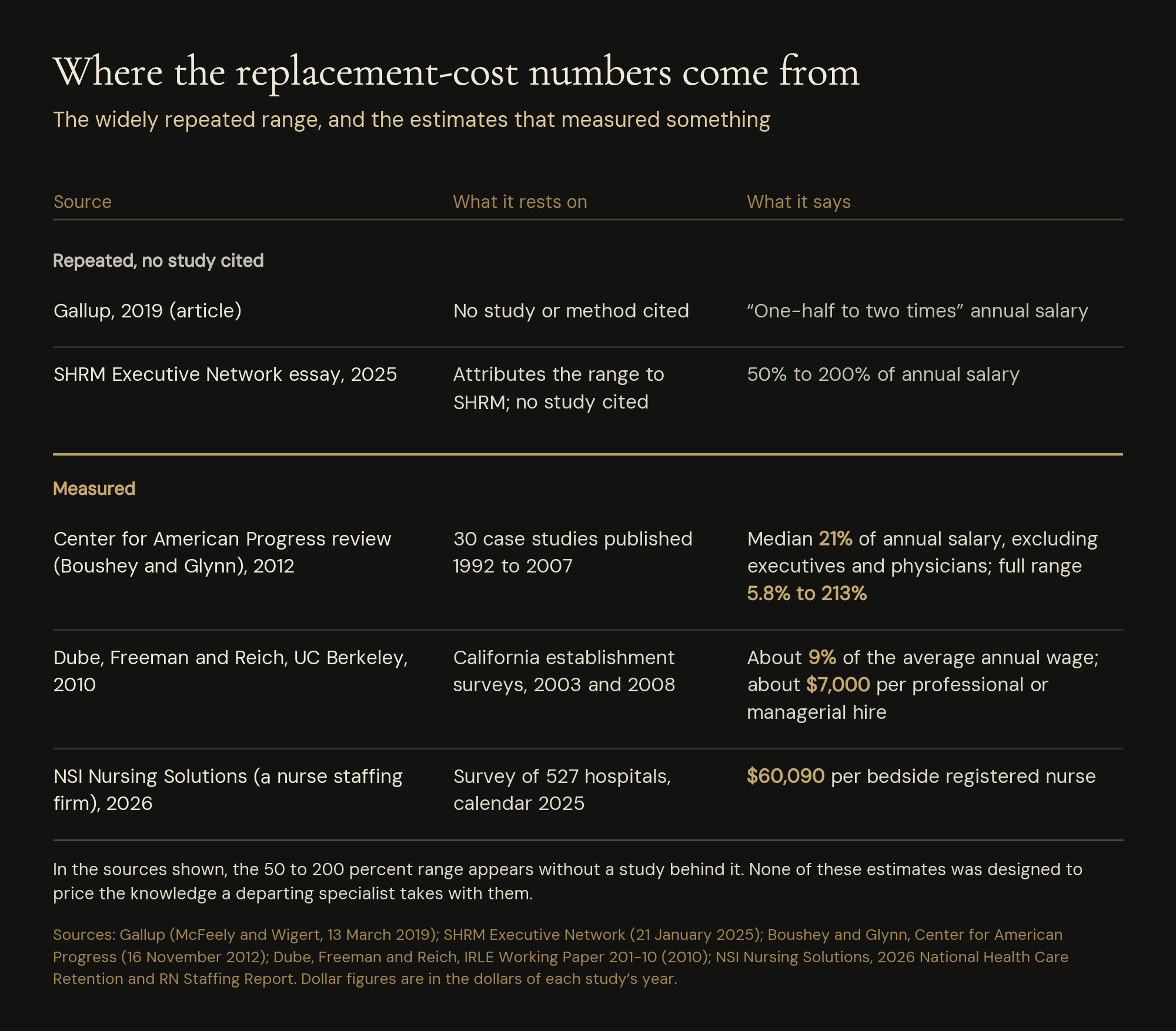
So the measured cost of refilling a job runs from about a tenth of a year’s wages in the California surveys to roughly half or more of a bedside nurse’s pay in the staffing firm’s survey, depending on who measured what. Either way, that is the part that lands in a recruiting budget. Refilling a line restores the hours. It does not restore what the last person knew.
The bigger costs never land there. They show up the way Fogbank did, years later, as a capability that is just gone. They show up in Bartel’s hospital data as lost productivity. And they show up in the price of the replacement. Matthew Bidwell studied personnel records from the U.S. investment banking arm of a financial services firm. In “Paying More to Get Less,” he found that external hires were paid more than insiders promoted into similar jobs, performed worse at first and left more often (Administrative Science Quarterly, 2011). More money, a worse start, a faster exit. Two meta-analyses find turnover negatively related to organizational performance: modestly in one, close to zero on average in the other, which found the link strongest for quality and safety measures (Park and Shaw, Journal of Applied Psychology, 2013; Hancock and colleagues, Journal of Management, 2013).
The usual comeback is that people who want more money can leave. In health care, that is easier said than done. In a natural experiment at Veterans Affairs hospitals, labor supply to individual hospitals was “quite inelastic, with short-run elasticity around 0.1” (Staiger, Spetz and Phibbs, Journal of Labor Economics, 2010). Hospital mergers that sharply raised concentration slowed wage growth for workers with industry-specific skills (Prager and Schmitt, American Economic Review, 2021). In a 2014 national survey, about 18 percent of U.S. labor force participants were bound by noncompetes, more often in high-skill, high-paying jobs (Starr, Prescott and Bishara, Journal of Law and Economics, 2021). And when leaving is the only answer, the organization loses the knowledge that goes out the door with the person, then pays more for the outsider who replaces them.
Expertise on the payroll, unused
A quieter version of the same loss requires nobody to quit. A company hires a software architect and has the architect closing routine tickets. A firm hires an experienced litigator and parks the litigator on document review. The expertise is on the payroll. It is just not being used.
OPM’s classification guidance counts this among management’s responsibilities:
to assure that work is organized in an efficient and cost-effective manner and that the skills and abilities of employees are used to the fullest extent possible.
A budget counted in FTEs does not track that. Hours are easy to count.
Bengt Holmström and Paul Milgrom explained the trap (Journal of Law, Economics, and Organization, 1991), in work the Royal Swedish Academy of Sciences described when Holmström shared the 2016 economics prize: when a job has several tasks and only some are easy to measure, paying for the measurable ones pulls effort away from everything else. Count closed tickets and you get closed tickets. The redesign nobody asked for and the mentoring that gets a new hire competent sooner fall out of the count. Eventually they fall out of the job.
In health care, this has been measured. In a study of 767 nurses on thirty-six medical-surgical units, documentation took 35.3 percent of nursing practice time, while “only 7.2% (31 minutes)” went to patient assessment and reading vital signs (Hendrich and colleagues, Permanente Journal, 2008). Fifty-seven physicians observed for 430 hours spent 27.0 percent of their office day face to face with patients and 49.2 percent on electronic records and desk work (Sinsky and colleagues, Annals of Internal Medicine, 2016; self-selected practices, funded by the American Medical Association).
For dietitians, the clearest example is in federal regulation. Since a 2014 amendment, Medicare’s hospital conditions of participation have let a qualified dietitian order patient diets, including therapeutic diets, when the medical staff authorizes it and state law allows:

The rule allows it. Whether a hospital uses it is a choice. Where it has been tried, the evidence is thin but encouraging. In one small performance improvement project, compared with historical controls, after intensive care dietitians gained order-writing privileges, the share of protein needs actually delivered rose from 72.1 to 89.1 percent (Arney and colleagues, Nutrition in Clinical Practice, 2019).
The dietitian as a case study
I use dietitians because I am one and because the numbers are public. I work as a hospital dietitian and research this workforce, so I have a personal stake in how the profession is paid. Read this section with that in mind. The point is not that dietitians are uniquely mistreated.
Start with how the federal rules count us. Medicare’s conditions of participation for hospitals say:
There must be a qualified dietitian, full-time, part-time, or on a consultant basis.
That is the federal floor for dietitian staffing in a hospital. It sets no headcount (42 CFR 482.28(a)(2)). It is written in the language of FTEs: full-time, part-time, consultant. Our work is not billed on its own either. Medicare pays for a hospital stay through a diagnosis-related group, and the regulation calls that amount “the total Medicare payment for the inpatient operating costs” and capital-related costs of the stay (42 CFR 412.2(b)(1)). Our time is paid for inside it. On a budget, that makes us a cost to cover.
The payment system still leans on the work, and this year somebody argued it should not. When CMS wrote its fiscal 2027 inpatient rule, a requestor asked it to downgrade severe malnutrition as a major complication, arguing that “nutritional assessment is the standard of care for all hospital admissions” and that treatment, once started, “adds little or no additional costs to overall resource utilization for the encounter.” That is the FTE view of nutrition care in two sentences. Routine. Free. Commenters pushed back; one called nutritional status “a critical clinical indicator that informs diagnosis, treatment planning, and recovery.” In the final rule, published 4 August 2026, CMS kept all four codes “as MCCs without modification, for FY 2027,” and finalized “mandatory reporting for the Malnutrition Care Score eCQM beginning with the FY 2030 payment determination.”
The coding rules keep the diagnosis with the treating provider. The official guidelines say:
Code assignment is based on the documentation by the patient’s provider (i.e., physician or other qualified healthcare practitioner legally accountable for establishing the patient’s diagnosis).
A dietitian’s note can support a body mass index code, but “the associated diagnosis” must be documented by the patient’s provider (ICD-10-CM Official Guidelines, FY 2027, section I.B.14). And documentation cuts both ways. In 2020 the HHS Inspector General found that “hospitals used severe malnutrition diagnosis codes when they should have used codes for other forms of malnutrition or no malnutrition diagnosis code at all,” and estimated about $1.0 billion in overpayments over two fiscal years on claims where severe malnutrition was the only major complication (report A-03-17-00010). A code is legitimate only when the condition is present, the provider has diagnosed it and the record supports it. So no, dietitians do not pay for themselves through coding. Accurate assessment is clinical work and compliance work at once. Neither kind of value shows up on the line where the dietitian is budgeted.
The clinical evidence is not soft. In the EFFORT trial, 2,088 medical inpatients at eight Swiss hospitals were randomized to usual hospital food or to nutrition support in which “individualised nutritional support goals were defined by specialist dietitians.” Adverse outcomes by thirty days fell from 27 to 23 percent. Deaths fell from 10 to 7 percent (Schuetz and colleagues, Lancet, 2019). The trial’s economic evaluation found that per-patient savings nearly disappeared once dietitians’ consultation time was counted, from 214 Swiss francs to about 20 (Schuetz and colleagues, Clinical Nutrition, 2020). The value was in the outcomes. A cost budget does not look there.
The way we assess feeds into diagnoses and treatment plans that a quality measure CMS has now made mandatory will track, and we have the evidence to support this, through a randomized trial showing that we improve quality outcomes, yet we are budgeted as hours of cost rather than hours of savings. Not to mention the amount of revenue that can be generated by those diagnoses when the record supports them. And this is before we talk about the effect that would take place if Medicare’s medical nutrition therapy benefit were expanded beyond diabetes and kidney disease.
Where Medicare does cover outpatient nutrition therapy, the statute bases payment on the lesser of the actual charge or “85 percent of the amount determined under the fee schedule” for “the same services if furnished by a physician” (42 U.S.C. 1395l(a)(1)(T)). The price attaches to the credential class. Not to anyone’s results.
One more fact shapes what a fix can look like. Of the roughly 136,000 dietitians and nutritionists counted in the 2025 Current Population Survey, 91.7 percent were women. The Wisconsin teacher data showed flexible pay widening the gap between women and men with the same credentials. In a workforce like this one, letting each manager decide what each person is worth is not a neutral remedy.
What a better review would ask
A pay review can ask what a salary band cannot, without turning people into points.
A band answers exactly one question well: what do people in this role usually earn? It cannot tell you what this person’s accumulated knowledge is worth to you. It was never built to. A better pay review starts where the band stops. What would we lose if this person left? How long would it take to rebuild? What has this person built that other people now depend on? How much of their capability does the job, as designed, actually use? Is the scope they carry the scope the position was priced for?
The law does not require flat bands. The Equal Pay Act bars paying women less than men for equal work, except where the difference is paid:
pursuant to (i) a seniority system; (ii) a merit system; (iii) a system which measures earnings by quantity or quality of production; or (iv) a differential based on any other factor other than sex
That is 29 U.S.C. 206(d)(1). Merit is written right into the statute. Written criteria still matter, because transparent rules guard against the bias that bands were built to prevent. A manager’s private sense of who is valuable does not. Not everything will have a clean return; Canice Prendergast concluded that economists “still know little” about incentives for workers whose output is hard to measure (Journal of Economic Literature, 1999). The decisions can still be concrete. A title that matches the work. Authority that matches responsibility. A share of the value when something a person built earns or saves money. An organization that keeps capturing value from someone’s expertise, with no change in their pay, authority or title, should ask itself an uncomfortable question: is its pay system pricing the asset it depends on?
There is some movement. Since November 2020 the Securities and Exchange Commission has required public companies to describe their “human capital resources,” to the extent material to the business, including any human capital measures or objectives they focus on in managing the business (17 CFR 229.101(c)(2)(ii)). The SEC’s own Investor Advisory Committee had urged that such disclosure “be crafted so as to reflect the varied circumstances of different businesses, and to eschew simple ‘one-size-fits-all’ approaches that obscure more than they add.” In adopting the rule, the SEC noted commenters who said there was “no consensus on the most appropriate metrics or methodology.” They were right about that.
What replacement leaves out
The economy these organizations compete in runs more and more on knowledge. In 2025, 40 percent of U.S. private nonresidential fixed investment went to intellectual property products: software, research and development, and creative originals. That was more than businesses spent on equipment and nearly twice what they spent on structures, according to the Bureau of Economic Analysis. The national accounts began counting research and development as investment in 2013. Under U.S. accounting rules, most companies still expense research, salaries included, as it happens.
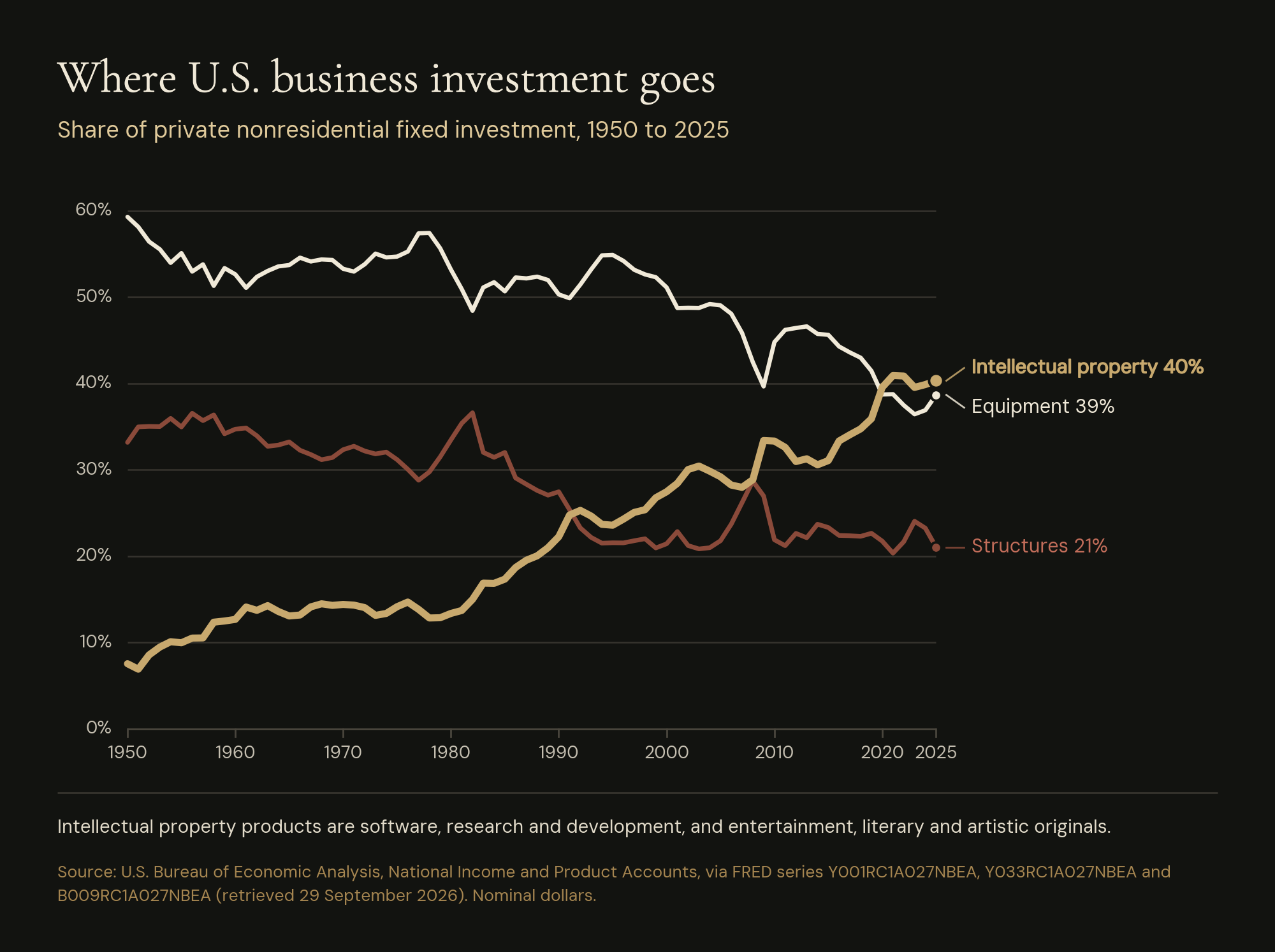
Whether an employee can be replaced is not the useful question, because anyone can be, at some cost. The useful question is what an organization gives up when it replaces someone whose value it never learned to measure.
If a CFO or a compensation department has read this entire thing, what would I want them to take away the next time they post for a replacement? Obviously you want to make sure the person has the credentials just to enter, but that is the bare minimum. We need to stop treating people and positions in specialized fields like standardized jobs that just require a warm body.
The views here are my own.
References
Arney BD, et al. Effect of registered dietitian nutritionist order-writing privileges on enteral nutrition administration in selected intensive care units. Nutrition in Clinical Practice. 2019;34(6):899-905. https://pubmed.ncbi.nlm.nih.gov/30741444/
Baker G, Gibbs M, Holmström B. The internal economics of the firm: evidence from personnel data. Quarterly Journal of Economics. 1994;109(4):881-919. https://doi.org/10.2307/2118351
Baker M, Halberstam Y, Kroft K, Mas A, Messacar D. Pay transparency and the gender gap. American Economic Journal: Applied Economics. 2023;15(2):157-183. https://doi.org/10.1257/app.20210141
Bartel AP, Beaulieu ND, Phibbs CS, Stone PW. Human capital and productivity in a team environment: evidence from the healthcare sector. American Economic Journal: Applied Economics. 2014;6(2):231-259. https://doi.org/10.1257/app.6.2.231
Becker GS. Investment in human capital: effects on earnings. In: Human Capital, 2nd ed. NBER; 1975. https://www.nber.org/system/files/chapters/c3733/c3733.pdf
Bennett B, Erel I, Stern LH, Wang Z. Paid leave pays off: the effects of paid family leave on firm performance. ECGI Finance Working Paper 643/2019 (revised March 2023). https://www.ecgi.global/sites/default/files/working_papers/documents/paidleavepaysoff.pdf
Biasi B, Sarsons H. Flexible wages, bargaining, and the gender gap. Quarterly Journal of Economics. 2022;137(1):215-266. https://doi.org/10.1093/qje/qjab026
Bidwell M. Paying more to get less: the effects of external hiring versus internal mobility. Administrative Science Quarterly. 2011;56(3):369-407. https://doi.org/10.1177/0001839211433562
Boushey H, Glynn SJ. There are significant business costs to replacing employees. Center for American Progress; 16 November 2012. https://cdn.americanprogress.org/wp-content/uploads/2012/11/CostofTurnover.pdf
Centers for Medicare and Medicaid Services. FY 2027 hospital inpatient prospective payment system final rule. Federal Register 91 FR 49570; 4 August 2026.
Centers for Medicare and Medicaid Services. ICD-10-CM Official Guidelines for Coding and Reporting, FY 2027, section I.B.14. https://www.cms.gov/files/document/fy-2027-icd-10-cm-coding-guidelines.pdf
42 CFR 412.2(b)(1); 42 CFR 482.28(a)(2) and (b)(2); 17 U.S.C. 201(b); 26 U.S.C. 197; 29 U.S.C. 206(d)(1); 42 U.S.C. 1395l(a)(1)(T).
Commission on Dietetic Registration. Graduate degree requirement. https://www.cdrnet.org/graduatedegree (read 29 September 2026)
Doeringer PB, Piore MJ. Internal Labor Markets and Manpower Analysis. Report to the U.S. Department of Labor; 1970. https://files.eric.ed.gov/fulltext/ED048457.pdf
Dube A, Freeman E, Reich M. Employee replacement costs. IRLE Working Paper 201-10; 2010. https://irle.berkeley.edu/wp-content/uploads/2010/03/Employee-Replacement-Costs.pdf
Gallup. McFeely S, Wigert B. This fixable problem costs U.S. businesses $1 trillion. 13 March 2019. https://www.gallup.com/workplace/247391/fixable-problem-costs-businesses-trillion.aspx
Gesetz über Arbeitnehmererfindungen (Employee Inventions Act), section 9. https://www.gesetze-im-internet.de/arbnerfg/__9.html
Groysberg B, Lee LE, Nanda A. Can they take it with them? The portability of star knowledge workers’ performance. Management Science. 2008;54(7):1213-1230. https://doi.org/10.1287/mnsc.1070.0809
Hancock JI, Allen DG, Bosco FA, McDaniel KR, Pierce CA. Meta-analytic review of employee turnover as a predictor of firm performance. Journal of Management. 2013;39(3):573-603. https://doi.org/10.1177/0149206311424943
Hand RK, Merlino Barr S, Fenton TR, Groh-Wargo S. US neonatal intensive care unit registered dietitian nutritionists salary description and correlates: results of a survey. Journal of Human Nutrition and Dietetics. 2024;37(4):1032-1039. https://pubmed.ncbi.nlm.nih.gov/38739733/
Hendrich A, Chow MP, Skierczynski BA, Lu Z. A 36-hospital time and motion study: how do medical-surgical nurses spend their time? Permanente Journal. 2008;12(3):25-34. https://pubmed.ncbi.nlm.nih.gov/21331207/
HHS Office of Inspector General. Hospitals overbilled Medicare $1 billion by incorrectly assigning severe malnutrition diagnosis codes to inpatient hospital claims. A-03-17-00010; July 2020. https://oig.hhs.gov/oas/reports/region3/31700010.pdf
Holmström B, Milgrom P. Multitask principal-agent analyses: incentive contracts, asset ownership, and job design. Journal of Law, Economics, and Organization. 1991;7(special issue):24-52. https://doi.org/10.1093/jleo/7.special_issue.24
Huckman RS, Pisano GP. The firm specificity of individual performance: evidence from cardiac surgery. Management Science. 2006;52(4):473-488. https://doi.org/10.1287/mnsc.1050.0464
IFRS Interpretations Committee. Agenda decision: Training costs to fulfil a contract (IFRS 15); March 2020, quoting IAS 38 paragraph 15.
Jackson CK, Rockoff JE, Staiger DO. Teacher effects and teacher-related policies. Annual Review of Economics. 2014;6:801-825. https://doi.org/10.1146/annurev-economics-080213-040845
Kambourov G, Manovskii I. Occupational specificity of human capital. International Economic Review. 2009;50(1):63-115. https://doi.org/10.1111/j.1468-2354.2008.00524.x
Kline P, Petkova N, Williams H, Zidar O. Who profits from patents? Rent-sharing at innovative firms. Quarterly Journal of Economics. 2019;134(3):1343-1404. https://doi.org/10.1093/qje/qjz011
Medoff JL, Abraham KG. Experience, performance, and earnings. Quarterly Journal of Economics. 1980;95(4):703-736. https://doi.org/10.2307/1885488
Nobel Prize Outreach. Popular science background: Contract theory, the Sveriges Riksbank Prize in Economic Sciences 2016. https://www.nobelprize.org/prizes/economic-sciences/2016/popular-information/
NSI Nursing Solutions. 2026 National Health Care Retention and RN Staffing Report. https://www.nsinursingsolutions.com/documents/library/nsi_national_health_care_retention_report.pdf
Park TY, Shaw JD. Turnover rates and organizational performance: a meta-analysis. Journal of Applied Psychology. 2013;98(2):268-309. https://doi.org/10.1037/a0030723
Prager E, Schmitt M. Employer consolidation and wages: evidence from hospitals. American Economic Review. 2021;111(2):397-427. https://doi.org/10.1257/aer.20190690
Prendergast C. The provision of incentives in firms. Journal of Economic Literature. 1999;37(1):7-63. https://doi.org/10.1257/jel.37.1.7
Schmidt FL, Hunter JE. The validity and utility of selection methods in personnel psychology: practical and theoretical implications of 85 years of research findings. Psychological Bulletin. 1998;124(2):262-274. https://doi.org/10.1037/0033-2909.124.2.262
Schmidt FL, Oh IS, Shaffer JA. The validity and utility of selection methods in personnel psychology: practical and theoretical implications of 100 years of research findings. Working paper; 2016.
Schuetz P, et al. Individualised nutritional support in medical inpatients at nutritional risk (EFFORT). Lancet. 2019;393(10188):2312-2321. https://doi.org/10.1016/S0140-6736(18)32776-4
Schuetz P, Sulo S, Walzer S, et al. Economic evaluation of individualized nutritional support in medical inpatients: secondary analysis of the EFFORT trial. Clinical Nutrition. 2020;39(11):3361-3368. https://pubmed.ncbi.nlm.nih.gov/32147200/
SHRM Executive Network. The myth of replaceability: preparing for the loss of key employees. 21 January 2025. https://www.shrm.org/executive-network/insights/myth-replaceability-preparing-loss-key-employees
Sinsky C, et al. Allocation of physician time in ambulatory practice. Annals of Internal Medicine. 2016;165(11):753-760. https://doi.org/10.7326/M16-0961
Staiger DO, Spetz J, Phibbs CS. Is there monopsony in the labor market? Evidence from a natural experiment. Journal of Labor Economics. 2010;28(2):211-236. https://doi.org/10.1086/652734
Starr EP, Prescott JJ, Bishara ND. Noncompete agreements in the US labor force. Journal of Law and Economics. 2021;64(1):53-84. https://doi.org/10.1086/712206
Topel R. Specific capital, mobility, and wages: wages rise with job seniority. Journal of Political Economy. 1991;99(1):145-176. https://doi.org/10.1086/261744
U.S. Bureau of Economic Analysis. Private fixed investment by type, via FRED series Y001RC1A027NBEA, Y033RC1A027NBEA and B009RC1A027NBEA (retrieved 29 September 2026).
U.S. Bureau of Labor Statistics. Current Population Survey, 2025 annual averages, Table 11.
U.S. Bureau of Labor Statistics. Handbook of Methods, Productivity Measures: Business Sector and Major Subsectors, Concepts. https://www.bls.gov/opub/hom/msp/concepts.htm
U.S. Bureau of Labor Statistics. Occupational Employment and Wage Statistics, May 2025, national estimates (retrieved 29 September 2026 through the BLS Public Data API).
U.S. Government Accountability Office. A Glossary of Terms Used in the Federal Budget Process. GAO-05-734SP; September 2005. https://www.gao.gov/products/gao-05-734sp
U.S. Government Accountability Office. Nuclear Weapons: NNSA and DOD Need to More Effectively Manage the Stockpile Life Extension Program. GAO-09-385; March 2009. https://www.gao.gov/products/gao-09-385
U.S. Government Accountability Office. Statewide Transportation Planning: Surveys of State Departments of Transportation and Regional Planning and Development Organizations, definition of full-time equivalent. GAO-11-78SP; December 2010. https://files.gao.gov/special.pubs/gao-11-78sp/fte.htm
U.S. Office of Personnel Management. Introduction to the Position Classification Standards. https://www.opm.gov/policy-data-oversight/classification-qualifications/classifying-general-schedule-positions/positionclassificationintro.pdf
U.S. Securities and Exchange Commission. Modernization of Regulation S-K Items 101, 103, and 105. 85 FR 63726; 8 October 2020. 17 CFR 229.101(c)(2)(ii).
This article is general nutrition education, not individualized medical or nutrition advice, and it does not create a dietitian–client relationship. Medications and their side effects should be managed with your prescribing clinician. See the full disclaimer.