Summary
Patients often ask me whether a protein powder is a good one. The better question is whether a tub does its one job, cleanly, at a price you will keep paying. I read the back of the tub first. The front is marketing.
- Find the protein per scoop, not per serving. A serving is sometimes two scoops. Work out the cost per serving. When a shake replaces a meal, I want 25 to 40 grams for most adults.
- Then I want modest added sugar, a short ingredient list with the protein first, and no “proprietary blend,” which hides the amounts.
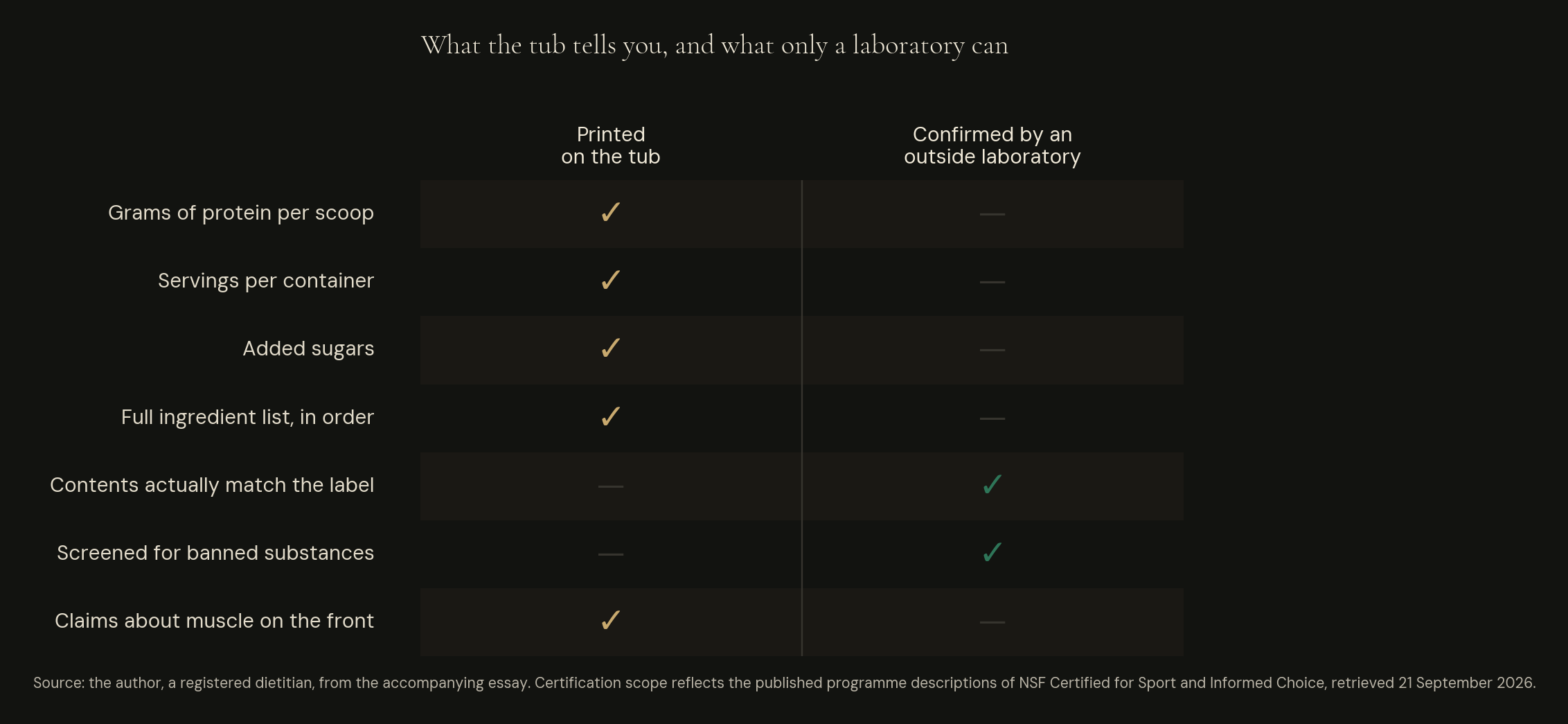
- In the United States, supplements are not approved for safety or effectiveness before sale. A mark such as NSF Certified for Sport or Informed Sport means an outside laboratory checked the contents. It is not a health claim.
- The 2025 to 2030 Dietary Guidelines for Americans set adult protein at 1.2 to 1.6 grams per kilogram a day. For patients losing weight on GLP-1 medicines, a class of weight-loss and diabetes drugs, I aim for about 1.6 grams per kilogram of ideal body weight. I found no completed trial that sets the best intake on these drugs.
- I ignore muscle claims on the front. The maker must hold evidence, but nobody checks it before sale. This is general education. If you take medication or have a diagnosis, confirm your target with your clinical team.
Summary added 2 October 2026.
Patients ask me about protein powders, often with several tubs in mind, because someone at the gym recommended one and a podcast recommended another and the third was on sale. The question they ask is almost always whether it is a good one. That is the wrong question, and I do not mean that unkindly. A protein powder is a tool with one job, and the useful question is whether this particular tub does that job, cleanly, at a price you will keep paying.
So here is the order I read a label in, which is roughly the reverse of the order the packaging wants. The front of the tub is marketing. The back of the tub is the product. A disclosure before going further. I have a practitioner store on Fullscript, the supplement dispensing platform. It would pay me a margin on supplements sold through it, which can include protein powders. As of 30 September 2026 the store has made no sales.
Protein per scoop, not protein per serving
The first number I look for is grams of protein, and the first trap is that the number on the front is per serving, and a serving is sometimes two scoops. I have seen tubs advertising a large round number that deliver a little more than half of it per scoop, which means the tub holds half as many usable servings as the buyer thought.
So: find the serving size on the panel, whether the tub carries Nutrition Facts or Supplement Facts, note how many scoops that is, and divide. Then work out the cost per serving. That single piece of arithmetic changes the ranking of most people's shortlist, and it is why the expensive-looking tub is often the cheaper one.
What counts as enough depends on what the powder is for. If it is standing in for a meal or filling the gap left by a meal you could not finish, I want it in the range I want any protein-containing meal to be in, which for most adults is somewhere between 25 and 40 g. If it is topping up a meal that already has protein in it, less is fine. A powder that delivers 15 g per scoop is not a bad product. It is a product that will take two scoops to do the job, and you should price it that way.
The rest of the panel, which is mostly about what is not there
After protein I read down the panel for added sugars, then the ingredient list for what is bulking out the tub. Some added sugar is not a problem and in some products it is the reason the thing is drinkable. A large amount of it in something sold as a protein supplement means the formulator was solving for taste at the expense of the only job the product has.
Fillers are harder to see because they do not have their own line. I want a short ingredient list where the protein source appears first, and an absence of two patterns. The first is a long tail of gums, starches and flours ahead of, or near, the protein source. The second is a "proprietary blend," which is a legal way of telling you the proportions are not your business. I do not treat that as sinister. I treat it as an unanswered question, and there are enough products on the shelf that answer it.
Third-party testing, and the reason it exists
This is the part most patients have never been told, and it changes how they shop.
Dietary supplements in the United States are not approved for safety or efficacy before they are sold. The manufacturer is responsible for the product being safe and the label being accurate, and regulatory attention mostly arrives afterward, if something goes wrong. That is not a scandal and not a reason to avoid supplements. It is a reason independent verification is worth a small premium.
Voluntary third-party certification programs exist to fill exactly that gap, and the differences between them matter more than most people are told.
NSF Certified for Sport tests finished product against a long list of substances banned in sport, screens for unsafe levels of contaminants such as heavy metals, confirms that the contents match the label, and requires the manufacturing facility to be audited. Informed Choice, from the same laboratory group as Informed Sport, tests against a comparable banned-substance list and reviews the manufacturing operation, and samples lots through the year rather than testing every one.
That distinction catches people out. Informed Sport tests every batch before release and exists for athletes and service members under drug testing; Informed Choice samples batches and is aimed at everyone else. If you are subject to an anti-doping code, Informed Sport is the mark you need, because an Informed Choice tub may come from a lot that was never tested. Both publish searchable directories, so you can confirm the specific product, and on the Informed side the specific batch number.
A mark does not mean the product is better for you than an uncertified one, and it is not a health claim. It means an outside laboratory with no stake in selling the tub has actually opened it. For most people that is a reasonable default costing a few dollars per tub.
Protein type matters less than the aisle suggests
Whey, casein, whey isolate, pea, soy, blends. The differences are real and smaller than the shelf space implies. What I care about, in order: whether you tolerate it, whether the amino acid profile is complete, and whether you will drink it.
Tolerance ends the conversation fastest. If a whey concentrate leaves someone bloated, the best-formulated whey concentrate in the store is the wrong product for them and an isolate or a plant blend is the right one, regardless of any comparison chart. Plant proteins are usually blended precisely because a single plant source is often low in one or more essential amino acids. A single-source plant protein can still be fine; it may simply take a slightly larger serving to do the same work.
Whether you will drink it is not trivial. A powder you do not like sits in the cupboard, and the nutritional value of a full tub in a cupboard is zero.
When the powder is the right answer
I am not a powder maximalist. Most people meet their protein target more cheaply and more pleasantly with eggs, yogurt, fish, poultry, beans and dairy, and I would rather build a plan from those.
The powder earns its place when appetite and capacity are the constraint rather than knowledge or willingness. That describes a great many people on GLP-1 medications, where total food volume falls sharply and protein is usually the first thing to get squeezed.
Be careful with the numbers here, because the baseline moved this year. The familiar 0.8 g per kilogram comes from the 2005 dietary reference intakes and was derived to prevent deficiency, not to protect lean tissue during rapid loss. The Dietary Guidelines for Americans, 2025 to 2030, issued in January 2026, set adult protein guidance at 1.2 to 1.6 grams per kilogram per day. So the target I work toward for people in active loss, around 1.6 g per kilogram of ideal body weight, is the top of the current federal range rather than double anything, and I would rather say so than lean on a comparison to a twenty-year-old figure. I found no completed prospective trial that establishes an optimal protein intake specifically during GLP-1 therapy (ClinicalTrials.gov and PubMed, searched 2 October 2026), though at least two registered trials testing protein strategies in people on these drugs are now recruiting; the working ranges are extrapolated from bariatric surgery protocols.
Hitting the top of that range on a shrunken appetite is a volume problem before it is anything else, and a shake delivering 25 to 40 g in eight to twelve ounces solves a volume problem in a way a chicken breast cannot.
The same logic applies after an illness, around surgery, on a travel week, or any day when the real alternative to a shake is skipping the meal. I would rather a patient drink something imperfect than eat nothing.
The two things on the front of the tub I ignore
Anything about muscle, and anything about a number of grams of an individual amino acid.
A muscle claim is not lawless, and I want to be accurate rather than cynical about it. It is a structure and function claim: the manufacturer has to hold substantiation that it is truthful and not misleading, print the disclaimer that the statement has not been evaluated by the Food and Drug Administration, and notify the agency within thirty days of going to market. What none of that involves is anybody checking the claim before the tub reaches the shelf.
The highlighted amino acid content, usually branched-chain amino acids, is a real measurement making an argument that does not hold: if you are eating enough complete protein you are already getting those amino acids, and the figure is mostly there to give the panel something to be proud of.
Read the back. Do the division. Check for a certification mark. That is the whole method, and it takes about ninety seconds in the aisle.
New essays go out Tuesdays, free to everyone, and Fridays for paid subscribers, where the research deep dives live.
The full archive is at https://vitaearete.substack.com/archive
This is general education and not individual medical advice. If you take medication, have kidney or liver disease, or are managing a diagnosis, confirm your own protein target with your clinical team before changing anything.
And when you want a plan built around your own labs, medications, and life: https://vitaearete.com
Updated 2 October 2026: a few examples were reworded in general terms, and a disclosure about my supplement dispensary was added. None of this changes the advice.
This article is general nutrition education, not individualized medical or nutrition advice, and it does not create a dietitian–client relationship. Medications and their side effects should be managed with your prescribing clinician. See the full disclaimer.