Summary
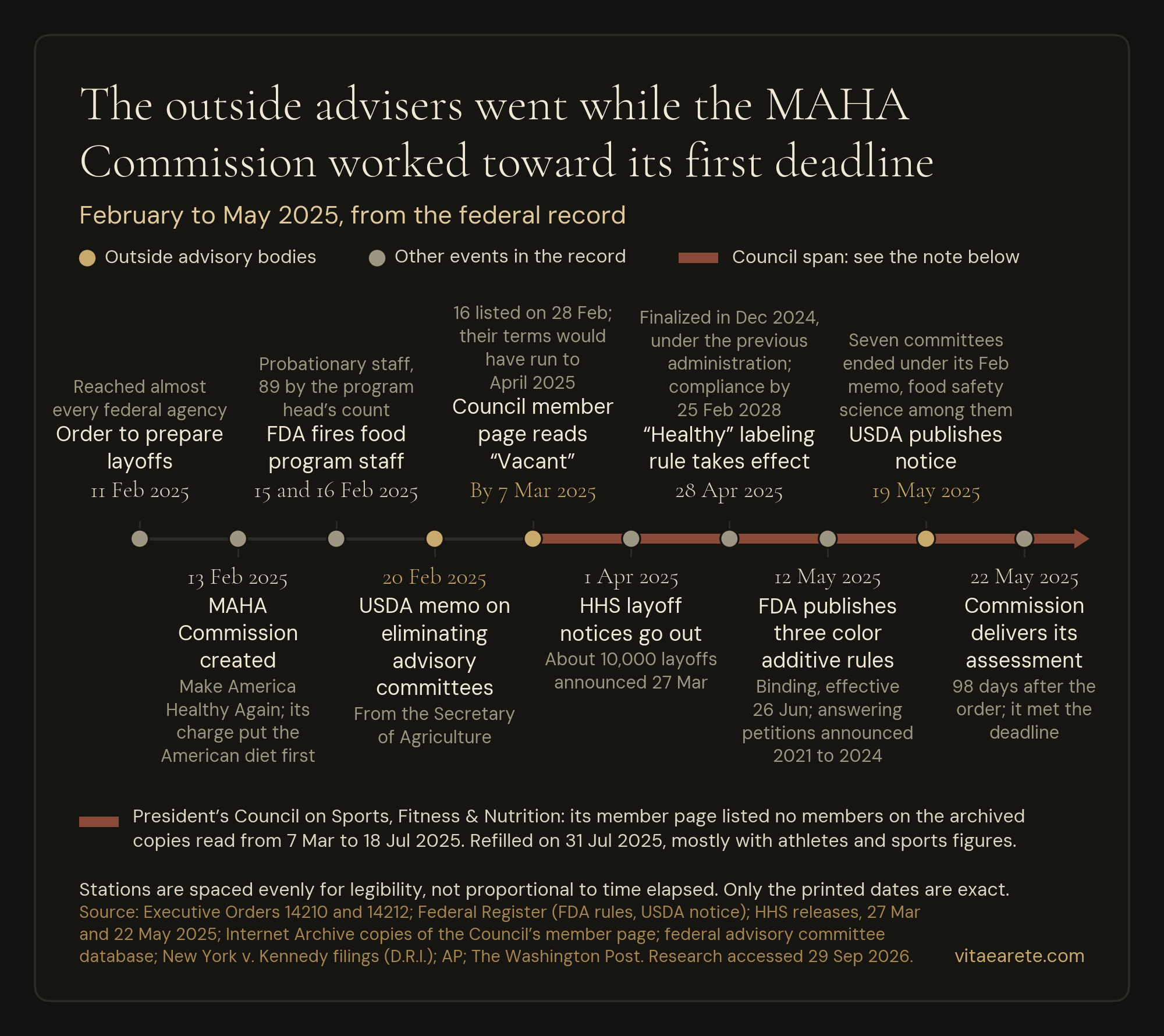
In February 2025 President Trump told federal agencies to prepare large layoffs. Two days later he created the Make America Healthy Again (MAHA) Commission to study childhood chronic disease, with the American diet first among its possible causes, and made his Health Secretary, Robert F. Kennedy Jr., its chair. I read the records from February to May 2025 to see whether the government kept the nutrition expertise that work needed. My grade is an F.
The layoff list the Department of Health and Human Services produced in a lawsuit in June 2026 does not name four federal nutrition offices I checked. Some entries name only a parent office, so it cannot prove no one there lost a job.
The Food and Drug Administration fired staff still on probation in its food program. Its food chief resigned. He wrote that they included nutrition and infant formula experts.
The Agriculture Department ended its food safety science committee. A presidential council on fitness and nutrition listed no members on the copies of its web page I read from March to July 2025, then was refilled mostly with athletes and sports figures. Neither version of the Commission’s May 2025 report uses the word “dietitian.”
Kennedy announced his department’s March 2025 restructuring under a layoff order named for DOGE, the Department of Government Efficiency, which the President said Elon Musk headed. Under oath, the department counted the adviser who drafted its layoff plans among those brought in to work on its DOGE team. In the records this piece cites, I found no document tying DOGE to those firings or that committee.
The record has credits: binding FDA rules on three food colors and on the “healthy” label. Both began before 2025.
The layoff list HHS produced in a lawsuit in June 2026 does not name four federal nutrition offices I checked. They are FDA’s nutrition center, NIH’s Office of Nutrition Research, CDC’s nutrition division and the Office of Disease Prevention and Health Promotion, which provides, in its own words, “science-based nutrition and physical activity guidance.” The states suing HHS say the record appears to hold an incomplete list. Some entries give only a parent office. So it cannot prove that nobody there lost a job.
What went, in the records I read, sat mostly at the edges. FDA fired probationary staff in its food program, and the program’s head wrote that they included staff with expertise in nutrition and infant formula. A senior NIH nutrition scientist retired, alleging censorship that HHS denies. USDA ended its food safety science committee. The President’s Council on Sports, Fitness & Nutrition listed no members on the archived copies of its page that I read from 7 March to 18 July 2025, and was then refilled mostly with athletes and sports figures.
On 11 February 2025 President Trump told agency heads to prepare “large-scale reductions in force,” the government’s phrase for layoffs. That order reached almost every federal agency. I searched its text in the Federal Register on 1 October 2026 for “nutrition,” “diet,” “health” and “food” and found none of them. Two days later he created the Make America Healthy Again Commission to study childhood chronic disease and its possible causes, the American diet first among them. He made the Secretary of Health and Human Services its chair.
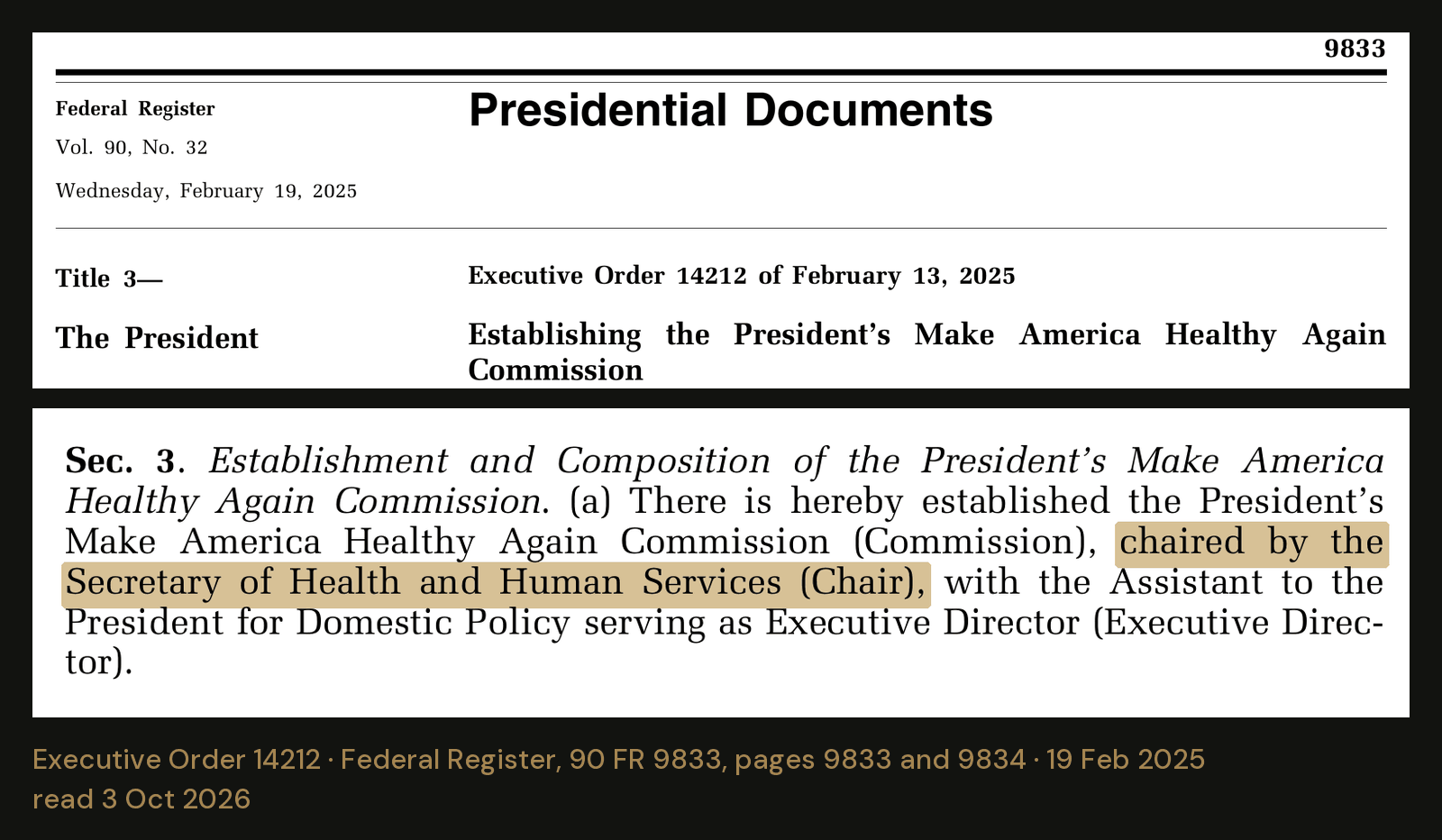
That Secretary was Robert F. Kennedy Jr. He was sworn in on 13 February, the day the order was signed, in the Oval Office. The order also made the President’s domestic policy adviser the Commission’s executive director. Its assessment went to the President through both of them. Kennedy had “created a nationwide movement” and would “lead a great national mission to make America healthy again,” the President said at the swearing-in. A reporter asked Kennedy about his plans at HHS. The President answered. “He’s going to be running it. He’s going to do a great job. That’s my plan.” In March Kennedy announced his department’s restructuring. The White House’s MAHA page, as I read it on 3 October 2026, says “President Trump launched” the initiative. At the Commission’s meeting on 22 May 2025, Kennedy asked the room to applaud the President “for his leadership of this.”
This series grades the MAHA record, one set of documents at a time. This piece covers February to May 2025 and asks whether the government built the nutrition expertise the Commission needed, or lost it.
A disclosure first. I am a registered dietitian, and I publish this newsletter under the name of my nutrition practice, Vitae Arete. I research the dietitian workforce and have argued in public for dietitians’ pay and Medicare coverage. This series is not that argument. It is my reading of the paperwork, and it gives the government’s good calls the same attention as its bad ones.
What they said
The Commission order says the administration must protect “expert recommendations from inappropriate influence” and increase “transparency regarding existing data.”
On 27 March Kennedy announced what HHS called a transformation to Make America Healthy Again. HHS said it acted “in accordance with President Trump’s Executive Order” titled “Implementing the President’s ‘Department of Government Efficiency’ Workforce Optimization Initiative,” the layoff order of 11 February. Its staffing had grown 17 percent in four years, it said. It would shrink from 82,000 full-time employees to 62,000, about 10,000 of them through layoffs that it said would save $1.8 billion a year. “We are realigning the organization with its core mission and our new priorities in reversing the chronic disease epidemic,” Kennedy said. FDA would lose about 3,500 people. The fact sheet promised the cut “will not affect drug, medical device, or food reviewers.”
What they did
On the weekend of 15 and 16 February, FDA fired staff in its food program. The Associated Press reported that the firings, as at other agencies, went to employees still on probation. That week the Office of Personnel Management was directing agencies across the government to dismiss probationary staff, apart from top performers in “mission critical” roles. I read the AP report on 1 October 2026 and found no mention of that directive. In September 2025 a federal judge in California ruled the directive unlawful. The government appealed. The appeal was argued on 28 August 2026. I found no decision in CourtListener’s copy of its docket on 1 October 2026.
On Monday, 17 February, the program’s head, Jim Jones, resigned, citing the firings. “The indiscriminate firing of 89 staff in the Human Foods Program is beyond short sighted,” he wrote, in a letter The Washington Post published. Those fired, he wrote, “included staff with highly technical expertise in nutrition, infant formula, food safety response.” Within a week, the AP reported, FDA was asking some back, among them at least ten who review the safety of new food ingredients. As of 29 September 2026, the reports I read give no count for nutrition or infant formula staff.
On 19 February a further order told three White House officials to name more advisory committees to end. One was the President’s domestic policy adviser, the Commission’s executive director. The next day the Secretary of Agriculture issued a memo on eliminating advisory committees at USDA.
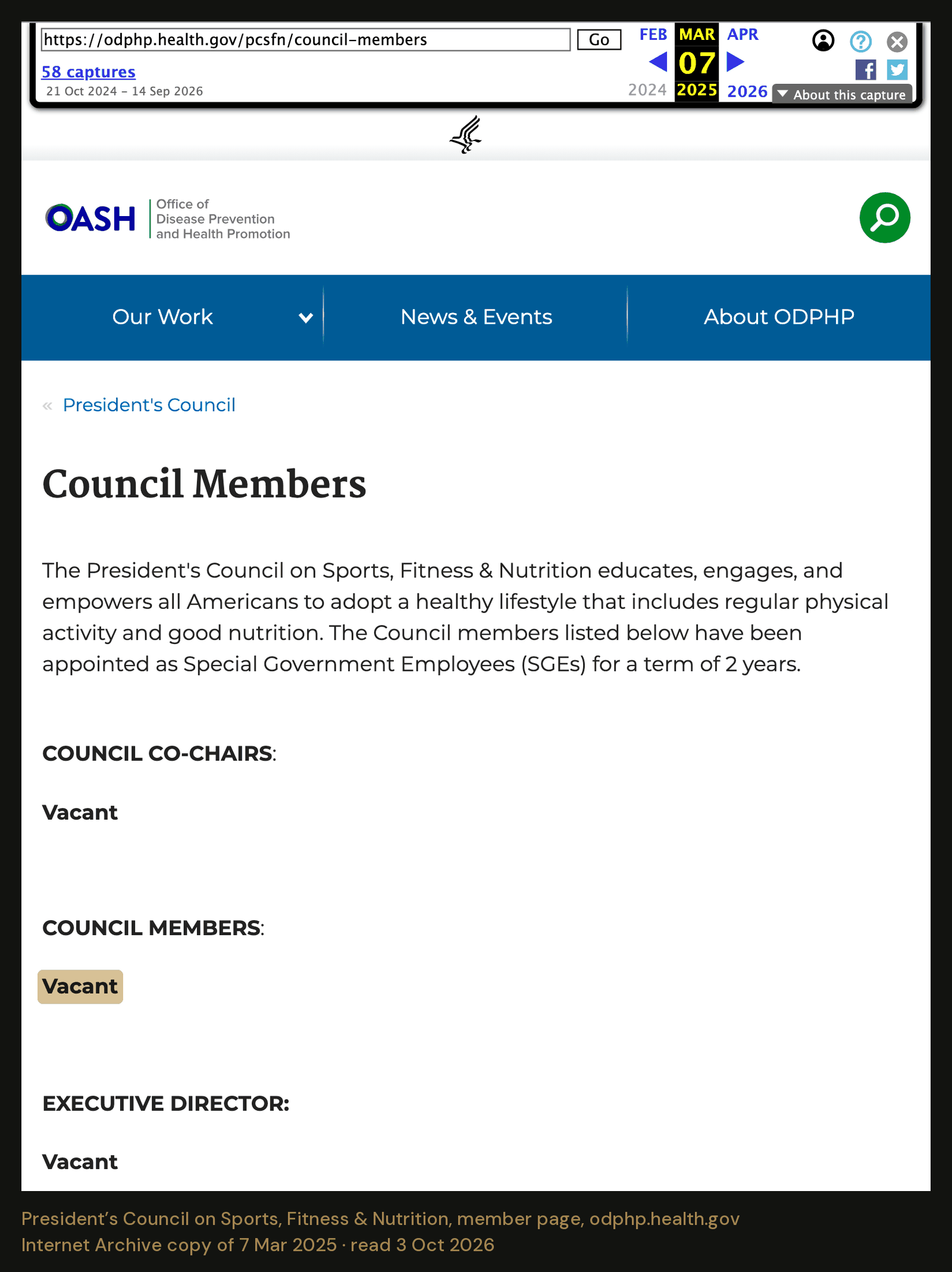
On 28 February the Council’s member page listed sixteen members, appointed in April 2023 for two-year terms that would have run to that April. By 7 March every line read “Vacant.”
On 10 March Kennedy directed FDA to explore ending the pathway that lets companies declare food ingredients safe without telling it. On 18 March HHS and FDA launched Operation Stork Speed, promising the first full review of infant formula nutrients since 1998.
Layoff notices went out on 1 April. Nineteen states and the District of Columbia sued on 5 May. That July a federal judge in Rhode Island blocked parts of the layoffs with a preliminary injunction, not a final ruling. Both sides later agreed to dismiss the government’s appeal. As of 1 October 2026 the case is still open.
In June 2026 HHS produced what its index calls a “Final Reduction-in-Force List,” with names blacked out, and a shorter “Additional” list. The states’ lawyers say the record includes what appears to be “an incomplete list of some of the employees HHS terminated.” By my count the final list has 8,443 entries. It holds 259 from FDA’s food program, mostly management, policy, communications and laboratory staff. None of their unit names, as I read them, is a review branch. That fits the fact sheet’s promise. It holds 287 from CDC’s chronic disease center and 161 from the Assistant Secretary for Health’s office. I searched both lists on 1 October 2026 for all four, under current and older names, and found none. Some entries give only a parent office. The Office of Disease Prevention and Health Promotion sits under the Assistant Secretary for Health. The shorter list has code-only lines at a higher level for three of the four. So I cannot rule them out.
On 16 April Kevin Hall, a senior NIH investigator who studied ultra-processed food, announced his early retirement. “I experienced censorship in the reporting of our research,” he wrote, “because of agency concerns that it did not appear to fully support preconceived narratives of my agency’s leadership about ultra-processed food addiction.” His team’s study, published in March, had found no significant dopamine response in the brain’s striatum after an ultra-processed milkshake. Hall said HHS kept him from being interviewed directly by The New York Times, and that his written answers were edited and sent without his consent. CNN reported that it saw copies, and that an approved version sent to the reporter added a line suggesting the study was small. HHS denied editing his answers. It said he was “fabricating false claims.” A month later STAT reported that NIH’s director had asked him back; Hall said he was unlikely to return.
Between 29 March and 26 April the staff page of NIH’s Office of Nutrition Research went from nine names, two of them registered dietitians, to one, the director. On 1 October 2026 it still lists only him. But a faculty list for the American Society for Nutrition’s July 2026 meeting places three of the other eight at NIH. A web page is not a personnel record.
On 22 April FDA announced a phase-out of petroleum-based food dyes, starting the process of revoking two and asking companies to drop six more by the end of 2026. On 28 April an inherited rule on when foods may be labeled “healthy” took effect. FDA had finalized it in December 2024. A regulatory freeze delayed its effective date. Companies must comply by 25 February 2028. FDA and NIH announced a joint nutrition research program on 9 May. FDA published rules on 12 May permitting three color additives in named foods, effective 26 June, each answering a company’s petition that FDA had announced between 2021 and 2024. It asked for public input on infant formula nutrients on 14 May. I searched the Federal Register on 1 October 2026 and found no proposed rule for either dye revocation or the change to the self-declared safe-ingredient pathway dated before June 2025. FDA proposed removing Orange B’s listing on 17 September 2025 and ordered the revocation on 23 July 2026, effective 8 September 2026. It also proposed revoking Citrus Red No. 2’s listing on 23 July 2026, and on 11 August 2026 it proposed requiring companies to notify it of substances they declare generally recognized as safe. On 1 October 2026 I also searched FDA’s final rules published from 11 February to 31 May 2025. Besides the “healthy” rule and the three color rules, I found one more on human food, also inherited. A color additive for ground meat and poultry substitutes, issued in January 2025, took effect on 19 February.
On 19 May USDA published notice that, under its February memo, it had ended seven advisory committees as “no longer necessary.” One was the National Advisory Committee on Microbiological Criteria for Foods, which since 1988 had given USDA and HHS “impartial scientific advice” on food safety. The other six covered agricultural statistics, cotton standards, the fruit and vegetable industry, meat and poultry inspection, wildlife services and a forest plan. I read the notice in full on 1 October 2026 and found no successor named. Asked about the committee, a USDA spokesperson said on 2 October 2026, the day after my deadline, that it “was terminated in 2025 as part of USDA’s implementation of the Executive Order directing federal agencies to reduce the number of discretionary advisory committees.” The spokesperson said the Food Safety and Inspection Service “continues to draw on the expertise of its scientists, veterinarians, inspectors, and other food safety professionals” and “continues to engage regularly with outside experts, consumer and industry groups, and other stakeholders.” The statement did not say what analysis supported ending the committee or name a body that now does its work.
On 22 May the Commission delivered its assessment, ninety-eight days after the order. It met the deadline. It listed poor diet first among four “potential drivers” of chronic disease in children, and what it rested on is the subject of a later piece.
Where DOGE fits
The Department of Government Efficiency, DOGE, was the President’s creation. He set it up by executive order on 20 January 2025, his first day in office. The order also told each agency head to set up a DOGE team of at least four employees inside the agency. I searched its text in the Federal Register on 3 October 2026 for “Musk” and “Elon” and found neither. On 19 February the President said he had “put a man named Elon Musk in charge” of it. DOGE was “headed by Elon Musk,” he told Congress on 4 March.
The account in court was narrower. Two days before the first of those remarks, a White House official told a federal court that Musk was a senior adviser to the President. Musk had “no actual or formal authority to make government decisions himself,” the official declared, under penalty of perjury. He could “only advise the President and communicate the President’s directives.” He was not the administrator of the U.S. DOGE Service, the declaration said.
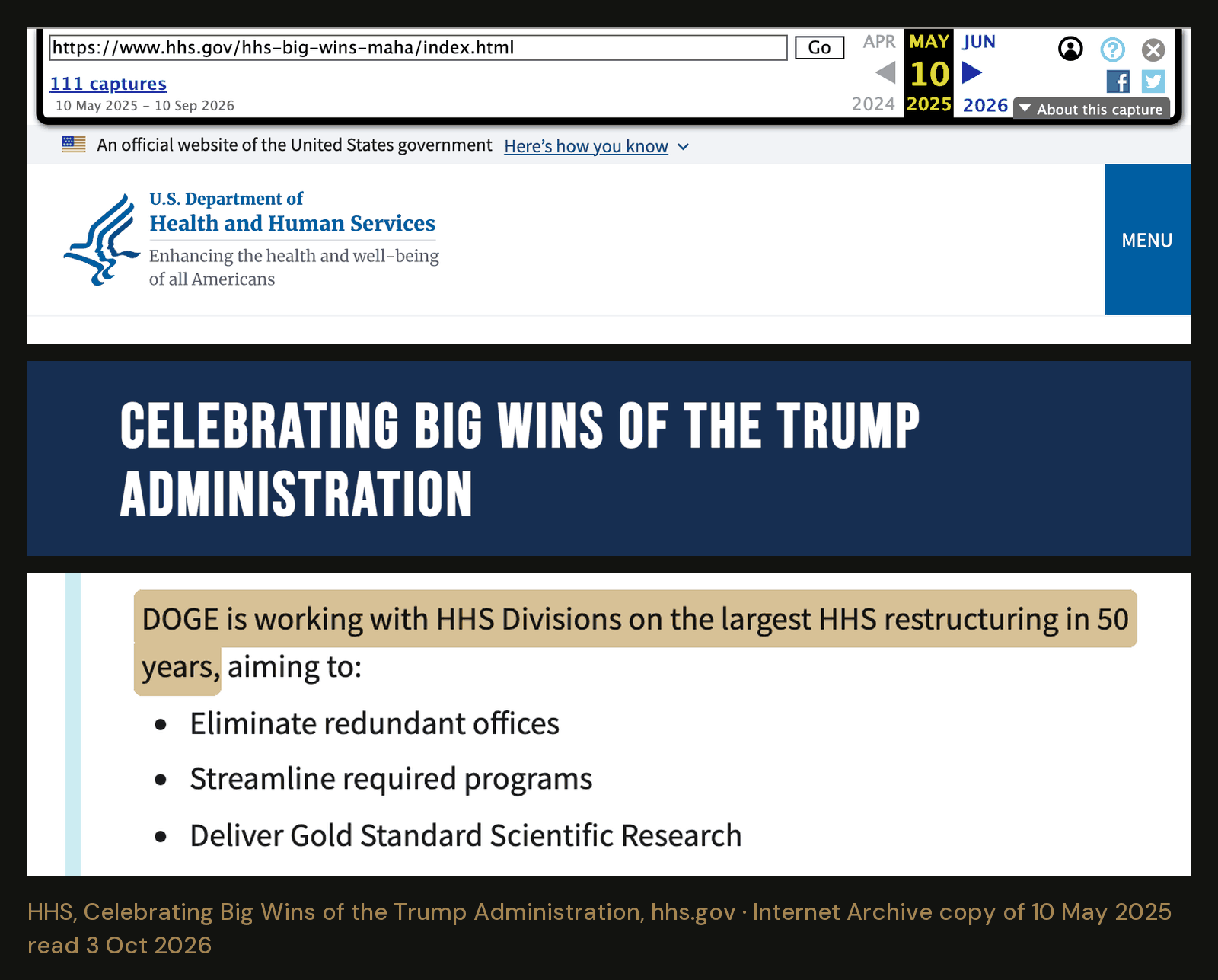
At HHS, the department’s own papers place DOGE inside the restructuring. They do not say how much of any decision was DOGE’s. The record HHS certified in the states’ lawsuit includes guidance of 26 February 2025 from the White House budget office and the Office of Personnel Management. It told agency heads to “collaborate” with their DOGE team leads “in developing competitive areas” for their layoff and reorganization plans. Competitive areas are the units within which employees compete to keep their jobs. The 11 February order left the layoffs to agency heads. “DOGE is working with HHS Divisions on the largest HHS restructuring in 50 years,” an HHS web page said in May 2025. The page, titled “Celebrating Big Wins of the Trump Administration,” still said so in September 2026.
In April 2026, in an appeal before the board that hears federal employees’ cases, HHS listed the people who had taken part in, or advised on, its layoff decisions. One senior adviser to the Secretary drafted the layoff plans “across the Department,” it said. A second senior adviser oversaw them. A year earlier HHS’s designated witness, under oath in another case, had agreed that both advisers were “DOGE team affiliates” at the department. The questioning lawyer defined the term as people hired or detailed “to work as part of the DOGE team” at HHS since 19 January 2025. The witness accepted that definition. The second adviser, the witness agreed, was “the HHS DOGE team lead” at the time. Kennedy approved “high-level, Department-wide objectives” for the layoffs, the April 2026 filing says. It says he was “not involved in deciding which specific competitive areas” the layoffs would reach.
On 24 March, three days before he announced the restructuring, Kennedy spoke in the Cabinet Room. He was “very grateful for the partnership with DOGE and with Elon,” he told the President. HHS had forty communications departments, he said, and forty each for procurement and IT. “We are, with Elon’s help, eliminating the redundancies,” he said. The Rhode Island judge’s order, drawing on the states’ complaint, describes an interview he gave CBS News on 9 April. By the order’s account, he said a close look at employees’ duties before the notices went out “takes too long,” and the chance to capitalize on “political momentum” would be lost. He testified to senators on 14 May. According to a transcript the states filed in court, he said, “we understood that there would be some mistakes made and that we would go back and reverse them when they were made.”
That judge found in July 2025 that the states were likely to show the restructuring was arbitrary and capricious. That is the legal term for a decision an agency has not reasonably explained. She wrote that “the record is completely devoid of any evidence” that HHS had researched the plan’s repercussions. That was the record before her in 2025, not the one HHS certified in 2026. The restructuring had “launched several HHS programs into a rapid freefall away from their statutory obligations,” she found. Her findings were preliminary. In a separate case, the Supreme Court on 8 July 2025 put on hold an injunction against the 11 February order and the 26 February guidance. It found the government likely to show that both were lawful. It expressed no view on any agency’s layoff plan.
In her order I found none of the four nutrition offices this piece checks among the programs she named. The order did reach programs at CDC, where one of the four sits. The states had not asked her to cover FDA’s food program. Her order did not. I checked this piece’s other cuts too. On 3 October 2026 I searched the court records, agency pages and news reports it cites. I looked for a document tying DOGE to the February FDA firings, the committees USDA ended or the changes to NIH’s and CDC’s nutrition web pages. I found none.
The order that created DOGE also told agency heads to give it “full and prompt access to all unclassified agency records, software systems, and IT systems,” as far as the law allowed. DOGE “shall adhere to rigorous data protection standards,” it said. HHS has its own court record. Unions and other groups sued HHS, the Labor Department and DOGE over DOGE’s access to their members’ records. The federal judge hearing that case in Washington ruled on both sides’ motions in March 2026. It was “undisputed,” he wrote, that HHS had given DOGE affiliates access to two systems holding Medicare patient and provider data, and that they had actually accessed them. Among the plaintiffs’ evidence, drawn from HHS’s own testimony, he listed ten DOGE affiliates at HHS getting access to nineteen of its systems. He did not rule that the access broke the law. One claim went to the government. Whether HHS had adopted a new policy of giving DOGE such access, he found, was still in genuine dispute. The case continues.
The government’s own admissions come from a case about the Social Security Administration. That agency is outside this piece’s subject. None of this bears on the grade. On 20 March 2025 a federal judge in Maryland issued a temporary order, not a final ruling. The agency had given its DOGE team “unbridled access to the personal and private data of millions of Americans,” she found. The defendants, she wrote, had “never identified or articulated even a single reason” the team needed unlimited access to the agency’s entire record systems. She issued a preliminary injunction on 17 April. On 6 June the Supreme Court put it on hold, letting the access go ahead while the case continued. Three justices disagreed.
In January 2026 the Social Security Administration corrected its account to the Maryland court. Members of its DOGE team, it said, had shared data from 7 to 17 March 2025 through Cloudflare, an outside server not approved for storing the agency’s data. The agency “has not been able to determine exactly what data were shared to Cloudflare or whether the data still exist on the server,” it told the court. In April 2026 the full appeals court for that circuit vacated the judge’s later injunction, nine judges to six. The opinion that announced the judgment found, for three of those nine, that the plaintiffs had not shown irreparable harm on the record then before her. The government’s recent acknowledgments were “alarming,” it said. The case continues in the district court.
Two federal employees went to Congress. Daniel Berulis worked in IT at the National Labor Relations Board. On 14 April 2025 he alleged that DOGE team members had unlawfully accessed the board’s case systems in March. NPR, which reported his account, said that from what he could see, about ten gigabytes of data, almost all text files, left the board’s network. In April 2025 the board denied giving DOGE access and said DOGE had not asked for it. Its own review “determined that no breach of agency systems occurred,” it said. The DOGE team had been “extremely public and transparent in its efforts,” a White House spokesperson said after NPR’s story ran.
Board officials later told federal auditors that DOGE first contacted them on 15 April 2025, the day after his disclosure. Two General Services Administration employees were then detailed to the board as DOGE staff, from 16 April to 25 July 2025. They asked for access to seven of the board’s human resources systems. The auditors’ report, dated 28 April 2026, found no evidence that they used any of them in that period. It did not review the weeks before, to avoid overlapping an investigation by the board’s inspector general. I searched for a result of that investigation on 3 October 2026 and found none published.
In August 2025 Charles Borges, then Social Security’s chief data officer, made a disclosure to Congress. DOGE staff had created “a live copy of the country’s Social Security information in a cloud environment that circumvents oversight,” he alleged. The data were kept in “a long-standing environment used by SSA and walled off from the internet,” the agency told ABC News. It was “not aware of any compromise to this environment,” it said, and its information security team provided oversight. I looked for an official finding that DOGE staff stole data, in the court records and the federal audit I read on 3 October 2026. I found none.
The public’s access to DOGE’s own records also went to court. A watchdog group, Citizens for Responsibility and Ethics in Washington, asked for them under the Freedom of Information Act. The government said DOGE was not subject to that law. A federal judge in Washington found on 10 March 2025 that DOGE likely was covered. Its operations had been “marked by unusual secrecy,” he wrote. On 6 June the Supreme Court paused his orders for discovery into DOGE and said the discovery should be narrowed. It did not decide whether the law covers DOGE. That question “cannot turn on the entity’s ability to persuade,” it said. Three justices would have refused the pause.
On 3 October 2026 I searched the record HHS certified in the states’ lawsuit again. This time I looked for Musk and for the people HHS’s witness called its DOGE team affiliates. One of them, the adviser who drafted the layoff plans, is named once, as the recipient of an email. I did not find the others. I did not find Musk’s name either. The states told the court on 11 September 2026, in a motion for discovery, that the record leaves out the part DOGE’s members played. As of 3 October 2026, HHS’s response to that motion is due on 9 October.
What the evidence says
As of 29 September 2026, the records I read hold no before-and-after count of the government’s nutrition staff. They do allow a test of the administration’s own rules.
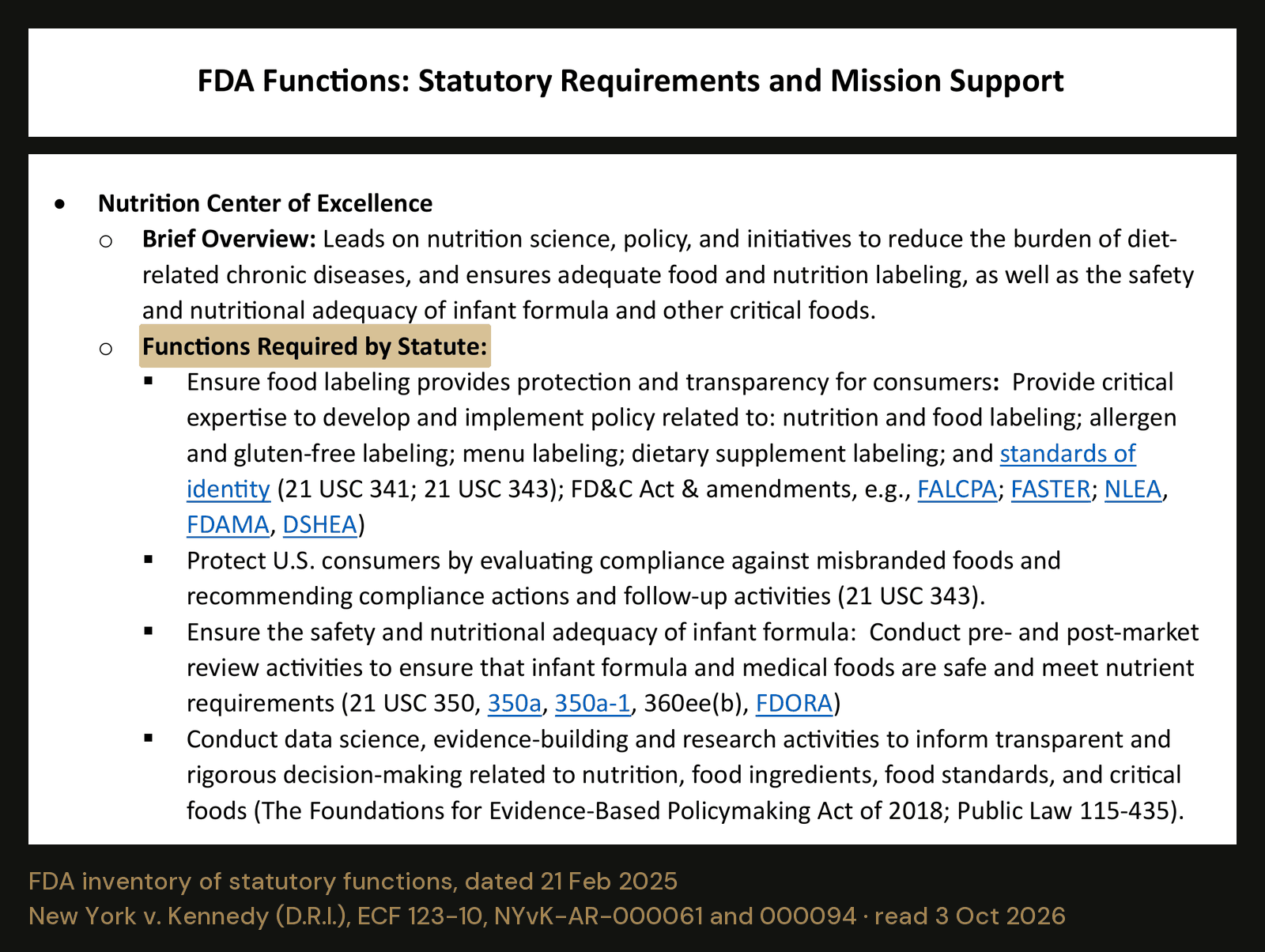
Executive Order 14210, the layoff order, said offices doing work no law requires should go first. The record HHS certified in the case includes an FDA inventory, dated 21 February 2025, that lists the nutrition center’s work as required by law, from nutrition labeling to infant formula review. The center is not on the list. But the same inventory lists work required by law for all fourteen offices in FDA’s food program, including those whose staff are on the list. By FDA’s own account the rule cannot tell them apart, and I found nothing in the record that says why the center was left off.
HHS certified that record as the non-privileged materials it “considered, either directly or indirectly,” twenty documents plus an email added in July. I searched both filed parts on 1 October 2026. “Make America Healthy Again” appears only in the press release and the fact sheet. I found no analysis of what the Commission’s work would need from HHS’s nutrition staff. That silence proves less than it seems. The Justice Department, for HHS, told the states that deliberative documents, HHS’s reorganization plans among them, do not belong in such a record. I asked HHS whether one exists.
The gold standard order, Executive Order 14303, was signed on 23 May, five weeks after Hall’s announcement, so nothing in April could have broken it. It asks for science “accepting of negative results as positive outcomes,” and says employees’ “communication of scientific information shall be consistent with the results of the relevant analysis.” Hall’s negative result reached print. The dispute is over what was said about it. A caveat about a study’s size can be good practice. Added to a scientist’s answers without his consent, as he says it was, it is no longer his answer. HHS says his account is false. I searched for the full exchange on 1 October 2026 and did not find it published.
Who advised
The Commission’s members were all officials, FDA’s commissioner and NIH’s director among them. The order made no one outside the administration a member, nutrition scientists and dietitians included, though the chair, Kennedy, could take “expert input from leaders in public health.” Neither version of the assessment uses the word “dietitian.” I searched both on 1 October 2026.
In July 2025 a new order revived the President’s Council, and the White House named the golfer Bryson DeChambeau its chair. On 1 October 2026 the federal advisory committee database listed seventeen members, all appointed on 31 July 2025. Their listed occupations are athletes and former athletes, two league commissioners, a sports broadcaster, a wrestling company executive and a businessman. The sixteen listed in February 2025 had included four physicians, three chefs and two people who work on hunger. The same record says the President draws on “health care professionals” and “nutrition professionals,” and HHS’s May 2026 notice renewing the charter says the work needs leaders from “nutrition science.” None of the seventeen is listed in either field, and none of the earlier sixteen was described on that page as a nutrition professional either. HHS’s member page, which I read on 1 October 2026, names no one. Its meetings page, read the same day, says the Council meets each year but lists none since 6 September 2024, or in 2021 and 2022.
The Office of Disease Prevention and Health Promotion’s page listed the same director on 5 March 2025 and 1 October 2026, and the Office of Nutrition Research staff page listed the same director on 29 March and 26 April 2025. CDC’s nutrition division page listed the same director on 29 March and 10 June 2025, and an acting director by July 2026. I did not check FDA’s nutrition center.
What could have been done instead
All were within the same agencies’ authority at the time.
FDA could have sought the directive’s exemption for “mission critical” roles for probationary staff doing work the law requires of it.
The President could have named the Council’s members in these months, when its page listed none. When he did, he could have included the nutrition and health professionals that the Council’s federal record names among the people he picks, and called the Council together.
USDA could have said where its food safety committee’s work would go before ending it.
HHS could have published the answers Hall wrote and the version that was sent. Its own statement says NIH scientists answer reporters “through written responses or other means.” Publishing the exchange would test both accounts.
And before the March restructuring, HHS could have written down what the Commission’s charge would need from its nutrition staff. No rule required it. But the charge put the American diet first.
My grade
Each piece carries a letter and four lines. Substance asks whether anything binding changed. Evidence asks whether the action rests on the best evidence and meets the administration’s own standards, including the gold standard order for actions after 23 May 2025. Health asks who benefits, how much and how soon. Integrity asks whether qualified experts, dietitians among them, took part in an open process. Grades run both ways. They are my judgment on the documents cited, not a finding about motive, and I will revise one in a dated note if the record changes.
F. The record has credits. FDA’s color additive approvals of May 2025 are binding, and so is the “healthy” labeling rule that took effect in April, though companies have until 25 February 2028 to comply. The approvals answered company petitions already in the pipeline, which FDA had announced between 2021 and 2024. The rule was finalized in December 2024, under the previous administration. The Commission met its first deadline. A met deadline is process. The layoff list does not name the four nutrition offices I checked, though some of its entries give only a parent office, and an office not named on a list is an absence, not an action. None of that lifts the grade. The outside advice was ended or refilled with no nutrition or health professional listed, and the FDA and HHS food steps this administration began were, in the records I read, still announcements or a request for information at the end of May. Most of those steps read as performative. By the end of May 2025, in the records I read, none of them was an actual change that would improve health, health equity, access to health care or preventive health.
Substance: The changes to capacity that I found were mostly subtractions, from probationary firings, some of them asked back within a week, to a Council page that read “Vacant.” The binding FDA food rules I found from these months were three color additive rules published on 12 May, effective 26 June, and two inherited rules that took effect, a color additive for ground meat and poultry substitutes and the “healthy” labeling rule, which companies do not have to follow until 25 February 2028.
Evidence: The layoff order’s own rule, by FDA’s inventory, cannot tell the nutrition center from offices whose staff are on the list. The February firings went to probationary staff. The reports I read do not say whether function was considered. I found no analysis in the certified record of what the Commission needed, though the Justice Department, for HHS, says deliberative documents do not belong in it.
Health: In the records I read, I found no measured gain or loss for nutrition. The harms a judge found in a preliminary ruling on the HHS restructuring were to programs other than the four nutrition offices I checked. The infant formula review was at a request for information, and the dye revocations and the change to the self-declared safe-ingredient pathway were not yet proposed rules by the end of May 2025.
Integrity: The food chief resigned, citing the firings. A nutrition scientist left alleging censorship that HHS calls fabricated, a food safety committee ended with no successor named in the notice, and a nutrition council was refilled with no member listed in a health or nutrition field. Three of the four offices listed the same director on a page from before the April 2025 layoff notices and on one from after them, though CDC’s nutrition division named an acting director by July 2026. I did not check the fourth.
I asked HHS, USDA and the White House
On 29 September 2026, between 7:59 and 8:01 a.m. Eastern, I sent questions to HHS through its request-for-comment form, to USDA’s press office by email and to the White House through its contact form. Each message said I write an independent newsletter and am not credentialed media. I asked HHS about the February firings, the four offices, any staffing analysis for the Commission and Hall’s written answers; USDA about ending its food safety committee; and the White House about the committee list, the Council’s members and the Commission’s advisers. I asked for replies by 5 p.m. Eastern on Thursday 1 October 2026. HHS sent an automatic receipt that morning. None of the three had answered by the deadline. USDA’s press office answered on 2 October 2026, before this piece ran, with a statement from a spokesperson, which appears above in the paragraph on its food safety committee. It did not answer my questions about the analysis behind ending that committee, the eight committees whose terminations were paused, or the text of the two memoranda. HHS and the White House had not answered when this piece was published. I will add any answer that comes later, with the date it arrived. The material on Secretary Kennedy and DOGE added on 3 October 2026, including the section “Where DOGE fits,” came after those questions were sent. It rests mostly on the government’s own records and statements. I did not put it to HHS or the White House before adding it.
On Wednesday 7 October 2026 this series takes up the SNAP waivers USDA began approving in May 2025, and the court ruling that vacated five of them.
This is a reading of public records: executive orders and Federal Register documents, official transcripts of public remarks, agency pages and archived copies, a federal database, a federal audit and court filings. Where I rely on a news report, I name the outlet. It is not legal advice.
Revised 3 October 2026: a new section, “Where DOGE fits,” and other added sentences say more about the roles of Health Secretary Robert F. Kennedy Jr. and of DOGE, the Department of Government Efficiency, in the events this piece covers. The Summary and the Health line of the grade box were changed to match. The grade is unchanged.
References
Executive Office of the President. Executive Order 14158, Establishing and Implementing the President’s “Department of Government Efficiency”. Signed 20 January 2025. Federal Register 90 FR 8441, 29 January 2025, FR Doc. 2025-02005. https://www.federalregister.gov/documents/2025/01/29/2025-02005/establishing-and-implementing-the-presidents-department-of-government-efficiency (accessed 3 October 2026)
Executive Office of the President. Executive Order 14210, Implementing the President’s “Department of Government Efficiency” Workforce Optimization Initiative. Signed 11 February 2025. Federal Register 90 FR 9669, 14 February 2025, FR Doc. 2025-02762. https://www.federalregister.gov/documents/2025/02/14/2025-02762/implementing-the-presidents-department-of-government-efficiency-workforce-optimization-initiative (accessed 29 September 2026)
Executive Office of the President. Executive Order 14212, Establishing the President’s Make America Healthy Again Commission. Signed 13 February 2025. Federal Register 90 FR 9833, 19 February 2025, FR Doc. 2025-02871. https://www.federalregister.gov/documents/2025/02/19/2025-02871/establishing-the-presidents-make-america-healthy-again-commission (accessed 29 September 2026)
Executive Office of the President. Executive Order 14217, Commencing the Reduction of the Federal Bureaucracy. Signed 19 February 2025. Federal Register 90 FR 10577, 25 February 2025, FR Doc. 2025-03133. https://www.federalregister.gov/documents/2025/02/25/2025-03133/commencing-the-reduction-of-the-federal-bureaucracy (accessed 29 September 2026)
Executive Office of the President. Executive Order 14303, Restoring Gold Standard Science. Signed 23 May 2025. Federal Register 90 FR 22601, 29 May 2025, FR Doc. 2025-09802. https://www.federalregister.gov/documents/2025/05/29/2025-09802/restoring-gold-standard-science (accessed 29 September 2026)
Executive Office of the President. Executive Order 14327, President’s Council on Sports, Fitness, and Nutrition, and the Reestablishment of the Presidential Fitness Test. Signed 31 July 2025. Federal Register 90 FR 37993, 6 August 2025, FR Doc. 2025-15011. https://www.federalregister.gov/documents/2025/08/06/2025-15011/presidents-council-on-sports-fitness-and-nutrition-and-the-reestablishment-of-the-presidential (accessed 29 September 2026)
Daily Compilation of Presidential Documents. Remarks During a Swearing-in Ceremony for Robert F. Kennedy, Jr., as Secretary of Health and Human Services and an Exchange With Reporters. 13 February 2025. DCPD-202500261. https://www.govinfo.gov/content/pkg/DCPD-202500261/html/DCPD-202500261.htm (accessed 3 October 2026)
Daily Compilation of Presidential Documents. Remarks and a Question-and-Answer Session at the Future Investment Initiative Institute Priority Summit in Miami Beach, Florida. 19 February 2025. DCPD-202500280. https://www.govinfo.gov/content/pkg/DCPD-202500280/html/DCPD-202500280.htm (accessed 3 October 2026)
Daily Compilation of Presidential Documents. Address Before a Joint Session of the Congress. 4 March 2025. DCPD-202500325. https://www.govinfo.gov/content/pkg/DCPD-202500325/html/DCPD-202500325.htm (accessed 3 October 2026)
Daily Compilation of Presidential Documents. Remarks Following a Cabinet Meeting and an Exchange With Reporters. 24 March 2025. DCPD-202500389. https://www.govinfo.gov/content/pkg/DCPD-202500389/html/DCPD-202500389.htm (accessed 3 October 2026)
Daily Compilation of Presidential Documents. Remarks at a Meeting of the Make America Healthy Again Commission. 22 May 2025. DCPD-202500628. https://www.govinfo.gov/content/pkg/DCPD-202500628/html/DCPD-202500628.htm (accessed 3 October 2026)
The White House. Make America Healthy Again (MAHA), priorities page. https://www.whitehouse.gov/priorities/maha/ (accessed 3 October 2026)
Code of Federal Regulations. 5 CFR 351.402, Competitive area. Electronic Code of Federal Regulations, current through 29 September 2026. https://www.ecfr.gov/current/title-5/chapter-I/subchapter-B/part-351/subpart-D/section-351.402 (accessed 3 October 2026)
The White House. President Trump Revives Iconic Pillars of American Youth. Release, 1 August 2025. https://www.whitehouse.gov/releases/2025/08/president-trump-revives-iconic-pillars-of-american-youth/ (accessed 29 September 2026)
The White House. The President’s Council on Sports, Fitness, and Nutrition (Council page, updated 18 June 2026). https://www.whitehouse.gov/presidents-sports-council/ (accessed 29 September 2026)
U.S. General Services Administration, FACA Database. 2026 Current Fiscal Year Report: President’s Council on Sports, Fitness, and Nutrition (committee no. 1004), report run 1 October 2026. https://www.facadatabase.gov/FACA/apex/FACACommitteeLevelReportAsPDF?id=a10t0000001gzwWAAQ (accessed 1 October 2026)
U.S. Department of Health and Human Services. Renewal of the President’s Council on Sports, Fitness & Nutrition’s Charter. Federal Register 91 FR 30662, 26 May 2026, FR Doc. 2026-10411. https://www.federalregister.gov/documents/2026/05/26/2026-10411/renewal-of-the-presidents-council-on-sports-fitness-and-nutritions-charter (accessed 29 September 2026)
Office of Disease Prevention and Health Promotion. President’s Council on Sports, Fitness & Nutrition, Council Members. https://odphp.health.gov/pcsfn/council-members (Internet Archive copies of 28 February 2025, https://web.archive.org/web/20250228221826/https://odphp.health.gov/pcsfn/council-members, 7 March 2025, https://web.archive.org/web/20250307062912/https://odphp.health.gov/pcsfn/council-members, 30 April 2025, https://web.archive.org/web/20250430201234/https://odphp.health.gov/pcsfn/council-members, 14 June 2025, https://web.archive.org/web/20250614232849/https://odphp.health.gov/pcsfn/council-members, and 18 July 2025, https://web.archive.org/web/20250718161908/https://odphp.health.gov/pcsfn/council-members; live page accessed 1 October 2026)
Office of Disease Prevention and Health Promotion. President’s Council on Sports, Fitness & Nutrition, Council Meetings. https://odphp.health.gov/pcsfn/council-meetings (accessed 1 October 2026)
Office of Disease Prevention and Health Promotion. About ODPHP. https://odphp.health.gov/about-odphp (Internet Archive copy of 5 March 2025, https://web.archive.org/web/20250305141218/https://odphp.health.gov/about-odphp; live page accessed 1 October 2026)
U.S. Department of Health and Human Services. HHS Announces Transformation to Make America Healthy Again. Press release, 27 March 2025. https://www.hhs.gov/press-room/hhs-restructuring-doge.html (read in the Internet Archive’s copy of 27 March 2025, https://web.archive.org/web/20250327135807/https://www.hhs.gov/about/news/hhs-restructuring-doge.html; accessed 29 September 2026)
U.S. Department of Health and Human Services. Fact Sheet: HHS’ Transformation to Make America Healthy Again. 27 March 2025. https://www.hhs.gov/press-room/hhs-restructuring-doge-fact-sheet.html (read in the Internet Archive’s copy of 27 March 2025, https://web.archive.org/web/20250327145747/https://www.hhs.gov/about/news/hhs-restructuring-doge-fact-sheet.html; accessed 29 September 2026)
U.S. Department of Health and Human Services. Celebrating Big Wins of the Trump Administration. https://www.hhs.gov/hhs-big-wins-maha/index.html (read in the Internet Archive’s copies of 10 May 2025, https://web.archive.org/web/20250510090559/https://www.hhs.gov/hhs-big-wins-maha/index.html, and 10 September 2026, https://web.archive.org/web/20260910192634/https://www.hhs.gov/hhs-big-wins-maha/index.html; accessed 3 October 2026)
U.S. Department of Health and Human Services. HHS Secretary Kennedy Directs FDA to Explore Rulemaking to Eliminate Pathway for Companies to Self-Affirm Food Ingredients Are Safe. Press release, 10 March 2025. https://www.hhs.gov/press-room/revising-gras-pathway.html (read in the Internet Archive’s copy of 4 April 2025, https://web.archive.org/web/20250404230533/https://www.hhs.gov/press-room/revising-gras-pathway.html; accessed 29 September 2026)
U.S. Food and Drug Administration. HHS, FDA Announce Operation Stork Speed to Expand Options for Safe, Reliable, and Nutritious Infant Formula for American Families. 18 March 2025. https://www.fda.gov/news-events/press-announcements/hhs-fda-announce-operation-stork-speed-expand-options-safe-reliable-and-nutritious-infant-formula (accessed 29 September 2026)
U.S. Food and Drug Administration. HHS, FDA to Phase Out Petroleum-Based Synthetic Dyes in Nation’s Food Supply. 22 April 2025. https://www.fda.gov/news-events/press-announcements/hhs-fda-phase-out-petroleum-based-synthetic-dyes-nations-food-supply (accessed 29 September 2026)
U.S. Food and Drug Administration. Food Labeling: Nutrient Content Claims; Definition of Term “Healthy”. Final rule. Federal Register 89 FR 106064, 27 December 2024, FR Doc. 2024-29957. https://www.federalregister.gov/documents/2024/12/27/2024-29957/food-labeling-nutrient-content-claims-definition-of-term-healthy (accessed 29 September 2026)
U.S. Food and Drug Administration. Food Labeling: Nutrient Content Claims; Definition of Term “Healthy” (effective date delayed to 28 April 2025). Federal Register 90 FR 10592, 25 February 2025, FR Doc. 2025-03118. https://www.federalregister.gov/documents/2025/02/25/2025-03118/food-labeling-nutrient-content-claims-definition-of-term-healthy (accessed 29 September 2026)
U.S. Food and Drug Administration. FDA and NIH Announce Innovative Joint Nutrition Regulatory Science Program. 9 May 2025. https://www.fda.gov/news-events/press-announcements/fda-and-nih-announce-innovative-joint-nutrition-regulatory-science-program (accessed 29 September 2026)
U.S. Food and Drug Administration. Listing of Color Additives Exempt From Certification: Calcium Phosphate (90 FR 20097, FR Doc. 2025-08249), Butterfly Pea Flower Extract (90 FR 20101, FR Doc. 2025-08248) and Galdieria Extract Blue (90 FR 20104, FR Doc. 2025-08250). Federal Register, 12 May 2025. https://www.federalregister.gov/documents/2025/05/12/2025-08249/listing-of-color-additives-exempt-from-certification-calcium-phosphate ; https://www.federalregister.gov/documents/2025/05/12/2025-08248/listing-of-color-additives-exempt-from-certification-butterfly-pea-flower-extract ; https://www.federalregister.gov/documents/2025/05/12/2025-08250/listing-of-color-additives-exempt-from-certification-galdieria-extract-blue (accessed 29 September 2026). Each rule names the company petition it answers and the Federal Register notice that announced the petition: galdieria extract blue, 9 September 2021 (86 FR 50495); calcium phosphate, 27 February 2023 (88 FR 12281); butterfly pea flower extract, 8 February 2024 (89 FR 8537).
U.S. Food and Drug Administration. Listing of Color Additives Exempt From Certification; Myoglobin. Federal Register 90 FR 5590, 17 January 2025, FR Doc. 2025-01239, effective 19 February 2025; effective date confirmed in 90 FR 22627, 29 May 2025, FR Doc. 2025-09680. https://www.federalregister.gov/documents/2025/01/17/2025-01239/listing-of-color-additives-exempt-from-certification-myoglobin ; https://www.federalregister.gov/documents/2025/05/29/2025-09680/listing-of-color-additives-myoglobin-confirmation-of-effective-date (accessed 29 September 2026)
U.S. Food and Drug Administration. Proposal To Remove the Color Additive Listing for Use of Orange B on Casings or Surfaces of Frankfurters and Sausages. Federal Register 90 FR 44786, 17 September 2025, FR Doc. 2025-18023. https://www.federalregister.gov/documents/2025/09/17/2025-18023/proposal-to-remove-the-color-additive-listing-for-use-of-orange-b-on-casings-or-surfaces-of (accessed 29 September 2026)
U.S. Food and Drug Administration. Proposal To Revoke the Color Additive Listing for Use of Citrus Red No. 2 on the Skins of Mature Oranges. Federal Register 91 FR 46330, 23 July 2026, FR Doc. 2026-14909. https://www.federalregister.gov/documents/2026/07/23/2026-14909/proposal-to-revoke-the-color-additive-listing-for-use-of-citrus-red-no-2-on-the-skins-of-mature (accessed 29 September 2026)
U.S. Food and Drug Administration. Revocation of the Color Additive Listing for Use of Orange B on Casings or Surfaces of Frankfurters and Sausages. Final order. Federal Register 91 FR 46276, 23 July 2026, FR Doc. 2026-14910, effective 8 September 2026. https://www.federalregister.gov/documents/2026/07/23/2026-14910/revocation-of-the-color-additive-listing-for-use-of-orange-b-on-casings-or-surfaces-of-frankfurters (accessed 29 September 2026)
U.S. Food and Drug Administration. Substances Generally Recognized as Safe. Proposed rule. Federal Register 91 FR 51834, 11 August 2026, FR Doc. 2026-16296; comments close 9 December 2026. https://www.federalregister.gov/documents/2026/08/11/2026-16296/substances-generally-recognized-as-safe (accessed 29 September 2026)
U.S. Food and Drug Administration. Infant Formula Nutrient Requirements; Request for Information. Federal Register 90 FR 20475, 14 May 2025, FR Doc. 2025-08419. https://www.federalregister.gov/documents/2025/05/14/2025-08419/infant-formula-nutrient-requirements-request-for-information (accessed 29 September 2026)
U.S. Department of Agriculture. Notice of Termination of Seven Discretionary Federal Advisory Committees. Federal Register 90 FR 21270, 19 May 2025, FR Doc. 2025-08859. https://www.federalregister.gov/documents/2025/05/19/2025-08859/notice-of-termination-of-seven-discretionary-federal-advisory-committees (accessed 29 September 2026)
U.S. Department of Agriculture, Food Safety and Inspection Service. National Advisory Committee on Microbiological Criteria for Foods (NACMCF). https://www.fsis.usda.gov/policy/advisory-committees/national-advisory-committee-microbiological-criteria-foods-nacmcf (read in the Internet Archive’s copy of 1 April 2024, https://web.archive.org/web/20240401051727/https://www.fsis.usda.gov/policy/advisory-committees/national-advisory-committee-microbiological-criteria-foods-nacmcf; accessed 29 September 2026)
U.S. Department of Health and Human Services. MAHA Commission Unveils Landmark Report Exposing Root Causes of Childhood Chronic Disease Crisis. Press release, 22 May 2025. https://www.hhs.gov/press-room/maha-commission-childhood-chronic-disease-root-causes.html (read in the Internet Archive’s copy of 22 May 2025, https://web.archive.org/web/20250522215611/https://www.hhs.gov/press-room/maha-commission-childhood-chronic-disease-root-causes.html; accessed 29 September 2026)
The President’s Make America Healthy Again Commission. Make Our Children Healthy Again Assessment. Released 22 May 2025. The file served now, https://www.whitehouse.gov/wp-content/uploads/2025/05/MAHA-Report-The-White-House.pdf (created 29 May 2025), and the file as released, https://www.whitehouse.gov/wp-content/uploads/2025/05/WH-The-MAHA-Report-Assessment.pdf, read in the Internet Archive’s copy of 22 May 2025, https://web.archive.org/web/20250522215748/https://www.whitehouse.gov/wp-content/uploads/2025/05/WH-The-MAHA-Report-Assessment.pdf (both accessed 29 September 2026)
U.S. District Court for the District of Rhode Island. State of New York v. Kennedy, No. 1:25-cv-00196. Complaint, ECF No. 1. 5 May 2025. https://storage.courtlistener.com/recap/gov.uscourts.rid.59507/gov.uscourts.rid.59507.1.0.pdf (accessed 29 September 2026)
U.S. District Court for the District of Rhode Island. State of New York v. Kennedy, No. 1:25-cv-00196. Memorandum and Order granting a preliminary injunction, ECF No. 73. 1 July 2025. https://storage.courtlistener.com/recap/gov.uscourts.rid.59507/gov.uscourts.rid.59507.73.0_1.pdf (accessed 29 September 2026)
U.S. District Court for the District of Rhode Island. State of New York v. Kennedy, No. 1:25-cv-00196. Declaration of Molly Brachfeld, ECF No. 55, 19 May 2025, transcribing Secretary Kennedy’s testimony to the Senate Committee on Health, Education, Labor and Pensions on 14 May 2025. https://storage.courtlistener.com/recap/gov.uscourts.rid.59507/gov.uscourts.rid.59507.55.0.pdf (accessed 3 October 2026)
U.S. Court of Appeals for the First Circuit. State of New York v. Kennedy, No. 25-1780. Judgment, entered 30 October 2025: appeal “voluntarily dismissed pursuant to Fed. R. App. P. 42(b)(1)” on the parties’ stipulation. Docketed in the district court as ECF No. 99, 3 November 2025. https://storage.courtlistener.com/recap/gov.uscourts.rid.59507/gov.uscourts.rid.59507.99.0.pdf (accessed 29 September 2026)
U.S. District Court for the District of Rhode Island. State of New York v. Kennedy, No. 1:25-cv-00196. Notice of Service of Revised Administrative Record, ECF No. 119, with the Index to the Revised Administrative Record (ECF No. 119-1) and the Certification of Administrative Record (ECF No. 119-2). 2 July 2026. https://storage.courtlistener.com/recap/gov.uscourts.rid.59507/gov.uscourts.rid.59507.119.0_1.pdf ; https://storage.courtlistener.com/recap/gov.uscourts.rid.59507/gov.uscourts.rid.59507.119.1_1.pdf ; https://storage.courtlistener.com/recap/gov.uscourts.rid.59507/gov.uscourts.rid.59507.119.2_1.pdf (accessed 29 September 2026)
U.S. District Court for the District of Rhode Island. State of New York v. Kennedy, No. 1:25-cv-00196. Plaintiffs’ motion for discovery, ECF No. 122. 11 September 2026. https://storage.courtlistener.com/recap/gov.uscourts.rid.59507/gov.uscourts.rid.59507.122.0.pdf (accessed 29 September 2026)
U.S. District Court for the District of Rhode Island. State of New York v. Kennedy, No. 1:25-cv-00196. Defendants’ motion to extend to 9 October 2026 their time to respond to ECF No. 122, ECF No. 125, 28 September 2026, granted by text order of 30 September 2026. https://storage.courtlistener.com/recap/gov.uscourts.rid.59507/gov.uscourts.rid.59507.125.0.pdf ; docket: https://www.courtlistener.com/docket/70134295/state-of-new-york-v-kennedy/ (accessed 3 October 2026)
U.S. District Court for the District of Rhode Island. State of New York v. Kennedy, No. 1:25-cv-00196. Exhibit D to ECF No. 123: letter from the Department of Justice, for the defendants, to counsel for the plaintiff states, 2 July 2026. https://storage.courtlistener.com/recap/gov.uscourts.rid.59507/gov.uscourts.rid.59507.123.4_1.pdf (accessed 29 September 2026)
U.S. District Court for the District of Rhode Island. State of New York v. Kennedy, No. 1:25-cv-00196. Exhibit G to ECF No. 123: HHS’s agency file in consolidated appeals before the Merit Systems Protection Board, Docket No. CF-0351-26-0076-I-1, submitted 9 April 2026, listing those who took part in or gave input on the HHS and FDA reductions in force (MSPB pp. 35 to 37). https://storage.courtlistener.com/recap/gov.uscourts.rid.59507/gov.uscourts.rid.59507.123.7_1.pdf (accessed 3 October 2026)
U.S. District Court for the District of Rhode Island. State of New York v. Kennedy, No. 1:25-cv-00196. Exhibit I to ECF No. 123: deposition of the Department of Health and Human Services under Rule 30(b)(6), through its designee Garey Rice, 8 April 2025, in AFL-CIO v. Department of Labor, No. 1:25-cv-00339-JDB (D.D.C.), ECF No. 82-3, filed 29 April 2025 (transcript pp. 10 to 12 and 43). https://storage.courtlistener.com/recap/gov.uscourts.rid.59507/gov.uscourts.rid.59507.123.9_1.pdf (accessed 3 October 2026)
U.S. District Court for the District of Rhode Island. State of New York v. Kennedy, No. 1:25-cv-00196. Exhibit J to ECF No. 123: the administrative record as produced on 8 June 2026, including the Office of Management and Budget and Office of Personnel Management memorandum of 26 February 2025 on agency layoff and reorganization plans (NYvK-AR-000008 onward; the sentence on DOGE team leads at NYvK-AR-000009), an FDA inventory of statutory functions dated 21 February 2025 (NYvK-AR-000061 onward), an Office of Personnel Management email to HHS of 2 May 2025 (NYvK-AR-000201), the “Final Reduction-in-Force List” (NYvK-AR-000206 to 000365), the “Additional Reduction-in-Force List” (NYvK-AR-000366 to 000367) and the template notices dated 31 March 2025 (NYvK-AR-000368 onward). https://storage.courtlistener.com/recap/gov.uscourts.rid.59507/gov.uscourts.rid.59507.123.10_1.pdf (accessed 29 September and 3 October 2026)
U.S. District Court for the District of Rhode Island. State of New York v. Kennedy, No. 1:25-cv-00196. Exhibit K to ECF No. 123: the corrections to the administrative record produced on 2 July 2026 (Document 12.1, NYvK-AR-000183.001 onward). https://storage.courtlistener.com/recap/gov.uscourts.rid.59507/gov.uscourts.rid.59507.123.11_1.pdf (accessed 29 September and 3 October 2026)
U.S. District Court for the Northern District of California. American Federation of Government Employees v. U.S. Office of Personnel Management, No. 3:25-cv-01780-WHA. Order on cross-motions for summary judgment, ECF No. 261. 12 September 2025. https://storage.courtlistener.com/recap/gov.uscourts.cand.444883/gov.uscourts.cand.444883.261.0_2.pdf (accessed 29 September 2026)
U.S. Court of Appeals for the Ninth Circuit. American Federation of Government Employees v. U.S. Office of Personnel Management, No. 25-5875, appeal from No. 3:25-cv-01780-WHA. Docket: case opened 18 September 2025; argued and submitted 28 August 2026 (entry 46); no later entry. Read in CourtListener’s copy of the docket, https://www.courtlistener.com/docket/71412094/american-federation-of-government-employees-afl-cio-et-al-v-united/ (accessed 29 September 2026)
U.S. District Court for the District of Columbia. Aragon v. Rollins, No. 1:26-cv-00861-ABJ. Order, ECF No. 37. 22 June 2026, vacating and remanding the approvals of the Colorado, Iowa, Nebraska, Tennessee and West Virginia pilot projects. https://storage.courtlistener.com/recap/gov.uscourts.dcd.290291/gov.uscourts.dcd.290291.37.0.pdf (accessed 29 September 2026)
U.S. District Court for the District of Columbia. New Mexico v. Musk, No. 1:25-cv-00429-TSC. Declaration of Joshua Fisher, Director, Office of Administration, ECF No. 24-1. 17 February 2025. https://storage.courtlistener.com/recap/gov.uscourts.dcd.277463/gov.uscourts.dcd.277463.24.1.pdf (accessed 3 October 2026)
U.S. District Court for the District of Columbia. American Federation of Labor and Congress of Industrial Organizations v. Department of Labor, No. 1:25-cv-00339-JDB. Memorandum Opinion, ECF No. 100, and Order, ECF No. 101. 31 March 2026. https://storage.courtlistener.com/recap/gov.uscourts.dcd.277150/gov.uscourts.dcd.277150.100.0.pdf ; https://storage.courtlistener.com/recap/gov.uscourts.dcd.277150/gov.uscourts.dcd.277150.101.0.pdf (accessed 3 October 2026)
U.S. District Court for the District of Columbia. Citizens for Responsibility and Ethics in Washington v. U.S. DOGE Service, No. 1:25-cv-00511-CRC. Memorandum Opinion, ECF No. 18. 10 March 2025. https://storage.courtlistener.com/recap/gov.uscourts.dcd.277646/gov.uscourts.dcd.277646.18.0.pdf (accessed 3 October 2026)
Supreme Court of the United States. U.S. DOGE Service v. Citizens for Responsibility and Ethics in Washington, No. 24-1246 (24A1122). Order of 6 June 2025. https://www.supremecourt.gov/orders/courtorders/060625zr_5426.pdf (accessed 3 October 2026)
U.S. District Court for the District of Maryland. American Federation of State, County and Municipal Employees v. Social Security Administration, No. 1:25-cv-00596-ELH. Memorandum Opinion on the temporary restraining order, ECF No. 49. 20 March 2025. https://storage.courtlistener.com/recap/gov.uscourts.mdd.577321/gov.uscourts.mdd.577321.49.0.pdf (accessed 3 October 2026)
U.S. District Court for the District of Maryland. American Federation of State, County and Municipal Employees v. Social Security Administration, No. 1:25-cv-00596-ELH. Memorandum Opinion on the preliminary injunction, ECF No. 146. 17 April 2025. https://storage.courtlistener.com/recap/gov.uscourts.mdd.577321/gov.uscourts.mdd.577321.146.0.pdf (accessed 3 October 2026)
Supreme Court of the United States. Social Security Administration v. American Federation of State, County and Municipal Employees, No. 24A1063. Order granting a stay, 6 June 2025. https://www.supremecourt.gov/opinions/24pdf/24a1063_6j37.pdf (accessed 3 October 2026)
U.S. District Court for the District of Maryland. American Federation of State, County and Municipal Employees v. Social Security Administration, No. 1:25-cv-00596-ELH. Notice of Corrections to the Record, ECF No. 197. 16 January 2026. https://storage.courtlistener.com/recap/gov.uscourts.mdd.577321/gov.uscourts.mdd.577321.197.0.pdf (accessed 3 October 2026)
U.S. Court of Appeals for the Fourth Circuit. American Federation of State, County and Municipal Employees v. Social Security Administration, No. 25-1411 (en banc). Published opinion, decided 10 April 2026: preliminary injunction vacated; opinion of Judge Heytens, Part IV joined by Chief Judge Diaz and Judge Harris. https://www.ca4.uscourts.gov/opinions/251411.P.pdf (accessed 3 October 2026)
Supreme Court of the United States. Trump v. American Federation of Government Employees, No. 24A1174. Order granting a stay, 8 July 2025. https://www.supremecourt.gov/opinions/24pdf/24a1174_h3ci.pdf (accessed 3 October 2026)
U.S. Government Accountability Office. Department of Government Efficiency: National Labor Relations Board Detailees Did Not Access IT Systems Between April 16 and July 25, 2025. GAO-26-108774, 28 April 2026. https://www.gao.gov/products/gao-26-108774 (read in the Internet Archive’s copy of the report, https://web.archive.org/web/20260917052003/https://www.gao.gov/assets/gao-26-108774.pdf; accessed 3 October 2026)
Government Accountability Project, for Charles Borges. Protected whistleblower disclosure to Senate and House committees and the U.S. Office of Special Counsel, 26 August 2025. Filed as Exhibit A to ECF No. 172 (ECF No. 172-1) in No. 1:25-cv-01237-DLC (S.D.N.Y.), 15 December 2025. https://www.eff.org/files/2025/12/15/172-1_ex._a_-_whistleblower_disclosure_to_congress.pdf (accessed 3 October 2026)
The Washington Post. Read the resignation letter by FDA food director Jim Jones. 6 March 2025. https://www.washingtonpost.com/health/2025/03/06/jim-jones-fda-resignation-text/ (read in the Internet Archive’s copy of 6 March 2025, https://web.archive.org/web/20250306222314/https://www.washingtonpost.com/health/2025/03/06/jim-jones-fda-resignation-text/; accessed 29 September 2026)
The Associated Press. FDA moves to rehire staffers who were fired. As republished by the Brookings Register, 3 March 2025. https://www.brookingsregister.com/national-news/fda-moves-to-rehire-staffers-who-were-fired/ (accessed 29 September 2026)
McLaughlin J. Whistleblower details how DOGE may have taken sensitive NLRB data. NPR, 15 April 2025. https://www.npr.org/2025/04/15/nx-s1-5355896/doge-nlrb-elon-musk-spacex-security (accessed 3 October 2026)
Steakin W. Whistleblower complaint alleges DOGE uploaded all Social Security numbers to an unsecured server. ABC News, 26 August 2025 (dated 27 August 2025 on the WPVI copy), as carried by WPVI-TV (6abc). https://6abc.com/post/doge-uploaded-social-security-numbers-unsecured-server-whistleblower-complaint-alleges/17656478/ (accessed 3 October 2026)
Hall K. Post on X announcing his early retirement from NIH. 16 April 2025. https://x.com/KevinH_PhD/status/1912611967493177674 (accessed 29 September 2026)
Tirrell M. Top NIH nutrition researcher studying ultraprocessed foods departs, citing censorship under Kennedy. CNN, 16 April 2025, updated 17 April 2025. https://edition.cnn.com/2025/04/16/health/nih-nutrition-researcher-departs (accessed 29 September 2026)
Tin A. RFK Jr. aides accused of censoring NIH’s top ultra-processed food scientist. CBS News, 16 April 2025, updated 17 April 2025. https://www.cbsnews.com/news/kevin-hall-rfk-jr-ultra-processed-food-nih-censorship/ (accessed 29 September 2026)
Lawrence L. Top NIH nutrition scientist Kevin Hall says he’s ‘unlikely’ to return to agency. STAT, 16 May 2025. https://www.statnews.com/2025/05/16/nih-kevin-hall-ultraprocessed-foods-nutrition-censorship/ (accessed 29 September 2026)
Darcey VL, Guo J, Chi M, and others, Hall KD. Brain dopamine responses to ultra-processed milkshakes are highly variable and not significantly related to adiposity in humans. Cell Metabolism 2025;37(3):616-628.e5. doi:10.1016/j.cmet.2025.02.002. PMID 40043691 (abstract read 29 September 2026)
National Institutes of Health, Division of Program Coordination, Planning, and Strategic Initiatives. Office of Nutrition Research Staff Listing. https://dpcpsi.nih.gov/onr/onr-staff-listing (Internet Archive copies of 29 March 2025, https://web.archive.org/web/20250329175741/https://dpcpsi.nih.gov/onr/onr-staff-listing, and 26 April 2025, https://web.archive.org/web/20250426221019/https://dpcpsi.nih.gov/onr/onr-staff-listing; live page accessed 1 October 2026)
American Society for Nutrition. NUTRITION 2026, Certificate of Participation (faculty list for the meeting of 25 to 28 July 2026). https://discover.nutrition.org/content/nutrition-2026-certificate-participation (accessed 29 September 2026)
Centers for Disease Control and Prevention. About the Division of Nutrition, Physical Activity, and Obesity. https://www.cdc.gov/nccdphp/divisions-offices/about-the-division-of-nutrition-physical-activity-and-obesity.html (Internet Archive copies of 29 March 2025, https://web.archive.org/web/20250329180253/https://www.cdc.gov/nccdphp/divisions-offices/about-the-division-of-nutrition-physical-activity-and-obesity.html, 10 June 2025, https://web.archive.org/web/20250610061032/https://www.cdc.gov/nccdphp/divisions-offices/about-the-division-of-nutrition-physical-activity-and-obesity.html, and 25 July 2026, https://web.archive.org/web/20260725213038/https://www.cdc.gov/nccdphp/divisions-offices/about-the-division-of-nutrition-physical-activity-and-obesity.html; accessed 29 September 2026)
This article is general nutrition education, not individualized medical or nutrition advice, and it does not create a dietitian–client relationship. Medications and their side effects should be managed with your prescribing clinician. See the full disclaimer.