Summary
Between May 2025 and May 2026 the U.S. Department of Agriculture approved 23 state requests to stop SNAP, the food assistance program many people still call food stamps, from paying for sweetened drinks. Every approval cites one section of law, which allows pilot projects testing ways to make the program run more efficiently. On 22 June 2026 a federal judge held that this section does not cover health projects. She vacated (set aside) five states’ approvals. The department has appealed, and the other 18 rest on the same section. My grade is an F.
Health Secretary Robert F. Kennedy Jr. urged governors to apply. The approvals were the Agriculture Department’s, and its releases put him beside its Secretary, Brooke Rollins, when 19 were signed or announced.
A section Congress added in 2008 for health pilots requires an independent evaluation. Searching all 23 letters on 23 September, I found none that cites it or requires one.
The judge held that the department skipped its own public notice rule in four states. The other 18 are open for public comment until 15 October. On 23 September 2026, by the states’ own pages, eight states’ restrictions were in effect.
Three early studies, not peer reviewed as of 3 October 2026, found SNAP households bought 11 to 13 percent less of what was restricted. Two small trials found no gain in diet quality from restriction alone and no difference in weight, which neither was built to detect. In a USDA trial, a bonus on fruit and vegetables raised how much of them people ate.
Between May 2025 and May 2026, the U.S. Department of Agriculture, or USDA, signed twenty-three letters. They let states take certain foods off the list of things SNAP benefits can buy. SNAP is the federal food assistance program many people still call food stamps. Every one of the twenty-three covers sweetened drinks of some definition. Fifteen also covered candy when they were signed.
Every one of them also cites the same section of federal law, 7 U.S.C. § 2026(b). It lets USDA run pilot projects that test ways to make the program run more efficiently.
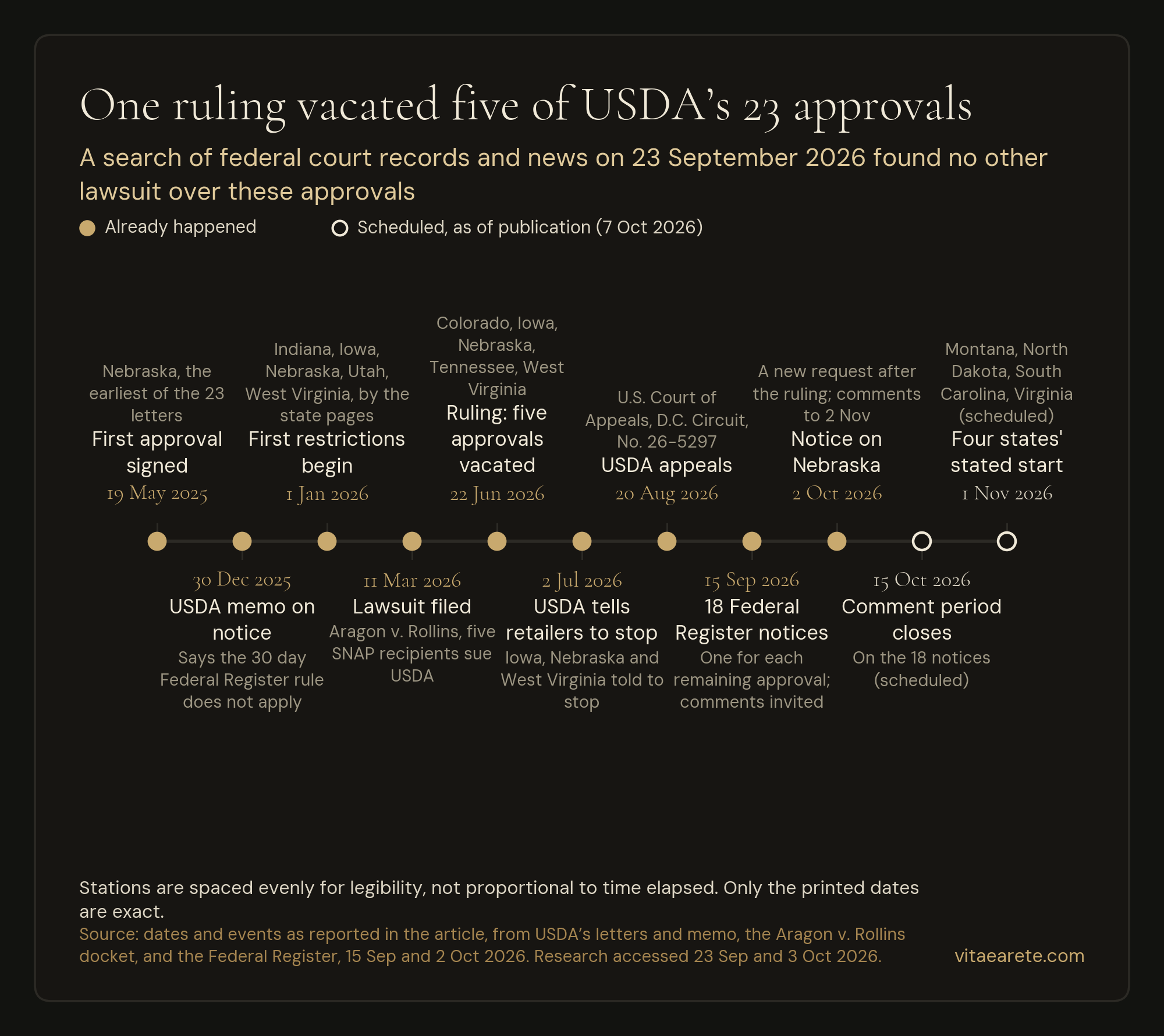
On 22 June 2026 a federal judge in Washington, D.C., held that this section “does not cover projects aimed towards improving the health of SNAP recipients.” She vacated, or set aside, USDA’s approvals for five states. USDA has appealed. The other eighteen approvals rest on the same section of the same law. I found no court ruling on any of them.
Each of the twenty-three approval letters is signed by Agriculture Secretary Brooke Rollins. Health Secretary Robert F. Kennedy Jr. urged governors to apply for them. On 28 March 2025 he was in Martinsburg, West Virginia. “I urge every Governor to follow West Virginia’s lead and submit a waiver to the USDA to remove soda from SNAP,” he said. That is from his department’s release. Eleven days later he and Rollins wrote in a USA Today opinion piece, “[W]e call on all governors to submit waivers.” The waivers they called for included ones that “can limit what can be purchased with food stamps.”
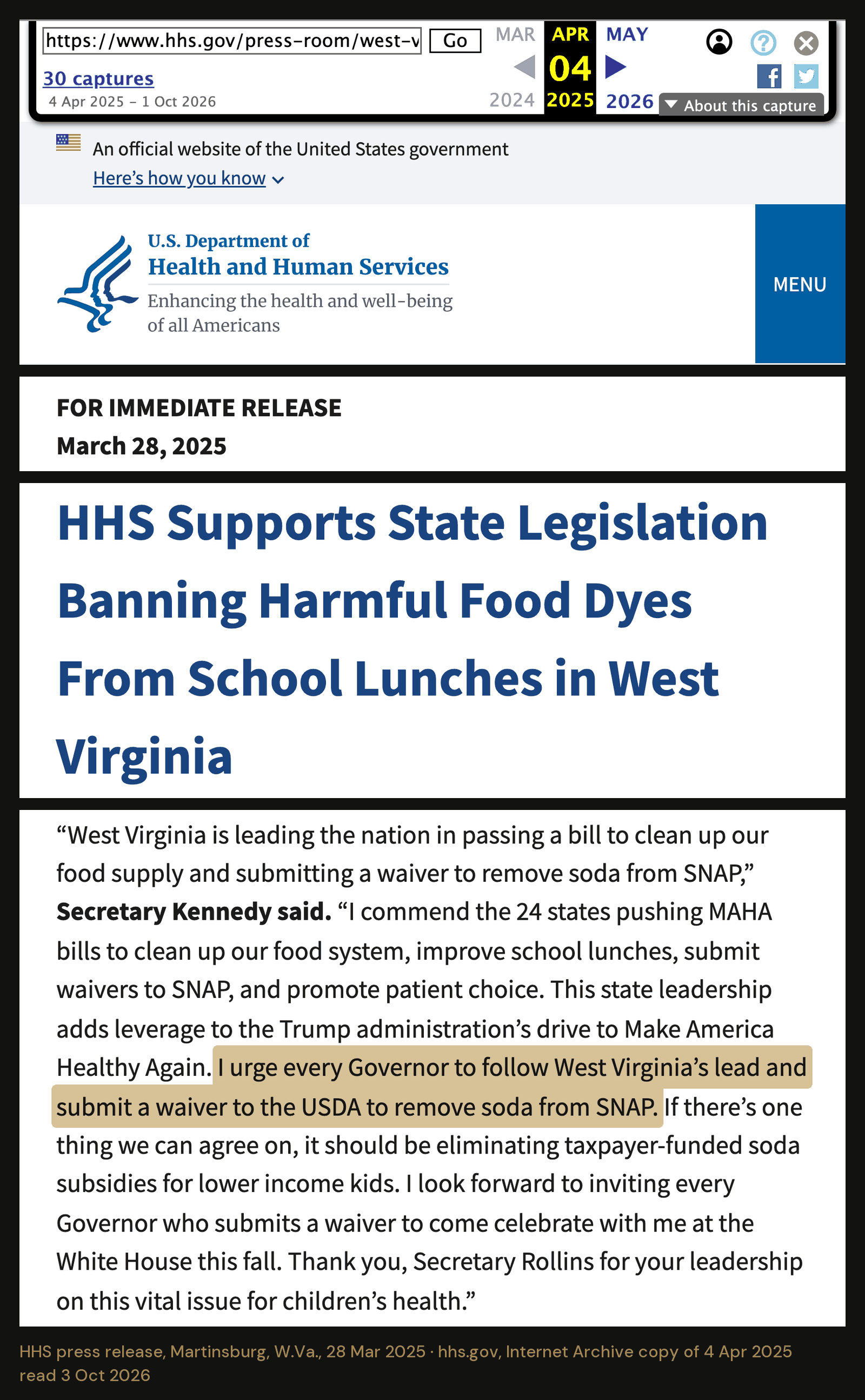
President Donald Trump’s executive order of 13 February 2025 had made the Health Secretary chair of the Make America Healthy Again Commission. At the Commission’s meeting on 22 May 2025, President Trump said, “Earlier this week, we approved a SNAP waiver request from Nebraska.” Nebraska’s was the first approval. In September 2025 the Commission’s strategy, addressed to the President, said USDA would give states “technical assistance in SNAP waiver development and implementation.”
USDA’s releases put Kennedy beside Rollins when nineteen of the twenty-three were signed or announced. On 3 October 2026 I searched the text of the twenty-three letters for Kennedy and for the federal Department of Health and Human Services. I also read their letterheads and signature blocks. I found neither.
Every part of that comes from a document you can open yourself. They are listed at the end.
This series grades the record of the Make America Healthy Again era, the MAHA record. It runs twice a week, on Wednesdays and Saturdays. Each piece takes one set of documents the agencies issued. It notes the authority each one claims, follows what happened to it, and grades it. This one runs now because a court has already read this paperwork closely. The dates are also close. The comment period on the remaining eighteen states closes on 15 October. As of 23 September four states’ own pages gave 1 November as their start.
A disclosure before the documents. I am a registered dietitian, I publish this newsletter under the name of my nutrition practice, Vitae Arete, and I have argued in public for dietitians’ pay and Medicare coverage. I am a member of the Academy of Nutrition and Dietetics, which I quote below, and hold no role in it. In a short note here on 19 September I wrote that I “hold two things at once” about restricting what SNAP can buy. This series is not that argument. It is an audit of the paperwork. Where the paperwork cuts against something I have said, I will say so.
It already has. That note said eighteen states are restricting what SNAP dollars can buy this year. That was wrong, and I have posted a correction. Eighteen is how many approvals USDA had signed by 30 December 2025. It is also how many remain after the court vacated five. By the states’ own pages, the number with restrictions in effect that week was eight.
What USDA signed
The letters set the terms for each state’s project. They are public, each on a USDA page for its state. They went out on seven dates, from 19 May 2025 for Nebraska to 19 May 2026 for Montana. They follow one template.
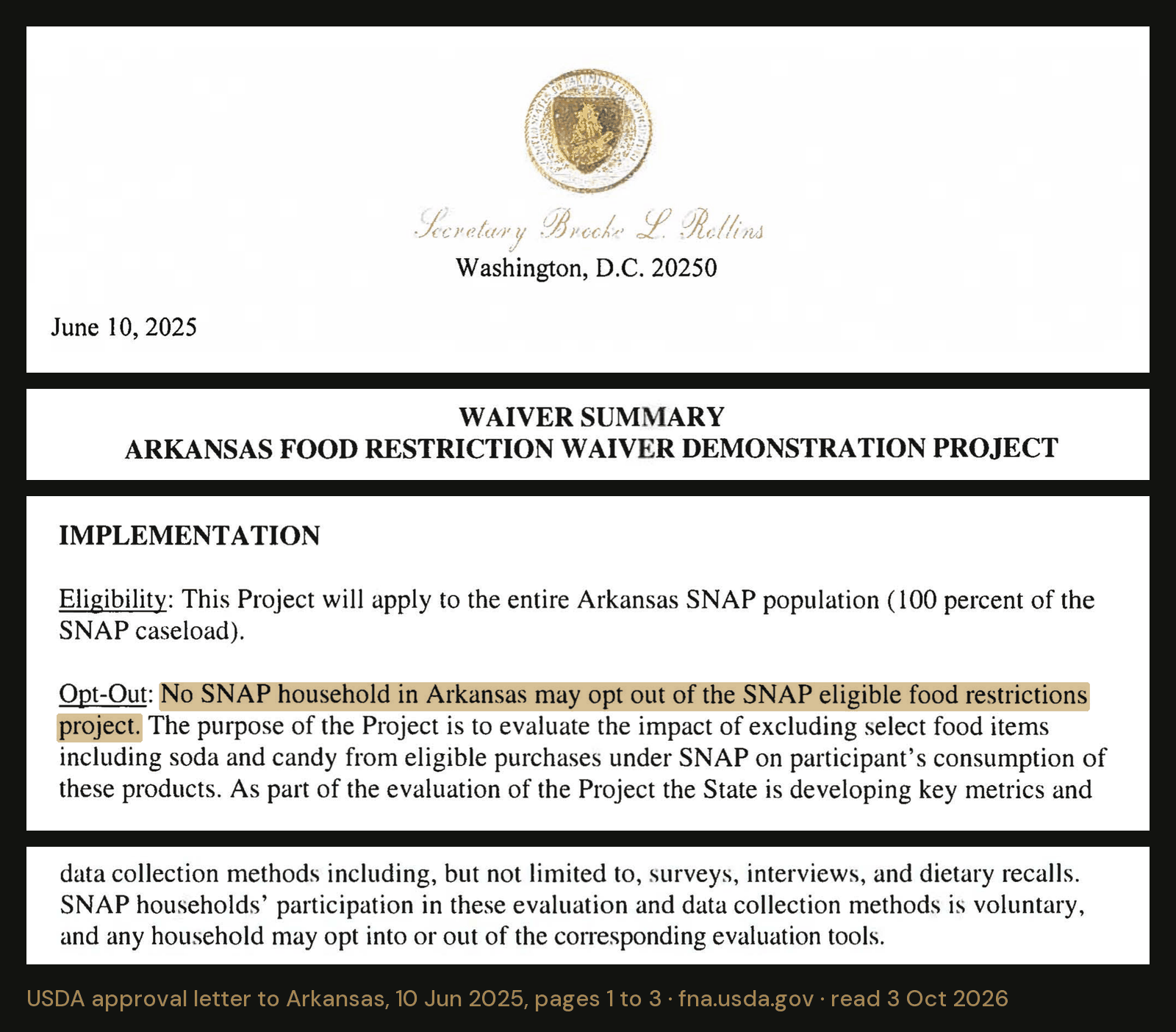
Each says the project “will apply to the entire” state SNAP population, “100 percent of the SNAP caseload.” Each says no SNAP household “may opt out.” The same passage says that taking part in the evaluation is voluntary. That means the surveys, the interviews and the dietary recalls, in which people report what they ate. Everyone is under the restriction. Answering the surveys is optional.
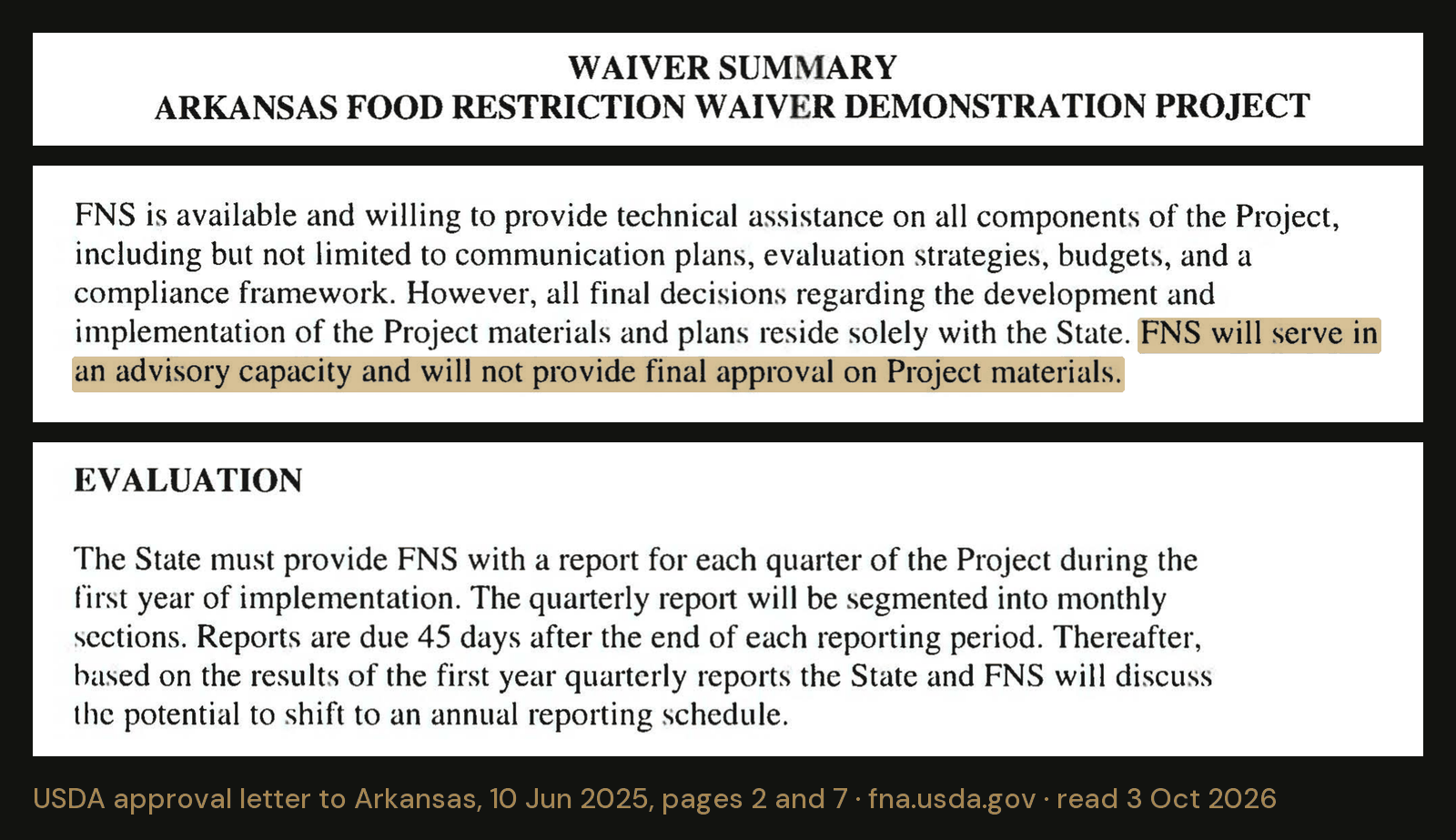
Each approval runs two years. It can be extended to five. Each says: “Continued approval of the Project is contingent upon the results of the ongoing Project evaluation.” In plain words, staying approved depends on what the evaluation finds. The state runs that evaluation. In the first year it owes USDA a report every quarter. The agency, the letters say, “will serve in an advisory capacity and will not provide final approval on Project materials.”
I found no letter that requires an independent evaluator. I searched all twenty-three on 23 September for “independent,” “third-party” and “external” evaluation and found no match. The same search found one letter, Arkansas’s, that describes comparing “a treatment and control group.” That letter also says the state has identified two university research centers as “potential evaluation partners for the Project.” They are at the University of Notre Dame and the University of Pennsylvania. Colorado’s own request, quoted in the court’s opinion, described “an outcome study” that “does not establish cause and effect conclusions.”
The lists differ by state. Arkansas’s reaches “low and no-calorie soda.” Montana’s excludes “artificially sweetened beverages.” Idaho’s candy excludes items “containing flour.” Oklahoma’s, as modified, includes products with “flour components when they are primarily sold as candy.” The table near the end gives each state’s categories.
The law they cite, and the one they do not
Two sections of the same law matter here, § 2026(b) and § 2026(k). Every letter cites (b). Congress wrote (k) for health pilots.
Section 2026(b) lets USDA run “pilot or experimental projects designed to test program changes that might increase the efficiency” of SNAP “and improve the delivery” of its benefits. It also lets USDA “waive any requirement” of the Act, the SNAP law itself, to do so. The approvals use that power to waive the Act’s definition of food. That is why USDA calls them waivers. In law they are pilot projects.
A project under (b) must be consistent with SNAP’s goal of “providing food assistance to raise levels of nutrition among low-income individuals.” It must include “an evaluation to determine the effects of the project.” And it must do one of four things. It must “improve program administration,” “increase the self-sufficiency” of recipients, “test innovative welfare reform strategies,” or “allow greater conformity with the rules of other programs.”
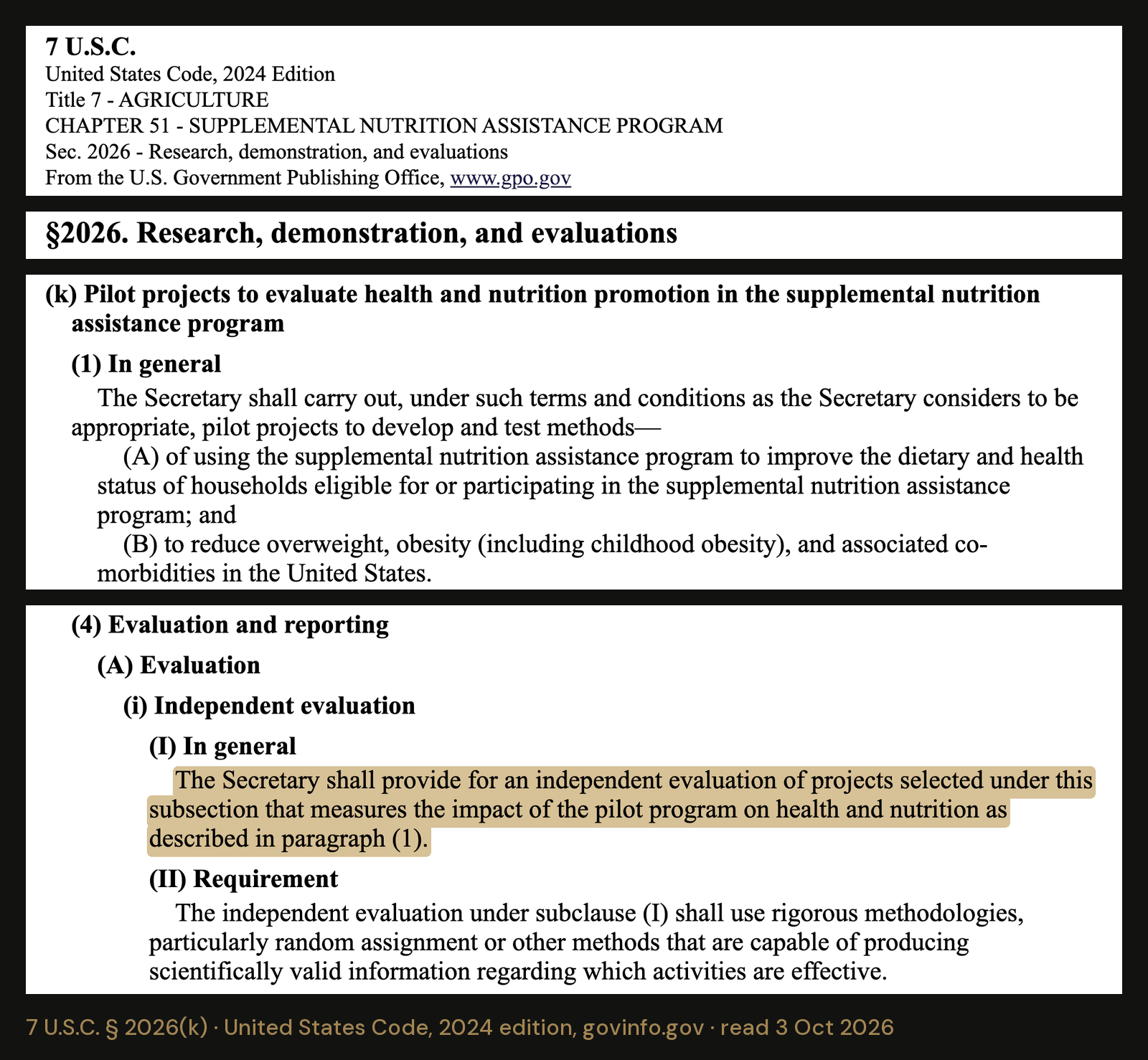
In 2008 Congress added a separate section, § 2026(k), for “Pilot projects to evaluate health and nutrition promotion in the supplemental nutrition assistance program.” Its projects test ways to improve “the dietary and health status” of SNAP households and “to reduce overweight, obesity (including childhood obesity), and associated co-morbidities.”
Its evidence standard is different. Projects under (k) get “an independent evaluation” using “rigorous methodologies, particularly random assignment or other methods that are capable of producing scientifically valid information.” Random assignment means chance decides who gets the change and who does not. The results “shall be shared broadly.”
I found no letter that cites § 2026(k). I searched all twenty-three for it on 23 September. The approvals were issued under (b). The (k) rules did not govern them as written. I am not saying the letters broke those rules. I put the two sections side by side because the court did.
The case for the restrictions, in the record
Before the ruling, the strongest case for these projects, in the words of the people who made it.
The states said what they wanted. Nebraska wrote that its project would “improve the health of low-income SNAP recipients and increase responsible spending of federal SNAP dollars.” West Virginia called soda “detrimental to the health of its SNAP population.” Iowa, Nebraska, Tennessee and West Virginia filed a friend-of-the-court brief on USDA’s side. They said they created the projects “for the very purpose of advancing SNAP’s goal.” In their telling, that goal is to raise “the nutrition levels of low-income individuals by cutting out innutritious junk food.” Colorado did not join them.
Congress’s own statement of SNAP’s purpose, quoted in the opinion, speaks of “raising levels of nutrition among low-income households.” Section 2026(b) requires every pilot to be consistent with that goal.
USDA built its defense on that. It argued that the projects “increase SNAP efficiency” because they improve “recipients’ levels of nutrition for a constant level of benefits.” Its brief put it this way: “[I]f USDA can achieve better health outcomes while awarding the same benefit amount, that would be ‘efficient.’”
That is a serious argument. It measures efficiency by what the program buys for each dollar. It also points to a goal Congress wrote down. The judge rejected it. But the restrictions had a legal theory, and it is in the record.
What the court held
Here is what the court decided, and what it left open.
The case is Aragon v. Rollins, No. 1:26-cv-00861, in the U.S. District Court for the District of Columbia. Five people who use SNAP in Colorado, Iowa, Nebraska, Tennessee and West Virginia sued USDA on 11 March 2026. Several have diabetes or other medical conditions. Judge Amy Berman Jackson decided the case on 22 June, on the written record, without a trial.
Her first holding, or ruling on the law, is about § 2026(b). It “authorizes projects related to the administrative and logistical efficiency of the SNAP program itself,” she wrote. “Improving the health and diet of SNAP recipients is not included.”
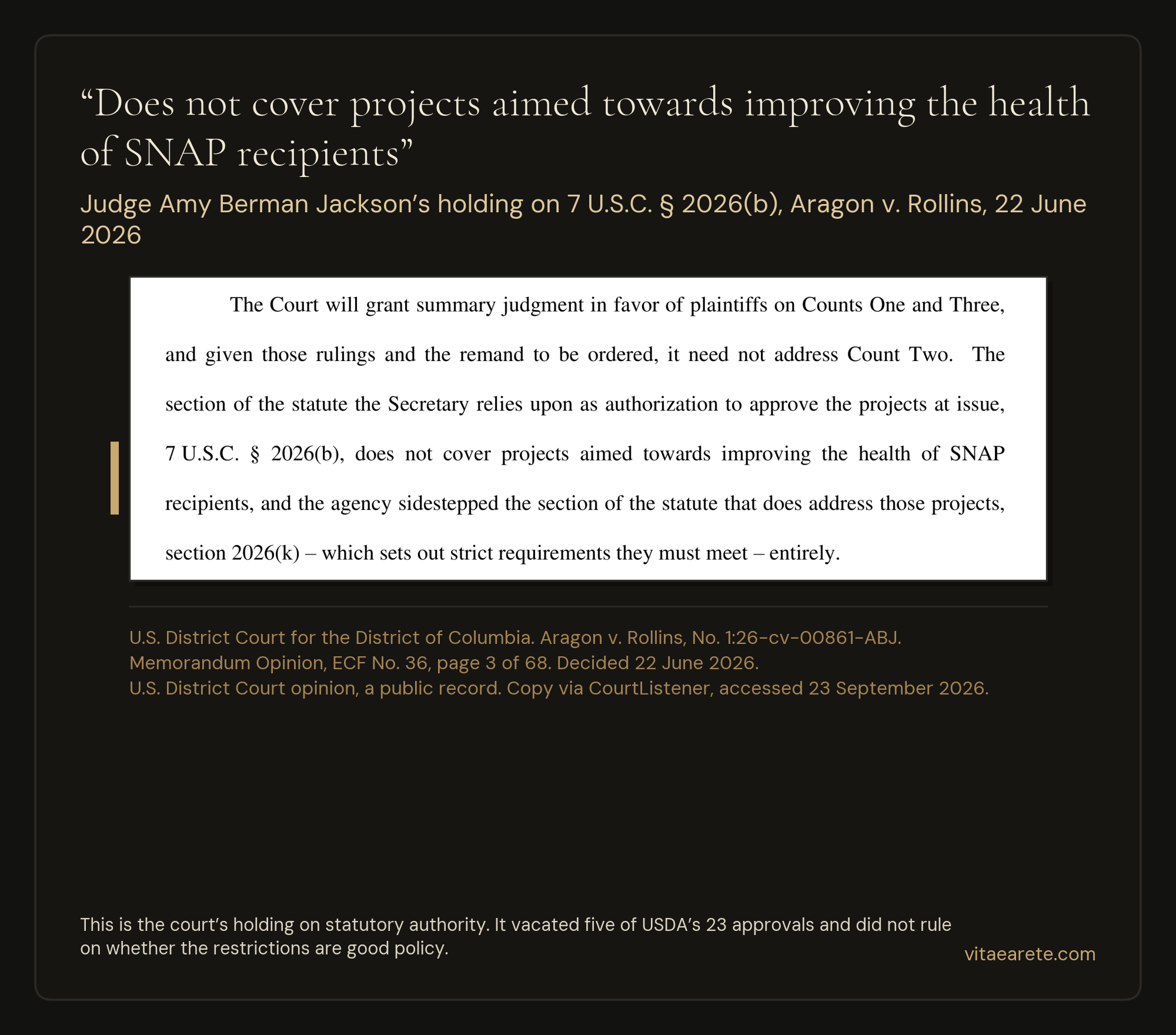
She got there through the law’s words, its structure and its history back to 1977. On the words, she read “increase the efficiency of the supplemental nutrition assistance program” as the program’s own efficiency. On the structure, even if (b) gave USDA a broad power and (k) a specific one, “it would still be subsection (k) that governs.” And she read (k) as containing no power to waive the definition of food at all. “Congress defined what ‘food’ is supposed to be,” she wrote, “and it did not authorize the agency to amend or waive the definition it enacted. It did not authorize the agency to cut types of food out of SNAP entirely.”
She also found that the projects “actually add administrative complexity.” Her reason was that shoppers and retailers alike “must deal with new rules affecting what can and cannot be purchased.” Of one USDA instruction to retailers, she wrote that the scheme “certainly does not reflect programmatic efficiency.”
The opinion asks why USDA passed over (k). It answers that (k) projects “are required to meet more stringent mandatory criteria.” That is the court’s inference about the agency’s reasons, and I report it as the court’s. Since no letter I searched mentions (k), none of them explains the choice. The statute, meaning the law as Congress wrote it, is also looser than that phrase. Its selection criteria for (k) projects are a list that “may include” certain factors. The independent evaluation is a “shall.” In a statute, “may” allows and “shall” requires.
The order vacated USDA’s approvals for the five states where the plaintiffs, the people who sued, use SNAP. The legal name for that step is vacatur. The order also sent the approvals back to the agency. “This means,” it says, “that the pilot projects in Colorado, Iowa, Nebraska, Tennessee, and West Virginia may not proceed.” It also vacated a USDA memo from 30 December 2025. The judge declined to issue an injunction, which is an order telling a party to do or stop doing something. She vacated USDA’s approvals, not any state’s law.
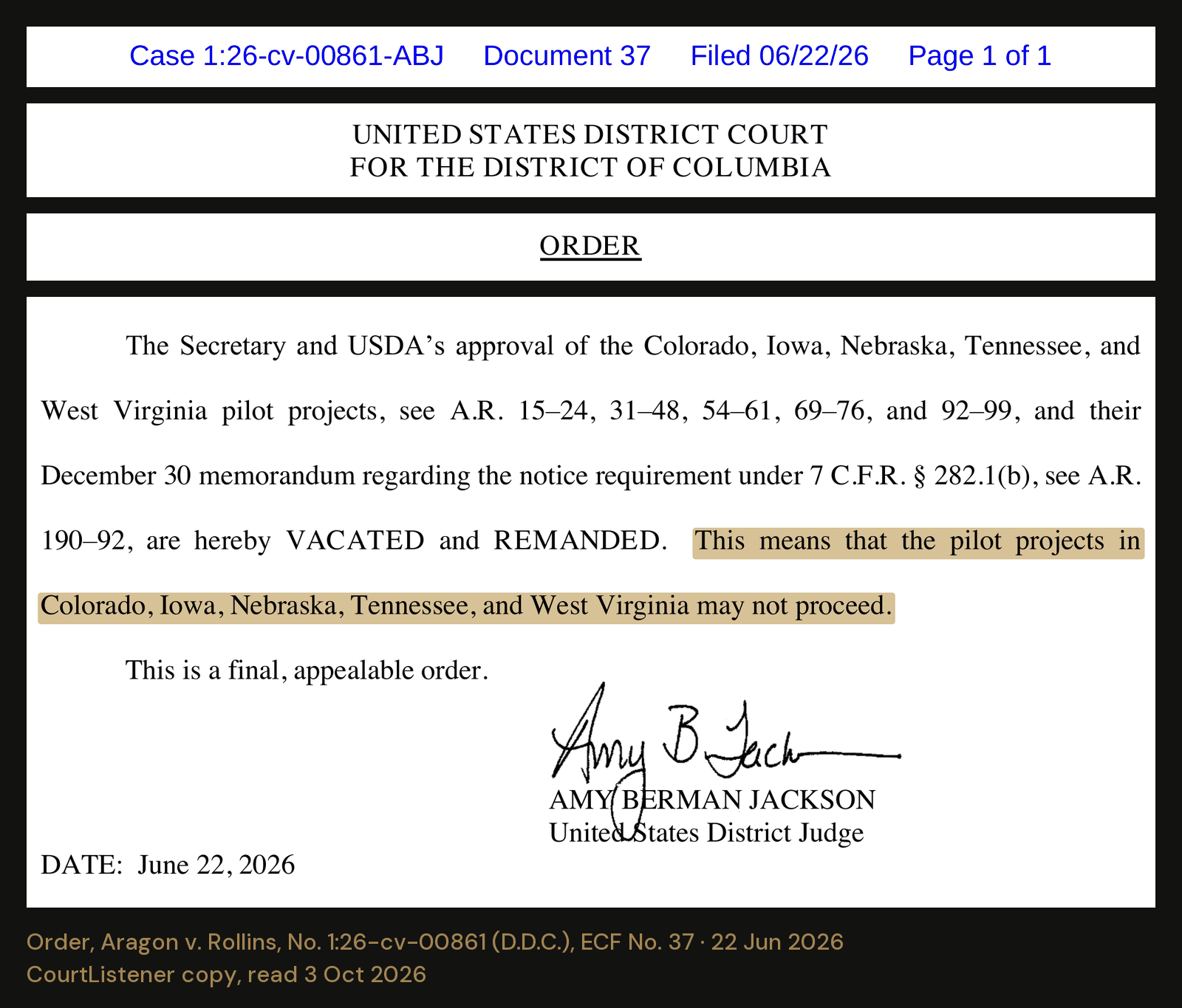
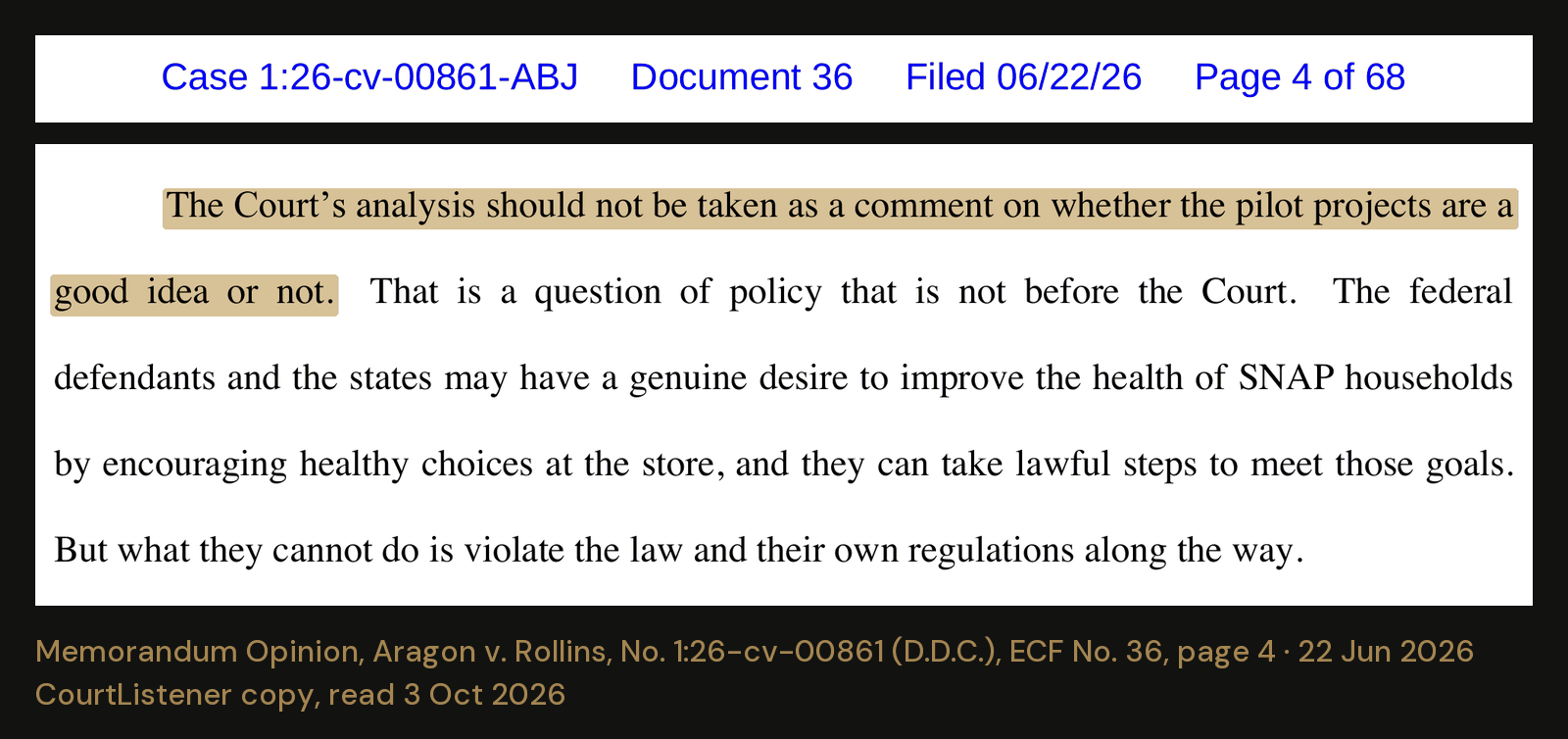
She was explicit about what she was not deciding. “The Court’s analysis should not be taken as a comment on whether the pilot projects are a good idea or not,” she wrote. “That is a question of policy that is not before the Court.” USDA and the states, the opinion goes on, “may have a genuine desire to improve the health of SNAP households by encouraging healthy choices at the store, and they can take lawful steps to meet those goals. But what they cannot do is violate the law and their own regulations along the way.”
She did not decide whether the approvals were arbitrary and capricious. That is the legal test for whether an agency reasoned its way to a decision. She did not assess the evaluation plans. In a footnote she said there “appears to be no statutory authorization for blanket restrictions with no exceptions for individual circumstances.” Later she wrote that it “would be prudent to consider whether individual medical circumstances should be taken into account.” Those are observations, not holdings. “Appears” is her word.
A search of the publicly indexed federal court records and of news on 23 September found no other lawsuit over these approvals. State courts were not searched.
The notice USDA decided it did not need
The second holding is about a notice. It covers four states, not five.
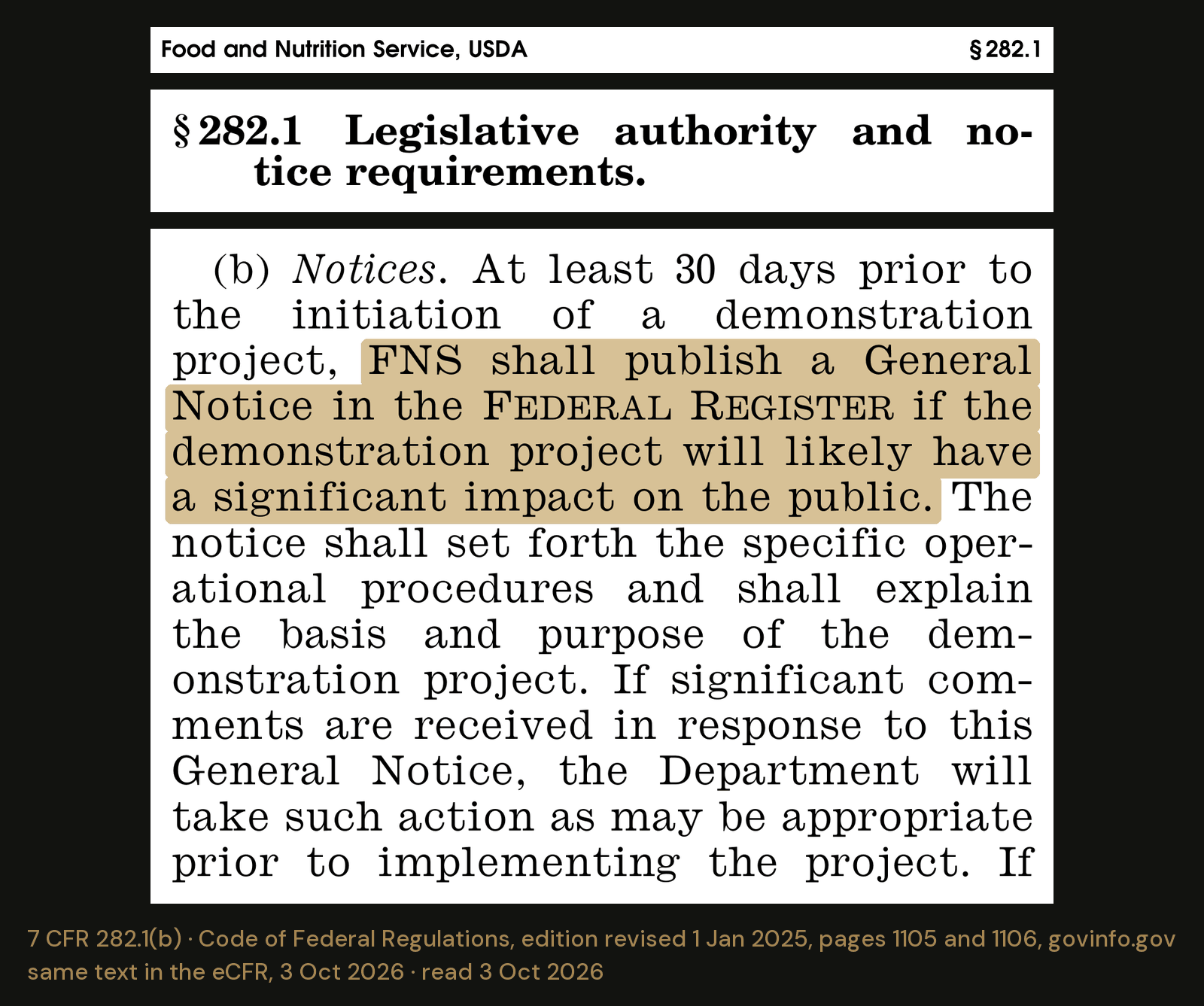
A USDA regulation, 7 CFR 282.1(b), requires one. The agency “shall publish a General Notice in the Federal Register if the demonstration project will likely have a significant impact on the public.” It must do so at least thirty days before a pilot project begins. The Federal Register is the government’s daily publication of rules and notices. If significant comments come in, the regulation says, the Department “will take such action as may be appropriate prior to implementing the project.”
On 30 December 2025, two days before the first restrictions were due to start, an internal USDA memo decided the rule did not apply. “SNAP has determined that the General Notice Rule of 7 CFR 282.1(b) is not applicable to the Food Restriction Waivers,” it says. The restrictions would limit “accessory food items,” it went on, “but they will not change SNAP eligibility criteria, allotment levels or access to staple foods.” Allotment levels are benefit amounts. The memo covered all eighteen states approved at that point, not only the five in the lawsuit.
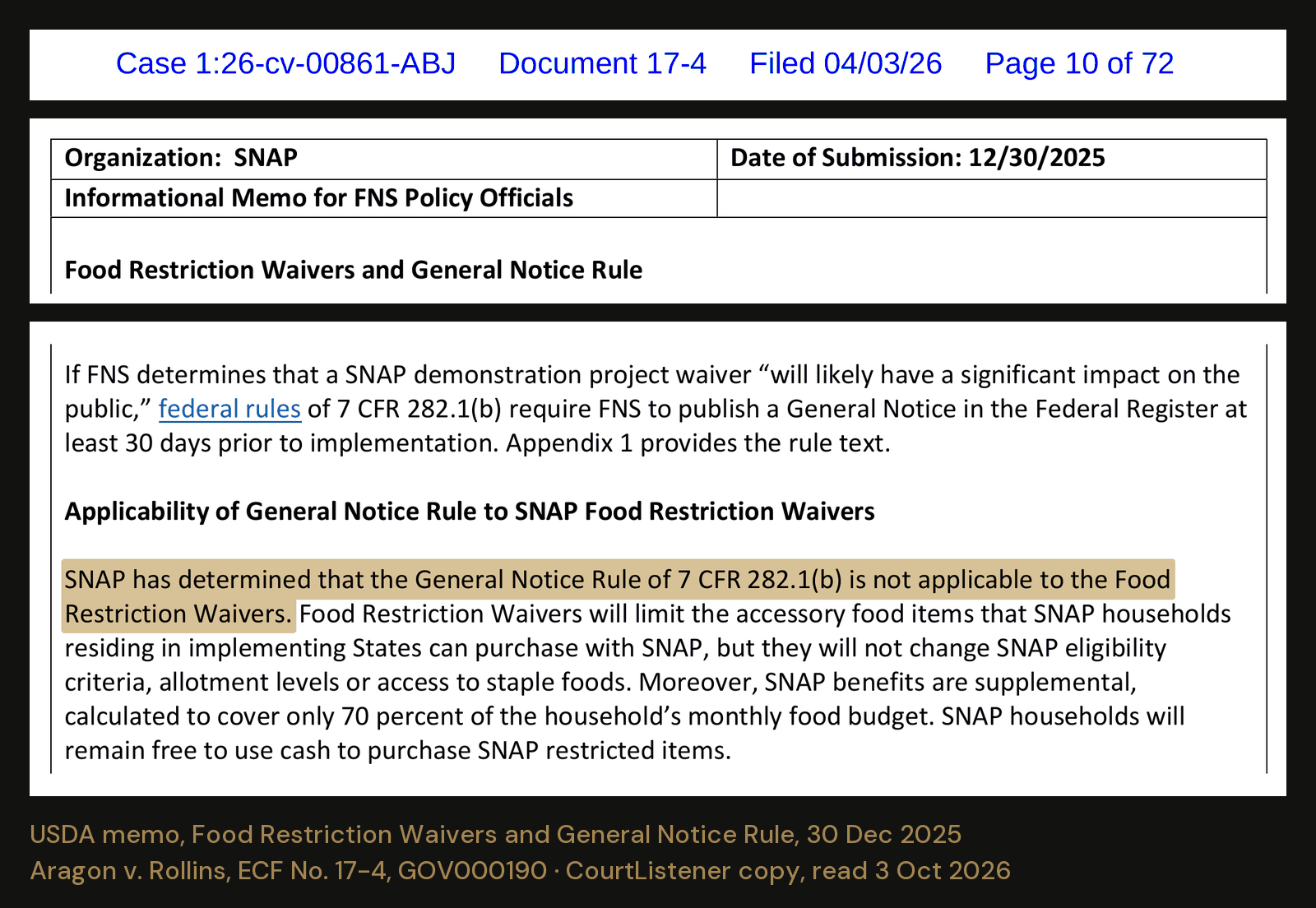
Then it added a second point. “SNAP benefits are supplemental, calculated to cover only 70 percent of the household’s monthly food budget,” the memo says. “SNAP households will remain free to use cash to purchase SNAP restricted items.”
I wrote in April about the word “supplemental,” and I will not repeat that argument here. What is new is what happened to the 70 percent in court. According to the opinion, “neither the December 30 memorandum, nor government counsel could tell the Court where the seventy percent determination came from.” The judge’s best reading was that it comes from § 2017(a) of the Act. That section sets a household’s benefit at the cost of the thrifty food plan minus 30 percent of its income. The thrifty food plan is the government’s model budget diet. She quoted the government’s lawyer conceding that “the country’s neediest citizens do rely exclusively on SNAP.” I have not read the hearing transcript, so both quotes come from the opinion. In court the government also suggested the plaintiffs could use “other funds” for these items. The judge answered that they “are SNAP recipients precisely because they do not have sufficient funds for food in the first place.”
The court held that the regulation’s own words decided it. “What begins and ends the inquiry is the plain language of section 282.1(b),” the opinion says. It gave the memo’s reading no deference, the weight courts sometimes give an agency’s reading of its own rules. There was “no doubt,” it said, that the projects were likely to have a significant impact on the public. For confirmation it cited the documents USDA had filed in the case, starting with the April 2025 opinion piece by Rollins and Kennedy. USDA, it found, “violated the regulation by failing to post notice thirty days before the initiation of the projects in Iowa, Nebraska, West Virginia, and Colorado.” The error was not harmless. “The error,” the opinion says, “is that they skipped the procedure entirely.” Tennessee is not on that list. Its project had not begun.
Colorado is on the list, and the documents disagree about it. The opinion says Colorado “started on April 30, 2026.” Colorado’s letters to USDA of 3 and 14 April say the state “suspended the planned implementation date of April 30 pending ongoing rulemaking.” On 11 May USDA approved a new start date of 30 October. The administrative record, the documents USDA filed in the case, went in on 3 April. I cannot reconcile the opinion with those letters. I will not guess why they differ. The first holding covers Colorado whatever the date. Colorado’s agency now says it is “discontinuing its efforts” to implement the restriction.
What USDA did next
This section follows USDA’s steps after the ruling, from July into October.
Ten days after the ruling, on 2 July 2026, USDA told retailers in Iowa, Nebraska and West Virginia to stop. “You must stop implementing the ban,” the notices say. Iowa’s agency posted that USDA had directed it “to return to federal SNAP guidelines.”
On 20 August USDA appealed to the U.S. Court of Appeals for the D.C. Circuit, No. 26-5297. On 21 September it filed what it called a “nonbinding, preliminary statement of the issues to be raised in this appeal.” It asks whether the district court “correctly vacated four letters.” It does not say which four. The order named five states. CourtListener, a public archive of court records, keeps copies of both courts’ dockets, the running lists of filings in each case. As of 29 September the appeal was pending on CourtListener’s copy of its docket, last updated 25 September. CourtListener’s copy of the district court’s docket, last updated 27 August, showed no stay of the ruling. A stay would pause the ruling during the appeal.
On 25 August USDA’s nutrition agency wrote to South Carolina. The agency now calls itself the Food and Nutrition Administration, or FNA. The approval letters were issued under its old name, the Food and Nutrition Service. The letter began by saying that USDA’s Office of General Counsel and the Department of Justice “continue to review and analyze the recent court order” that vacated the five approvals. “To demonstrate FNA’s commitment to transparency,” it said, it would publish a Federal Register notice at least thirty days before the project began. It asked the state to move its start to 1 November 2026. The reason, it said, was “so that FNA can issue a notice in the Federal Register and assess public comments prior to project implementation.”
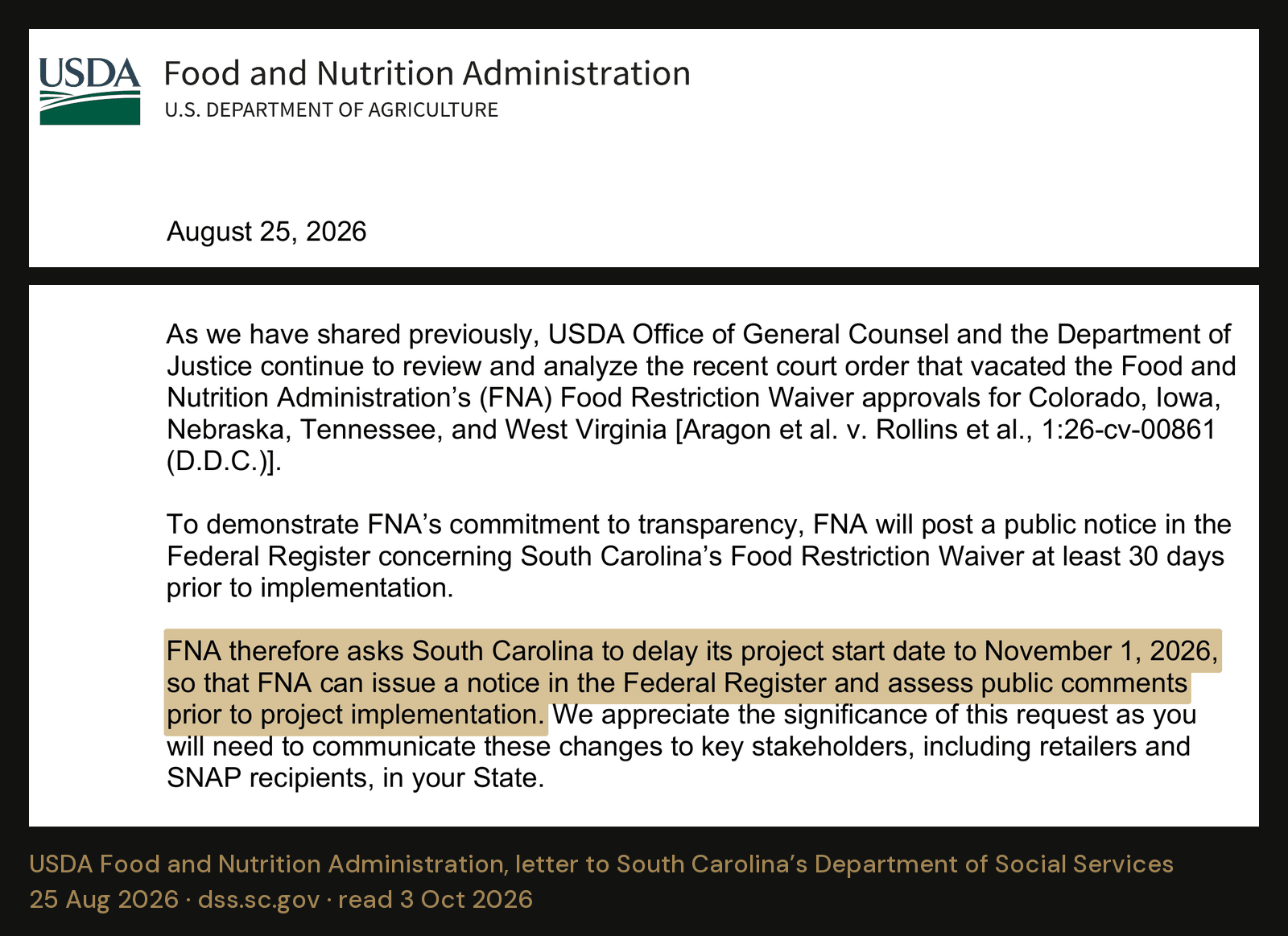
North Dakota’s agency says it asked to move its start to 1 November “in collaboration with and at the direction of” FNA. On 4 September Ohio said its restriction, planned for 1 October, “is being put on hold” at FNA’s request until Ohio “receives further guidance.” Montana’s and Virginia’s pages also give 1 November. Neither page, as it read on 23 September, says why.
On 15 September USDA published eighteen notices in the Federal Register, one for each state whose approval stands. They invited comments until 15 October 2026. The notices still rest on § 2026(b). For the eight projects already running, they ask for comments on the state’s “implementation and operation” of the project. Each says comments are invited “although not required by statute.” That is accurate as far as it goes. The notice requirement is in USDA’s own regulation, not in the statute Congress passed.
I searched all eighteen notices on 23 September. I looked for any mention of the court, the case, the vacatur, the notice regulation, the December memo or § 2026(k). I found none.
A further notice followed on 2 October. After the vacatur, it says, Nebraska filed a new request on 1 September. It proposes restricting soda, soft drinks and energy drinks from 1 December and candy from 1 March 2027. This notice names the case. It still cites § 2026(b). USDA will take comments until 2 November, then publish a separate notice authorizing or refusing the project.
The comment period closes on 15 October. The comments go into online dockets, FNA-2026-0298 through FNA-2026-0315, on regulations.gov.
Where each state stands
This is every approval as of 23 September 2026, by each state agency’s own page unless the table says otherwise. A start date on a state page is the state’s statement. It is not proof of what happens at every register.
By that count, eight states’ restrictions are in effect: Arkansas, Florida, Idaho, Indiana, Louisiana, Oklahoma, Texas and Utah. Three more, in Iowa, Nebraska and West Virginia, ran from 1 January 2026 until USDA told retailers to stop. Two, Colorado and Tennessee, were vacated before they began. Four give 1 November 2026 as their start: Montana, North Dakota, South Carolina and Virginia. Ohio’s is on hold with no date. Five are set for 2027 or 2028: Hawaii, Kansas, Missouri and Wyoming in 2027, Nevada in 2028.
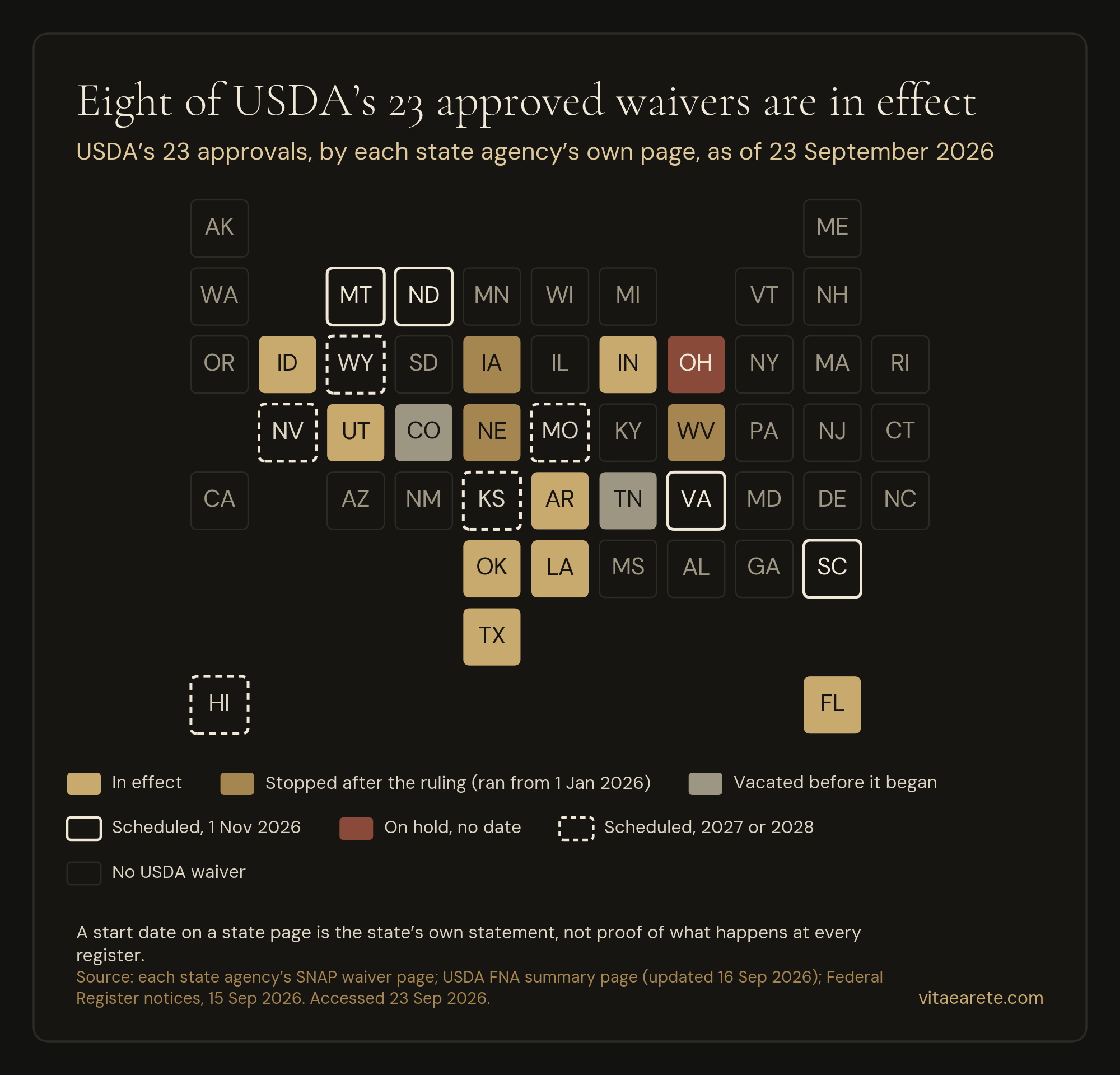
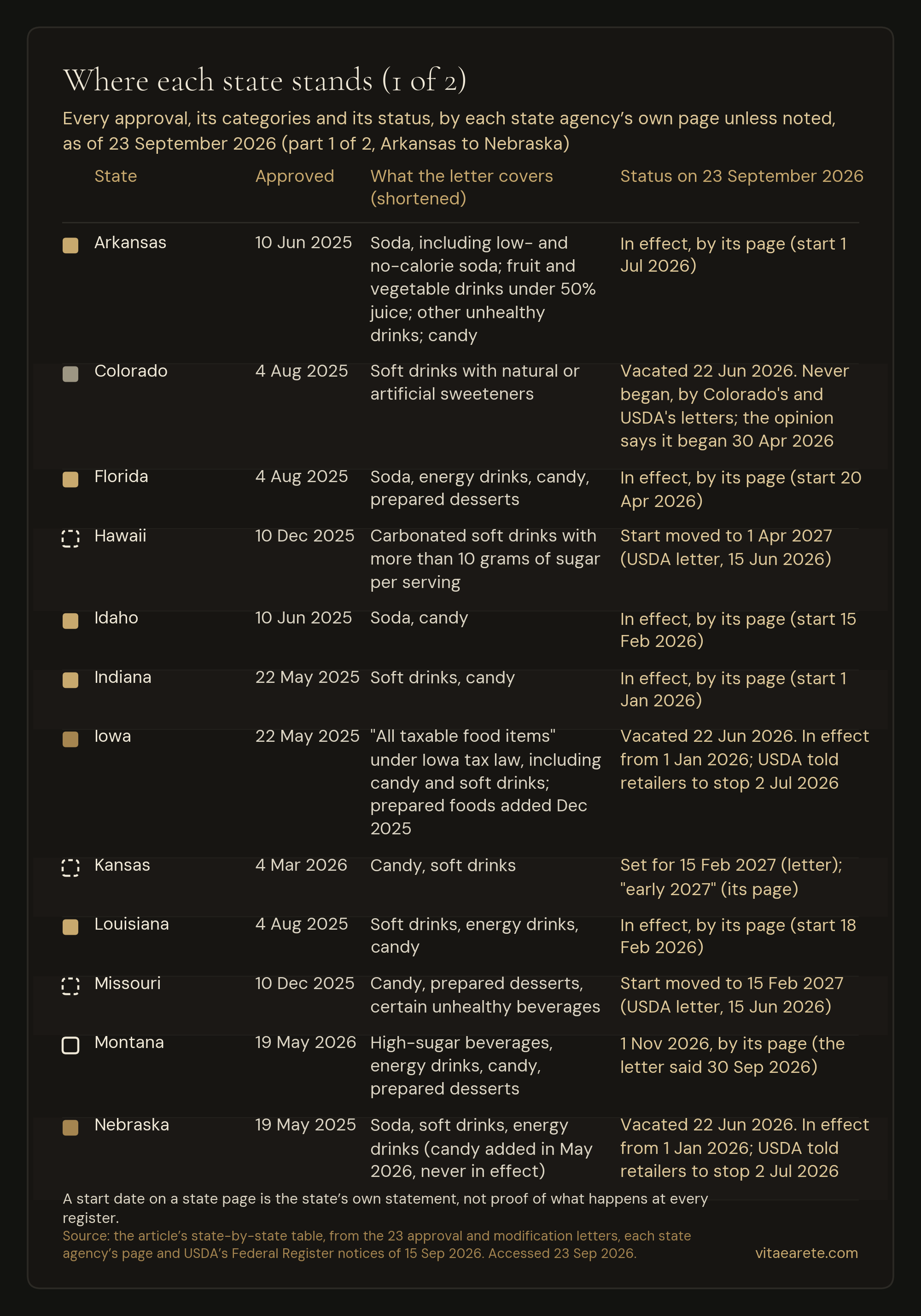
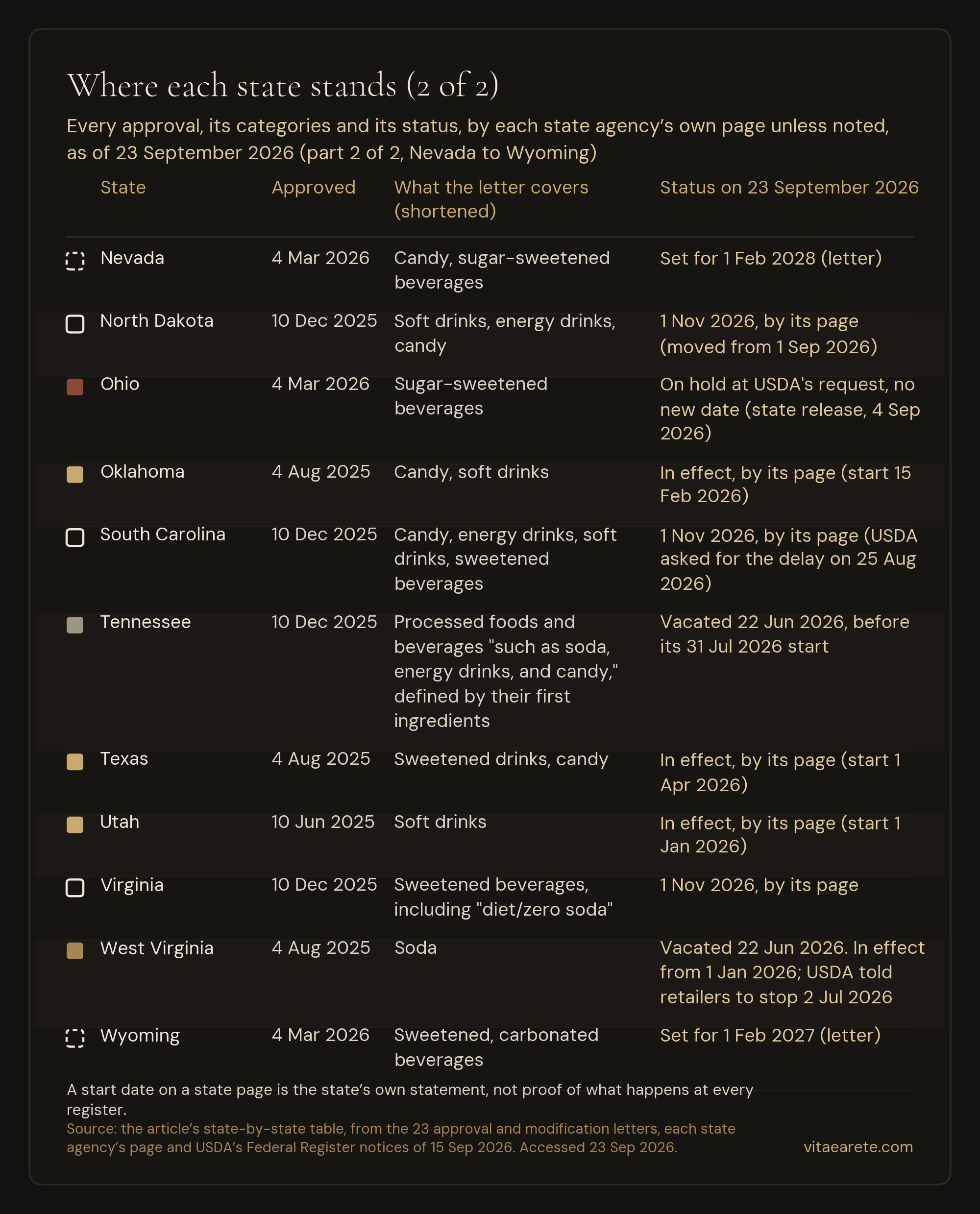
USDA’s own summary table still showed older target dates on 23 September for South Carolina, North Dakota, Montana, Ohio and Virginia. The page had been updated on 16 September. The page was updated again on 25 September and on 2 October. On 3 October it listed 1 November for all five, Ohio included. Ohio’s own release of 4 September says its start is on hold. On 29 September I found no later release about it on Ohio’s news page. On 3 October the page also listed Nebraska, with a target date of 1 December 2026 and a link to the 2 October notice. That notice says FNA is “considering whether to approve” Nebraska’s new request.
If you use SNAP, your state agency’s page governs what your card buys. It will be more current than this table.
What I cannot tell you
I cannot tell you how the appeal will come out, or when.
I cannot tell you whether the other eighteen approvals are lawful. I found no ruling on them. They cite the section the court read, and that is as far as the documents go. The court also vacated the December memo, which applied to every state approved at the time. What that means for the others is a legal question, and I am not a lawyer.
I cannot tell you whether any state has filed the quarterly evaluation reports its letter requires. On 23 September none was posted on USDA’s twenty-three state pages. I checked each page’s list of documents. Iowa’s first was due on 15 May 2026. Not posted is not the same as not written.
And I cannot tell you whether taking these items off the SNAP list improves health. The court did not reach that question, and the research has not settled it. What the research does show is set out below.
What the research says
The court left open whether these restrictions improve health. The studies so far point both ways.
They do change what people buy. Three studies of the 2026 restrictions found that SNAP households bought 11 to 13 percent less of what was restricted in the first months. None had been peer reviewed when I looked on 3 October 2026. One, funded through a grant from Bloomberg Philanthropies, found a 12 percent drop and more stigma among recipients. Some households switched to other drinks still allowed, such as fruit drinks. Even so, one of the three found that the calories and sugar these households bought in drinks and packaged snacks fell 5 to 8 percent.
Buying less is not the same as eating better. Two randomized trials in Minnesota gave low-income people who were not on SNAP a study food card. Some cards carried the rule. In the 2016 trial, 279 adults over twelve weeks, the authors found that restriction alone cut calories but did not improve diet quality. Paired with a 30 percent bonus on fruit and vegetables, diet quality improved. The authors note that none of their results would pass a strict correction for the 128 tests they ran. The 2024 trial, 233 adults over twenty weeks, found no diet gain from either version.
Both trials also tracked weight and found no difference. Neither was built to detect one. Weight was a side measure, in a few hundred people over a few months.
The health gains I found are all model projections, and they point toward benefit. Models published in 2014 and 2025 projected less obesity from ending SNAP purchases of sugary drinks, and the 2014 one less diabetes. A 2018 model projected that adding a sugary-drink rule to a produce bonus would more than double the heart disease and stroke events the bonus alone prevents. A 2026 model projects that excluding all sugary drinks from SNAP nationwide would take 0.27 pounds off the average adult on SNAP. It would also prevent about 33,000 new cases of type 2 diabetes over ten years. Its authors call that part “more speculative” than what they measured. They conclude that the rule appears to harm recipients, through stigma, but to raise overall welfare through lower public health care costs. Models are not measurements. Restriction has not been shown to improve weight or diabetes. That is not proof that it cannot.
A 2007 USDA report, written before any of these trials, concluded that the idea had “serious conceptual and practical flaws.” It warned that shoppers might simply pay cash instead. The 2026 studies found they bought less. The report said the way to know was “carefully designed and evaluated pilot tests.”
On 2 May 2025, seventeen days before the first approval, the Congressional Budget Office, which advises Congress, weighed in. It called the evidence on how SNAP households would respond to restrictions “unclear.” It noted that simulation studies suggested health gains. It asked for new randomized trials. It also asked for comparisons of places with and without such rules.
The state requests USDA approved did cite research. West Virginia’s cited the 2014 model. Nebraska’s cited a Los Angeles study linking SNAP use to higher odds of obesity, a kind of study that shows a link but not a cause. In court, the government’s lawyers cited one page of a model study of weight and diabetes risk, on a different point. In the parts of the court record I read, I found no randomized trial cited. On 3 October 2026 I also searched USDA’s seven releases on the approvals and the Commission’s report and strategy of 2025. I found none that cites a study of what restrictions do. The first two releases cite rates of prediabetes and daily soda drinking among young people.
Experts split. The Academy of Nutrition and Dietetics said in April 2025 that “imposing restrictions without addressing broader systemic barriers is unlikely to achieve meaningful public health improvements.” It called instead for wider access to affordable, nutritious food and for nutrition education. In a 2026 JAMA viewpoint, two researchers called removing unhealthy foods from SNAP “a MAHA strategy to take seriously.” Lisa Harnack led both Minnesota trials. Quoted in a New York Times article in August 2026, she said: “I wish it had been done in a smaller number of states with a more rigorous evaluation plan.”
What could have been done instead
The states’ stated goal was better diets in SNAP homes. The section Congress wrote in 2008 for health pilots lists projects it may include toward that goal. They include larger benefits, produce bonuses, stricter stocking rules for stores and nutrition education. Taking foods off the list is not one of them. Some of these have stronger evidence for diet than restriction does, though not yet for weight. Paying for them at scale takes Congress.
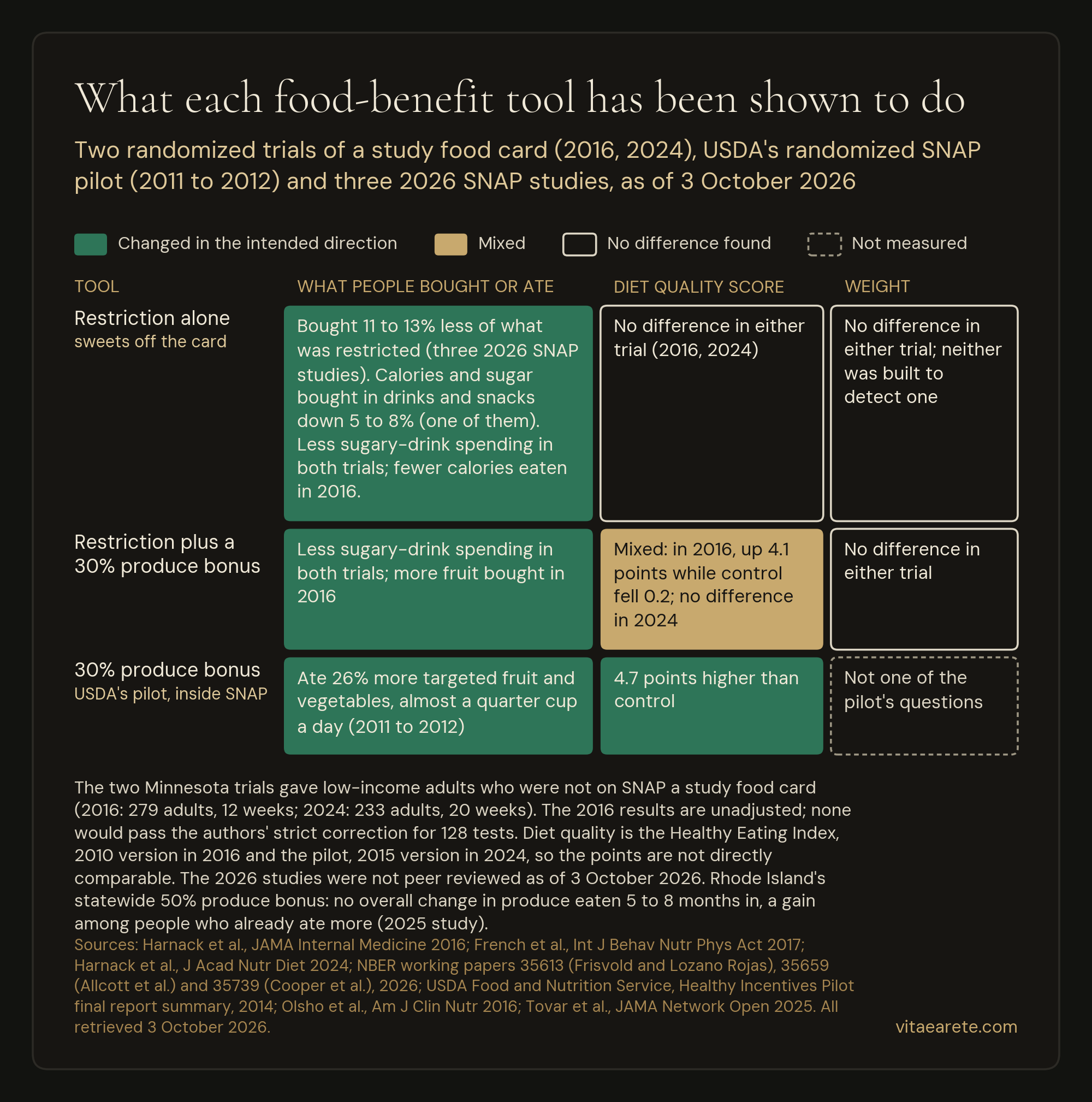
A bonus on fruit and vegetables. USDA’s own randomized pilot ran in Hampden County, Massachusetts, from November 2011 to December 2012. Households got 30 cents back for each SNAP dollar spent on most fruit and vegetables (not white potatoes or juice). Participants ate 26 percent more of those, almost a quarter cup a day. Weight was not among its questions. The 2014 model projected that a bonus alone would not significantly change obesity or diabetes. USDA’s 2014 report put a national version at $825 million to $4.5 billion a year in bonuses. The 2008 law that wrote § 2026(k) paid for the pilot.
Bonuses are not sure wins. Rhode Island’s statewide version was not linked to an overall change in produce eaten five to eight months in. People who already ate more produce did eat more. USDA kept funding produce bonuses through a grant program Congress set up. In December 2025 it announced $36.3 million for 27 such projects. The Commission’s strategy said that three agencies, USDA among them, would “work with grocers on sustainable incentive programs.” The statewide projects USDA approved were restrictions.
Pair it and test it. In the 2016 trial, restriction did best alongside a produce bonus. The 2024 trial did not repeat that. That split is the case for a fair test inside SNAP, one that assigns the change by chance, as § 2026(k) asks of health pilots. On the court’s reading, USDA has no power to cut types of food out of SNAP, so that test needed Congress too. Grant money under § 2026(k) may not pay for any project that limits what benefits buy. The Minnesota trials ran outside SNAP. The 2016 authors wrote that for legal reasons the program itself could not be altered. USDA instead approved restriction for whole states under § 2026(b), on terms that leave the evaluation to each state. A defender can fairly answer that USDA had turned down four earlier requests to restrict, as one of the 2026 studies reports. The statewide starts also gave outside researchers real SNAP data within months. That is the comparison the Budget Office also asked for.
Protect the benefit, and teach. Four states ended extra pandemic SNAP benefits in August 2021. A study linked that to a 5 percentage point rise in the risk that a SNAP household lacked enough to eat, against eight states that kept them into 2022. In an Indiana trial, SNAP’s nutrition education program improved household food security a year later, though not children’s scores. The budget law Congress passed and the President signed on 4 July 2025 went the other way. It bars any re-evaluation of the thrifty food plan, which sets the benefit, from raising its cost. It tightens work requirements and ends the education program’s federal funding after fiscal 2025. The Congressional Research Service reports the Budget Office’s July 2025 estimate: the law’s nutrition changes cut federal spending by $186.7 billion over fiscal 2025 to 2034. Part shifts costs to the states. These were Congress’s choices, not USDA’s approvals, and my grade does not rest on them.
My grade
This grade is my judgment on the documents cited here. It uses the four lines set out in the piece that opened this series on 3 October 2026: Substance, Evidence, Health and Integrity. Each line answers only what these documents show. It is not a finding about anyone’s motive. I will revise it in a dated note if the record changes.
F. After the ruling, USDA told retailers in three states to stop. It also opened the eighteen approvals still standing to public comment. Neither lifts the grade. The court’s order said the pilot projects in the five vacated states “may not proceed.” The comment notices came after eight of the eighteen projects had started. The other ten had not begun. But the notices rest on the same section as the approvals. All twenty-three cite a section of law that a federal court held does not cover health projects. That court vacated five of them. As of 23 September that ruling was on appeal.
Substance: Binding. No SNAP household in an approved state may opt out. Eight states’ restrictions were in effect on 23 September, by their own pages. The ruling vacated five approvals.
Evidence: Each letter leaves the evaluation to the state and requires it to report to USDA. I searched all twenty-three letters on 23 September and found none that requires an independent evaluator. Arkansas’s letter notes that the state has identified two university research centers as potential evaluation partners. The section Congress wrote for health pilots requires an independent evaluation. It must use “rigorous methodologies, particularly random assignment or other methods that are capable of producing scientifically valid information.” These approvals cite a different section. That standard did not govern them as written. On 3 October I searched USDA’s releases on the approvals and the Commission’s report and strategy, and found none that cites a study of what restrictions do. The state requests I read in the court record cite, among other sources, a 2014 computer model and a Los Angeles study that shows a link but not a cause. I found no randomized trial cited. On 2 May 2025 the Congressional Budget Office called the evidence on how SNAP households would respond to restrictions “unclear.” It asked for new research, randomized trials first among it.
Health: Not shown. Three early studies of the 2026 restrictions, not peer reviewed as of 3 October, found SNAP households bought 11 to 13 percent less of what was restricted. In two small, short randomized trials, restriction alone did not improve overall diet quality. Neither found a difference in weight. Neither was built to detect one. The health gains I found are model projections. On 23 September I found no evaluation report posted on USDA’s twenty-three state pages. Not posted is not the same as not written.
Integrity: The same ruling held that USDA skipped its own notice rule in four states, Colorado among them. Colorado’s own letters, though, say the state suspended its planned start. On 2 July, ten days after the ruling, USDA told retailers in three states to stop. On 25 August it asked South Carolina to delay its start so it could “assess public comments.” On 15 September it published eighteen Federal Register notices inviting comment on the approvals still standing. On 23 September I searched those eighteen notices for the court, the case and the vacatur. I found no mention. USDA’s 25 August letter to South Carolina does refer to the court order. So does its 2 October notice on Nebraska’s new request.
I asked USDA
On 24 September I wrote to USDA’s press office with three questions. Where does the appeal stand, including any request for a stay? Will the 1 November start dates hold, and when will Ohio start? And how will the agency assess the comments before any of these projects begins? I asked for a reply by 5 p.m. Eastern on 2 October. I offered to print it in full or in summary. On 28 September the press office sent this statement, attributed to a USDA spokesperson:
Upon her first day in office, Secretary Rollins invited States to think more boldly about ways to improve Americans’ health. These waivers, restricting soft drinks, candy, and other junk food from purchase with SNAP benefits, are one of many ways States can do better for both their residents and the American taxpayer.
It did not address the appeal, the start dates or the comments. If USDA answers those, the answers will go here.
On Wednesday 14 October 2026 this series takes up the citations in the MAHA report.
This is general education about a public legal record and a reading of public documents. It is not legal advice or individual medical advice.
References
U.S. District Court for the District of Columbia. Aragon v. Rollins, No. 1:26-cv-00861-ABJ. Memorandum Opinion, ECF No. 36. 22 June 2026. https://storage.courtlistener.com/recap/gov.uscourts.dcd.290291/gov.uscourts.dcd.290291.36.0.pdf (CourtListener copy of the court filing; accessed 23 September and 3 October 2026; the April 2025 opinion piece is discussed at page 54; the government’s citation of A.R. 342 is in footnote 5, page 33)
U.S. District Court for the District of Columbia. Aragon v. Rollins, No. 1:26-cv-00861-ABJ. Order, ECF No. 37. 22 June 2026. https://storage.courtlistener.com/recap/gov.uscourts.dcd.290291/gov.uscourts.dcd.290291.37.0.pdf (accessed 23 September 2026)
U.S. District Court for the District of Columbia. Aragon v. Rollins, No. 1:26-cv-00861-ABJ. Notice of Appeal, ECF No. 42. 20 August 2026. https://storage.courtlistener.com/recap/gov.uscourts.dcd.290291/gov.uscourts.dcd.290291.42.0.pdf (accessed 23 September 2026)
U.S. District Court for the District of Columbia. Aragon v. Rollins, No. 1:26-cv-00861-ABJ. Docket. https://www.courtlistener.com/docket/72419889/aragon-v-rollins/ (accessed 23 and 29 September 2026; CourtListener copy last updated 27 August 2026)
U.S. Court of Appeals for the District of Columbia Circuit. Aragon v. Rollins, No. 26-5297. Clerk’s Order, Document No. 2189358. 21 August 2026. https://storage.courtlistener.com/recap/gov.uscourts.cadc.43509/gov.uscourts.cadc.43509.01208880969.0.pdf (accessed 23 September 2026)
U.S. Court of Appeals for the District of Columbia Circuit. Aragon v. Rollins, No. 26-5297. Appellants’ Statement of Issues, Document No. 2194058. 21 September 2026. https://storage.courtlistener.com/recap/gov.uscourts.cadc.43509/gov.uscourts.cadc.43509.01208890029.0.pdf (accessed 29 September 2026)
U.S. Court of Appeals for the District of Columbia Circuit. Aragon v. Rollins, No. 26-5297. Docket. https://www.courtlistener.com/docket/74683781/nieves-aragon-v-brooke-rollins/ (accessed 29 September 2026; CourtListener copy last updated 25 September 2026)
U.S. Department of Agriculture, Food and Nutrition Service. Informational Memo for FNS Policy Officials: Food Restriction Waivers and General Notice Rule. 30 December 2025. Administrative record in Aragon v. Rollins, ECF No. 17-4 at GOV000190 to GOV000192. https://storage.courtlistener.com/recap/gov.uscourts.dcd.290291/gov.uscourts.dcd.290291.17.4.pdf (accessed 23 September 2026)
U.S. District Court for the District of Columbia. Aragon v. Rollins, No. 1:26-cv-00861-ABJ. Administrative record, ECF No. 17-2: state requests, including Nebraska’s (its Los Angeles study citation at GOV000051) and West Virginia’s (its citation of the 2014 model at GOV000080). Filed 3 April 2026. https://storage.courtlistener.com/recap/gov.uscourts.dcd.290291/gov.uscourts.dcd.290291.17.2.pdf (accessed 3 October 2026)
United States Code, 2024 edition. 7 U.S.C. § 2026, Research, demonstration, and evaluations, subsections (b) and (k). https://www.govinfo.gov/content/pkg/USCODE-2024-title7/html/USCODE-2024-title7-chap51-sec2026.htm (accessed 23 September 2026)
United States Code, 2024 edition. 7 U.S.C. § 2017, Value of allotment, subsection (a). https://www.govinfo.gov/content/pkg/USCODE-2024-title7/html/USCODE-2024-title7-chap51-sec2017.htm (accessed 23 September 2026)
Code of Federal Regulations. 7 CFR 282.1, Legislative authority and notice requirements, paragraph (b). Text as of 21 September 2026, retrieved from the eCFR on 23 September 2026. https://www.ecfr.gov/current/title-7/section-282.1 Print edition revised 1 January 2025, pages 1105 to 1106, https://www.govinfo.gov/content/pkg/CFR-2025-title7-vol4/pdf/CFR-2025-title7-vol4-sec282-1.pdf
U.S. Department of Agriculture, Food and Nutrition Administration. SNAP Food Restriction Waivers, with links to each state’s approval letter, request and modifications. Web page, updated 16 September 2026 (the version read on 23 September 2026), 25 September 2026 (the version read on 29 September 2026) and 2 October 2026 (the version read on 3 October 2026). https://www.fna.usda.gov/snap/waivers/foodrestriction (accessed 23 and 29 September and 3 October 2026)
U.S. Department of Agriculture, Food and Nutrition Service. Approval letter, Iowa SNAP Healthy Choice Waiver Demonstration Project. 22 May 2025. https://www.fna.usda.gov/sites/default/files/resource-files/snap-foodrestriction-waiverApproval-Iowa.pdf (accessed 23 September 2026)
U.S. Department of Agriculture, Food and Nutrition Service. Approval letter, Arkansas. 10 June 2025. https://www.fna.usda.gov/sites/default/files/resource-files/snap-foodrestriction-waiverApproval-arkansas.pdf (accessed 23 September 2026)
U.S. Department of Agriculture, Food and Nutrition Service. Approval letter, Idaho. 10 June 2025. https://www.fna.usda.gov/sites/default/files/resource-files/snap-foodrestriction-waiverApproval-idaho.pdf (accessed 23 September 2026)
U.S. Department of Agriculture, Food and Nutrition Service. Modification approval letter, Oklahoma. 12 December 2025. https://www.fna.usda.gov/sites/default/files/resource-files/snap-foodrestriction-waiverMod-OK.pdf (accessed 23 September 2026)
U.S. Department of Agriculture, Food and Nutrition Service. Approval letter, Virginia. 10 December 2025. https://www.fna.usda.gov/sites/default/files/resource-files/snap-foodrestrictionwaiver-virginia.pdf (accessed 23 September 2026)
U.S. Department of Agriculture, Food and Nutrition Service. Approval letter, Montana. 19 May 2026. https://www.fna.usda.gov/sites/default/files/resource-files/mt-snap-foodrestrictionwaiver-approval.pdf (accessed 23 September 2026)
U.S. Department of Agriculture, Food and Nutrition Administration. Modification approval letters, Hawaii and Missouri. 15 June 2026. https://www.fna.usda.gov/sites/default/files/resource-files/hi-snapfoodrestrictionwaiver-modification.pdf and https://www.fna.usda.gov/sites/default/files/resource-files/mo-snapfoodrestrictionwaiver-modification.pdf (accessed 23 September 2026)
Colorado Department of Human Services. Modification requests to USDA. 3 April 2026 and 14 April 2026. https://www.fna.usda.gov/sites/default/files/resource-files/co-snap-foodrestrictionwaiver-modification-request-04032026.pdf and https://www.fna.usda.gov/sites/default/files/resource-files/co-snap-foodrestrictionwaiver-modification-request-04142026.pdf (accessed 23 September 2026)
U.S. Department of Agriculture, Food and Nutrition Service. Modification approval letter, Colorado. 11 May 2026. https://www.fna.usda.gov/sites/default/files/resource-files/co-snap-foodrestrictionwaiver-modification.pdf (accessed 23 September 2026)
U.S. Department of Agriculture, Food and Nutrition Administration. Retailer notices, “Stop Implementing,” for Iowa, Nebraska and West Virginia. 2 July 2026. https://www.usda.gov/guidance-documents/snap/fna/retailer-notice-stop-implementing-iowas-ban-unhealthy-foods-and-beverages-snap-ebt and https://www.usda.gov/guidance-documents/snap/fna/retailer-notice-stop-implementing-nebraskas-ban-unhealthy-beverages-snap-ebt and https://www.usda.gov/guidance-documents/snap/fna/retailer-notice-stop-implementing-west-virginias-ban-soda-snap-ebt (accessed 23 September 2026)
U.S. Department of Agriculture, Food and Nutrition Administration. Letter to the South Carolina Department of Social Services. 25 August 2026. https://dss.sc.gov/media/u1hgnog5/sc-start-date-letter-82126.pdf (linked from the South Carolina page below; accessed 23 September 2026)
U.S. Department of Agriculture, Food and Nutrition Administration. Supplemental Nutrition Assistance Program: State SNAP Demonstration Projects, eighteen notices of request for public comments, one per state. Federal Register, 15 September 2026. FR Doc. 2026-18879 to 2026-18897 (2026-18883 is not one of them), 91 FR 58400 to 58412, dockets FNA-2026-0298 through FNA-2026-0315. Example, the Arkansas notice: https://www.federalregister.gov/documents/2026/09/15/2026-18886/supplemental-nutrition-assistance-program-state-of-arkansas-snap-demonstration-project (accessed 23 September 2026)
U.S. Department of Agriculture, Food and Nutrition Administration. Supplemental Nutrition Assistance Program: State of Nebraska SNAP Demonstration Project, notice of request for public comments. Federal Register, 2 October 2026. FR Doc. 2026-20211, 91 FR 62687 to 62688. https://www.federalregister.gov/documents/2026/10/02/2026-20211/supplemental-nutrition-assistance-program-state-of-nebraska-snap-demonstration-project (accessed 3 October 2026)
Executive Office of the President. Executive Order 14212, Establishing the President’s Make America Healthy Again Commission. Signed 13 February 2025. Federal Register, 90 FR 9833, 19 February 2025, FR Doc. 2025-02871. https://www.federalregister.gov/documents/2025/02/19/2025-02871/establishing-the-presidents-make-america-healthy-again-commission (accessed 3 October 2026)
U.S. Department of Health and Human Services. HHS Supports State Legislation Banning Harmful Food Dyes From School Lunches in West Virginia. Press release, Martinsburg, West Virginia, 28 March 2025. https://www.hhs.gov/press-room/west-virginia-morrisey-ban-food-dyes-schools-snap.html (accessed 3 October 2026; read in the Internet Archive's copy of 4 April 2025, https://web.archive.org/web/20250404011603/https://www.hhs.gov/press-room/west-virginia-morrisey-ban-food-dyes-schools-snap.html)
Kennedy RF Jr., Rollins BL. Kennedy: America’s kids are obese. Making families healthier starts with the food we eat. USA Today, 8 April 2025. https://www.usatoday.com/story/opinion/2025/04/08/kennedy-rollins-food-stamps-obesity-kids-health/82973835007/ (read in the Internet Archive’s copy of 8 April 2025, https://web.archive.org/web/20250408115346/https://www.usatoday.com/story/opinion/2025/04/08/kennedy-rollins-food-stamps-obesity-kids-health/82973835007/; accessed 3 October 2026)
Daily Compilation of Presidential Documents. Remarks at a Meeting of the Make America Healthy Again Commission. 22 May 2025. DCPD-202500628. https://www.govinfo.gov/content/pkg/DCPD-202500628/html/DCPD-202500628.htm (accessed 3 October 2026)
President’s Make America Healthy Again Commission. Make Our Children Healthy Again Strategy (linked as “The MAHA Strategy” from the White House’s MAHA page). Released 9 September 2025. Pages 11 and 12. https://www.whitehouse.gov/wp-content/uploads/2025/09/The-MAHA-Strategy-WH.pdf (accessed 3 October 2026)
U.S. Department of Agriculture. Press releases on the approvals: USDA 0113.25, 19 May 2025; USDA 0118.25, 23 May 2025; USDA 0129.25, 10 June 2025; USDA 0188.25, 4 August 2025; USDA 0241.25, 10 December 2025; USDA 0039.26, 4 March 2026; USDA 0068.26, 19 May 2026. https://www.fna.usda.gov/newsroom/usda-0113.25 and https://www.fna.usda.gov/newsroom/usda-0118.25 and https://www.fna.usda.gov/newsroom/usda-0129.25 and https://www.fna.usda.gov/newsroom/usda-0188.25 and https://www.fna.usda.gov/newsroom/usda-0241.25 and https://www.fna.usda.gov/newsroom/usda-0039.26 and https://www.fna.usda.gov/newsroom/usda-0068.26 (accessed 3 October 2026)
Harnack L, Oakes JM, Elbel B, Beatty T, Rydell S, French S. Effects of Subsidies and Prohibitions on Nutrition in a Food Benefit Program: A Randomized Clinical Trial. JAMA Internal Medicine, 2016;176(11):1610-1618. https://doi.org/10.1001/jamainternmed.2016.5633 (full text PMC5988257, accessed 3 October 2026)
French SA, Rydell SA, Mitchell NR, Oakes JM, Elbel B, Harnack L. Financial incentives and purchase restrictions in a food benefit program affect the types of foods and beverages purchased: results from a randomized trial. International Journal of Behavioral Nutrition and Physical Activity, 2017;14:127. https://doi.org/10.1186/s12966-017-0585-9 (accessed 3 October 2026)
Harnack LJ, Oakes JM, Elbel B, Rydell SA, Lasswell TA, Mitchell NR, Valluri S, French SA. Effects of Inclusion of Food Purchase Restrictions and Incentives in a Food Benefit Program on Diet Quality and Food Purchasing: Results From a Randomized Trial. Journal of the Academy of Nutrition and Dietetics, 2024;124(5):569-582.e3 (online 3 December 2023). https://doi.org/10.1016/j.jand.2023.11.024 (full text PMC11032229, accessed 3 October 2026)
Frisvold DE, Lozano Rojas F. Short-Run Impacts of SNAP Restriction Waivers on Beverage Purchases. NBER Working Paper 35613, August 2026. Not peer reviewed. https://doi.org/10.3386/w35613 (the paper reports no specific grant; its data were paid for from university research accounts; accessed 3 October 2026)
Allcott H, Finkelstein A, Grummon A, Notowidigdo MJ. The Effects of SNAP Sugary Drink Restrictions on Consumption and Welfare. NBER Working Paper 35659, August 2026, revised October 2026. Not peer reviewed. https://doi.org/10.3386/w35659 (funded by the Food Policy Research Program at the University of Illinois Chicago, supported by a grant from Bloomberg Philanthropies’ Food Policy Program, per the paper; accessed 3 October 2026)
Cooper C, Seim K, Song J. A Sin Ban, Not a Sin Tax? Consumption and Incidence of SNAP Soda Restrictions. NBER Working Paper 35739, September 2026. Not peer reviewed. https://doi.org/10.3386/w35739 (one author acknowledges support from Policy Impacts at MIT; accessed 3 October 2026)
Basu S, Seligman HK, Gardner C, Bhattacharya J. Ending SNAP subsidies for sugar-sweetened beverages could reduce obesity and type 2 diabetes. Health Affairs, 2014;33(6):1032-1039. https://doi.org/10.1377/hlthaff.2013.1246 (accessed 3 October 2026)
Musicus AA, Barrett JL, McCulloch SM, Long MW, Ward ZJ, Cradock AL, Bleich SN, Gortmaker SL. Cost-Effectiveness and Health Equity Improvements From Excluding Sugar-Sweetened Beverages From the Supplemental Nutrition Assistance Program. American Journal of Preventive Medicine, 70(3):108082 (online 8 September 2025). https://doi.org/10.1016/j.amepre.2025.108082 (accessed 3 October 2026)
Mozaffarian D, Liu J, Sy S, Huang Y, Rehm C, Lee Y, Wilde P, Abrahams-Gessel S, de Souza Veiga Jardim T, Gaziano T, Micha R. Cost-effectiveness of financial incentives and disincentives for improving food purchases and health through the US Supplemental Nutrition Assistance Program (SNAP): A microsimulation study. PLOS Medicine, 2018;15(10):e1002661. https://doi.org/10.1371/journal.pmed.1002661 (accessed 3 October 2026)
Chaparro MP, Harrison GG, Pebley AR, Wang M. The Relationship Between Obesity and Participation in the Supplemental Nutrition Assistance Program (SNAP): Is Mental Health a Mediator? Journal of Hunger and Environmental Nutrition, 2014;9(4):512-522. https://doi.org/10.1080/19320248.2014.962780 (accessed 3 October 2026)
U.S. Department of Agriculture, Food and Nutrition Service. Implications of Restricting the Use of Food Stamp Benefits. 1 March 2007. https://fns-prod.azureedge.us/sites/default/files/FSPFoodRestrictions.pdf (accessed 3 October 2026)
Duchovny N. A Call for New Research in the Area of Nutritional Standards in SNAP. Congressional Budget Office, 2 May 2025. https://www.cbo.gov/publication/61290 (cbo.gov refuses scripted requests; read in the Internet Archive’s copy of 6 December 2025, https://web.archive.org/web/20251206224137/https://www.cbo.gov/publication/61290, on 3 October 2026)
The White House. The MAHA Report: Make Our Children Healthy Again Assessment. May 2025. https://www.whitehouse.gov/wp-content/uploads/2025/05/WH-The-MAHA-Report-Assessment.pdf (accessed 3 October 2026)
Academy of Nutrition and Dietetics. HHS Secretary Would Support State Waivers to Ban Soda from SNAP. Published 1 April 2025. https://www.eatrightpro.org/news-center/public-policy-news/hhs-secretary-approves-state-waivers-to-ban-soda-from-snap (the live page asks for a member sign-in; read in the Internet Archive’s copy of 16 January 2026, https://web.archive.org/web/20260116173404/https://www.eatrightpro.org/news-center/public-policy-news/hhs-secretary-approves-state-waivers-to-ban-soda-from-snap, on 3 October 2026)
Chrisinger BW, Schmidt LA. Removing Unhealthy Foods From SNAP: A MAHA Strategy to Take Seriously. JAMA, 2026;335(12):1027-1028. https://doi.org/10.1001/jama.2026.0666 (PubMed record read 3 October 2026)
Blatt B. Some states banned the use of food stamps to buy soda. Did it work? The New York Times, August 2026. Read in the New York Times News Service reprint, Hawaii Tribune-Herald, 23 August 2026, https://www.hawaiitribune-herald.com/2026/08/23/nation-world-news/some-states-banned-the-use-of-food-stamps-to-buy-soda-did-it-work/ (accessed 3 October 2026)
U.S. Department of Agriculture, Food and Nutrition Service. Evaluation of the Healthy Incentives Pilot (HIP): Final Report, Summary. September 2014. https://www.fna.usda.gov/sites/default/files/ops/HIP-Final-Summary.pdf (accessed 3 October 2026)
Olsho LE, Klerman JA, Wilde PE, Bartlett S. Financial incentives increase fruit and vegetable intake among Supplemental Nutrition Assistance Program participants: a randomized controlled trial of the USDA Healthy Incentives Pilot. American Journal of Clinical Nutrition, 2016;104(2):423-435. https://doi.org/10.3945/ajcn.115.129320 (accessed 3 October 2026)
Tovar A, Powell LM, Leider J, Elenio E, Oddo VM, Vadiveloo MK. Evaluation of a State-Level Incentive Program to Improve Diet. JAMA Network Open, 2025;8(11):e2544215. https://doi.org/10.1001/jamanetworkopen.2025.44215 (accessed 3 October 2026)
U.S. Department of Agriculture, National Institute of Food and Agriculture. NIFA Invests $41.5M in Gus Schumacher Nutrition Incentive Program. 3 December 2025. https://www.nifa.usda.gov/about-nifa/announcements/nifa-invests-415m-gus-schumacher-nutrition-incentive-program (nifa.usda.gov did not respond on 3 October 2026; read in the Internet Archive’s copy of 7 January 2026, https://web.archive.org/web/20260107063501/https://www.nifa.usda.gov/about-nifa/announcements/nifa-invests-415m-gus-schumacher-nutrition-incentive-program)
Austin AE, Ettinger de Cuba S, Maierhofer CN, Naumann RB, Chen M, Anderson KN, Shafer PR. Food insufficiency and difficulty affording expenses after the end of Supplemental Nutrition Assistance Program emergency allotments in the United States among households with and without children. Preventive Medicine, 2025;199:108385. https://doi.org/10.1016/j.ypmed.2025.108385 (accessed 3 October 2026)
Rivera RL, Maulding MK, Abbott AR, Craig BA, Eicher-Miller HA. SNAP-Ed (Supplemental Nutrition Assistance Program-Education) Increases Long-Term Food Security among Indiana Households with Children in a Randomized Controlled Study. Journal of Nutrition, 2016;146(11):2375-2382. https://doi.org/10.3945/jn.116.231373 (accessed 3 October 2026)
Public Law 119-21, 4 July 2025, sections 10101, 10102 and 10107. https://www.govinfo.gov/content/pkg/PLAW-119publ21/html/PLAW-119publ21.htm (accessed 3 October 2026)
Congressional Research Service. SNAP and Related Nutrition Programs in P.L. 119-21. R48552, version 7, Table 3 (Congressional Budget Office estimate of 21 July 2025, fiscal 2025 to 2034, budget authority). https://www.congress.gov/crs_external_products/R/PDF/R48552/R48552.7.pdf (accessed 3 October 2026)
State agency pages, all accessed 23 September 2026: Arkansas Department of Human Services. SNAP Nutrition Waiver. https://humanservices.arkansas.gov/divisions-shared-services/county-operations/supplemental-nutrition-assistance-snap/snap-nutrition-waiver/ Colorado Department of Human Services. SNAP Healthy Choice Waiver. https://cdhs.colorado.gov/snap-healthy-choice-waiver Florida Department of Children and Families. Florida Healthy SNAP. https://healthysnap.myflfamilies.com/ Idaho Department of Health and Welfare. Idaho SNAP Retailer Information Page. https://healthandwelfare.idaho.gov/providers/snap-candy-and-soda-restrictions/idaho-snap-retailer-information-page Indiana Family and Social Services Administration. Smart SNAP Retailers. https://www.in.gov/fssa/dfr/snap-food-assistance/smart-snap/smart-snap-retailers/ Iowa Department of Health and Human Services. Supplemental Nutrition Assistance Program (SNAP), update as of 2 July 2026. https://hhs.iowa.gov/assistance-programs/food-assistance/snap Kansas Department for Children and Families. SNAP Food Restriction Waiver. https://www.dcf.ks.gov/services/ees/Pages/Food/SNAP-Food-Restriction-Waiver.aspx Louisiana Department of Health. SNAP Food Restriction Waiver. https://ldh.la.gov/page/snap-food-restriction-waiver Montana Department of Public Health and Human Services. Healthy SNAP Food Restriction Demonstration Waiver. https://dphhs.mt.gov/HCSD/SNAP/SNAP-Food-Restriction Nebraska Department of Health and Human Services. SNAP Healthy Choice Waiver. https://dhhs.ne.gov/Pages/Healthy-Choices-Waiver.aspx North Dakota Health and Human Services. SNAP Healthy Choice Waiver. https://www.hhs.nd.gov/snap-healthy-choice-waiver Ohio Department of Job and Family Services. Ohio SNAP Sugary Beverage Ban Delayed, news release. 4 September 2026. https://jfs.ohio.gov/page/QJ3DfaqWzL3RqFwsoATLl (read again on 29 September 2026, with the agency’s news page, https://jfs.ohio.gov/about/communications/news) Oklahoma Human Services. Healthy Food Waiver. https://oklahoma.gov/okdhs/ebt/healthyfoodwaiver.html South Carolina Department of Social Services. Healthy Food SC. https://dss.sc.gov/assistance-programs/healthy-food-sc/ Texas Health and Human Services. SNAP Food Benefits. https://www.hhs.texas.gov/services/food/snap-food-benefits Utah Department of Workforce Services. Buying Groceries: What You Can Buy with Food Stamps. https://jobs.utah.gov/customereducation/services/foodstamps/groceries.html Virginia Department of Social Services. SNAP Healthy. https://www.dss.virginia.gov/relief/food-assistance/snap/snap-healthy/
Fee J. SNAP Then vs. Now: The Supplemental Myth in a 2026 Economy. Vitae Arete. 18 April 2026. https://vitaearete.substack.com/p/snap-supplemental-mythhtml
This article is general nutrition education, not individualized medical or nutrition advice, and it does not create a dietitian–client relationship. Medications and their side effects should be managed with your prescribing clinician. See the full disclaimer.