Summary
I set out to find what it costs, on average, to earn the registered dietitian credential. I could not find a sourced national figure. The range that circulates traces to websites that sell advertising to degree programs, not to the body that grants the credential or to any federal dataset I could locate. What is documented is the degree requirement, a federal borrowing cap and federal help with repayment.
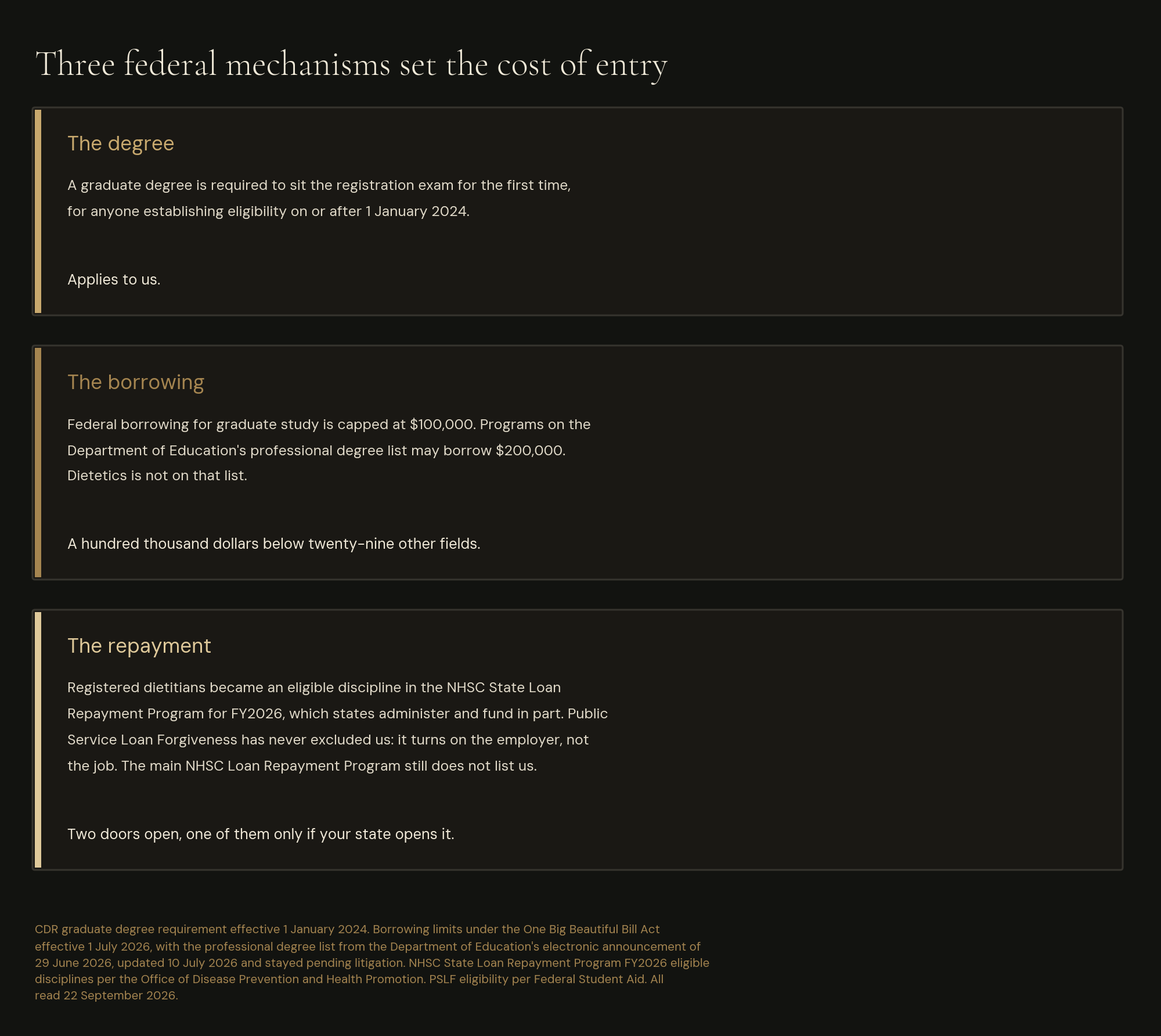
Since 1 January 2024, a first-time candidate needs a graduate degree to sit the registration exam.
From 1 July 2026, a graduate student may borrow at most $100,000 in federal loans for graduate study. Students in programs the Department of Education treats as professional degrees may borrow $200,000. Its list, widened after a court order in June 2026, names twenty-nine programs. Dietetics is not one of them. The court case is not settled.
The Bureau of Labor Statistics put the median wage for dietitians and nutritionists at $76,400 in May 2025. Borrowing to the cap is close to sixteen months of that pay, before interest.
In the 2026 funding round, registered dietitians became eligible for a loan repayment program that states run with federal matching money, for clinicians in high-need areas. A state may include dietitians. That does not mean any state has.
Public Service Loan Forgiveness turns on the employer, not the job, and has never excluded dietitians.
Summary added 2 October 2026.
There is a number that gets quoted whenever this profession talks about itself, and I went looking for where it comes from, and I could not find it.
That is the piece. I had planned a different one.
What I went looking for
The question is simple to ask. What does it cost to enter this profession? Not what does a semester cost at one school. What does the credential cost, on average, across the people who actually earn it.
I expected this to take an afternoon. Medicine has that number. Law has that number. Both professions publish it, argue about it, and organize around it.
I could not find ours.
What circulates instead is a range, and the range traces back to websites that sell advertising to degree programs. It does not trace back to the Commission on Dietetic Registration, which owns the credential. It does not trace back to ACEND, which accredits the programs. It does not trace back to any federal dataset I could locate. Individual universities publish their own tuition, and those figures are real. Loyola University Chicago lists its dietetics master's at $42,005, which is thirty-one credit hours at $1,355 a credit. Loyola attaches no academic year to that number and notes only that tuition is subject to change, which tells you something about how durable these figures are even at the institutions that set them. And one school is not a profession.
So I am not going to print a national figure, because I would be reprinting somebody's marketing estimate with my name on it, and this is the worst possible piece in which to do that.
The honest finding is that, as far as I could find, nobody is counting. That is not a rhetorical flourish. It is the answer to the question in the subtitle.
What is actually documented
Three things about the cost of entry are documented, and all three are federal.
The first is the requirement itself. Since 1 January 2024, the Commission on Dietetic Registration has required a graduate degree as the minimum to establish first-time eligibility for the registration examination. Anyone who established eligibility on or before 31 December 2023, and anyone already registered, is not required by CDR to go back and get one. The graduate degree does not have to be in nutrition. Any accredited master's or doctoral degree satisfies it, alongside ACEND-accredited coursework and a minimum of one thousand hours of supervised practice.
That is a real cost and a knowable one. A master's degree has a price. What I could not find published anywhere is what it adds up to across the field.
The second is how that degree can be financed, and this is where the number stops being about us and starts being about a list.
The list
The One Big Beautiful Bill Act eliminated the Grad PLUS loan and replaced open-ended graduate borrowing with caps, effective 1 July 2026. A graduate student may now borrow $20,500 a year and $100,000 in total across graduate study, on top of any undergraduate loans. A student in a program the Department of Education designates a professional degree may borrow $50,000 a year and $200,000 in total.
So the cost of entry is not only what the degree costs. It is also what the federal government will lend you to pay for it, and that turns on which list your program is on.
The Department published its definition in the RISE final rule on 1 May 2026, and the definition was narrow. Twenty-five states and the District of Columbia sued. Nurse practitioner and physician associate groups sued separately. On 24 June 2026 the United States District Court for the District of Columbia stayed part of the definition under section 705 of the Administrative Procedure Act, days before it would have taken effect.
The Department then published a longer list, in an electronic announcement dated 29 June 2026 and updated on 10 July, of programs that "will be treated as awarding professional degrees for the duration of the Court's stay." There are twenty-nine of them.
Veterinary medicine. Law. Divinity and ministry. Rabbinical studies. Clinical psychology, counseling psychology, school psychology, clinical child psychology, health and medical psychology, family psychology, forensic psychology, and a twelfth entry for clinical, counseling and applied psychology not otherwise specified. Chiropractic. Audiology. Speech-language pathology. Dentistry. Anesthesiologist assistant. Physician associate. Athletic training. Medicine. Osteopathic medicine. Podiatry. Optometry. Pharmacy. Occupational therapy. Physical therapy. Registered nursing. Nurse anesthetist. Nursing practice.
Dietetics is not on it. Neither is nutrition, under any spelling.
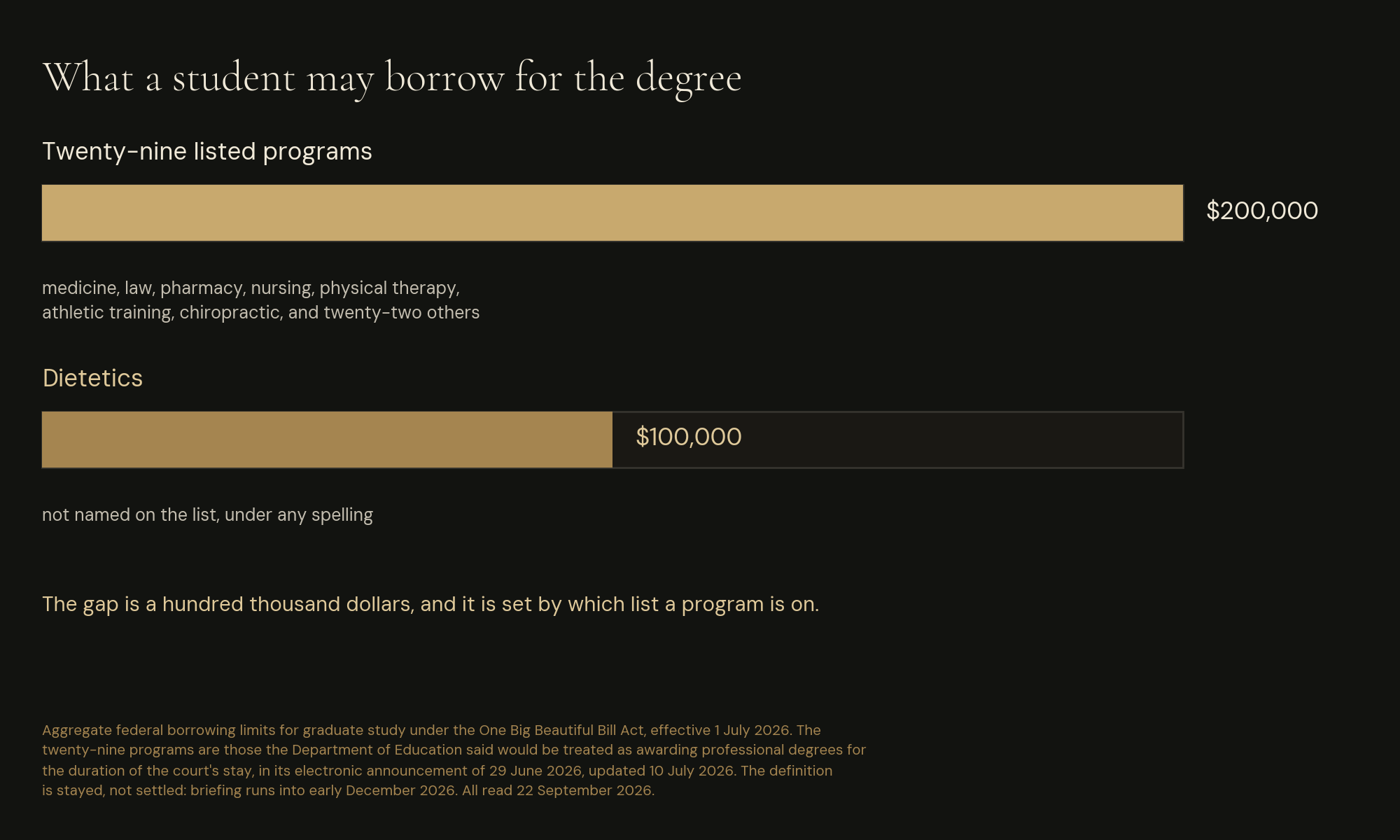
I want to be precise about what that does and does not mean, because it is easy to make this sound like a verdict on the profession and it is not one. The list is a financial aid category. It decides how much a student may borrow. It does not decide whether the work matters, and several of the fields on it fought their way on through exactly the process this series has been describing.
What it means concretely is a hundred thousand dollar difference in borrowing capacity across graduate study, between a student entering one of those twenty-nine fields and a student entering ours, for degrees that in several cases take comparable time.
It is worth holding our own cap against what the work pays. The Bureau of Labor Statistics counts about 86,300 dietitian and nutritionist jobs in 2025, and puts their median wage at $76,400 in May 2025. A student who borrows to the graduate ceiling takes on close to sixteen months of median gross pay in federal debt, before interest and before anything else they owe. I am not going to run the same comparison for the other twenty-nine, because those fields have their own wages and the honest version of that chart would need all of them.
What changed while I was not looking
Here is the part that made this an essay rather than a status update, and it is the one piece of good news in it.
Registered dietitians are now an eligible discipline in the National Health Service Corps State Loan Repayment Program. The federal Office of Disease Prevention and Health Promotion states it plainly: "In the FY 2026 NHSC SLRP competition, registered dietitians have been included as an eligible discipline." The program provides federal and state matching funds for loan repayment to clinicians who commit to service in high-need areas. The federal maximum is up to $50,000 for a two-year full-time commitment, or up to $25,000 for half-time. Primary care physicians, nurse practitioners, certified nurse midwives and physician assistants sit in a higher tier at up to $75,000. We are in the general one.
I would ask you not to let anyone oversell this, including me.
The State Loan Repayment Program is not the main National Health Service Corps loan repayment program, and registered dietitians are not, as far as I can establish, an eligible discipline in that one. SLRP is a matching program that states administer. Federal eligibility means a state may include dietitians. It does not mean any particular state has, or will, or has money to. Whether this reaches a single dietitian in a given state depends on that state's own program and its own budget.
So it is a door that opened, not a room anybody is standing in yet. It is still the first genuinely good federal development this series has been able to report, and it arrived without anybody I know noticing.
There is also one federal program that never excluded us, and I should say so in a piece that spends this long on exclusion. Public Service Loan Forgiveness turns on where you work rather than what you are. Federal Student Aid puts it in those words: eligibility "is based on your employer, not your job." A dietitian working full time for a government agency or a qualifying nonprofit, making a hundred and twenty qualifying payments on Direct Loans, is eligible on the same terms as the physician down the hall. Full time means an average of thirty hours a week for this purpose, whatever the employer calls it.
What this cannot tell you
The list is stayed, not settled. The briefing schedule in the litigation runs into early December 2026, which means the twenty-nine-program list stands for now and the question of what the definition finally says is open past the end of this year. Anything I write about it today has a shelf life measured in weeks.
I also cannot tell you what any of this has done to enrollment, because the timing does not allow it. Enrollment in dietetics programs fell about forty-two percent between 2014 and 2024, from 24,423 to 14,170, which I reported in August. That decline is older than the borrowing caps and cannot be blamed on them. Whether the caps accelerate it is a question the data cannot answer for another two admissions cycles, and I would be inventing a finding if I claimed otherwise now.
And I cannot tell you the thing I set out to tell you, which is what the credential costs. I can tell you that the degree is required, that the borrowing is capped lower for us than for twenty-nine other fields, and that the profession does not appear to have measured its own cost of entry in any form that can be audited.
What would change the answer
One study. Someone with access to the CDR registry and a survey instrument could establish what the credential actually costs the people who earn it, with a stated method and a stated sample, and publish it. It would take a year and it would end the guessing permanently.
Until that exists, every argument this profession makes about its own cost of entry rests on a number from a marketing page that does not show its method. That is a bad foundation for an argument we are going to keep having.
Where this leaves the series
This is No. 8 of On the Record, and it is running out of order. When I announced the series I would not promise it a date, because it only ran if it turned out to be a new argument rather than a repeat of what I published in August. It did, and a piece about a partly stayed rule with a shelf life measured in weeks cannot wait for the end of the series. Nos. 3 through 7 run from October to December as announced.
The series set out to document, in public and against primary sources, how the value of this profession gets set and by whom, and to say plainly where the record stops. On the cost of entry it stops harder than anywhere else. The thing I cannot source is the price of the door.
A note on who pays for this
No outside institution does. Paid subscriptions help fund it. There is no grant behind this work and no outside organization underwriting the time or the document retrieval. That is why every figure in this series carries the date it was pulled and the place it came from, and why the one figure that could not be sourced is missing from this piece instead of estimated into it.
Correction, 1 October 2026. An earlier version of this piece said the Bureau of Labor Statistics counted 86,300 dietitians and nutritionists in May 2025. The 86,300 is the Bureau's count of jobs in 2025, from its Occupational Outlook Handbook, not a May 2025 figure. Its May 2025 wage survey, the source of the $76,400 median, counted 77,570 jobs. It was my error. The comparison with the borrowing cap does not change. The note at the end also said that nobody pays for this work. Paid subscriptions help fund it, and the note now says so.
Updated 2 October 2026: the federal borrowing cap is now described as a total across all graduate study, in the text, the summary and both charts. One sentence about where a circulating cost figure came from now says only what I can show. None of this changes the argument.
General education, not individual medical or financial advice.
This article is general nutrition education, not individualized medical or nutrition advice, and it does not create a dietitian–client relationship. Medications and their side effects should be managed with your prescribing clinician. See the full disclaimer.