Summary
Most people starting chemotherapy are told it attacks cells that divide quickly, which is why hair, the gut lining and the bone marrow take damage. That is true but incomplete. A 2025 review argues that side effects run through several different processes. Knowing which one is behind a symptom changes what helps.
- Nausea is driven in large part by serotonin, a chemical signal, which is why the anti-nausea drugs block one of its receptors. When you take them relative to the infusion matters a great deal.
- Mouth sores involve inflammation. Fatigue is partly a problem of how cells make energy, though that link is still argued. Appetite is partly turned down in the brain. So “just eat more” and “push through it” are poor advice. Smaller, higher-calorie meals on a schedule, and pacing, tend to help.
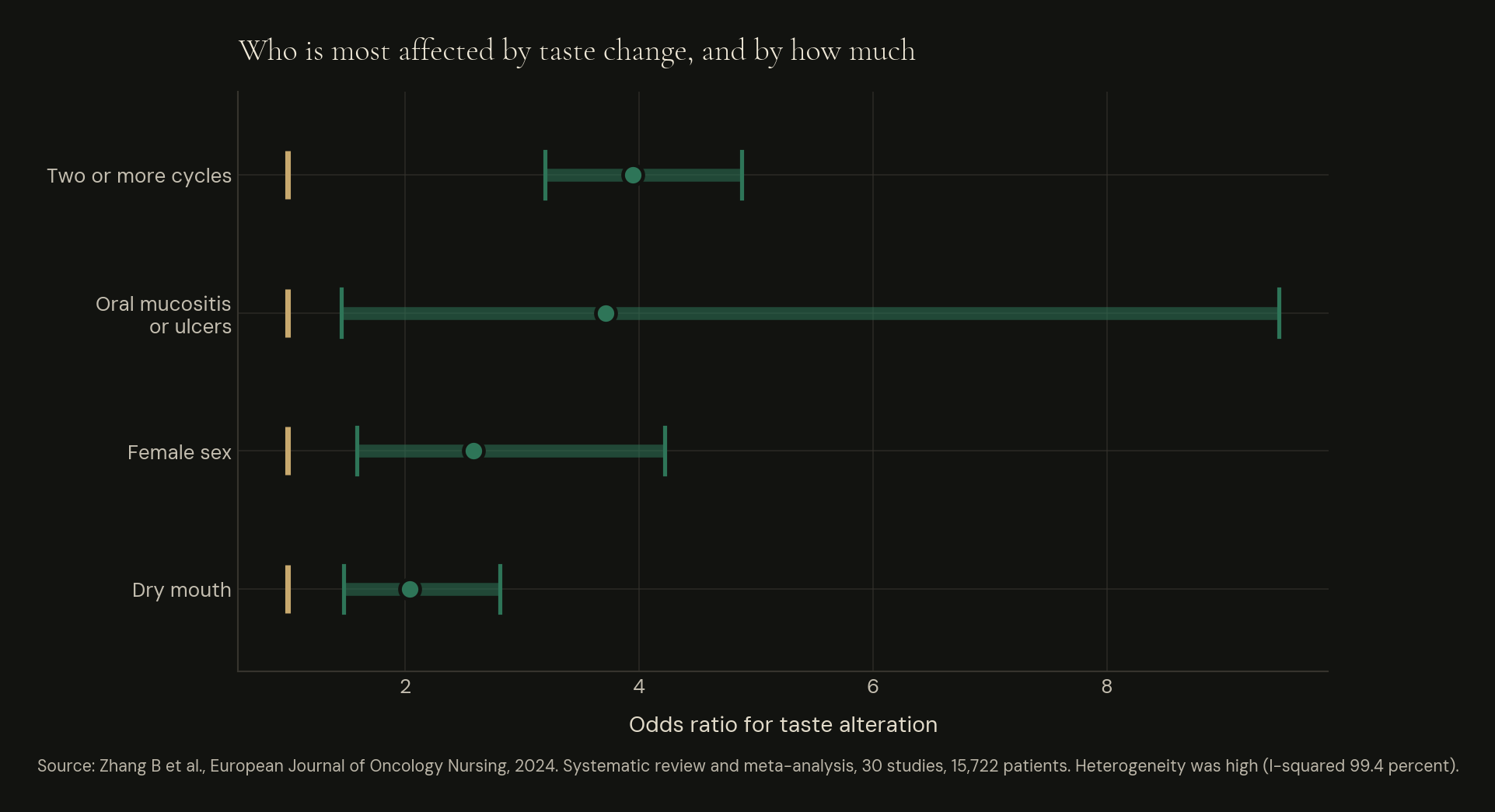
- Taste changes get the least attention for how common they are. A 2024 review of 30 studies and 15,722 patients put the share at 70 percent, but the studies disagreed widely, so read that as “very common.” The odds were higher for women, people with dry mouth or mouth sores, and after two or more cycles.
- A 2023 review of taste changes in breast cancer noted that clinicians usually underestimate them, while patients find them very worrying.
- Side effects vary by drug. Ask your oncology team which ones your regimen is known for, and tell them if your taste changes. This is education, not medical advice.
Summary added 2 October 2026.
Almost everyone starting treatment gets the same explanation, usually in about fifteen seconds: chemotherapy attacks cells that divide quickly, cancer cells divide quickly, and unfortunately so do the cells in your hair, your gut lining and your bone marrow. That is why you lose your hair, get mouth sores, and have your blood counts checked.
That explanation is not wrong. It is also not the whole thing, and the missing part is the part that changes what you should actually do.
Because if the story really were only about fast-dividing cells, then every side effect would be a version of the same problem, and the only response would be to endure it. That is roughly what most people are told, in slightly kinder words.
The actual picture is more specific. And specificity is useful, because a mechanism you can name is a mechanism somebody can sometimes interrupt.
The explanation you were given, and where it holds
Start with what is true.
Conventional chemotherapy uses cytotoxic drugs that stop tumor growth by targeting rapidly dividing cells (Brianna, Medical Oncology, 2023). These drugs are not selective in the way a modern targeted therapy tries to be. They act on the machinery of cell division itself, and the normal tissues that divide fastest take collateral damage: the lining of the digestive tract, the bone marrow, the hair follicles. That is the classic triad of mucositis, myelosuppression and alopecia (Alam, 2018).
So the fifteen-second version earns its place. If you remember only that, you can predict most of the trouble in advance, which is genuinely worth something.
But hold the question the explanation cannot answer. If it is all one mechanism, why does one drug wreck your mouth and another mostly makes you tired? Why does nausea respond to a specific class of drug rather than to anything that settles a stomach? Why do some people lose their appetite even on days they do not feel sick?
What is actually happening
A 2025 review argues, and I think correctly, that these toxicities are driven by molecular and cellular mechanisms extending well beyond direct killing of dividing cells (Martin, Bulletin of Stomatology and Maxillofacial Surgery, 2025). Inflammatory cytokine cascades. Oxidative stress. Neurotransmitter imbalance. Mitochondrial dysfunction. Disruption of the epithelial barrier.
Taken one at a time, the specifics are strikingly different from each other.
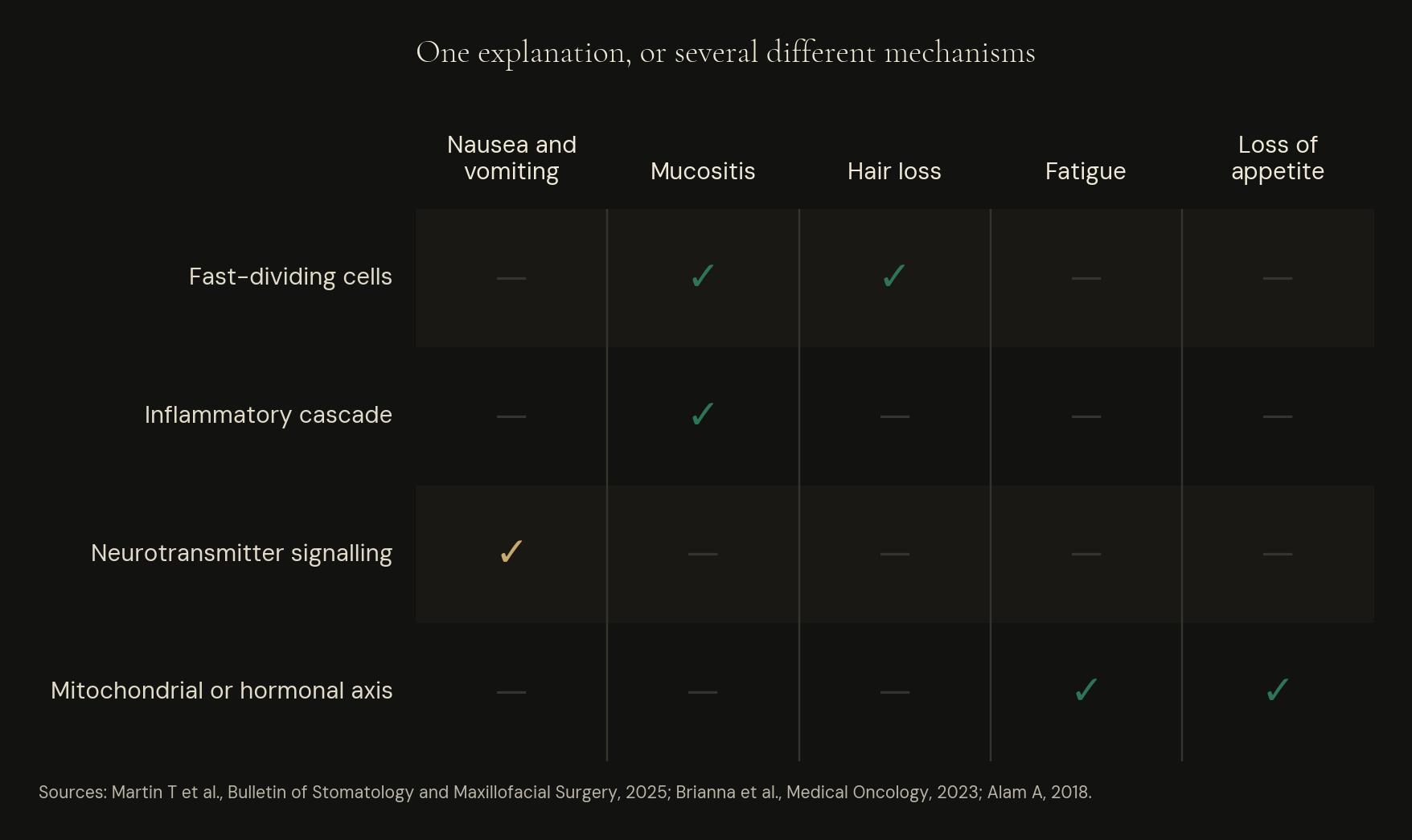
Nausea and vomiting are driven substantially by serotonin release and activation of 5-HT3 receptors. That is not a stomach problem in the way most people picture it. It is a signalling problem, and it is precisely why the anti-nausea drugs you get are 5-HT3 receptor antagonists rather than antacids. Somebody worked out the mechanism, and the drug class followed from it.
Mucositis arises from reactive oxygen species driving NF-kappa-B activation and apoptosis in the epithelium. So the mouth sores are not simply the consequence of cells failing to replace themselves fast enough. There is an inflammatory cascade running.
Diarrhea, at least with irinotecan, traces to enterocyte damage from its active metabolite SN-38, together with disruption of the tight junctions between gut cells and shifts in the microbiome. Three distinct problems, one symptom.
Hair loss comes from p53-mediated apoptosis in hair follicle keratinocytes. The follicle cells are not merely caught in the crossfire of cell division; a specific cell-death program is being switched on in them.
Fatigue is attributed to altered signalling in the hypothalamic-pituitary-adrenal axis and to mitochondrial energy deficits. This is the one I most want people to sit with. Treatment fatigue is not ordinary tiredness scaled up, and it does not answer to rest the way ordinary tiredness does, because at least part of it is a problem of energy production rather than energy expenditure.
Loss of appetite involves dysregulation at the hypothalamus. Appetite is being turned down centrally. It is not only that food tastes bad or that you feel sick, although both of those are also happening.
Why this is not an academic distinction
Look at what changes once you know the mechanism.
If anorexia during treatment is partly hypothalamic, then “you just have to eat more” is not encouragement. It is an instruction to override a signal that is being suppressed upstream, by willpower, which is not how that signal works. The useful responses are different: smaller volumes, higher energy density, eating on a schedule rather than on appetite, and not treating a missed meal as a personal failure.
If fatigue is partly mitochondrial and partly HPA-axis, then “push through it” is bad advice and so is “just rest.” What tends to help is pacing, and protecting the hours when energy is actually available for the things that matter.
If nausea is serotonergic, then the timing of anti-nausea medication relative to infusion matters a great deal, and taking it only once you already feel sick is giving up ground you cannot easily recover.
And if mucositis is an inflammatory cascade rather than a slow failure of cell replacement, then it has a predictable time course you can plan food around instead of being surprised by.
None of this makes the side effects optional. Some are genuinely unavoidable, and the honest reviews say so plainly (Brianna, Medical Oncology, 2023). But there is a real difference between a symptom you endure blindly and one you can anticipate, time, and work around.
The one almost nobody warns you about
Here is the side effect that gets least attention relative to how common it is.
A 2024 systematic review and meta-analysis of 30 studies and 15,722 patients found the pooled prevalence of chemotherapy-induced taste alteration was 70.0 percent (95% CI 59.1 to 79.9), with individual studies ranging from 21 to 100 percent (Zhang, European Journal of Oncology Nursing, 2024).
Seven in ten. And the same analysis identified who is most affected: women (odds ratio 2.59, 95% CI 1.59 to 4.22), people with dry mouth (2.04, 1.48 to 2.81), people with oral mucositis or ulcers (3.72, 1.46 to 9.47), and anyone who has had two or more cycles (3.95, 3.20 to 4.88).
That last one matters for expectations. Taste change is not a first-cycle surprise that settles. It gets more likely as treatment goes on.
Now the part that should be uncomfortable for my own profession. A 2023 review of taste changes in breast cancer noted that dysgeusia is usually underestimated by clinicians while patients find it very worrying and disturbing, because it changes what they can eat and how they eat with other people, with a real effect on quality of life (Pellegrini, Nutrients, 2023). The same review found the literature scarce, methodologically limited, and too heterogeneous to produce firm clinical recommendations.
So: a symptom affecting roughly seven in ten patients, which the 2024 meta-analysis calls a significant predictor of malnutrition and poor prognosis, that clinicians usually underestimate and researchers have not studied well enough to give clear guidance on. That gap is not a small thing, and I will give it its own article later in this series.
What this evidence cannot tell us
The mechanisms above come from reviews synthesizing laboratory and clinical work, and reviews smooth over disagreement. The confidence attached to each pathway is not equal: the serotonin story behind nausea is very well established, since an entire drug class was built on it, while the mitochondrial contribution to fatigue is a more active area of argument.
These mechanisms also vary by drug. “Chemotherapy” is not one thing. What I have described is a general picture, and your specific regimen has its own profile, which your team can tell you and I cannot.
And knowing a mechanism does not automatically produce a treatment. Understanding that hair loss runs through p53-mediated apoptosis has not yet given us a reliable way to prevent it.
The taste-alteration numbers deserve their own caution. That meta-analysis had an I-squared of 99.4 percent, which is about as heterogeneous as pooled data gets. The 70 percent figure is best read as “very common, and studies disagree substantially about how common,” not as a precise estimate.
What I would take from this
Ask your team which side effects your specific regimen is known for, rather than which ones chemotherapy in general causes. The answer is more useful and it is usually available.
Ask about timing. For several of these, when you act matters more than what you take.
And if your taste changes, say so. It is not a trivial complaint, it is not vanity, and given a 70 percent prevalence rate it is very unlikely to be just you. It is also one of the few things where practical adjustments help quickly.
This is education, not medical advice. Your regimen, your side effects and your plan belong to you and your oncology team. If something is urgent, call them. In an emergency, call 911.
Next Wednesday: apricot seeds, laetrile, and the compound sold for decades as the gentle alternative.
---
*I wrote two books on nutrition during cancer treatment before I wrote any of these articles, one for patients and one for caregivers, in English and in Spanish.*
Updated 2 October 2026: one sentence about taste changes now uses the more cautious words of the two studies it cites. None of this changes the argument.
References
Brianna, Lee SH. Chemotherapy: how to reduce its adverse effects while maintaining the potency? Medical Oncology. 2023;40(3):88. https://doi.org/10.1007/s12032-023-01954-6
Martin T, Khalid J, Kumar M. The Global Challenge of Chemotherapy Toxicity: Rethinking Supportive Care in Modern Oncology. Bulletin of Stomatology and Maxillofacial Surgery. 2025;21(8):268-280. https://doi.org/10.58240/1829006x-2025.21.8-268
Alam A. Chemotherapy Treatment and Strategy Schemes: A Review. Open Access Journal of Toxicology. 2018;2(5):555600. https://doi.org/10.19080/oajt.2018.02.555600
Zhang B, Zhang N, Zhang Y, et al. Prevalence and risk factors of chemotherapy-induced taste alterations among cancer patients: A systematic review and meta-analysis. European Journal of Oncology Nursing. 2024;74:102735. https://doi.org/10.1016/j.ejon.2024.102735
Pellegrini M, Merlo FD, Agnello E, et al. Dysgeusia in Patients with Breast Cancer Treated with Chemotherapy: A Narrative Review. Nutrients. 2023;15(1):226. https://doi.org/10.3390/nu15010226
Vitae Arete provides nutrition education and does not diagnose, treat, or manage cancer, nor prescribe or manage medication. This article is general information, not individualized medical or nutrition advice, and does not create a dietitian–client relationship. See the full disclaimer.