Summary
I read the record on who can stop a compounded copy of a GLP-1 drug, and what the Food and Drug Administration has done. Nothing here says a law was broken.
A single-patient pharmacy may make what would otherwise be a copy when a prescriber notes a significant difference for that patient. In September 2026 the agency told a Houston pharmacy that some such notes on orders it filled appeared repeated word for word. That is the agency’s account, not a court’s finding. If you take a compounded GLP-1, do not stop or change it because of anything here without talking to your prescriber.
The agency’s database lists 113 warning letters it labels as telehealth cases since September 2025. Its manual calls a warning letter “informal and advisory.” On October 6, 2026, none had a posted reply or closing letter. Under its manual, the agency posts a reply when the company asks.
A federal cap on shipping these drugs across state lines became law in 1997. The agency has not begun enforcing it. After a 2021 court ruling it chose to write a rule first, and that rule’s target date has moved later six times since 2022. Its page still calls putting the cap in place “an important public health priority.” When I searched the Federal Register on October 14, 2026, I found no proposed rule.
In one Houston pharmacy’s records, the federal government says, the sentence that was supposed to be about a patient’s body may have come from a menu.
That is my plain-English version of what the Food and Drug Administration wrote. In September 2026 the agency sent a warning letter to a pharmacy in Houston. Some prescriber notes on orders it filled, the agency said, appeared to be repeated word for word. The letter says they may have been “pre-generated for selection by the prescriber.” Personalized medicine, in the FDA’s account, may have shipped with a copy and paste function. That is the agency’s account, not a court’s finding.
It sounds like paperwork. It is paperwork, the way a parachute is fabric. A compounded drug is prepared by a pharmacy or a similar facility, and it is not approved by the FDA. For a pharmacy that compounds for one patient at a time, what often matters is a note on the prescription. In it, the prescriber says why this patient needs something other than the brand. Whether a compounded GLP-1 counts as a copy of a brand-name drug such as Wegovy or Zepbound can come down to that note.
So if you take a compounded GLP-1, the legal reason your pharmacy may make it can rest on one sentence you have probably never read. You can ask whether your prescriber recorded such a reason. Do not stop or change it because of anything here without talking to your prescriber.
This piece asks who can stop a compounded copy, and what each of them has done so far. I take the FDA, the Justice Department, the states, the Federal Trade Commission (FTC) and the drugmakers in turn, in their own documents. I do not claim that any company named here broke a law. A warning letter is an agency’s account, and I say so each time.
Here is my read, so you know where I land before the evidence. The FDA describes much of its enforcement here in the future tense: it intends, it plans, it will. On the shipping cap, it has talked that way since at least 2020, about a limit Congress wrote in 1997. On the question of copies, the document that can decide the answer is the note on a patient’s prescription. The FDA’s plan for checking that note sits in a guidance that calls itself a recommendation on every page of its text. Federal enforcement in this market is, for long stretches, a grammar lesson. The people at the other end of that grammar are injecting what arrives in the mail, and the FDA’s own patient page tells them to check whether it arrived warm.
One line on a prescription can carry the copy question, and the FDA’s check on it is a recommendation
Congress let the prescriber make the call. In 2018 the FDA said, in writing, that it generally would not second-guess the call.
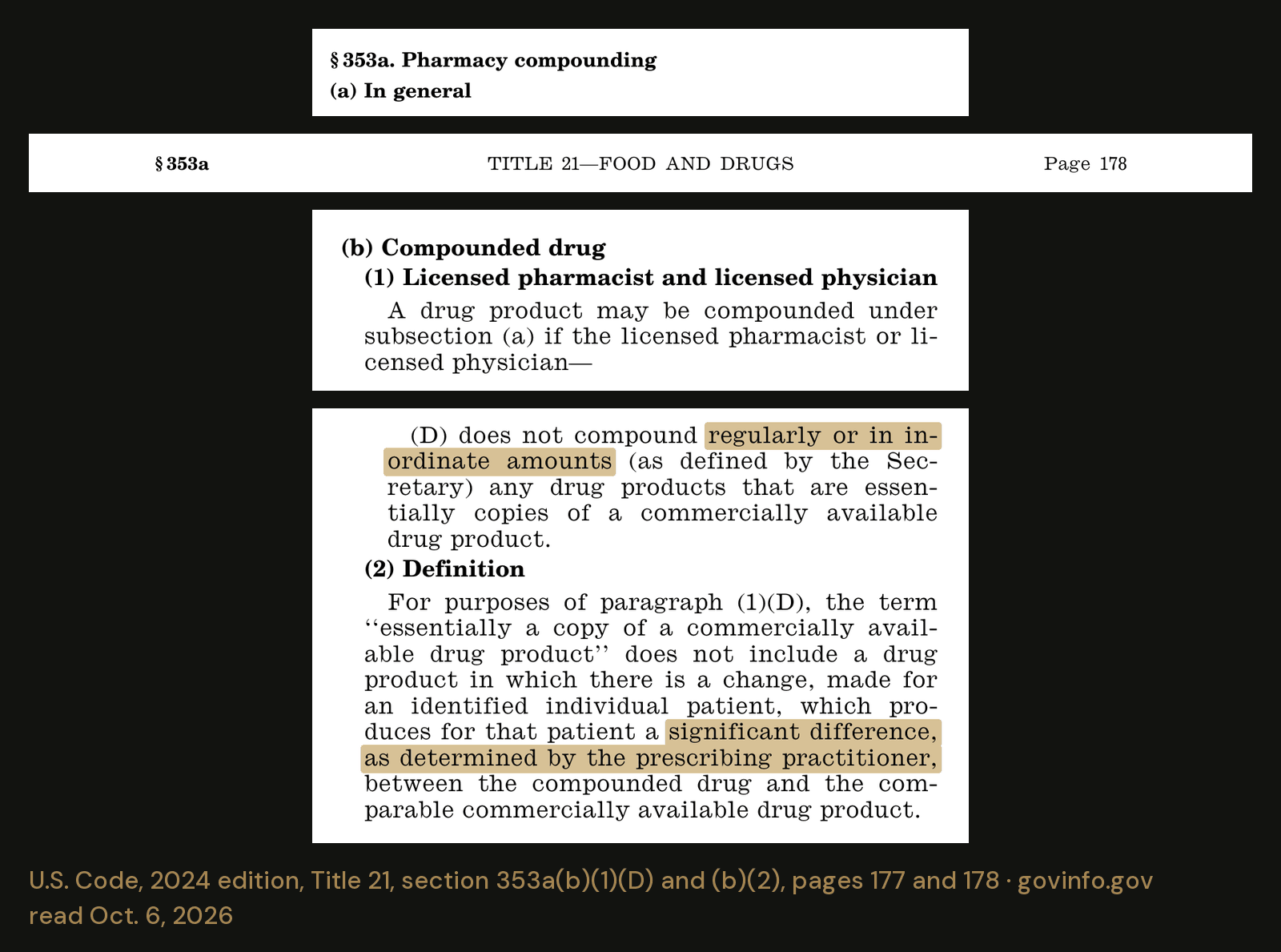
Start with the law. Section 503A of the federal drug law is the law for pharmacies that compound for one patient at a time. It exempts a compounded drug from FDA approval and some other federal rules when a pharmacy makes it for an identified patient on a valid prescription. It also sets conditions. One matters most here. To keep the exemption, a pharmacy may not compound “regularly or in inordinate amounts” any drug that is “essentially a copy” of one already on the market. Wegovy and Zepbound are on the market.
Then comes the escape hatch. A drug is not a copy if a change “made for an identified individual patient” produces “a significant difference, as determined by the prescribing practitioner.” In practice, that determination is written on the prescription. One line on a prescription can carry the copy question. It is the most important sentence in this whole story, and you may never have seen yours.
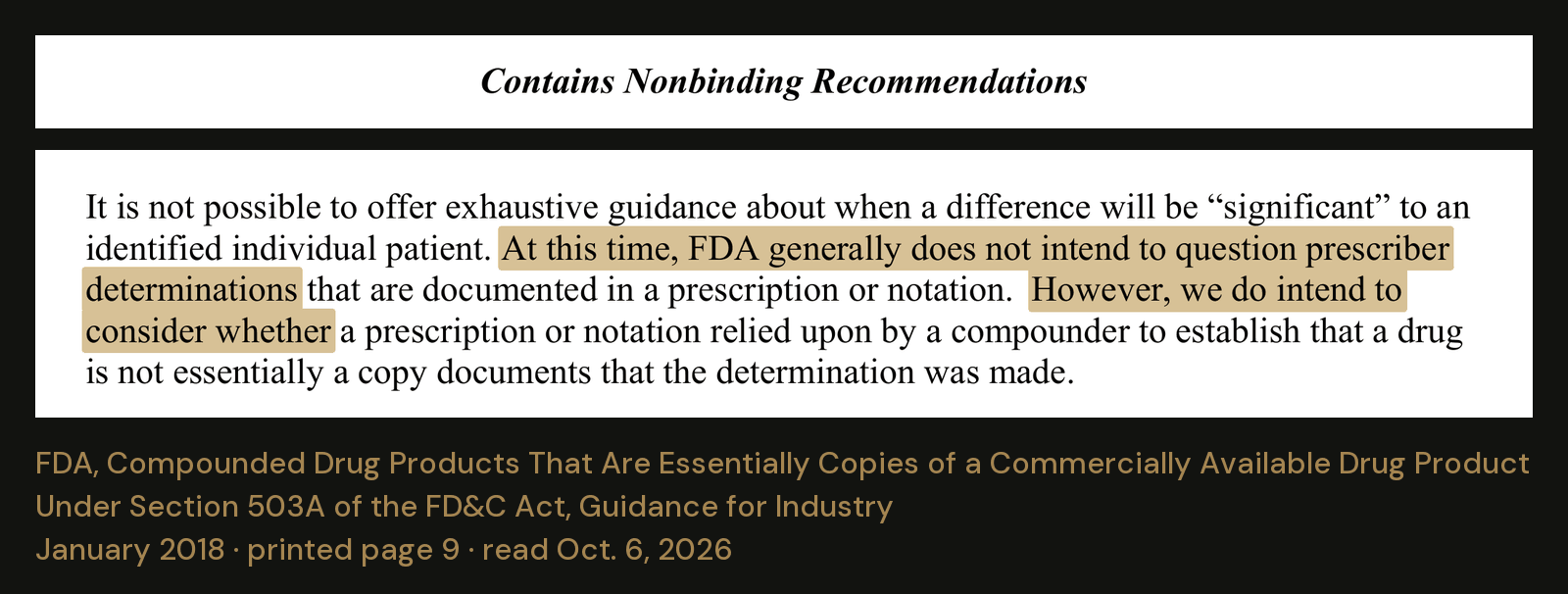
The FDA’s guidance on this, from January 2018, says the prescriber’s determination should be documented on the prescription. A lower price is not enough. The guidance calls itself nonbinding: each page of its text is headed “Contains Nonbinding Recommendations.” That header is the federal cousin of the TPS report cover sheet in Office Space (1999): everyone insists on it, and it changes nothing about the work. The FDA also says it does not intend to act against a pharmacy that fills four or fewer prescriptions for a copy in a calendar month, counting each refill. Four copies a month is, in effect, the federal free sample. On the note itself, it says this:
“At this time, FDA generally does not intend to question prescriber determinations that are documented in a prescription or notation. However, we do intend to consider whether a prescription or notation relied upon by a compounder to establish that a drug is not essentially a copy documents that the determination was made.”
Read the second sentence twice. The FDA intends to look for the note. It generally does not intend to question the judgment in it.
The members of Congress who wrote the final bill in 1997 saw this coming from both sides. Their example of a significant difference was removing a dye for a patient allergic to it. That is a real difference for a real body. They expected FDA and the courts to give “great deference” to the prescriber’s judgment. But where it is “readily apparent” that a difference is “a mere pretext” for copying, they wrote, the exemption would not cover copies made regularly or in inordinate amounts.
In April 2026 the FDA added a GLP-1 example. A product that combines semaglutide with vitamin B12 may still be a copy, the agency said. That holds when it is given the same way as the marketed drugs, and each ingredient is within 10 percent of the strength of its own marketed product. An added vitamin may not be enough. That is a fair extension of the dye example, and it is still not a rule.
The FDA had already raised a harder point about those add-ins. An agency alert on dosing errors, current as of July 26, 2024, notes that some compounders add vitamin B12, vitamin B6, L-carnitine or NAD to semaglutide. Its footnote says: “The safety and effectiveness of combining semaglutide with other ingredients has not been established.” So an added vitamin may not be enough to make a product legally different, and, by the FDA’s own footnote, the combination’s safety and effectiveness have not been established. Where an add-in is a fig leaf, it may not cover the copy question, and the FDA has not vouched for the fabric.
My practice, Vitae Arete, offers GLP-1 nutrition care, does not prescribe or dispense GLP-1s and, as of October 15, 2026, has sold no guides.
The FDA says some notes a Houston pharmacy received appeared repeated word for word
The letter is dated September 18, 2026. The FDA addressed it to Empower Clinic Services, LLC, which does business as Empower Pharmacy, in Houston, and posted it on September 22, 2026. FDA investigators had inspected the pharmacy from November 3 to 14, 2025. The letter treats the pharmacy under section 503A, the single-patient law. Outsourcing facilities, the other kind of compounder, register with the FDA and can make drugs in bulk. The FDA’s register of them, updated September 30, 2026, also lists two facilities under the Empower name, in Houston and New Jersey. This letter is about the 503A pharmacy, not those registered facilities.
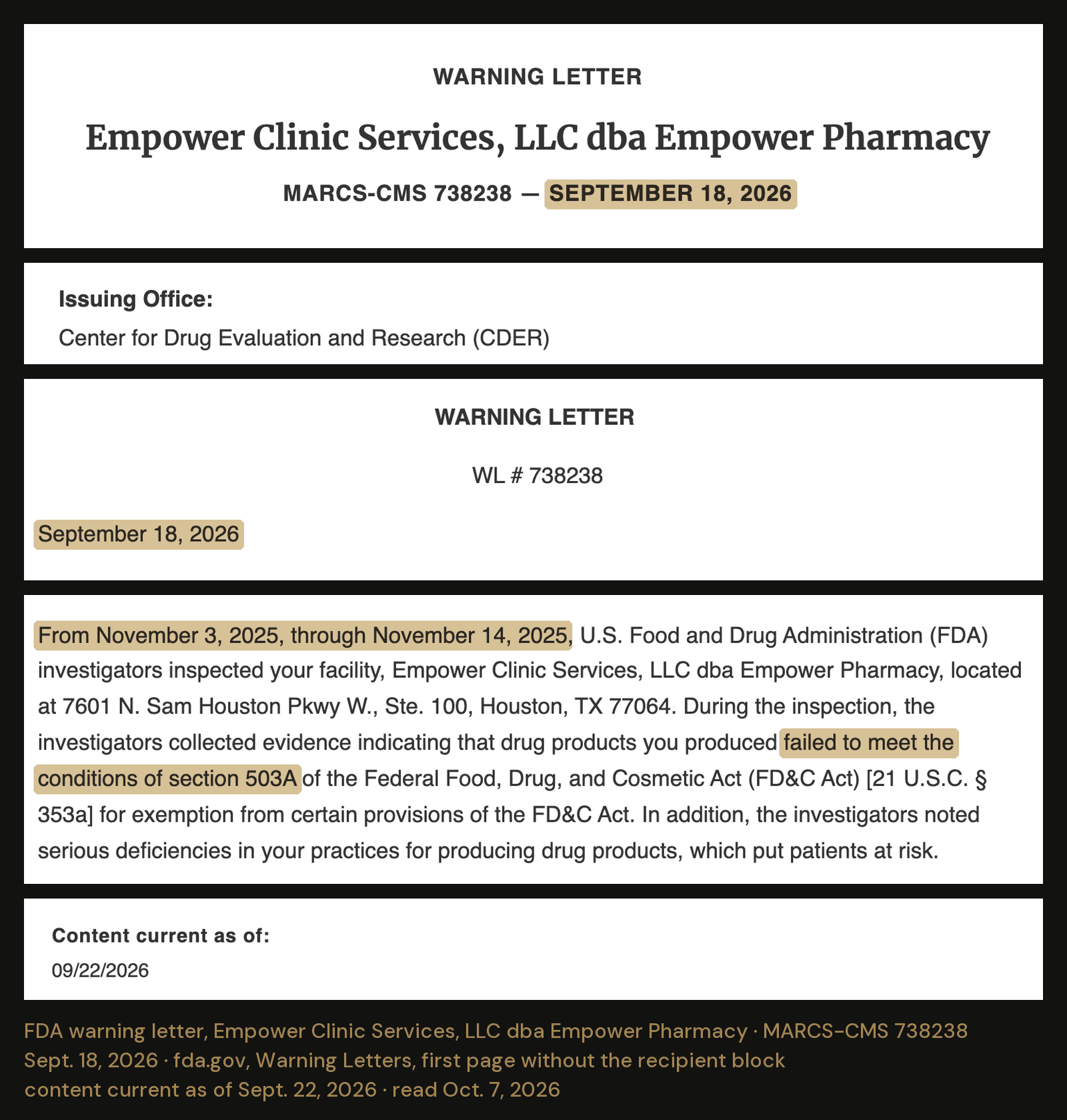
Three products are named. In two, tirzepatide is combined with niacinamide, a form of vitamin B3. In the third, semaglutide is combined with cyanocobalamin, which is vitamin B12. In the FDA’s words, they “appear to be essentially copies” of approved semaglutide and tirzepatide products. It said the volume the pharmacy produced “suggests that differences between products you are compounding and the FDA-approved products are pretextual.” The monthly order counts are redacted, so I cannot give you the volume.
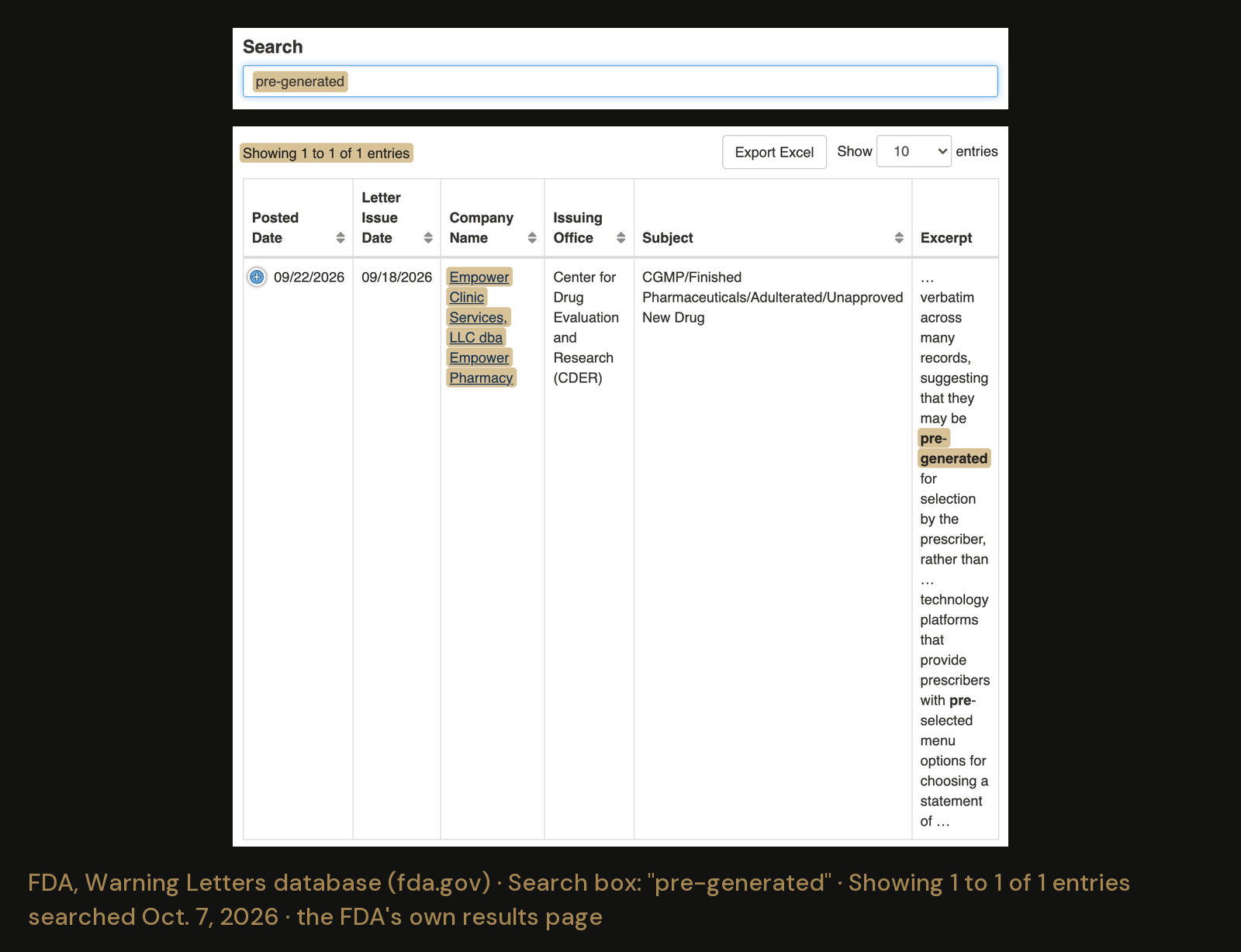
Then the letter turns to the paperwork, and the temperature drops. Its evidence, the FDA said, included orders with no note of a significant difference at all. It also included notes “that appear to be repeated verbatim across many records, suggesting that they may be pre-generated for selection by the prescriber, rather than written by the prescriber for an identified individual patient.”
The one sentence on an order that is supposed to be about a single patient may, in the agency’s account, have been the same sentence for many. It is the Agent Smith problem from The Matrix Reloaded (2003): a crowd of identical men in identical suits, each one filed as an individual.
The letter offers one way that can happen. It describes “third-party technology platforms that provide prescribers with pre-selected menu options for choosing a statement of significant difference.” Tools like that, the FDA said, “call the individualized nature of those determinations into question.” The letter does not name a platform. It names no prescriber and no telehealth company whose orders it describes. Nothing in this piece, or in this series, says which company’s prescriptions the FDA meant.
Put that beside the history. In 1997, Congress’s example of a significant difference was a dye taken out for an allergic patient. In 2026, the FDA is describing menu options. In 2018 it said it generally would not question these notes. That is a hell of a promise to have made about a sentence that, in its own account, may come from a menu.
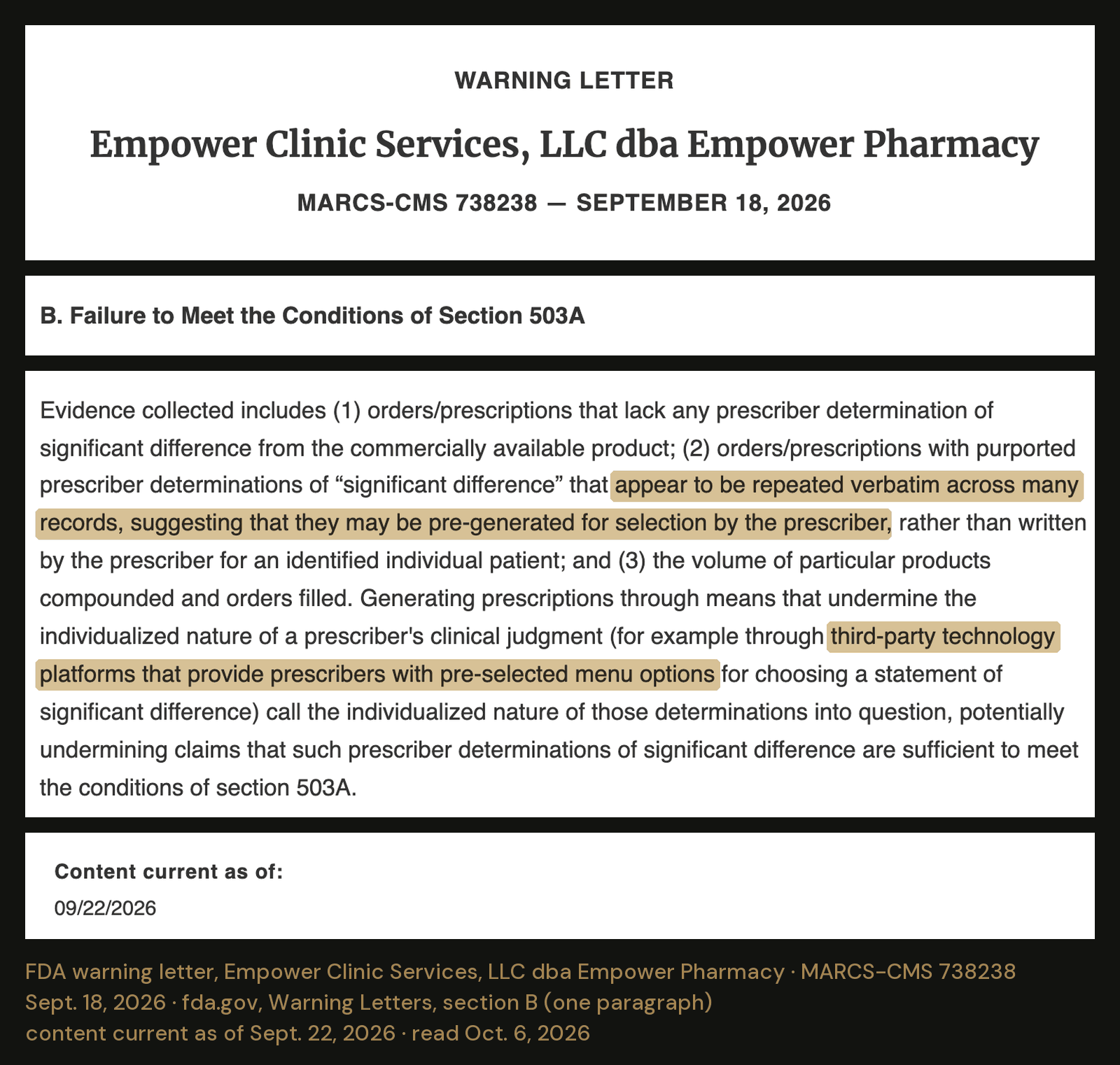
The letter goes past paperwork. It describes what the FDA called insanitary conditions for sterile products, and lapses in manufacturing practice. Some of the pharmacy’s corrections “appear adequate,” it says, and others “appear deficient.” It acknowledges three written responses sent before the letter. It asks for an answer within fifteen working days and warns that “seizure and injunction” may follow without further notice. All of this is the FDA’s account, not a court’s finding. The pharmacy can answer it or dispute it. I asked it for comment.
The FDA’s database also lists earlier warning letters to Empower facilities in Houston, dated October 15, 2021, and April 2, 2025. None names a GLP-1 drug. On October 6, 2026, the database showed no close-out letter posted for any of them. That does not show whether Empower answered them. The FDA sends a close-out letter only after it has verified a company’s corrections, its procedures manual says. Eli Lilly’s July 2025 suit alleges unfair competition and deceptive trade practices in Empower’s sale and marketing of its tirzepatide products. In April 2026 the judge dismissed Lilly’s federal false advertising claims and its Texas claims. Lilly’s claims under eight other states’ laws went on. As I read the court’s docket on October 6, 2026, the case was still open.
The FDA has announced decisive steps twice, and called its past ad enforcement lax
In September 2025 the FDA put its own history on trial, in a press release. “Despite widespread violations, the FDA has been increasingly lax and reactive in its enforcement approach over the last few decades,” its September 9, 2025, release on drug advertising says. By the release’s own count, the number of warning letters sent to pharmaceutical companies “dropped to one in 2023 and zero in 2024.” Then it promised a new posture: “Going forward, the agency will aggressively deploy its available enforcement tools.” Rare is the agency that writes its own bad performance review. Rarer still is the one that then promises to do better next quarter.
The commissioner, Martin A. Makary, said in that release: “For far too long, the FDA has permitted misleading drug advertisements.” The Secretary of Health and Human Services, Robert F. Kennedy Jr., spoke in it too. “We will shut down that pipeline of deception and require drug companies to disclose all critical safety facts in their advertising,” he said. That release was about drug advertising in general, not only these sellers. The FDA later tied its telehealth letters to that crackdown, in its own words, as you will see below.
The same day, the president signed a memorandum. It orders that the Commissioner of Food and Drugs “shall take appropriate action to enforce” the drug law’s prescription drug advertising provisions. The memo ends the way such memos routinely end. It “is not intended to, and does not, create any right or benefit, substantive or procedural, enforceable at law or in equity by any party against the United States.” An order to enforce, closing with a line that says no one can hold the government to it. That is boilerplate.
Four days earlier, on September 5, 2025, the FDA had launched a “green list” for imported GLP-1 ingredients. “This is part of the agency’s decisive steps to safeguard consumers,” that release said.
Then, on February 6, 2026, the FDA announced its intent “to take decisive steps to restrict GLP-1 active pharmaceutical ingredients” meant for compounded drugs “being mass-marketed by companies.” The statement came from Martin A. Makary, then the Commissioner of Food and Drugs. It named Hims & Hers among those companies. It warned companies in this market that if they did not adequately address any violations, “seizure and injunction” could follow.
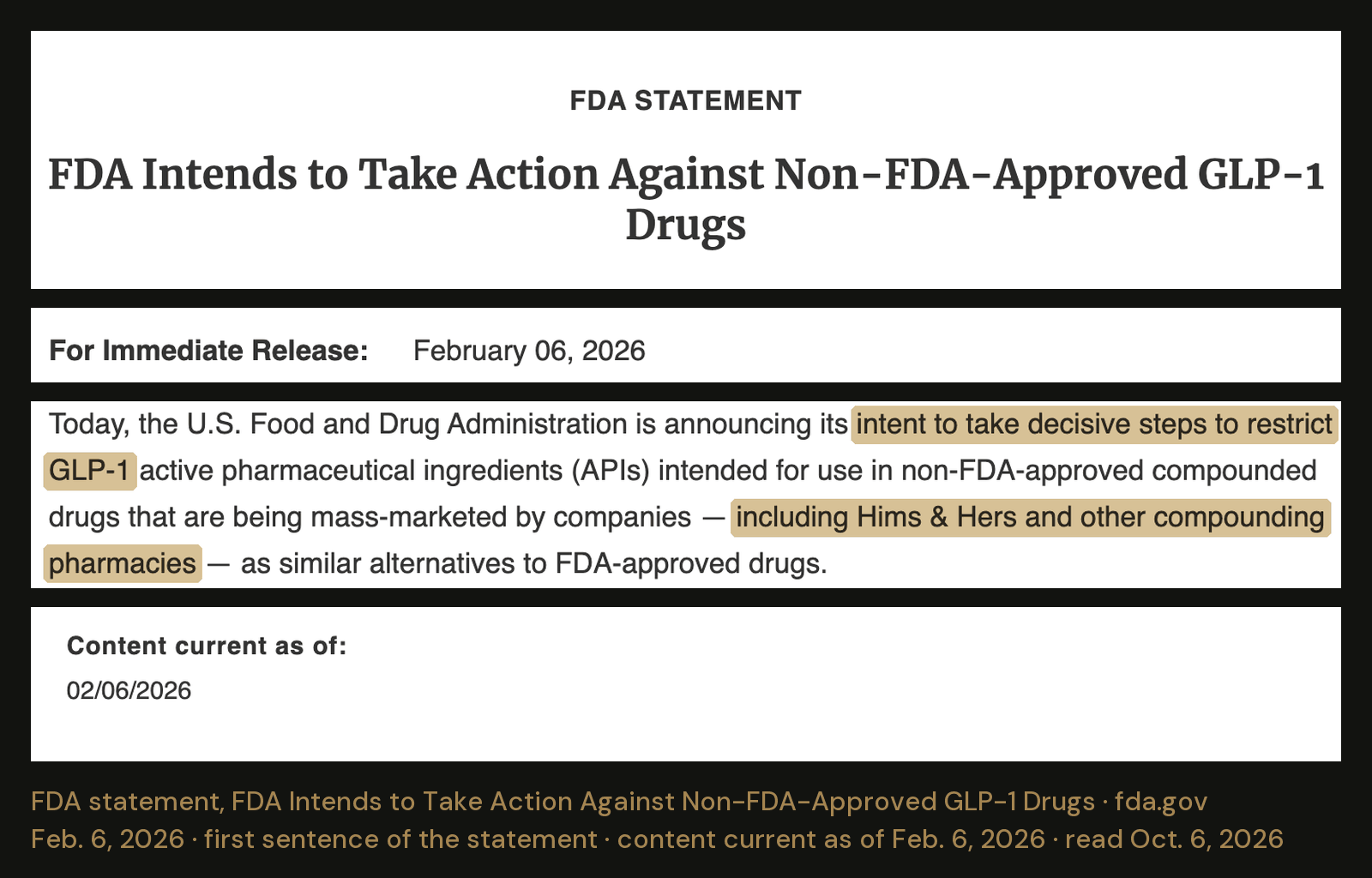
So the FDA announced decisive steps in September 2025, then announced its intent to take decisive steps in February 2026. Decisiveness, it seems, renews like a subscription. The states had asked for it first. In February 2025 the California attorney general announced a letter from a coalition of 38 states and territories. His office’s headline: “FDA Should Take Quick and Decisive Action Against Makers of Counterfeit Weight Loss Drugs.” That September the FDA used the word about an import list, and in February 2026 it used it again, as an intent.
When the FDA announced its February 2026 letters to telehealth sellers, on March 3, 2026, it also gave itself a number. It said it had sent “thousands of letters” to drug and telehealth companies in six months, more than in the decade before. That is the FDA’s count. I have not checked it. The same release quotes Makary: “It’s a new era.” He said the agency was “taking swift action.” The letters being announced were dated February 20, 2026. Swift is a relative word in a story where one federal rule has had six new target dates. The FDA’s own page lists his time as commissioner as April 2025 to May 2026. The website kept the era.
Press releases cost nothing to publish, and these were generous with adjectives. An intent is not an action, and a priority is not a rule. Below is what the record shows for each promise, in the agency’s own documents. Where the record backs the FDA, I say so.
The shipping cap became law in 1997, and the FDA has not begun enforcing it
The cap on shipping compounded drugs across state lines is older than Google. It is in section 503A, in a law approved on November 21, 1997. Google’s own history dates the company’s founding to 1998. Duke Nukem Forever, the video game, was announced in April 1997 and finally shipped in 2011, after fourteen years of development. The cap became law seven months after that announcement. The game shipped first.
Here is what the cap says. Section 503A sets the limit for pharmacies in states without a signed agreement with the FDA. They may ship compounded drugs out of state only up to 5 percent of the prescriptions they fill. The law’s own words are “in quantities that do not exceed 5 percent of the total prescription orders dispensed or distributed by such pharmacy or physician.” An online seller can take patients in many states, so this limit bears on any pharmacy that fills its orders across state lines.
Congress also assigned the homework. The 1997 law says the Secretary “shall, in consultation with the National Association of Boards of Pharmacy, develop a standard memorandum of understanding for use by the States.” That agreement is the document a state signs with the FDA. Shall is about as firm as statute language gets. The FDA published a draft in 1999. It withdrew that draft for a new one in 2015, withdrew that one for a revised draft in 2018, and offered states its final model agreement in 2020. Three drafts and twenty-one years, for one standard form. Plenty of graduate students have finished a dissertation faster, and no statute told them shall.
In fairness to the FDA, part of that wait belongs to the courts. After the 2002 Supreme Court ruling described below, the law’s standing was in doubt until Congress updated it in 2013, which, the FDA says, “removed uncertainty about the validity of section 503A.” Take those years out, and the cap has still waited longer than Duke Nukem did.
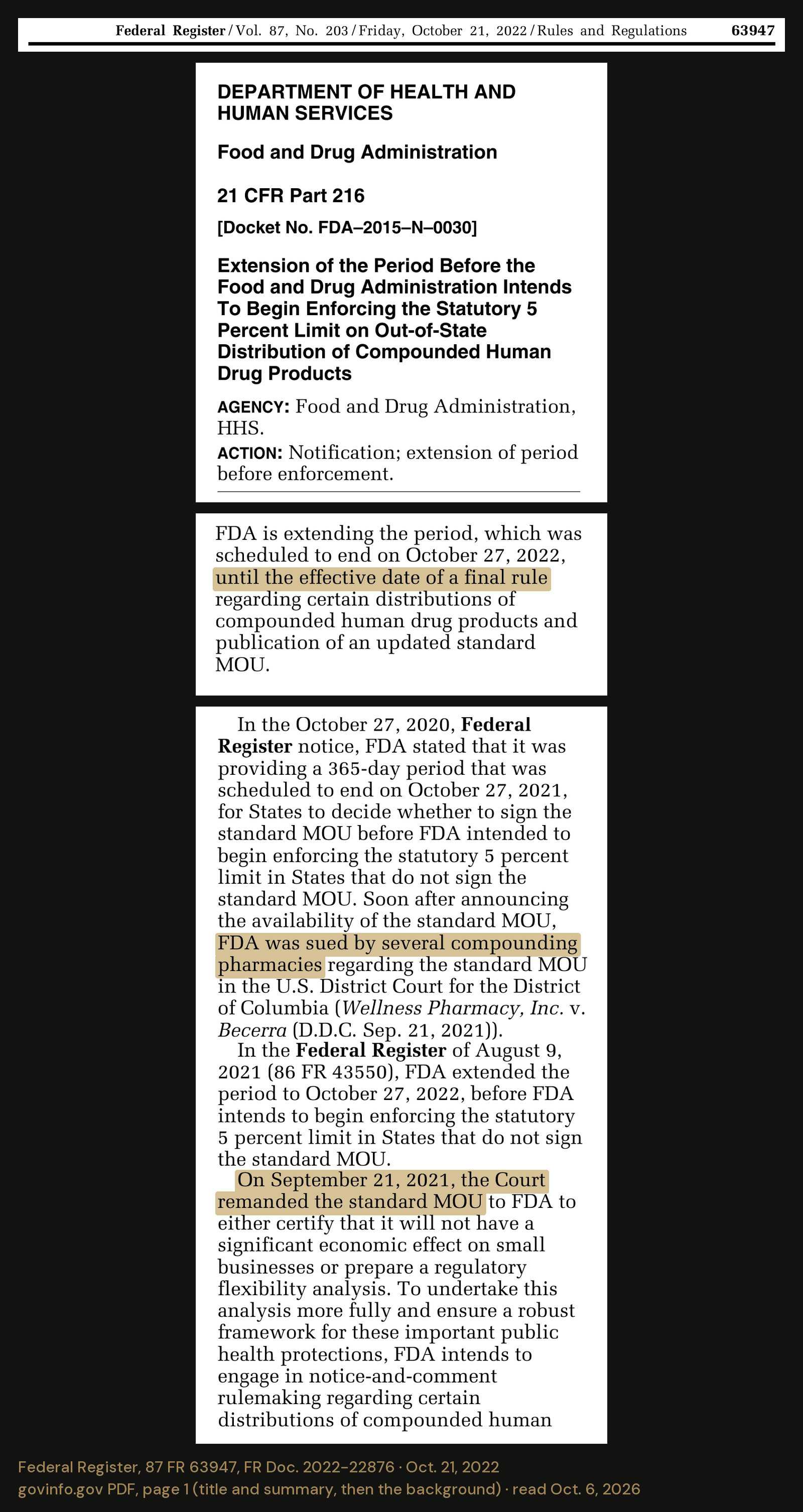
The FDA has not begun enforcing the cap. In October 2022 it extended “the period before FDA intends to begin enforcing the statutory 5 percent limit.” The wait runs until a final rule takes effect and a new state agreement is published. The FDA calls its 2020 model agreement “suspended.” It does not expect states that signed it to carry it out. The notice is dated October 17, 2022, and signed by Lauren K. Roth, Associate Commissioner for Policy.
The pause has a real cause, and it belongs on the record. Several compounding pharmacies sued over the 2020 agreement. In September 2021 a federal court sent it back to the FDA, to certify that it would not significantly affect small businesses or to analyze the effect. The FDA then chose to write a rule, and it set the wait to run until that rule takes effect. A court asked for a certification or an analysis. The FDA answered with a plan for a whole rulemaking, “to undertake this analysis more fully and ensure a robust framework for these important public health protections.” Asked for a receipt, it decided to build a store, for thoroughness.
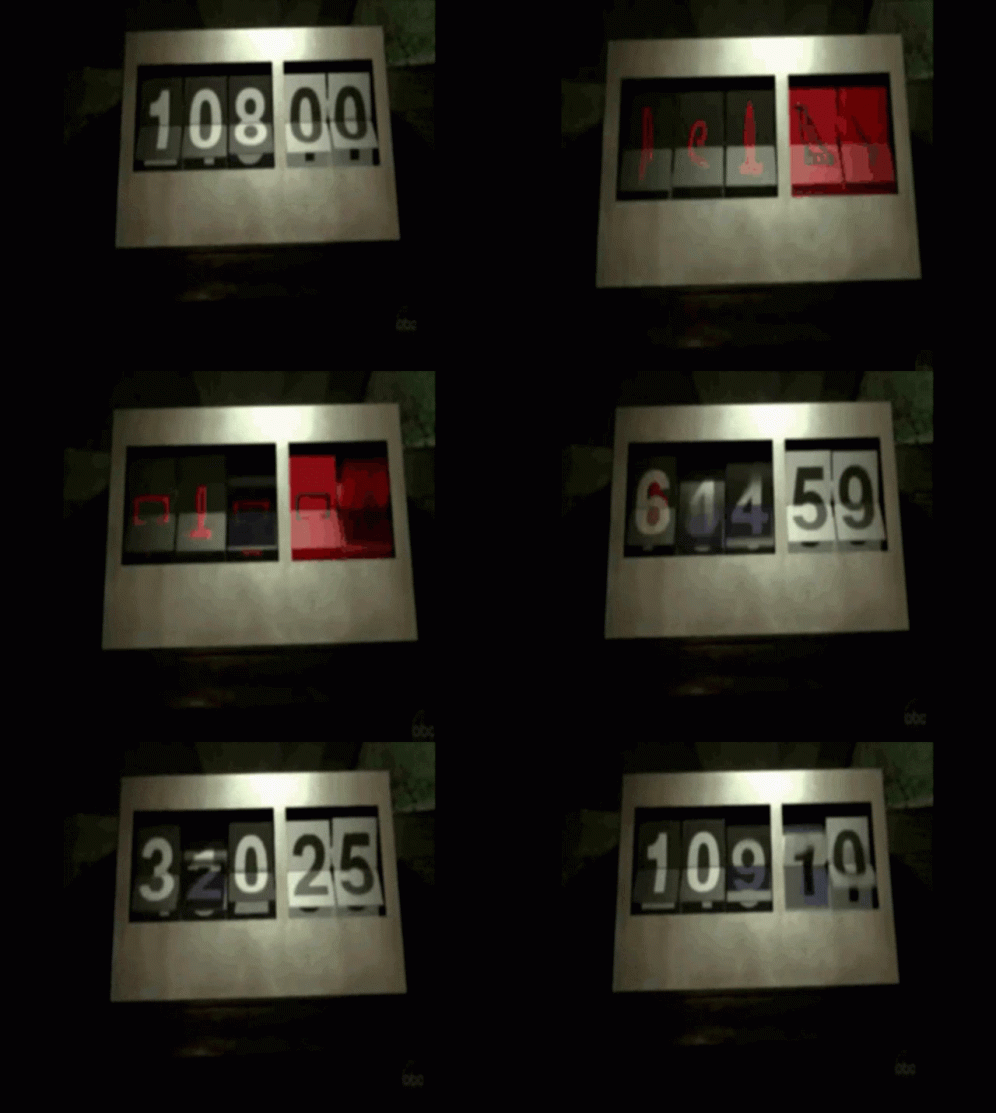
That rule first appeared on the federal regulatory agenda in the spring of 2022, and its target date has moved later six times since. Each edition of that agenda gives a target date for a proposed rule. The spring 2022 edition said December 2022. The 2026 edition says November 2026, with “Legal Deadline: None.” Those three words may be the most candid thing the government has published about this rule. In the second season of Lost (ABC, 2005), a man in an underground hatch keeps typing the same numbers to reset a countdown clock. This rule’s target date keeps getting reset the same way, with less typing.
When I searched the Federal Register, where federal rules and notices are published, on October 6, 2026, I found no proposed rule. A second search on October 14, 2026, by the rule’s agenda number, returned only five agenda listings, the newest from 2024.
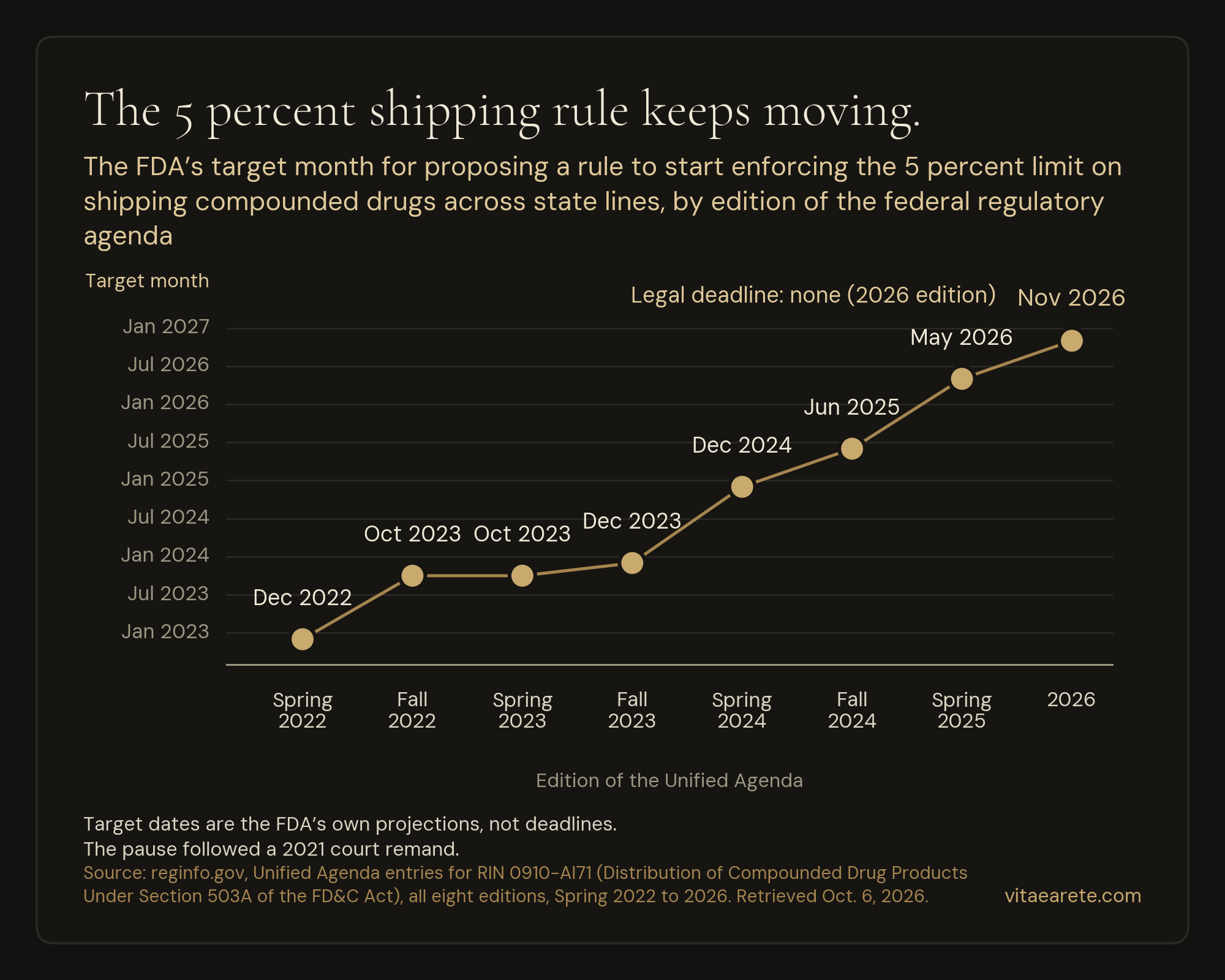
The stall belongs to no one party. By the FDA’s own 2022 notice, it first set a waiting period in October 2020, extended it in August 2021 and made it open-ended in October 2022. The latest move, to November 2026, came in the 2026 edition. That run spans presidents of both parties. Missing your own target date, at last, is bipartisan.
Meanwhile, on a page about the shipping cap, the FDA writes: “Implementing these statutory provisions remains an important public health priority.” The page was last updated on October 20, 2022, and it is still posted. I read it again on October 14, 2026. Severance (Apple TV+, 2022) is about office workers who are told their work is important and are never allowed to see what it does. The page shares the premise, and its last update came the same year.
So here is my verdict on the FDA’s sentence, “Implementing these statutory provisions remains an important public health priority.” MISLEADING, as of October 14, 2026. By misleading I mean that what the page says is true as far as it goes, and the impression it leaves is not. The page gives real reasons the cap matters, and the rule is still on the agenda. It also lists what the FDA has done. In 2020 it offered states a model agreement, which it now calls suspended. In 2022 it said it would write a rule, and it extended the wait. The page says the FDA plans updates on the rulemaking “as appropriate.” Its last update is dated October 2022. What the sentence leaves out is the pace since that update: six new target dates, no legal deadline, and no proposed rule that I found in the Federal Register. That verdict is about a 2022 page, and it would read the same under any administration.
A priority on that schedule is a hope with a page number. The cap has been on the books for almost twenty-nine years, and the rule meant to start enforcing it has a target date and no deadline. If the FDA proposes the rule, I will print the date.
The FDA sent 113 letters, and its own manual calls them advisory
The warning letters quote the ads back to the sellers. One FDA letter of September 9, 2025, to Hims & Hers quotes two lines from the company’s website: “Same active ingredient as Ozempic and Wegovy” and “Clinically proven ingredients.” The FDA’s letter said the claims imply the products are “the same as an FDA-approved product when they are not.” Four words carried that letter: when they are not. That is the FDA’s account, and it is one letter of many. If you have seen an ad for a compounded GLP-1, you may have met a claim like those two.
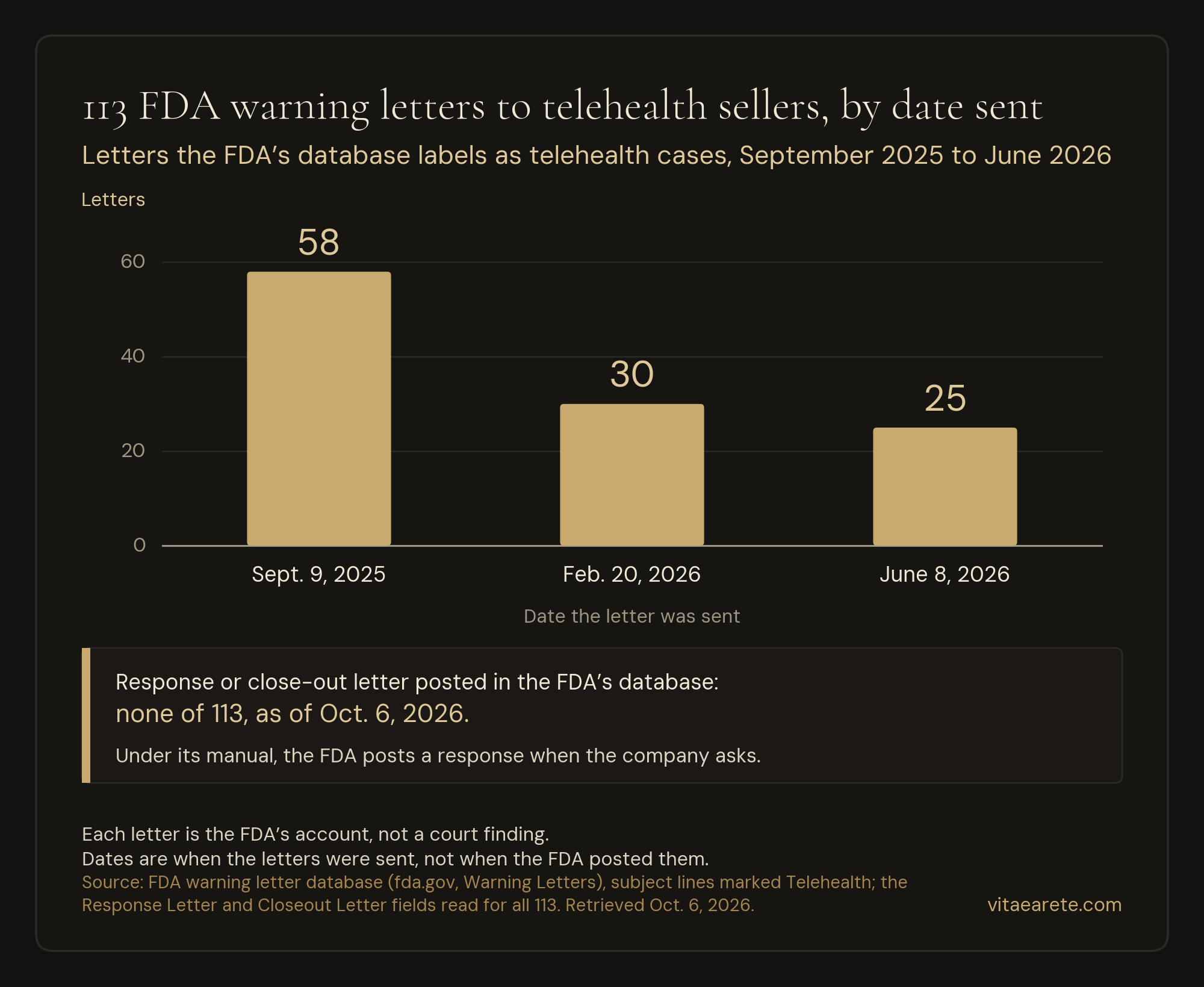
The FDA’s database lists 113 letters with a telehealth subject since September 2025. Fifty-eight are dated September 9, 2025, thirty are dated February 20, 2026, and twenty-five are dated June 8, 2026. Of those, 110 mention a GLP-1 drug. Like every letter here, those are the FDA’s account.
Every one cites section 502(bb) of the drug law. It makes a compounded drug misbranded if its advertising is “false or misleading in any particular.” In announcing the February letters, the FDA said the main problems were claims “implying sameness with FDA-approved products” and branding that implied the seller was the compounder. The same release called them “the second group of warning letters sent to telehealth firms since the agency launched in September a crackdown on misleading direct-to-consumer pharmaceutical advertisements.” So, in the FDA’s own words, the September and February letters belong to the crackdown announced on September 9, 2025.
Compounders can advertise a particular drug, a GLP-1 included, because Congress tried to stop that and lost. The 1997 law let a pharmacy keep the exemption only if it “does not advertise or promote the compounding of any particular drug, class of drug, or type of drug.” It could still advertise its compounding service. On April 29, 2002, the Supreme Court struck down the drug-ad limits, five to four, in Thompson v. Western States Medical Center. “We conclude, as did the courts below, that § 127(a)’s provisions regarding advertisement and promotion amount to unconstitutional restrictions on commercial speech,” Justice Sandra Day O’Connor wrote for the Court. Section 127(a) is the part of the 1997 law that created section 503A. When Congress updated the compounding law in 2013, the FDA says, it “eliminated provisions concerning advertising of compounded drugs that had been found to be unconstitutional.” Congress tried silence on particular drugs, the Court said no, and what survived is a rule against ads that are false or misleading. That is the legal backdrop for every compounded GLP-1 ad you scroll past.
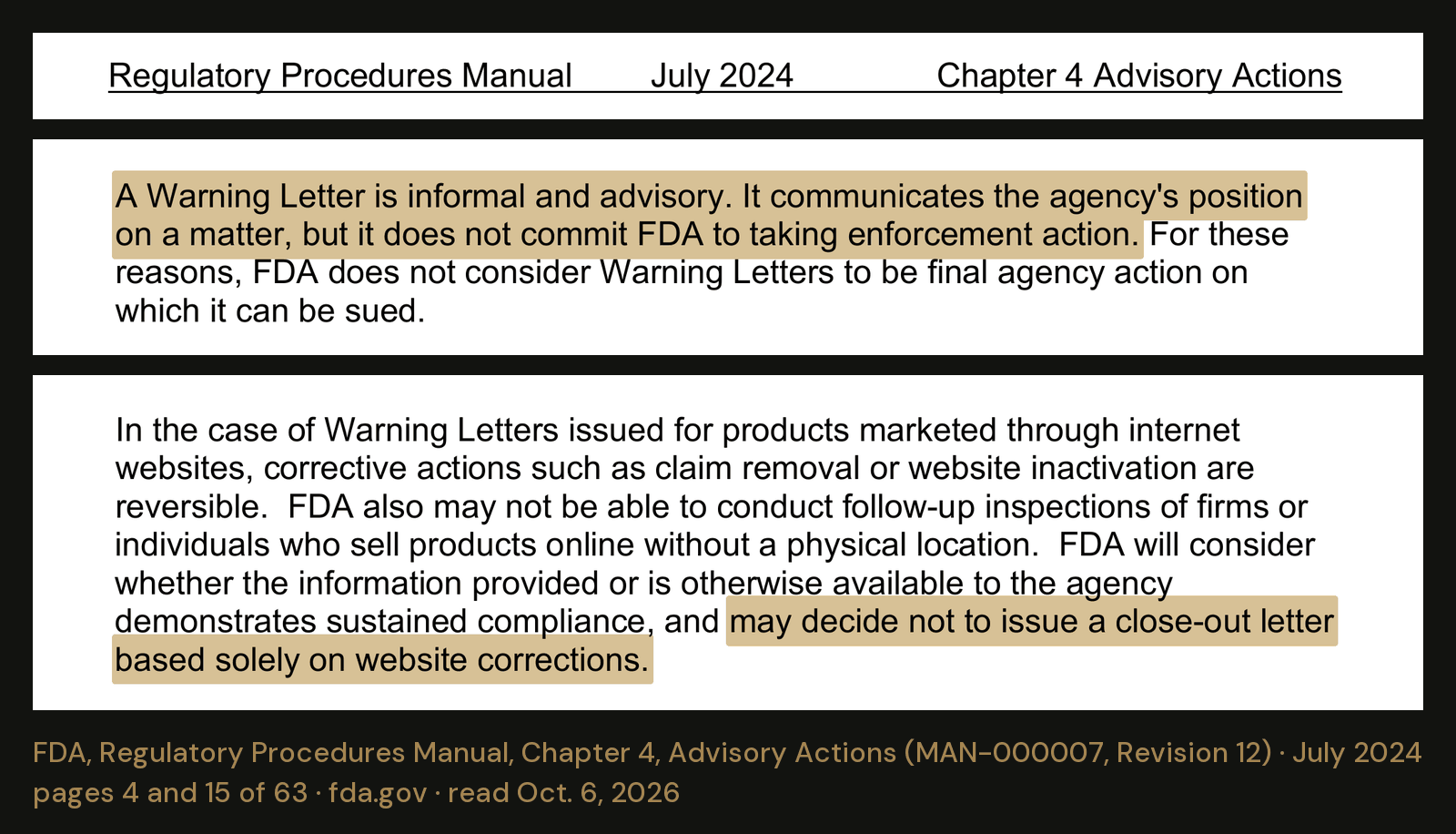
The FDA’s own manual explains what these letters are. A warning letter “is informal and advisory,” it says, and “does not commit FDA to taking enforcement action.” The agency sends them expecting that “most individuals and firms will voluntarily comply with the law.” A warning letter is also “not a prerequisite” to going to court.
Each letter asks for a written answer within fifteen working days, or fifteen business days in the June batch. Each warns that “seizure and injunction” may follow. For an informal document, it has a formal ending. It is the only casual note I know of that signs off with federal court.
On October 6, 2026, the database showed no response letter and no close-out letter posted for any of the 113. That does not mean no company answered. Under its manual, the FDA posts a company’s response when the company asks it to. A close-out letter comes only after the FDA has verified the corrections, the manual says. For online sellers, it adds, website changes are “reversible,” so the agency may not close out a letter on those alone. A seller can fix a web page in an afternoon and unfix it by dinner, and the FDA’s manual knows it. On the public database, the trail of 113 letters stops at the letters, like 113 packages stuck on the tracking status everyone dreads: label created.
My read: by its own manual, the FDA’s most visible tool against these sellers is a request that also puts the company on notice. The promise in September 2025 was to “aggressively deploy” enforcement tools. The tool the public can see is the one the manual calls informal.
To stop a business, the FDA needs a court, and I found no FDA court case against any of the 113
A warning letter asks for an answer. Under the drug law, the FDA needs a court to make a business stop. The statute says such cases “shall be by and in the name of the United States.” In practice the Justice Department files them. On September 21, 2026, for example, a federal court in Minnesota entered a consent decree against a warehouse operator that handled food, drugs and other products. That is a court order the company agreed to. The FDA had found persistent insanitary conditions there. The decree bars the company from distributing FDA-regulated products until it meets federal requirements. The Justice Department filed that complaint “on behalf of the FDA.” It was not a GLP-1 case.
So the road to a courthouse exists, and this September the FDA took a warehouse down it. When I searched on October 6, 2026, I found no court case by the FDA or the Justice Department against any of the 113 telehealth letter recipients. I searched the FDA’s press announcements and the web. I did not search every federal docket for every name.
Duke Nukem Forever did eventually get out of development hell. On the record I could find, the FDA has not followed any of the 113 letters into a courtroom.
The FDA’s own scorecard tells you what it counts. The compliance office of its drug center published a 2025 annual report, dated April 2026. “We issued 72 compounding-related warning letters, a major increase from the previous year, with 58 letters addressing misbranded compounded drugs promoted through false or misleading advertising,” it says. On October 14, 2026, I searched the report’s text for “seizure” and “injunction,” and found neither word. The report covers 2025, before the February 2026 statement. On compounding, the report counts warning letters, five untitled letters, six meetings with compounders and recalls it oversaw. That is a fine scorecard for a post office with a returns desk.
The February statement warned of “seizure and injunction.” I have not established whether any seizure or injunction followed. I asked the FDA.
Now the referral. Two of the September 2025 letters went to Hims & Hers, and those are the FDA’s account. On February 6, 2026, the same day as the FDA’s statement, the general counsel of the Department of Health and Human Services posted on X. The post went up at 4:16 p.m. Eastern, on a Friday. It reads: “Based on a review of the applicable facts, earlier today @HHSOGC referred Hims & Hers Health, Inc. (“Hims”) to the Department of Justice for investigation for potential violations by Hims of the Federal Food, Drug, and Cosmetic Act and applicable Title 18 provisions.” Hims’s quarterly report describes the same referral, “for investigation for potential violations of the Federal Food, Drug, and Cosmetic Act and applicable Title 18 provisions.” Hims adds that it is “unclear what actions the FDA, HHS, or DOJ may take.” A referral is not a charge. The same report says Hims shifted toward brand-name GLP-1s in March 2026. For compounded GLP-1s, it says, as of that quarter Hims uses only 503A pharmacies, and offers them only “on a limited scale.” I asked Hims for any update.
The Justice Department has a written policy for this kind of moment, and it reads like a footnote somebody wrote in advance. “Sometimes, the requestor then publicizes the request,” its manual says. “There is a distinction between reviewing a request and opening an investigation.” And: “DOJ generally will not confirm the existence of or otherwise comment about ongoing investigations.” The section pictures individuals, groups and organizations writing in to ask for an investigation. This requestor was the government’s own lawyer, on X, at 4:16 on a Friday.
Law & Order (NBC, 1990) split every episode in two: first the police investigate, then the lawyers prosecute. On the public record I could find, this one has a statement, a post and a long quiet. When I searched on October 6, 2026, I found no Justice Department case that followed this referral. Under its own manual, the department generally would not say if it had opened one. My take: a referral announced by post is still only a referral.
I believe in calling things what they are, so I tested the biggest word on the shelf. The Cambridge Dictionary defines authoritarian as “demanding that people obey completely.” The FDA’s own manual says it sends warning letters expecting that “most individuals and firms will voluntarily comply with the law.” This record shows close to the reverse problem: a government that announces force in the future tense and uses an advisory letter in the present one. I looked for a statement here that the record proves false, and I did not find one. What I found were promises, with dates on them. Those are easier to check. The word does not fit, so I do not use it.
The one open federal proposal I found is about the other kind of compounder
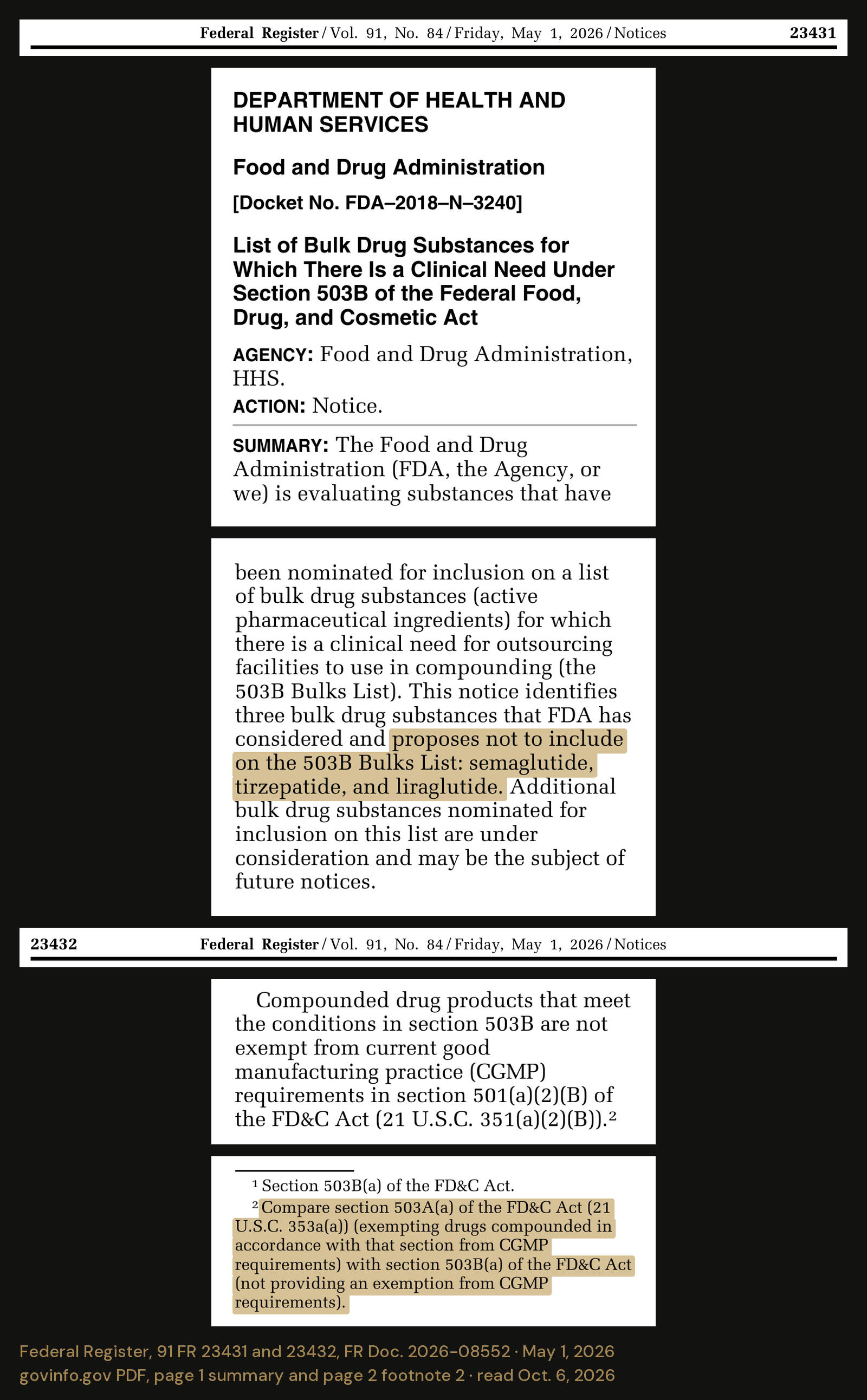
The one open federal proposal on compounded GLP-1s that I found is about outsourcing facilities. Those are the compounders that register with the FDA and can make drugs in bulk. On May 1, 2026, the FDA said it “proposes not to include” semaglutide, tirzepatide and liraglutide on a list of bulk ingredients those facilities may use. Comments closed on July 30, 2026. A proposal to say no, it turns out, also takes time. When I searched on October 6, 2026, I found no final decision in the Federal Register or in the FDA’s press announcements. That leaves the decision where SpongeBob leaves its plot whenever time passes: on a title card.

That list is for outsourcing facilities only. Single-patient pharmacies answer to section 503A, which the proposal mentions once, in a footnote. The last piece in this series explained the two kinds. By its own terms, then, the open proposal would not reach single-patient pharmacies. That is how the law is built. If you have been waiting for the federal government to close a door on copies, this one is closing slowly, on a different room.
Credit where the record gives it: the bigger change came earlier, and it needed no new rule. “Semaglutide injection products have been in shortage since 2022 due to increased demand,” the FDA wrote on February 21, 2025, in the entry that declared that shortage over. While the brand-name versions of semaglutide and tirzepatide were in shortage, both kinds of compounder (single-patient pharmacies and outsourcing facilities) had room to make copies of them. That shortage is the opening the copies came through. The FDA’s final decisions that the shortages were over came in December 2024 for tirzepatide and February 2025 for semaglutide. Its grace periods for compounders ended between March and May 2025. A federal court in Texas twice declined to pause the change at the request of the Outsourcing Facilities Association. Once the grace periods ended, the law’s copy limits applied again. That change is in the past tense, which in this story makes it a collector’s item. As of April 2026, the FDA says, neither drug was on its shortage list or on the outsourcing list.
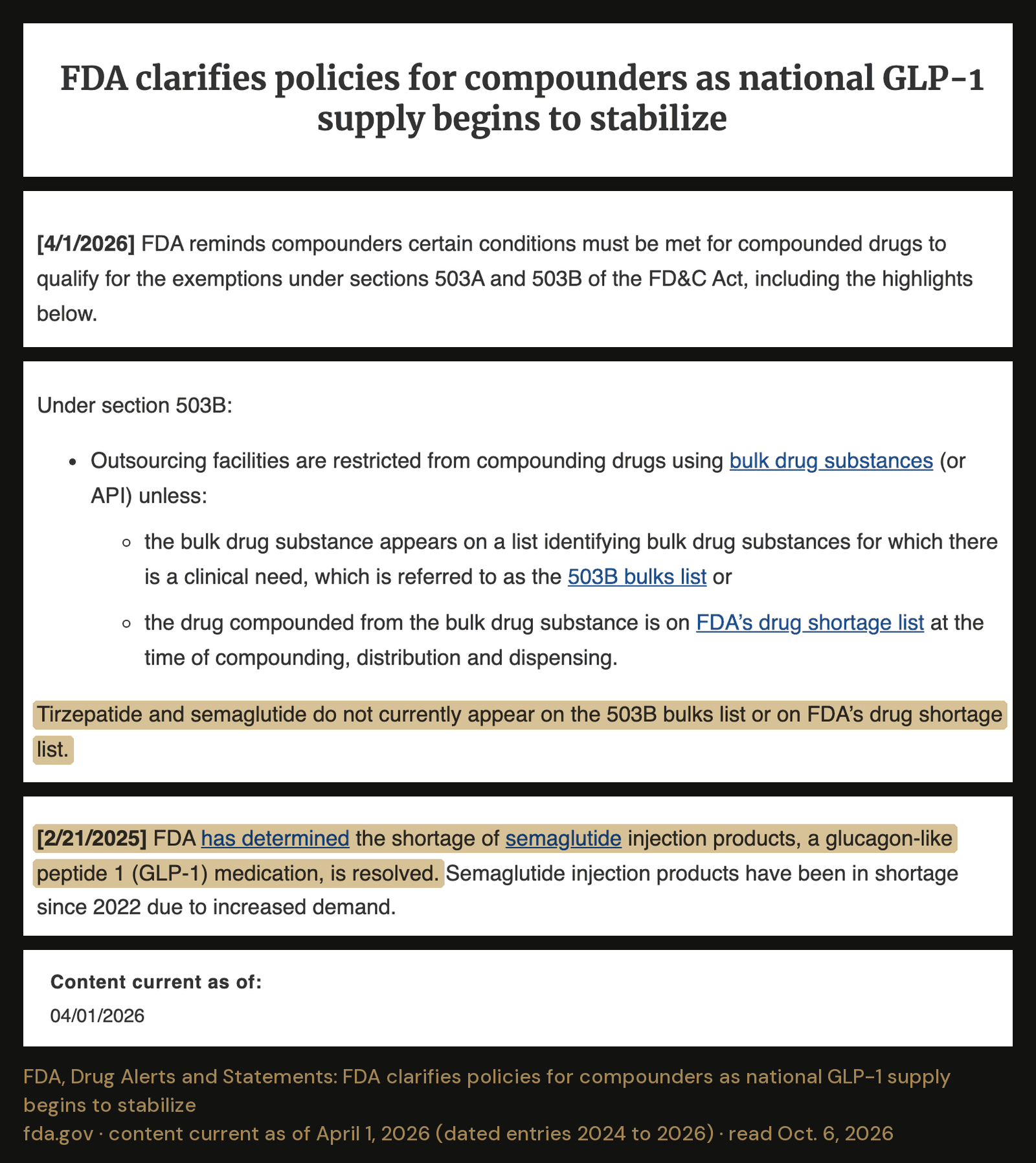
My read: the biggest federal change in this record came from a supply finding, not from enforcement.
The FDA says side effects of these compounded drugs are likely underreported
The second kind of compounder was created after a disaster. In 2012, contaminated steroid injections from the New England Compounding Center in Framingham, Massachusetts, set off a multistate outbreak of fungal meningitis and other infections. The CDC counted 753 cases in 20 states, and 64 deaths. Congress passed the Drug Quality and Security Act “in response to the 2012 fungal meningitis outbreak, as well as numerous other serious adverse events, including deaths, linked to poor quality compounded drugs,” the FDA says. It was enacted on November 27, 2013. It added section 503B, which “established a new, voluntary category of compounders known as outsourcing facilities.” It left section 503A in place for pharmacies that compound for one patient at a time. Nothing in this record ties any GLP-1 compounder to that outbreak. I raise it because it is the disaster the FDA names first behind the current law, and because it is what “who can stop it” meant the last time.
Today the duty to report harm is split. Outsourcing facilities must report side effects to the FDA. Single-patient pharmacies have no federal duty to report them. The FDA says this makes it “likely” that side effects of compounded GLP-1s are underreported. My read: the pharmacies that fill orders on those notes are the ones with no federal duty to tell the FDA when something goes wrong.
As of May 31, 2026, the FDA had received 990 reports linked to compounded semaglutide and more than 730 linked to compounded tirzepatide. It says it is “not always possible” to tell whether the drug caused the event. It also says many of the reported events “appear to be consistent” with those of the approved drugs. The FDA’s page, as I read it on October 6, 2026, gives no count of how many people have used compounded versions. Without one, these reports cannot show how often harm happens, or whether it happens more often than with the brand-name drugs. The government is counting harm through a window that the law itself left half shut.
At the border, the FDA has acted, and twenty states warn its safety list can become a laundering channel
The FDA also acts upstream. Since September 2025, imported GLP-1 ingredients have been subject to detention at the border unless they come from facilities on an FDA “green list.” Section 503A separately requires a pharmacy’s bulk ingredients to come from makers registered with the FDA.
The FDA launched that list on September 5, 2025, with a phrase you may now recognize. “This is part of the agency’s decisive steps to safeguard consumers,” its release said. The commissioner added, “we are taking aggressive action to protect consumers from poor-quality or dangerous GLP-1 drugs.” That makes the list a “decisive step” by the FDA’s own label, and February’s statement the sequel. So it is fair to ask how the original has held up.
Start with the FDA’s own mail. In May 2026 the agency wrote to a Chinese supplier that, Alabama’s attorney general’s office says, was on the list and relabeled semaglutide made elsewhere. The FDA’s letter said the relabeling “may have been an attempt to circumvent safeguards” tied to the list. The letter also says the supplier agreed, after a call with the FDA in February 2026, to recall two batches. If you saw The Big Short (2015), you know this movie: the stamp travels with the box, not with whatever is inside it. By the FDA’s own hedged account, the safeguard may have been the very thing someone tried to get around.
Alabama’s office raised that supplier while announcing a bigger complaint. Some state attorneys general dispute how well the list works. In September 2026, attorneys general from 20 states wrote to the Secretary of State about it. Alabama’s attorney general led the letter, and his office’s announcement says the list “has become a proven laundering channel.” The letter itself, for 20 states, says a green list “can quickly become a laundering channel rather than a safeguard,” and that the concern “is no longer hypothetical.” It also says the FDA, through the list, gave Chinese suppliers “a green light to ship unapproved, knock-off product to America without detention or inspection.” That is 20 states describing a federal safety list in the language of a money trail. It is not often a federal safety list gets reviewed by twenty attorneys general. So one list has now had two reviews a year apart: a decisive step, in the FDA’s words, and a possible laundering channel, in the states’.
I set out to grade the February promise of “decisive steps” on these ingredients. The record would not let me say nothing followed it. The FDA’s letter dates its call with that Chinese supplier to February 10, 2026, four days after the statement. I do not know whether the statement prompted it. The supplier began its recall on February 19, the FDA’s letter says. The list itself has been revised since. The import alert behind it, as I read it on October 14, 2026, carries a published date of October 9, 2026. It cites an internal FDA memo of March 19, 2026, “recommending revision.” The alert says that revision added product codes. It also added makers of orforglipron, a newer GLP-1 ingredient, to the green list. Whether that is decisive is a judgment. Twenty attorneys general have made theirs about the list. I give the promise no verdict.
States can stop a pharmacy themselves, and one did with a single notice
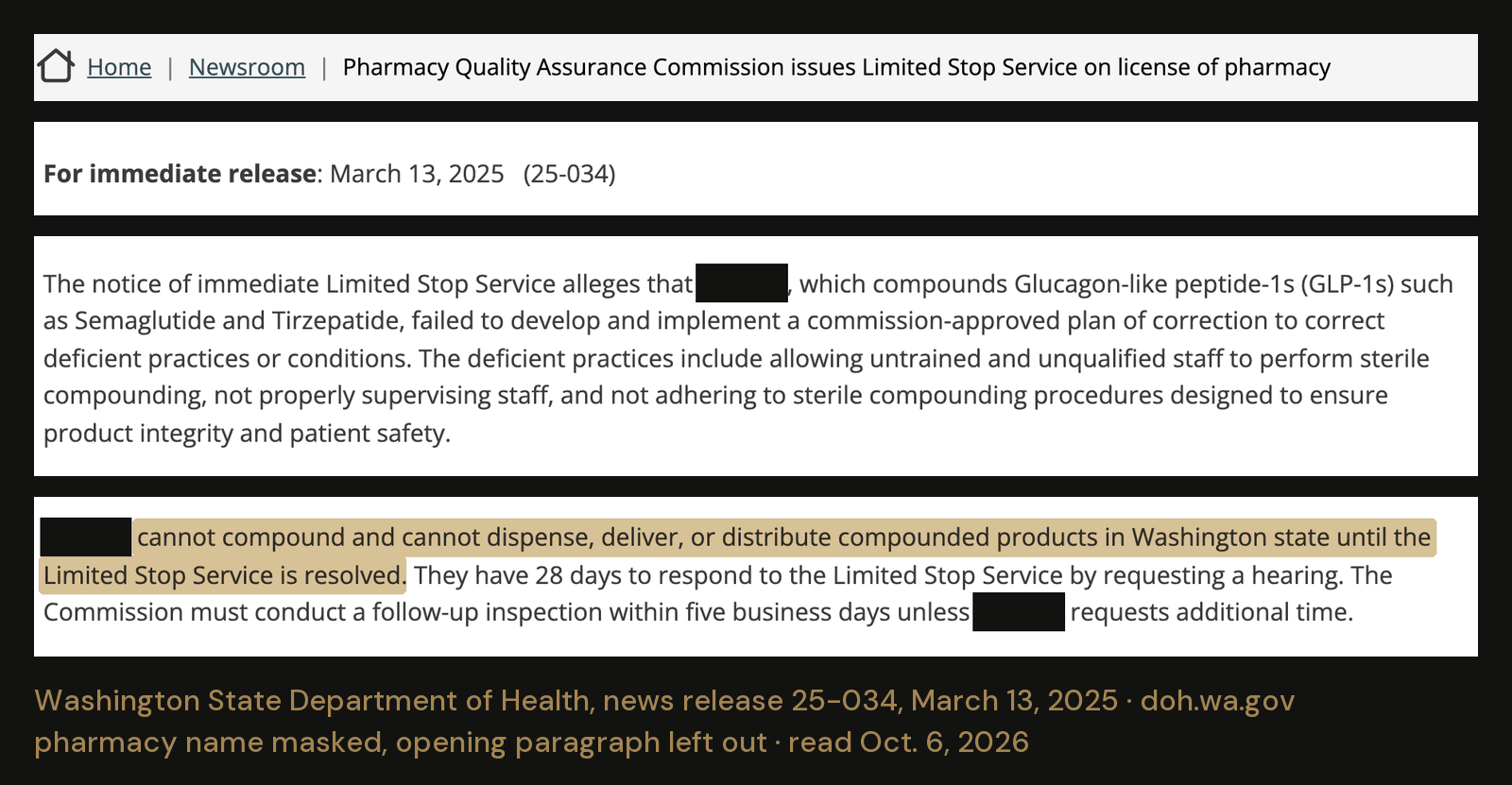
States license pharmacies, and a state board can stop one by its own notice. Washington’s pharmacy commission did that in March 2025. It ordered a Kirkland pharmacy that compounded semaglutide and tirzepatide to stop compounding, and to stop dispensing compounded drugs in Washington, until the matter was resolved. No intent, no plan, no future tense. The notice said stop.
Read that beside the FDA’s statements in this piece, which keep much of their action in the future tense. In 2022 the FDA described “the period before FDA intends to begin enforcing” the shipping cap. In 2026 it announced its intent “to take decisive steps.” Washington’s commission skipped the intending and went straight to the verb.
The notice alleged problems with sterile compounding, including untrained staff doing it. That allegation should make anyone who injects a sterile drug sit up. It was not a case about copies or advertising. In July 2025, the department said in a later release, the commission and the pharmacy entered an agreed order. Its terms include restrictions on sterile compounding, compliance monitoring, quarterly reporting and continuing education for staff. From the stop notice to the agreed order took about four months. The federal rule meant to start enforcing the shipping cap has moved its target date six times since 2022. I asked the state whether the order is still in effect.
Attorneys general use consumer protection law. Connecticut’s attorney general has sent warning and cease-and-desist letters to clinics and spas. Two clinics that settled with his office have stopped advertising and selling compounded GLP-1s, the office says.
States have also asked the FDA to do more. In February 2025 the coalition of 38 states and territories urged the agency to “ramp up enforcement against any compounding pharmacies that may be illegally participating in this market.” California’s announcement of that letter ran under a headline asking for quick and decisive action. A year later, the word decisive arrived, as an intent. I am still checking the package for the rest. My read: in this record, the only order I found that told a pharmacy to stop came from a state board, in a single notice.
The FTC actions and drugmaker suits I read use other laws, not the copy rule
The coldest sentence in this section is a short one in the drug law. Apart from an exception that covers food, proceedings to enforce the law or restrain violations of it “shall be by and in the name of the United States.” That is 21 U.S.C. 337(a). Drugmakers cannot sue to enforce the drug law itself. That power belongs to the United States. I found no drug-law case filed in its name against any of the 113 telehealth letter recipients when I searched on October 6, 2026.
So under federal drug law, the copy question has one plaintiff. The FDA’s own manual says a warning letter is “not a prerequisite” to going to court, so the letters are not a step that has to come first. Everyone else in this section, the FTC, Utah and Eli Lilly, has to sue about something else.
The Federal Trade Commission enforces a different law. It bars false advertising for drugs, and the commission can sue in federal court through its own lawyers. The first piece in this series covered two of its actions. One is a 2025 order against the telehealth company NextMed. It was issued by the commission itself rather than a court, over the commission’s charges about how NextMed advertised and billed for its weight-loss programs. The other is a pending suit against Hims & Hers. It alleges that Hims shared health information with advertising platforms and misled users about billing and cancellation. By the commission’s own summaries, neither is about whether a compounded drug is a copy.
Utah has joined the FTC and California in that suit, the state’s commerce department announced on August 10, 2026. Utah’s attorney general, Derek Brown, said in that release: “What Utahns actually got was a subscription trap and their most personal health data shipped to advertisers.” Those are allegations, and Hims can contest them in court. By the time a GLP-1 seller reaches the FTC, the question is no longer whether the drug is a copy. It is the ad copy and the cancel button.
The court route has a limit. In 2021 the Supreme Court held that this route “does not grant the Commission authority to obtain equitable monetary relief.” Refunds remain available, the Court said, when the commission uses its administrative process. The NextMed order, made that way, came with a $150,000 payment the commission expects to use for refunds. So the commission collects refunds the slow way now, which makes it fit right in with the rest of the federal government in this story.
Drugmakers sue under other laws instead. Eli Lilly has sued several telehealth companies in federal court in California. What those judges decided is the subject of the final piece in this series.
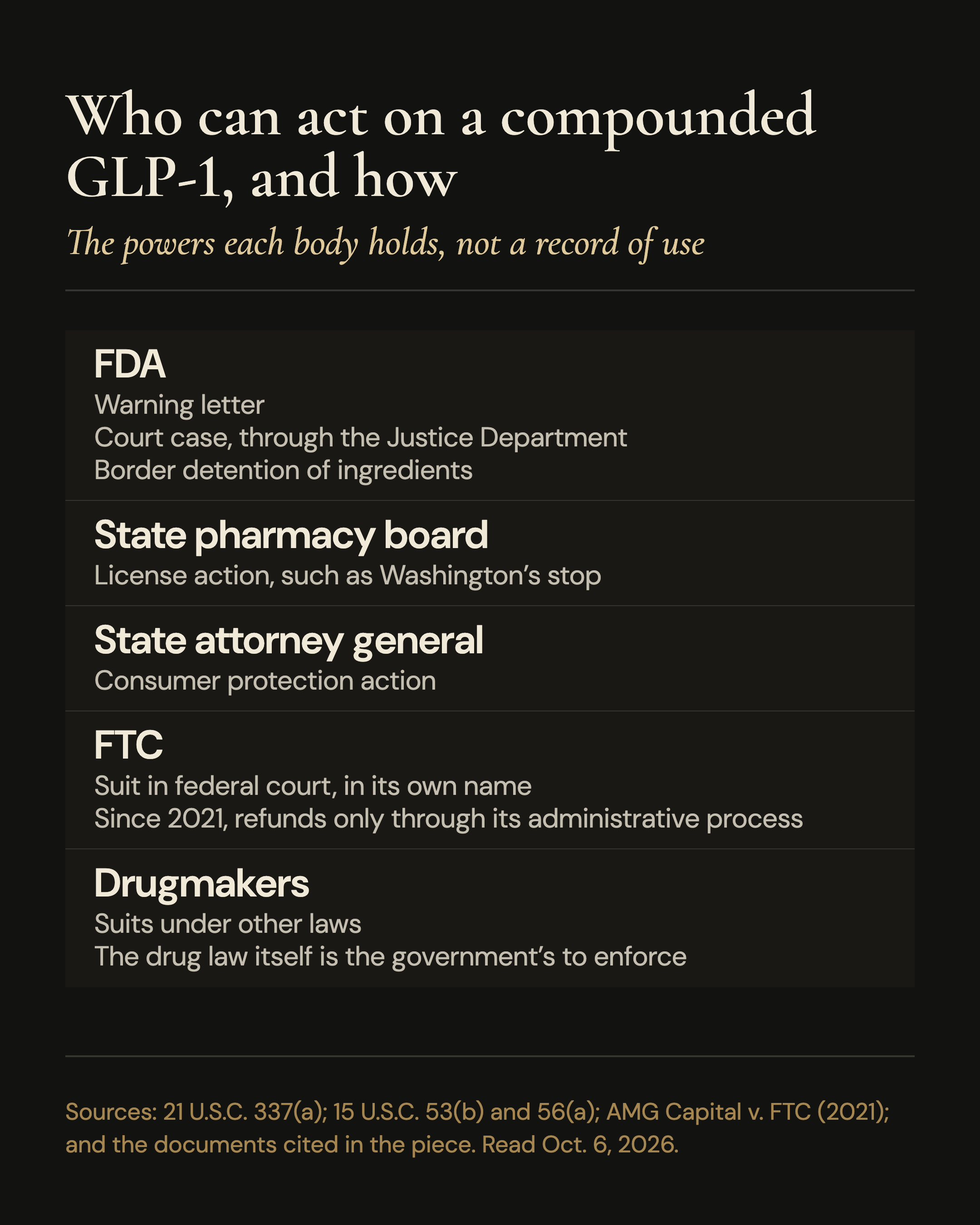
Of the government letters, orders and suits in this piece, only the FDA’s September 2026 letter to Empower takes up whether a GLP-1 is a copy. The rest show the other powers each body has, and what it has used them for. My read: the one plaintiff the copy question allows is the United States. Its most visible tool in this record is an FDA letter, and I found no drug-law case in its name against any of the 113. Everyone else is left suing over the ad copy, the cancel button and the data.
If you use a compounded GLP-1, read the FDA’s own warnings, then ask what your prescriber recorded
Nothing here tells you whether your own prescription is lawful, and I cannot judge that from public records. The FDA’s page on these drugs, as I read it on October 6, 2026, says compounded drugs “should only be used in patients whose medical needs cannot be met by an FDA-approved drug.” It tells patients to fill prescriptions “at a state-licensed pharmacy.” For questions about the label, it points them to “the compounder who made the drug or the telehealth platform where you purchased the drug.”
The same page gives a list of telehealth red flags. One is a company that “makes claims such as the compounded drug is the same as an FDA-approved drug.” Another is one that “offers medicine at deep discounts or prices that seem too good to be true.” Another is one that “makes spelling errors on the label or provides incorrect addresses of the pharmacy.” Federal drug safety advice now includes proofreading.
Here is my read, for a patient buying a compounded GLP-1 online. Much of the FDA’s part in this record runs on target dates and on letters its own manual calls advisory. The record closest to you is the note on your own prescription, and the label on your own vial. If you want to know whether your prescriber recorded a reason you need a compounded version, you can ask.
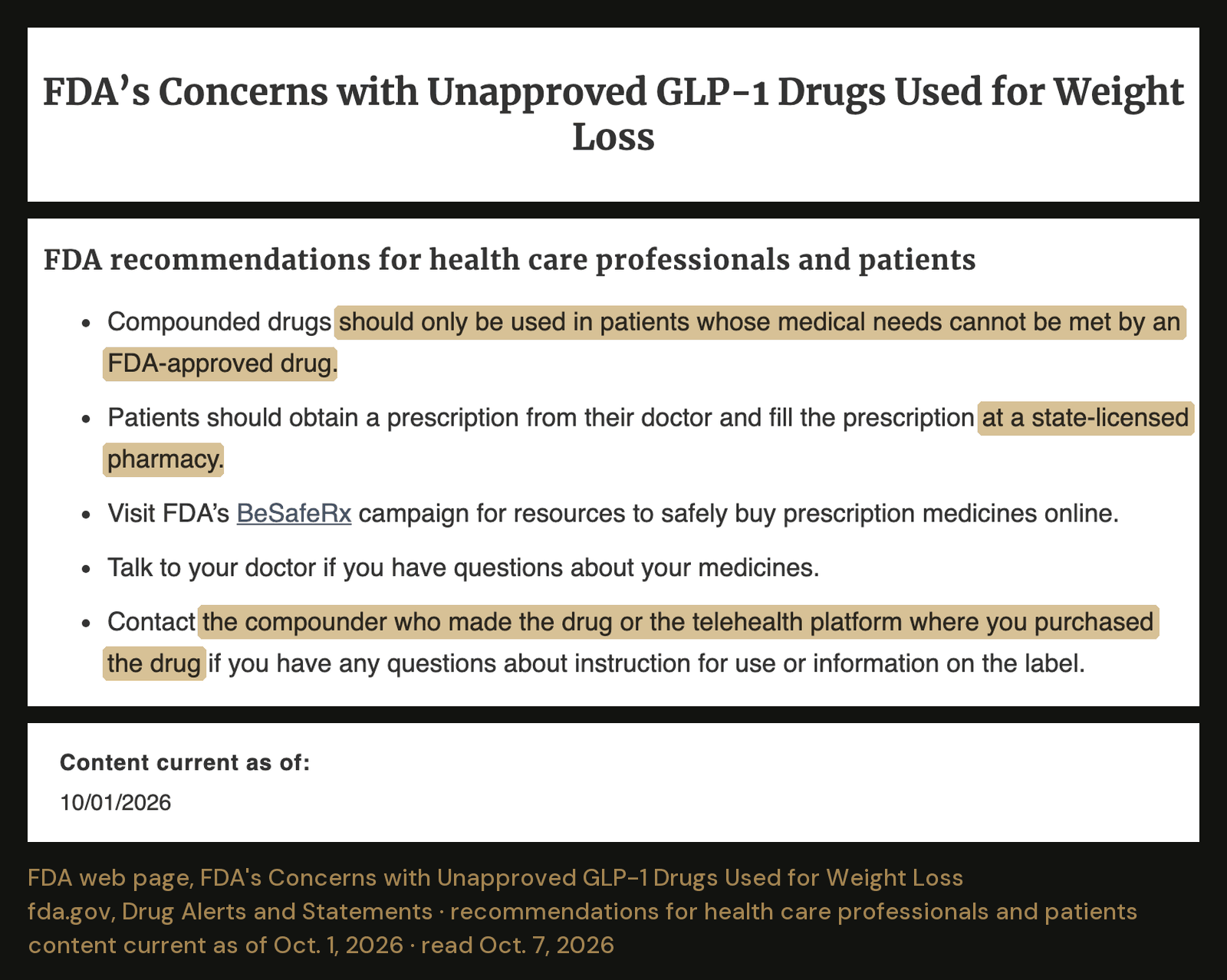
Now the part every patient should read. The FDA’s page, current as of October 1, 2026, says it “received multiple reports of adverse events, some requiring hospitalization, that may be related to dosing errors associated with compounded injectable semaglutide products.” Its 2024 alert explained how. Some compounded semaglutide comes in multiple-dose vials, which patients draw up with a syringe. “In these instances, patients administered five to 20 times more than the intended dose of semaglutide,” the alert says. In several reports, patients “were directed to administer 5 units from a vial. However, these patients mistakenly administered 50 units instead.” The FDA also said some patients had “been given syringes that are significantly larger than the prescribed volume of semaglutide.”
One case in that alert is this whole piece in miniature. In one reported case, the FDA wrote, “it was difficult for the patient to obtain clarity on dosing instructions from the telemedicine provider, who prescribed the compounded semaglutide, leading the patient to conduct an online search for medical advice and resulting in the patient taking five times the intended dose.” The FDA’s page tells patients to take questions about instructions for use to the compounder or the telehealth platform. Its own 2024 alert describes a patient who could not get clear dosing instructions from the telemedicine provider who prescribed, and took five times the dose.
The label itself may not be what it seems. The FDA says it is aware of fraudulent compounded semaglutide and tirzepatide with false labels. “In some cases, the compounding pharmacies identified on the labels of the products do not exist.” In others, the label names “a licensed pharmacy that, based on information FDA has gathered, did not compound these products.” The page also warns about salt forms of semaglutide. “These salt forms, including semaglutide sodium and semaglutide acetate, are different active ingredients than are used in the approved drugs.”
The box matters too. The FDA says it “has received complaints that certain compounded GLP-1 drugs have arrived warm or with inadequate ice packs.” It recommends patients “not use any injectable GLP-1 drug that arrives warm or with insufficient refrigeration.” For multiple-dose vials, it says: “Do not continue using medication from the vial after 28 days, even if instructions from the compounder say the medication can be used for longer than 28 days.” The federal government is telling patients to overrule the compounder’s own instructions.
My take: the most alarming documents in this record are not the warning letters. They are the FDA’s own instructions to patients, which assume the vial, the syringe, the label and the box may each be wrong. If you are taking a compounded GLP-1, do not stop or change it because of anything here without talking to your prescriber.
What I checked, and what I cannot tell you
I read all 113 telehealth letters by script. On October 6, 2026, I also searched the FDA’s warning letter database for the word “pre-generated.” It appears in one letter, the Houston letter. That is a search of what the database indexes. It cannot show what the FDA has raised in inspections or in letters it did not post.
On October 6, 2026, for a final decision on the outsourcing proposal, I searched the Federal Register and the FDA’s press announcements. For the shipping rule, I searched the Federal Register, and on October 14, 2026, I searched it again by the rule’s agenda number. The Federal Register files those agenda printings under proposed rules. None is the rule itself, and its rule-number field returned no document when I searched on October 14, 2026. For court cases against the letter recipients, I searched the FDA’s press announcements and the web, not every federal docket for every name.
On October 14, 2026, I searched the text of the FDA drug compliance office’s 2025 annual report for “seizure” and “injunction” and found neither. The phrase “consent decree” appears once, about monitoring drug manufacturers. That search covers one report’s text and one year, and only the text I could extract from its PDF. Words inside images would not show up, and the search cannot show actions the report does not describe. The same day I read the general counsel’s post through X’s public embed service. I also read the Justice Department’s media policy, the 1997 law, the 2002 decision and the FDA pages quoted here, as posted.
On the states, this is not a fifty-state survey. I read the releases of the states named here.
I cannot tell you whether any of the 113 letter recipients answered the FDA or changed what they sell. The database does not say.
I cannot tell you which platform, if any, produced the notes the FDA described in Houston. The letter does not say, and I will not guess.
I cannot tell you what share of compounded GLP-1s comes from 503A pharmacies rather than outsourcing facilities. On October 6, 2026, I searched the outsourcing notice, three FDA web pages and the Houston letter for such a figure and found none. Hims’s statement covers Hims.
I cannot tell you when, or whether, the FDA will finalize the outsourcing proposal or propose the shipping rule. Its own target dates have moved before.
I asked them
On October 6, 2026, I wrote to the FDA through the press request form its website points to. I asked about the outsourcing proposal, the 113 letters, the 5 percent limit, its February statement, the Houston letter and the attorneys general’s letter about the green list. I wrote to Hims & Hers the same day, and to Washington’s Department of Health on October 13, 2026. When I looked on October 13, 2026, I found no press address on Empower Pharmacy’s website. So on October 13, 2026, I wrote to the support address in its privacy policy and asked that the letter go to its media relations team. I sent each a summary of what the piece said about it, as drafted then, with dates, and asked whether I had anything wrong. Some passages were written or revised after I sent my questions. Among them, on October 14, 2026, were the verdict on the FDA’s “priority” sentence and the section on the border. Later that day I rebuilt the piece and added more. They include the 1997 law and the 2002 decision, officials’ statements from 2025 and 2026, and the text and time of the general counsel’s post, with the Justice Department’s manual. They also include the FDA’s 2025 compliance report, its safety pages for patients, the ad lines quoted in its letter to Hims & Hers, and Utah’s suit. I did not put those additions to the FDA, Washington or Empower. On October 15, 2026, I sent Hims & Hers a second note on the four that concern it, with a deadline of 5 p.m. Eastern on October 19. My letter to the FDA set out the agenda record behind that verdict: six moved target dates, no legal deadline and no proposed rule I had found. It did not quote the “priority” sentence. The FDA and Hims & Hers had until 5 p.m. Eastern on October 15. Empower and the department were given until 5 p.m. Eastern on October 21, the day after publication. I offered to print each answer in full or in summary. Any later reply will be added here with the date it arrived. On October 14, 2026, the department’s public information officer replied that everything releasable about the pharmacy is in its online credential search and up to date. By the morning of October 20, 2026, the FDA, Hims & Hers and Empower had sent only automatic acknowledgments.
What comes next
The next piece adds up what a month of treatment costs once every fee is counted. The last reads the federal court rulings on whether a prescriber’s decision breaks the chain between a telehealth company’s advertising and a drugmaker’s lost sale.
This is general education and a reading of public documents. It is not legal advice or individual medical advice, and nothing here is a claim that any company or person named has broken a law. Decisions about your own treatment belong with your own clinician.
References
U.S. Food and Drug Administration. List of Bulk Drug Substances for Which There Is a Clinical Need Under Section 503B of the Federal Food, Drug, and Cosmetic Act. Federal Register, 91 FR 23431, FR Doc 2026-08552. May 1, 2026. https://www.federalregister.gov/documents/2026/05/01/2026-08552 (accessed October 6, 2026)
U.S. Food and Drug Administration. List of Bulk Drug Substances for Which There Is a Clinical Need Under Section 503B of the Federal Food, Drug, and Cosmetic Act; Extension of Comment Period. Federal Register, 91 FR 38719, FR Doc 2026-12937. June 26, 2026. https://www.federalregister.gov/documents/2026/06/26/2026-12937 (accessed October 6, 2026)
Federal Register. Documents in docket FDA-2018-N-3240, newest first, and public inspection list. https://www.federalregister.gov/api/v1/documents.json?conditions[docket_id]=FDA-2018-N-3240&order=newest (searched October 6, 2026); Regulations.gov, docket FDA-2018-N-3240 (searched October 6, 2026)
Federal Register. Full-text search for RIN 0910-AI71, newest first. https://www.federalregister.gov/api/v1/documents.json?conditions[term]=0910-AI71&order=newest (searched October 14, 2026)
United States Code, 2024 edition. 21 U.S.C. 352(bb), 353a, 353b(b)(5), 337(a); 15 U.S.C. 52, 53(b), 56(a). U.S. Government Publishing Office, govinfo. https://www.govinfo.gov/app/collection/uscode (accessed October 6, 2026)
Food and Drug Administration Modernization Act of 1997. Public Law 105-115, 111 Stat. 2296. Approved November 21, 1997. https://www.govinfo.gov/content/pkg/PLAW-105publ115/html/PLAW-105publ115.htm (accessed October 14, 2026)
Supreme Court of the United States. Thompson v. Western States Medical Center, 535 U.S. 357 (2002). Decided April 29, 2002. https://tile.loc.gov/storage-services/service/ll/usrep/usrep535/usrep535357/usrep535357.pdf (accessed October 14, 2026)
U.S. Food and Drug Administration. Human Drug Compounding Laws. https://www.fda.gov/drugs/human-drug-compounding/human-drug-compounding-laws (accessed October 14, 2026)
Centers for Disease Control and Prevention. Multistate Outbreak of Fungal Meningitis and Other Infections (archived page; case counts final as of October 30, 2015). https://archive.cdc.gov/www_cdc_gov/hai/outbreaks/meningitis.html (accessed October 14, 2026)
U.S. Food and Drug Administration. Compounded Drug Products That Are Essentially Copies of a Commercially Available Drug Product Under Section 503A of the Federal Food, Drug, and Cosmetic Act: Guidance for Industry. January 2018. https://www.fda.gov/media/98973/download (accessed October 6, 2026)
U.S. House of Representatives. Food and Drug Administration Modernization Act of 1997: Conference Report to Accompany S. 830. H.R. Rep. No. 105-399. 1997. https://www.govinfo.gov/content/pkg/CRPT-105hrpt399/html/CRPT-105hrpt399.htm (accessed October 6, 2026)
U.S. Food and Drug Administration. FDA clarifies policies for compounders as national GLP-1 supply begins to stabilize. Dated entries from October 2, 2024, to April 1, 2026; content current as of April 1, 2026. https://www.fda.gov/drugs/drug-alerts-and-statements/fda-clarifies-policies-compounders-national-glp-1-supply-begins-stabilize (accessed October 6, 2026)
U.S. Food and Drug Administration. FDA’s Concerns with Unapproved GLP-1 Drugs Used for Weight Loss. Content current as of October 1, 2026; adverse event counts as of May 31, 2026. https://www.fda.gov/drugs/drug-alerts-and-statements/fdas-concerns-unapproved-glp-1-drugs-used-weight-loss (accessed October 6 and October 14, 2026)
U.S. Food and Drug Administration. FDA alerts health care providers, compounders and patients of dosing errors associated with compounded injectable semaglutide products. Content current as of July 26, 2024. https://www.fda.gov/drugs/human-drug-compounding/fda-alerts-health-care-providers-compounders-and-patients-dosing-errors-associated-compounded (accessed October 14, 2026)
U.S. Food and Drug Administration. Warning Letter to Empower Clinic Services, LLC dba Empower Pharmacy, MARCS-CMS 738238. September 18, 2026, posted September 22, 2026. https://www.fda.gov/inspections-compliance-enforcement-and-criminal-investigations/warning-letters/empower-clinic-services-llc-dba-empower-pharmacy-738238-09182026 (accessed October 6, 2026)
U.S. Food and Drug Administration. Warning Letter to Empower Clinic Services, LLC dba Empower Pharmacy, MARCS-CMS 613792. October 15, 2021. https://www.fda.gov/inspections-compliance-enforcement-and-criminal-investigations/warning-letters/empower-clinic-services-llc-dba-empower-pharmacy-613792-10152021 (accessed October 6, 2026)
U.S. Food and Drug Administration. Warning Letter to Empower Clinic Services, LLC dba Empower Pharma, MARCS-CMS 700962. April 2, 2025. https://www.fda.gov/inspections-compliance-enforcement-and-criminal-investigations/warning-letters/empower-clinic-services-llc-dba-empower-pharma-700962-04022025 (accessed October 6, 2026)
U.S. Food and Drug Administration. Warning Letter to Empower Clinic Services, LLC dba Empower Pharmacy, MARCS-CMS 700964. April 2, 2025. https://www.fda.gov/inspections-compliance-enforcement-and-criminal-investigations/warning-letters/empower-clinic-services-llc-dba-empower-pharmacy-700964-04022025 (accessed October 6, 2026)
Eli Lilly and Company v. Empower Clinic Services, LLC, No. 4:25-cv-03464 (S.D. Tex.), filed July 25, 2025; Memorandum Opinion and Order granting the motion to dismiss in part and denying it in part, April 29, 2026; docket through September 21, 2026. https://www.courtlistener.com/docket/70920996/eli-lilly-and-company-v-empower-clinic-services-llc/ (docket read through CourtListener’s search API, October 6, 2026)
U.S. Food and Drug Administration. Facilities Registered as Human Drug Compounding Outsourcing Facilities Under Section 503B of the Federal Food, Drug, and Cosmetic Act. Updated as of September 30, 2026. https://www.fda.gov/drugs/human-drug-compounding/registered-outsourcing-facilities (accessed October 6, 2026)
U.S. Food and Drug Administration. Warning letter database: full-text searches for “Telehealth”, “502(bb)”, “semaglutide”, “tirzepatide” and “pre-generated”, with the 113 telehealth letters dated September 9, 2025, February 20, 2026, and June 8, 2026. https://www.fda.gov/inspections-compliance-enforcement-and-criminal-investigations/compliance-actions-and-activities/warning-letters (searched October 6, 2026)
U.S. Food and Drug Administration. Extension of the Period Before the Food and Drug Administration Intends To Begin Enforcing the Statutory 5 Percent Limit on Out-of-State Distribution of Compounded Human Drug Products. Federal Register, 87 FR 63947, FR Doc 2022-22876. October 21, 2022. https://www.federalregister.gov/documents/2022/10/21/2022-22876 (accessed October 6, 2026)
U.S. Food and Drug Administration. Memorandum of Understanding Addressing Certain Distributions of Compounded Drugs. Content current as of October 20, 2022. https://www.fda.gov/drugs/human-drug-compounding/memorandum-understanding-addressing-certain-distributions-compounded-drugs (accessed October 6 and October 14, 2026)
Office of Information and Regulatory Affairs. Unified Agenda entries for RIN 0910-AI71, Distribution of Compounded Drug Products Under Section 503A of the Federal Food, Drug, and Cosmetic Act, Spring 2022 to 2026. https://www.reginfo.gov/public/do/eAgendaViewRule?pubId=202510&RIN=0910-AI71 (accessed October 6, 2026; 2026 edition re-read October 14, 2026)
U.S. Food and Drug Administration. FDA Warns 30 Telehealth Companies Against Illegal Marketing of Compounded GLP-1s. Press release, March 3, 2026. https://www.fda.gov/news-events/press-announcements/fda-warns-30-telehealth-companies-against-illegal-marketing-compounded-glp-1s (accessed October 6, 2026)
The White House. Memorandum for the Secretary of Health and Human Services and the Commissioner of Food and Drugs: Addressing Misleading Direct-to-Consumer Prescription Drug Advertisements. September 9, 2025. https://www.whitehouse.gov/presidential-actions/2025/09/memorandum-for-the-secretary-of-health-and-human-services-the-commissioner-of-food-and-drugs/ (accessed October 14, 2026)
U.S. Food and Drug Administration. FDA Launches Crackdown on Deceptive Drug Advertising. Press release, September 9, 2025. https://www.fda.gov/news-events/press-announcements/fda-launches-crackdown-deceptive-drug-advertising (accessed October 14, 2026)
U.S. Food and Drug Administration. Warning Letter to Hims & Hers Health, Inc. dba Hims, MARCS-CMS 716567. September 9, 2025. https://www.fda.gov/inspections-compliance-enforcement-and-criminal-investigations/warning-letters/hims-hers-health-inc-dba-hims-716567-09092025 (accessed October 14, 2026)
U.S. Food and Drug Administration. Regulatory Procedures Manual, Chapter 4, Advisory Actions. July 2024. https://www.fda.gov/media/71878/download (accessed October 6, 2026)
U.S. Food and Drug Administration, Center for Drug Evaluation and Research, Office of Compliance. 2025 Annual Report. April 2026. https://www.fda.gov/media/192091/download (accessed and text searched October 14, 2026)
U.S. Food and Drug Administration. Federal Court Enters Consent Decree Against Gold Star Distribution, Inc. Following Persistent Insanitary Warehouse Conditions. Press release, September 23, 2026. https://www.fda.gov/news-events/press-announcements/federal-court-enters-consent-decree-against-gold-star-distribution-inc-following-persistent (accessed October 6, 2026)
U.S. Food and Drug Administration. FDA Intends to Take Action Against Non-FDA-Approved GLP-1 Drugs. Statement, February 6, 2026. https://www.fda.gov/news-events/press-announcements/fda-intends-take-action-against-non-fda-approved-glp-1-drugs (accessed October 6, 2026)
General Counsel, U.S. Department of Health and Human Services (X account @HHSGCMikeStuart). Post of February 6, 2026, 4:16 p.m. Eastern. https://x.com/HHSGCMikeStuart/status/2019882833041608990 (read October 14, 2026, through X’s public embed service)
U.S. Department of Justice. Justice Manual 1-7.000, Confidentiality and Media Contacts Policy, sections 1-7.400 and 1-7.410. https://www.justice.gov/jm/jm-1-7000-media-relations (accessed October 14, 2026)
Hims & Hers Health, Inc. Annual Report on Form 10-K for the fiscal year ended December 31, 2025 (filed February 23, 2026) and Quarterly Report on Form 10-Q for the quarter ended June 30, 2026 (filed August 10, 2026). U.S. Securities and Exchange Commission. https://www.sec.gov/Archives/edgar/data/1773751/000177375126000163/hims-20260630.htm (accessed October 6, 2026; filing list checked October 6, 2026)
U.S. Food and Drug Administration. FDA Launches Green List to Protect Americans from Illegal Imported GLP-1 Drug Ingredients. Press release, September 5, 2025. https://www.fda.gov/news-events/press-announcements/fda-launches-green-list-protect-americans-illegal-imported-glp-1-drug-ingredients (accessed October 6, 2026)
U.S. Food and Drug Administration. Import Alert 66-80, Detention Without Physical Examination of Glucagon-Like Peptide-1 (GLP-1) Receptor Agonist Bulk Drug Substances. Published date September 21, 2026, as read October 6, 2026; published date October 9, 2026, as read October 14, 2026. https://www.accessdata.fda.gov/cms_ia/importalert_1186.html (accessed October 14, 2026)
Alabama Attorney General. Attorney General Marshall Leads Coalition Alerts National Security Council to Exploitation of FDA Approved Drugs by China Supply Chain. September 18, 2026. https://www.alabamaag.gov/attorney-general-marshall-leads-coalition-alerts-national-security-council-to-exploitation-of-fda-approved-drugs-by-china-supply-chain/ (accessed October 6, 2026)
Attorneys General of Alabama and 19 other States. Letter to Secretary of State Marco Rubio. September 17, 2026. https://www.alabamaag.gov/wp-content/uploads/2026/09/2026.09.17-Letter-to-Sec.-Rubio-re-GLPs.pdf (accessed October 14, 2026)
U.S. Food and Drug Administration. Warning Letter to Harbin Jixianglong Biotech Co., Ltd., MARCS-CMS 723330. May 1, 2026. https://www.fda.gov/inspections-compliance-enforcement-and-criminal-investigations/warning-letters/harbin-jixianglong-biotech-co-ltd-723330-05012026 (accessed October 6 and October 14, 2026)
Washington State Department of Health. Pharmacy Quality Assurance Commission issues Limited Stop Service on license of pharmacy. News release 25-034, March 13, 2025. https://doh.wa.gov/newsroom/pharmacy-quality-assurance-commission-issues-limited-stop-service-license-pharmacy (accessed October 6, 2026)
Washington State Department of Health. State disciplines health care providers. News release 25-112, September 22, 2025. https://doh.wa.gov/newsroom/state-disciplines-health-care-providers-09-22-2025 (accessed October 13, 2026)
Connecticut Attorney General. Attorney General Tong Announces New Developments in Crackdown on Bootleg GLP-1 Weight Loss Drugs. December 3, 2025. https://portal.ct.gov/ag/press-releases/2025-press-releases/attorney-general-tong-announces-new-developments-in-crackdown-on-bootleg-glp-1-weight-loss-drugs (accessed October 6, 2026)
Connecticut Attorney General. Attorney General Tong Announces Online Platform to Cease Bootleg Weight Loss Drug Sales. May 6, 2026. https://portal.ct.gov/ag/press-releases/2026-press-releases/attorney-general-tong-announces-online-platform-to-cease-bootleg-weight-loss-drug-sales (accessed October 6, 2026)
California Attorney General. Attorney General Bonta: FDA Should Take Quick and Decisive Action Against Makers of Counterfeit Weight Loss Drugs. February 20, 2025. https://oag.ca.gov/news/press-releases/attorney-general-bonta-fda-should-take-quick-and-decisive-action-against-makers (accessed October 6 and October 14, 2026)
Federal Trade Commission. FTC Approves Final Order against Telehealth Provider NextMed Over Charges It Used Deceptive Advertising Claims to Sell GLP-1 Weight-Loss Programs. Press release, December 3, 2025. https://www.ftc.gov/news-events/news/press-releases/2025/12/ftc-approves-final-order-against-telehealth-provider-nextmed-over-charges-it-used-deceptive (accessed October 6, 2026)
Federal Trade Commission. Hims & Hers, case page (case status: pending; last updated August 31, 2026). https://www.ftc.gov/legal-library/browse/cases-proceedings/hims-hers (accessed October 6, 2026)
Federal Trade Commission, et al. v. Hims & Hers Health, Inc., No. 3:26-cv-07871 (N.D. Cal.), docket through October 5, 2026. https://www.courtlistener.com/docket/73687351/federal-trade-commission-v-hims-hers-health-inc/ (accessed October 6, 2026)
Utah Department of Commerce. Utah Sues Hims & Hers. August 10, 2026. https://commerce.utah.gov/2026/08/10/utah-sues-hims-hers/ (accessed October 14, 2026)
Supreme Court of the United States. AMG Capital Management, LLC v. Federal Trade Commission, No. 19-508, 593 U.S. 67 (2021). April 22, 2021. https://www.supremecourt.gov/opinions/20pdf/19-508_l6gn.pdf (accessed October 6, 2026)
Google. Our story. https://about.google/company-info/our-story/ (accessed October 14, 2026)
U.S. Food and Drug Administration. Memorandum of Understanding Addressing Certain Distributions of Compounded Human Drug Products Between the State Board of Pharmacy or Other Appropriate State Agency and the Food and Drug Administration; Availability. Federal Register, FR Doc 2020-23687. October 27, 2020. https://www.federalregister.gov/documents/2020/10/27/2020-23687 (accessed October 14, 2026)
Cambridge Dictionary. “Authoritarian.” https://dictionary.cambridge.org/dictionary/english/authoritarian (accessed October 14, 2026)
Fee J. $75 a Customer, $100 a Sign-Up: What Some GLP-1 Sellers Pay. Vitae Arete (Substack). October 6, 2026. https://vitaearete.substack.com/p/who-gets-paid-between-the-ad-and
This article is general nutrition education, not individualized medical or nutrition advice, and it does not create a dietitian–client relationship. Medications and their side effects should be managed with your prescribing clinician. See the full disclaimer.