Summary
I argue for a published pay floor of a hundred thousand dollars a year for dietitians, which employers could adopt on their own. At 2,080 working hours, that is $48.08 an hour. It is not an ambitious number. A dietitian paid at the floor would still earn less than the average occupational therapist, registered nurse and physical therapist.
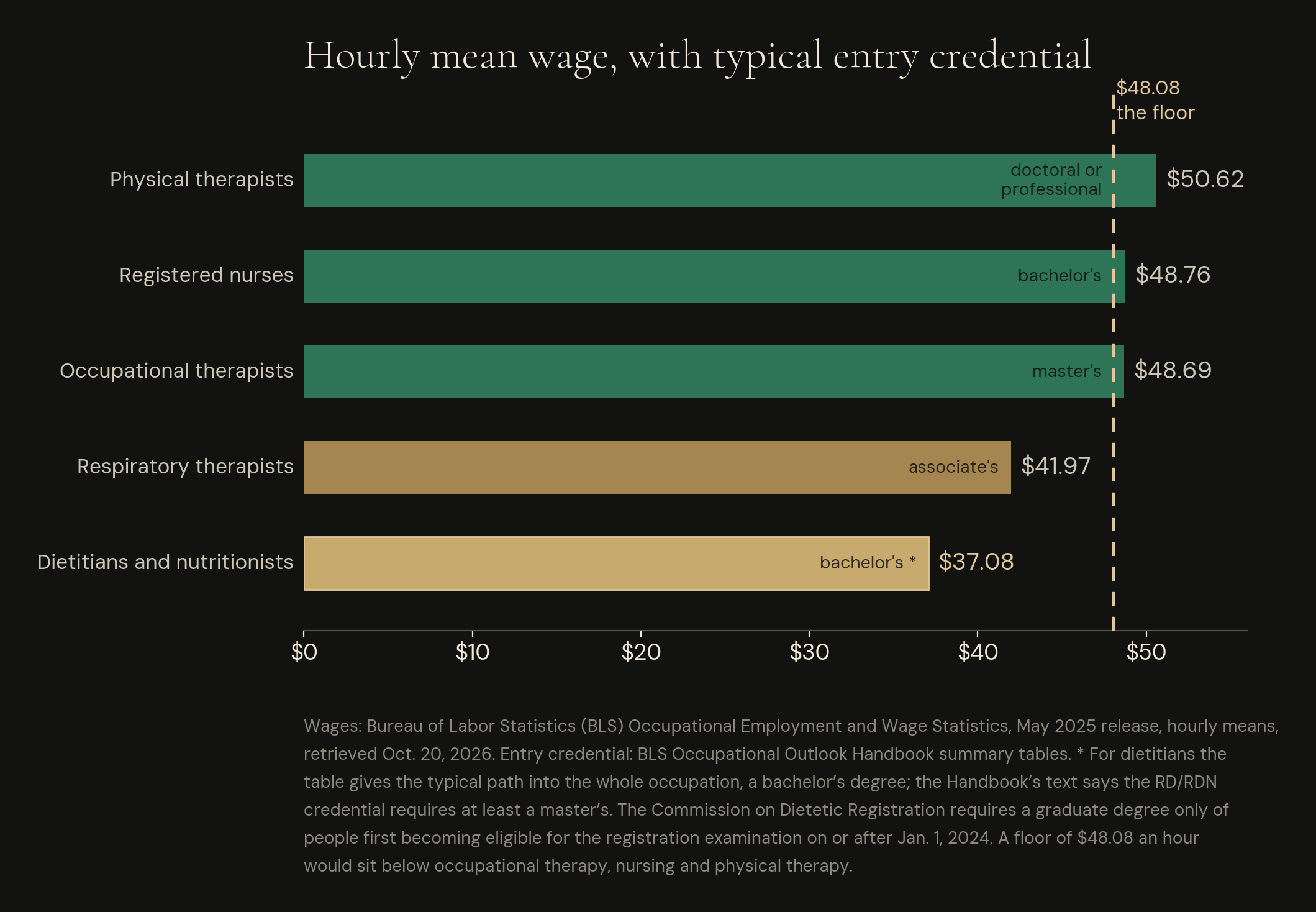
In May 2025, Bureau of Labor Statistics figures put average hourly pay at $48.69 for occupational therapists, $48.76 for registered nurses and $50.62 for physical therapists. The floor sits below all three.
Dietitians and nutritionists averaged $77,130 a year, or $37.08 an hour, about twenty-four thousand dollars a year below the nearest of those three.
Respiratory therapists averaged $87,300, which is $10,170 more than dietitians. They typically enter with an associate’s degree. Since January 1, 2024, people first becoming eligible for the dietitian registration exam need a graduate degree. As of October 20, 2026, the government’s job profile lists a bachelor’s as typical entry education and says the credential requires at least a master’s.
In a rule published May 1, 2026, the Department of Education declined to treat that graduate pathway as a professional degree. That category carries a higher loan limit.
A published number cannot force any employer to pay it. It is a thin tool. I am a registered dietitian, and a floor would benefit me directly.
Dietitians and nutritionists averaged $37.08 an hour in May 2025, according to federal wage figures from the Bureau of Labor Statistics (BLS). Registered nurses averaged $48.76. If you are a dietitian, this piece gives you three numbers from the same release to take into your next salary conversation. It also gives you a few federal documents to be furious about on the drive home.
If you are not a dietitian, your stake is simpler. If you or a parent is ever admitted to a hospital malnourished, a Medicare quality measure will check for a nutrition assessment. Its own description gives that job to a registered dietitian. The hospital decides what that dietitian is paid. This piece is about that decision.
The number I want to argue for is a hundred thousand dollars a year. I carried it around for a long time as though it were a demand. Then I did the arithmetic.
A hundred thousand dollars a year, at two thousand and eighty hours, is $48.08 an hour. Six figures sounds like a lake house. Divide it by a work year and it is still a lake house, if the lake is a puddle and the house is a rental.

This is who the puddle loses to. These are the hourly means for the credentialed clinicians a hospital dietitian works beside, from the same BLS release, May 2025:
Occupational therapists: $48.69
Registered nurses: $48.76
Physical therapists: $50.62
My radical demand loses to the average occupational therapist by sixty-one cents an hour, by my arithmetic. It loses to the average registered nurse by sixty-eight cents. It loses to the average physical therapist by $2.54. So the number I carried around like a demand comes in last in its own heat.
On The Price Is Right, the winning bid is the one closest to the price without going over. By that rule my floor wins the round, sixty-one cents under the nearest price. In a hospital budget meeting, the same bid gets called a stretch.
Now the counter, because those are averages. The median registered nurse, the one in the middle of the national range, earned $97,550 a year in the same May 2025 release, a little under the floor. I am putting that on the table myself because somebody in a budget meeting will. So my extravagant demand is, give or take $2,450, what the nurse in the exact middle of the country already makes. A floor the middle nurse nearly reaches is still the most modest demand in the building.
So here is my take, plainly. A dietitian paid a hundred thousand dollars can sound like an extravagance in a budget meeting. That dietitian would still trail the average registered nurse, the average occupational therapist and the average physical therapist. The comparison with those averages is the entire argument of this piece. Everything below it is receipts.
Two earlier pieces in this series, On the Record, were about a payment system, and about a committee that recommends to Medicare what a clinical service is worth. Both move at the speed of a federal comment period. Neither is where most dietitians are actually paid. This one is about the pay an employer sets. It needs no rulemaking, no committee and nobody’s permission. Weather happens to you. A wage is decided, in a room, by someone with a title.
In May 2025, dietitians and nutritionists averaged about twenty-four thousand dollars a year less than occupational therapists
Start with how few of us there are. In May 2025, BLS counted 77,570 dietitians and nutritionists employed. It counted 3,379,720 registered nurses. That is about forty-four nurses for every dietitian, by my arithmetic. Most people have met a nurse. The dietitian can pass for a rumor the hospital tells at orientation. A profession that small does not get noticed by accident. It barely gets noticed on purpose.
BLS counts dietitians and nutritionists as one category. I say dietitians for short. The largest single industry on the list is general medical and surgical hospitals, with 20,290 of them, about one in four. Second is special food services, at 7,740. So when I say the employer that sets the wage, for a quarter of the profession I mean a hospital.
The annual mean wage for dietitians and nutritionists is $77,130. The hourly mean is $37.08. On annual means from the same release, the gap to the nearest of the three peers, occupational therapists, is about twenty-four thousand dollars a year.
Averages hide the shape of a profession, so here is the shape. BLS publishes percentiles from the same survey. A dietitian at the 75th percentile earned $89,340 in May 2025. One at the 90th percentile earned $103,720. The floor sits between them. At least three in four dietitians earned less than the number I keep calling modest.
Now put a nurse beside her. A registered nurse at the 25th percentile, the line a quarter of nurses fall below, earned $80,330. The average dietitian earned $77,130. So at least three in four registered nurses out-earned the average of my whole profession, by $3,200 a year or more. Drop the average dietitian into nursing’s pay scale and she lands in its bottom quarter.
Pay a dietitian the floor and she beats at least three in four of her colleagues. She still trails the average occupational therapist. And the average nurse. And the average physical therapist. In dietetics, that is what we call a parade.
The 90th percentile, the highest one BLS publishes, is the profession’s penthouse. It earned $103,720. The average physical therapist earned $105,280. The penthouse turns out to be a two-bedroom down the hall from the average.
This is my view, not a finding: a pay gap like this one does not stay on the pay stub. In a hospital, dietitians help decide what patients eat, and patients are downstream of how that work is valued.
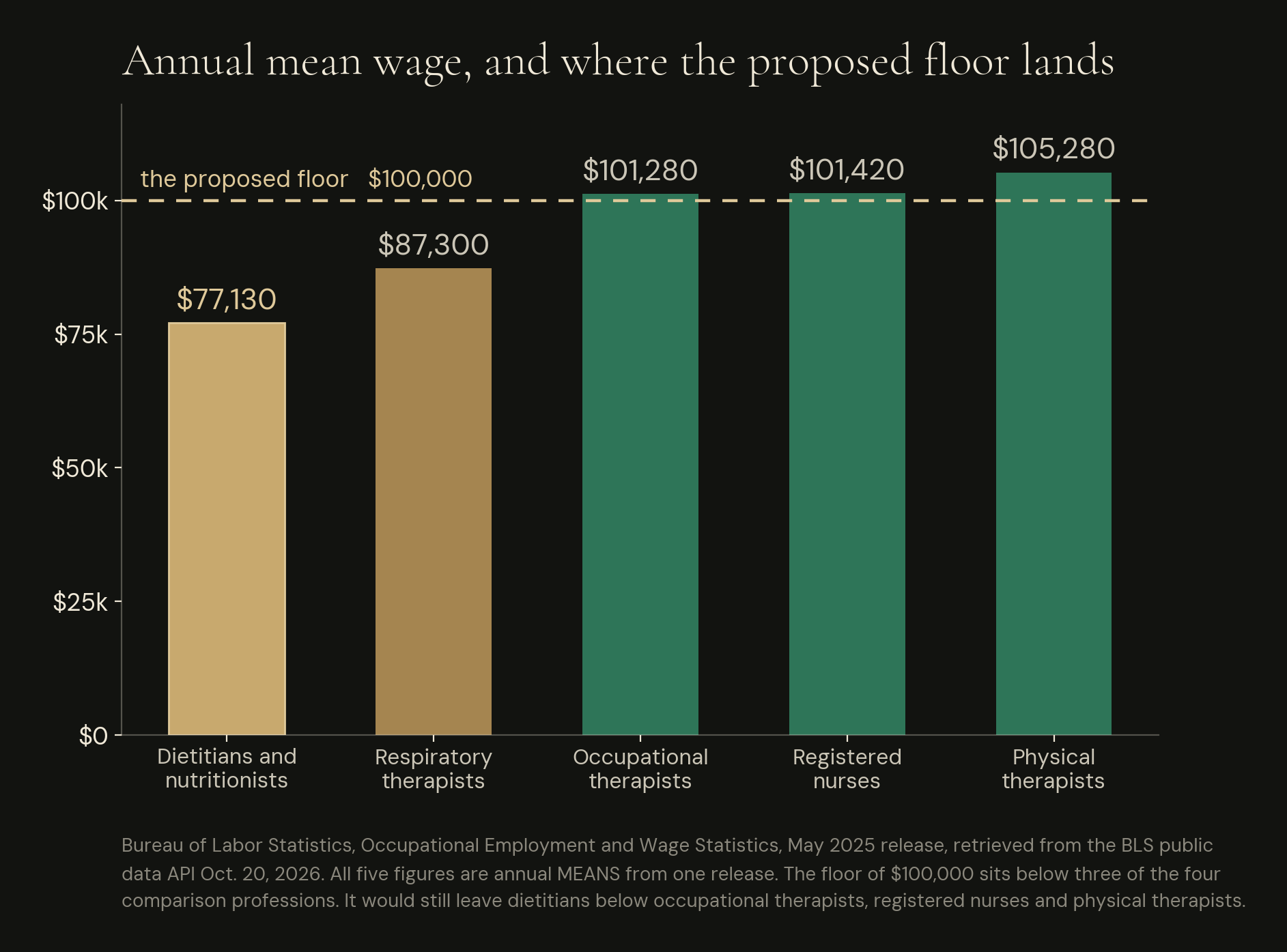
Respiratory therapists typically enter with an associate’s degree and averaged $10,170 more than dietitians in May 2025
Look again at the second bar in that chart.
Respiratory therapists averaged $87,300 in May 2025, against a dietitian’s $77,130. The difference is $10,170. Respiratory therapists manage ventilators, respond to codes and keep people breathing, and nothing here argues they are overpaid. They earned every cent. The question is what the dietitian credential costs to get, and whether the wage ever looked up from its phone.
In its Occupational Outlook Handbook, the Bureau of Labor Statistics lists the typical entry-level education for respiratory therapists as an associate’s degree.
As of October 20, 2026, the same handbook’s summary table lists a bachelor’s degree as dietitians’ typical entry-level education. Its longer text says more. Dietitians and nutritionists “typically need a bachelor’s or master’s degree,” it says, and “A graduate degree is required for some credentials.” For the registered dietitian credential, which it calls the RD/RDN designation, it says the designation “requires completion of a minimum of a master’s degree and a Dietetic Internship.”
So one federal page puts a bachelor’s in its summary table and, for the registered dietitian credential, a master’s minimum in its text. That is how the Handbook is built. The table gives the typical path into the whole occupation. The text says employers may prefer the credential but that it is “not always required.” A student who wants the registered dietitian credential today is choosing the graduate degree.
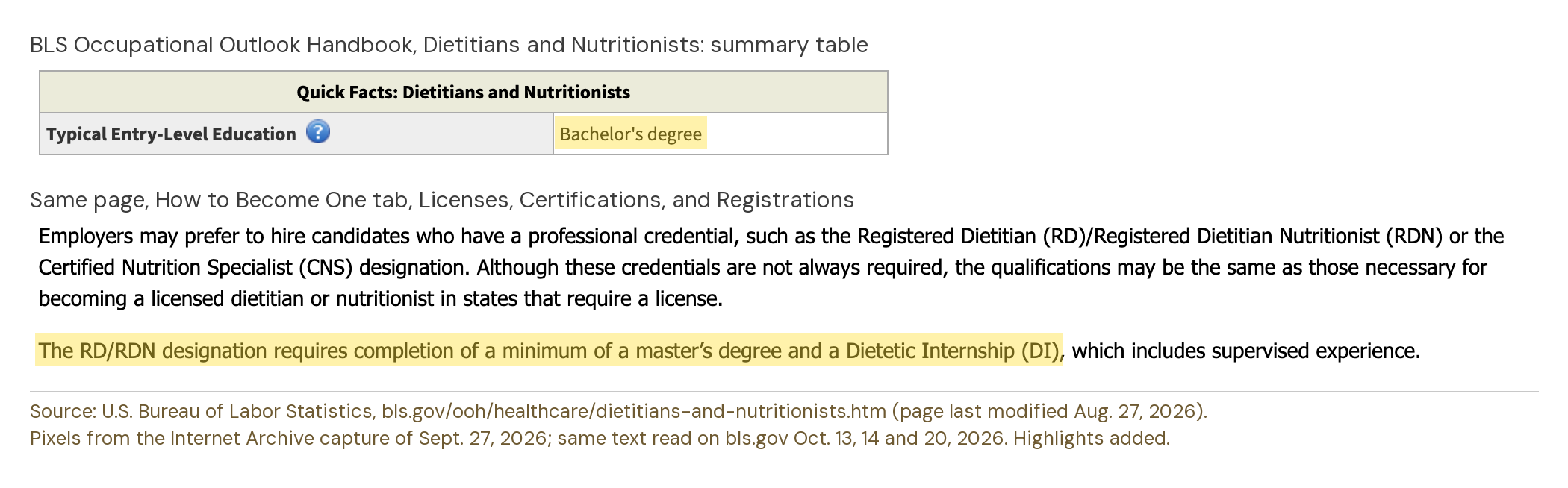
The credential rule has a date, and that is where precision matters. The Commission on Dietetic Registration requires a graduate degree only of people first becoming eligible for the registration examination on or after January 1, 2024. Those eligible earlier are exempt. That date does not appear in the Handbook’s registered dietitian sentence.
So the precise statement needs the date. For people first becoming eligible for the registration examination on or after January 1, 2024, the credential requires a graduate degree. And the average wage for the occupation that credential leads into is $10,170 below a profession that enters at an associate’s. Two degree levels up, ten thousand fewer dollars. In any other market that is called a bad trade, and somebody gets fired for it.
The change was not sudden. The Commission says it came from a “2013 joint consensus agreement decision,” based on a 2012 visioning report. The first reason it lists is that “almost all other health care professions had already increased entry-level educational standards beyond bachelor’s degrees.” The rule took effect in 2024, eleven years after that decision. The Commission’s public FAQ on it is dated July 2013. That FAQ, laying out the case for the change, said: “In 2010, RD salaries were 40-45% less than salaries of other non-physician health professionals.” Eleven years is a long time for a wage to keep looking at its phone. The degree went to graduate school. On the May 2025 means, the wage stayed home.
There is a third document in the pile. Medicare’s definition of a registered dietitian or nutrition professional, for anyone qualifying “on or after December 22, 2000,” still asks for “a bachelor’s or higher degree granted by a regionally accredited college or university.” That rule governs who may provide Medicare’s nutrition therapy. The Commission’s rule governs who may sit the exam. The Handbook table describes the whole occupation. Three documents walk into a hospital. Each is right about what it governs. Only the Handbook mentions pay, and none of them picks up the check.
My read is not a kind one. I would not blame a student who ran those numbers and chose the associate’s degree. Anyone hiring dietitians will eventually have to answer that student with a number.
The respiratory therapist gap is measured mean to mean, from the same release, for the same year.
In 2026, the Education Department weighed the dietitian’s graduate degree and declined to call it professional
That student now has a second problem, and it is printed in the Federal Register. On May 1, 2026, the Department of Education published its final rule on federal student loan limits. In its section on nutrition and dietetics, it says: “The Department is not revising § 685.102 to treat nutrition and dietetics pathways that lead to RDN credentialing as qualifying professional degree programs.”
In plain English, the government looked at the graduate degree a new dietitian must now earn and decided it does not count as professional for borrowing. That label decides how much a student can borrow.
The machinery is this. President Trump signed Public Law 119-21 on July 4, 2025. For periods of enrollment beginning on or after July 1, 2026, a new graduate student can borrow $20,500 a year in federal direct loans, and $100,000 in total. A professional student can borrow $50,000 a year and $200,000 in total. The law also, in the rule’s words, “eliminates the authority to disburse new Graduate PLUS Loans,” the loan that used to cover the rest.
A Department press release of November 24, 2025, called it “President Trump’s One Big Beautiful Bill Act” and said it “placed commonsense limits on federal student loans.” By the final rule, it was “the Working Families Tax Cuts Act.” The rule even notes that the Department “previously referred to” it by the first name. A working family’s kid who wants to be a dietitian loses Grad PLUS under either one. The law got a new name between the press release and the rule. The dietitian’s degree went into the same rule asking for a new label and came out without one.
Now the arithmetic. The most recent federal table I could reach puts average graduate tuition and required fees for full-time students at $20,513 in the 2021-22 academic year. The new annual cap is $20,500. That leaves the average graduate student thirteen dollars short, on tuition alone, at prices four years old. Thirteen dollars. That is not a gap. That is a parking validation.
The concession is real, so here it is. At public universities, in-state, the 2021-22 average was $12,596, and the cap covers that tuition with room left for rent somewhere very small. At private nonprofits it was $29,931. None of those figures includes rent, groceries or gas to a forty-hour rotation.
The Department heard all of this before it decided. Commenters told it that dietetics students “often cannot work” while finishing the required training. Individual commenters described “full-time clinical or hospital rotations of 40 or more hours per week.” The Department’s answer reads like a breakup text drafted by a statute. “The Department recognizes the seriousness of those concerns,” it wrote, and listed them. Then: “But those are not factors that Congress directed the Department to consider when classifying degrees as professional degrees or graduate degrees.”
It had already said what it would weigh instead. It would look at the program and the profession, “rather than broader workforce need, public health value, or the general importance of the work.” So the general importance of the work was walked out of the room, in writing, by a federal agency.
Then came the test, and the test is a trap with a citation. The rule says master’s degrees leading to the credential “fail the operative test for two reasons.” Some paths take “as few as five years,” against “the six years required by the definitional test.” And “to the extent that they take six years or longer, such degrees are at the master’s level, not the doctorate level.” Too short when it is short, and the wrong letters after the name when it is long. That is a catch-22 with a page number.
And then there is the sentence that deserves to be read twice. “Under that framework, the Department does not adopt commenters’ request to treat nutrition and dietetics pathways as professional degree programs because the RDN pathway now requires a master’s degree, accredited supervised practice, and credentialing. That is the core reason the Department is not revising the rule here.”

Read it the way it is printed and it says two things at once. Grammatically, the “because” can belong to the commenters, whose request rested on the master’s requirement, nearly in their own words. But the sentence is built so that it also reads as the government saying the core reason for no is that the degree is required. Four sentences later, the rule says the Department “does not revise the rule merely because the RDN pathway is now graduate entry, supervised practice based, and professionally significant.” The word “merely” arrives like a guest who missed dinner and still wants a plate.
To be fair to the Department, its longer explanation is narrower than that sentence. It says the master’s opens one credential, not the whole nutrition field, so it fails the legal test. I have read the longer version. I am quoting the grammar, not reading anyone’s mind. The line the Federal Register labels the core reason is the short one, and that is a hell of a sentence to print about a profession.
Dietetics was not singled out, and I want that on the record too. The refusal itself, “The Department is not revising § 685.102 to treat ...,” appears nearly word for word, with the field swapped in, for business degrees, education degrees, public health, social work and architecture. Even the “core reason” line turns up a second time, in the rule’s answer on fields with both undergraduate and graduate paths. The Department said no to a long line. What happened next is why it stings for the comparison in this piece.
A court stepped in. On June 24, 2026, the U.S. District Court for the District of Columbia preliminarily stayed part of the rule’s professional degree definition. The Department posted an interim list of professional degree programs on June 29, 2026, and updated it on July 10, 2026.
Occupational therapy is on that list. Physical therapy is on it. Graduate nursing, the MSN, is on it. So are physician assistants, athletic trainers and speech-language pathologists. On October 15, 2026, I searched the page for “dietet” and “nutrition” and found zero matches. Dietetics is in the room, holding everyone’s coats.
The list is interim. The Department calls the designations interim and says they “may change as litigation in the case proceeds.” It also says it “is confident that the professional degree definition in the RISE Final Rule is lawful and will continue to defend it.” Read the list beside my first chart anyway. The Department posted that interim list to carry out the court’s order. As of October 15, 2026, the three peers that out-earn even my floor on the BLS page also out-borrow dietitians on the Education Department page. The gap gets built twice, once on the pay stub and once on the loan.
Now I have to call two things by their names. On November 24, 2025, the Department published a release titled “Myth vs. Fact: The Definition of Professional Degrees.” It said: “Certain progressive voices have been fear mongering about the Department of Education supposedly excluding nursing degrees from being eligible for graduate student loans. This is misinformation.”
I call that misleading. Nursing students could still borrow at the graduate cap, so the narrowest reading survives. But a few lines down, the same release takes up the “Myth” that nurses are not seen as professionals because they are not classified as a professional degree. Its answer does not dispute the classification. It calls the label “an internal definition” and “not a value judgement,” and says 95 percent of nursing students borrow below the annual limit. So the release called the worry misinformation, then explained why the classification behind it did not matter. Translation: there is no fire, and the fire is not a value judgement.
Five months later, the final rule kept graduate nursing out of the higher limit: its factors “do not fully support treating the MSN, DNP, or DNAP as being eligible for the higher professional loan limits.” Graduate nursing reached the higher limit only after a court stayed part of the rule.
The same release said: “The Act’s annual federal loan caps are already reining in inflated prices at graduate programs across the country.” The caps apply to enrollment beginning on or after July 1, 2026, seven months after that sentence. The release’s evidence hangs on one hyperlinked word, “reining.” It leads to a think-tank blog post about one law school’s new scholarship for the following fall. The release’s own first paragraph says the limits “will help drive down the cost of graduate programs,” future tense. By its last paragraph they are already working. I call “across the country” unsupported by its own link. It is a national weather report read off one window in Santa Clara. I asked the Department on October 15, 2026, what data supported that sentence. It had not answered by publication.

To be fair to the idea, the same think tank keeps a tracker. Updated September 17, 2026, it counts 38 graduate schools and programs that have cut their net price since the caps became law. Six of those announcements cite the law. The release’s link points to the one-school post, not to any count.
Calling things what they are cuts both ways, so I checked the bigger word too. By the definition I use, authoritarian means power that answers to no court, no legislature and no voter. This record does not fit it. Congress passed the caps, the Department took public comment, a court stayed part of the rule, and the Department complied. That is ordinary government doing damage through the front door, with the lights on and a Federal Register citation. I find that worse, because it cannot be written off as a glitch. It did not take a broken rule to make this degree harder to finance. It took a comment period.
Meanwhile the same BLS Handbook projects dietitian jobs to grow 8 percent from 2025 to 2035, with “About 5,700 openings” a year. The Handbook calls that much faster than average. The Department summarized commenters’ warning that lower limits would “worsen shortages in nutrition care.” Its own rule had already said that workforce need was not the test. One federal agency projects more jobs for us. Another has capped what a student can borrow to fill one.
Here is my take, and it is the darkest one in this piece. The profession now requires the degree. Washington declined to finance it as professional. The students who cannot cover the difference will not become dietitians. Someday, in the worst week of your family’s life, you will meet whoever could afford it.
Medicare will require hospitals to report on the dietitian’s work and leaves her price to them
On August 4, 2026, Medicare published its final payment rule for hospitals for fiscal year 2027. It finalized “mandatory reporting for the Malnutrition Care Score eCQM beginning with the FY 2030 payment determination.” An eCQM is an electronic clinical quality measure, a score built from a hospital’s electronic records and reported to Medicare.
In its section for cancer hospitals, the same rule spells out the best practice the measure scores against: adult inpatients “assessed by a registered dietitian (RD) or registered dietitian nutritionist (RDN),” and given “a current nutrition care plan performed by an RD/ RDN.” When commenters urged Medicare to consider “limited dietician and nutritionist resources,” it answered that the measure can be completed at any point in the stay, which “allows flexibility for facilities that do not have a dietician on staff at all hours.”
Sit with that for a second. If you are admitted to a hospital malnourished, the federal scorecard will ask whether you got the assessment it assigns to a dietitian. Whether one is there to see you depends on how many the hospital hired, and what it decided each one is worth. The score gets computed either way. A blank box is still an answer: the measure scores it zero.
Now look at how Medicare pays for the same skill outside the hospital bed. Its nutrition therapy benefit is paid on “85 percent of the physician fee schedule amount.” A referral “may only be made by a physician when the beneficiary has been diagnosed with diabetes or renal disease.” Two conditions, and a physician has to sign the permission slip.
Payment for that benefit is made only if the beneficiary “Is not an inpatient of a hospital, SNF, nursing home, or hospice.” So for a hospital inpatient, the Medicare nutrition therapy benefit pays nothing. Zero percent of the fee schedule. At least the math is easy.
Medicare has done the Moneyball part. It started keeping her stats. It has not done the part where her contract goes up, because Medicare does not write her contract. Her employer does.
That is why this piece is about employers. For the inpatient dietitian, there is no separate Medicare payment to point at. Her time is a line in the hospital’s budget, and the hospital sets her pay. The federal scorecard will count her work from the fiscal 2030 payment determination. The pay still rounds her down. The rule I read sets no wage for her.
By MIT’s count, the average dietitian wage in Florida falls short of a living wage there for a single parent
Florida is a good place to test the floor, because its voters wrote a wage floor into the state constitution. The section, adopted by initiative in 2004 and raised by another initiative in 2020, says working Floridians are entitled to a minimum wage “sufficient to provide a decent and healthy life for them and their families.” The minimum reached $15.00 an hour on September 30, 2026. Voters put the word healthy into a wage law. It is the most nutrition-forward sentence I have read in a state constitution, and it took a ballot to get it there. I would like that clause read aloud at the start of every hospital budget meeting.
MIT’s Living Wage Calculator prices a bare-minimum version of that life for Florida statewide, on a 2,080-hour year, with data last updated February 15, 2026. One adult with one child needs $39.87 an hour, by MIT’s numbers. In the same May 2025 federal release, dietitians and nutritionists in Florida averaged $35.23 an hour. That is $4.64 an hour short, every hour, by my arithmetic. Even the national average, $37.08, falls $2.79 short.
One adult with two children needs $49.88. My floor, the number I keep calling unambitious, is $48.08. Even my radical demand is $1.80 underwater.
Bob Belcher has spent the whole run of Bob’s Burgers (Fox, 2011 to present) keeping a restaurant open that never quite clears the rent. His shortfall comes out of a writers’ room. Hers comes out of federal wage data and a university calculator, to the cent.
I want to stay here a moment, because this is a household, not a statistic. Picture a dietitian earning Florida’s average and raising one child alone there. She finished the training. She passed the exam. She spends her shifts planning other people’s meals. By MIT’s arithmetic, she is still short every hour she works. She is not the problem in this piece, and nothing in it asks her to be grateful.
Florida’s legal minimum is now about a third of my floor. The floor itself falls short of what MIT says one parent needs to raise two children in Florida.
A published floor gives a dietitian a document to argue from, and not much more
On March 21, 1957, an Army dietitian stood at a bedside on a hospital ward in Landstuhl, Germany, and wrote down what a patient wanted to drink. Somebody photographed her doing it.

Sixty-nine years later, on August 4, 2026, Medicare finalized a rule making hospitals report on a dietitian’s bedside work, starting with the fiscal 2030 payment determination. The assessment and the care plan its measure scores against are assigned, in the rule’s own words, to a registered dietitian. The work made it into federal regulation. Her pay is still set one hospital at a time.
I am not proposing that anyone can compel a hospital to pay a number. A published benchmark does something narrower and more useful. It gives one clinician something to put on a desk. A document cannot be talked out of itself, and it does not accept gift cards.
Right now a dietitian negotiating a salary may be arguing from a feeling. Feelings do not survive budget meetings. Spreadsheets sometimes do. With a published floor, derived from a stated method against a named comparison class, she is arguing from a document. The burden then shifts to explaining why this particular institution pays below it.
So read the document out loud, because it is short. On the May 2025 percentiles, a dietitian paid the floor would out-earn at least three in four of her own colleagues. The nurse at the 25th percentile, at $80,330, would no longer out-earn her. She would still trail the average occupational therapist, nurse and physical therapist, in the same release.
I carried the hundred thousand around as a demand. Read against that release, it is a nurse’s average with a discount. In a budget meeting it will still be called ambitious, which tells you more about the meeting than about the number.
That is not nothing. It is also not much. Its limits come at the end of this piece. First, here is how to use it.
If you are one person, ask for the reasoning behind the gap
Take the three peer numbers into your next compensation conversation. Not the hundred thousand. The three peer numbers, and the release they come from.
Do not lead with “will you pay me more.” That question gets you a sympathetic face and a form. Put the question this way: occupational therapy, nursing and physical therapy all averaged above forty-eight dollars an hour nationally in May 2025. What is the reasoning for this position sitting at thirty-seven?
If you supervise or hire dietitians, you may be the one asked that question. Run the same comparison for your own institution before someone runs it for you. From the fiscal 2030 payment determination on, Medicare will require hospitals to report a measure that scores the assessment and care plan its own description assigns to the dietitian. The question gets louder.
None of this is on you if you are the dietitian in that chair. You did the training they asked for. The question belongs to the people who set the number.
That question has an answer, or it does not. Either outcome tells you something. If the answer arrives as a pizza party, that is also an answer.

Severance built a whole workplace thriller on employees rewarded with waffle parties and finger traps. It was supposed to be satire. Most hospitals have not gone full Lumon. Pizza, though, is within budget.
Ask every year. Write the answer down every time. Groundhog Day (1993) ran one day on a loop until Phil Connors got it right. A salary conversation loops once a year whether or not anyone gets it right. An answer that does not change for three years in a row is also data, and you are allowed to act on it.
Bring the release name with the numbers: Bureau of Labor Statistics, Occupational Employment and Wage Statistics, May 2025. A wage with a release attached is harder to wave away than a feeling. And remember what the release says: the average dietitian earned less than a nurse at the 25th percentile, and her assessment is what Medicare will check for.
If you are an organization, publish a benchmark anyone can rebuild
Publish your own, with the method attached.
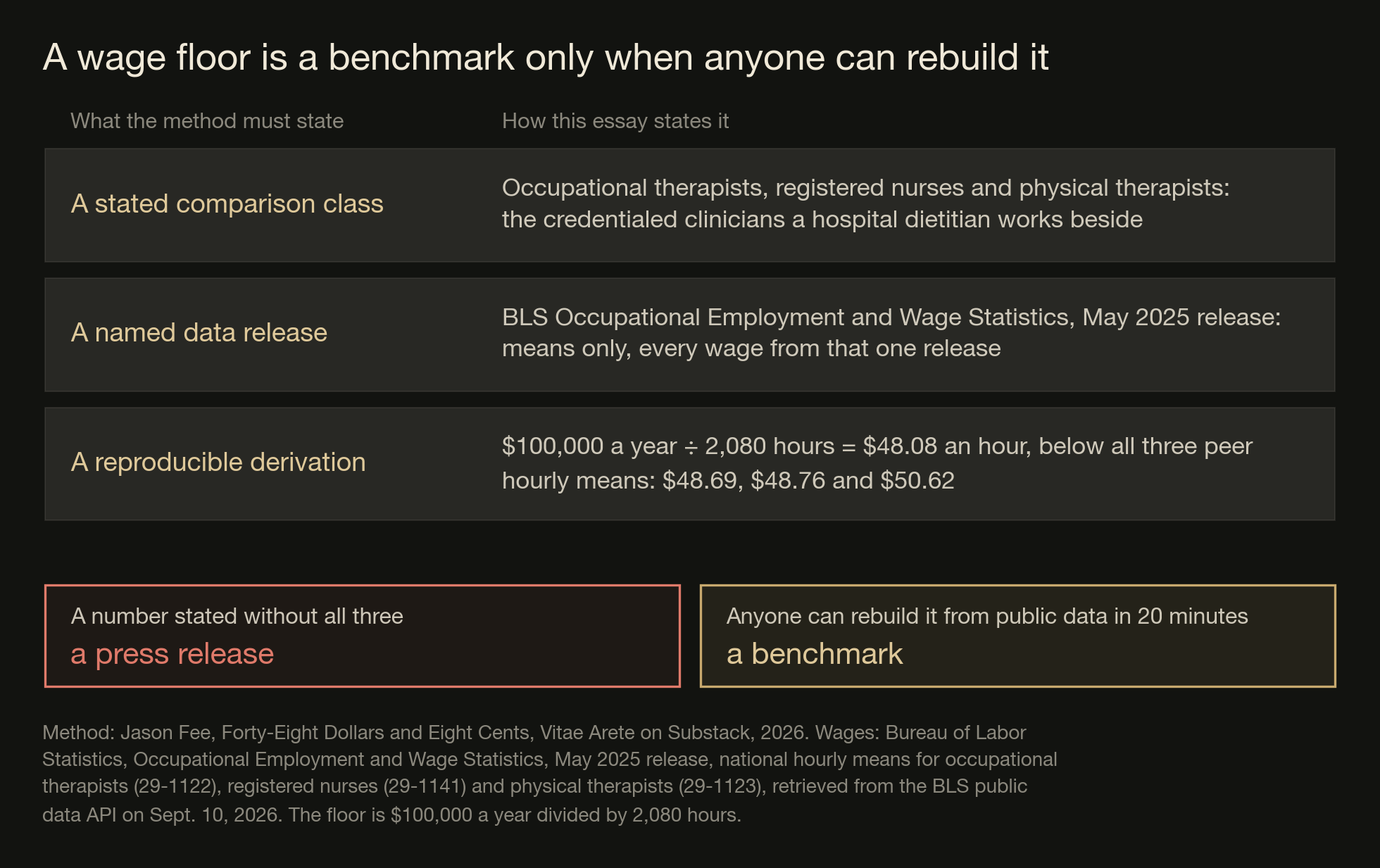
The method is the whole thing. A number without a stated comparison class, a named data release and a reproducible derivation is a press release. A number like that has the evidence base Brian Fantana gives his cologne in Anchorman (2004): “60% of the time, it works every time.” A number that anyone can rebuild from public data in twenty minutes is a benchmark. It works like the phone-a-friend lifeline on Who Wants to Be a Millionaire (ABC, 1999), except the friend is a federal statistical agency and it has the answer written down.
In 1937, the Commissioner of Labor Statistics pointed at a chart of industrial payrolls in his Washington office, and Harris & Ewing photographed him doing it. The agency he ran produced every occupational wage figure in this piece. Eighty-eight years later, in 2025, the White House called the same agency incompetent. The chart did not change. The people looking at it did.
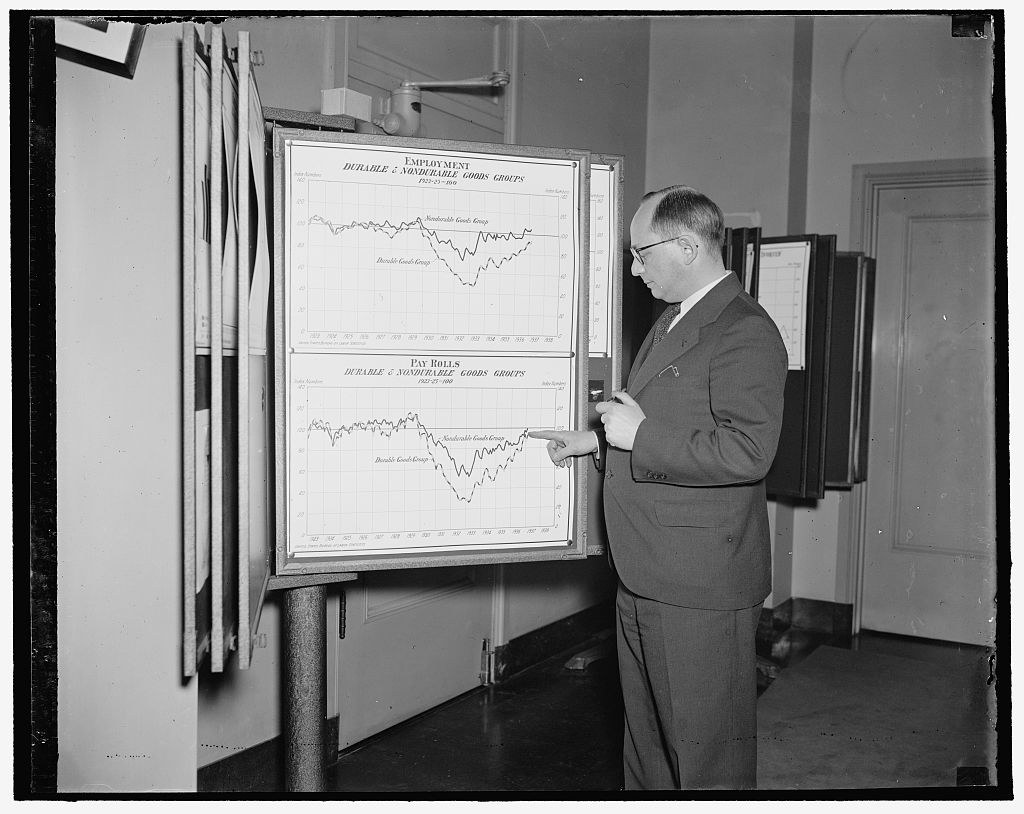
That chart hung in the agency that still publishes the wage figures this piece is built on. Below is the same kind of derivation, for 2025.
About 2025. On August 1, 2025, a White House release headlined “BLS Has Lengthy History of Inaccuracies, Incompetence” said that under its commissioner, BLS “consistently published overly optimistic jobs numbers” that were “quietly revised later.” I call “quietly” misleading. The release’s own first example was a revision BLS published that same day: “Today, BLS had to revise down May and June jobs reports by a combined 258,000 jobs.” And the technical note BLS publishes with every jobs report already said, in its version dated July 3, 2025, four weeks before the White House release: “The prior 2 months are routinely revised to incorporate additional sample reports and recalculated seasonal adjustment factors.” Quiet, in the sense of printed in advance on the agency’s own website.
The wages in this piece come from a different BLS survey, Occupational Employment and Wage Statistics, not the jobs report. Those wage figures are not optimistic about anything. If anything, they are rude. I raise the White House release anyway, because you will carry a BLS number into a meeting. Someone across the table may have heard that federal numbers are suspect when they are inconvenient. In season four of The Wire (HBO, 2006), Baltimore’s schools teach to the test so the numbers look good. This piece wants the opposite: numbers that look bad and are right. The method is published. Check it, then put it on the desk.
The wage and employment figures in this piece came from the Bureau of Labor Statistics. They came through its public data API, its system for downloading data directly, and its occupation profile and query pages. The occupation codes are in the source note below, so anyone who wants to check the figures can. Every other source is listed there too.
I would rather be corrected than repeated.
If you hold a board seat, a chair or a directorship and you would rather start from something than from nothing, message me, and I will send the derivation above.
If you are not in one of those roles but you know somebody who is, send this to them. A benchmark only does work once somebody with standing publishes one.
Publication is the only mechanism in this piece, and it is a thin one
The only mechanism in this piece is publication. Print a number, hope employers respond to it, hope individual clinicians use it in individual conversations. That is the whole plan, and I am aware it sounds like a vision board.
This piece does not survey how other professions moved their wages. In the cases I know of, wage gains in other professions came with something more than publication. Some have had collective bargaining. Some have had a licensure structure that constrained who could do the work. Some have had a payment change underneath.
Two floors I can document were written into law, not posted online. Florida’s came by voter initiative, into the state constitution. California’s came by statute. SB 525, a health care worker minimum wage, was approved by the governor on October 13, 2023. According to the state’s labor department, it reached $25 an hour on July 1, 2026, at hospitals and health systems with 10,000 or more full-time employees. The state’s guidance defines covered work broadly, as “patient care-related services” and services supporting patient care. It does not name dietitians, and I am not claiming more than its words.
Neither state published a benchmark and waited for a thank-you card. Benchmarks are how you ask nicely. Floors are how a state stops asking. In May 2025, a dietitian at the national 10th percentile earned $23.60 an hour. That is a national figure set beside one state’s law, so it is not a like-for-like comparison. It is still a dietitian or nutritionist earning less per hour than the floor California set for many health care workers at its largest systems, food service included.
So a benchmark alone is a thin instrument. I am proposing it because it is the one option here that requires nobody’s permission. In clinical terms, it is the multivitamin of labor strategy: no prescription needed, and no cure on the label. Anyone who tells you a published number will fix this is overselling it.
I do not have a worked argument for collective bargaining in dietetics. I have not studied it. I do not know what proportion of clinical dietitians are in bargaining units, or what happened to wages where they are. That is a piece I would like to read and cannot currently write.
Next
Four more, and all of them run before the end of the year. Next month, the bill that would expand Medicare’s nutrition benefit and the question that has stopped it for years, which is not a clinical question at all.
A note on who pays for this
No outside institution does.
There is no grant behind this work and no outside organization underwriting the time, the document fees, or the research.
This piece is free to read. If it is useful to you and you can afford it, a paid subscription is what funds the next one and the advocacy that goes with it. If you cannot, that is genuinely fine. Forwarding this to one person who is in a position to act on it is worth more to me than the subscription is.
Wage figures are annual and hourly means from the Bureau of Labor Statistics Occupational Employment and Wage Statistics, May 2025 release, retrieved from the BLS public data API: dietitians and nutritionists 29-1031, respiratory therapists 29-1126, occupational therapists 29-1122, registered nurses 29-1141, physical therapists 29-1123. Entry-level education fields are from the BLS Occupational Outlook Handbook profiles for the same occupations; the Handbook text quoted above was read October 13, 14 and 20, 2026 (page last modified August 27, 2026). The point that the summary table gives the typical path into the whole occupation comes from the Bureau of Labor Statistics method notes, read October 14, 2026. The Occupational Outlook Handbook reports medians from the same wage survey; medians and means are different statistics and are not mixed in any comparison here. The one median in the text, for registered nurses, comes from the same May 2025 release as the means and is labeled as a median. Percentiles (10th, 25th, 75th and 90th) come from the same May 2025 release and are labeled as percentiles wherever they sit beside a mean. The Commission on Dietetic Registration’s graduate degree requirement took effect January 1, 2024. It applies only to people first becoming eligible for the registration examination on or after that date (Commission on Dietetic Registration, 2024 Graduate Degree Requirement, read October 20, 2026).
Other sources, read October 15, 2026: BLS Occupational Employment and Wage Statistics profiles for 29-1031, 29-1141 and 29-1126, May 2025 (percentiles, employment and industries); BLS OEWS May 2025 state estimates, Florida, 29-1031 (OEWS query system); BLS Occupational Outlook Handbook, Dietitians and Nutritionists, Job Outlook (last modified August 27, 2026); U.S. Department of Education, Reimagining and Improving Student Education final rule, Federal Register, May 1, 2026, 91 FR 23768, FR Doc 2026-08556 (loan limits at 91 FR 23785 and 23815; Grad PLUS at 91 FR 23769; nursing at 91 FR 23795; nutrition and dietetics at 91 FR 23805 to 23807; the same “not revising § 685.102” discussion for business, education, public health, social work and architecture pathways at 91 FR 23792 to 23803); Federal Student Aid, Electronic Announcement GENERAL-26-42, posted June 29, 2026, updated July 10, 2026; U.S. Department of Education, “Myth vs. Fact: The Definition of Professional Degrees,” November 24, 2025; American Enterprise Institute, Preston Cooper, “The ‘Big, Beautiful Bill’ Is Already Bringing Down Tuition,” October 2, 2025, and Graduate School Tuition Cut Tracker, updated September 17, 2026; National Center for Education Statistics, Digest of Education Statistics 2022, Table 330.50 (2021-22); Centers for Medicare and Medicaid Services, fiscal year 2027 hospital inpatient payment final rule, Federal Register, August 4, 2026, 91 FR 49570, FR Doc 2026-15833 (mandatory reporting at 91 FR 49573; staffing comments and response at 50006; measure overview at 50008 to 50010); eCQI Resource Center (HealthIT.gov), definition of electronic clinical quality measures; 42 CFR 410.132, 410.134 and 414.64; Commission on Dietetic Registration, “Why is the Degree Requirement for Registration Examination Eligibility Changing?”; Commission on Dietetic Registration, Graduate Degree FAQ, July 2013 (Internet Archive capture of February 9, 2014); MIT Living Wage Calculator, Florida (data updated February 15, 2026); Florida Constitution, Article X, Section 24; California SB 525 (Chapter 890, Statutes of 2023) and the California Department of Industrial Relations health care worker minimum wage FAQ; The White House, “BLS Has Lengthy History of Inaccuracies, Incompetence,” August 1, 2025; BLS Employment Situation technical note (last modified October 2, 2026; and the version last modified July 3, 2025, Internet Archive capture of July 14, 2025). Arithmetic on these figures is mine.
This article is general nutrition education, not individualized medical or nutrition advice, and it does not create a dietitian–client relationship. Medications and their side effects should be managed with your prescribing clinician. See the full disclaimer.