Summary
On May 22, 2025, a presidential commission chaired by Health and Human Services Secretary Robert F. Kennedy Jr. released the Make America Healthy Again report on children’s health. I compared, footnote by footnote, four versions the White House posted in its first week. Some errors were fixed and others still stand, though the files do not show why or who wrote the citations. My grade is an F.
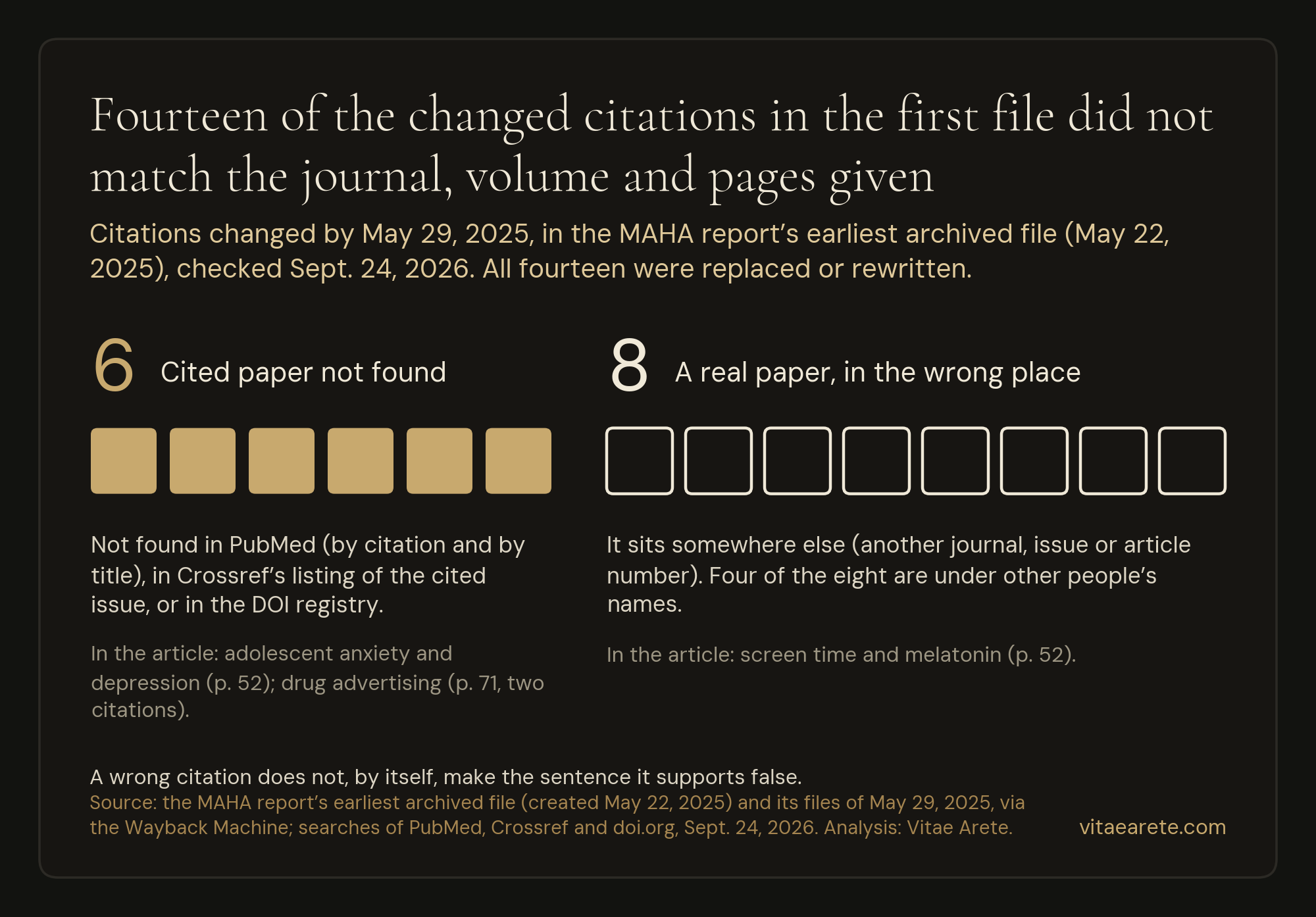
Of the citations changed by May 29, 2025, fourteen in the first file did not match the journal and pages they gave. Six named papers I could not find anywhere I searched. Eight named real papers that sit elsewhere.
A May 27, 2025, version marked five fixes with dated notes. The May 29 versions dropped them. On September 24, 2026, I found no notice in the file online that it had changed.
That file still cites a 2018 study for a 250 percent rise in stimulant prescriptions. I did not find that number in the study. It found stimulant use doubled, measured by drug weight, not prescriptions. The same sentence says stimulants did not improve outcomes long-term, which is more certain than the wider research I read. Of five claims I set beside that research, two hold up, including the rise in diagnoses of ADHD, an attention disorder, and two hold in part.
Some fixes reached one footnote but not another. A claim about ultra-processed food in mothers’ diets still names the wrong authors and paper. The right paper comes close to supporting it.
I read seventeen citations, mostly as abstracts (a paper’s short summary). Fifteen overstate their source or, on what I read, do not support the sentence. Three of those were already replaced. The seventeen are not a fair sample.
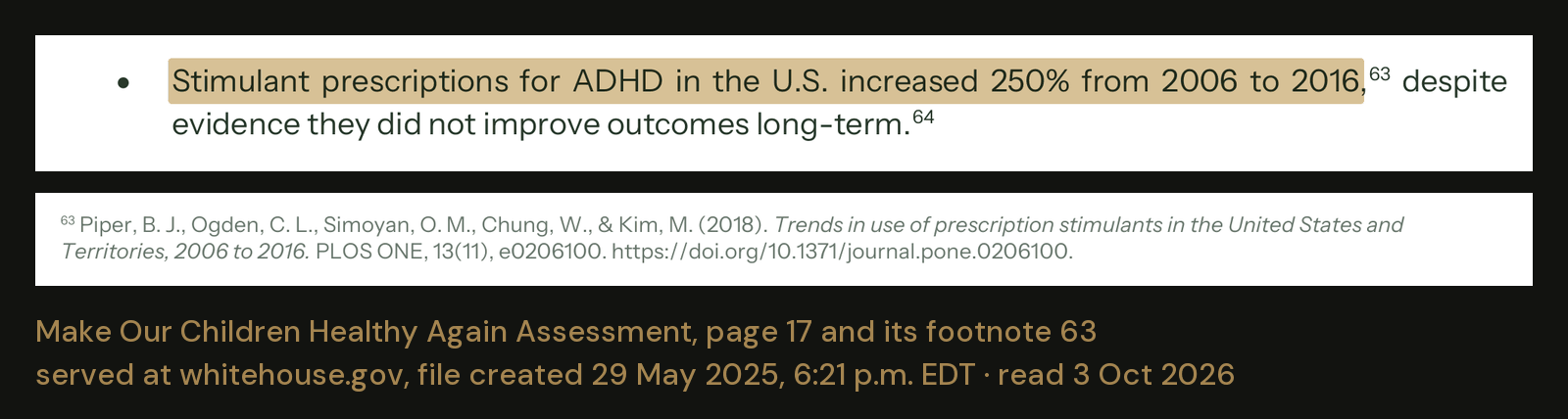
On page 17, the Make America Healthy Again (MAHA) report says stimulant prescriptions for ADHD, an attention disorder, rose 250 percent from 2006 to 2016. The file the White House serves today cites one 2018 study for that rise. On September 24, 2026, I searched the study’s full text for that number. It is not there.
On May 22, 2025, the Presidential Commission to Make America Healthy Again released the Make Our Children Healthy Again Assessment. The White House’s own page calls it “The MAHA Report.” President Trump’s order made the Secretary of Health and Human Services, Robert F. Kennedy Jr., the commission’s chair. The same order made the President’s domestic policy adviser its executive director. Kennedy presented the report to the President that day.
The file online today also keeps citations that were corrected in one footnote and left wrong in another. And on September 24, 2026, it carried no notice that it was ever changed. A version posted in the report’s first week had marked five fixes with dated notes.
The report runs seventy-three pages, with 522 footnotes. In its first week the White House website served at least four versions of the file. I compared all four, footnote by footnote. I checked where every changed citation points. And I read seventeen of its citations against the sentences they support.
Others got here first. On May 29, 2025, the news site NOTUS reported that the report cited studies that did not appear to exist. The Washington Post reported the same day that, according to AI experts, some citations appeared to have been generated using artificial intelligence. Both reported that the fixes made that day removed the report’s earlier correction notes. NOTUS also found that some replacement citations, including those for psychotherapy and for recess, still did not support their sentences. What I add is a comparison of all four files and a record of what is still wrong in the one online today.
A footnote is supposed to tell you where a claim comes from, down to the page. That way you can check it yourself instead of taking the report’s word. It fails when the source is not where the footnote says. It also fails when the source says something other than the sentence.
This piece is part of my series grading the MAHA record. The series runs on Wednesdays and Saturdays.
A May 27 file marked five fixes with dated notes, and later files dropped them
The Internet Archive’s Wayback Machine, which saves copies of web pages, holds all four files. Each records when it was made, shown here in Eastern time:
May 22, 2025, 12:59 p.m. The earliest copy archived.
May 27, 7:25 p.m.
May 29, 1:56 p.m.
May 29, 6:21 p.m. The file online today.
On September 24, 2026, both of the report’s web addresses served that last file, byte for byte.
By my comparison, fifty-three of the 522 footnotes differ between the earliest file and the current one. Twelve of those changes are punctuation. The other forty-one change a source, its details or its link.
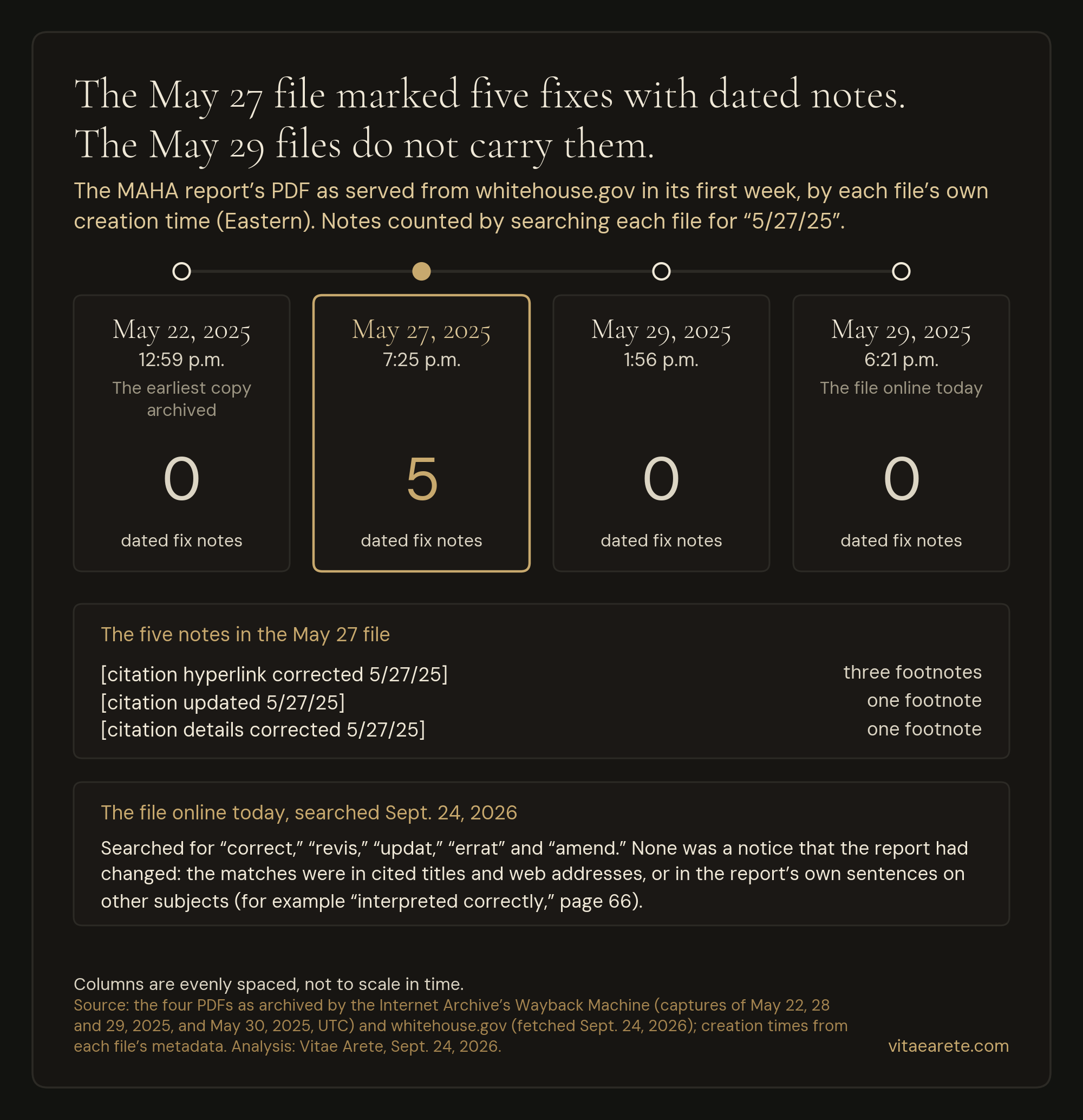
The May 27 file marked five of its fixes inside the footnotes. Three notes read “[citation hyperlink corrected 5/27/25],” one reads “[citation updated 5/27/25]” and one “[citation details corrected 5/27/25].” The files made on May 29 do not have them. A search of each version for “5/27/25” finds it zero times in the first, five times in the second, and zero times in the third and fourth.
On September 24, 2026, I searched the current file for the word stems “correct,” “revis,” “updat,” “errat” and “amend.” None of the matches was a notice that the report had changed. They were in cited titles and web addresses, or in the report’s own sentences on other subjects (for example “interpreted correctly,” page 66). I am holding the file to the standard its own May 27 version set: a dated note on each fix.
The fixes started early. The May 27 file was made, and archived by the next afternoon, before NOTUS’s first story on the citations. That story came early on May 29, 2025. I do not know what prompted the fixes.
Spokespeople for Kennedy’s department, the Department of Health and Human Services (HHS), gave NOTUS and The Washington Post the same statement that day. It said: “Minor citation and formatting errors have been corrected, but the substance of the MAHA report remains the same.” It went on to call the report “a historic and transformative assessment by the federal government.” On September 24, 2026, I searched HHS’s website for any statement about the corrections and found none. HHS’s own site search failed on several of my queries that day, so that search is incomplete.
On May 29, 2025, the White House press secretary, Karoline Leavitt, was asked at her briefing whether information from HHS could be trusted. “We have complete confidence in Secretary Kennedy and his team at HHS,” she said. She understood there were “some formatting issues with the MAHA report that are being addressed,” and that the report would be updated.
On June 24, 2025, Kennedy testified on his department’s budget to a House Energy and Commerce subcommittee. Representative Raul Ruiz, a California Democrat, asked whether he had read the report and fact-checked its sources before it was published. Kennedy said he had not fact-checked them himself, and that “all of the foundational assertions in that report are accurate.” He called the wrong citations “a mistake” and said they had been corrected within a day.
What the first file cited
Of the citations changed by May 29, 2025, fourteen in the earliest file do not match what sits at the journal, volume and pages they give. For six, I could not find the cited paper anywhere I searched on September 24, 2026. I searched PubMed, the National Library of Medicine’s index, by citation and by title. I searched the listing of each cited issue at Crossref, where publishers register their papers. And I searched the registry of DOIs, the permanent web addresses publishers give papers. The other eight are real papers that sit somewhere else: another journal, issue or article number. Four of them are listed under other people’s names.
By May 29, 2025, all fourteen had been replaced or rewritten. A wrong citation does not by itself make a sentence false. Some of the sentences below are true of the right paper.
NOTUS’s widely repeated count was seven studies that did not appear to exist. The NOTUS stories I read name four of them, and all four are among my six. The two counts use different tests. In mine, a real paper cited in the wrong place counts among the eight, not the six.
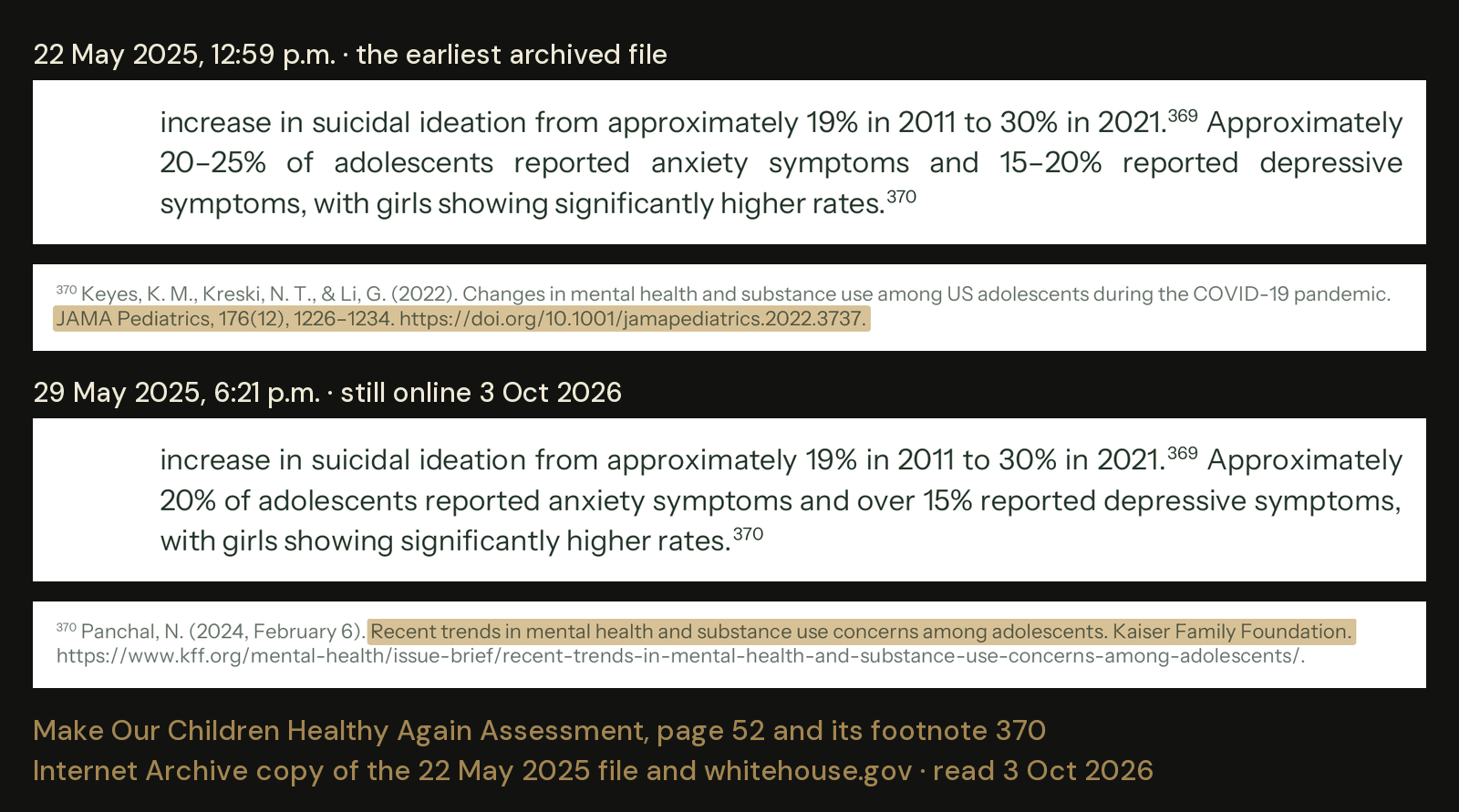
One of the six sat under a sentence on page 52 about adolescents. It gave ranges: anxiety symptoms in 20 to 25 percent, depressive symptoms in 15 to 20 percent. It cited a 2022 paper in JAMA Pediatrics, with a DOI. On September 24, 2026, that DOI was not registered. Crossref’s listing of the issue shows other articles at those pages. The May 29 files cited a 2024 brief from KFF, the health policy research group, instead. They also changed the numbers to “Approximately 20%” and “over 15%.” The brief supports them: “In 2021 and 2022, 21% of adolescents reported experiencing symptoms of anxiety in the past two weeks and 17% reported experiencing symptoms of depression.” That repair worked.
Two more of the six sat on page 71, under sentences about drug advertising. The earliest file said the ads “were found” to use vague symptom lists, and cited two studies. A PubMed search for either title on September 24, 2026, returned no records. The cited pages hold other articles. The current file cites a New York Times article and a 2006 study of prescribing trends instead. Its sentences now say such advertising has “been suggested” to use those lists. They also say it “is believed to encourage” more use of psychiatric drugs by adolescents.
One of the eight sat under another sentence on page 52. It said evening screen time “delays melatonin production by up to 1.5 hours in children.” The paper it cited is really a 2011 study of twenty-one college students, as its lead author, Figueiro, told NOTUS in May 2025. Its abstract calls the effect of the monitor alone “not statistically significant.” A figure of about ninety minutes does appear in a second cited study, of adults under room light.
The May 29 files dropped the number and cited newer papers on children’s screens and sleep. NOTUS noted the swap at the time.
On page 18 the earliest file said “a systematic overview shows that psychotherapy is just as effective as drugs in the short term, and potentially more effective in the long term.” It cited a Cochrane review that compared antidepressants with each other and with placebo, not with psychotherapy. One of its authors made that point to NOTUS in May 2025. The replacement does make the comparison. It is a 2023 overview by Cuijpers and colleagues. Its abstract also says psychotherapy’s effects “are significantly smaller in children and adolescents.” And it says “Combined treatment is more effective than either psychotherapy or pharmacotherapy alone.” The report puts the comparison in a sentence about teenagers. Cuijpers told NOTUS in May 2025 that the reference is “not usable in adolescents.” I have read only the abstract.
What the fixes changed in the text
The fixes also reached the report’s own numbers. On page 18, antidepressant prescription rates in teens “increased by 1,400%” became “increased by 14-fold.” The cited paper says use “grew 14-fold between 1987 and 2014.” Fourteen-fold is a 1,300 percent rise, so the new wording is the paper’s. Antipsychotic prescriptions for children went from “increased by 800% between 1993 and 2009” to “increased eight-fold between 1995 and 2005.” That matches the cited paper.
The numbers now match. The limits on those numbers did not come along. The fourteen-fold rise comes from young people under twenty “continuously enrolled during each study year in a mid-Atlantic state Medicaid program.” The report presents it as a figure for teens. The eight-fold rise counts “treatment visits.” The report says prescriptions.
The new citation did not always fix the sentence. On page 50, the sentence “Since the 1970s, recess and physical education (PE) have steadily declined” now cites a 2009 study in the journal Pediatrics. The study looked at how much recess 8- and 9-year-olds got, using data on the kindergarten class of 1998 to 1999. As NOTUS pointed out in May 2025, it does not support the claim. On September 24, 2026, I read its abstract and found no decline since the 1970s. The sentence cites two more sources, which I have not checked.
Page 17 says 250 percent and page 59 says doubled, citing the same study
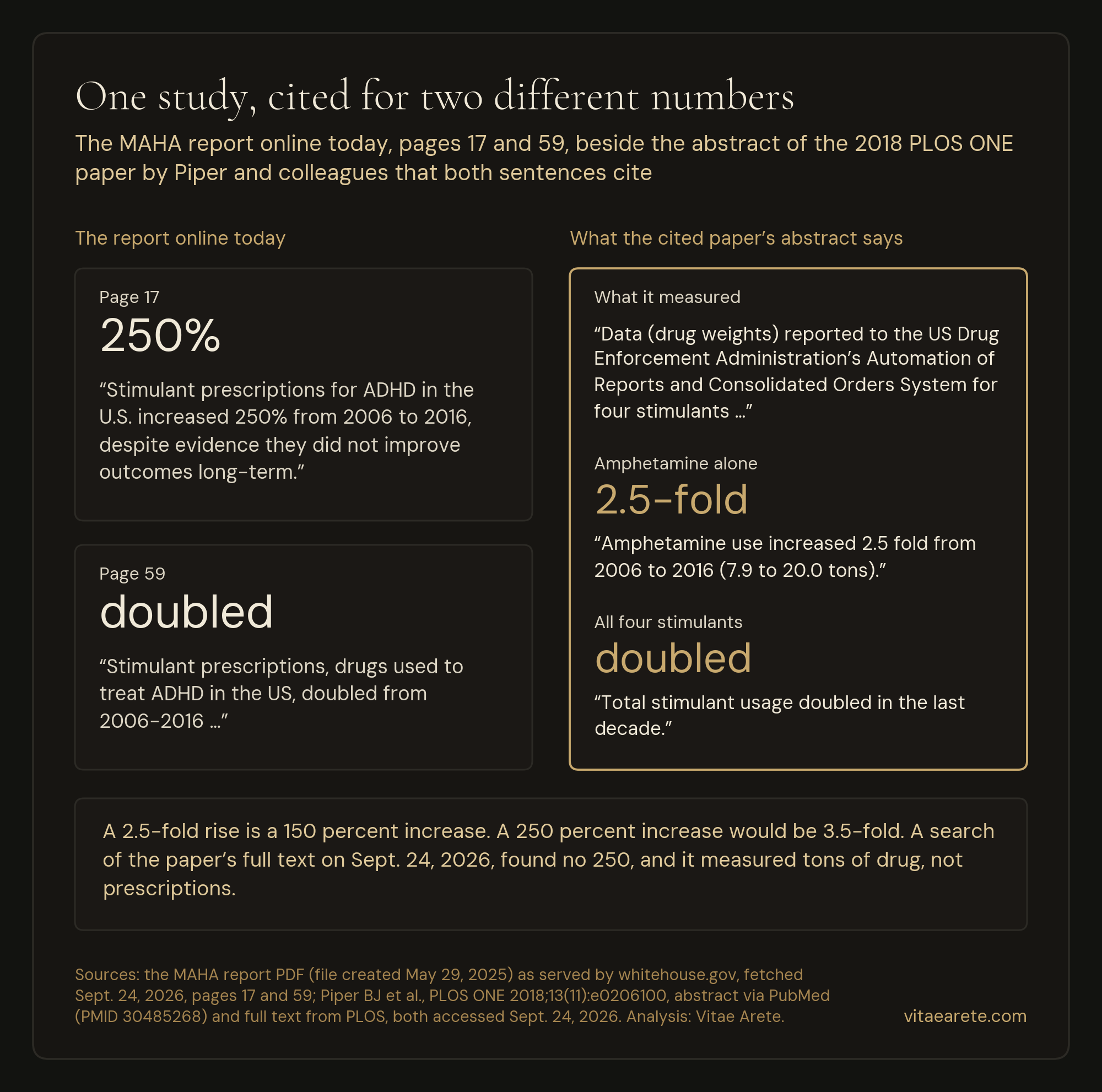
The report cites one study for two different numbers. On page 17: “Stimulant prescriptions for ADHD in the U.S. increased 250% from 2006 to 2016, despite evidence they did not improve outcomes long-term.” On page 59: “Stimulant prescriptions, drugs used to treat ADHD in the US, doubled from 2006-2016 ...” The study is a 2018 paper in the journal PLOS ONE, by Piper and colleagues. Neither sentence has changed since the earliest file.
The paper tracked four stimulants. For all four together, its figure is the one on page 59: “Total stimulant usage doubled in the last decade.” Its larger number belongs to one drug: “Amphetamine use increased 2.5 fold from 2006 to 2016 (7.9 to 20.0 tons).” A 2.5-fold rise is a 150 percent increase. A 250 percent increase would be 3.5-fold. And the paper’s data are “drug weights” reported to the Drug Enforcement Administration, not prescriptions.
On page 18 the report fixed the same kind of slip for antidepressants. The stimulant sentence is one page earlier. It is unchanged. Understood.org rated that sentence “somewhat true, but very misleading” in June 2025, for its claim about long-term outcomes. My point here is narrower. It is about the number. The research section below takes up the long-term claim.
What else still stands
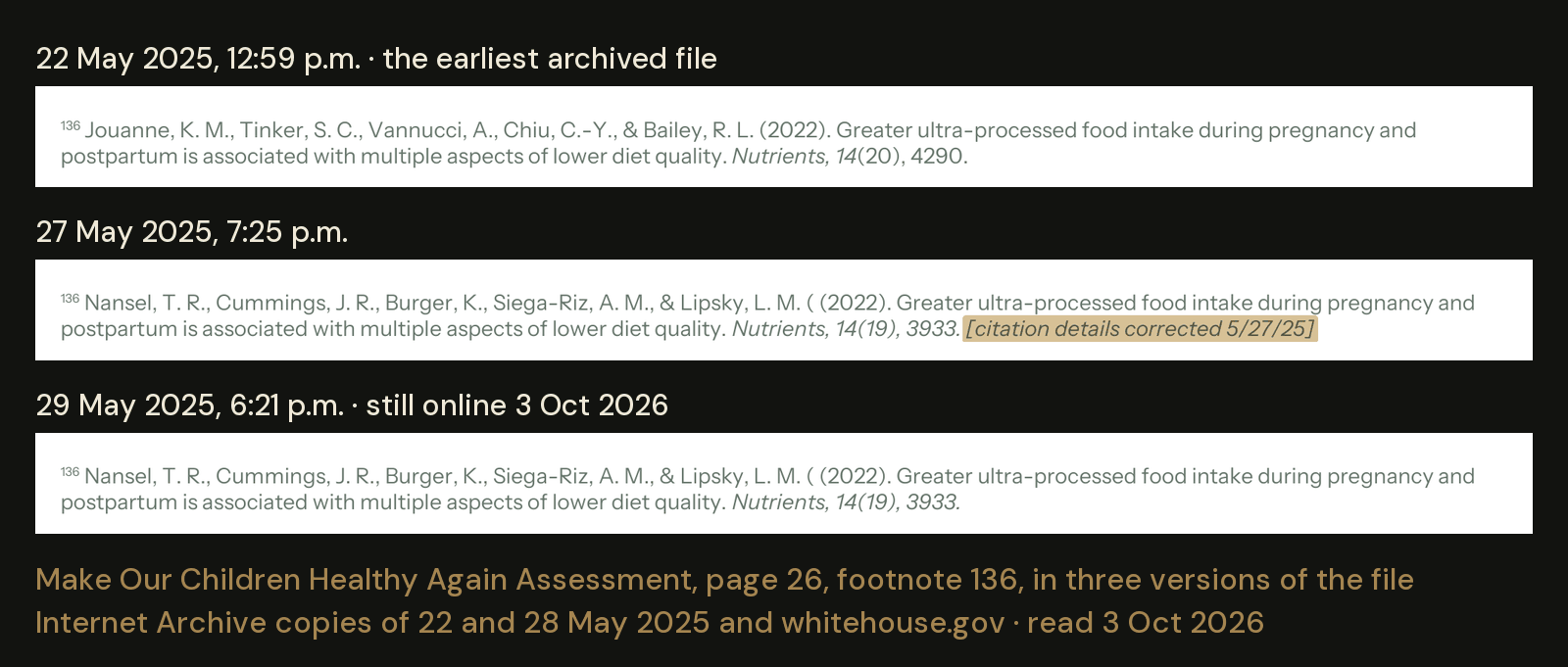
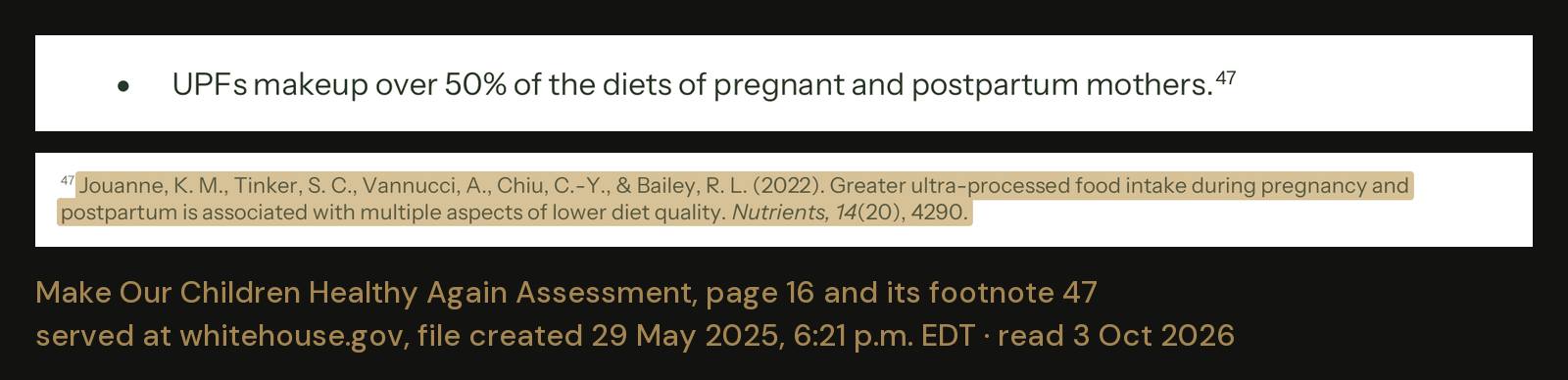
The file online today has other citation problems. On page 16 the report says: “UPFs makeup over 50% of the diets of pregnant and postpartum mothers.” UPFs are ultra-processed foods. Footnote 47 credits the claim to “Jouanne, K. M.” and four co-authors, 2022, in Nutrients, volume 14, issue 20, article 4290. That slot holds a different paper, about menus in diet apps. The same citation appears again at footnote 136. There, on May 27, 2025, it was corrected to the real authors, Nansel and colleagues, and the real location, issue 19, article 3933. The fix carried the note “[citation details corrected 5/27/25].” Footnote 47 still carries the old version.
The finding is in the right paper. Nansel and colleagues report that “ultra-processed food comprised 52.6 ± 15.1% (mean ± SD) of energy intake in pregnancy and 50.6 ± 16.6% in postpartum.” That is just over half their calories, on average. The number after each ± is the SD, or standard deviation, a measure of how widely the women varied. It is one group of women in one study, not all mothers. The sentence is close to true of the right paper, filed under the wrong names.
Two more papers had their author lists fixed in one footnote and left alone in another. The Piper paper and a paper on antidepressant use by Zito and colleagues each appear twice. Their footnotes on page 59 were corrected on May 29, 2025. The earlier one, on page 17 or 18, still lists the wrong co-authors. One May 29 replacement added a new error. Footnote 508 credits a 2019 Science news article on prediabetes to “Woolston, C. (2019, March 6).” The article’s own page gives March 7, 2019, and Charles Piller.
On page 70 the report says the DSM-5 panelists’ recommendations “loosened criteria for ADHD and bipolar disorder, driving a 40-fold increase in diagnoses in children 1994-2003.” The DSM-5, the fifth edition of the American Psychiatric Association’s diagnostic manual, was published in May 2013. That was about ten years after that period ended.
The source the report gives for the forty-fold figure is a 2008 New York Times article. It says one psychiatrist’s work “helped to fuel a controversial 40-fold increase from 1994 to 2003 in the diagnosis of pediatric bipolar disorder.” That is one diagnosis, not two. A search of the article on September 24, 2026, found no mention of the DSM.
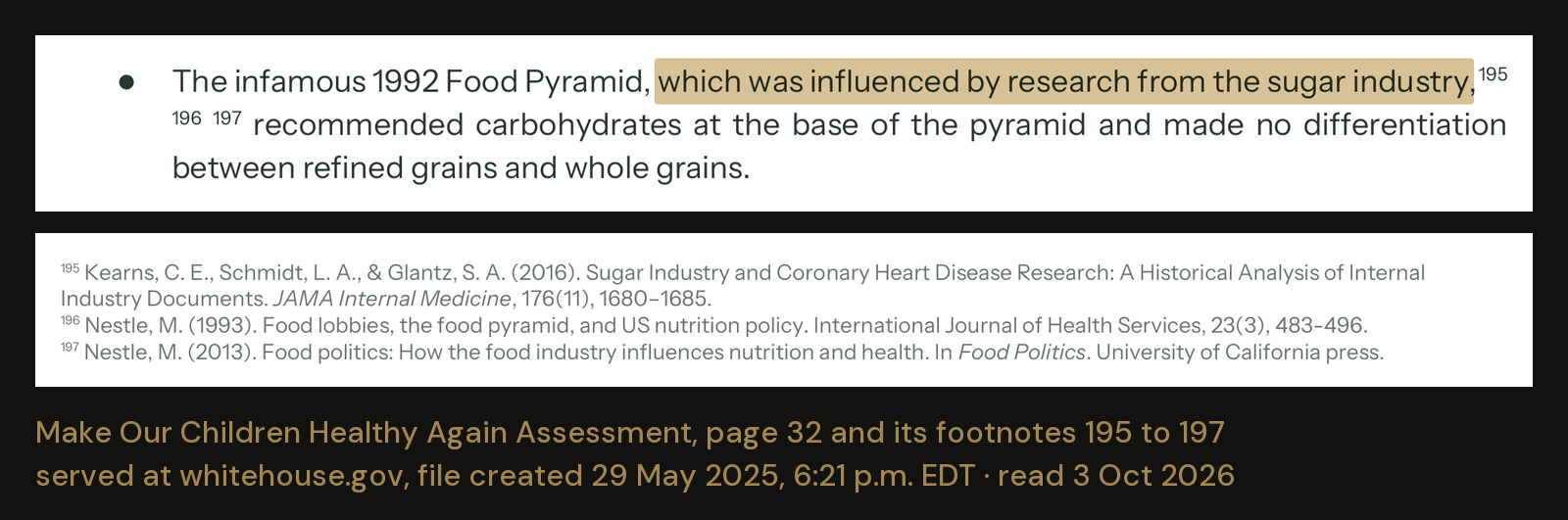
One sentence, on page 32, is in my own field: “The infamous 1992 Food Pyramid, which was influenced by research from the sugar industry, recommended carbohydrates at the base of the pyramid ...” It cites three sources. The first is a 2016 analysis by Kearns and colleagues of sugar-industry documents. It describes industry-funded heart research in the 1960s. It also notes that “the first 1980 Dietary Guidelines for Americans focused on reducing total fat, saturated fat, and dietary cholesterol.” That supports the report’s chain of events in outline. A search of its full text on September 24, 2026, found no mention of the pyramid.
The second source, a 1993 paper by Nestle, is about the pyramid. Its abstract names a different industry: “The U.S. Department of Agriculture’s 1991 withdrawal of its Eating Right Pyramid food guide in response to pressure from meat and dairy producers ...” The third is Nestle’s book Food Politics, which I have not checked.
What I checked, and what I cannot tell you
I checked where every changed citation points, in its earliest and current form. I ran every footnote in the current file through Crossref and every DOI it prints through the DOI registry. I read seventeen citations, under thirteen of the report’s sentences, against their sources, mostly at the level of the abstract. I chose them because their citations changed, because they carry a number, or because they are in my field. The source supports the sentence for two. Eight say more than their source allows. For footnote 47, I used the right paper. For seven, what I read does not support the sentence. Three of those are first-file citations since replaced.
Most of the report’s claims I have not checked against their sources. That includes almost every one that rests on a report, web page, book or news article. Nothing here tells you whether the report’s citations are mostly right or mostly wrong. The commission’s September 2025 strategy is not part of the citation check. I searched it on September 24, 2026, and found no reference list. I read it again on October 3, 2026, for the research section below.
I cannot tell you why any of this happened, or who wrote these citations. The files do not say.
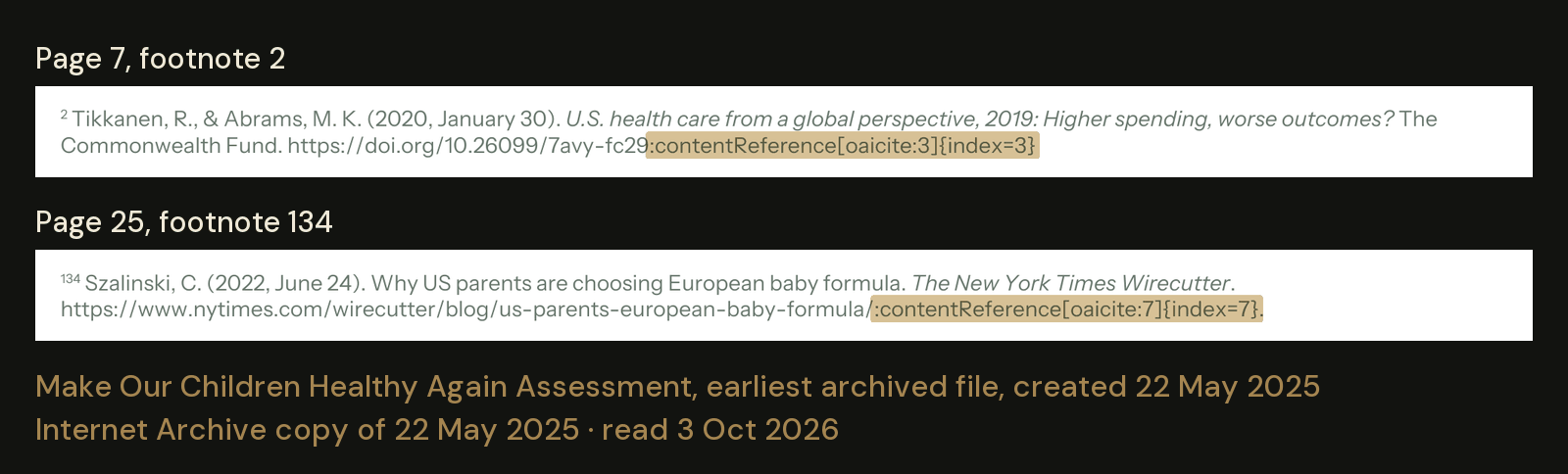
In the earliest file, two footnotes end their web addresses with a string that breaks the link. The strings are “:contentReference[oaicite:3]{index=3}” in one and “:contentReference[oaicite:7]{index=7}” in the other. The Washington Post reported on May 29, 2025, that some references had “oaicite” attached to their web addresses. The Post called that “a definitive sign that the research was collected using artificial intelligence.” In the text of these four public files I find the string twice, once, once and not at all. The files show that it was there. They do not show how it got there.
What the research says
The sections above test the footnotes. This one sets five of the report’s claims beside the wider research. I picked claims close to the ones checked above, so they are not a fair sample either.
The first holds. The report says nearly 70 percent of an American child’s calories come from ultra-processed foods. Its source, a 2021 analysis of a national federal survey, found 67 percent in 2017 and 2018.
Page 17 says stimulants “did not improve outcomes long-term.” Its footnote 64 is a 2007 follow-up of a federally funded trial that assigned 579 children with ADHD to treatments at random. In 1999 the trial reported that closely managed medication beat behavioral treatment on core symptoms at fourteen months. At two years it still did, by less. At three years the groups did not differ significantly. By then 45 percent of the behavioral group took medication more than half the time. The trial was no longer a clean test. At six and eight years the groups still did not differ significantly in nearly every analysis.
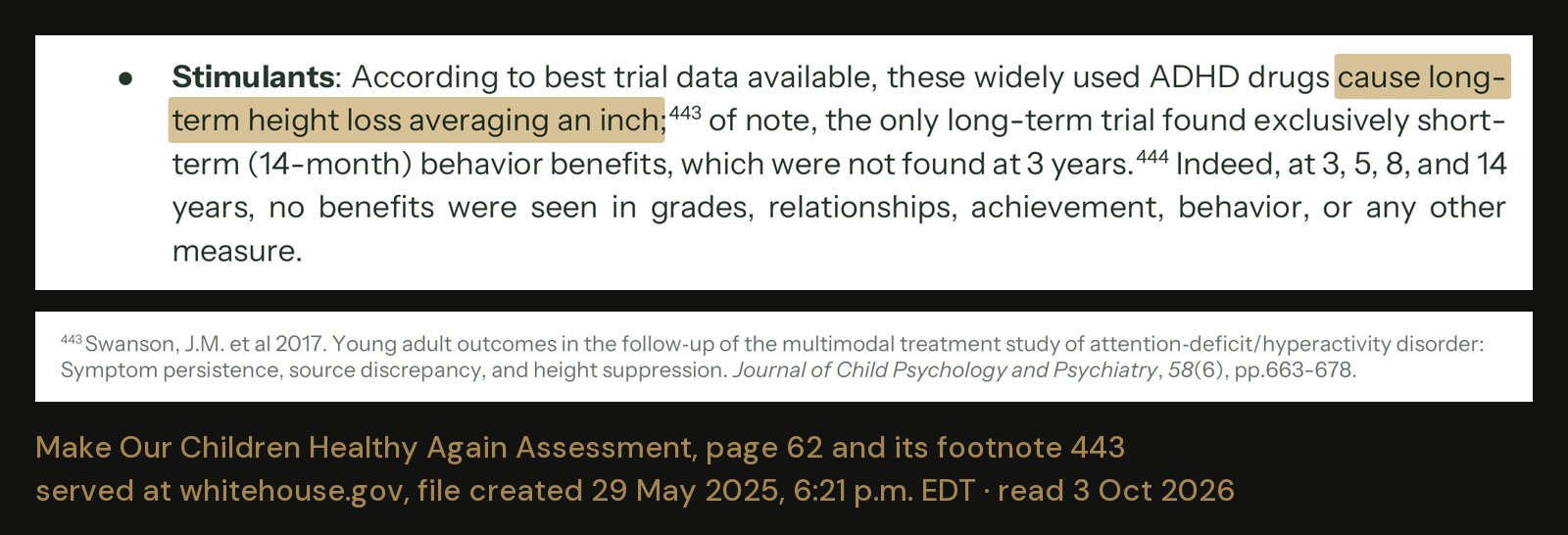
So the trial shows that the edge from fourteen months of closely managed medication faded. It cannot show whether years of medication help, because after the trial the families chose who stayed on it. At about age twenty-five, those who had taken stimulants steadily or on and off were about an inch shorter than those who took little or none. Their symptoms were not significantly milder. The authors call that comparison hypothesis-generating. Page 62 of the report cites the same study and says the drugs “cause” the lost height.
Other studies point the other way. In a 2019 Dutch trial, 94 young people who had taken methylphenidate for over two years were kept on it or tapered onto a placebo, at random. Over seven weeks, symptoms worsened more in those taken off it. Swedish register studies from 2024 and 2025 followed people aged 6 to 64, half of them under about seventeen. Starting medication was linked to lower rates of death, suicidal behavior and, from age 15, crime over the two years after diagnosis. Seven weeks and two years are shorter than the three years in the report’s own source. Register studies also cannot prove cause.
The American Academy of Pediatrics wrote in 2019 that the long-term benefits of behavioral treatment, as with medication, have yet to be determined. None of the trials I read could test whether years of medication change how children fare later. Page 17 cites a real finding. Its clause is more certain than the record.
Page 12’s picture of rising ADHD diagnoses holds up. It says more than 10 percent of children have been diagnosed, about a million more in 2022 than in 2016. Its source, an analysis of a federal survey, found that 11.4 percent of children aged 3 to 17 had been diagnosed by 2022. Another federal survey shows the rise began long before: 6.1 percent in 1997 and 1998, 10.2 percent in 2015 and 2016. This is separate from the forty-fold figure on page 70, whose source concerns bipolar disorder alone. Page 56 raises overdiagnosis, citing a 2021 review of 334 studies. That review found evidence of it, with signs that many added cases may be milder.
Page 32 says the 1992 pyramid “recommended carbohydrates at the base” and “made no differentiation between refined grains and whole grains.” The first part holds. The August 1992 poster put bread, cereal, rice and pasta at the base, six to eleven servings, with no line between whole and refined grains. But the poster pointed readers to a booklet. The 1996 printing I could read told them to “choose several servings a day of foods made from whole grains.” So the second part holds for the poster only.
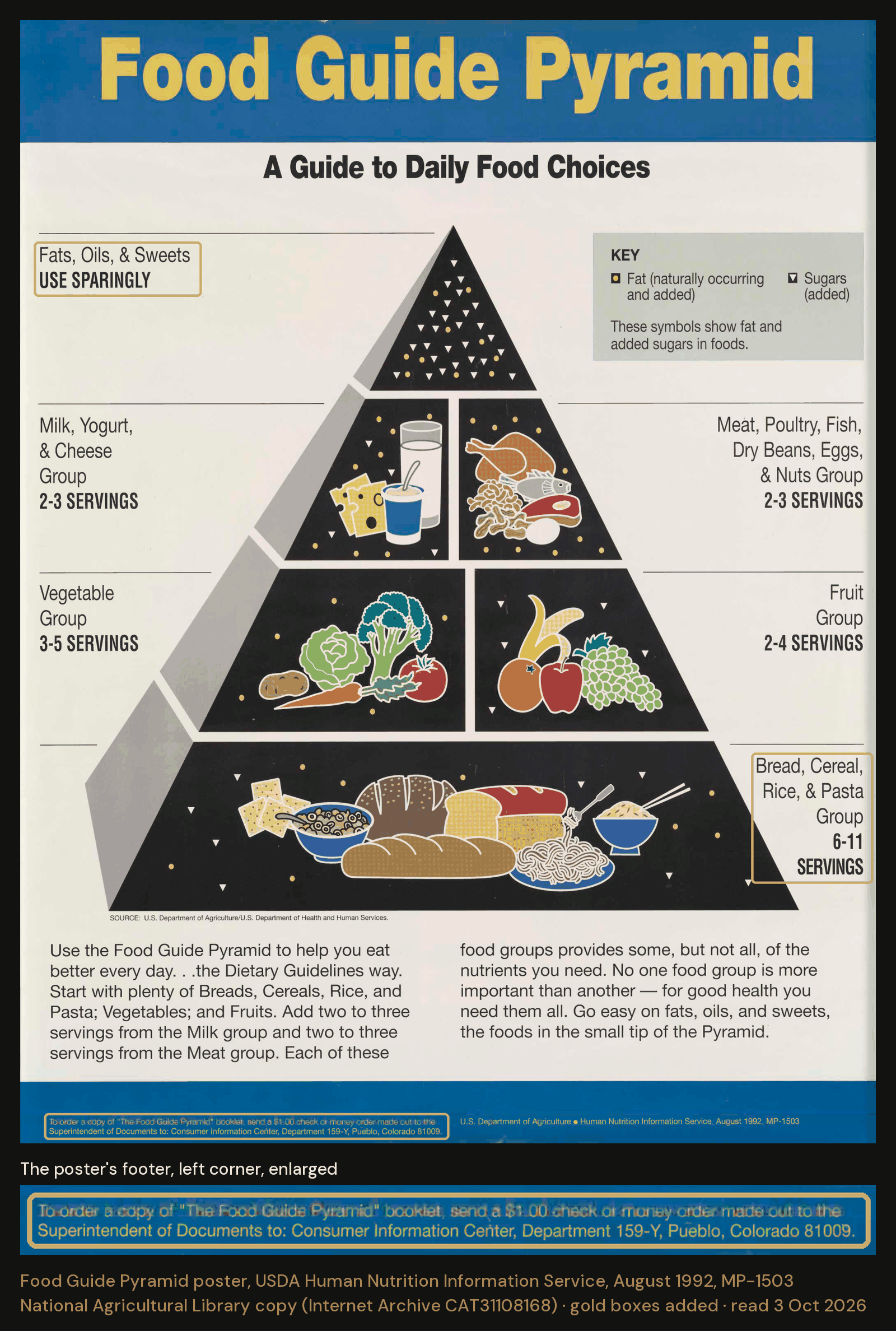
I could not confirm the sugar half. Kearns and colleagues tie sugar money to 1960s heart research that blamed fat, which supports the chain only in outline. In what I read, nothing ties the sugar industry to the pyramid itself. On October 3, 2026, two PubMed searches for the sugar industry and the food guide pyramid found no records. PubMed does not index books, and I have not read Food Politics, the third source. None of this shows there was no influence. The poster itself told readers to use fats, oils and sweets “sparingly.”
Page 16 says ultra-processed foods are “over 50%” of mothers’ diets. The right paper, as shown above, comes close for the women it studied. A larger 2026 study of 6,693 first-time American mothers found 51.3 percent of calories around conception. Neither group is a national sample. Page 26 goes further, citing a 2025 review for evidence that these foods in pregnancy harm children’s health. That review called the data limited. In the studies I read, it has not been shown that these foods cause harm in pregnancy. Two larger reviews link these foods to diabetes in pregnancy and to preeclampsia, a dangerous rise in blood pressure. One rated that evidence very low in certainty. Neither found a clear link to preterm birth or birth weight, though the 2026 study linked higher intake to preterm birth. The review for the 2025 Dietary Guidelines committee graded the link to extra body fat “limited,” in children and adults, as page 31 says. On weight gain in pregnancy it found too little evidence to conclude anything.
Experts spoke at the time. On release day, Dariush Mozaffarian of Tufts University told the Associated Press the report “is a pretty accurate depiction of the nutrition crisis facing our country.” A week later, after the citation errors were reported, Georges Benjamin of the American Public Health Association told The Washington Post the garbled citations undermined its credibility. “This is not an evidence-based report,” he said.
What could have been done instead
Keep the dated notes. Correct what still stands, starting with the stimulant figures, footnote 47, footnote 508 and the DSM-5 dates.
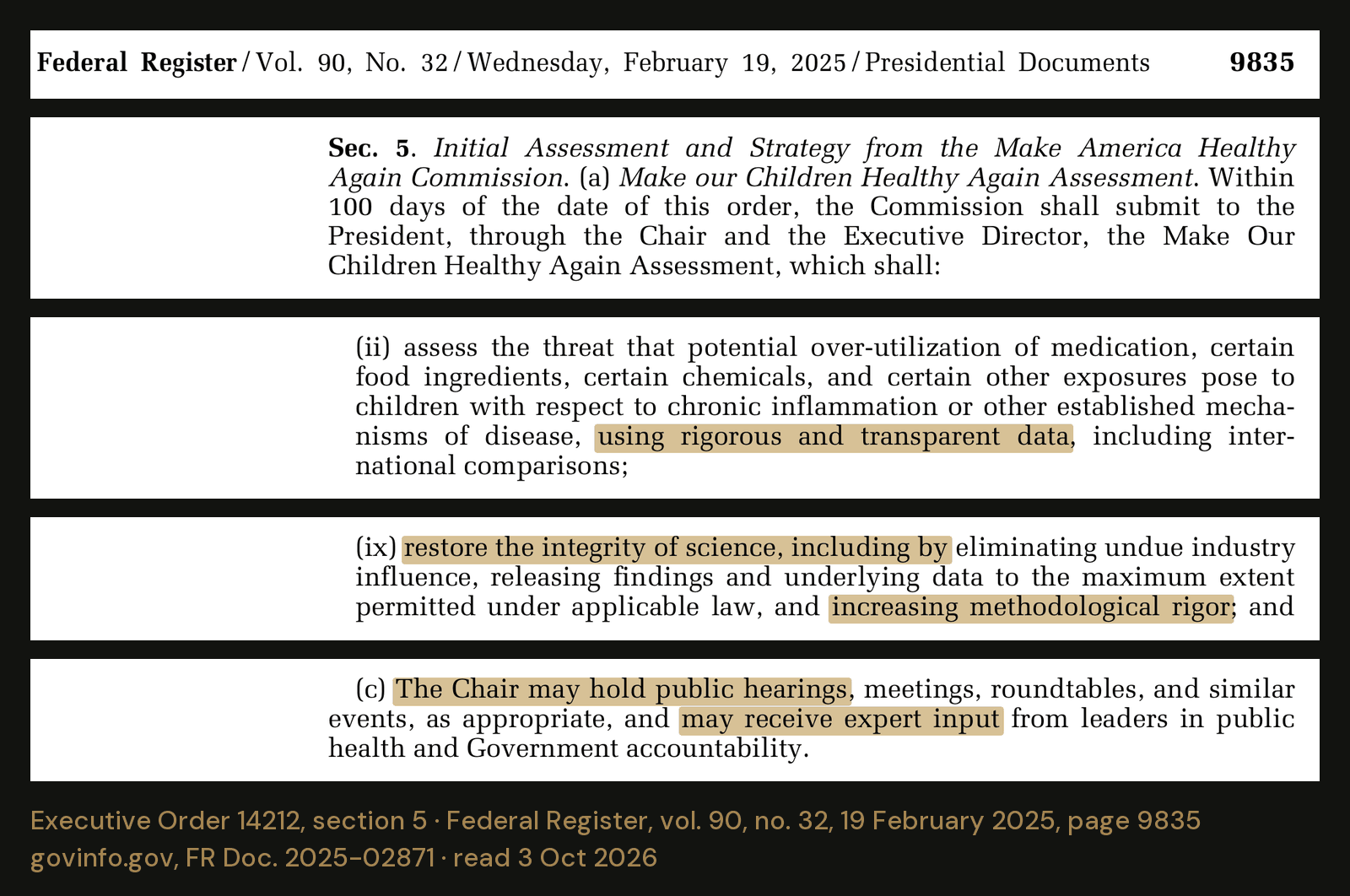
The order that created the commission told its assessment to weigh threats to children “using rigorous and transparent data.” Among its aims, it asked the assessment to help “restore the integrity of science,” including by “increasing methodological rigor.” It allowed the chair, Kennedy, to hold public hearings and take expert input.
Reviews built that way exist. The U.S. Preventive Services Task Force, which rates screening and preventive care, takes public comment on its research plan and again on its draft. Outside experts read its evidence reviews. One topic usually takes nine to fifteen months from an approved work plan to a vote. Every report from the National Academies of Sciences, Engineering, and Medicine must be reviewed by experts other than its authors before release. In fiscal 2016 Congress gave the U.S. Department of Agriculture (USDA) $1 million for the Academies to review how the Dietary Guidelines are made.
The President’s order gave the commission 100 days, and it delivered in ninety-eight. Fast reviews exist. A 2015 survey of 100 papers found they took one to twelve months, so speed alone is not the flaw. The order did not require public comment either.
What I could not find is an account of method. On October 3, 2026, I searched the file online for word stems such as “literature search,” “inclusion criteria,” “reviewed by” and “public comment,” and found none. Every hit for “methodolog,” “peer review” and “expert” was about other work. I found no account of how its evidence was gathered or checked, and no description of hearings or expert input. Nor did I find a notice asking for public comment in the Federal Register, the government’s daily journal of rules and notices. I did not search for meetings anywhere else.
The report itself pointed to evidence on two things that shape what children eat. The strategy made a firm commitment on neither. A third I did not find in either document, on my search of October 3, 2026.
WIC fruit and vegetable money. WIC is the federal food program for low-income pregnant women, new mothers, babies and children under 5. The report says it “has a proven track record of improving children’s health,” including more fruit and vegetables eaten (page 34). It cites a study that found obesity among WIC children aged 2 to 4 turned from rising to falling after the 2009 food changes. That package changed several foods at once, and the study ended before the voucher grew in the pandemic. In the strategy’s text, searched October 3, 2026, WIC appears once, in a line on breastfeeding. The budget requests for fiscal 2026 and 2027 proposed returning the fruit and vegetable voucher to its pre-pandemic level, adjusted for inflation. USDA said that would let WIC reach more people. Congress instead wrote the level the National Academies recommended, adjusted for inflation, into the law the President signed on November 12, 2025. A stopgap law signed on September 2, 2026, carries it to December 11, 2026.
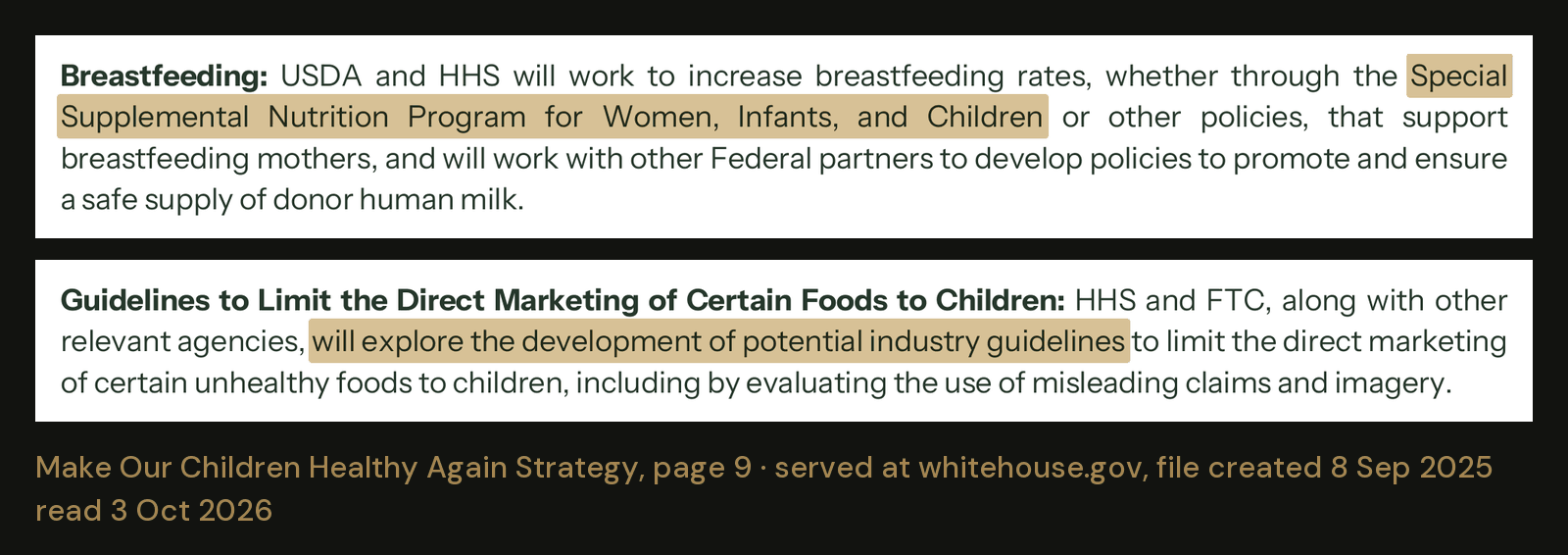
Limits on food ads aimed at children. The report cites reviews linking food ads to what children eat. I found no proposal in it to limit those ads. A 2022 review that pooled eighty studies found the same link, at very low to moderate certainty. Those studies measured the effect of seeing ads, not of limiting them. The strategy says HHS and the Federal Trade Commission, with other agencies, will “explore the development of potential industry guidelines.” On October 3, 2026, I found no Federal Register action on it, though voluntary guidelines might not appear there. There is a precedent. In 2011, at Congress’s direction, four federal agencies proposed voluntary principles for marketing food to children and took public comment on them.
Free meals for every student. A federal option, the Community Eligibility Provision, lets schools in low-income areas serve breakfast and lunch free to every student. In 3,531 eligible California schools from 2013 to 2019, taking it up was linked to 0.60 percentage points less obesity in grades 5, 7 and 9. That is about 2.4 percent of the starting rate. A 2024 review rated that obesity evidence very low in certainty, from one study, and the rise in children eating school lunch moderate. A 2021 review of 47 studies found no sign that free meals raise weight. Searching both documents on October 3, 2026, including every mention of school meals, I found no proposal to make meals free for every student. Schools choose whether to use the option now. Paying for free meals everywhere would take federal or state money. I did not price it.
My grade is an F
This grade is my judgment on the documents cited here. It uses the grading rules set out in the piece that opened this series on October 3, 2026. It is not a finding about anyone’s motive. I will revise it in a dated note if the record changes.
F. Some fixes made the report more accurate. They began in its first week, before NOTUS’s first story on the citations. That credit does not lift the grade, because the fixes stop short. The file online today keeps citation errors that were fixed in other footnotes. When I searched the file online on September 24, 2026, I found no notice that it had changed.
Substance: A report, not a rule. It came out within the 100 days set by the order that created the commission.
Evidence: Of the citations changed by May 29, 2025, fourteen in the earliest file did not match the journal, volume and pages given. All fourteen were replaced or rewritten by May 29, 2025. I read seventeen of the report’s citations, mostly as abstracts. Fifteen say more than their source allows or, on what I read, do not support the sentence. Three of those fifteen are citations from the earliest file that had been replaced by May 29, 2025. I chose the seventeen because their citations changed, because they carry a number, or because they are in my field. So they are not a fair sample of the report. Most of the report’s claims I have not checked. The administration’s gold standard order was signed on May 23, 2025, the day after the report came out. It counts being “communicative of error and uncertainty” as part of gold standard science. I use it as the administration’s own yardstick, not as a rule this file broke. The report came first, and the order gave agencies up to thirty days to begin following its rules. Measured against it, the May 29 files dropped the five dated notes. On October 3, 2026, I found no account in the file online of how its evidence was gathered or checked. Of five claims I set beside the wider research, two hold, two hold in part, and page 17’s long-term stimulant clause is more certain than the evidence.
Health: Indirect for a report. This line does not carry the letter.
Integrity: The first fixes came before NOTUS’s first story on the citations. The May 27 file marked five of them with dated notes. The May 29 files do not. HHS told NOTUS and The Washington Post on May 29, 2025, that minor citation and formatting errors had been corrected. When I searched the file online on September 24, 2026, I found no notice of any change. On September 29, 2026, I searched the text of all four files for who wrote or reviewed the citations. I found no name. In June 2025 the commission’s chair, Kennedy, told a House hearing that he had not fact-checked the report’s sources himself. He said its foundational assertions were accurate.
I asked HHS and the White House
On September 24, 2026, I emailed HHS’s press office at [email protected]. I also wrote to the White House, which hosts the file, through its public contact form. HHS’s automatic reply said that inbox is not monitored. It pointed me to the department’s request-for-comment form, which HHS says is for credentialed media outlets only. So that day I sent the same questions through the form. On September 24, 2026, I found no press address on the White House site. All three messages say I am not credentialed media. On October 8, 2026, the White House’s correspondence office replied and asked me to resend the questions to its press office’s email address. I did that the same morning and asked for a reply by noon Eastern on October 13, 2026.
I asked whether there is a public record of the corrections made in May 2025. I also asked whether the file will carry a notice of them. And I asked whether they will correct what still stands in the current file. I named the stimulant figures on pages 17 and 59, the citation at footnote 47, the author at footnote 508, and the DSM-5 dates on page 70. My first messages asked for a reply by 5 p.m. Eastern on October 8, 2026.
On October 13, 2026, at 12:24 p.m. Eastern, the White House press office asked for another hour, and I agreed. At 1:38 p.m. it sent a statement attributed to White House spokeswoman Allison Schuster: “When President Trump pledged to Make America Healthy Again, he launched a grassroots movement of concerned parents, physicians, researchers, and educators across our country. The Trump administration’s commitment to working closely with the MAHA movement to deliver on the MAHA agenda isn’t about political gain, but ensuring a better future for the next generation of Americans.”
The statement does not mention the report, its citations or any correction, and it does not answer the questions I sent. By the afternoon of October 13, 2026, HHS had not answered. The paragraphs on Secretary Kennedy and the White House briefing were written after I sent those questions.
This is general education and a reading of public documents, including official transcripts and recordings of public remarks. It is not medical advice. If you or your child takes a medicine mentioned here, talk with the prescriber before changing anything.
References
Presidential Commission to Make America Healthy Again. Make Our Children Healthy Again Assessment. Released May 22, 2025. The file online today, created May 29, 2025, 6:21 p.m. EDT, is served at two addresses: https://www.whitehouse.gov/wp-content/uploads/2025/05/MAHA-Report-The-White-House.pdf and https://www.whitehouse.gov/wp-content/uploads/2025/05/WH-The-MAHA-Report-Assessment.pdf (identical files, SHA-256 beginning da01f409; both accessed September 24 and October 3, 2026, the same file on both dates)
Earlier versions of the same file, as archived by the Internet Archive’s Wayback Machine (all accessed September 24, 2026): Created May 22, 2025, 12:59 p.m. EDT, the earliest archived copy (captured May 22, 2025). https://web.archive.org/web/20250522215748id_/https://www.whitehouse.gov/wp-content/uploads/2025/05/WH-The-MAHA-Report-Assessment.pdf Created May 27, 2025, 7:25 p.m. EDT (captured May 28, 2025). https://web.archive.org/web/20250528190607id_/https://www.whitehouse.gov/wp-content/uploads/2025/05/WH-The-MAHA-Report-Assessment.pdf Created May 29, 2025, 1:56 p.m. EDT (captured May 29, 2025). https://web.archive.org/web/20250529192840id_/https://www.whitehouse.gov/wp-content/uploads/2025/05/WH-The-MAHA-Report-Assessment.pdf Created May 29, 2025, 6:21 p.m. EDT, the file online today (captured May 30, 2025, UTC). https://web.archive.org/web/20250530001352id_/https://www.whitehouse.gov/wp-content/uploads/2025/05/WH-The-MAHA-Report-Assessment.pdf
The White House. MAHA page, with links titled “The MAHA Report” and “The MAHA Strategy.” https://www.whitehouse.gov/maha/ (accessed September 24, 2026)
Presidential Commission to Make America Healthy Again. The MAHA Strategy, as the White House’s page titles it (file created September 8, 2025). https://www.whitehouse.gov/wp-content/uploads/2025/09/The-MAHA-Strategy-WH.pdf (accessed September 24 and October 3, 2026)
Executive Order 14212 of February 13, 2025, Establishing the President’s Make America Healthy Again Commission. 90 FR 9833, February 19, 2025. https://www.federalregister.gov/documents/2025/02/19/2025-02871/establishing-the-presidents-make-america-healthy-again-commission (accessed September 29 and October 3, 2026)
Executive Order 14303 of May 23, 2025, Restoring Gold Standard Science. 90 FR 22601, May 29, 2025. https://www.federalregister.gov/documents/2025/05/29/2025-09802/restoring-gold-standard-science (accessed September 29, 2026)
Daily Compilation of Presidential Documents. Remarks at a Meeting of the Make America Healthy Again Commission. May 22, 2025. DCPD-202500628. https://www.govinfo.gov/content/pkg/DCPD-202500628/html/DCPD-202500628.htm (accessed October 3, 2026)
The White House. Press Secretary Karoline Leavitt Briefs Members of the Media, May 29, 2025. Video, https://www.whitehouse.gov/videos/press-secretary-karoline-leavitt-briefs-members-of-the-media-may-29-2025/ (the exchange on the report at about 24:51 to 25:50). Transcript: The American Presidency Project, Press Briefing by Press Secretary Karoline Leavitt, May 29, 2025, https://www.presidency.ucsb.edu/documents/press-briefing-press-secretary-karoline-leavitt-29 (both accessed October 3, 2026)
U.S. House of Representatives, Committee on Energy and Commerce, Subcommittee on Health. The Fiscal Year 2026 Department of Health and Human Services Budget. Hearing, June 24, 2025, with Secretary Robert F. Kennedy Jr. The committee’s video, https://www.youtube.com/watch?v=zdQSSMuc3NY, embedded on its event page, https://energycommerce.house.gov/events/health-subcommittee-hearing-the-fiscal-year-2026-department-of-health-and-human-services-budget (Representative Raul Ruiz’s questioning at about 1:15:32 to 1:20:34, the exchange on the report from about 1:16:50; accessed October 3, 2026)
Kennard E, Manto M. The MAHA Report Cites Studies That Don’t Exist. NOTUS, May 29, 2025, updated the same day. https://www.notus.org/health-science/make-america-healthy-again-report-citation-errors (accessed September 24, 2026; the page now appears under the name The Washington Sun)
Manto M, Kennard E. The MAHA Report Has Been Updated With Fresh Errors. NOTUS, May 30, 2025. https://www.notus.org/health-science/maha-report-update-citation-errors (accessed September 24, 2026; the page now appears under the name The Washington Sun)
Weber L, Gilbert C. White House MAHA Report may have garbled science by using AI, experts say. The Washington Post, May 29, 2025. https://www.washingtonpost.com/health/2025/05/29/maha-rfk-jr-ai-garble/ (read September 24, 2026, through the Internet Archive’s earliest capture, made May 30, 2025, at 08:38 UTC, https://web.archive.org/web/20250530083831/https://www.washingtonpost.com/health/2025/05/29/maha-rfk-jr-ai-garble/; Benjamin’s words re-read on October 3, 2026, in the unaltered copy of the same capture, https://web.archive.org/web/20250530083831id_/https://www.washingtonpost.com/health/2025/05/29/maha-rfk-jr-ai-garble/)
Wynne KJ. Fact-checking the MAHA report’s claims about ADHD. Understood.org, June 25, 2025, updated May 5, 2026. https://www.understood.org/en/articles/maha-report-adhd-fact-checking (accessed September 24, 2026)
Panchal N. Recent Trends in Mental Health and Substance Use Concerns Among Adolescents. KFF, February 6, 2024. https://www.kff.org/mental-health/recent-trends-in-mental-health-and-substance-use-concerns-among-adolescents/ (accessed September 24, 2026; the address the report cites redirects here)
Thomas CP, Conrad P, Casler R, Goodman E. Trends in the use of psychotropic medications among adolescents, 1994 to 2001. Psychiatric Services. 2006;57(1):63-69. doi:10.1176/appi.ps.57.1.63. PMID 16399964.
Schwarz A. The Selling of Attention Deficit Disorder. The New York Times, December 14, 2013. Cited in the report’s current footnote 521; not read for this piece (paywall).
Figueiro MG, Wood B, Plitnick B, Rea MS. The impact of light from computer monitors on melatonin levels in college students. Neuro Endocrinology Letters. 2011;32(2):158-163. PMID 21552190.
Gooley JJ, Chamberlain K, Smith KA, Khalsa SB, Rajaratnam SM, Van Reen E, Zeitzer JM, Czeisler CA, Lockley SW. Exposure to room light before bedtime suppresses melatonin onset and shortens melatonin duration in humans. Journal of Clinical Endocrinology and Metabolism. 2011;96(3):E463-E472. doi:10.1210/jc.2010-2098. PMID 21193540.
Hetrick SE, McKenzie JE, Bailey AP, Sharma V, Moller CI, Badcock PB, Cox GR, Merry SN, Meader N. New generation antidepressants for depression in children and adolescents: a network meta-analysis. Cochrane Database of Systematic Reviews. 2021;5(5):CD013674. doi:10.1002/14651858.CD013674.pub2. PMID 34029378.
Cuijpers P, Miguel C, Harrer M, Plessen CY, Ciharova M, Papola D, Ebert D, Karyotaki E. Psychological treatment of depression: A systematic overview of a ‘Meta-Analytic Research Domain’. Journal of Affective Disorders. 2023;335:141-151. doi:10.1016/j.jad.2023.05.011. PMID 37178828.
Zito JM, Pennap D, Safer DJ. Antidepressant use in Medicaid-insured youth: trends, covariates, and future research needs. Frontiers in Psychiatry. 2020;11:113. doi:10.3389/fpsyt.2020.00113. PMID 32231593.
Alexander GC, Gallagher SA, Mascola A, Moloney RM, Stafford RS. Increasing off-label use of antipsychotic medications in the United States, 1995-2008. Pharmacoepidemiology and Drug Safety. 2011;20(2):177-184. doi:10.1002/pds.2082. Full text via PubMed Central, PMC3069498.
Barros RM, Silver EJ, Stein RE. School recess and group classroom behavior. Pediatrics. 2009;123(2):431-436. doi:10.1542/peds.2007-2825. PMID 19171606.
Piper BJ, Ogden CL, Simoyan OM, Chung DY, Caggiano JF, Nichols SD, McCall KL. Trends in use of prescription stimulants in the United States and Territories, 2006 to 2016. PLOS ONE. 2018;13(11):e0206100. doi:10.1371/journal.pone.0206100. PMID 30485268. Full text from PLOS, accessed September 24, 2026.
Nansel TR, Cummings JR, Burger K, Siega-Riz AM, Lipsky LM. Greater ultra-processed food intake during pregnancy and postpartum is associated with multiple aspects of lower diet quality. Nutrients. 2022;14(19):3933. doi:10.3390/nu14193933. PMID 36235585.
Piller C. The war on ‘prediabetes’ could be a boon for pharma, but is it good medicine? Science, March 7, 2019. https://www.science.org/content/article/war-prediabetes-could-be-boon-pharma-it-good-medicine (accessed September 24, 2026)
American Psychiatric Association. Diagnostic and Statistical Manual of Mental Disorders, Fifth Edition. Published in print May 22, 2013, per the association’s Crossref record for doi:10.1176/appi.books.9780890425596 (accessed September 24, 2026).
Harris G, Carey B. Researchers Fail to Reveal Full Drug Pay. The New York Times, June 8, 2008. https://www.nytimes.com/2008/06/08/us/08conflict.html (the report’s footnote 510; read September 24, 2026, in the copy its first file linked, https://w.astro.berkeley.edu/~kalas/ethics/documents/ethics/Researchers%20Fail%20to%20Reveal%20Full%20Drug%20Pay%20-%20NYTimes.com.pdf)
Kearns CE, Schmidt LA, Glantz SA. Sugar industry and coronary heart disease research: a historical analysis of internal industry documents. JAMA Internal Medicine. 2016;176(11):1680-1685. doi:10.1001/jamainternmed.2016.5394. Full text via PubMed Central, PMC5099084 (accessed September 24, 2026).
Nestle M. Food lobbies, the food pyramid, and U.S. nutrition policy. International Journal of Health Services. 1993;23(3):483-496. doi:10.2190/32F2-2PFB-MEG7-8HPU. PMID 8375951.
Wang L, Martínez Steele E, Du M, Pomeranz JL, O’Connor LE, Herrick KA, Luo H, Zhang X, Mozaffarian D, Zhang FF. Trends in Consumption of Ultraprocessed Foods Among US Youths Aged 2-19 Years, 1999-2018. JAMA. 2021;326(6):519-530. doi:10.1001/jama.2021.10238. PMID 34374722. (The report’s footnote 46.)
MTA Cooperative Group. A 14-month randomized clinical trial of treatment strategies for attention-deficit/hyperactivity disorder. Archives of General Psychiatry. 1999;56(12):1073-1086. doi:10.1001/archpsyc.56.12.1073. PMID 10591283.
MTA Cooperative Group. National Institute of Mental Health Multimodal Treatment Study of ADHD follow-up: 24-month outcomes of treatment strategies for attention-deficit/hyperactivity disorder. Pediatrics. 2004;113(4):754-761. doi:10.1542/peds.113.4.754. PMID 15060224.
Jensen PS, Arnold LE, Swanson JM, et al. 3-year follow-up of the NIMH MTA study. Journal of the American Academy of Child and Adolescent Psychiatry. 2007;46(8):989-1002. doi:10.1097/CHI.0b013e3180686d48. PMID 17667478. (The report’s footnotes 64 and 444.)
Molina BSG, Hinshaw SP, Swanson JM, et al. The MTA at 8 years: prospective follow-up of children treated for combined-type ADHD in a multisite study. Journal of the American Academy of Child and Adolescent Psychiatry. 2009;48(5):484-500. doi:10.1097/CHI.0b013e31819c23d0. PMID 19318991.
Swanson JM, Arnold LE, Molina BSG, et al. Young adult outcomes in the follow-up of the multimodal treatment study of attention-deficit/hyperactivity disorder: symptom persistence, source discrepancy, and height suppression. Journal of Child Psychology and Psychiatry. 2017;58(6):663-678. doi:10.1111/jcpp.12684. PMID 28295312. (The report’s footnote 443.)
Matthijssen AM, Dietrich A, Bierens M, et al. Continued Benefits of Methylphenidate in ADHD After 2 Years in Clinical Practice: A Randomized Placebo-Controlled Discontinuation Study. American Journal of Psychiatry. 2019;176(9):754-762. doi:10.1176/appi.ajp.2019.18111296. PMID 31109200.
Li L, Zhu N, Zhang L, et al. ADHD Pharmacotherapy and Mortality in Individuals With ADHD. JAMA. 2024;331(10):850-860. doi:10.1001/jama.2024.0851. PMID 38470385.
Zhang L, Zhu N, Sjölander A, et al. ADHD drug treatment and risk of suicidal behaviours, substance misuse, accidental injuries, transport accidents, and criminality: emulation of target trials. BMJ. 2025;390:e083658. doi:10.1136/bmj-2024-083658. PMID 40803836. Correction (figure 2 labels only): BMJ. 2025;390:r1827. doi:10.1136/bmj.r1827 (read October 3, 2026).
Wolraich ML, Hagan JF, Allan C, et al. Clinical Practice Guideline for the Diagnosis, Evaluation, and Treatment of Attention-Deficit/Hyperactivity Disorder in Children and Adolescents. Pediatrics. 2019;144(4):e20192528. doi:10.1542/peds.2019-2528. PMID 31570648. Full text via PubMed Central, PMC7067282 (accessed October 3, 2026).
Danielson ML, Claussen AH, Bitsko RH, et al. ADHD Prevalence Among U.S. Children and Adolescents in 2022: Diagnosis, Severity, Co-Occurring Disorders, and Treatment. Journal of Clinical Child and Adolescent Psychology. 2024;53(3):343-360. doi:10.1080/15374416.2024.2335625. PMID 38778436. (The report’s footnote 27.)
Xu G, Strathearn L, Liu B, Yang B, Bao W. Twenty-Year Trends in Diagnosed Attention-Deficit/Hyperactivity Disorder Among US Children and Adolescents, 1997-2016. JAMA Network Open. 2018;1(4):e181471. doi:10.1001/jamanetworkopen.2018.1471. PMID 30646132.
Kazda L, Bell K, Thomas R, McGeechan K, Sims R, Barratt A. Overdiagnosis of Attention-Deficit/Hyperactivity Disorder in Children and Adolescents: A Systematic Scoping Review. JAMA Network Open. 2021;4(4):e215335. doi:10.1001/jamanetworkopen.2021.5335. PMID 33843998. (The report’s footnote 405.)
U.S. Department of Agriculture, Human Nutrition Information Service. Food Guide Pyramid: A Guide to Daily Food Choices. Poster, August 1992, MP-1503 (source line: U.S. Department of Agriculture/U.S. Department of Health and Human Services). National Agricultural Library copy, Internet Archive item CAT31108168, https://archive.org/details/CAT31108168 (accessed October 3, 2026)
U.S. Department of Agriculture, Center for Nutrition Policy and Promotion. The Food Guide Pyramid. Home and Garden Bulletin No. 252, August 1992, slightly revised October 1996 (the file’s own cover misprints the year as 1966). Read in the Internet Archive’s copy of USDA’s file, https://web.archive.org/web/20160131062603id_/http://www.cnpp.usda.gov/sites/default/files/archived_projects/FGPPamphlet.pdf (accessed October 3, 2026)
Hall R, Hernandez AM, Rosas-Rogers S, Liegl M, Pan AY, Cohen C, Palatnik A. The Association Between Periconceptional Consumption of Ultra-Processed Food and the Incidence of Adverse Pregnancy Outcomes. Nutrients. 2026;18(4):627. doi:10.3390/nu18040627. PMID 41754144.
Morales-Suarez-Varela M, Rocha-Velasco OA. Impact of ultra-processed food consumption during pregnancy on maternal and child health outcomes: A comprehensive narrative review of the past five years. Clinical Nutrition ESPEN. 2025;65:288-304. doi:10.1016/j.clnesp.2024.12.006. PMID 39662587. (The report’s footnote 137.)
Paula WO, Patriota ESO, Gonçalves VSS, Pizato N. Maternal Consumption of Ultra-Processed Foods-Rich Diet and Perinatal Outcomes: A Systematic Review and Meta-Analysis. Nutrients. 2022;14(15):3242. doi:10.3390/nu14153242. PMID 35956418.
Talebi S, Mehrabani S, Ghoreishy SM, et al. The association between ultra-processed food and common pregnancy adverse outcomes: a dose-response systematic review and meta-analysis. BMC Pregnancy and Childbirth. 2024;24(1):369. doi:10.1186/s12884-024-06489-w. PMID 38750456.
Stanford FC, Taylor C, Hoelscher DM, et al. Dietary Patterns with Ultra-Processed Foods and Growth, Body Composition, and Risk of Obesity: A Systematic Review. November 2024. U.S. Department of Agriculture, Food and Nutrition Service, Center for Nutrition Policy and Promotion, Nutrition Evidence Systematic Review (2025 Dietary Guidelines Advisory Committee). doi:10.52570/NESR.DGAC2025.SR11. https://nesr.usda.gov/sites/default/files/2024-11/Dietary-patterns-ultraprocessed_growth-obesity-2025DGACSystematicReview.pdf (accessed October 3, 2026)
Seitz A, Price ML. RFK Jr.’s MAHA report raises concerns about vaccines, American foods and prescription drugs. Associated Press, May 22, 2025. Read in the WSLS reprint, https://www.wsls.com/business/2025/05/22/rfk-jrs-maha-report-raises-concerns-about-vaccines-american-foods-and-prescription-drugs/ (accessed October 3, 2026)
U.S. Preventive Services Task Force. Procedure Manual, Section 1. https://www.uspreventiveservicestaskforce.org/uspstf/about-uspstf/methods-and-processes/procedure-manual/procedure-manual-section-1 (accessed October 3, 2026)
National Academies of Sciences, Engineering, and Medicine. Guidelines for the Review of Products of the National Academies of Sciences, Engineering, and Medicine. https://www.nationalacademies.org/guidelines-for-the-review-of-products-of-the-national-academies-of-sciences-engineering-and-medicine (accessed October 3, 2026)
Congressional Research Service. The Dietary Guidelines for Americans: Overview and Considerations for Congress. R47488. Read in the EveryCRSReport copy, https://www.everycrsreport.com/reports/R47488.html (accessed October 3, 2026)
Tricco AC, Antony J, Zarin W, et al. A scoping review of rapid review methods. BMC Medicine. 2015;13:224. doi:10.1186/s12916-015-0465-6. PMID 26377409.
Daepp MIG, Gortmaker SL, Wang YC, Long MW, Kenney EL. WIC Food Package Changes: Trends in Childhood Obesity Prevalence. Pediatrics. 2019;143(5):e20182841. doi:10.1542/peds.2018-2841. PMID 30936251. (The report’s footnote 231.)
Public Law 117-2, American Rescue Plan Act of 2021, approved March 11, 2021, section 1105 (authority to raise the WIC cash-value voucher to as much as $35 during the COVID-19 public health emergency). https://www.govinfo.gov/content/pkg/PLAW-117publ2/html/PLAW-117publ2.htm (accessed October 3, 2026)
U.S. Department of Agriculture. FY 2026 Budget Summary. https://www.usda.gov/sites/default/files/documents/2026-usda-budget-summary.pdf (usda.gov refuses scripted requests; read in the Internet Archive’s copy of February 10, 2026, https://web.archive.org/web/20260210024505/https://www.usda.gov/sites/default/files/documents/2026-usda-budget-summary.pdf, on October 3, 2026)
U.S. Department of Agriculture. FY 2027 Budget Summary. https://www.usda.gov/sites/default/files/documents/fy-2027-budget-summary.pdf (read in the Internet Archive’s copy of April 6, 2026, https://web.archive.org/web/20260406232346/https://www.usda.gov/sites/default/files/documents/fy-2027-budget-summary.pdf, on October 3, 2026)
Public Law 119-37, approved November 12, 2025, division B (Agriculture, Rural Development, Food and Drug Administration, and Related Agencies Appropriations Act, 2026), WIC heading. https://www.govinfo.gov/content/pkg/PLAW-119publ37/html/PLAW-119publ37.htm (accessed October 3, 2026)
Public Law 119-103, Continuing Appropriations and Extensions Act, 2027, approved September 2, 2026, sections 101 and 106. https://www.govinfo.gov/content/pkg/PLAW-119publ103/html/PLAW-119publ103.htm (accessed October 3, 2026)
Boyland E, McGale L, Maden M, Hounsome J, Boland A, Angus K, Jones A. Association of Food and Nonalcoholic Beverage Marketing With Children and Adolescents’ Eating Behaviors and Health: A Systematic Review and Meta-analysis. JAMA Pediatrics. 2022;176(7):e221037. doi:10.1001/jamapediatrics.2022.1037. PMID 35499839.
Federal Trade Commission. Interagency Working Group Seeks Input on Proposed Voluntary Principles for Marketing Food to Children. Press release, April 28, 2011. https://www.ftc.gov/news-events/news/press-releases/2011/04/interagency-working-group-seeks-input-proposed-voluntary-principles-marketing-food-children (accessed October 3, 2026)
Localio AM, Knox MA, Basu A, Lindman T, Walkinshaw LP, Jones-Smith JC. Universal Free School Meals Policy and Childhood Obesity. Pediatrics. 2024;153(4):e2023063749. doi:10.1542/peds.2023-063749. PMID 38495019.
Spill MK, Trivedi R, Thoerig RC, et al. Universal Free School Meals and School and Student Outcomes: A Systematic Review. JAMA Network Open. 2024;7(8):e2424082. doi:10.1001/jamanetworkopen.2024.24082. PMID 39120904.
Cohen JFW, Hecht AA, McLoughlin GM, Turner L, Schwartz MB. Universal School Meals and Associations with Student Participation, Attendance, Academic Performance, Diet Quality, Food Security, and Body Mass Index: A Systematic Review. Nutrients. 2021;13(3):911. doi:10.3390/nu13030911. PMID 33799780.
Fee J. Eating Through Immunotherapy: What’s Different and Why It Matters. Vitae Arete. Correction of August 6, 2026, and update of September 23, 2026. https://vitaearete.com/insights/immunotherapy-nutrition.html (accessed September 24, 2026)
Routy B, Le Chatelier E, Derosa L, et al. Gut microbiome influences efficacy of PD-1-based immunotherapy against epithelial tumors. Science. 2018;359(6371):91-97. doi:10.1126/science.aan3706. PMID 29097494. Published online November 2, 2017; print issue January 5, 2018 (PubMed record accessed September 29, 2026).
Fee J. GLP-1 Muscle Loss: How Much of the Weight Is Lean Mass, and How to Protect It. Vitae Arete. Corrections of August 6, 2026, and September 23, 2026. https://vitaearete.com/insights/glp1-muscle-loss.html (accessed September 24, 2026)
Fee J. The Anti-Inflammatory Plate: A Blueprint for Metabolic Health. Vitae Arete. Correction of August 6, 2026, note added September 23, 2026. https://vitaearete.com/insights/anti-inflammatory-plate.html (accessed September 24, 2026)
Search tools, all used on September 24, 2026: PubMed (National Library of Medicine), including its citation matcher; the Crossref REST API; the DOI registry at doi.org; and the Internet Archive’s Wayback Machine index. For the research section, on October 3, 2026: PubMed searches and the Federal Register’s document search (federalregister.gov).
This article is general nutrition education, not individualized medical or nutrition advice, and it does not create a dietitian–client relationship. Medications and their side effects should be managed with your prescribing clinician. See the full disclaimer.