Summary
In January 2025 this administration inherited four Food and Drug Administration actions on food labels and salt that were not yet in force. I followed each through the public record to 6 October 2026. A finished rule on when foods may be called “healthy” took effect two months late, under a government-wide freeze on new rules. The other three are unfinished. My grade is a D.
A proposed label for the front of food packages would rate saturated fat, sodium and added sugars as low, medium or high. It is still a proposal. Its target for a final rule moved from May to December 2026, and the health department’s 2026 list of its most important rules leaves it out.
The Make America Healthy Again Commission, chaired by Health Secretary Robert F. Kennedy Jr., wrote in September 2025 that the agency would “consider” changes and “work toward” a “potential” final rule. On my search, that strategy does not mention sodium or salt.
Voluntary sodium targets for packaged and restaurant food have been a draft since August 2024. A rule letting food makers use salt substitutes passed the White House’s review of new rules on 23 July 2026. On 6 October I found it had not been published.
In the studies I read, labels change what people buy and what companies make. One study linked Chile’s law, which paired labels with marketing and school limits, to less excess weight in children. Cutting sodium lowers blood pressure in trials.
This piece is part of my series grading the MAHA record. The series runs on Wednesdays and Saturdays.
The Food and Drug Administration (FDA) still promises a next step on its web page about sodium. “The FDA will review all comments received by January 13, 2025 before issuing these targets in final guidance,” it says. At the bottom it reads “Content current as of: 11/01/2024.” I read it on 6 October 2026. The comments closed about twenty-one months before this piece. The targets are still a draft.
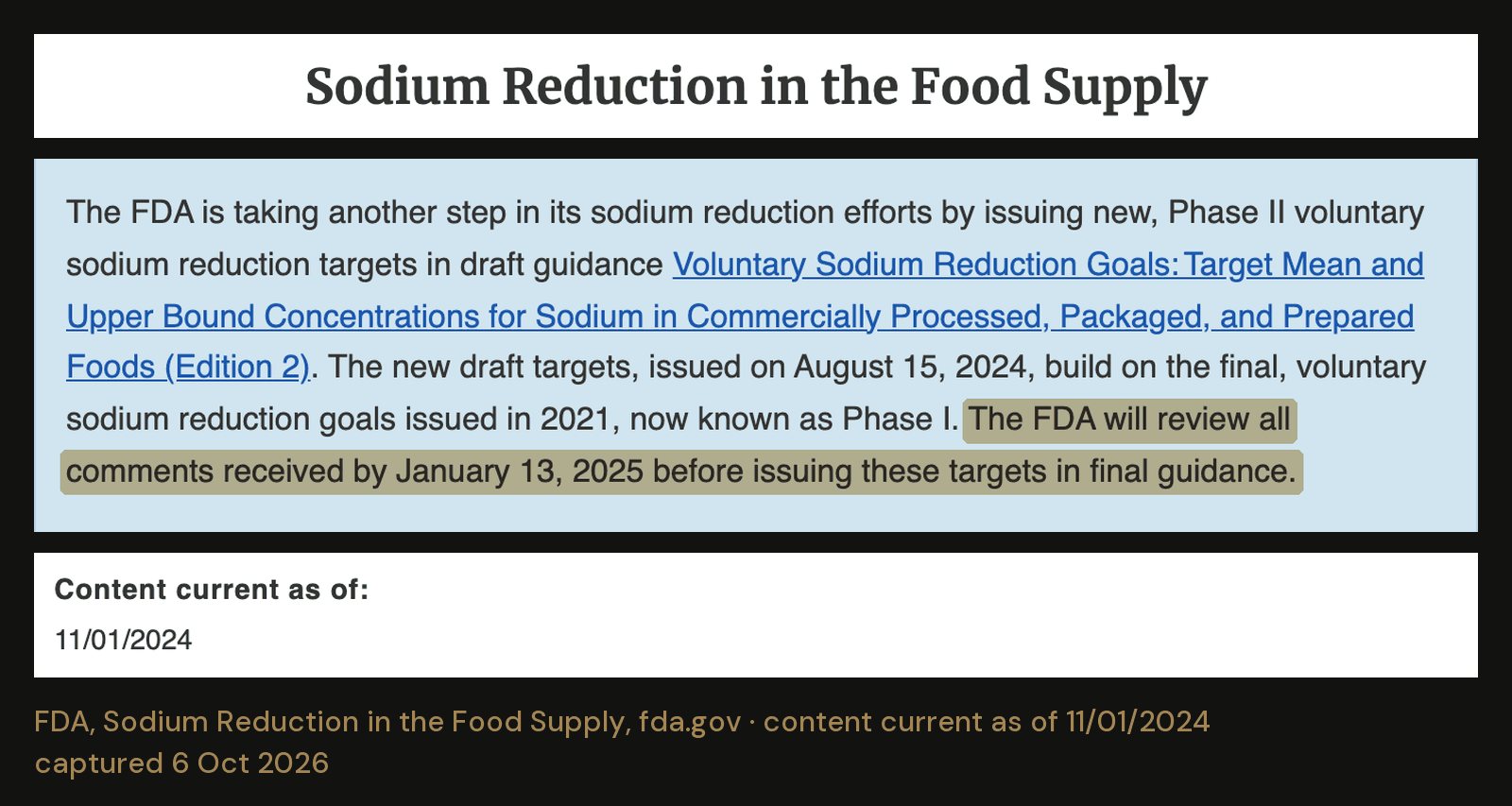
FDA’s page on sodium in the food supply, as it read on 6 October 2026. The targets it describes are still a draft.
That page is one of four records this piece follows. Each is an FDA action on food labels or salt that was not yet in force when this administration took office on 20 January 2025. They are:
A final rule updating when a food may be labeled “healthy.”
A proposed rule for a nutrition label on the front of food packages.
A draft of voluntary targets for sodium in packaged and restaurant foods.
A 2023 proposal to let makers of certain foods use salt substitutes.
On 6 October 2026 one of the four was in force. The “healthy” rule took effect two months late, under a freeze that covered new rules across the government. The salt-substitute rule has cleared White House review and has not been published. The front label and the sodium targets are at the stage they had reached in January 2025.
None of the four began under Health Secretary Robert F. Kennedy Jr. All four now sit in his department, because FDA is part of the Department of Health and Human Services. President Trump’s order of 13 February 2025 made the Health Secretary chair of the President’s Make America Healthy Again Commission. In September 2025 that commission published its strategy. It covers the front label in one sentence. On my search of its text, it does not mention sodium or salt.
The department calls addressing chronic disease “the cornerstone of the MAHA agenda.” Food labels and sodium have a large body of research behind them. The link between less sodium and lower blood pressure, for one, rests on more than a hundred trials. This piece asks what happened to the actions that rest on that research.
A disclosure first. I am a registered dietitian, and I publish this newsletter under the name of my nutrition practice, Vitae Arete. I research the dietitian workforce and have argued in public for dietitians’ pay and Medicare coverage. This series is not that argument. It is my reading of the paperwork, and it gives the government’s good calls the same attention as its bad ones.
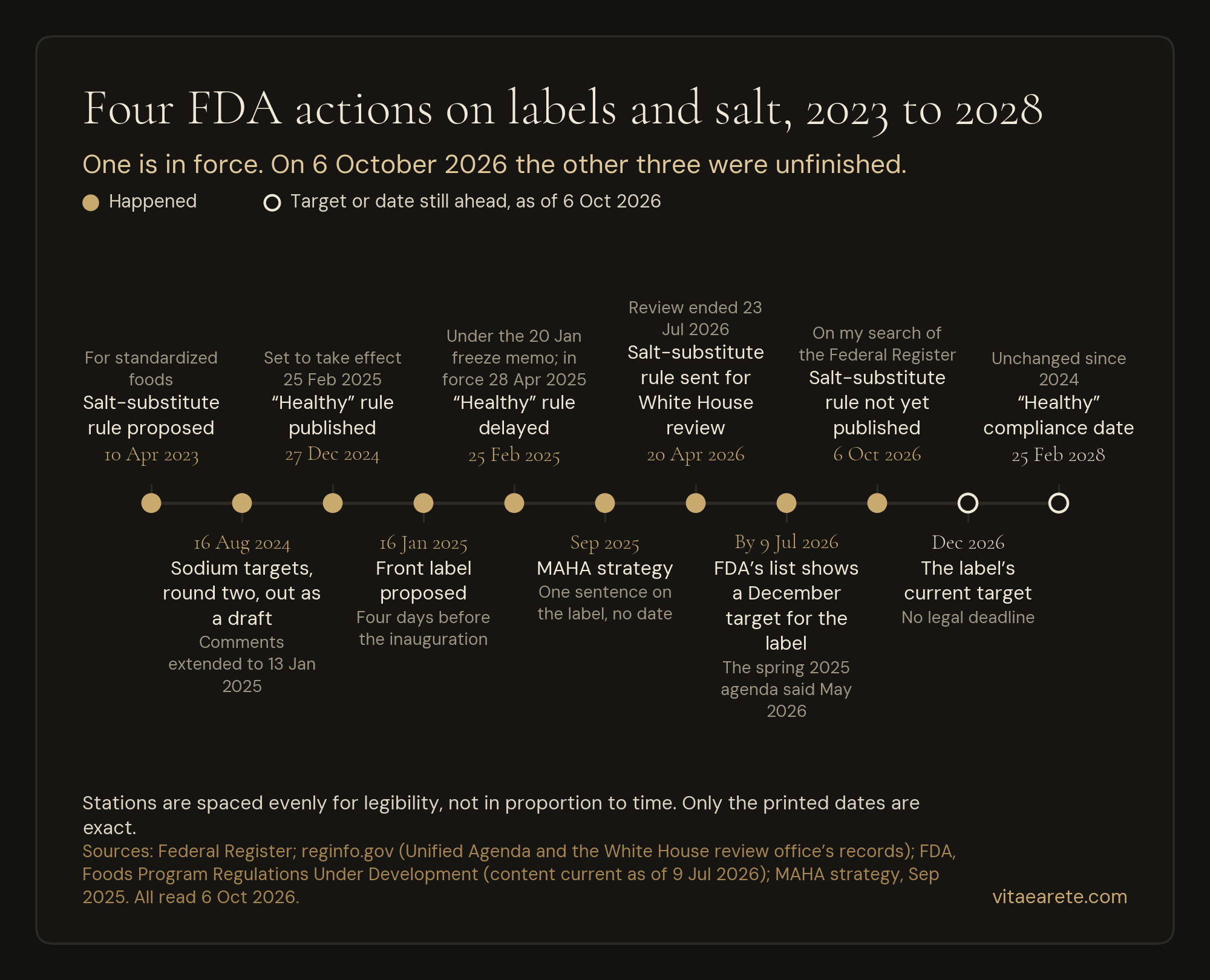
Four FDA actions on labels and salt, from April 2023 to the “healthy” rule’s compliance date in February 2028. Sources: Federal Register, reginfo.gov and FDA, read 6 October 2026.
What the commission and the department wrote
The strategy’s sentence on labels reads in full:
Nutrition Labeling: FDA will consider revisions to its proposed Front-of-Pack Nutrition Information rulemaking based on input received during the comment period and the forthcoming DGAs, once released, and will work toward development of a potential Front-of-Pack Nutrition Information final rule.
The DGAs are the Dietary Guidelines for Americans. Each part of that commitment is hedged. FDA will “consider” revisions. It will “work toward” a “potential” rule. Some of that caution is standard, because an agency must weigh public comments before it finishes a rule. The sentence still sets no date.
On 6 October 2026 I searched the strategy’s text for “sodium,” “salt,” “blood pressure,” “hypertension” and “heart disease,” and found none of them. Its three uses of “claim” are not about the “healthy” rule.
The commission’s first report, its May 2025 assessment, did take up sodium. Among what it called the guidelines’ “problematic reductionist recommendations,” it listed “Advising people to ‘reduce saturated fat’ or ‘limit sodium’ instead of focusing on minimizing ultra-processed foods.” The same page also notes that the guidelines recommend limiting excess sodium.
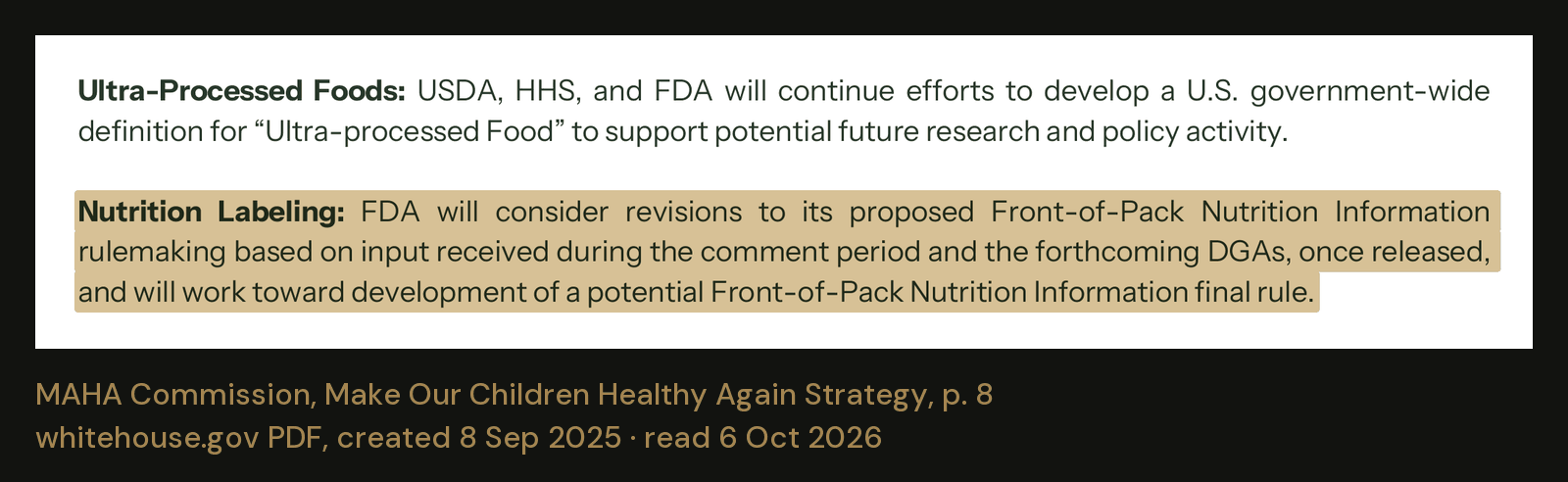
Page 8 of the Make Our Children Healthy Again Strategy, September 2025, in the file the White House served on 6 October 2026.
The guidelines the strategy was waiting for came out in January 2026. They open with a message signed by Kennedy and Agriculture Secretary Brooke Rollins. For people 14 and older, they keep the sodium limit at less than 2,300 milligrams a day, as the previous edition did. For children the limits run from less than 1,200 to less than 1,800 milligrams, by age.
Two sentences on sodium are worth quoting. One is new: “Highly active individuals may benefit from increased sodium intake to offset sweat losses.” The other says: “Highly processed foods that are high in sodium should be avoided.” Nine months later, on 6 October 2026, I searched the Federal Register, the government’s daily journal of rules and notices. I found no new FDA document on the front label.
The department’s statement of priorities for the year points elsewhere. On 14 August 2026 the Federal Register carried the government’s 2026 list of planned rules. The department’s statement in it says that “under Secretary Kennedy’s leadership,” it and two of its agencies, FDA among them, “have taken unprecedented steps to combat the obesity crisis”. The FDA food rules it highlights for the year ahead are a proposal requiring notices for substances “generally recognized as safe” and a new “low sugar” claim.
On 6 October 2026 I searched that statement for “front-of-package,” “Front-of-Pack,” the label rule’s number and “sodium.” I found none of them. That statement covers only the rules in the department’s regulatory plan, and the label’s 2026 entry, described below, says it is not in that plan.
The “healthy” rule: late, then in force
The “healthy” rule was published on 27 December 2024. It updates when a food may call itself “healthy” on its label. FDA’s analysis says “about 5 percent of all packaged foods are labeled as ‘healthy.’” The rule was set to take effect on 25 February 2025.
On that day FDA published a notice delaying it. The notice cites “the memorandum of January 20, 2025, from the President, entitled ‘Regulatory Freeze Pending Review.’” It says the effective date “is delayed until April 28, 2025.” The memo, as FDA describes it, told agencies “to consider postponing” the effective dates of rules not yet in force, so they could review them. It applied to new rules across the government, not to food rules alone. FDA added: “We note that the compliance date remains unchanged at this time.”
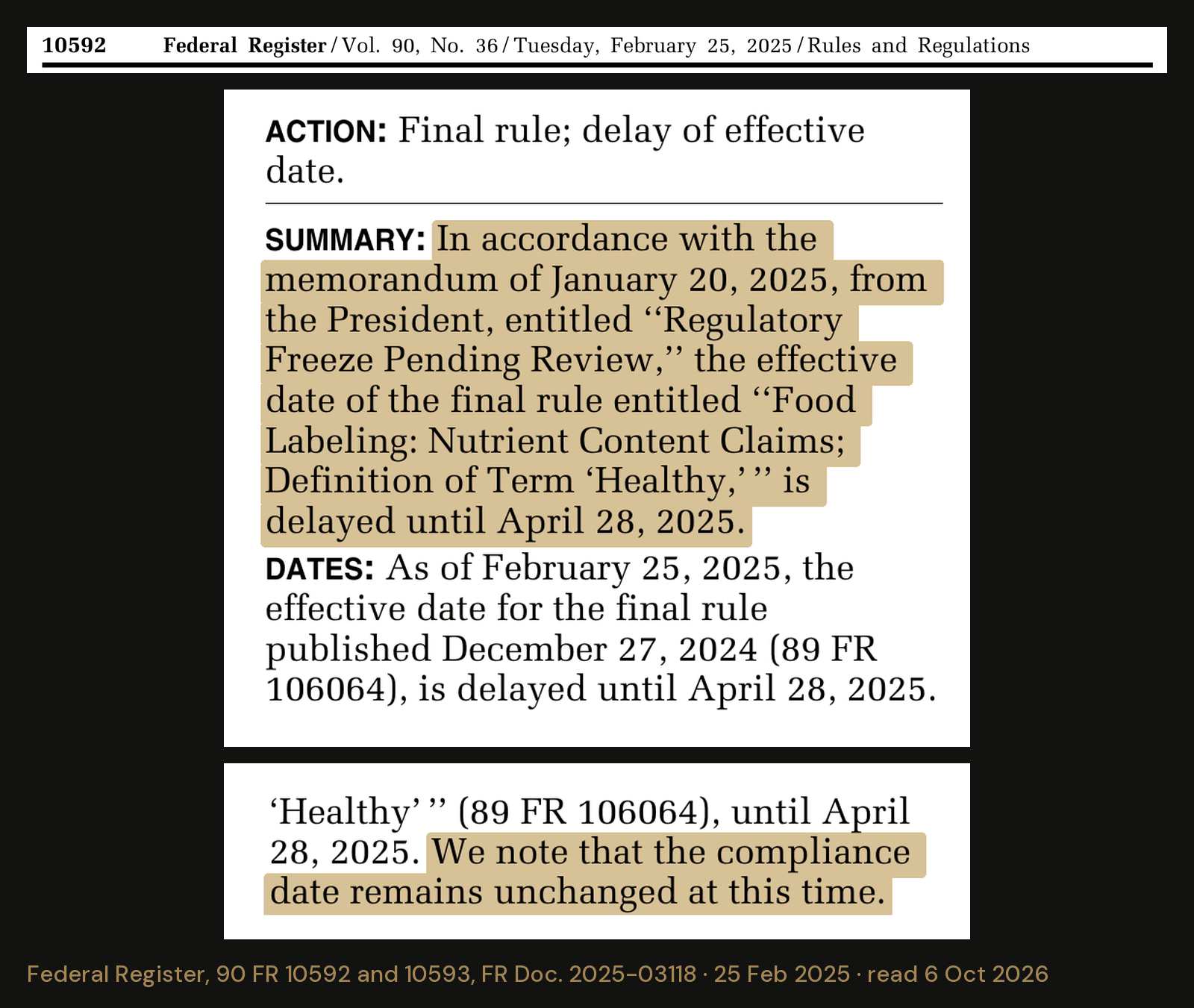
FDA’s notice in the Federal Register, 25 February 2025, the day the “healthy” rule was set to take effect.
The rule took effect on 28 April 2025. Companies that use the word must meet the new definition by 25 February 2028. In the rule’s Federal Register docket, searched on 6 October 2026, I found no action changing either date after the delay.
That is a credit: the administration let a finished rule stand.
Two pieces are unfinished. FDA’s page on the claim says, “The FDA continues to work on development of the symbol.” That page reads “Content current as of: 01/16/2025.” In January 2026, FDA’s food program set out its plans for the year. It said it “will assess whether changes to the ‘healthy’ claim are necessary to align with the 2025-2030 Dietary Guidelines for Americans.” It also said it would advance “a potential guidance that identifies a symbol to depict the ‘healthy’ claim.” On 6 October 2026 I found no Federal Register document that does either.
The front label: still a proposal
FDA proposed the front label on 16 January 2025, four days before the inauguration. It would put a “Nutrition Info box” on the front of most packaged foods. The box would rate saturated fat, sodium and added sugars per serving as “Low,” “Med” or “High.” It would also show the percent of the daily value.
Large companies would have three years after the rule took effect to comply. Companies with less than $10 million a year in food sales would have four. If FDA finished the rule in December 2026, by my arithmetic, larger companies would not have to show the box until about 2030. That assumes the rule takes effect soon after it is published, and companies could add it sooner.
FDA estimated the cost, in 2023 dollars, over ten years. It put the yearly cost at $191 million to $530 million, with a central estimate of $333 million, at a 2 percent discount rate. About two thirds of the total is the cost of companies changing their recipes. FDA says that “is not a requirement or goal of the proposed rule.”
FDA did not put a dollar figure on the benefits. Its summary table lists them as “Unquantified benefits.” It says: “The benefits of this proposed rule would come from the value consumers receive from the information provided in the interpretive label on food packages.”
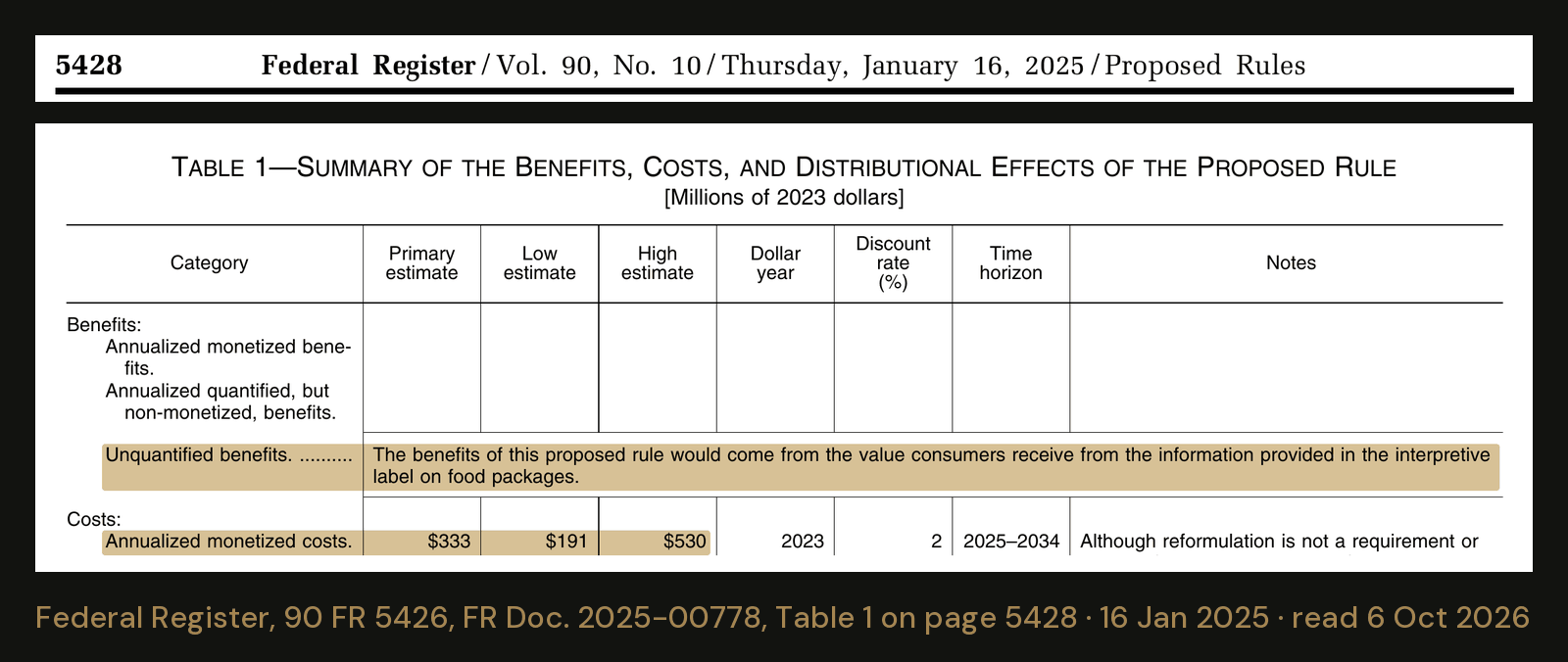
Table 1 of the proposed rule, Federal Register, 16 January 2025, in millions of 2023 dollars. FDA put numbers on the costs and listed the benefits as unquantified.
Comments were due on 16 May 2025, but on 9 May FDA added sixty days, to 15 July, “in response to requests for an extension.” The notice does not say who asked. FDA used the same words when it extended the sodium comments in November 2024. The May notice also says: “We believe that a 60-day extension allows adequate time for interested parties to submit comments without significantly delaying rulemaking on the important issues in the proposed rule.”
Each agency lists the rules it plans in the Unified Agenda, with target dates. In the spring 2025 agenda, which the Federal Register announced in September 2025, the label’s entry read “Final Rule 05/00/2026,” meaning May 2026. The next agenda, which the government’s site labels 2026, reads “Final Rule 12/00/2026.” That is seven months later. Both entries say “Legal Deadline: None,” so no law sets a date for this rule.
Agenda dates are targets, not deadlines, and they often move. Before this administration, the same label’s target for a proposal moved three times, from December 2023 to December 2024. FDA published the proposal in January 2025. Two recent FDA labeling rules also took time. The “healthy” rule took about twenty-seven months from proposal to final rule, from 29 September 2022 to 27 December 2024. The update to the Nutrition Facts label took about the same, from 3 March 2014 to 27 May 2016. A final front label in December 2026 would come about twenty-three months after the proposal. The delay I can document is against FDA’s own target, which moved seven months.
One more line changed. Under a 1993 executive order, certain agencies prepare each year a regulatory plan of their “most important significant regulatory actions,” published with the fall agenda. The spring 2025 entry, which carried over the plan issued in fall 2024, says “Included in the Regulatory Plan: Yes.” The 2026 entry, in the first plan prepared since January 2025, says “No.” The label was also out of the plan in spring 2023, before it was proposed. A planned FDA proposal on “low added sugar” claims, first listed in 2026, is in the plan.
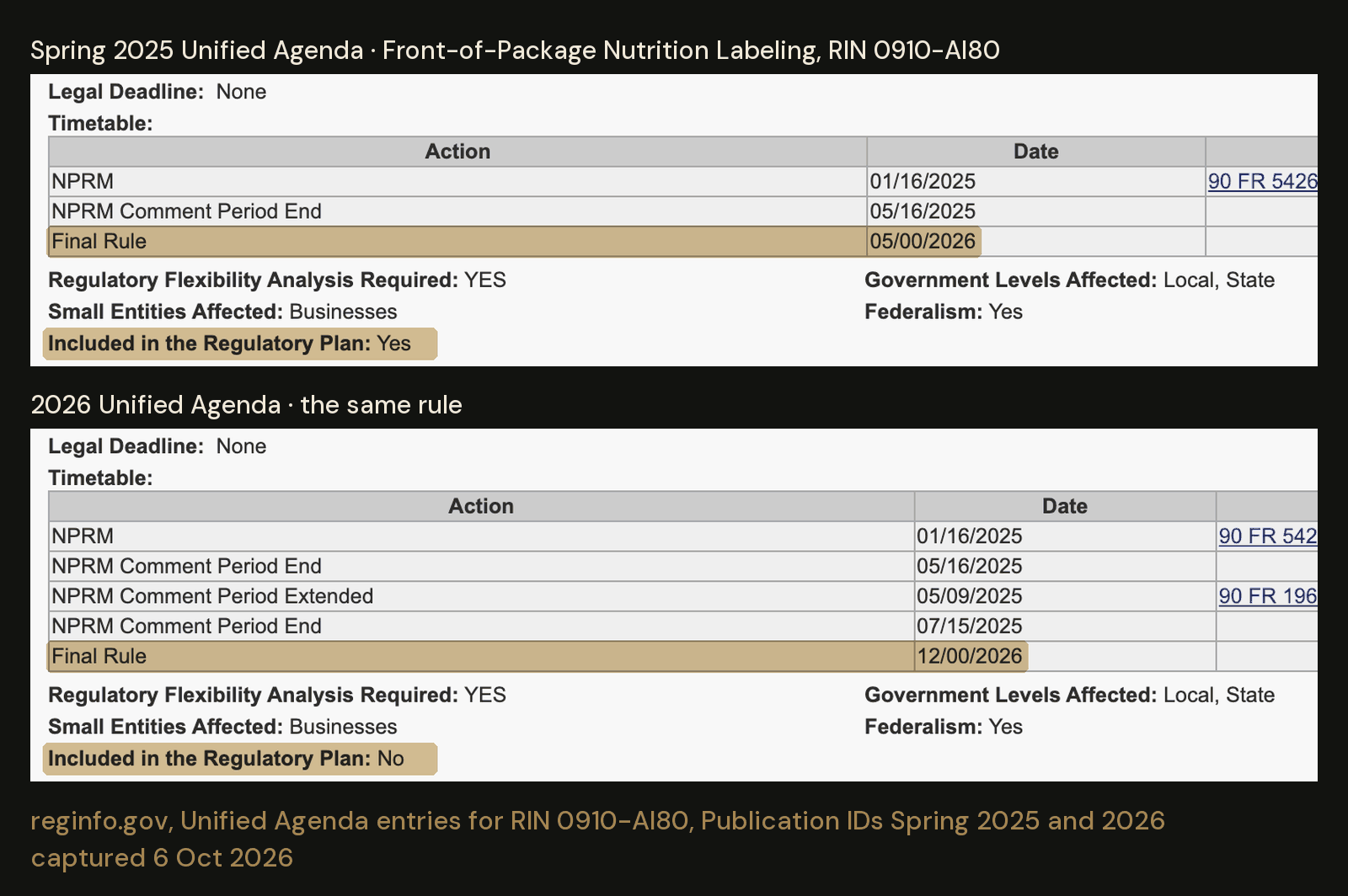
The same rule in two editions of the Unified Agenda, read on reginfo.gov on 6 October 2026.
The White House Office of Information and Regulatory Affairs reviews significant rules before they are published. Its log shows five meetings with outside groups on this rule, from 19 December 2024 to 8 January 2025, while it was reviewing the proposal, and none since.
On 6 October 2026 the label was not on that office’s list of rules under review. Its lists of reviews completed in 2025 and 2026 show only the proposal’s review, which ended on 10 January 2025. I found no record that a final version has been sent.
FDA’s Human Foods Program, HFP for short, did describe its next step. In its 2026 plan it wrote that FDA “received tens of thousands of public comments on the proposal, eliciting widespread support for FOP [front-of-package] labeling, but also providing varying opinions on the details of the label’s content and design.” It went on: “In 2026, HFP will assimilate and summarize the public comments and prepare options for leadership to make decisions on the content of a final regulation.” The same plan calls the label “important” and says it “could result in manufacturers reformulating products to make them healthier.”
FDA’s own page on the label reads “Content current as of: 05/08/2025,” and its newest item is the extension.
There are fair reasons to take time. The strategy said FDA would weigh the new guidelines, and those came out in January 2026. A label that changes a great deal from the proposal may need a new round of public comment. The research on which design works best, set out below, does not all point one way. And the label is costly. Executive Order 14192, which the President signed on 31 January 2025, says new costs must “be offset by the elimination of existing costs associated with at least 10 prior regulations.” Both of the label’s agenda entries tag it under that order, as does the added-sugar proposal. None of the documents I read gives any of these as the reason the target moved.
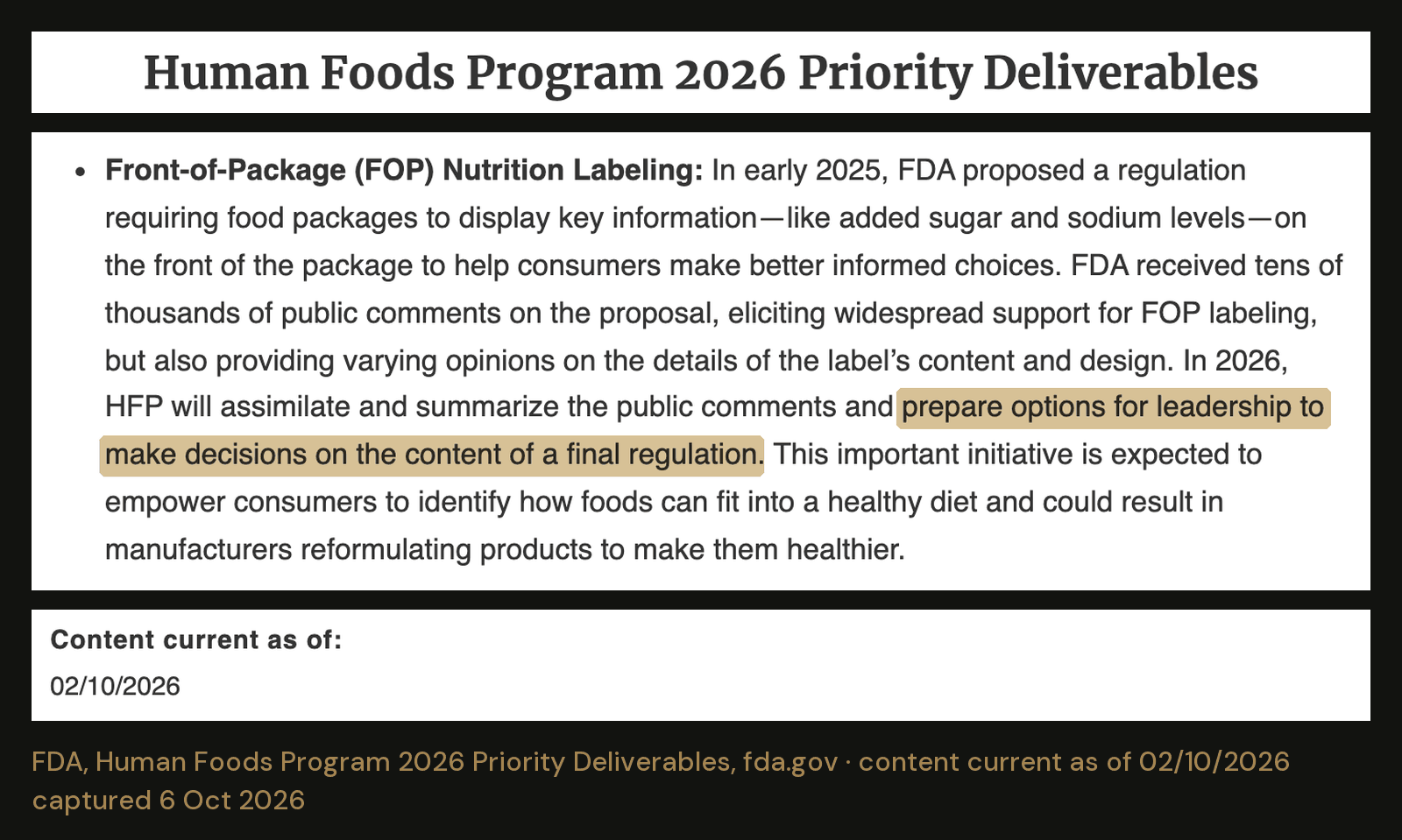
FDA’s Human Foods Program 2026 Priority Deliverables, content current as of 10 February 2026, read 6 October 2026.
Sodium: a draft, and a rule waiting to be published
FDA’s 2026 plan opens its sodium paragraph with this: “Reducing sodium intake has the potential for preventing hundreds of thousands of premature deaths in the coming years.”
FDA’s sodium page, last updated in November 2024, says “Average sodium intake in the U.S. is approximately 3,400 milligrams/day.” It says “Ninety percent of Americans are eating more sodium than is recommended.” That page still cites the 2020 to 2025 guidelines, which new ones replaced in January 2026.
FDA’s approach is voluntary: it sets targets for the sodium in categories of food, and companies decide whether to meet them. The first round, which FDA calls Phase I, became final guidance in October 2021. It aimed to bring average intake “from 3,400 milligrams/day (mg/day) to 3,000 mg/day.”
The second round, Phase II, came out as a draft on 16 August 2024. It sets targets for 163 food categories, which FDA says, if met, “would reduce sodium intake to about 2,750 milligrams/day.” Comments were first due on 14 November 2024, and on 4 November FDA extended that to 13 January 2025. Both dates came before this administration.
In the Federal Register on 6 October 2026, I found no final version and no withdrawal. The draft has been waiting for more than two years. The first round took longer: it was a draft from June 2016 until October 2021.
FDA’s own progress report, which compares 2010 with 2022, cuts both ways. “Overall, 40% of food categories had already achieved the Phase I sodium targets or were within 10% of meeting the targets,” it says. That is a count of categories, not a share of food sold. Across packaged and restaurant foods, more than half the categories went down in sodium. But “34% of the categories increased in sodium.” The report promised that “A formal evaluation will be made available once the FDA has reviewed the 2024 data.”
FDA’s 2026 plan makes a bigger claim. “Following the issuance of FDA’s Phase I voluntary targets in 2021, Americans’ sodium intake has decreased by about 10%,” it says. “In 2026, HFP will issue a formal evaluation of the Phase I targets.” I found no source cited for the 10 percent in the plan, and I found no change in intake in the 2024 report. On 6 October 2026 I found no formal evaluation on FDA’s site or in the Federal Register.
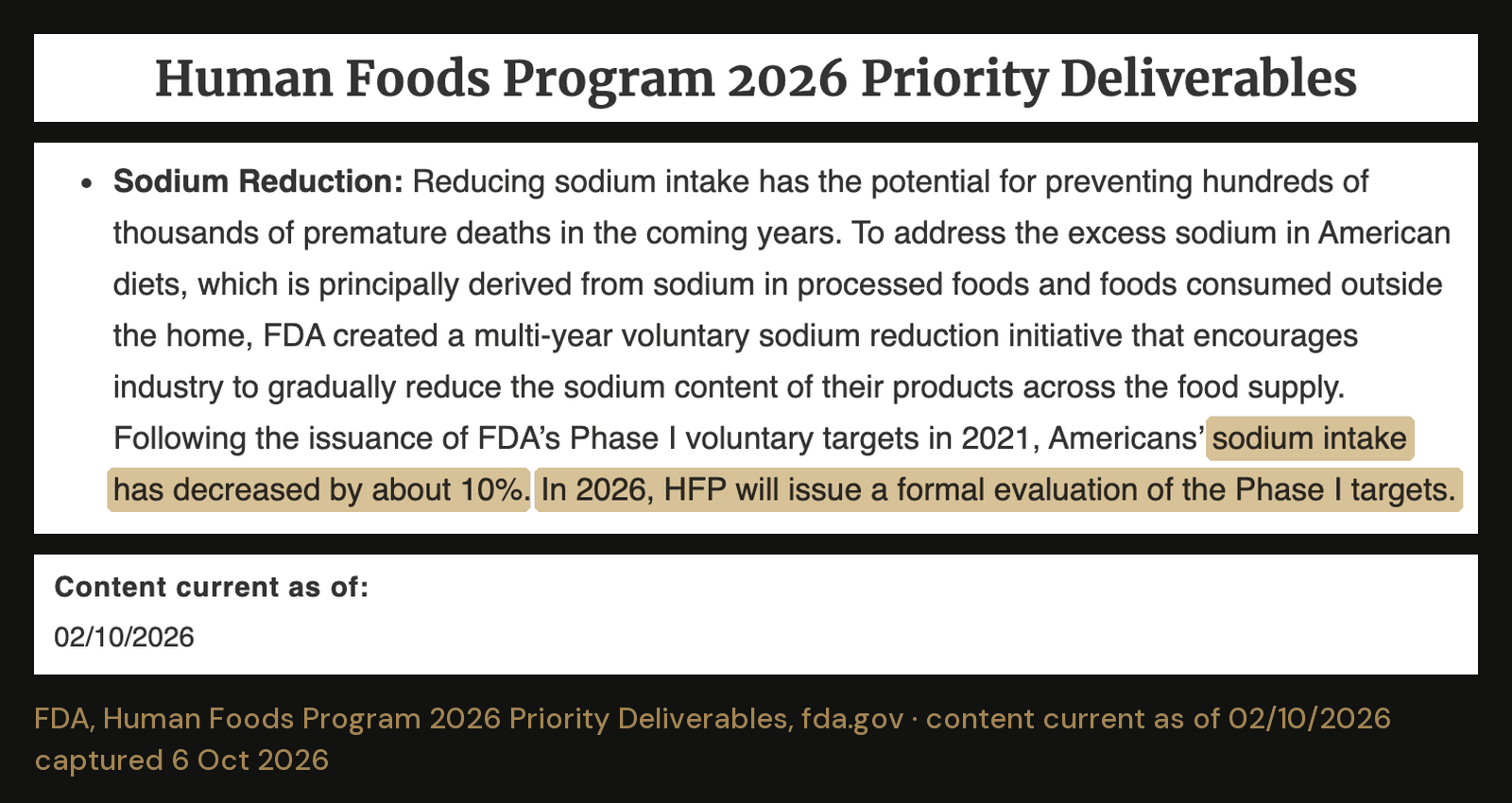
FDA’s Human Foods Program 2026 Priority Deliverables, the sodium paragraph, read 6 October 2026.
The federal food survey, What We Eat in America, gives one check. It put average sodium intake from food and drink, for people two and older, at 3,346 milligrams a day in 2017 to March 2020. In August 2021 to August 2023 it was 3,113 milligrams. By my arithmetic that is about 7 percent lower, and calories fell about 4 percent over the same years. The second survey began two months before FDA’s final targets, so it cannot show what the targets did.
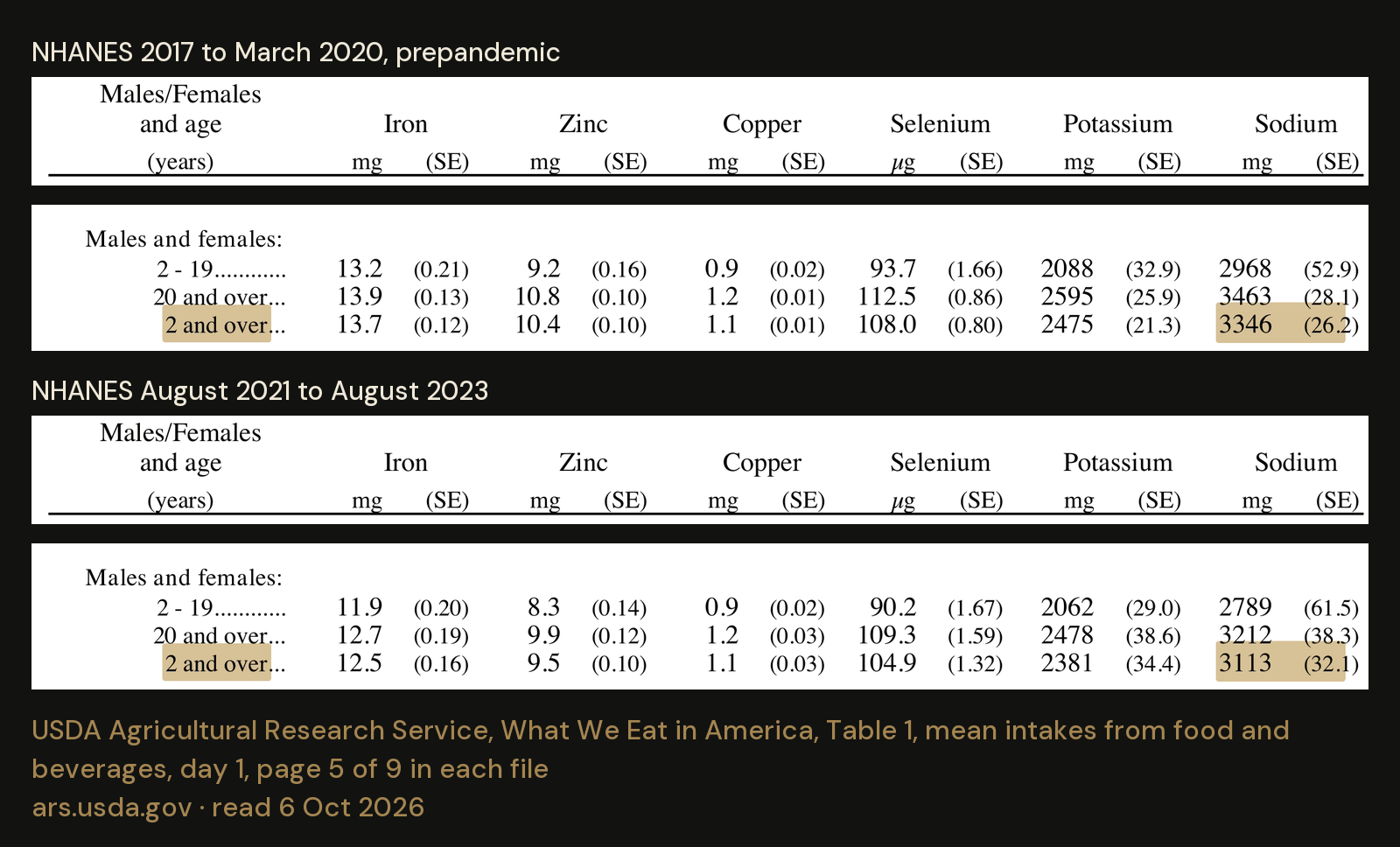
What We Eat in America, Table 1, from the U.S. Department of Agriculture, read 6 October 2026. The survey’s periods do not line up with FDA’s 2021 targets.
One sodium rule did move. In April 2023 FDA proposed letting makers of standardized foods, foods whose recipe is set by a federal standard, use salt substitutes. The agenda says the rule “would support industry efforts to reduce sodium content in standardized foods,” and it tags the rule “Deregulatory.” Before January 2025 its target for a final rule had moved from August 2024 to April 2025 to September 2025.
The White House review office received the final rule on 20 April 2026. It finished its review on 23 July 2026, with the finding “Consistent with Change,” which means the rule cleared review with changes. FDA’s own list of rules in progress, current as of 9 July 2026, gave a goal of July 2026. On 6 October 2026, seventy-five days after the review ended, I found it had not been published in the Federal Register.
What the research says
The sections above are about paperwork, and this one asks whether finishing these actions would improve health. Labels change what people buy, and the evidence for that is large, though mostly from labs and online studies. Only one study I found has measured health, in Chile, where labels came with other policies. Eating less sodium lowers blood pressure, on good evidence. The record on voluntary sodium targets is mixed.
Front labels change choices. A 2021 review pooled 156 studies, 101 of them randomized trials. Nutrient warning labels raised the odds that people chose a healthier product about three and a half times. Traffic-light labels raised them about one and a half times. Those warnings also cut the calories people bought by 12.9 percent and saturated fat by 16.3 percent. But 95 percent of the studies were done in labs, results varied widely, and none tested long-term effects. Two of its authors belong to salt and sugar reduction charities, as the paper discloses.
The strongest real-world test is Chile. It put warning labels on foods high in sugar, sodium, saturated fat or calories. The same law limited marketing those foods to children and banned their sale in schools. In 2,383 households, purchases of high-in drinks fell 23.7 percent after the first phase, compared with what earlier trends predicted. In a study of 2,381 households, sugar bought across all food and drink fell about 10 percent and sodium about 5 percent.
After a stricter second phase, in 2,844 households, sodium bought from high-in foods and drinks fell 21.9 percent and sugar 36.8 percent, the sugar mostly from drinks. Homes of lower and higher socioeconomic status showed a similar pattern. Some results changed when the authors used a shorter stretch of data from before the law. The studies cannot separate the labels from the other two policies. And Chilean children ate less sugar, saturated fat and sodium at school but more of them elsewhere.
One study has looked at health. In The Lancet in June 2026, researchers followed 321,597 Chilean children aged four to six. Children exposed to the law’s first phase were less likely to have excess weight after 18 months, by 2.4 percentage points in boys and 2.85 in girls. The labels, marketing limits and school ban came together, so the study cannot separate them. Its authors write that the first phase “plausibly caused a measurable decrease” in excess weight. Bloomberg Philanthropies funded it and the Chile purchase studies, and two of its authors wrote those studies too.
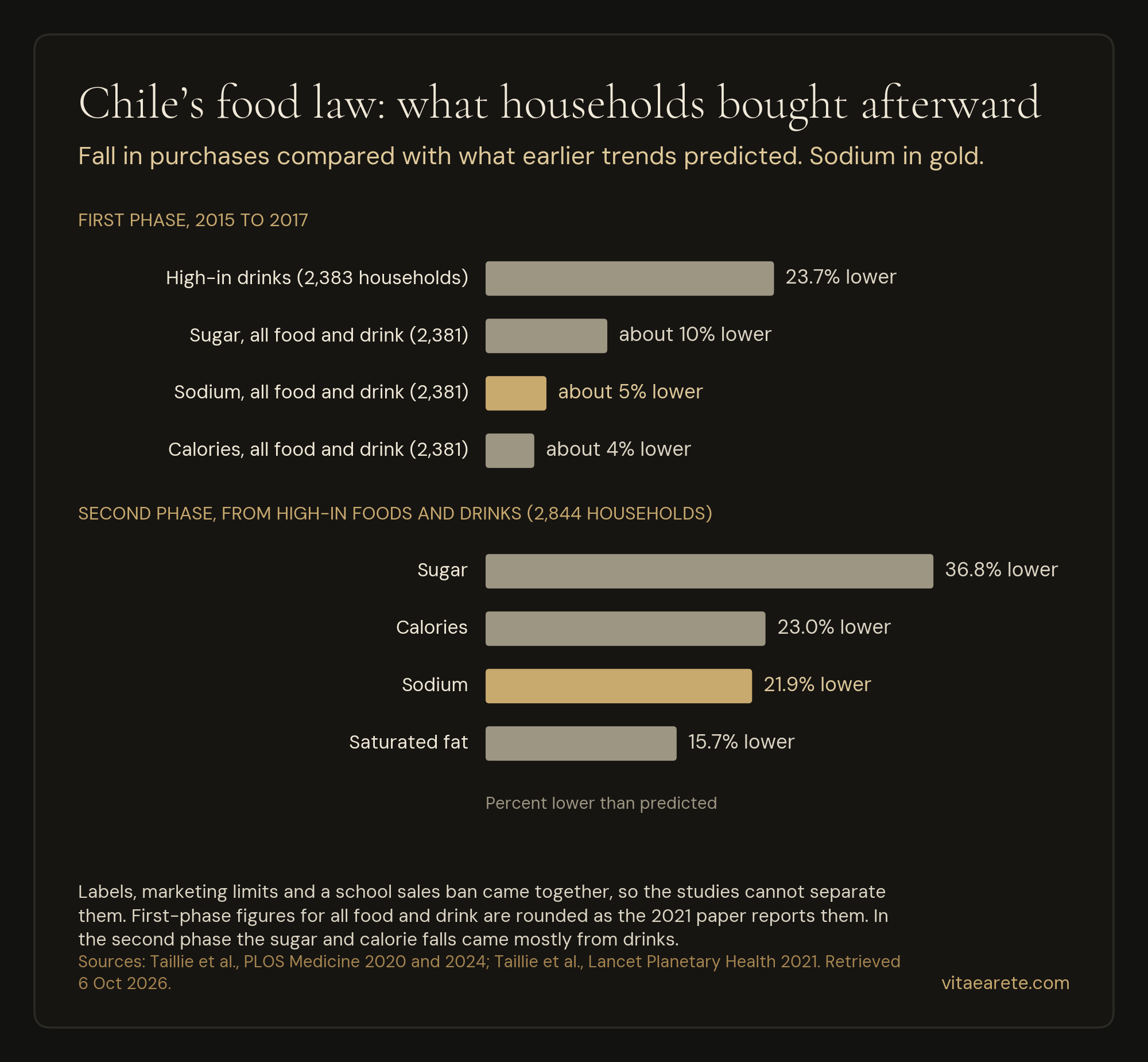
Change in purchases after Chile’s law, compared with what earlier trends predicted. Sources: Taillie and colleagues, PLOS Medicine 2020 and 2024, Lancet Planetary Health 2021. The three policies came together, so the studies cannot separate them.
A 2026 review of the mandatory labels in Chile, Colombia, Ecuador and Mexico found better awareness and fewer high-in choices. It said the studies give “little insight into long-term health impacts” or into inequalities. A 2021 review of studies in real stores and controlled settings was less positive. Traffic lights helped in five of twelve studies and warnings in one of two. Two other designs showed no effect, and its authors called the results “mixed and inconclusive.”
Labels also change what companies make. A 2023 review of 39 articles found that labels which interpret the numbers for shoppers pushed makers to reformulate. Labels showing only numbers did not: “those with numerical information without specific guidance had no impact on reducing unhealthy nutrients.” Mandatory labels did more than voluntary ones. A 2024 review of 77 real-world studies looked at policies other than taxes. Reformulation improved in 60 of 63 studies with a clear direction. Mandatory measures improved it in 15 of 15, and voluntary ones in 40 of 43. Sodium was the nutrient most often targeted, and most of the studies were low in quality.
Which design works best is less settled. FDA’s own experiment, with 9,200 adults online, found that its “Nutrition Info schemes performed best overall in helping consumers identify healthier nutrient profiles.” “High In” labels “performed the worst” on that task.
An independent trial of 13,929 adults, run online in April 2025, set FDA’s design beside three others and a group shown no label. One version of FDA’s own label showed “High” in red and dropped the percentages. It did better than FDA’s design at picking out the healthiest and least healthy products, by 5.4 and 3.3 percentage points. A design with a separate “High-In” warning for each nutrient did better on picking the least healthy, by 1.7 points. People shown FDA’s design also rated unhealthy products as healthier than people shown those warnings.
On a secondary measure, choosing a snack for themselves, people shown the separate warnings picked a high-in snack 7.7 points less often than people shown FDA’s design. It made no difference when they chose for their child. The trial was funded by Healthy Eating Research, a Robert Wood Johnson Foundation program, and Bloomberg Philanthropies. Both studies measured reactions to labels, not health.
No study I found has tested a front label alone against a health outcome.
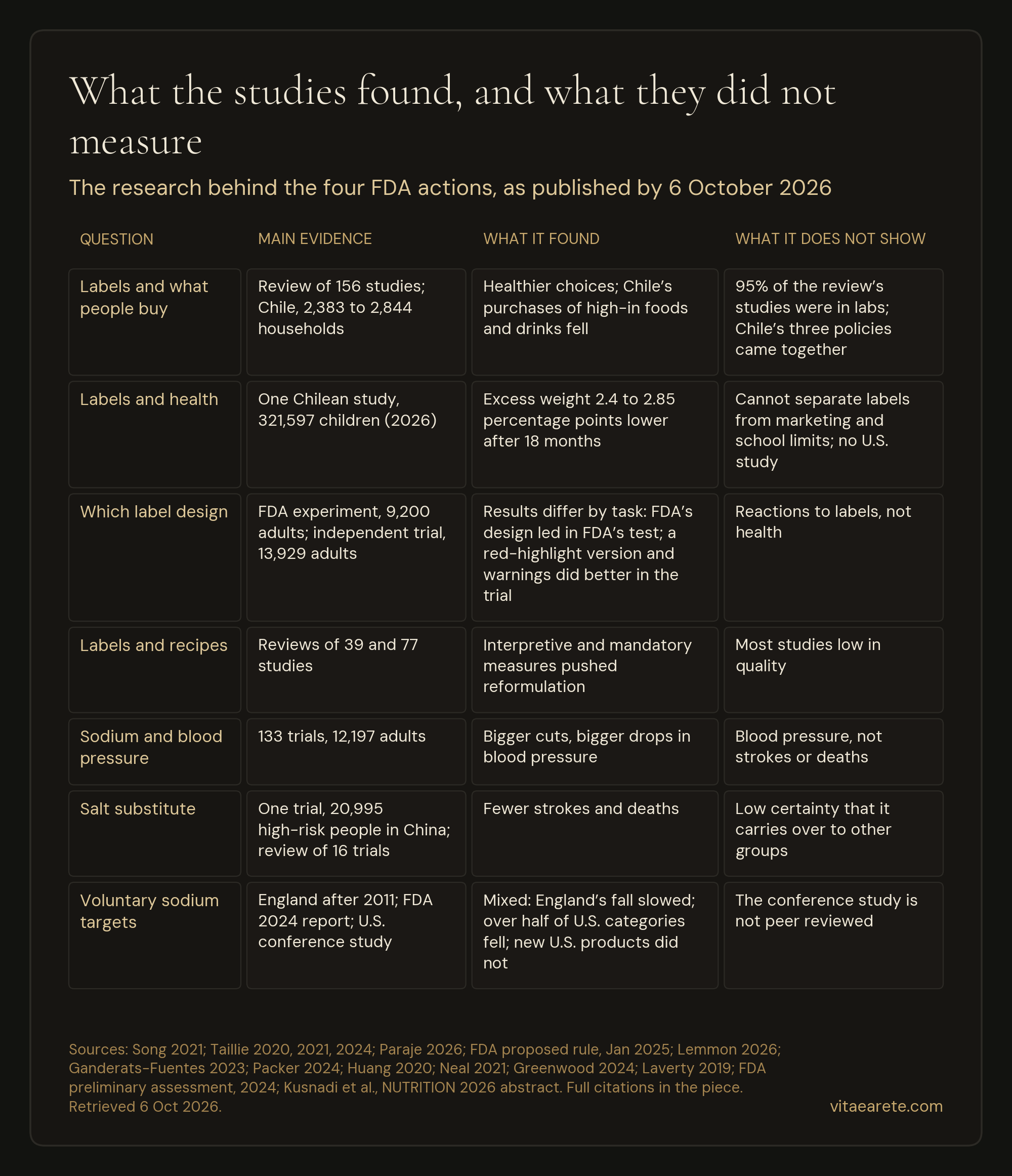
What the studies found, and what they did not measure. Sources are listed at the end.
Claims like “healthy” move choices too. A 2017 review found that health-related claims raised the odds a product was chosen or eaten (odds ratio 1.75). Most studies were in artificial settings, and real-world studies found smaller effects. That is why the definition matters.
FDA modeled its updated definition at $686 million in benefits and $403 million in costs over twenty years. That is a net $283 million in present value, at a 3 percent discount rate. The benefits rest on an observed link between diet quality scores and death from any cause, not on a trial. No study I found has tested the new definition in use.
Less sodium means lower blood pressure. A 2020 review of 133 trials with 12,197 adults found that the bigger the cut, the bigger the drop. Each 50 millimoles a day less sodium, about 1,150 milligrams, lowered systolic blood pressure, the top number, by 1.10 points. In trials of 15 days or more it was 2.13 points. The effect was larger in older people, non-white people and people with higher blood pressure, and it showed up with or without hypertension. Some of the authors belong to salt-reduction advocacy groups, as the paper discloses.
A trial in 600 villages in China, with 20,995 people at high risk, tested a salt substitute. It was 75 percent regular salt and 25 percent potassium salt. Over 4.74 years it cut strokes by about 14 percent (rate ratio 0.86) and major heart and blood vessel events by about 13 percent (0.87). Deaths fell about 12 percent (0.88). It found no significant rise in serious events from high potassium.
A 2024 review of 16 trials found salt substitutes may lower deaths, but rated that evidence low in certainty. It said “generalizability to other populations is very limited,” and one trial dominates it. That bears on FDA’s unpublished rule.
England cut salt across its population from 2003 to 2011, with targets for industry and public campaigns. Salt intake fell 1.4 grams a day, or 15 percent, and blood pressure fell 3.0/1.4 points. Deaths from stroke and heart disease fell 42 and 40 percent, though cholesterol, smoking and treatment also changed. Two of those authors lead or belong to salt-reduction charities, as their paper discloses.
In 2011, England handed target-setting to industry. The yearly fall in salt intake slowed, from 0.20 to 0.11 grams a day in men and from 0.12 to 0.07 in women. A model put the cost of the slowdown at about 9,900 extra cases of heart disease and stroke between 2011 and 2018.
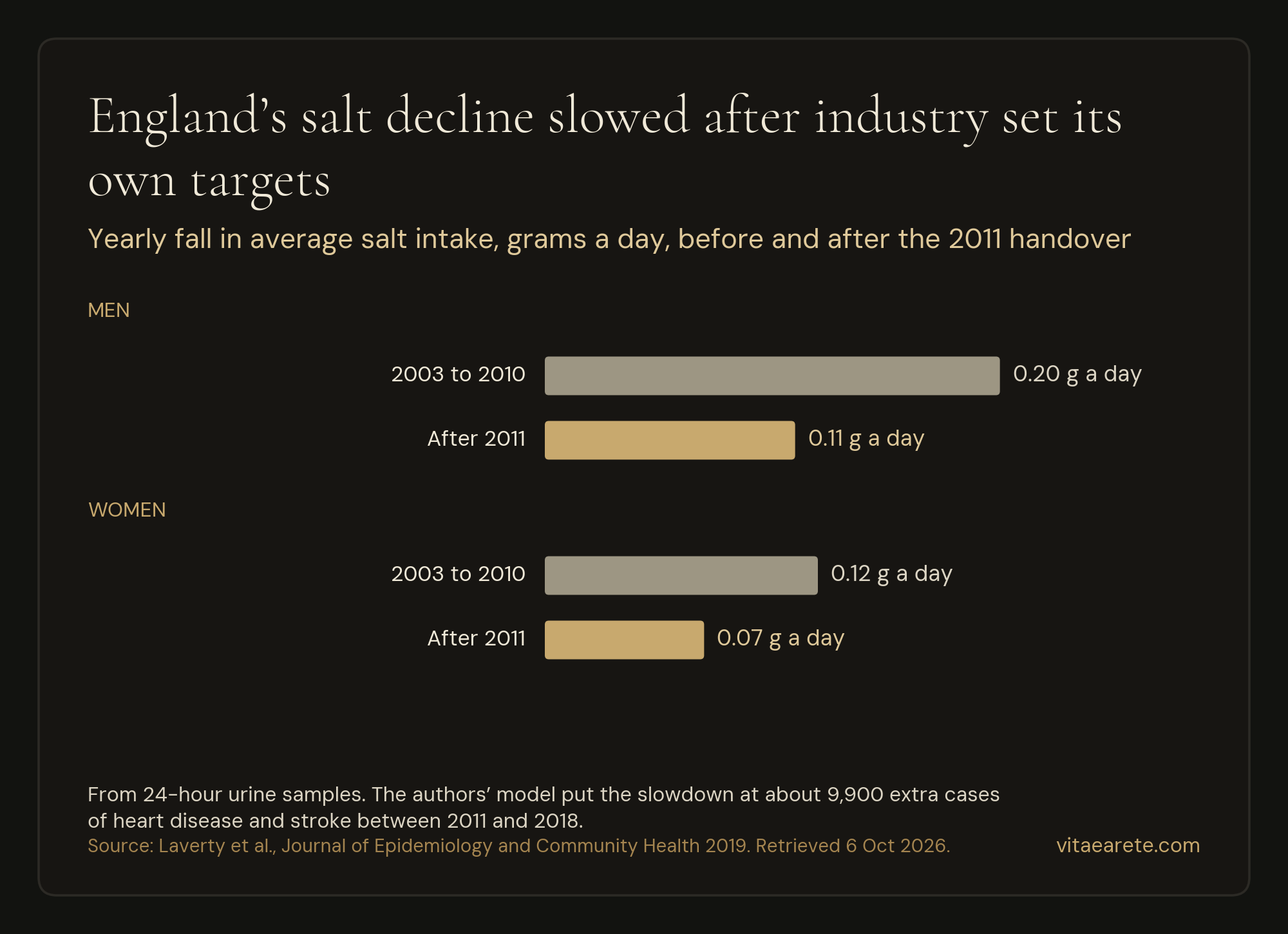
Yearly fall in salt intake in England, before and after the 2011 handover of target-setting to industry. Source: Laverty and colleagues, Journal of Epidemiology and Community Health, 2019.
For the United States, a 2018 model studied the voluntary targets FDA had proposed in 2016. If they were fully met, it projected about 450,000 cases of heart disease and stroke prevented from 2017 to 2036, with net savings of about $41 billion. Even half compliance saved $19 billion in the model. One author worked for the American Heart Association, and others reported food-industry consulting, as the paper discloses. Models are projections, not measurements.
The evidence on FDA’s first targets is mixed. FDA’s 2024 report found sodium down in more than half of food categories, as described above. A study presented at a nutrition conference in July 2026, not peer reviewed, looked at newly launched products. Across nine major categories combined, sodium did not fall after the 2021 targets, and it rose in four, among them breads and dry soups. Its authors call for mandatory targets with penalties.
Some cohort studies disagree about sodium. One, of 103,570 people in 18 countries, found the lowest risk at moderate intakes, 3 to 5 grams of sodium a day, with more potassium. FDA’s sodium page puts average American intake at about 3,400 milligrams, inside that band. Trial researchers dispute its method, which estimates sodium from a single urine sample. The trials above point the other way.
In 2023 the World Health Organization listed front-of-package labeling among four “best buy” interventions for cutting sodium. The others were reformulation targets, rules for food that public institutions buy, and public campaigns. It said only 5 percent of its member states were protected by sodium policies that were both mandatory and broad.
What could have been done instead
Each step below was within the existing power of FDA or, for marketing, the department and the Federal Trade Commission, and none needed a new law.
Publish the evaluation of the first targets. FDA promised it for 2026. It would show what FDA’s claim of a 10 percent drop in intake rests on. A conference study of new products found no fall in sodium across nine major categories combined. I did not find the evaluation on 6 October 2026.
Finish the sodium targets. They are guidance, so no new law is needed. Comments closed on 13 January 2025. England’s record suggests targets do more when government sets and checks them than when industry does. A fair reason to wait is to measure the first round before setting the second, and FDA promised that evaluation for 2026. On 6 October 2026 I found no final version.
Publish the salt-substitute rule. Review ended on 23 July 2026. The largest trial shows fewer strokes and deaths in people at high risk. A review warns the result may not carry over to everyone. FDA itself tags the rule deregulatory.
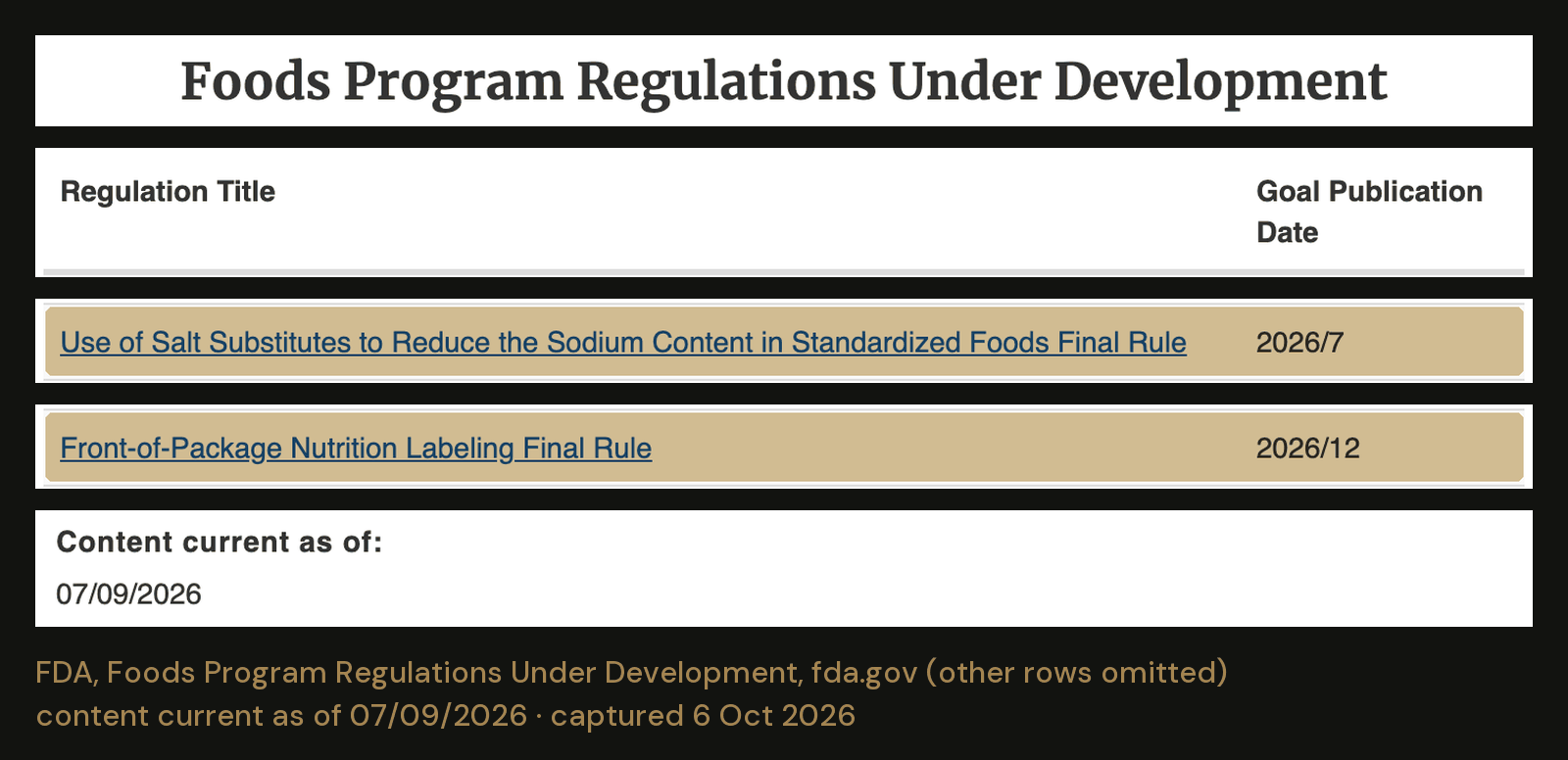
FDA’s Foods Program Regulations Under Development, content current as of 9 July 2026, read 6 October 2026.
Finish the front label, or propose a better one. FDA put the cost at $333 million a year in 2023 dollars, its central estimate, and gave no dollar figure for benefits. It did a break-even calculation, which I have not read. The evidence favors interpretive, mandatory labels. In one independent trial, a red-highlight version of FDA’s own label did better than FDA’s at picking out the healthiest and least healthy products. Separate warnings cut picks of high-in snacks, on a secondary measure. If FDA changes the design a great deal, it may need to propose it again. Either path starts with a decision, and FDA’s 2026 plan says it will “prepare options for leadership.” I found no sign of that decision in the public record on 6 October 2026.
Issue the “healthy” symbol. The rule is in force, but the symbol is not. FDA’s 2026 plan also raises changing the definition to fit the new guidelines, which could reopen a finished rule.
Pair labels with limits on marketing to children. Chile’s results come from labels and marketing limits together. The commission’s strategy says the department and the Federal Trade Commission, with other agencies, “will explore the development of potential industry guidelines to limit the direct marketing of certain unhealthy foods to children”. It sets no date.
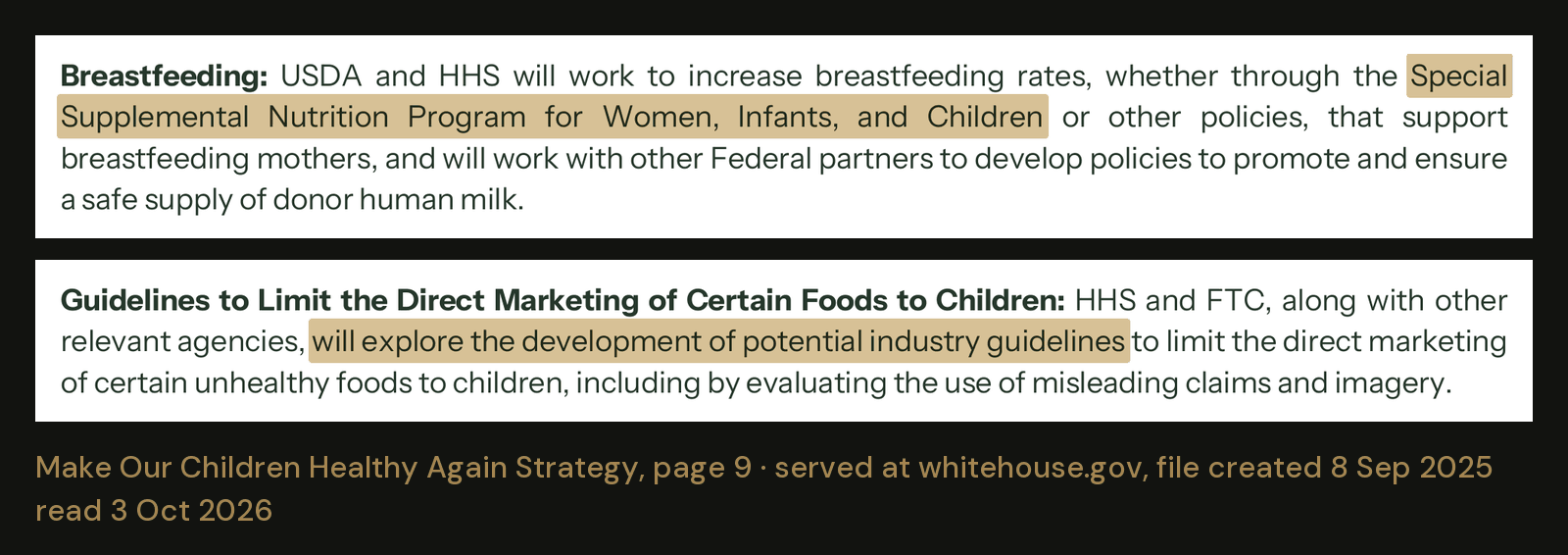
Page 9 of the Make Our Children Healthy Again Strategy, September 2025. The commitment on marketing to children is to “explore.”
Democratic sponsors in both chambers have filed the Food Labeling Modernization Act of 2026, which would write front-of-package requirements into law. Both bills were referred to committee, and on 6 October 2026 neither had moved further. They are Congress’s work, not the administration’s, and my grade does not rest on them.
What I checked, and what I cannot tell you
On 6 October 2026 I searched the Federal Register’s records for each action, by docket, by rule number and by term. I read the Unified Agenda entries for the front label and the salt-substitute rule from spring 2023 to 2026, and for the “healthy” rule in spring 2025. The sodium targets are guidance and have no agenda entry. I read the White House review office’s list of rules under review that day, its lists of completed reviews for 2025 and 2026, and its meeting log for the label. I read FDA’s pages on each action and its 2026 plan, the federal food survey’s sodium tables, and the commission’s strategy and May 2025 assessment. Each source is listed at the end.
I cannot tell you why the label’s target moved, or why the 2026 plan left it out. The documents I read give no reason.
I have not counted the comments on the label; FDA says it received “tens of thousands.” I did not open FDA’s full economic analysis. FDA says it includes “a break-even calculation” of how large the benefits would need to be. I report only the costs it put numbers on.
Published reports this year describe remarks by officials at the department and at FDA on the label’s future. I have not checked those remarks against a recording or a transcript, so I do not quote them, and my grade does not rest on them. As reported, they point to changing the label, possibly through a new proposal, rather than dropping it. If that is the plan, no document I read sets a date for it.
I cannot tell you whether FDA has drafted a final label inside the agency. A draft that has not been sent for review would not show in any record I read.
And I cannot tell you whether a front label on its own would improve anyone’s health. The one health study I found measured Chile’s labels together with its marketing and school limits. What the research does show is set out above.
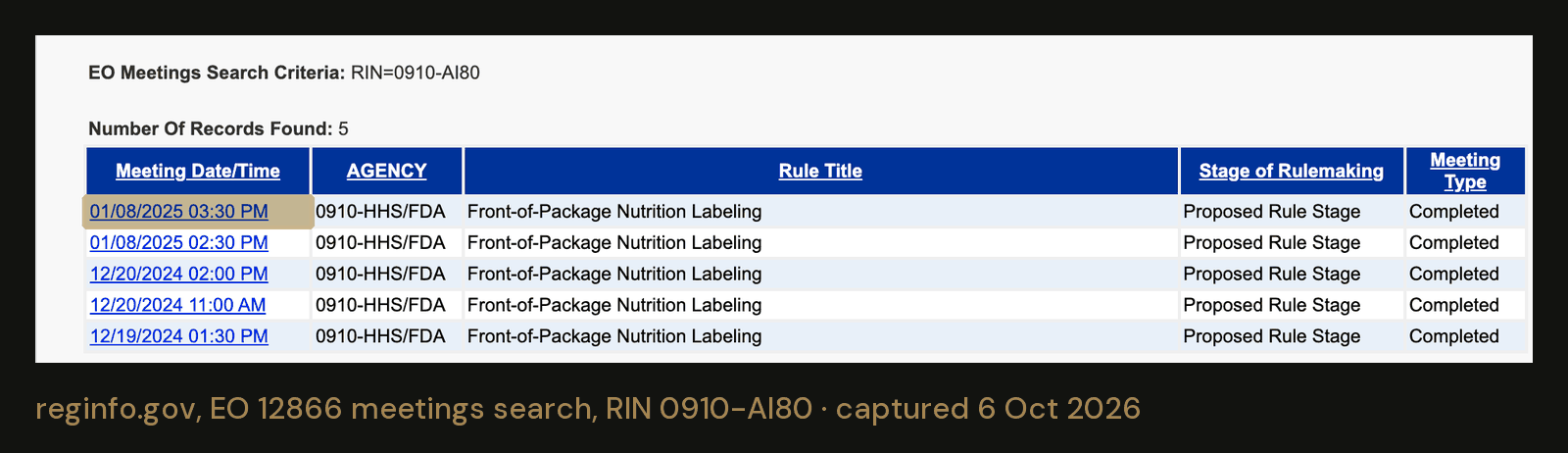
The Office of Information and Regulatory Affairs’ log of meetings on the front-of-package rule, read on reginfo.gov on 6 October 2026.
My grade
This grade is my judgment on the documents cited here. It uses the four lines set out in the piece that opened this series on 3 October 2026: Substance, Evidence, Health and Integrity. All four actions began before January 2025, so each is graded only on what was done with it afterward. Each line answers only what these documents show. It is not a finding about anyone’s motive. I will revise it in a dated note if the record changes.
D. On 6 October 2026 I found no withdrawal of any of the four. FDA let the “healthy” rule take effect after the two-month freeze and kept its 2028 date. It moved the salt-substitute rule, whose target had moved twice before 2025, through White House review. Those credits keep this above an F. But the front label and the sodium targets, the two actions with the most research on what people buy and on blood pressure, are where they stood in January 2025. After FDA added sixty days of comment in May 2025, its spring 2025 agenda, announced that September, still set May 2026. The 2026 agenda moved the target to December 2026 and left the label out of the department’s regulatory plan, for reasons no document I read gives. The commission chaired by Secretary Kennedy committed only to “consider” and “work toward” a “potential” label, and on my search its strategy does not mention sodium. The guidelines he co-signed in January 2026 keep the limit of less than 2,300 milligrams. A fair reader could give this a C. One inherited rule is in force, a second cleared White House review, and FDA’s December target for the label has not yet passed. I will look again in January 2027 and note any change.
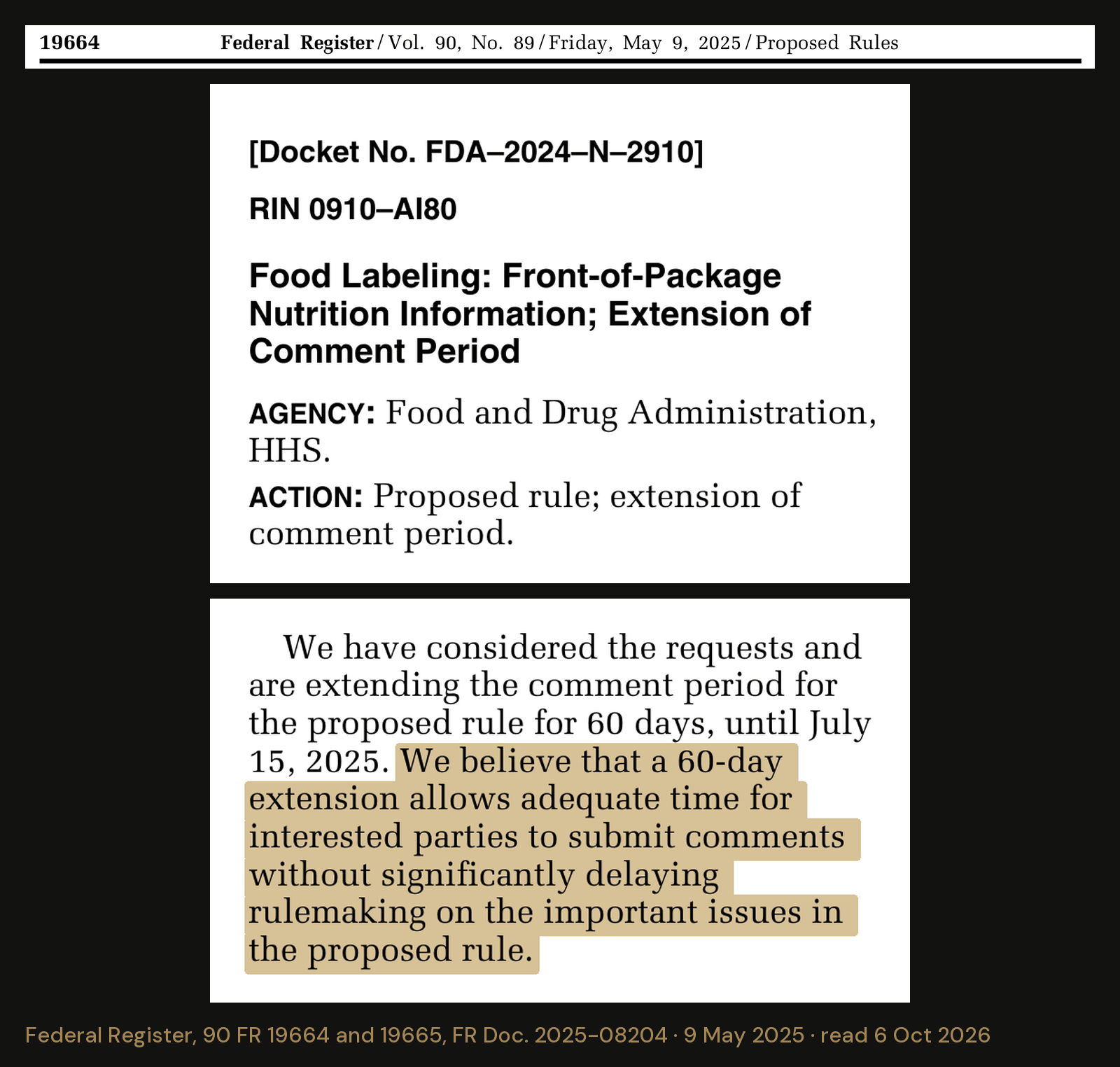
FDA’s extension notice in the Federal Register, 9 May 2025. Its spring 2025 agenda, announced that September, still targeted May 2026.
Substance: One binding rule took effect: the inherited “healthy” rule, two months late. None of the other three became binding. The salt-substitute rule cleared review but, on 6 October 2026, had not been published. The sodium targets would be voluntary even if final.
Evidence: The two actions that stalled have the most research on purchases and blood pressure. The action with the only trial of strokes and deaths, the salt substitute, is the one that moved. Labels change what people buy and what companies make, mostly in lab and online studies, with Chile the strongest real-world case. The research on label design is mixed, which is a fair reason to revise the proposal. The record does not give it as the reason for the delay. FDA’s 2026 plan states a 10 percent fall in sodium intake, and I found no source cited for it. By my arithmetic, the federal food survey shows a fall of about 7 percent across years that straddle the targets. The evaluation FDA promised for 2026 was not out on 6 October.
Health: No measured change in the United States. One Chilean study links a combined label, marketing and school law to less excess weight in young children, and no study I found isolates the label. Models, one of them FDA’s own, project gains from the “healthy” rule and from meeting sodium targets. Those gains wait on actions that are not finished.
Integrity: The process stayed in public view. The proposals took public comment, and the review office logged five meetings with outside groups on the label before January 2025. The comment extension answered “requests” it does not name, as FDA’s November 2024 sodium extension also did. The 2026 plan, the first the department prepared after January 2025, left the label out, while a planned “low added sugar” proposal went in. The label was also out of the plan in spring 2023, before it was proposed.
I asked FDA and HHS
On 6 October 2026 I sent questions to FDA through the request-for-comment form that FDA’s contact page points reporters to. I sent a second set to HHS through the same form, for Secretary Kennedy as the commission’s chair. Both messages say I am not credentialed media.
I asked FDA whether December 2026 is still its target for the label and whether a final version has gone to the White House for review. I also asked whether it is revising or proposing the label again. I asked why the label is no longer in the regulatory plan. I asked whether it estimated the label’s benefits in dollars and when it will finish the sodium targets. I asked what its 10 percent figure rests on, when the promised evaluation will be published, and when it will publish the salt-substitute rule. I also asked whether it plans any change to the “healthy” rule or its 2028 date, and when it will issue the symbol.
I asked HHS whether the Secretary, as chair, has a target date for the label, and why it is no longer in the department’s plan. I asked whether the commission publishes its progress on the strategy, and whether the label is waiting on a federal definition of ultra-processed food. Given the assessment’s criticism of “limit sodium” advice, I asked whether HHS intends FDA to finish, revise or withdraw the sodium targets. I also asked whether it plans any change to the “healthy” rule. I asked both for a reply by 5 p.m. Eastern on Thursday 8 October 2026, and offered to print it whole or summarized.
By [DATE AND TIME CHECKED] I had received no reply from either. If an answer arrives, it will go here, with the date it arrived.
On Wednesday 14 October 2026 this series takes up the citations in the MAHA report.
This is general education and a reading of public documents. It is not medical advice. Salt substitutes contain potassium. If you have kidney disease or take a medicine that raises potassium, ask your clinician before using one.
References
U.S. Food and Drug Administration. Food Labeling: Nutrient Content Claims; Definition of Term “Healthy.” Final rule. Federal Register, 27 December 2024. 89 FR 106064, FR Doc. 2024-29957, RIN 0910-AI13, Docket FDA-2016-D-2335. https://www.federalregister.gov/documents/2024/12/27/2024-29957/food-labeling-nutrient-content-claims-definition-of-term-healthy (accessed 6 October 2026; dates in DATES; costs and benefits in section I.D)
U.S. Food and Drug Administration. Food Labeling: Nutrient Content Claims; Definition of Term “Healthy.” Proposed rule. Federal Register, 29 September 2022. 87 FR 59168, FR Doc. 2022-20975. https://www.federalregister.gov/documents/2022/09/29/2022-20975/food-labeling-nutrient-content-claims-definition-of-term-healthy (accessed 6 October 2026)
U.S. Food and Drug Administration. Food Labeling: Nutrient Content Claims; Definition of Term “Healthy.” Final rule; delay of effective date. Federal Register, 25 February 2025. 90 FR 10592, FR Doc. 2025-03118. https://www.federalregister.gov/documents/2025/02/25/2025-03118/food-labeling-nutrient-content-claims-definition-of-term-healthy (accessed 6 October 2026)
Executive Office of the President. Memorandum of 20 January 2025, Regulatory Freeze Pending Review. Federal Register, 28 January 2025. 90 FR 8249, FR Doc. 2025-01906. https://www.federalregister.gov/documents/2025/01/28/2025-01906/regulatory-freeze-pending-review (accessed 6 October 2026)
U.S. Food and Drug Administration. Food Labeling: Revision of the Nutrition and Supplement Facts Labels. Proposed rule, Federal Register, 3 March 2014, 79 FR 11880, FR Doc. 2014-04387; final rule, Federal Register, 27 May 2016, 81 FR 33742, FR Doc. 2016-11867. https://www.federalregister.gov/documents/2014/03/03/2014-04387/food-labeling-revision-of-the-nutrition-and-supplement-facts-labels and https://www.federalregister.gov/documents/2016/05/27/2016-11867/food-labeling-revision-of-the-nutrition-and-supplement-facts-labels (accessed 6 October 2026)
U.S. Food and Drug Administration. Food Labeling: Front-of-Package Nutrition Information. Proposed rule. Federal Register, 16 January 2025. 90 FR 5426, FR Doc. 2025-00778, RIN 0910-AI80, Docket FDA-2024-N-2910. https://www.federalregister.gov/documents/2025/01/16/2025-00778/food-labeling-front-of-package-nutrition-information (accessed 6 October 2026; Executive Summary; costs in section I.D and Table 1; FDA’s consumer experiment in section III)
U.S. Food and Drug Administration. Food Labeling: Front-of-Package Nutrition Information; Extension of Comment Period. Federal Register, 9 May 2025. 90 FR 19664, FR Doc. 2025-08204. https://www.federalregister.gov/documents/2025/05/09/2025-08204/food-labeling-front-of-package-nutrition-information-extension-of-comment-period (accessed 6 October 2026)
U.S. Food and Drug Administration. Voluntary Sodium Reduction Goals: Target Mean and Upper Bound Concentrations for Sodium in Commercially Processed, Packaged, and Prepared Foods; Draft Guidance for Industry; Availability. Federal Register, 2 June 2016. 81 FR 35363, FR Doc. 2016-12950. Final guidance (Phase I): Federal Register, 14 October 2021, 86 FR 57156, FR Doc. 2021-22453. https://www.federalregister.gov/documents/2016/06/02/2016-12950 and https://www.federalregister.gov/documents/2021/10/14/2021-22453 (accessed 6 October 2026)
U.S. Food and Drug Administration. Voluntary Sodium Reduction Goals: Target Mean and Upper Bound Concentrations for Sodium in Commercially Processed, Packaged, and Prepared Foods; Draft Guidance for Industry (Edition 2); Availability. Federal Register, 16 August 2024. 89 FR 66727, FR Doc. 2024-18261, Docket FDA-2014-D-0055. https://www.federalregister.gov/documents/2024/08/16/2024-18261/voluntary-sodium-reduction-goals-target-mean-and-upper-bound-concentrations-for-sodium-in (accessed 6 October 2026)
U.S. Food and Drug Administration. Voluntary Sodium Reduction Goals: Target Mean and Upper Bound Concentrations for Sodium in Commercially Processed, Packaged, and Prepared Foods (Edition 2); Draft Guidance for Industry; Extension of Comment Period. Federal Register, 4 November 2024. 89 FR 87589, FR Doc. 2024-25567. https://www.federalregister.gov/documents/2024/11/04/2024-25567/voluntary-sodium-reduction-goals-target-mean-and-upper-bound-concentrations-for-sodium-in (accessed 6 October 2026)
U.S. Food and Drug Administration. Use of Salt Substitutes To Reduce the Sodium Content in Standardized Foods. Proposed rule. Federal Register, 10 April 2023. 88 FR 21148, FR Doc. 2023-06456, RIN 0910-AI72, Docket FDA-2022-N-2226. https://www.federalregister.gov/documents/2023/04/10/2023-06456/use-of-salt-substitutes-to-reduce-the-sodium-content-in-standardized-foods (accessed 6 October 2026)
Executive Order 14212 of 13 February 2025, Establishing the President’s Make America Healthy Again Commission. Federal Register, 19 February 2025. 90 FR 9833, FR Doc. 2025-02871. https://www.federalregister.gov/documents/2025/02/19/2025-02871/establishing-the-presidents-make-america-healthy-again-commission (accessed 6 October 2026; section 3(a))
Executive Order 14192 of 31 January 2025, Unleashing Prosperity Through Deregulation. Federal Register, 6 February 2025. 90 FR 9065, FR Doc. 2025-02345. https://www.federalregister.gov/documents/2025/02/06/2025-02345/unleashing-prosperity-through-deregulation (accessed 6 October 2026; section 3(c))
Regulatory Information Service Center. Introduction to the Unified Agenda of Federal Regulatory and Deregulatory Actions-2026. Federal Register, 14 August 2026. 91 FR 52792, FR Doc. 2026-16603. https://www.federalregister.gov/documents/2026/08/14/2026-16603 (accessed 6 October 2026; the description of the regulatory plan under Executive Order 12866; the Department of Health and Human Services’ statement of regulatory priorities, section I)
Regulatory Information Service Center. Introduction to the Unified Agenda of Federal Regulatory and Deregulatory Actions-Spring 2025. Federal Register, 22 September 2025. 90 FR 45468, FR Doc. 2025-18323. https://www.federalregister.gov/documents/2025/09/22/2025-18323 (accessed 6 October 2026)
U.S. Department of Health and Human Services. Regulatory Agenda (2026). Federal Register, 14 August 2026. 91 FR 52992, FR Doc. 2026-16597. https://www.federalregister.gov/documents/2026/08/14/2026-16597 (accessed 6 October 2026; Food and Drug Administration, Final Rule Stage)
Office of Information and Regulatory Affairs. Unified Agenda entries for RIN 0910-AI80, Front-of-Package Nutrition Labeling, spring 2023 to 2026: https://www.reginfo.gov/public/do/eAgendaViewRule?pubId=202304&RIN=0910-AI80 ; https://www.reginfo.gov/public/do/eAgendaViewRule?pubId=202310&RIN=0910-AI80 ; https://www.reginfo.gov/public/do/eAgendaViewRule?pubId=202404&RIN=0910-AI80 ; https://www.reginfo.gov/public/do/eAgendaViewRule?pubId=202410&RIN=0910-AI80 ; https://www.reginfo.gov/public/do/eAgendaViewRule?pubId=202504&RIN=0910-AI80 ; https://www.reginfo.gov/public/do/eAgendaViewRule?pubId=202510&RIN=0910-AI80 (all accessed 6 October 2026)
Office of Information and Regulatory Affairs. Unified Agenda entries for RIN 0910-AI72, Use of Salt Substitutes to Reduce the Sodium Content in Standardized Foods, spring 2023 to 2026: https://www.reginfo.gov/public/do/eAgendaViewRule?pubId=202304&RIN=0910-AI72 ; https://www.reginfo.gov/public/do/eAgendaViewRule?pubId=202310&RIN=0910-AI72 ; https://www.reginfo.gov/public/do/eAgendaViewRule?pubId=202404&RIN=0910-AI72 ; https://www.reginfo.gov/public/do/eAgendaViewRule?pubId=202410&RIN=0910-AI72 ; https://www.reginfo.gov/public/do/eAgendaViewRule?pubId=202504&RIN=0910-AI72 ; https://www.reginfo.gov/public/do/eAgendaViewRule?pubId=202510&RIN=0910-AI72 ; for RIN 0910-AI13, the “healthy” rule, spring 2025, https://www.reginfo.gov/public/do/eAgendaViewRule?pubId=202504&RIN=0910-AI13 ; and for RIN 0910-AJ20, Nutrient Content Claims for Added Sugars, 2026, https://www.reginfo.gov/public/do/eAgendaViewRule?pubId=202510&RIN=0910-AJ20 (accessed 6 October 2026)
Office of Information and Regulatory Affairs. EO 12866 meetings, RIN 0910-AI80. https://www.reginfo.gov/public/do/eom12866SearchResults?pubId=202510&rin=0910-AI80&viewRule=true (accessed 6 October 2026; five records, the last on 8 January 2025)
Office of Information and Regulatory Affairs. Regulatory actions under EO 12866 review (run date 6 October 2026) and reviews completed in 2025 and in 2026 to date, published as XML files on reginfo.gov: EO_RULES_UNDER_REVIEW.xml, EO_RULE_COMPLETED_2025.xml and EO_RULE_COMPLETED_YTD.xml. https://www.reginfo.gov/public/do/XMLReportList (accessed 6 October 2026)
U.S. Food and Drug Administration. Sodium Reduction in the Food Supply. Web page, content current as of 1 November 2024. https://www.fda.gov/food/nutrition-food-labeling-and-critical-foods/sodium-reduction-food-supply (accessed 6 October 2026)
U.S. Food and Drug Administration. Sodium Reduction in the U.S. Food Supply (2010-2022): Preliminary Assessment of Progress. Web page, content current as of 15 August 2024. https://www.fda.gov/food/nutrition-food-labeling-and-critical-foods/sodium-reduction-us-food-supply-2010-2022-preliminary-assessment-progress (accessed 6 October 2026)
U.S. Food and Drug Administration. FDA Issues Sodium Reduction Final Guidance. Constituent update, 13 October 2021. https://www.fda.gov/food/hfp-constituent-updates/fda-issues-sodium-reduction-final-guidance (accessed 6 October 2026)
U.S. Food and Drug Administration. Front-of-Package Nutrition Labeling. Web page, content current as of 8 May 2025. https://www.fda.gov/food/nutrition-food-labeling-and-critical-foods/front-package-nutrition-labeling (accessed 6 October 2026)
U.S. Food and Drug Administration. Use of the “Healthy” Claim on Food Labeling. Web page, content current as of 16 January 2025. https://www.fda.gov/food/nutrition-food-labeling-and-critical-foods/use-healthy-claim-food-labeling (accessed 6 October 2026)
U.S. Food and Drug Administration. Human Foods Program 2026 Priority Deliverables. Web page, content current as of 10 February 2026. https://www.fda.gov/about-fda/human-foods-program/human-foods-program-2026-priority-deliverables (accessed 6 October 2026)
U.S. Food and Drug Administration. Foods Program Regulations Under Development. Web page, content current as of 9 July 2026. https://www.fda.gov/food/guidance-documents-regulatory-information-topic-food-and-dietary-supplements/foods-program-regulations-under-development (accessed 6 October 2026)
President’s Make America Healthy Again Commission. Make Our Children Healthy Again Strategy (linked as “The MAHA Strategy” from the White House’s MAHA page). September 2025. Pages 8 and 9. https://www.whitehouse.gov/wp-content/uploads/2025/09/The-MAHA-Strategy-WH.pdf (accessed 6 October 2026; file created 8 September 2025)
President’s Make America Healthy Again Commission. The MAHA Report: Make Our Children Healthy Again Assessment. May 2025. Page 30. https://www.whitehouse.gov/wp-content/uploads/2025/05/WH-The-MAHA-Report-Assessment.pdf (accessed 6 October 2026; file modified 29 May 2025)
U.S. Department of Health and Human Services and U.S. Department of Agriculture. Dietary Guidelines for Americans, 2025-2030. January 2026. Message from the Secretaries, page 2; sodium, printed page 5. https://cdn.realfood.gov/DGA.pdf (accessed 6 October 2026)
U.S. Department of Agriculture, Agricultural Research Service. What We Eat in America, NHANES 2017-March 2020 Prepandemic and NHANES August 2021-August 2023, Table 1: Nutrient Intakes from Food and Beverages, males and females 2 and over, day 1. https://www.ars.usda.gov/ARSUserFiles/80400530/pdf/1720/Table_1_NIN_MaleFemale_1720.pdf and https://www.ars.usda.gov/ARSUserFiles/80400530/pdf/2123/Table_1_NIN_MaleFemale_2123.pdf (accessed 6 October 2026)
U.S. Congress, 119th Congress. Food Labeling Modernization Act of 2026: S. 5166 (Blumenthal, introduced 29 July 2026, referred to the Committee on Health, Education, Labor, and Pensions) and H.R. 8385 (Pallone, introduced 20 April 2026, referred to the Committee on Energy and Commerce), Sec. 2. Bill texts from GovInfo; status from congress.gov data via the GovTrack API. https://www.govinfo.gov/content/pkg/BILLS-119s5166is/html/BILLS-119s5166is.htm and https://www.govinfo.gov/content/pkg/BILLS-119hr8385ih/html/BILLS-119hr8385ih.htm (accessed 6 October 2026)
Song J, Brown MK, Tan M, MacGregor GA, Webster J, Campbell NRC, et al. Impact of color-coded and warning nutrition labelling schemes: A systematic review and network meta-analysis. PLOS Medicine, 2021;18(10):e1003765. https://doi.org/10.1371/journal.pmed.1003765 (authors’ roles in salt and sugar reduction charities disclosed in the paper; accessed 6 October 2026)
Taillie LS, Reyes M, Colchero MA, Popkin B, Corvalán C. An evaluation of Chile’s Law of Food Labeling and Advertising on sugar-sweetened beverage purchases from 2015 to 2017: A before-and-after study. PLOS Medicine, 2020;17(2):e1003015. https://doi.org/10.1371/journal.pmed.1003015 (funded in part by Bloomberg Philanthropies, per the paper; accessed 6 October 2026)
Taillie LS, Bercholz M, Popkin B, Reyes M, Colchero MA, Corvalán C. Changes in food purchases after the Chilean policies on food labelling, marketing, and sales in schools: a before and after study. The Lancet Planetary Health, 2021;5(8):e526-e533. https://doi.org/10.1016/S2542-5196(21)00172-8 (funded in part by Bloomberg Philanthropies, per the paper; accessed 6 October 2026)
Taillie LS, Bercholz M, Popkin B, Rebolledo N, Reyes M, Corvalán C. Decreases in purchases of energy, sodium, sugar, and saturated fat 3 years after implementation of the Chilean food labeling and marketing law: An interrupted time series analysis. PLOS Medicine, 2024;21(9):e1004463. https://doi.org/10.1371/journal.pmed.1004463 (funded by Bloomberg Philanthropies, per the paper; accessed 6 October 2026)
Fretes G, Corvalán C, Reyes M, Taillie LS, Economos CD, Wilson NL, et al. Changes in children’s and adolescents’ dietary intake after the implementation of Chile’s law of food labeling, advertising and sales in schools: a longitudinal study. International Journal of Behavioral Nutrition and Physical Activity, 2023;20:40. https://doi.org/10.1186/s12966-023-01445-x (accessed 6 October 2026)
Paraje G, Valdés N, Macaya AV, Corvalán C, Popkin B. The impact of Chile’s multipronged food labelling and advertising law on early childhood excess weight: a cohort difference-in-differences study. The Lancet, 2026;407(10548):2630-2640. https://doi.org/10.1016/S0140-6736(26)00651-3 (published online 11 June 2026; funded by Bloomberg Philanthropies, per the paper; accessed 6 October 2026)
Moreno-Mattar O, Gutiérrez-Zamora M, Morrison J, Cash-Gibson L, Pericàs JM, Benach J. Systematic review of impact of mandatory front-of-package nutrition labeling on behavioral and cognitive outcomes and inequalities. Revista Panamericana de Salud Pública, 2026;50:e63. https://doi.org/10.26633/RPSP.2026.63 (accessed 6 October 2026)
An R, Shi Y, Shen J, Bullard T, Liu G, Yang Q, et al. Effect of front-of-package nutrition labeling on food purchases: a systematic review. Public Health, 2021;191:59-67. https://doi.org/10.1016/j.puhe.2020.06.035 (accessed 6 October 2026)
Ganderats-Fuentes M, Morgan S. Front-of-Package Nutrition Labeling and Its Impact on Food Industry Practices: A Systematic Review of the Evidence. Nutrients, 2023;15(11):2630. https://doi.org/10.3390/nu15112630 (accessed 6 October 2026)
Packer J, Michalopoulou S, Cruz J, Dhar D, Stansfield C, Kaczmarska H, et al. The Impact of Non-Fiscal Mandatory and Voluntary Policies and Interventions on the Reformulation of Food and Beverage Products: A Systematic Review. Nutrients, 2024;16(20):3484. https://doi.org/10.3390/nu16203484 (accessed 6 October 2026)
Lemmon B, Grummon AH, Marquez A, Soederberg Miller LM, Au LE, Brown SD, et al. Efficacy of front-of-package nutrient labels designed for mandatory implementation in the USA: an online randomised controlled trial. The Lancet Public Health, 2026;11(4):e221-e232. https://doi.org/10.1016/S2468-2667(26)00027-7 (trial NCT06903403; funded by Healthy Eating Research, a program of the Robert Wood Johnson Foundation, and Bloomberg Philanthropies, per the paper; accessed 6 October 2026)
Kaur A, Scarborough P, Rayner M. A systematic review, and meta-analyses, of the impact of health-related claims on dietary choices. International Journal of Behavioral Nutrition and Physical Activity, 2017;14:93. https://doi.org/10.1186/s12966-017-0548-1 (accessed 6 October 2026)
Huang L, Trieu K, Yoshimura S, Neal B, Woodward M, Campbell NRC, et al. Effect of dose and duration of reduction in dietary sodium on blood pressure levels: systematic review and meta-analysis of randomised trials. BMJ, 2020;368:m315. https://doi.org/10.1136/bmj.m315 (authors’ salt-reduction advocacy disclosed in the paper; accessed 6 October 2026)
Neal B, Wu Y, Feng X, Zhang R, Zhang Y, Shi J, et al. Effect of Salt Substitution on Cardiovascular Events and Death. New England Journal of Medicine, 2021;385(12):1067-1077. https://doi.org/10.1056/NEJMoa2105675 (accessed 6 October 2026)
Greenwood H, Barnes K, Clark J, Ball L, Albarqouni L. Long-Term Effect of Salt Substitution for Cardiovascular Outcomes. Annals of Internal Medicine, 2024;177(5):643-655. https://doi.org/10.7326/M23-2626 (accessed 6 October 2026)
He FJ, Pombo-Rodrigues S, MacGregor GA. Salt reduction in England from 2003 to 2011: its relationship to blood pressure, stroke and ischaemic heart disease mortality. BMJ Open, 2014;4(4):e004549. https://doi.org/10.1136/bmjopen-2013-004549 (authors’ roles in salt-reduction charities disclosed in the paper; accessed 6 October 2026)
Laverty AA, Kypridemos C, Seferidi P, Vamos EP, Pearson-Stuttard J, Collins B, et al. Quantifying the impact of the Public Health Responsibility Deal on salt intake, cardiovascular disease and gastric cancer burdens: interrupted time series and microsimulation study. Journal of Epidemiology and Community Health, 2019;73(9):881-887. https://doi.org/10.1136/jech-2018-211749 (accessed 6 October 2026)
Pearson-Stuttard J, Kypridemos C, Collins B, Mozaffarian D, Huang Y, Bandosz P, et al. Estimating the health and economic effects of the proposed US Food and Drug Administration voluntary sodium reformulation: Microsimulation cost-effectiveness analysis. PLOS Medicine, 2018;15(4):e1002551. https://doi.org/10.1371/journal.pmed.1002551 (an author’s American Heart Association employment and other authors’ food-industry consulting disclosed in the paper; accessed 6 October 2026)
American Society for Nutrition. FDA-issued sodium targets yield no apparent impact. News release on a study by Kusnadi, Marklund and colleagues, Johns Hopkins Bloomberg School of Public Health, presented at NUTRITION 2026, 25 to 28 July 2026. Conference abstract, not peer reviewed. Newswise, 25 July 2026. https://www.newswise.com/articles/fda-issued-sodium-targets-yield-no-apparent-impact (accessed 6 October 2026)
O’Donnell M, Mente A, Rangarajan S, McQueen MJ, O’Leary N, Yin L, et al. Joint association of urinary sodium and potassium excretion with cardiovascular events and mortality: prospective cohort study. BMJ, 2019;364:l772. https://doi.org/10.1136/bmj.l772 (accessed 6 October 2026)
World Health Organization. Massive efforts needed to reduce salt intake and protect lives. News release, 9 March 2023. https://www.who.int/news/item/09-03-2023-massive-efforts-needed-to-reduce-salt-intake-and-protect-lives (accessed 6 October 2026)
This article is general nutrition education, not individualized medical or nutrition advice, and it does not create a dietitian–client relationship. Medications and their side effects should be managed with your prescribing clinician. See the full disclaimer.