Summary
A vitamin label lists what is in the bottle, not who owns the name on the front. This series traces who owns supplement brands and stores, from the companies’ own dated documents. My Fullscript supplement store would pay my practice a margin on any brand here it carries, Pure Encapsulations among them; as of October 14, 2026, it had made no sales.
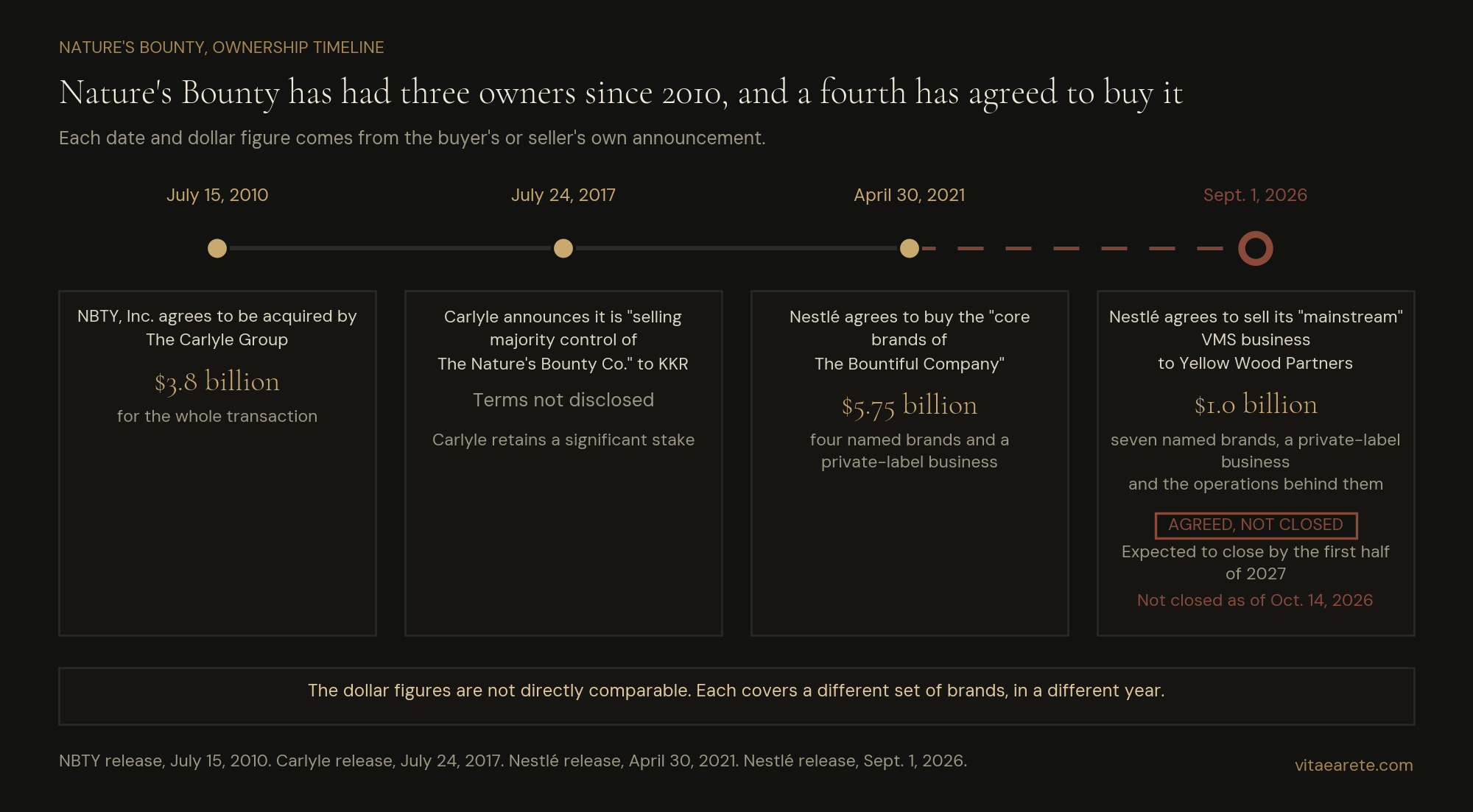
Nature’s Bounty has had three owners since 2010: the Carlyle Group, the investment firm KKR, and Nestlé. On September 1, 2026, Nestlé agreed to sell it, six other brands and related businesses to Yellow Wood Partners for $1.0 billion. As of October 14, 2026, that sale had not closed.
Under Carlyle, the brand’s parent company paid its shareholders dividends of $722 million in 2012 and about $446 million in 2013, mostly with borrowed money.
The stores changed hands too: GNC in a 2020 bankruptcy sale, The Vitamin Shoppe in May 2025, and Walgreens that August.
No United States regulator approves a supplement before sale. The familiar name a shopper relies on is sold along with the factories.
On September 23 and 24, 2026, I found no Food and Drug Administration warning letters or inspection findings tied to a current facility of the companies I searched. That was a general web search. It is not a clean bill of health. I make no claim about product quality.
On October 17, 2012, the holding company that owned the maker of Nature’s Bounty borrowed $550 million by selling notes. It added $200 million of the vitamin company’s own cash. Then it paid fees, and it paid its shareholders a $722 million dividend.
The holding company named its own shareholders in a filing with the Securities and Exchange Commission (SEC). By that filing’s own table, as of February 1, 2013, funds affiliated with the Carlyle Group held 99.5 percent of the holding company’s shares. This is not a leak or a lawsuit. Anyone can read it. This part reads like a heist movie, except the money leaves through the front door, legally, and everyone files the paperwork with the SEC on time.
Here is why a shopper should care. In the United States, no regulator approves a supplement before it is sold, as I laid out on October 12, 2026, in “A 1994 Law Makes the FDA Prove a Supplement Is Dangerous.” So the name on the front is one of the few things a shopper has to go on. It is also the thing being sold.
That name has changed owners three times since 2010. Its prospective buyer calls it the number two overall vitamin, mineral and supplement brand in the United States. The buyer’s release gives no measure. A fourth sale, to that buyer, was agreed on September 1, 2026. It has not closed. Until it does, I will say the sale was agreed, not that it happened.
That is rule one of this series, which follows who owns the brands on the shelf and the stores that sell them. Rule two: every ownership fact comes from a document the company itself issued or filed, with that document’s date.
On PBS’s Antiques Roadshow, the appraiser often asks where a piece came from. The vitamin aisle skips that question and goes straight to the price. So I went and got the provenance. It runs through three owners and a fourth on the way, two borrowed dividends and a stock offering that never happened. It ends at a private equity firm’s news page with a bronze medal from the Sexual Wellness Awards on it.
My take, up front. Two people on these deals, the seller’s chief executive in 2021 and a partner at the prospective buyer in 2026, called the brands trusted. Read the deal documents and the trust looks like part of the inventory. In the 2026 deal it is sold along with the factories. Read the filings underneath, and it gets colder. While shoppers were buying the trust, the owners were borrowing money that the company selling it would have to pay back.
This piece stays with the retail shelf. Clinicians’ supplement stores get a piece of their own.
A brand founded in 1971 has had three owners since 2010, and a fourth sale is agreed
The brand is Nature’s Bounty. Its own 2021 prospectus says it was “Originally founded as Nature’s Bounty, Inc. in 1971 as a subsidiary of Arco Pharmaceuticals.” From 1995 to 2017, the company ran “mainly under the name, NBTY, Inc.” Since 2010 it has changed binders like a playground Pokémon card, and nobody ever asked the card.
On July 15, 2010, NBTY, Inc., the company behind it, announced that it had agreed to be acquired by the Carlyle Group for $55.00 a share in cash. NBTY, then listed on the New York Stock Exchange, valued the whole transaction at $3.8 billion and filed the announcement with the SEC. The release says the equity came from Carlyle Partners V, which it calls “a $13.7 billion U.S. buyout fund.” Buyout is the release’s word, not mine.
On July 24, 2017, Carlyle announced that it was “selling majority control of The Nature’s Bounty Co.” to the investment firm KKR. Carlyle would “retain a significant stake in the company.” Financial terms were not disclosed. The same release notes that Nature’s Bounty had recently agreed to sell Holland & Barrett, its retail chain in the United Kingdom, to L1 Retail.
Seinfeld built a whole 1997 episode, “The Yada Yada,” around skipping the best part of the story. Carlyle’s release skipped the price. KKR, for its part, had already starred in one movie: Barbarians at the Gate, the 1993 HBO film about its fight for RJR Nabisco. James Garner played the chief executive on the other side. That deal got a movie. This one got a news release with the price left out.
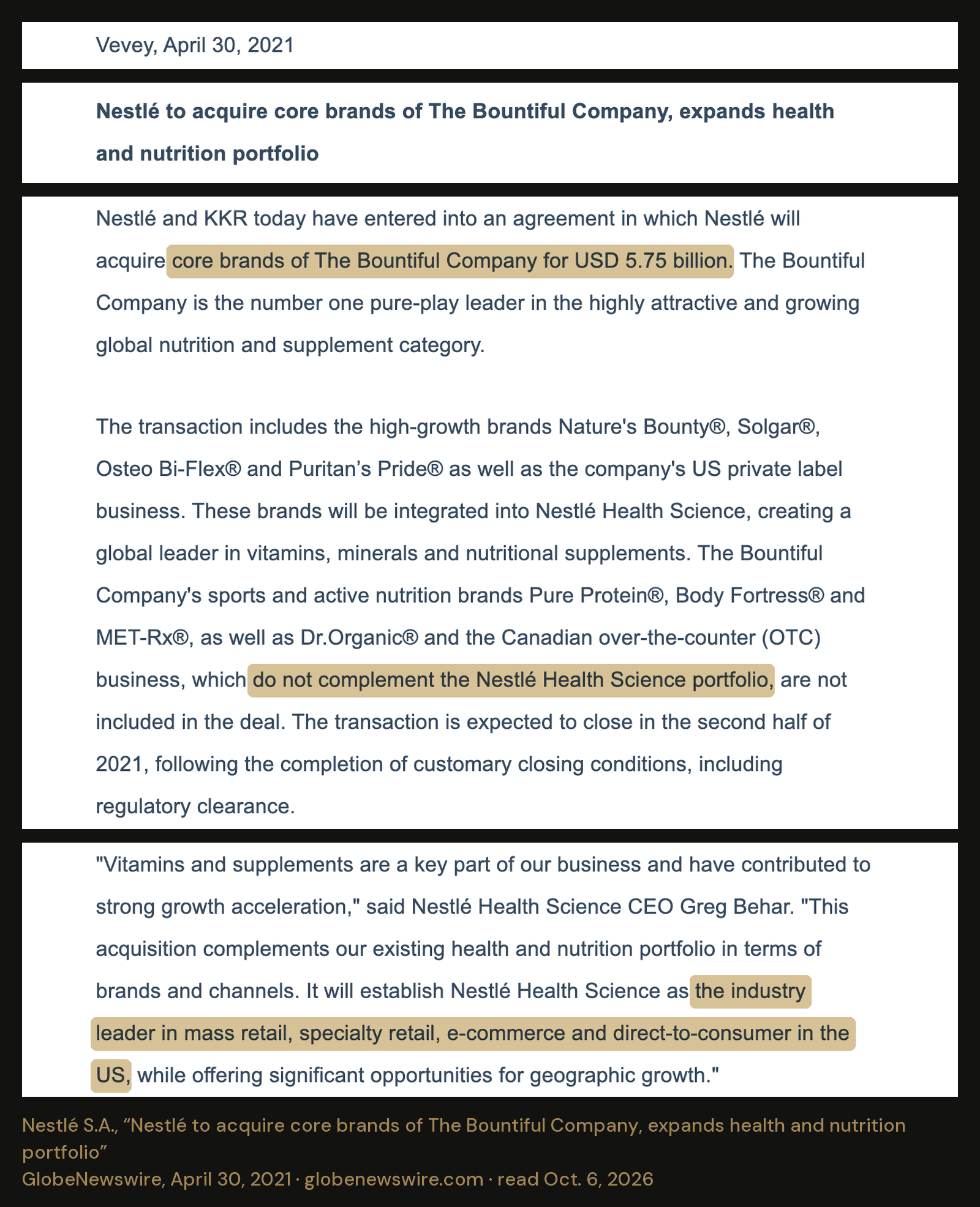
On April 30, 2021, Nestlé announced that it and KKR had agreed on the next sale. Nestlé agreed to buy the “core brands of The Bountiful Company,” which by then owned Nature’s Bounty, for $5.75 billion. The release says the deal includes Nature’s Bounty, Solgar, Osteo Bi-Flex and Puritan’s Pride, along with the company’s US private-label business.
Some brands were left out. Among them were the sports and active nutrition brands Pure Protein, Body Fortress and MET-Rx, along with Dr.Organic and a Canadian over-the-counter business. In Nestlé’s words, they “do not complement the Nestlé Health Science portfolio.” Nestlé Health Science’s chief executive, Greg Behar, said the purchase would establish Nestlé Health Science as “the industry leader in mass retail, specialty retail, e-commerce and direct-to-consumer in the US.” Keep that phrase handy. Nestlé describes the same business very differently in 2026.
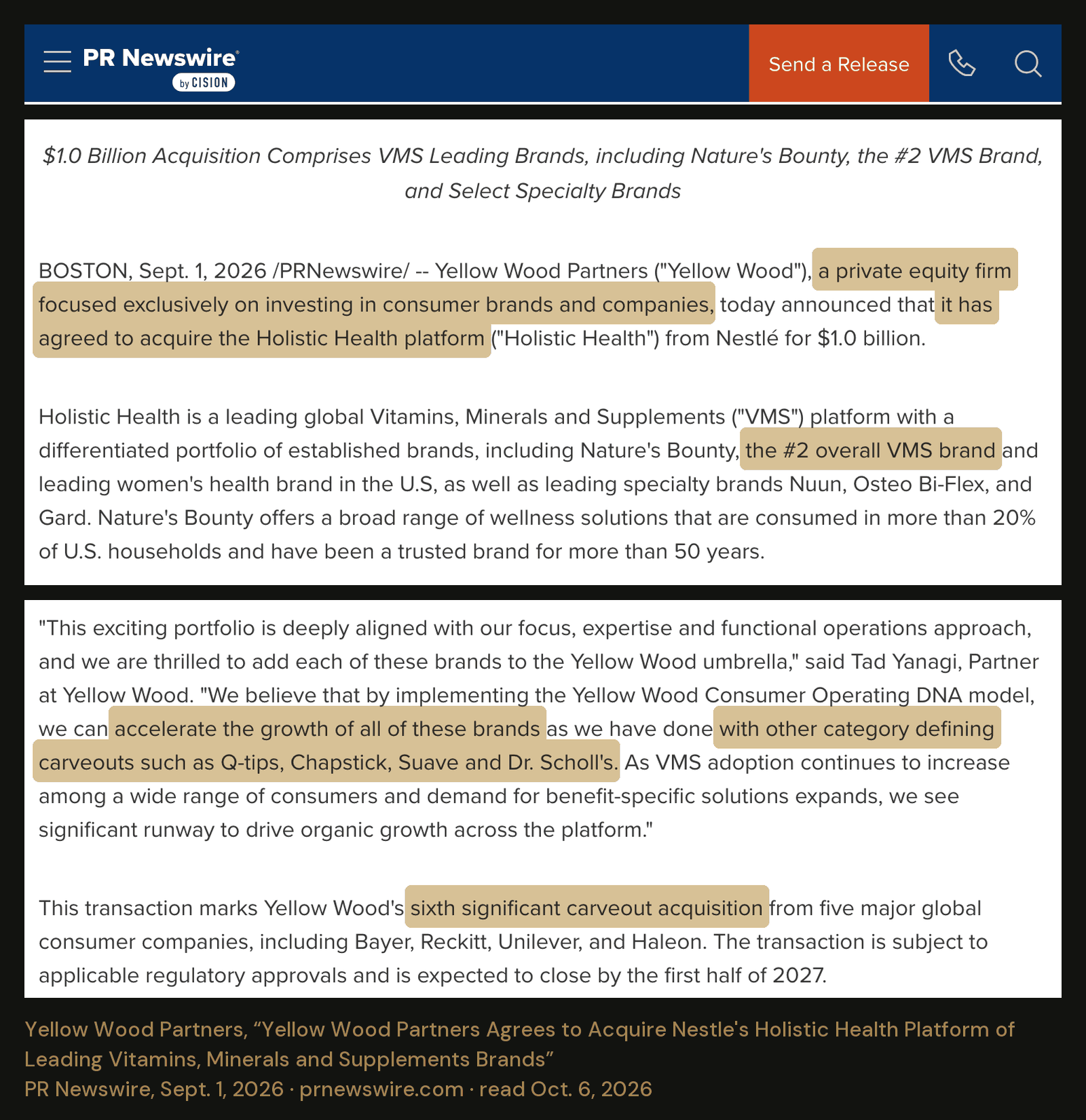
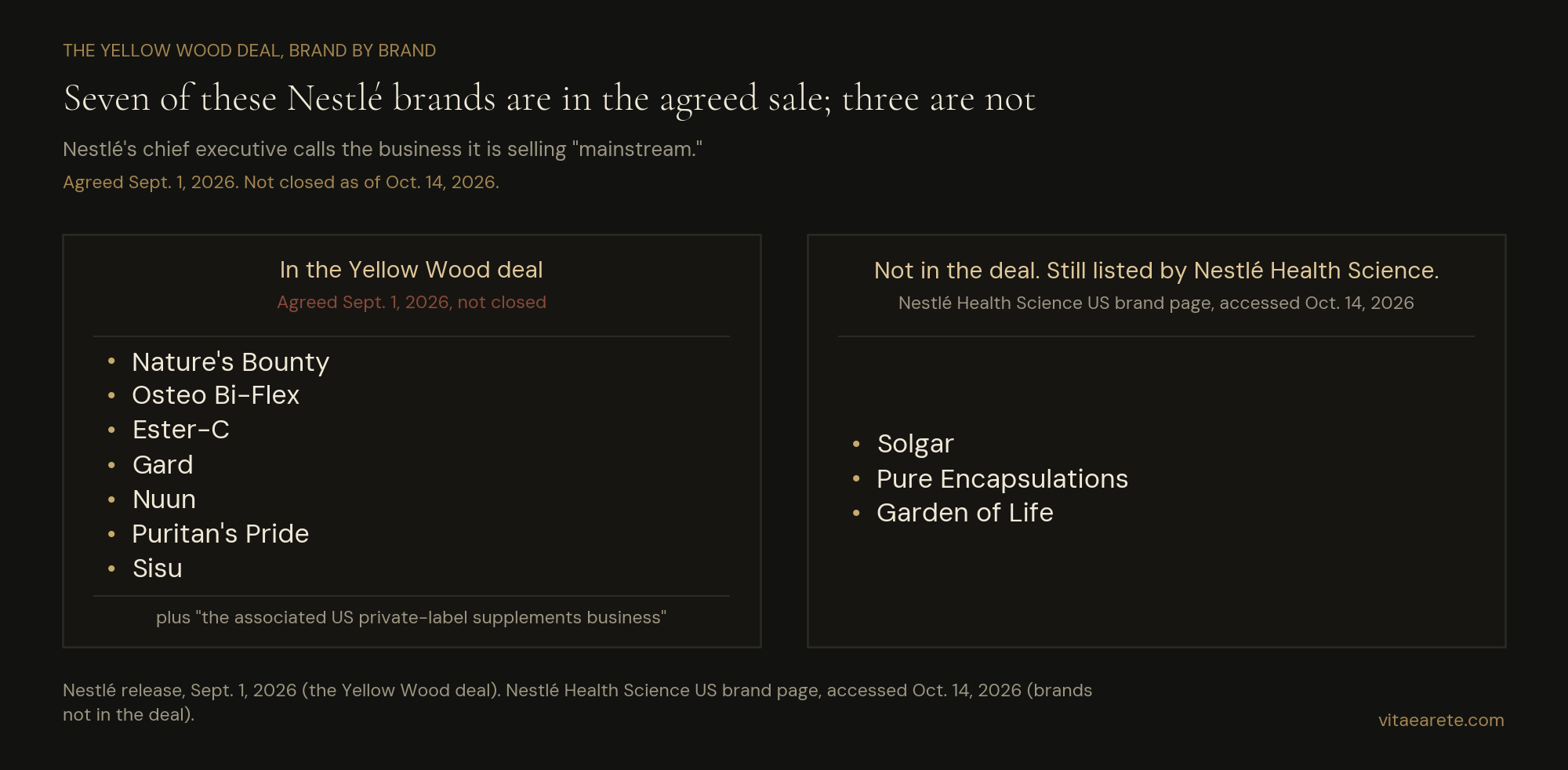
Five years later, Nestlé was the seller. On September 1, 2026, Nestlé announced that it had “agreed to divest its mainstream Vitamins, Minerals and Supplements (VMS) business” to Yellow Wood Partners for $1.0 billion. The deal covers seven brands: Nature’s Bounty, Osteo Bi-Flex, Ester-C, Gard, Nuun, Puritan’s Pride and Sisu.
It also covers “the associated US private-label supplements business” and “dedicated manufacturing, packaging, warehousing and distribution operations.” By Nestlé’s account, the business had $1.2 billion in sales in 2025. The deal “is subject to applicable regulatory approvals and is expected to close by the first half of 2027.” The release does not say which approvals. As of October 14, 2026, it had not closed.
In Toy Story 2, a collector prices Woody for a museum in Japan and never asks Woody. If the sale closes, Nature’s Bounty meets its fourth collector. The shopper is Andy, still assuming the toy is in his room.
In the United States, none of the three sales since 2010 came with a product approval to hand over. Under the law as it stands the fourth will not either. Each time, the name changed hands.
Under Carlyle, the parent company borrowed to pay its owners, twice in about fourteen months
Start with how the 2010 purchase was paid for, because everything after follows from it. A 2013 filing by the new parent company puts the equity from Carlyle’s funds and co-investors at “$1,550,400,” in thousands of dollars. That is about $1.55 billion.
The same filing gives a net purchase price of “$3,635,949,” also in thousands, so about $3.64 billion. The rest came from new borrowing: “NBTY’s $1,750,000 senior secured credit facilities” and “$650,000 principal amount of Opco Notes.” By my arithmetic, the equity was about 43 percent of the price. Loans in the company’s own name covered most of the rest.
That is the basic shape of a buyout. The buyer puts in some money, and the company being bought carries the loans. In a home sale, this is the part where the house takes out its own mortgage and you keep the rent.
Then the owners ran it. The filing names four directors of the holding company, Messrs. DeBenedetti, Holt and Wagner and Ms. Horbach, who were also “Managing Directors of Carlyle.” It describes a business in “transition from its prior status as a publicly held company to a privately-held company owned by Carlyle.”
The holding company had a name, too. By February 2013 it was Alphabet Holding Company, Inc. Google did not announce its own Alphabet until August 10, 2015. Silicon Valley gave us a fake Google called Hooli. The vitamin business had a real Alphabet more than two years before Google did.
Now the dividend, in the filing’s own words:
“On October 17, 2012, Holdings sold $550 million in aggregate principal amount of the outstanding notes through a private placement. The proceeds from the offering of the outstanding notes and $200 million of cash on hand at NBTY were used to pay fees and expenses related to the transaction and a cash dividend to Holdings’ shareholders in the amount of $722 million.”
Read it slowly. The parent borrowed $550 million, took $200 million out of the vitamin maker’s own drawer, and paid the owners $722 million. That is not a typo. The company wrote it down and filed it with the federal government. Wall Street calls this a dividend recapitalization. It is legal and it was disclosed, which is exactly what makes it scary.
The table I mentioned at the top sits in the same filing. As of February 1, 2013, it shows “Funds affiliated with The Carlyle Group” holding 99.5 percent.

The debt stayed behind. At the end of 2012, the filing reports “$2.8 billion of indebtedness on a consolidated basis, of which $1.5 billion was secured indebtedness.” It says total debt and interest expense were “significantly higher than before the Acquisition,” the filing’s name for Carlyle’s 2010 purchase.
The new notes paid “7.75% per annum” in cash, or “8.50% per annum” in what the filing calls PIK interest. PIK is interest paid by “increasing the principal amount of the notes or issuing new notes.” In plain words, the company could pay its interest with more debt. In The Big Short, Ryan Gosling explains mortgage bonds with a Jenga tower. This is the move where you pull a block from the bottom and set it on top.
Fourteen months later came the sequel. On December 12, 2013, Alphabet Holding Company announced that it had closed an offering of “an additional $450 million” of the same notes. It used the proceeds “to pay a cash dividend to the Company’s shareholders in the amount of approximately $446 million.” Like most sequels, it was smaller, and it still paid out.
My arithmetic, not the filings’: $722 million plus about $446 million is about $1.17 billion paid to shareholders. That came a little over three years after a $1.55 billion equity check. Both dividends were funded with new debt, and the first also with $200 million of the company’s cash.
For scale, the supplement store I disclosed at the top had made no sales as of October 14, 2026. I am in the same industry the way a lemonade stand is in the beverage industry.
My read, and only mine. For those years, the brand on your shelf had two jobs. One was selling vitamins. The other was paying for the money its owners had already taken out, and the filings document that second job in more detail than any label ever documented the first.
The filings do not give Carlyle’s final profit or proceeds, and I am not going to guess them. So I am not calling the $1.17 billion a return or a profit. I am calling it what the documents call it: cash dividends, paid with borrowed money. The cash went to the owners. The debt stayed behind, to be paid out of the company whose name is on your bottle.
Under KKR, the owners billed the company every year, then filed to sell shares and sold the brands instead
KKR bought majority control in 2017, with Carlyle keeping “a significant stake,” as above. By 2021 the company was called The Bountiful Company. On April 12, 2021, it filed with the SEC to sell shares to the public.
The cover page names the parent: “Clover Parent Holdings L.P., our direct parent owned by investment funds and other entities affiliated with Kohlberg Kravis Roberts & Co. L.P. and investment funds of The Carlyle Group Inc.” It says the company would be a “controlled company” under the stock exchange’s governance standards. The funds would keep control.
The chief executive, Paul Sturman, wrote the would-be shareholders a letter. “I am proud that our culture reflects that best blend of street fighter and commercial sophistication,” he wrote. It is a prospectus, not a WWE promo, but I respect the commitment. He wrote that the company’s people take nothing for granted and “act like owners.”
Then came the best line in the whole damn record. “Today, millions of consumers already ‘own’ a piece of The Bountiful Company,” Sturman wrote. After a dash my house style will not let me print, he added: “figuratively speaking.” Figuratively is the most honest word in the deal record. Shoppers owned no shares.
The prospectus also listed what came with the shares. “As of December 31, 2020, we had approximately $1.97 billion of indebtedness outstanding.” In the fourth quarter of fiscal 2020, the company paid “a $205.0 million Distribution” to its stockholders, “of which $202.1 million” went to Parent, the owners’ holding company. It “funded the Distribution with cash on hand.”
And there was a meter running. Under a services agreement with its owners, “we pay an aggregate annual advisory fee which increases by 3.0% annually on each anniversary” of the agreement. The fee was split between KKR and Carlyle by their stakes. It came to about $3.2 million, $3.1 million and $3.0 million in fiscal 2020, 2019 and 2018.
A fee with a raise written into it. On Shark Tank, Kevin O’Leary often asks for a royalty on every unit sold. This fee did not wait for a single sale: it rose 3.0 percent a year by contract, and the owners wrote that contract with a company they controlled.
Separately, the company paid KKR Capstone, which the filing calls “a team of operating professionals who work exclusively with KKR & Co.’s investments professionals and portfolio company management teams.” The fees and expenses were $3.1 million, $2.8 million and $3.9 million for those same three years.
One more. In fiscal 2020, “affiliates of KKR acquired $11,512,” in thousands, so about $11.5 million, “of the Company’s second-lien term loan in open market transactions.” So KKR’s side owned the company, billed it for advice, and held a slice of its debt. Landlord, consultant and lender, one firm, three hats.
The prospectus also told investors why vitamins hold up in bad times. People keep buying nutrition products in a recession, it said, and “new consumers who enter the category during these times are often converted to long-term users.” Where you see a recession, a prospectus sees a funnel.
Then the turn. Eighteen days after that filing, on April 30, 2021, Nestlé announced it would buy the core brands for $5.75 billion. On November 4, 2021, the company filed with the SEC to withdraw the stock offering. The public got a prospectus. Nestlé got the brands. You got the same name on the front.
KKR’s own annual report for 2021, filed February 28, 2022, says where the money landed. Its realized carried interest in private markets that year “consisted primarily of realized proceeds from the sales of our investments in The Bountiful Company (consumer products sector), Ingersoll Rand Inc.” and three other companies. Carried interest is the fund managers’ share of the profit. In Billions, it is what Bobby Axelrod lives for. Here it shares a sentence with an industrial equipment maker.
The annual report, as I read it, does not give KKR’s profit on this one investment, so I give none. Here is my read of what it does give. Investors were told in writing that hard times make customers. Shoppers were told the brands were trusted. Both were reading about the same bottle. The investors got a risk factors section. The shoppers got an adjective.
One warning before the next owner, because the two prices Nestlé put on this business, once as buyer and once as seller, invite a sum they cannot carry. Nestlé valued its 2021 purchase “on a cash free, debt free basis.” That is a pricing basis: the price is set as if the business carried no cash and no debt.
Now hold that next to the prospectus. Eighteen days earlier, the seller had put the whole company’s debt at approximately $1.97 billion as of December 31, 2020. The headline number was priced as if no debt came with it. That debt figure covers every brand the company owned, not only the four Nestlé bought, so it does not divide into the price either.
The baskets do not match. The 2021 price, $5.75 billion, bought four named brands and a private-label business, against $1.87 billion in net sales for those brands over the twelve months to March 31, 2021. The 2026 price, $1.0 billion, is for seven named brands, a private-label business and the operations behind them. That business had $1.2 billion in sales in 2025.
The lists overlap only in part. Nature’s Bounty, Osteo Bi-Flex and Puritan’s Pride are on both. Solgar is on the first list only. Ester-C, Gard, Nuun and Sisu are on the second and are not named on the first. Different baskets, different years.
Dividing one price by the other gives you a number the way a Tamagotchi gives you a pet. I am not going to do it, and you should be wary of anyone who does. The 2010 figure, $3.8 billion for all of NBTY, belongs to neither basket.
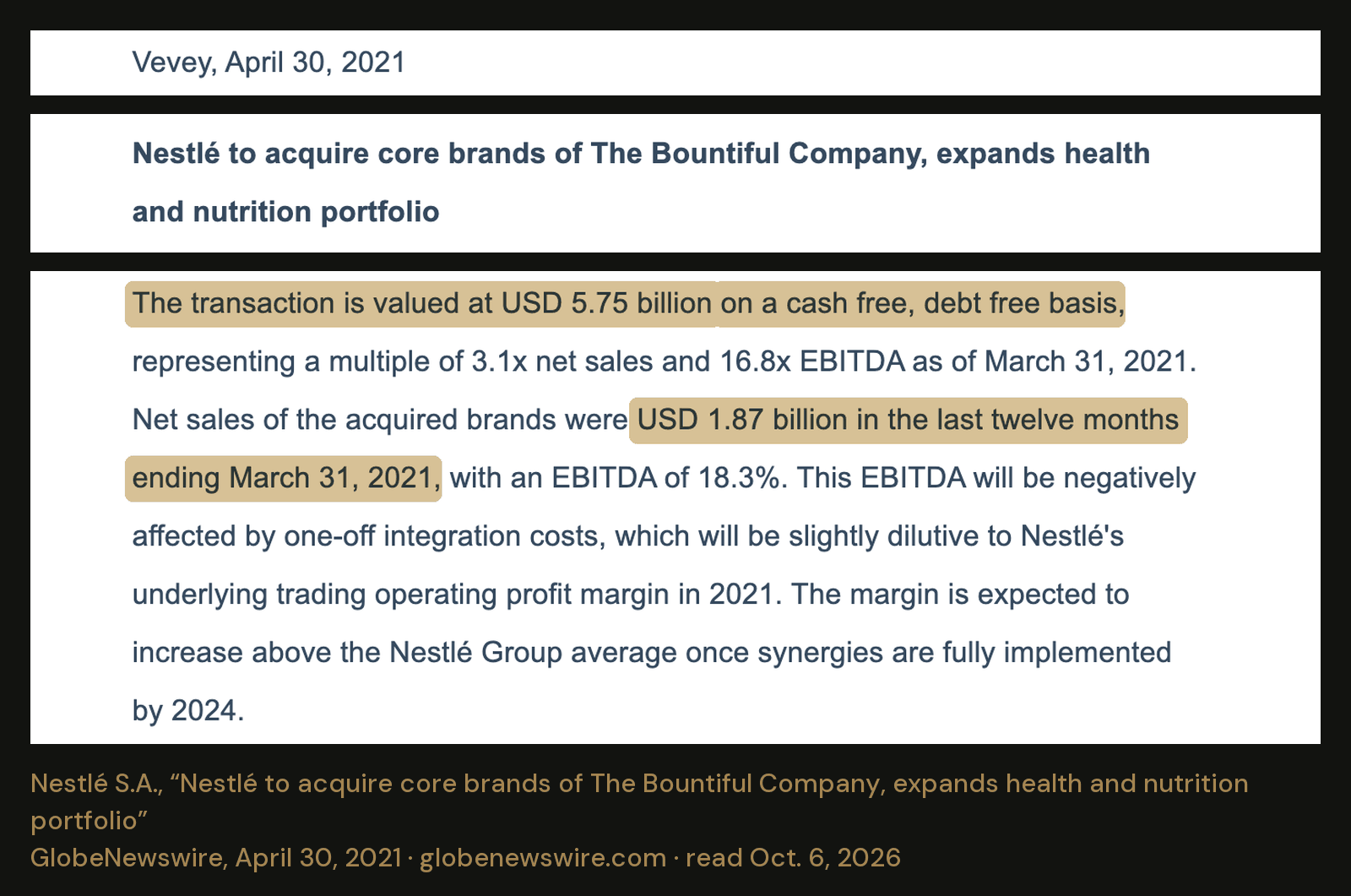
So here is what three deals have in common. Three prices, three different sets of brands, three different years, and one constant: the name on the front of the bottle, sold every time.
Nestlé said the 2021 deal would make it the industry leader, and in 2026 it called the business mainstream
Nestlé’s chief executive, Philipp Navratil, gave the company’s reason for the 2026 sale in the September 1 release:
“At the same time, the category has evolved, and the mainstream VMS business requires a different approach under dedicated ownership.”
Now rewind to 2021, when Nestlé Health Science said the purchase would make it “the industry leader in mass retail, specialty retail, e-commerce and direct-to-consumer in the US.” Five years, same Nature’s Bounty, from industry leader to a different approach. In Friends (NBC, 1999), Ross Geller tried to get a couch up a stairwell by yelling one word: “Pivot!” Nestlé’s version took a press release.
Yellow Wood calls itself “a private equity firm focused exclusively on investing in consumer brands and companies.” Its release describes the deal as its sixth “significant carveout acquisition.” A carveout is a business bought out of a larger company. In Pretty Woman, Richard Gere plays a man who buys companies and sells them in pieces. A carveout is the piece.
One of Yellow Wood’s partners, Tad Yanagi, said the firm believes it can “accelerate the growth of all of these brands.” He pointed to what it had done “with other category defining carveouts such as Q-tips, Chapstick, Suave and Dr. Scholl’s.” If the deal closes, Nature’s Bounty joins a résumé that already lists cotton swabs and lip balm. Osteo Bi-Flex, the joint supplement in the deal, would share an owner with Dr. Scholl’s. Finally, a full-body strategy.
The firm’s homepage tagline is “Taking the Road Less Traveled in Private Equity.” Robert Frost’s poem, first printed in 1915, opens with two roads in a yellow wood. In the next stanza, it admits the two roads were worn “really about the same.” The tagline kept the brave half.
The news page, read from the top with the hiring announcements skipped, is a better set than mine. September 1, 2026: the Nestlé deal. May 20, 2026: the parent of Dr. Scholl’s “has acquired VKTRY,” which makes carbon fiber insoles. April 30, 2026: a sponsorship of a museum’s floral art show in Boston.
January 20, 2026: Suave Brands and Elida Beauty “completed a merger to create Evermark, LLC,” a name that sounds like a password reset email. January 9, 2026: a product called Super Bullet “has won bronze for Solo Pleasure Treasure at the Sexual Wellness Awards.” If the deal closes, Nature’s Bounty is getting some very interesting siblings.
The homepage also carries a note for investors, printed under testimonials from the leaders of its own portfolio companies. Investors “should not rely on endorsements for any purpose and should conduct their own review prior to investing.” That is good advice. The firm gives it to people with money to invest. The deal release gives shoppers “trusted brands.”
The 2026 release mentions “applicable regulatory approvals” for the sale itself, without saying which. Whatever they turn out to be, none is a product approval. In the United States, a supplement does not get one.
Not every brand moves like this, and Vitafusion was sold in 2025
Here is the cleanest proof in this piece that a familiar name tells you nothing about who owns it. A bottle of Vitafusion bought in mid-December 2025 and another bought in mid-January 2026 carried the same name under two different owners. The change of owner was announced in a press release and an SEC filing, not on the shelf.
The seller was Church & Dwight, which describes itself as “the leading U.S. producer of sodium bicarbonate, popularly known as baking soda.” On December 9, 2025, it said it had “concluded its strategic review” of its vitamin business. It agreed to sell the Vitafusion and L’il Critters brands to Piping Rock Health Products.
The deal included the “relevant trademarks and licenses” and the manufacturing and distribution facilities in Vancouver and Ridgefield, Washington. Church & Dwight’s chief executive, Rick Dierker, called Piping Rock “a company with deep experience in the vitamin business.” He said the sale would make the portfolio stronger “while enabling even more focus on Church & Dwight’s remaining power brands.” The baking soda stayed. The baking soda always stays.
The sale closed on December 31, 2025. Neither of the two Church & Dwight releases I read states a price. The one dollar figure the company did attach to leaving runs the other way. It reported a one-time, after-tax charge of $45.6 million in the fourth quarter of 2025, booked in connection with what it called its “VMS exit.” So in the documents I read, the only number tied to this sale is a charge the seller booked on its way out, not a price anyone paid.
My take: the shopper who bought both of those bottles bought the same name twice, from two different owners, about a month apart. The announcement went to the people who read press releases and SEC filings. The bottles went to everyone else.
Nature Made sits at the other end of the aisle. It belongs to Pharmavite, which its own history page says was founded in 1971 and created its first Nature Made label in 1972. In 1989 Pharmavite was acquired by Otsuka, which the page calls “a global healthcare company dedicated to improving health through innovative pharmaceuticals and nutraceuticals.” The page shows no sale since. One owner since 1989, in this aisle, is like keeping the same dentist since the year the Berlin Wall fell. Pharmavite comes back near the end of this piece, in the lobbying records.
Centrum is a Haleon brand, listed on Haleon’s own brand page in its vitamins, minerals and supplements category. I have not traced Centrum’s earlier owners to primary documents, so its history here starts with that page.
Nature’s Way appears on the Schwabe Group’s own list of subsidiaries, as Schwabe North America, at an address in Green Bay, Wisconsin. The page gives no purchase date, and I have not confirmed one from a Schwabe document.
Nestlé is keeping some brands. Solgar, Pure Encapsulations and Garden of Life are not in the Yellow Wood deal. All three are still listed among Nestlé Health Science’s brands. These are the brands I traced, not every brand on the shelf.
GNC, The Vitamin Shoppe and Walgreens changed hands too, and GNC once relied on a piece of paper
The stores have owners too, and their paperwork reads stranger than the brands’. One chain agreed to be bought by the parent of a tax-preparation business. Another was paid for partly in something called a “divested asset proceed right.” The third, years before its bankruptcy sale, accepted in a deal with the government that it had done no additional testing to confirm a supplier’s claims.
On August 8, 2019, The Vitamin Shoppe still traded on the New York Stock Exchange. That day, Liberty Tax, Inc., “the parent company of Liberty Tax Service and Buddy’s Home Furnishings,” announced that it would buy the chain for $6.50 a share in cash. That came to about $208 million. A Liberty Tax board member, Pat Cozza, called the chain “an excellent fit” for the company’s strategy “to acquire franchise-centric businesses.”
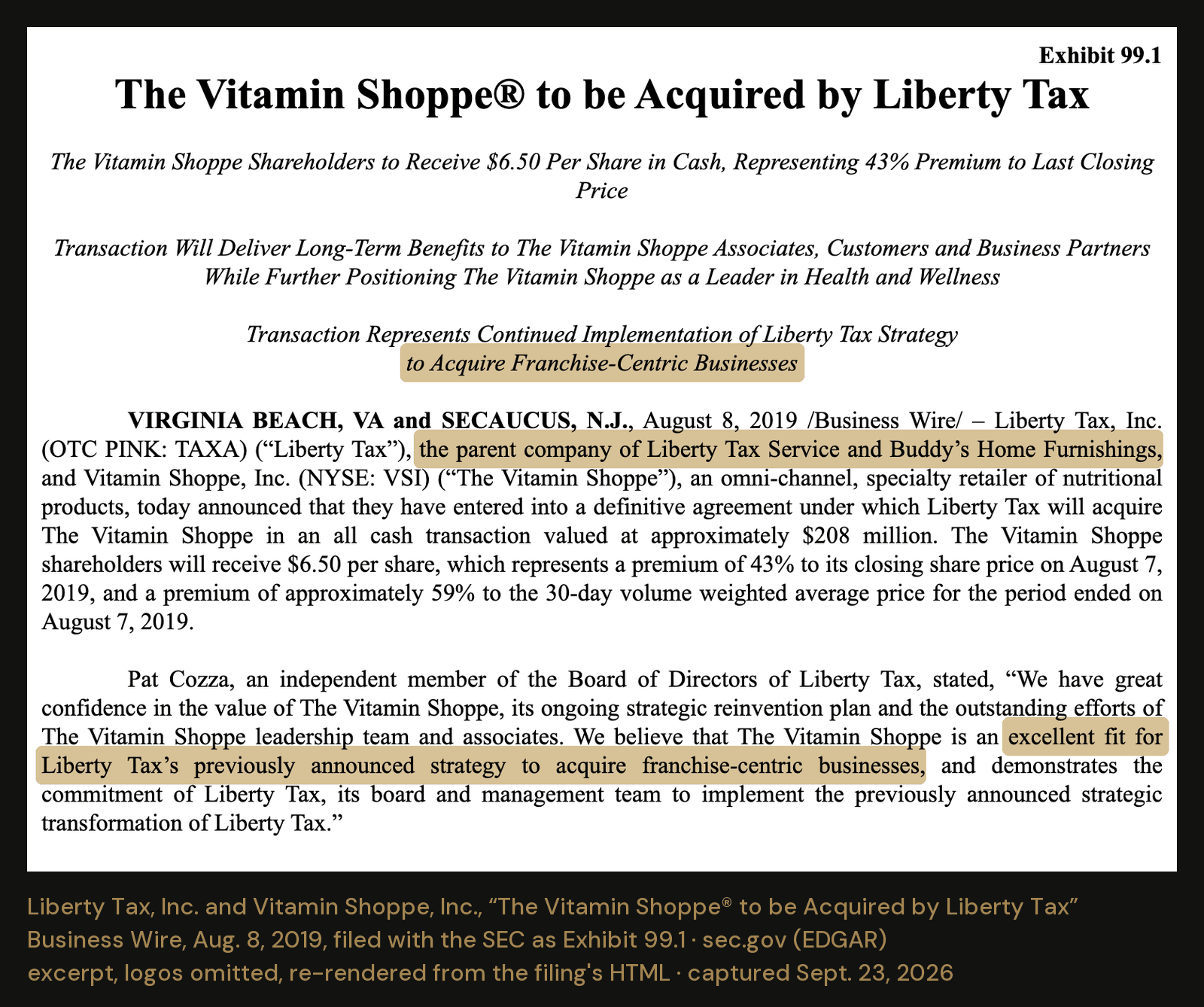
So the vitamin chain was set to join a tax service and a home-furnishings business under one parent. Vitamins, tax returns and furniture, under one roof. Franchise-centric covers a lot of ground.
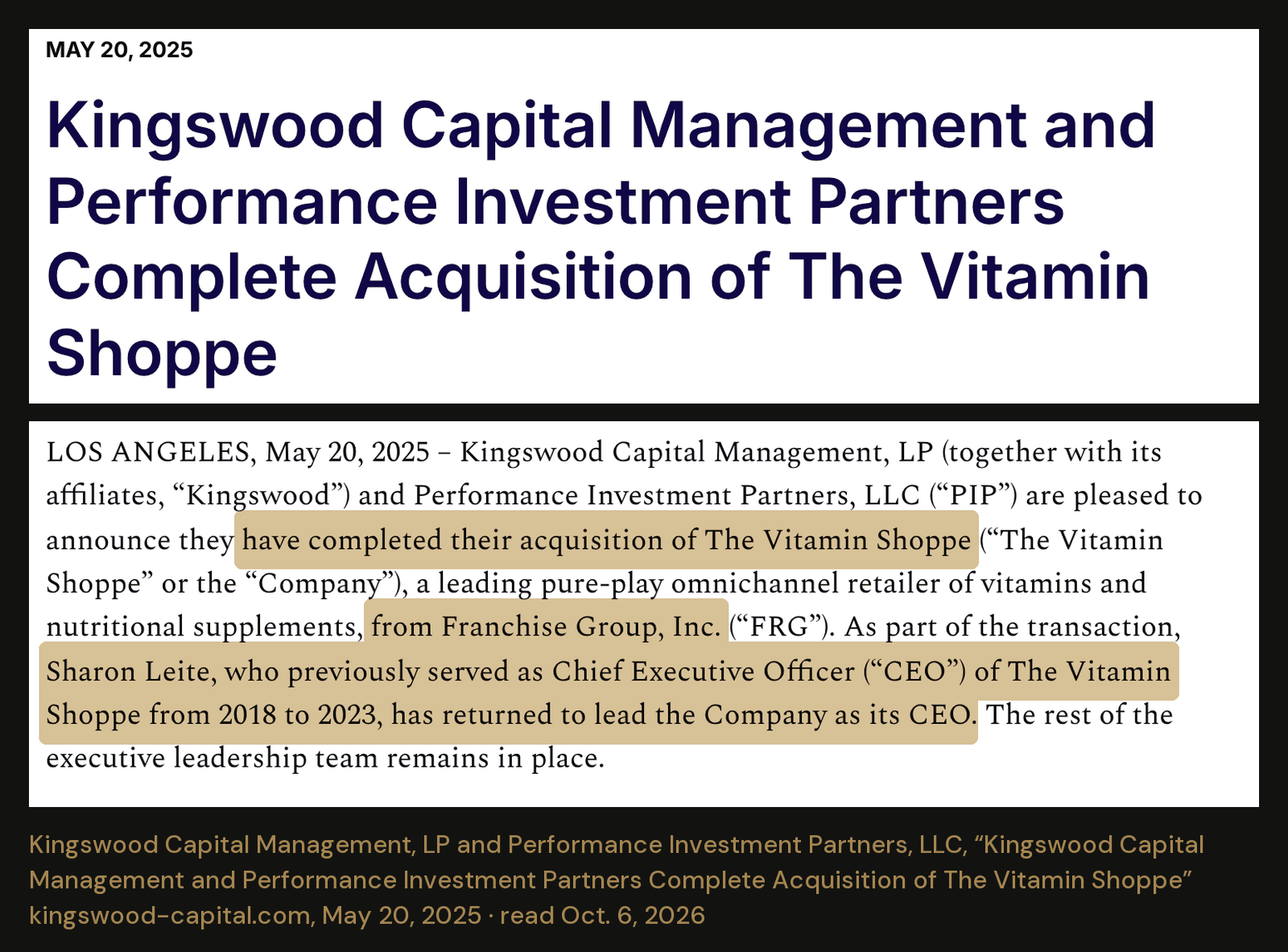
The same release said Liberty Tax planned to change its name to Franchise Group, Inc. On May 20, 2025, Kingswood Capital Management and Performance Investment Partners announced that they had completed their acquisition of The Vitamin Shoppe from Franchise Group. Sharon Leite, the chain’s chief executive from 2018 to 2023, came back to run it.
Walgreens is a drugstore chain, not a vitamin store. I have no figure for how much of its business the vitamin aisle is. Its ownership changed on August 28, 2025, when Sycamore Partners’ acquisition of Walgreens Boots Alliance closed. Stefano Pessina and his family, Walgreens’ announcement said, “reinvested 100% of their interests in Walgreens.”
The price is where precision matters. In the company’s own filing, each share became the right to receive “$11.45 in cash” and “one divested asset proceed right.” That right is a claim on part of the net proceeds if the company later sells or otherwise monetizes its interests in Village Practice Management Company Holdings. It is capped at $3.00 per right.
Its value was not fixed at closing. The filing calls the cash and the right together the “Per Share Consideration.” Quoted as $11.45 a share, the deal is missing its second part. The second part is, roughly, a coupon you can redeem only if the company later cashes out a stake it holds in another business.
GNC Holdings filed for Chapter 11 bankruptcy in June 2020, according to its own filing. The sale closed that October. On October 7, 2020, GNC reported to the SEC that it had completed “the disposition of substantially all of the Debtors’ assets.”
The buyer was Harbin Pharmaceutical Group Holding Co., Ltd. It acted through a wholly owned subsidiary, ZT Biopharmaceutical LLC, and bought “100% of the issued and outstanding equity interests in New GNC,” a new company formed to hold those assets. GNC’s stock had been suspended from trading on the New York Stock Exchange on June 30, 2020. The press has reported prices for the sale, but I have not matched one to the sale agreement or a court order, so none appears here.
Before any of that, GNC signed a different kind of paper. In a non-prosecution agreement with the U.S. Department of Justice, signed in December 2016, GNC agreed to pay “two million two hundred fifty thousand dollars ($2,250,000.00) to the United States, payable before December 31, 2016.” The facts it accepted concern products from a supplier, USP Labs.
The agreement says the government found enough evidence to conclude that USP Labs “provided false information, false assurances and fake documentation to third parties, including GNC.” It also says this about GNC: “GNC did not undertake additional testing or require additional verified certifications to confirm the representations made by USP Labs.” What GNC did have was “a written ‘guarantee’ from USP.” A written guarantee. So does a timeshare.
The false documents, by the government’s account, were the supplier’s. The extra checking that did not happen was the store’s.
Earlier, on March 30, 2015, New York’s attorney general had announced a deal requiring GNC to test herbal ingredients. It covered “all of its more than 6,000 stores nationwide, making this agreement the first in the nation to require testing standards for herbal supplements that exceed current FDA requirements.” First in the nation, in 2015, to test above the federal floor. That tells you where the floor is.
These three chains are not the whole shelf, and I have not traced every store or website that sells supplements. They were also three different kinds of transaction. GNC’s was a sale of assets inside a bankruptcy. The Vitamin Shoppe’s was a sale from one owner to another. Walgreens’ was a merger that took a public company private. Through all of it, the name over the door stayed the same. I am not going to rank their prices as if they were one kind.
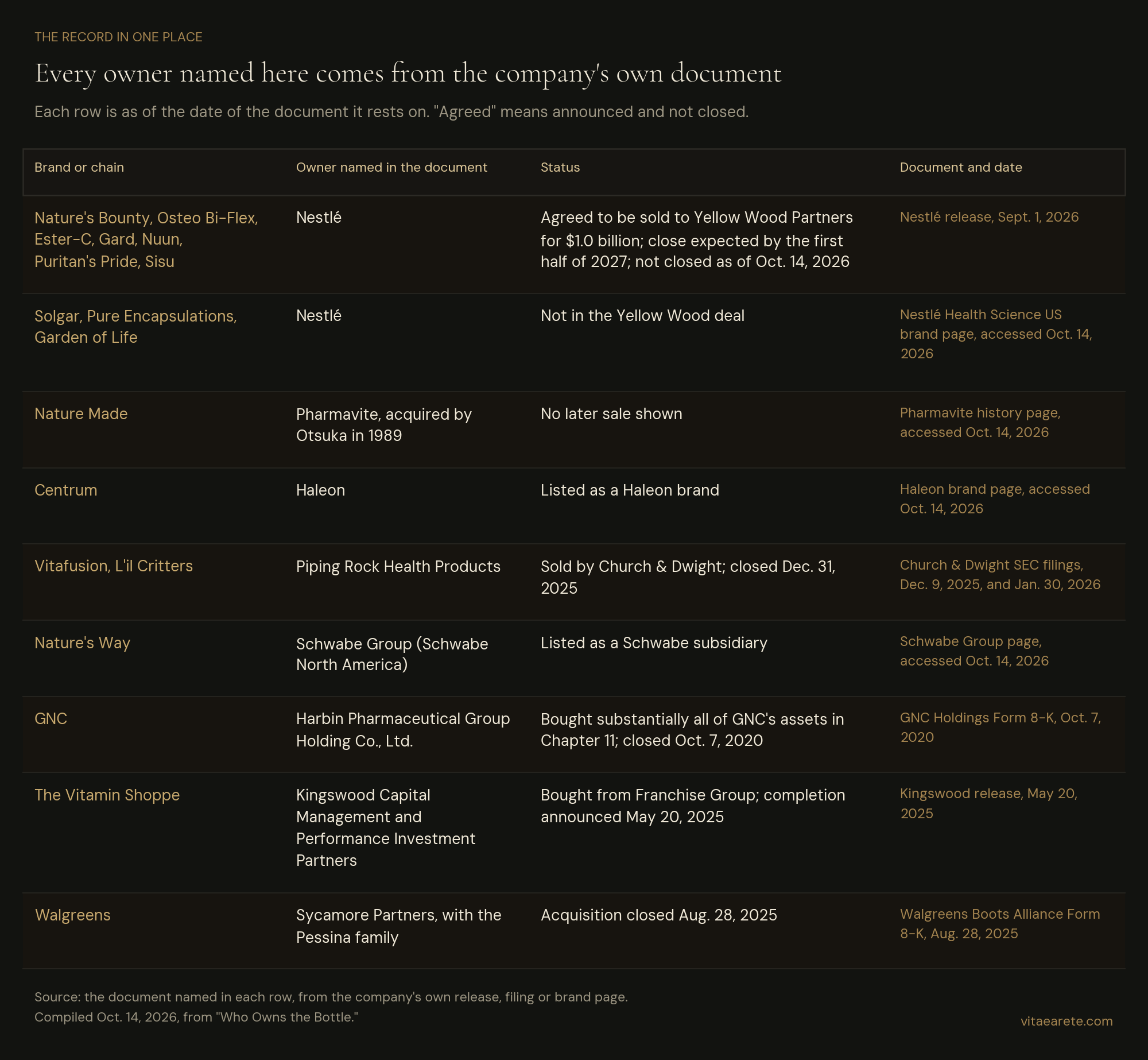
One more thing the table below makes plain. Each row is as of the date of the document it rests on. “Agreed” means announced and not closed. Of the nine rows, one is still open, and it is the one with Nature’s Bounty in it. Each of the three earlier Nature’s Bounty sales was announced in a press release. If this one closes, that is where to look.
Some owners call themselves private equity, and the company Carlyle owned said so in a paragraph about executive pay
It would be easy, and lazy, to write that private equity owns your vitamins. Some owners in this record call themselves private equity. Some do not. The fair way to sort them is by their own words.
Start with the most candid sentence I found. Explaining how it paid its executives, the company Carlyle owned wrote in its 2013 filing: “Because we are owned by a private equity investor, the Compensation Committee has concluded...” I have handled that label carefully all piece long. The company dropped it into a paragraph about executive pay, the way you mention the weather.
Carlyle uses the words too. Its 2017 release calls the funds behind its 2010 investment buyout funds, and lists Corporate Private Equity among its four business segments. Yellow Wood calls itself “a private equity firm.” Walgreens’ announcement describes Sycamore Partners as “a private equity firm based in New York.”
KKR took more work to sort. Carlyle’s 2017 release includes a paragraph about KKR. It calls KKR “a leading global investment firm that manages investments across multiple asset classes including private equity, energy, infrastructure, real estate, credit and hedge funds.” The 2017 money came “primarily from KKR’s Americas XII fund.”
When I first drafted this piece, I had not confirmed from KKR’s own documents what kind of fund that is. So I did not call KKR’s years with the brand private equity. On October 14, 2026, I read KKR’s annual report for 2021. It lists “Americas Fund XII” in a table under the heading “Private Equity Funds.” So now I will, in KKR’s own words.
The Vitamin Shoppe’s buyers do not call their own firms private equity in their announcement. Kingswood says it “partners with leading companies in the middle market.” Performance Investment Partners says it was formed in 2024 to invest in consumer-facing businesses. I have left it at that.
Most of the remaining owners are companies that make and sell products themselves. Pharmavite describes its parent, Otsuka, as “a global healthcare company.” Haleon calls itself “a consumer company that is solely focused on better everyday health.” Church & Dwight leads its own description with baking soda. Piping Rock, Schwabe and Harbin appear here by name only. I have not read their own descriptions of themselves.
The labels matter less than who sat at the table. In 2013 the board of the company above NBTY included four Carlyle managing directors, by the filing’s own list. The 2021 prospectus said the company would be a “controlled company” under New York Stock Exchange rules. My read: the people deciding about the company’s borrowing were tied to the people receiving its dividends.
Here is where I land. The owners describe themselves in very different words. Where a brand deal lists what was sold, as Church & Dwight’s in 2025 and Nestlé’s in 2026 do, the lists look alike. Brands go out the door with the factories behind them. Sorting the owners is not the shopper’s real problem. Finding out who owns a brand in a given year is the shopper’s homework. Since 2010 Nature’s Bounty has had three owners and a fourth agreed, and every one of the four was signed by companies, not by anyone holding the bottle.
The name on the bottle is part of what changes hands
The brand deals sell names along with factories. Church & Dwight’s release lists what changed hands: the brands, the “relevant trademarks and licenses,” and the facilities. The same word keeps coming up. In 2021, The Bountiful Company’s chief executive, Paul Sturman, said, “We’re incredibly proud of the trusted brands we’ve built.” In 2026, Yellow Wood’s partner Dana Schmaltz called the Nestlé business “an excellent platform of trusted brands with deep retailer relationships.”
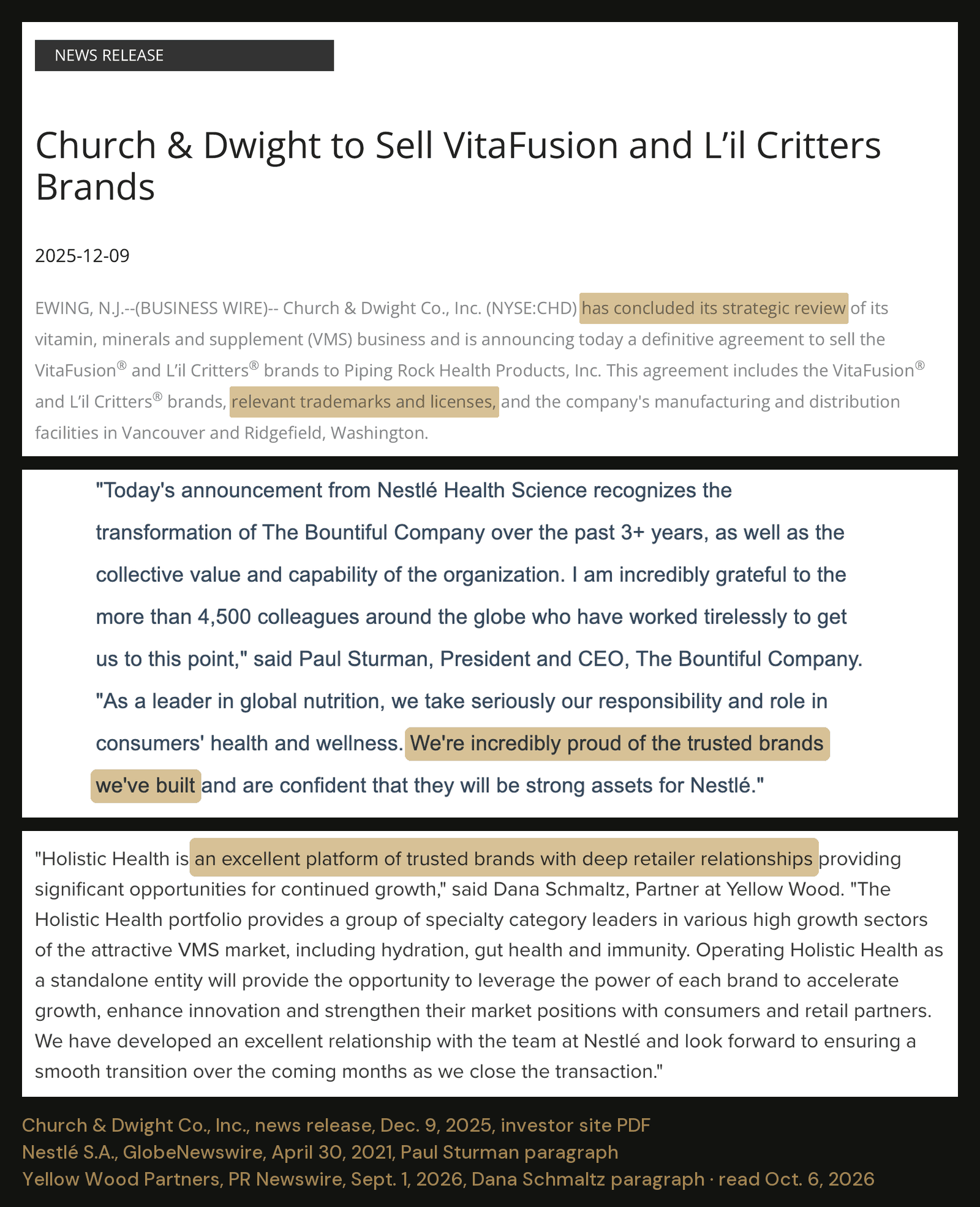
Sturman’s prospectus letter went a step further. “Our consumers invest with trust and confidence in what this company has to offer,” he wrote. Shoppers invest the trust. The owners invest the money. Only one of those investments came with a dividend.
My read, and only mine: the trust turns out to be transferable, and the shopper is not the one transferring it.
Two more layers sit behind the names. Nestlé’s 2021 deal included a US private-label business along with Nature’s Bounty. The 2026 deal includes “the associated US private-label supplements business.” Private label, in the trade, means products one company makes to be sold under another company’s name, usually a store’s. Neither release names the stores.
New York’s attorney general once named some. On February 3, 2015, he said DNA testing for his office “allegedly shows that, overall, just 21% of the test results from store brand herbal supplements verified DNA from the plants listed on the products’ labels.” The four retailers were GNC, Target, Walmart and Walgreens. At one of them, the release said, “Only 4% of the Walmart products tested showed DNA from the plants listed on the products’ labels.” The plants’ DNA, allegedly, had left the building.
On September 28, 2016, he announced an agreement with NBTY, then under Carlyle’s ownership, that the release tied to the same study. “These included NBTY-manufactured supplements sold at Walgreens and Walmart,” the release said. So on some of those jars, the store’s name was on the front and the company behind Nature’s Bounty had made what was inside.
Under the agreement, “NBTY will phase in DNA barcoding on herbal ingredients within two years.” The release’s subheadline said NBTY would use DNA barcoding to authenticate herbal ingredients “For First Time.” It called the deal the third such agreement to require testing and other reforms “that exceed the more permissive FDA requirements.” The same release says the agreement notes “there is no evidence that NBTY did not administer the minimum testing procedures the FDA requires.” So the state had no evidence the company fell short of the federal minimum. Its question was whether the minimum was enough. Picture a sushi bar agreeing with the state attorney general to start testing whether the tuna is tuna. The more permissive FDA requirements. That is the attorney general’s phrase, not mine.
The attorney general, Eric Schneiderman, put the standard in one sentence: “When consumers take an herbal supplement, they should be able to do so confident that the plant on the label is the plant in the bottle, and that every reasonable precaution was taken to ensure the product’s authenticity and purity.” That is New York’s account of one study of herbal products in 2015, and “allegedly” is the attorney general’s own word. It is not a finding about any bottle on today’s shelf, and I am not offering it as one.
A store can own brands too. The Vitamin Shoppe, by its buyers’ account, carries products from “approximately 700 national brand partners.” It also sells brands it owns, among them BodyTech, plnt, ProBioCare and True Athlete.
Nestlé sorts its own brands. The shelf does not show the sorting. Nestlé’s chief executive said the company is “well positioned for growth in the premium, science-led VMS space.” He named Solgar and Pure Encapsulations as brands there that “continue to perform strongly.” He called the business Nestlé is selling “mainstream.” Yellow Wood called the same brands “trusted.”
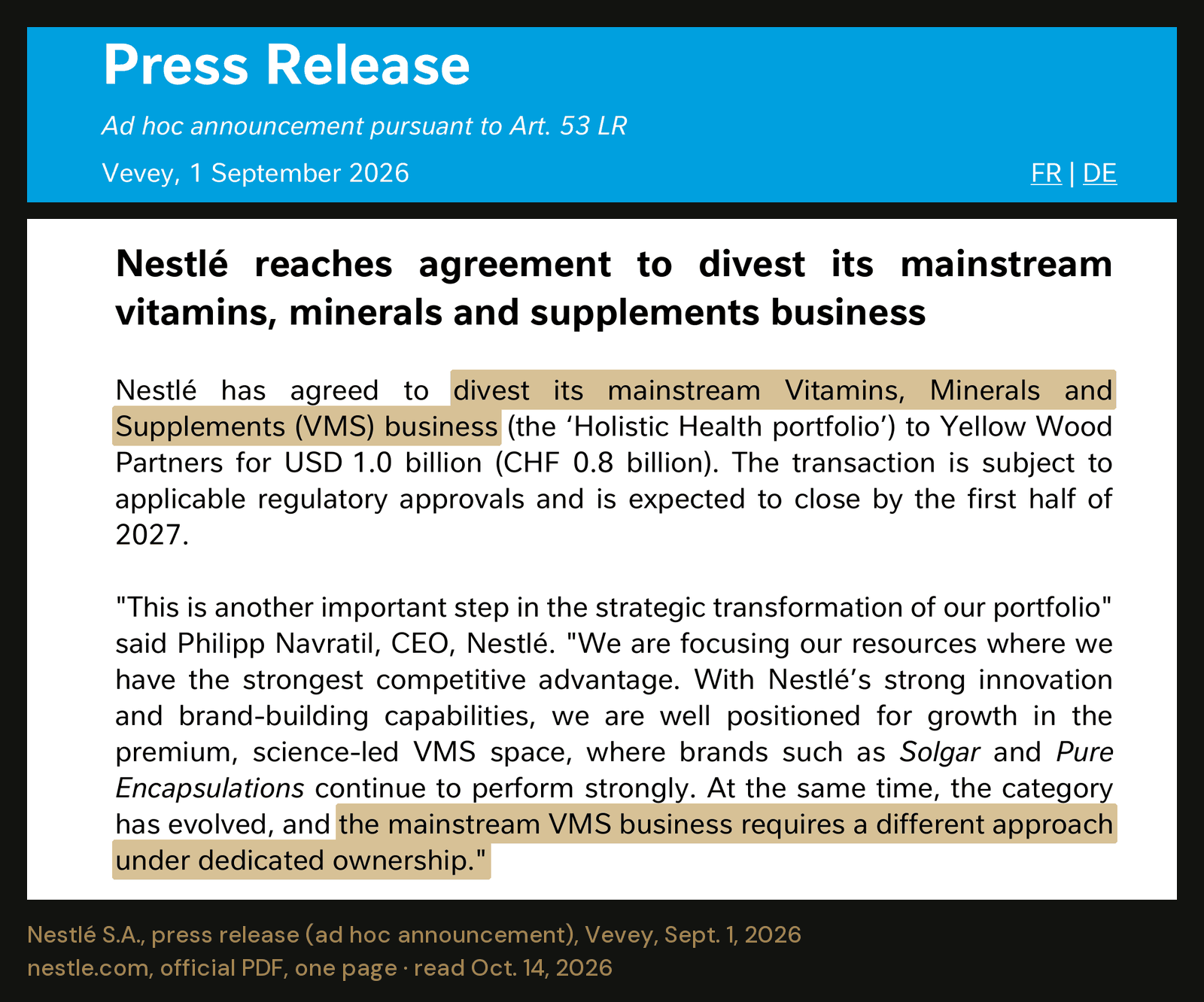
That is Nestlé’s description of its own brands. It is not a finding about what is in any bottle, and I am not offering it as one. Pure Encapsulations is also the brand in my disclosure above. What the documents do show is that Solgar and Nature’s Bounty, named together in the 2017 announcement and again in 2021, are now being separated.
The industry lobbies for tax breaks, and the future health secretary said vitamins were suppressed
The paperwork above is private deals. The rules around them are public, and they are being argued over right now.
The Council for Responsible Nutrition, a supplement trade group, reported spending $90,000, $110,000, $80,000 and $70,000 on its own lobbying in the four quarters of 2025. By my arithmetic, that is $350,000. One issue on every one of those reports: “All legislative proposals related to the inclusion of dietary supplement purchases within tax-deductible Health Savings Accounts and Flexible Spending Accounts (HSAs/FSAs).”
So the product no regulator approves before sale is being argued into the same tax-advantaged account you use for a prescription.
The Natural Products Association, another trade group, reported $100,000 of lobbying expenses in each quarter of 2025. That is $400,000 for the year, my arithmetic. Its own four reports check the box for no lobbying issue activity, so the work shows up in the reports of the firms it hired. One of them, McCarthy Advanced Consulting, described it in these words:
“Lobbied for the reintroduction of the Dietary Supplement Access Act, which would include dietary supplements as qualified medical expenses eligible for reimbursement under a Health Savings Account.”
Pharmavite, the owner of Nature Made, reported $90,000 of in-house lobbying expenses in each quarter of 2025. Its outside firm, Reinecke Strategic Solutions, listed “Inclusion of multivitamins and other dietary supplements in health savings accounts, flexible savings accounts and SNAP program.” SNAP is the federal food assistance program. The same firm listed “Tariffs on critical nutrients and dietary supplements.” Even your multivitamin has a trade policy now.
Credit where the filings earn it. The Council for Responsible Nutrition’s reports also list “Mandatory Product Listing for dietary supplements.” Pharmavite’s firm listed “Mandatory product listing for dietary supplements” and “Adequate budget and staffing for FDA.” Part of this industry is asking the government to keep a list of what it sells, and to fund the agency that would keep it.
Now the man in charge of the department above the FDA. On October 25, 2024, before he held office, Robert F. Kennedy Jr. posted on X:
“FDA’s war on public health is about to end. This includes its aggressive suppression of psychedelics, peptides, stem cells, raw milk, hyperbaric therapies, chelating compounds, ivermectin, hydroxychloroquine, vitamins, clean foods, sunshine, exercise, nutraceuticals and anything else that advances human health and can’t be patented by Pharma. If you work for the FDA and are part of this corrupt system, I have two messages for you: 1. Preserve your records, and 2. Pack your bags.”
He now signs Federal Register notices as Secretary of Health and Human Services, the department that runs the FDA. So the agency whose staff got that warning now answers to the man who wrote it.
Set the vitamins part beside this piece. The company behind the brand was sold in 2010 in a deal valued at $3.8 billion. Its owners took a $722 million dividend in 2012 and about $446 million more in 2013, both funded with new debt. Its core brands sold for $5.75 billion in 2021, and KKR’s annual report lists its Bountiful sales among the main sources of its carried interest that year. A $1.0 billion sale was agreed in 2026.
On this record, his claim that vitamins faced aggressive suppression is unsupported. The documents show a market that kept paying billions for the brand, and an agency with no power to approve a supplement before sale. That is a hell of a way to be suppressed. I would like to be suppressed like that.
Then there is your retirement. On August 7, 2025, the President signed Executive Order 14330, “Democratizing Access to Alternative Assets for 401(k) Investors.” Its statement of purpose opens: “Many wealthy Americans, and Government workers who participate in public pension plans, can invest in, or are the beneficiaries of investment in, a number of alternative assets.”
The order says such assets “offer competitive returns along with diversification opportunities.” It notes that “more than 90 million Americans participate in employer-sponsored defined-contribution plans,” the 401(k) kind. Its definition of alternative assets starts with “private market investments, including direct and indirect interests in equity, debt, or other financial instruments that are not traded on public exchanges, including those where the managers of such investments, if applicable, seek to take an active role in the management of such companies.” Four Carlyle managing directors on the holding company’s board, by the 2013 filing’s own list, is what an active role looks like.
It blames “regulatory overreach” and lawsuits “filed by opportunistic trial lawyers” for keeping alternatives out of those plans. And it tells the Labor Secretary to “consider whether to rescind the Department of Labor’s December 21, 2021, Supplemental Private Equity Statement.” The order states the “competitive returns” as a fact, in a sentence with no number in it.
I am not predicting what any 401(k) will earn. Here is my take on what the order means for the person in the vitamin aisle. Pharmavite’s outside firm put SNAP, the food assistance program, on the same lobbying line as health savings accounts. The order puts private market investments first on its list of alternative assets, and it points them at the more than 90 million Americans in employer-sponsored defined-contribution plans. The filings above are the record of what this kind of owner did with one vitamin company. The order’s statement of purpose opens on what wealthy Americans already get.
What I cannot tell you
The strongest objection to this piece is that none of it matters to what is in the bottle. It may not. I do not know whether any of these changes of owner changed a product. These documents cannot say either way. The debt and the dividends tell you who took cash out and when. They do not tell you what went into a capsule.
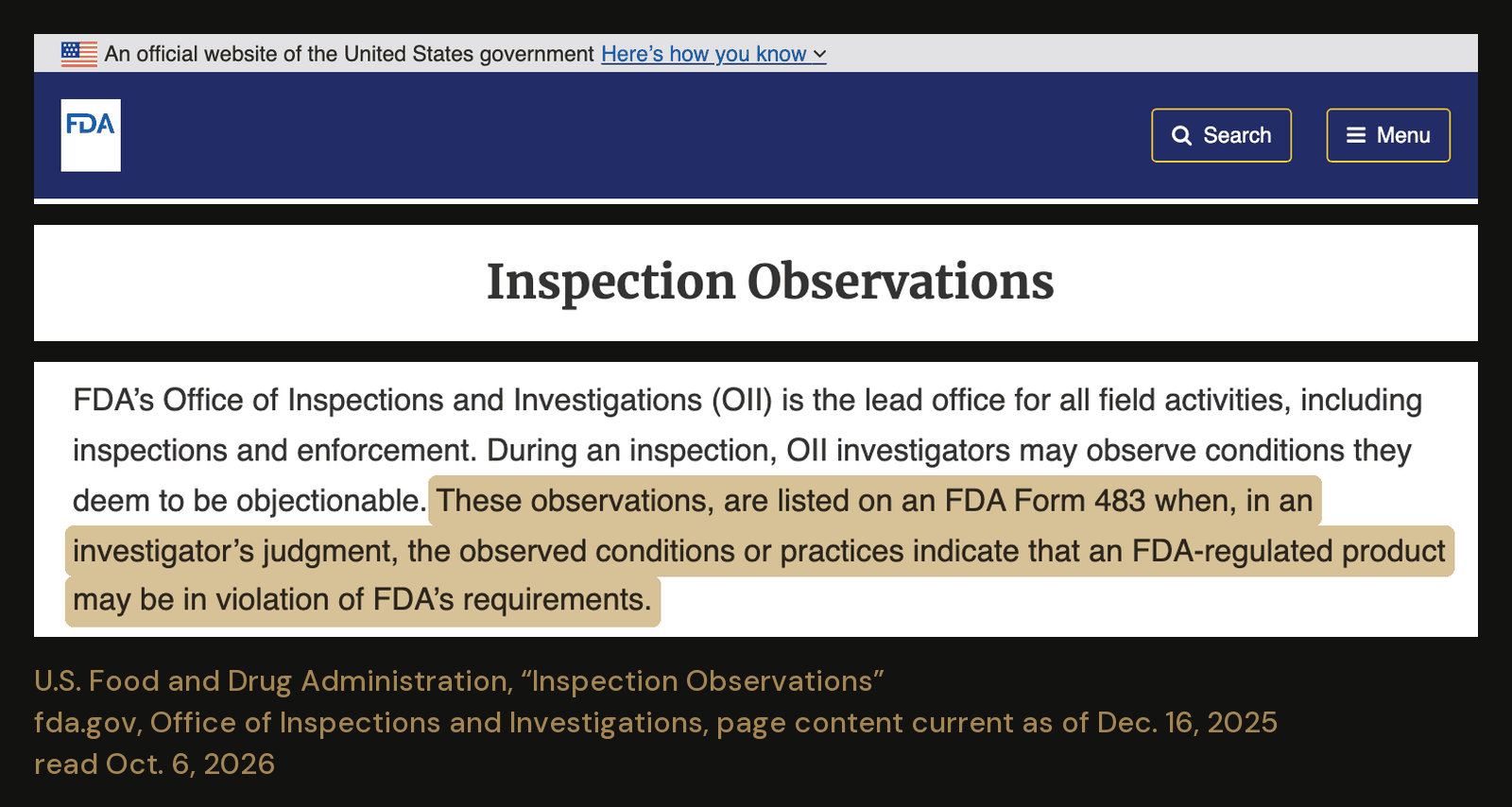
I looked for the kind of record that could. On September 23 and 24, 2026, I searched the web for warning letters and inspection findings from the Food and Drug Administration (FDA). The FDA records inspection findings on a form called a 483. The names I searched were NBTY, Nature’s Bounty, Garden of Life, Pharmavite, Otsuka, Haleon, Church & Dwight, Piping Rock, Schwabe, Nature’s Way and Yellow Wood. I found none tied to a current facility of any of them. That was a general web search. It was not a search of the FDA’s own databases. I did not run it for the store chains, or for every brand named here. A search that finds nothing is not a clean bill of health. This piece makes no claim, in either direction, about the quality of any product in it.
The New York and Justice Department records above are those offices’ accounts of specific products and years. I quote them for what they say about who was checking, not as findings about anything sold today.
I do not know how Ester-C, Gard, Nuun and Sisu came to belong to Nestlé. The 2021 release does not list them among the brands in the deal. It does list Ester-C among The Bountiful Company’s brands, and NBTY’s 2010 release lists Ester-C and Sisu among NBTY’s. None of the documents I read shows how any of the four passed to Nestlé.
I do not know what Carlyle or KKR made in total on Nature’s Bounty. The filings I read give dividends, a distribution, fees and prices, not either firm’s final profit, and I have not estimated one. I do not know why any of these companies bought or sold beyond what they said at the time. I have quoted what they said.
You can check who owns a brand yourself
Start with the owner’s own news page. Search it for the brand’s name with “acquire” or “divest.” For a company listed in the United States, the SEC’s EDGAR database holds its filings. Several of the documents in this piece came from there, including the 2013 filing with the dividends and the 2021 stock offering that was withdrawn.
Then read one word closely. “Agreed” means it has not closed. Netflix’s Love Is Blind runs on the same rule: an engagement in the pods is not a wedding.
The best advice in this piece came from the prospective buyer. Yellow Wood’s homepage tells investors they “should not rely on endorsements for any purpose and should conduct their own review prior to investing.” The same goes for anyone standing in the vitamin aisle.
The next piece in this series moves to the other shelf: the platforms clinicians use to recommend supplements to their own patients and to sell them. I have a store on one of them.
This is general education and analysis of public documents, not individual medical or investment advice. Decisions about what to take belong with your own clinician.
References
Nestlé S.A. Nestlé reaches agreement to divest its mainstream vitamins, minerals and supplements business. Press release, ad hoc announcement pursuant to Art. 53 LR. September 1, 2026. https://www.nestle.com/sites/default/files/2026-09/agreement-divest-mainstream-vitamins-minerals-supplements-en.pdf. Accessed October 14, 2026.
Yellow Wood Partners. Yellow Wood Partners Agrees to Acquire Nestle’s Holistic Health Platform of Leading Vitamins, Minerals and Supplements Brands. Press release, PR Newswire. September 1, 2026. https://www.prnewswire.com/news-releases/yellow-wood-partners-agrees-to-acquire-nestles-holistic-health-platform-of-leading-vitamins-minerals-and-supplements-brands-302866603.html. Accessed October 14, 2026.
Yellow Wood Partners. Home page and News page. Web pages. https://www.yellowwoodpartners.com/ and https://www.yellowwoodpartners.com/news. Accessed October 14, 2026.
NBTY, Inc. NBTY Agrees to Be Acquired by the Carlyle Group for $55.00 Per Share in Cash; Transaction Valued at $3.8 Billion. Press release, filed with the SEC as Exhibit 99.1 to Form 8-K. July 15, 2010. https://www.sec.gov/Archives/edgar/data/70793/000104746910006460/a2199420zex-99_1.htm. Accessed October 14, 2026.
Alphabet Holding Company, Inc. Form S-4, registration statement. Filed February 22, 2013. https://www.sec.gov/Archives/edgar/data/1566978/000104746913001473/a2212850zs-4.htm. Accessed October 14, 2026.
Alphabet Holding Company, Inc. Alphabet Holding Company, Inc. Announces Closing of Tack-On Notes Offering. Press release, filed with the SEC as Exhibit 99.1 to Form 8-K. December 12, 2013. https://www.sec.gov/Archives/edgar/data/1566978/000110465913089984/a13-26086_2ex99d1.htm. Accessed October 14, 2026.
Google Inc. Form 8-K, current report. August 10, 2015. https://www.sec.gov/Archives/edgar/data/1288776/000128877615000039/a20150810form8-k.htm. Accessed October 14, 2026.
The Carlyle Group. KKR to Acquire Majority Control of The Nature’s Bounty Co. from The Carlyle Group. News release 2017-052. July 24, 2017. https://www.carlyle.com/media-room/news-release-archive/kkr-acquire-majority-control-nature%E2%80%99s-bounty-co-carlyle-group. Accessed October 14, 2026.
The Bountiful Company. Form S-1, registration statement. Filed April 12, 2021. https://www.sec.gov/Archives/edgar/data/1842031/000119312521113287/d935664ds1.htm. Accessed October 14, 2026. Registration withdrawal (Form RW), November 4, 2021, accession 0001193125-21-319895, listed at https://data.sec.gov/submissions/CIK0001842031.json. Accessed October 14, 2026.
KKR & Co. Inc. Form 10-K, annual report for 2021. Filed February 28, 2022. https://www.sec.gov/Archives/edgar/data/1404912/000140491222000004/kkr-20211231.htm. Accessed October 14, 2026.
Nestlé S.A. Nestlé to acquire core brands of The Bountiful Company, expands health and nutrition portfolio. Press release, GlobeNewswire. April 30, 2021. https://www.globenewswire.com/news-release/2021/04/30/2220348/0/en/nestl-to-acquire-core-brands-of-the-bountiful-company-expands-health-and-nutrition-portfolio.html. Accessed October 14, 2026.
Nestlé Health Science USA. Our Brands. Web page. https://www.nestlehealthscience.us/our-brands. Accessed October 14, 2026.
Pharmavite. History. Web page. https://www.pharmavite.com/company/history/. Accessed October 14, 2026.
Haleon. Our Brands. Web page. https://www.haleon.com/our-brands. Accessed October 14, 2026.
Haleon. Who We Are. Web page. https://www.haleon.com/who-we-are. Accessed October 14, 2026.
Church & Dwight Co., Inc. Church & Dwight to Sell VitaFusion and L’il Critters Brands. Press release, filed with the SEC as Exhibit 99.1 to Form 8-K. December 9, 2025. https://www.sec.gov/Archives/edgar/data/313927/000119312525312870/chd-ex99_1.htm. Accessed October 14, 2026.
Church & Dwight Co., Inc. Church & Dwight Reports Q4 2025 and 2025 Results and Provides 2026 Outlook. Press release, filed with the SEC as Exhibit 99.1 to Form 8-K. January 30, 2026. https://www.sec.gov/Archives/edgar/data/313927/000119312526030474/chd-ex99_1.htm. Accessed October 14, 2026.
Schwabe Group. Nature’s Way (subsidiaries listing, Schwabe North America). Web page. https://www.schwabe-group.com/en/natures-way. Accessed October 14, 2026.
GNC Holdings, Inc. Form 8-K, current report. October 7, 2020. https://www.sec.gov/Archives/edgar/data/1502034/000119312520265653/d25873d8k.htm. Accessed October 14, 2026.
U.S. Department of Justice, Consumer Protection Branch. Non-prosecution agreement letter, Re: GNC Holdings, Inc., with Attachment A. Signed December 5 to 7, 2016 (dates on the signature pages); payment due before December 31, 2016. https://www.justice.gov/archives/opa/press-release/file/916091/dl. Accessed October 14, 2026.
New York State Office of the Attorney General. A.G. Schneiderman Asks Major Retailers To Halt Sales Of Certain Herbal Supplements As DNA Tests Fail To Detect Plant Materials Listed On Majority Of Products Tested. Press release. February 3, 2015. https://ag.ny.gov/press-release/2015/ag-schneiderman-asks-major-retailers-halt-sales-certain-herbal-supplements-dna. Accessed October 14, 2026.
New York State Office of the Attorney General. A.G. Schneiderman Announces Agreement With GNC To Implement Landmark Reforms For Herbal Supplements. Press release. March 30, 2015. https://ag.ny.gov/press-release/2015/ag-schneiderman-announces-agreement-gnc-implement-landmark-reforms-herbal. Accessed October 14, 2026.
New York State Office of the Attorney General. A.G. Schneiderman Announces Major Nationwide Agreement With NBTY, Herbal Supplement Maker For Walgreens And Walmart. Press release. September 28, 2016. https://ag.ny.gov/press-release/2016/ag-schneiderman-announces-major-nationwide-agreement-nbty-herbal-supplement-maker. Accessed October 14, 2026.
Liberty Tax, Inc. The Vitamin Shoppe to be Acquired by Liberty Tax. Press release, filed with the SEC as Exhibit 99.1 to Form 8-K/A. August 8, 2019. https://www.sec.gov/Archives/edgar/data/1528930/000117184319005363/exh_991.htm. Accessed October 14, 2026.
Kingswood Capital Management, LP. Kingswood Capital Management and Performance Investment Partners Complete Acquisition of The Vitamin Shoppe. Press release. May 20, 2025. https://www.kingswood-capital.com/kingswood-capital-management-and-performance-investment-partners-complete-acquisition-of-the-vitamin-shoppe/. Accessed October 14, 2026.
Walgreens Boots Alliance, Inc. Form 8-K, current report. August 28, 2025. https://www.sec.gov/Archives/edgar/data/1618921/000119312525190603/d87240d8k.htm. Accessed October 14, 2026.
Walgreen Co. Walgreen Co. To Operate as Private Standalone Company Following Acquisition By Sycamore Partners. Press release, filed with the SEC as Exhibit 99.2 to Form 8-K. August 28, 2025. https://www.sec.gov/Archives/edgar/data/1618921/000119312525190603/d87240dex992.htm. Accessed October 14, 2026.
U.S. Senate and House of Representatives. Lobbying Disclosure Act reports (LD-2), filing year 2025: Council for Responsible Nutrition (in-house); Natural Products Association (in-house) and McCarthy Advanced Consulting LLC for Natural Products Association; Pharmavite LLC (in-house) and Reinecke Strategic Solutions, Inc. for Pharmavite LLC. https://lda.gov/api/v1/filings/. Accessed October 14, 2026.
Robert F. Kennedy Jr. Post on X, October 25, 2024, 5:25 PM ET. https://x.com/RobertKennedyJr/status/1849925311586238737. Full text read on the X post page, October 14, 2026.
U.S. Department of Health and Human Services. Statement of Delegation of Authority, signed by Robert F. Kennedy, Jr., Secretary. Federal Register, Vol. 91, No. 197, October 14, 2026, p. 65219 (FR Doc. 2026-21001). https://www.federalregister.gov/documents/2026/10/14/2026-21001/statement-of-delegation-of-authority. Accessed October 14, 2026.
Executive Office of the President. Executive Order 14330 of August 7, 2025, Democratizing Access to Alternative Assets for 401(k) Investors. Federal Register, Vol. 90, No. 153, August 12, 2025, pp. 38921 to 38923. https://www.govinfo.gov/content/pkg/FR-2025-08-12/pdf/2025-15340.pdf. Accessed October 14, 2026.
Frost, Robert. The Road Not Taken. First published in The Atlantic Monthly, August 1915; collected in Mountain Interval, Henry Holt, 1916. Public domain. Project Gutenberg text: https://www.gutenberg.org/cache/epub/29345/pg29345.txt. Accessed October 14, 2026.
Fullscript. Fullscript’s Dispensing Catalog. Web page. https://fullscript.com/catalog. Accessed October 14, 2026.
This article is general nutrition education, not individualized medical or nutrition advice, and it does not create a dietitian–client relationship. Medications and their side effects should be managed with your prescribing clinician. See the full disclaimer.