Summary
In 2000 an expert committee advised that Medicare pay for nutrition therapy from a registered dietitian whenever a physician refers a patient, for any condition. The law signed on 21 December 2000 kept the referral. It covered only people with diabetes or kidney disease. I looked for the reason in sixty-eight documents from that Congress. I found none that gives one.
The committee found limited but consistent evidence that nutrition therapy helps with abnormal cholesterol and other blood fats, high blood pressure, heart failure, diabetes and kidney failure. It said paying on referral, not by diagnosis, may be simpler to run.
Senate bills in 2000 also named heart and blood vessel disease. The law did not. It also left out people whose regular dialysis Medicare pays for. A 2004 federal health department report said Congress left them out because they already get dietary services. That is the department’s account, not Congress’s.
The agency that runs Medicare wrote the rules in 2001. It required the referring physician to be the one treating the patient. It dropped that rule in November 2021.
In 2021 the agency wrote that less than 2 percent of an estimated 14 million eligible people on Medicare had used the benefit.
Bills to add heart and blood vessel disease came within six months of the law. As of September 2026, none had been enacted.
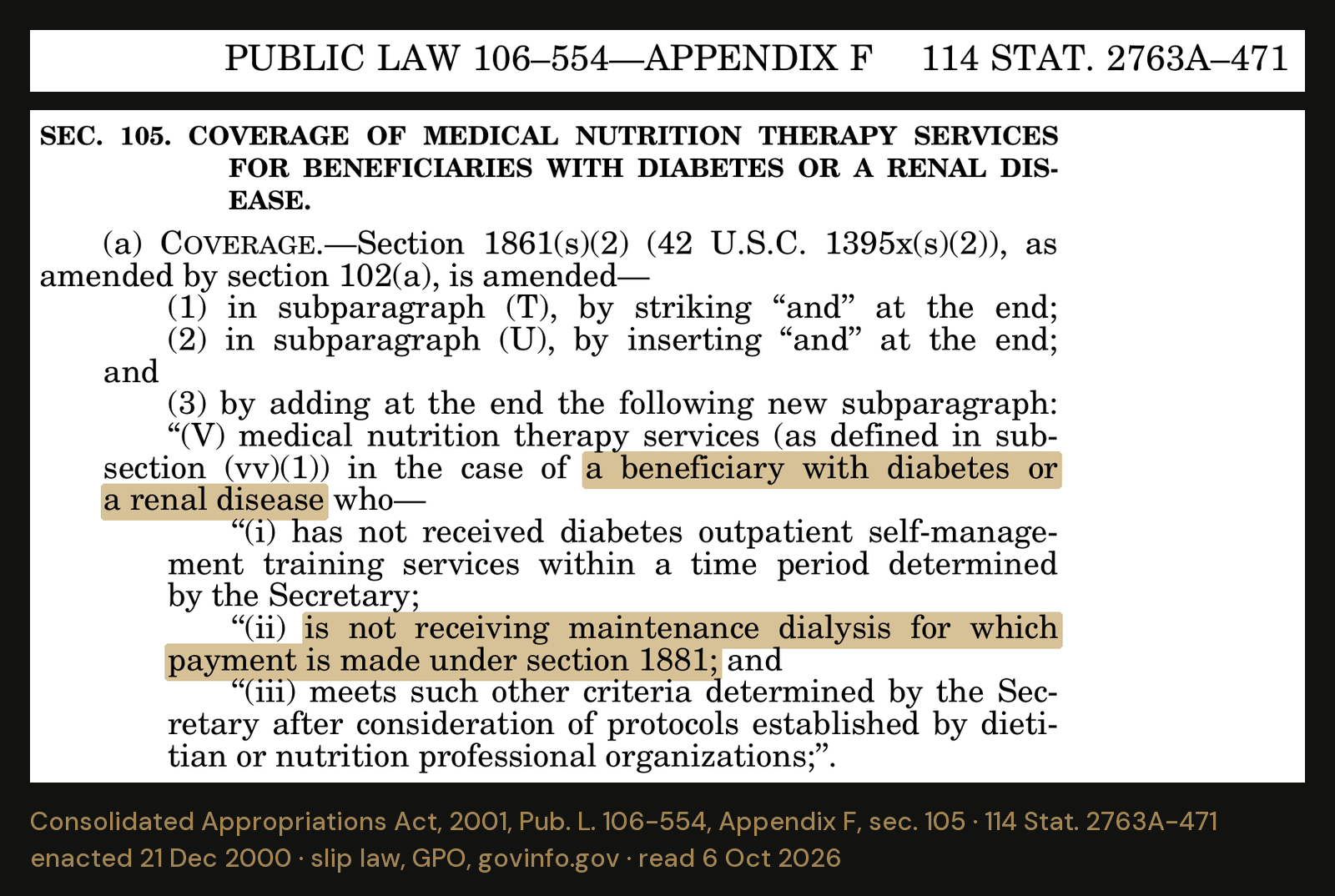
In 2000, three bills introduced in the Senate would have had Medicare pay for nutrition therapy for people with diabetes, cardiovascular disease or kidney disease. The last of them came from the chairman of the Finance Committee. In the House, the Commerce Committee proposed a five-year demonstration in five states, with no list of diagnoses at all. The text that became law on 21 December 2000 named diabetes and kidney disease. It also excluded people whose maintenance dialysis Medicare pays for.
An expert committee, carrying out a study Congress had ordered in 1997, had advised something else. Pay for nutrition therapy whenever a physician refers a patient, it said, rather than by diagnosis.
Then the agency that runs Medicare wrote the rules. It took its definitions of the diseases from the committee’s report. It added a requirement of its own about which physician could refer. Twenty years later it took that out.
This piece sets those documents side by side, in order, and marks what the record does not explain. It is the readable version of a history I set out, with full notes, in a report published on 29 September.
Before I quote any of it, you should know who is writing. I am a registered dietitian, so this is the origin story of my own profession’s Medicare benefit, and a change to that benefit would affect people like me. I own Vitae Arete LLC. I wrote that report, Report 3 of The Dietetics Workforce Reports, “Where the limits live.” My company publishes it, and it has not been peer reviewed by a journal. I filed two public comments in CMS docket CMS-2026-2377, the proposed 2027 physician fee schedule, on 6 August and 8 September 2026. Neither I nor Vitae Arete is enrolled in Medicare, and neither of us bills 97802 to 97804, the nutrition therapy codes. The American Dietetic Association, which appears below, is now the Academy of Nutrition and Dietetics. In July 2026 I met with the Academy’s leadership about a task force it convened on the dietetics pipeline and compensation.
The committee told Congress to pay on a physician’s referral, for any condition
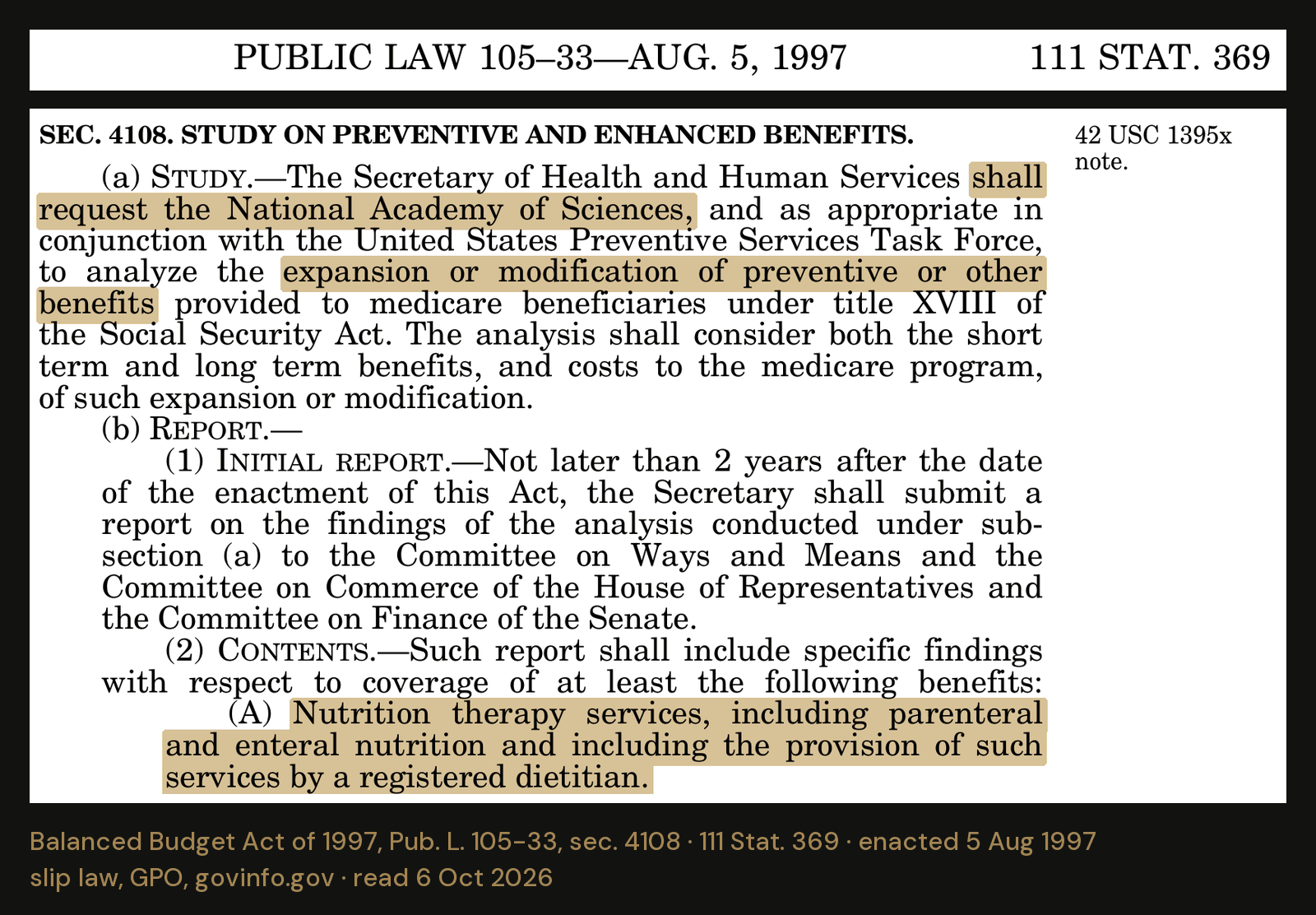
The Balanced Budget Act of 1997 told the Secretary of Health and Human Services to ask the National Academy of Sciences for a study. Its subject was expanding Medicare’s preventive and other benefits. First on the list the report had to cover was “Nutrition therapy services, including parenteral and enteral nutrition and including the provision of such services by a registered dietitian” (Pub. L. 105-33, sec. 4108).
The work fell to the Institute of Medicine, now the National Academy of Medicine, and its Committee on Nutrition Services for Medicare Beneficiaries. The committee’s report was published in 2000 as The Role of Nutrition in Maintaining Health in the Nation’s Elderly. I cite it by page below. Its recommendations refer to the Health Care Financing Administration, which became the Centers for Medicare & Medicaid Services in 2001. I call the agency CMS throughout.
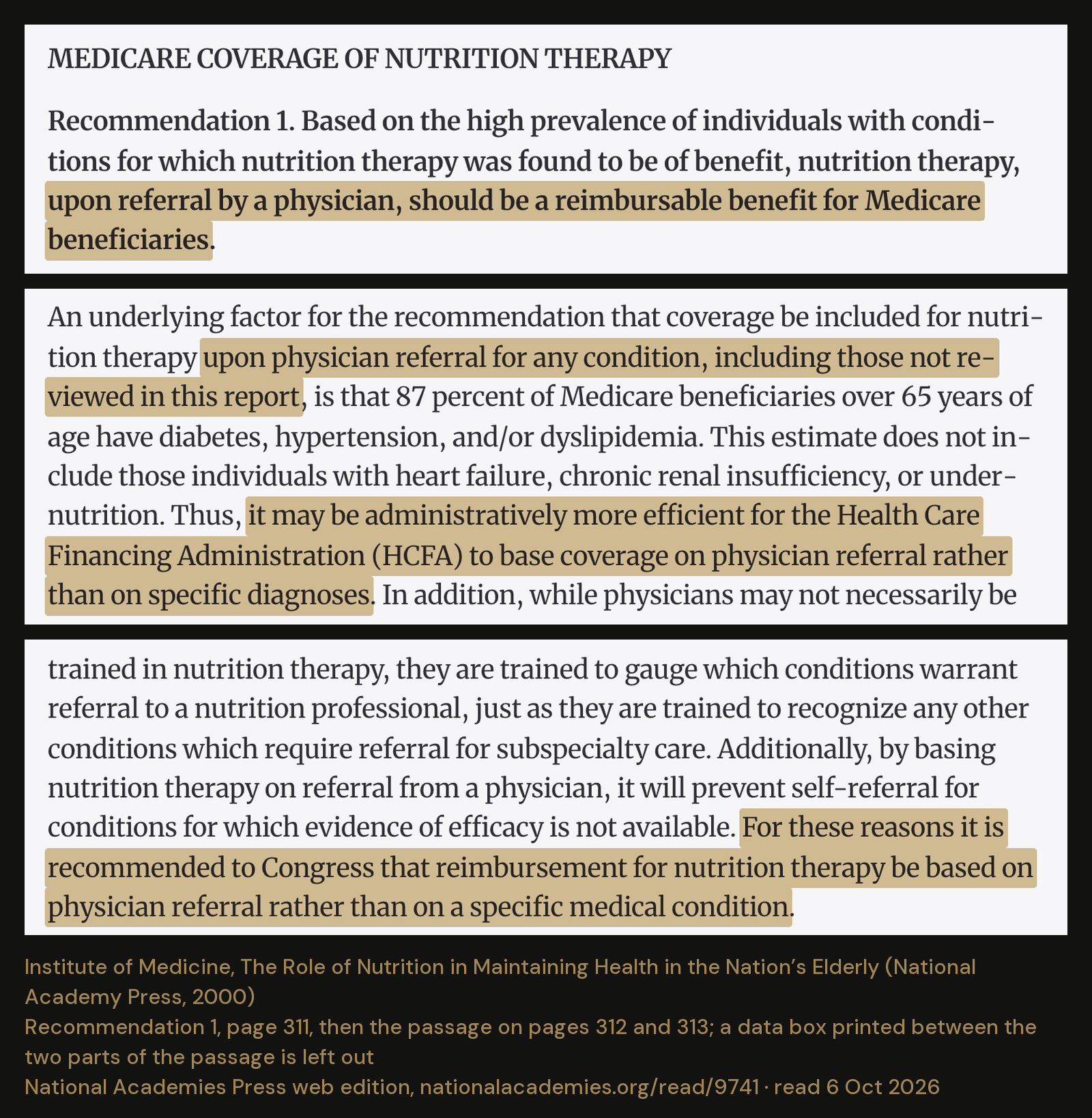
The first recommendation, on page 311, was about structure:
Recommendation 1. Based on the high prevalence of individuals with conditions for which nutrition therapy was found to be of benefit, nutrition therapy, upon referral by a physician, should be a reimbursable benefit for Medicare beneficiaries.
Under that recommendation, the committee reported consistent evidence, from limited data, that nutrition therapy works as part of treating several conditions. They were dyslipidemia (abnormal cholesterol and other blood fats), hypertension, heart failure, diabetes and kidney failure (p. 311). Its kidney review focused on the stages before end-stage disease (p. 3). It did not limit coverage to that list. “There are likely other conditions that were not specifically reviewed but may warrant coverage,” it wrote (p. 312). Then it told Congress how to pay:
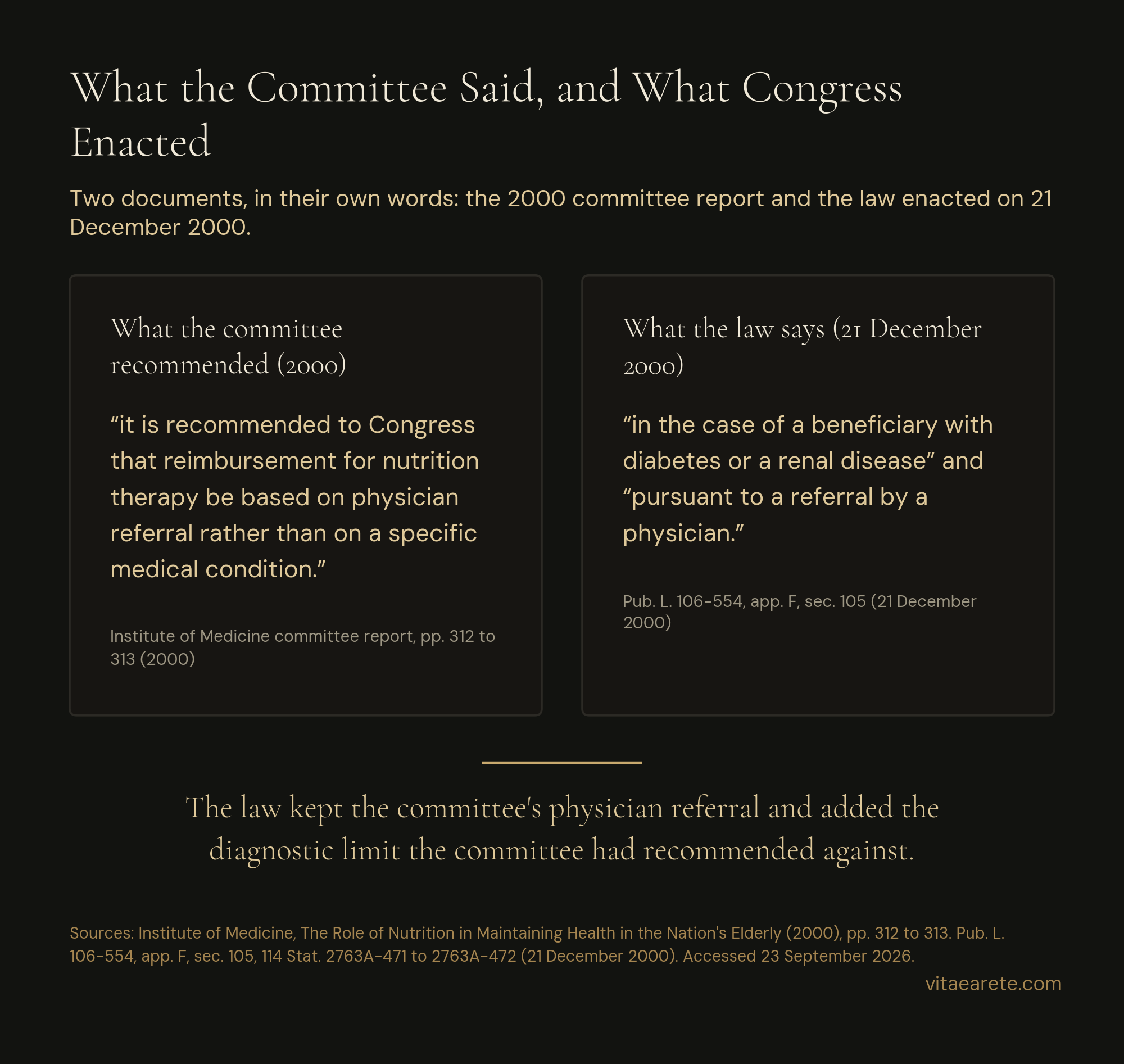
An underlying factor for the recommendation that coverage be included for nutrition therapy upon physician referral for any condition, including those not reviewed in this report, is that 87 percent of Medicare beneficiaries over 65 years of age have diabetes, hypertension, and/or dyslipidemia. … Thus, it may be administratively more efficient for the Health Care Financing Administration (HCFA) to base coverage on physician referral rather than on specific diagnoses. In addition, while physicians may not necessarily be trained in nutrition therapy, they are trained to gauge which conditions warrant referral to a nutrition professional … Additionally, by basing nutrition therapy on referral from a physician, it will prevent self-referral for conditions for which evidence of efficacy is not available. For these reasons it is recommended to Congress that reimbursement for nutrition therapy be based on physician referral rather than on a specific medical condition.
That passage runs across pages 312 and 313. The 87 percent is the committee’s own figure, from a 1997 National Center for Health Statistics source (p. 51). Note the last sentence. The sentence addressed to Congress names no disease. It asks Congress to pay on a physician’s referral, for any condition.
A careful reader can argue the opposite: that Congress simply enacted the committee’s own findings. I want to give that argument properly, because the report supports it in places.
The report’s diabetes chapter is direct: “The committee recommends that individualized nutrition therapy, provided by a registered dietitian, be a covered benefit as part of the multidisciplinary approach to the management of diabetes which includes diet, exercise, medications, and blood glucose monitoring” (p. 129). The chapter on outpatient care names dyslipidemia, hypertension, heart failure, diabetes and renal disease. Then it says “it is recommended that nutrition therapy be considered a covered benefit for Medicare beneficiaries in the ambulatory setting” (p. 222). And the consulting firm that helped estimate the costs was given, in the report’s words, “the committee’s recommendations on which conditions should be covered” (p. 4).
So the report does work condition by condition. Its final chapter then tells Congress how to structure payment.
The committee’s own cost estimate was not confined to the named diagnoses. It put the Medicare portion of charges for 2000 through 2004 at $1.43 billion, undiscounted (p. 321). Of “the remaining Medicare beneficiaries who either do not have one of the nutrition-related diagnoses indicated or are under the age of 65,” it assumed “25 percent would be eligible for one annual nutrition therapy session” (p. 279). A benefit limited to named diagnoses would not pay for anyone in that group who has none of them. The chapters’ lists also include dyslipidemia, hypertension and heart failure. The law does not.
A second objection is that the committee leaned on my profession. The report states its own terms. To avoid a conflict of interest, members “were limited to those who were employed in areas that would not be directly affected by any changes in legislation with regard to nutrition services (i.e., management, research, education).” One member “had experience in, but was not primarily responsible for, the evaluation of reimbursement for nutrition services within the professional association, the American Dietetic Association” (p. 3). The costing drew its patterns of care from “clinical practice guidelines proposed by the American Dietetic Association (ADA, 1998) and expert clinical judgment” (p. 283). Those facts are in the report for anyone to weigh.
The bills of 1999 and 2000
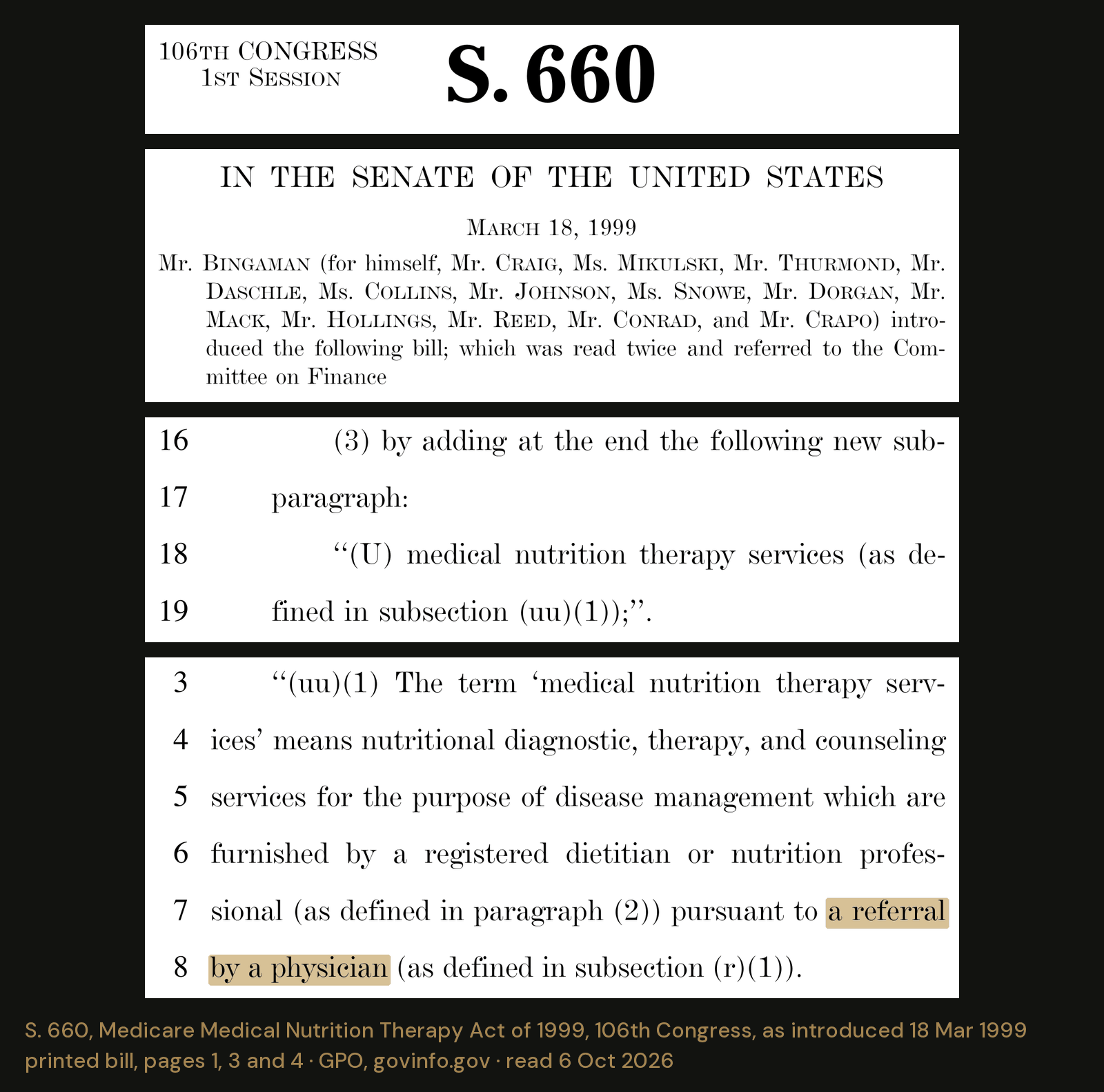
The first bills in this story came before the committee reported. On 18 March 1999, Senator Bingaman introduced the Medicare Medical Nutrition Therapy Act of 1999 in the Senate (S. 660). Representative Nancy Johnson of Connecticut introduced it in the House (H.R. 1187). It would have covered nutrition therapy furnished on “a referral by a physician,” with no list of conditions. The committee’s report recommended the same structure.
In 2000 the bills changed shape. The Medicare Wellness Act of 2000 was introduced on 9 March 2000 (S. 2232, with a House companion, H.R. 3887). It covered a beneficiary “with diabetes, a cardiovascular disease (including congestive heart failure, arteriosclerosis, hyperlipidemia, hypertension, and hypercholesterolemia), or a renal disease.” That day Senator Bingaman, one of its sponsors, made a statement in the Senate. The committee’s study, he said, “recommended that medical nutrition therapy, ‘upon referral by a physician, be a reimbursable benefit for Medicare beneficiaries’” (146 Cong. Rec. S1402).
The same list, in the same words, went into a bill Senator Moynihan introduced on 20 September (S. 3077) and into its House companion (H.R. 5324). It went into the bill that Senator Roth, the Finance Committee’s chairman, introduced on 5 October (S. 3165). The History of Bills records no further action on any of the three Senate bills.
The House Commerce Committee went another way. On 26 September 2000 it ordered reported, by voice vote, a bill for a five-year demonstration “in the 5 States which have the highest proportion of the population who are 65 years of age or older.” The cap was $60 million a year. The services required a physician’s referral. There was no list of diagnoses (H.R. 5291, sec. 107; H. Rept. 106-1019, pt. 1, p. 30).
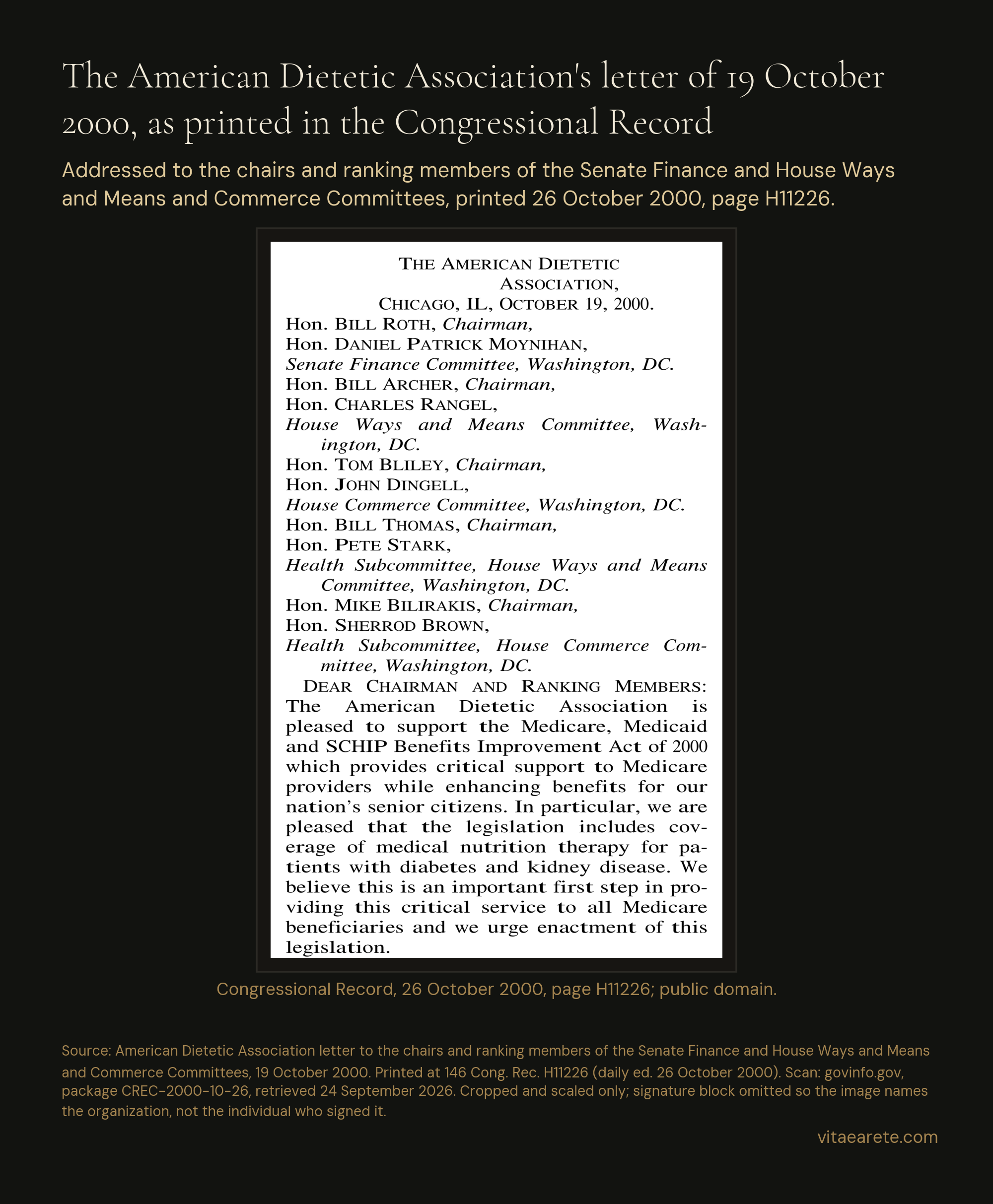
On 19 October 2000 the American Dietetic Association wrote to the chairs and ranking members of the Senate and House committees and subcommittees that handle Medicare. The letter is printed in the Congressional Record of 26 October (146 Cong. Rec. H11226). Its first paragraph ends:
In particular, we are pleased that the legislation includes coverage of medical nutrition therapy for patients with diabetes and kidney disease. We believe this is an important first step in providing this critical service to all Medicare beneficiaries and we urge enactment of this legislation.
On 14 December 2000 the same three representatives introduced a new bill under the same title, H.R. 5661. The Consolidated Appropriations Act, 2001, signed on 21 December, enacted it as introduced, by reference (Pub. L. 106-554, sec. 1(a)(6)).
The words “diabetes or a renal disease” did not change after 25 October. The coverage provision gained one clause. The conference text of 26 October does not contain it; the enacted text does. The beneficiary must be one who “is not receiving maintenance dialysis for which payment is made under section 1881,” Medicare’s end-stage renal disease program.
What the law says
Section 105 is short. It covers “medical nutrition therapy services” for “a beneficiary with diabetes or a renal disease” who meets the conditions in its clauses. The last requires that the beneficiary meet “such other criteria determined by the Secretary after consideration of protocols established by dietitian or nutrition professional organizations.” That clause lets the Secretary add criteria, not conditions.
The section defines the service as one furnished by a registered dietitian or nutrition professional “pursuant to a referral by a physician.” It bases payment on 85 percent of the physician fee schedule amount for the same service, now codified in the United States Code at 42 U.S.C. 1395l(a)(1)(T). Where that number came from is a later piece in this series.
Coverage began on 1 January 2002. The section also ordered a report. By 1 July 2003 the Secretary was to give Congress “recommendations with respect to the expansion to other medicare beneficiary populations of the medical nutrition therapy services benefit.”
So the law kept the committee’s physician referral and added the diagnostic limit the committee had recommended against. The conference report’s explanation of section 105 describes the provision, its payment and the required report. It gives no reason for the list (H. Rept. 106-1033, p. 877).
What the record does not explain
I looked for the reason. On 23 September 2026 the Government Publishing Office’s collections were searched for documents of the 106th Congress containing the phrase “medical nutrition therapy.” Setting aside index entries and duplicate editions left sixty-eight documents, from floor debates and bill texts to committee reports and hearings. Every passage that mentions the benefit was checked for language giving a reason, and read in full wherever any appeared. No committee report, conference report, hearing or floor statement of the 106th Congress that mentions the benefit, among those sixty-eight documents, gives a reason for the list. None says why the cardiovascular conditions of the Senate bills are absent from the law. The search behind Report 3, run on 15 September 2026, returned sixty-five documents and found the same.
CMS said something close to it in 2001. Answering commenters who wanted a broader definition of kidney disease, it wrote: “Neither the BIPA nor its legislative history indicates any specific intention regarding how to define renal disease for purposes of eligibility for this benefit” (66 FR 55276). BIPA is the 2000 Act. FR is the Federal Register, where agencies publish rules.
A reason does appear for one part of the design, four years later and from the executive branch. The report on expansion that section 105 ordered, from the Department of Health and Human Services (HHS), was due on 1 July 2003. By the Congressional Record, it reached the House on 1 April 2004, nine months after the deadline. It has no recommendations section. I found no recommendation in it.
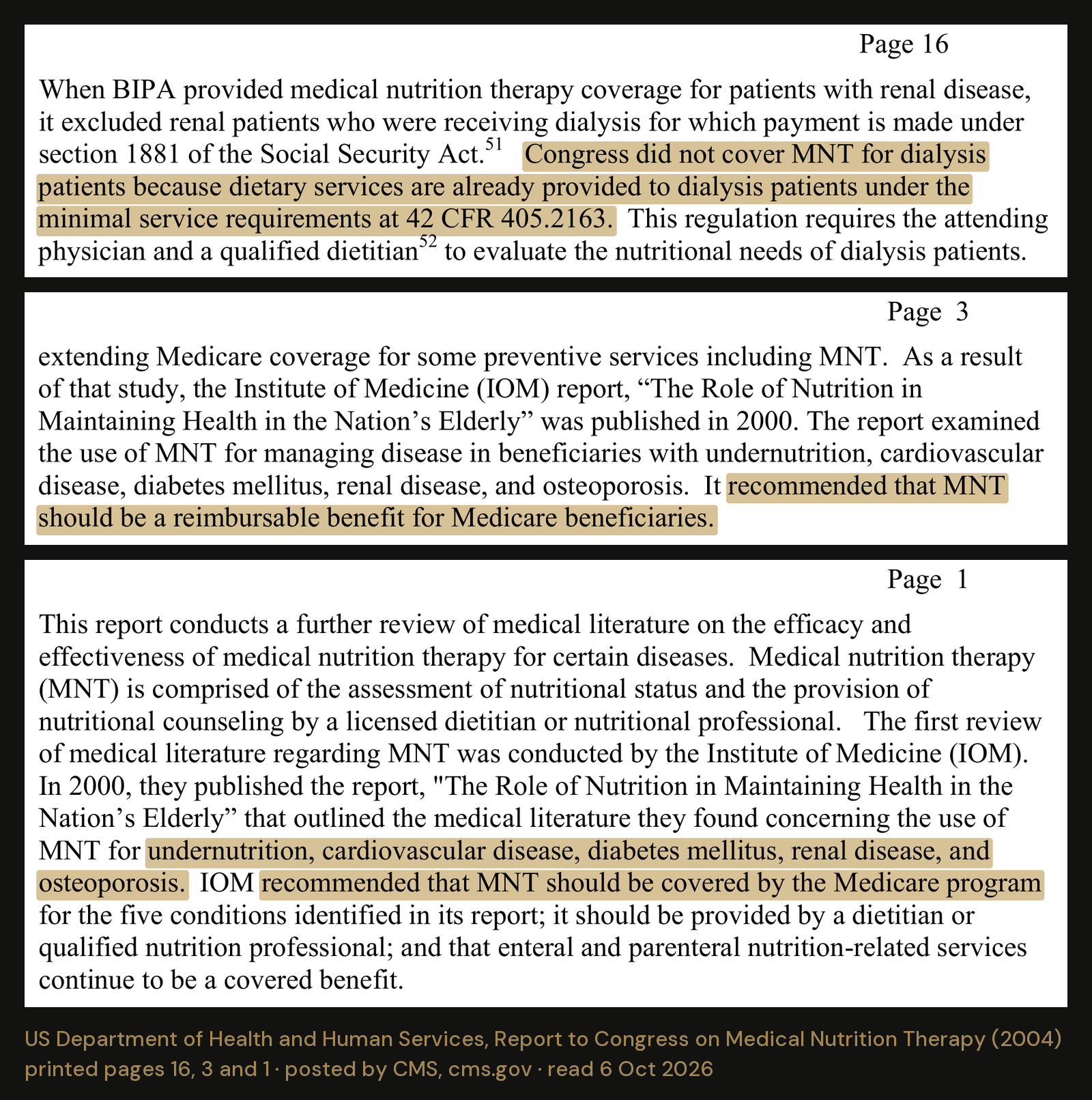
The report does explain the dialysis exclusion. It uses MNT for medical nutrition therapy and cites the Code of Federal Regulations (CFR): “Congress did not cover MNT for dialysis patients because dietary services are already provided to dialysis patients under the minimal service requirements at 42 CFR 405.2163” (HHS report, p. 16). That is the account of the Department of Health and Human Services, written in 2004. It is not a statement by Congress.
The same report describes the committee’s recommendation differently on different pages. On page 3, the committee “recommended that MNT should be a reimbursable benefit for Medicare beneficiaries.” On page 1, it “recommended that MNT should be covered by the Medicare program” for the conditions its report identified. The Department listed those as undernutrition, cardiovascular disease, diabetes mellitus, renal disease and osteoporosis. The first description matches Recommendation 1. The second turns a recommendation for coverage on referral into one for listed conditions.
What CMS did with it
CMS wrote the regulations into its physician fee schedule rule for 2002, published on 1 November 2001 (66 FR 55246; the nutrition therapy text begins at 55331).
Its definitions came from the committee: “We also established definitions of ‘diabetes’, ‘renal disease’, and ‘chronic renal insufficiency’ for the purpose of this benefit using definitions from the Institute of Medicine report” (66 FR 55276). The regulation defined renal disease as “chronic renal insufficiency, end-stage renal disease when dialysis is not received, or the medical condition of a beneficiary for 36 months after kidney transplant.” Chronic renal insufficiency meant a glomerular filtration rate, a standard measure of kidney function, of 13 to 50 (66 FR 55331).
It added a gate the committee had not proposed. The committee’s words were “upon referral by a physician.” CMS narrowed that to the “treating physician,” so that the physician who established the need was actually treating the patient for a covered disease. The final rule defined that physician as “the primary care physician or specialist coordinating care for the beneficiary with diabetes or renal disease.” Some commenters asked that any physician be allowed to refer. CMS answered: “We have not changed the final rule to allow any physician to make the referral for MNT” (66 FR 55276 to 55277).
On diabetes it wrote: “We believe that we do not have the statutory authority to extend coverage to beneficiaries who have not yet been diagnosed with diabetes.” It did extend coverage to gestational diabetes (66 FR 55276).
The hours were decided separately, in a CMS national coverage decision memo of February 2002, and they get a piece of their own.
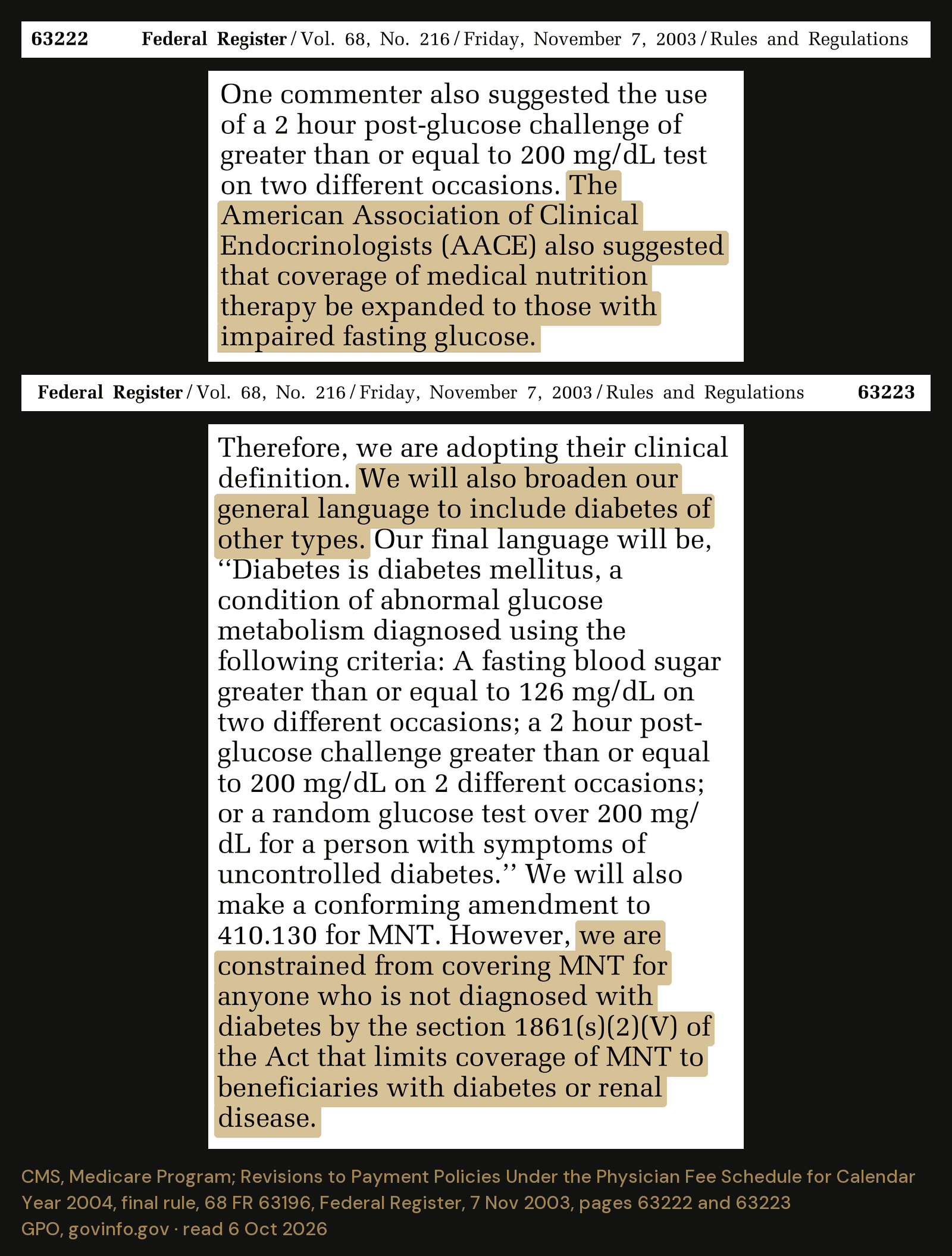
After that the changes came at the edges. In 2003 the American Association of Clinical Endocrinologists asked CMS to extend the benefit to people with impaired fasting glucose. CMS broadened its definition of diabetes instead. It answered the request with the statute: “we are constrained from covering MNT for anyone who is not diagnosed with diabetes by the section 1861(s)(2)(V) of the Act that limits coverage of MNT to beneficiaries with diabetes or renal disease” (68 FR 63223). In November 2005 it added individual nutrition therapy to the services Medicare pays for by telehealth, starting in 2006. Registered dietitians and nutrition professionals joined the practitioners who may furnish telehealth services (70 FR 70160).
In November 2021, in its rule for 2022, CMS removed the treating-physician requirement. It also moved the kidney definition’s range from 13 to 50 to 15 to 59. It said it made those changes “in order to improve access and utilization of the MNT benefit.” It gave the context:
Despite these findings and endorsement by leading clinical societies, including the American Diabetes Association, American College of Cardiology and the National Kidney Foundation, less than 2 percent of the estimated 14 million eligible Medicare beneficiaries have accessed MNT.
That is CMS’s figure, as of 2021 (86 FR 65250). In the same passage it said how far it could go on referral: “The statute expressly requires the order of a physician; therefore, we are unable to extend referral privileges to NPPs.” NPPs are nonphysician practitioners, such as nurse practitioners and physician assistants. The committee recommended referral by a physician. The law requires referral by a physician. In 2021 CMS read that requirement as ruling out referral by nurse practitioners and physician assistants.
In November 2023, in its rule for 2024, CMS took the laboratory test criteria out of the definition of diabetes. It wrote that “it is unnecessary to codify clinically specific test criteria into the regulatory definition of diabetes” (88 FR 79280). Commenters asked for the same change to the kidney definition. CMS said it was not responding to those comments in that rule. It would take them “into consideration for possible future rulemaking” (88 FR 79284). As of 22 September 2026, the kidney definition still carries the range of 15 to 59 (42 CFR 410.130).
Where the list stands
None of those changes added a condition. The statute’s list is where Congress left it in December 2000. In May and June 2001, within six months of enactment, bills in the Senate (S. 960) and the House (H.R. 2117) asked to add “a cardiovascular disease (including congestive heart failure, arteriosclerosis, hyperlipidemia, hypertension, and hypercholesterolemia).” They used the Senate bills’ wording from 2000. Neither got past referral to committee. Report 3 counts and dates the bills that followed. As of September 2026, none had been enacted.
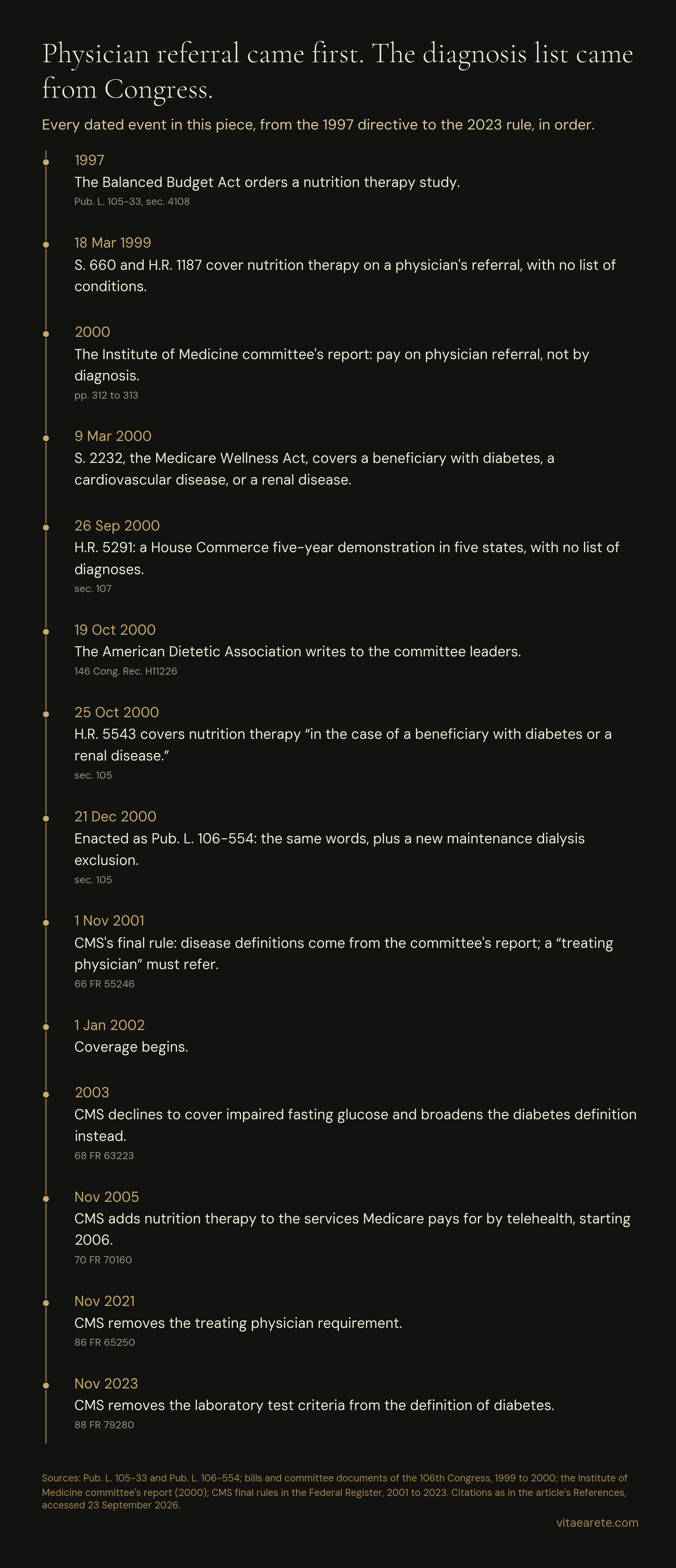
This piece opens a Friday series on how the numbers got made. Next comes the calorie count on a food label, and the 20 percent line FDA uses to check it. After that come how the threshold for prediabetes was set and where the 85 percent in a dietitian’s Medicare payment came from. The series closes with how to tell which of these numbers to distrust.
This is general education and policy analysis, not individual medical or billing advice. Questions about your own coverage belong with your clinician and with Medicare.
References
Fee J. Where the limits live: statute, regulation and coverage determination in Medicare’s nutrition therapy benefit, with an analysis of fee-for-service claims for 2010 to 2025. The Dietetics Workforce Reports, Report 3, version 1.0, Vitae Arete LLC (not journal peer-reviewed). 29 September 2026.
Institute of Medicine, Committee on Nutrition Services for Medicare Beneficiaries. The Role of Nutrition in Maintaining Health in the Nation’s Elderly: Evaluating Coverage of Nutrition Services for the Medicare Population. National Academy Press. 2000. Pages cited: 3, 4, 51, 129, 222, 279, 283, 311 to 313, 321. https://doi.org/10.17226/9741 (read in the National Academies’ online edition, https://www.nationalacademies.org/read/9741, accessed 23 September 2026)
National Academy of Medicine. About the NAM. Web page. Accessed 23 September 2026. https://nam.edu/about-the-nam/
US Congress. Balanced Budget Act of 1997, Pub. L. 105-33, sec. 4108, 111 Stat. 251, 369. Public law. 5 August 1997. https://www.govinfo.gov/content/pkg/PLAW-105publ33/html/PLAW-105publ33.htm (accessed 23 September 2026)
US Senate and House of Representatives. Medicare Medical Nutrition Therapy Act of 1999, S. 660 and H.R. 1187, 106th Congress, as introduced. Bill texts. 18 March 1999. https://www.govinfo.gov/content/pkg/BILLS-106s660is/html/BILLS-106s660is.htm and https://www.govinfo.gov/content/pkg/BILLS-106hr1187ih/html/BILLS-106hr1187ih.htm (accessed 23 September 2026)
US Senate and House of Representatives. Medicare Wellness Act of 2000, S. 2232 and H.R. 3887, 106th Congress, as introduced, sec. 209. Bill texts. 9 March 2000. https://www.govinfo.gov/content/pkg/BILLS-106s2232is/html/BILLS-106s2232is.htm and https://www.govinfo.gov/content/pkg/BILLS-106hr3887ih/html/BILLS-106hr3887ih.htm (accessed 23 September 2026)
Bingaman J. Statement on introduced bills (Medicare Wellness Act of 2000). 146 Cong. Rec. S1402 (daily ed. 9 March 2000). https://www.govinfo.gov/content/pkg/CREC-2000-03-09/html/CREC-2000-03-09-pt1-PgS1397.htm (accessed 23 September 2026)
US Senate and House of Representatives. Medicare, Medicaid, and SCHIP Balanced Budget Refinement Act of 2000, S. 3077 (20 September 2000) and H.R. 5324 (27 September 2000), 106th Congress, as introduced, sec. 234. Bill texts. September 2000. https://www.govinfo.gov/content/pkg/BILLS-106s3077is/html/BILLS-106s3077is.htm and https://www.govinfo.gov/content/pkg/BILLS-106hr5324ih/html/BILLS-106hr5324ih.htm (accessed 23 September 2026)
US Senate. Medicare, Medicaid, and SCHIP Balanced Budget Refinement Act of 2000, S. 3165, 106th Congress, as introduced, sec. 113. Bill text. 5 October 2000. https://www.govinfo.gov/content/pkg/BILLS-106s3165is/html/BILLS-106s3165is.htm (accessed 23 September 2026)
US Government Publishing Office. History of Bills, volume 146 (2000), entries for S. 2232, S. 3077 and S. 3165. History of Bills. 2000. https://www.govinfo.gov/content/pkg/HOB-2000/html/HOB-2000-s2232.htm, https://www.govinfo.gov/content/pkg/HOB-2000/html/HOB-2000-s3077.htm and https://www.govinfo.gov/content/pkg/HOB-2000/html/HOB-2000-s3165.htm (accessed 23 September 2026)
US House of Representatives. Beneficiary Improvement and Protection Act of 2000, H.R. 5291, 106th Congress, as introduced, sec. 107. Bill text. 26 September 2000. https://www.govinfo.gov/content/pkg/BILLS-106hr5291ih/html/BILLS-106hr5291ih.htm (accessed 23 September 2026)
House Committee on Commerce. Beneficiary Improvement and Protection Act of 2000. H. Rept. 106-1019, part 1, pp. 30, 38. 30 October 2000. https://www.govinfo.gov/content/pkg/CRPT-106hrpt1019/pdf/CRPT-106hrpt1019-pt1.pdf (accessed 23 September 2026)
American Dietetic Association. Letter to the chairs and ranking members of the Senate Committee on Finance, the House Committees on Ways and Means and on Commerce, and their House health subcommittees. 19 October 2000. Printed at 146 Cong. Rec. H11226 (daily ed. 26 October 2000). https://www.govinfo.gov/content/pkg/CREC-2000-10-26/html/CREC-2000-10-26-pt2-PgH11209.htm (accessed 23 September 2026)
US House of Representatives. Medicare, Medicaid, and SCHIP Benefits Improvement and Protection Act of 2000, H.R. 5543, 106th Congress, as introduced, sec. 105. Bill text. 25 October 2000. https://www.govinfo.gov/content/pkg/BILLS-106hr5543ih/html/BILLS-106hr5543ih.htm (accessed 23 September 2026)
Committee of Conference. Enactment of Certain Small Business, Health, Tax, and Minimum Wage Provisions: conference report to accompany H.R. 2614. H. Rept. 106-1004, pp. 414, 528. 26 October 2000. https://www.govinfo.gov/content/pkg/CRPT-106hrpt1004/pdf/CRPT-106hrpt1004.pdf (accessed 23 September 2026)
Grassley C. Statement on the conference report. 146 Cong. Rec. S11473 (daily ed. 1 November 2000). https://www.govinfo.gov/content/pkg/CREC-2000-11-01/html/CREC-2000-11-01-pt1-PgS11472.htm (accessed 23 September 2026)
US House of Representatives. Medicare, Medicaid, and SCHIP Benefits Improvement and Protection Act of 2000, H.R. 5661, 106th Congress, as introduced. Bill text. 14 December 2000. https://www.govinfo.gov/content/pkg/BILLS-106hr5661ih/html/BILLS-106hr5661ih.htm (accessed 23 September 2026)
Committee of Conference. Making Omnibus Consolidated and Emergency Supplemental Appropriations for Fiscal Year 2001: conference report to accompany H.R. 4577. H. Rept. 106-1033, p. 877. 15 December 2000. https://www.govinfo.gov/content/pkg/CRPT-106hrpt1033/pdf/CRPT-106hrpt1033.pdf (accessed 23 September 2026)
US Congress. Consolidated Appropriations Act, 2001, Pub. L. 106-554, sec. 1(a)(6), 114 Stat. 2763, and appendix F, Medicare, Medicaid, and SCHIP Benefits Improvement and Protection Act of 2000, sec. 105, 114 Stat. 2763A-471 to 2763A-472. Public law. 21 December 2000. https://www.govinfo.gov/content/pkg/PLAW-106publ554/html/PLAW-106publ554.htm (accessed 23 September 2026)
Office of the Law Revision Counsel. 42 U.S.C. 1395l(a)(1)(T). United States Code, preliminary edition. Accessed 23 September 2026. https://uscode.house.gov/view.xhtml?req=granuleid:USC-prelim-title42-section1395l&num=0&edition=prelim
US Government Publishing Office. GovInfo full-text search, query “medical nutrition therapy” AND congress:106: 452 results, of which 344 Congressional Record Index entries, 36 bound-edition duplicates and 4 further History of Bills entries were set aside, leaving 68 documents (42 daily Congressional Record items, 15 bill versions, 6 committee and conference reports, 2 hearings, 1 House Journal entry, the public law and 1 History of Bills entry). Search run 23 September 2026. https://www.govinfo.gov
Centers for Medicare & Medicaid Services. Medicare Program; Revisions to Payment Policies and Five-Year Review of and Adjustments to the Relative Value Units Under the Physician Fee Schedule for Calendar Year 2002. Final rule with comment period, 66 FR 55246, at 55275 to 55277 and 55331. 1 November 2001. https://www.federalregister.gov/documents/2001/11/01/01-27275/medicare-program-revisions-to-payment-policies-and-five-year-review-of-and-adjustments-to-the (accessed 23 September 2026)
Centers for Medicare & Medicaid Services. Medical Nutrition Therapy Benefit for Diabetes & ESRD (CAG-00097N). Decision memo. 28 February 2002. https://www.cms.gov/medicare-coverage-database/view/ncacal-decision-memo.aspx?proposed=N&ncaid=53 (accessed 23 September 2026)
Centers for Medicare & Medicaid Services. Medicare Program; Revisions to Payment Policies Under the Physician Fee Schedule for Calendar Year 2004. Final rule, 68 FR 63196, at 63222 to 63223. 7 November 2003. https://www.federalregister.gov/d/03-27639 (accessed 23 September 2026)
US Department of Health and Human Services. Report to Congress on Medical Nutrition Therapy. Report to Congress, printed pages 1, 3 and 16. 2004. https://www.cms.gov/Medicare/Coverage/InfoExchange/Downloads/Report-to-Congress-Medical-Nutrition-Therapy.pdf (accessed 23 September 2026)
Congressional Record. Executive communication 7418, transmitting the report “Medical Nutrition Therapy” under Pub. L. 106-554, sec. 105(f). 150 Cong. Rec. H2015 (daily ed. 1 April 2004). https://www.govinfo.gov/content/pkg/CREC-2004-04-01/html/CREC-2004-04-01-pt1-PgH2014-6.htm (accessed 23 September 2026)
Centers for Medicare & Medicaid Services. Medicare Program; Revisions to Payment Policies Under the Physician Fee Schedule for Calendar Year 2006 and Certain Provisions Related to the Competitive Acquisition Program of Outpatient Drugs and Biologicals Under Part B. Final rule, 70 FR 70116, at 70160. 21 November 2005. https://www.federalregister.gov/d/05-22160 (accessed 23 September 2026)
Centers for Medicare & Medicaid Services. Medicare Program; CY 2022 Payment Policies Under the Physician Fee Schedule and Other Changes to Part B Payment Policies (and other provisions). Final rule, 86 FR 64996, at 65250 and 65667. 19 November 2021. https://www.federalregister.gov/documents/2021/11/19/2021-23972/medicare-program-cy-2022-payment-policies-under-the-physician-fee-schedule-and-other-changes-to-part (accessed 23 September 2026)
Centers for Medicare & Medicaid Services. Medicare and Medicaid Programs; CY 2024 Payment Policies Under the Physician Fee Schedule and Other Changes to Part B Payment and Coverage Policies (and other provisions). Final rule, 88 FR 78818, at 79280, 79284 and 79529. 16 November 2023. https://www.federalregister.gov/d/2023-24184 (accessed 23 September 2026)
Electronic Code of Federal Regulations. 42 CFR 410.130 (definitions) and 410.132 (medical nutrition therapy). eCFR, current as of 22 September 2026. https://www.ecfr.gov/current/title-42/section-410.130 and https://www.ecfr.gov/current/title-42/section-410.132 (accessed 23 September 2026)
US Senate and House of Representatives. Medicare Medical Nutrition Therapy Amendment Act of 2001, S. 960 (24 May 2001) and H.R. 2117 (7 June 2001), 107th Congress, as introduced. Bill texts. 2001. https://www.govinfo.gov/content/pkg/BILLS-107s960is/html/BILLS-107s960is.htm and https://www.govinfo.gov/content/pkg/BILLS-107hr2117ih/html/BILLS-107hr2117ih.htm (accessed 23 September 2026)
This article is general nutrition education, not individualized medical or nutrition advice, and it does not create a dietitian–client relationship. Medications and their side effects should be managed with your prescribing clinician. See the full disclaimer.