Summary
America has taxed guns and ammunition for wildlife restoration since 1937, and most fishing gear for fish restoration since 1950. I propose the same for supplements, with the money set aside by law for clinical nutrition care. The Food and Drug Administration says it cannot approve supplements before sale, or keep a complete list.
The model still runs. Those two programs sent $842 million and $443 million to the states for fiscal 2026.
Supplement sales were $74.15 billion in 2025, by the industry’s own count. I do not claim the seven billion dollars a 10 percent retail tax suggests. My estimate is on the order of a billion dollars a year or more.
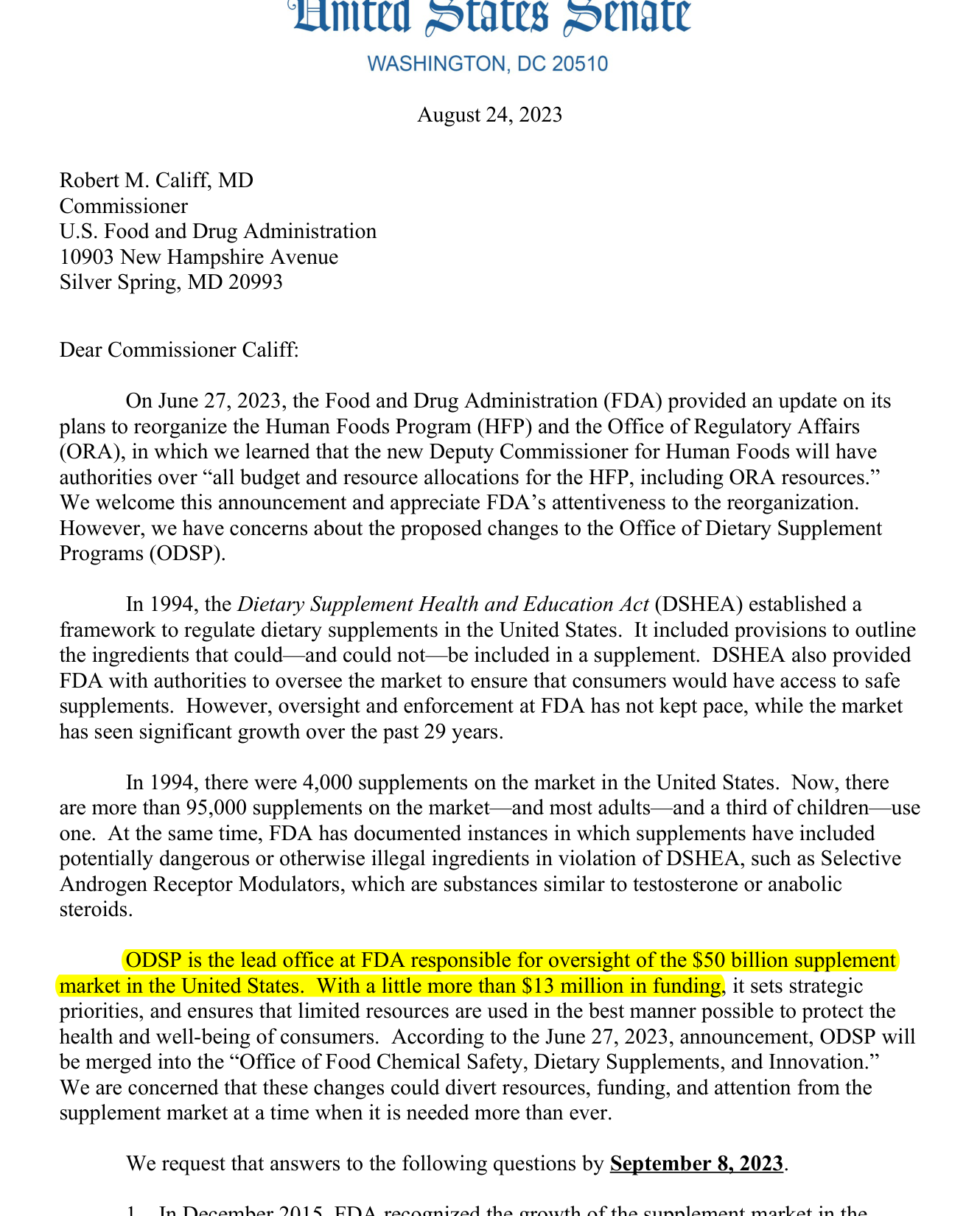
The referee is small. In August 2023, Senators Durbin and Blumenthal wrote that the Food and Drug Administration office that polices supplements had a little more than $13 million in funding. They described a $50 billion market.
The money would fund services, never wages: Medicare nutrition visits, loan repayment for clinicians in shortage areas, and licensed public nutrition services. Supplements dispensed after a clinical assessment would be exempt or rebated.
On October 14, 2026, I searched the text of bills in the 119th Congress and found no bill that taxes supplement sales to pay for nutrition care. A bill to list supplements with the agency was in committee that day.
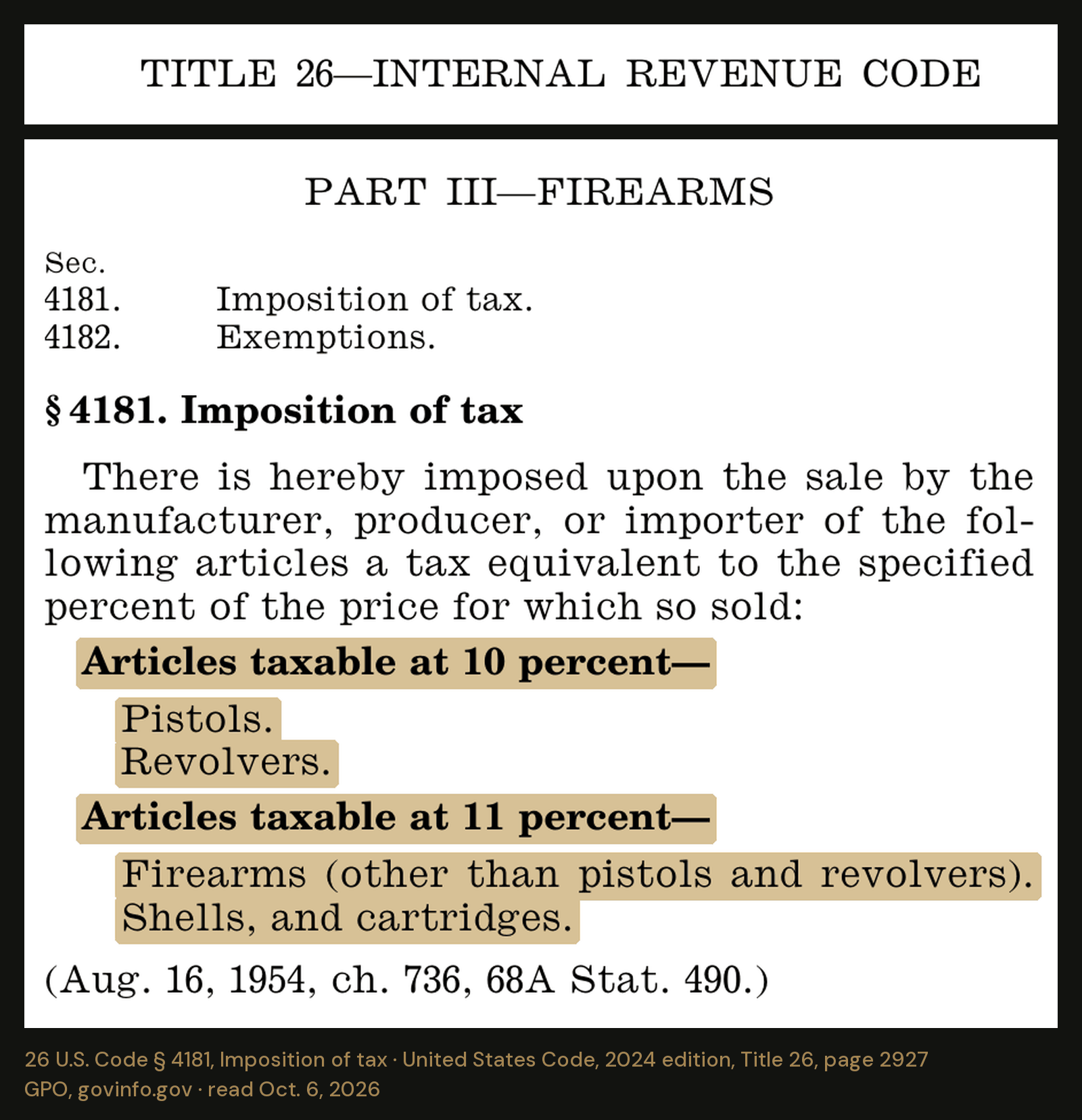
A box of shotgun shells sold in America pays a little rent to the deer. It has since 1937, when Congress routed the federal excise on rifles, shotguns and ammunition, by statute, to wildlife restoration. The rate has been 11 percent since 1941. Handguns pay 10 percent. Archery gear joined at 11 percent in 1972. Since 1950, the 10 percent tax on most fishing equipment has been routed to fish restoration.
In fiscal year 2026, those two programs moved over $1.2 billion, most of it from the sporting-goods counter, to conservation. Shooters and anglers pay. The habitat gets the check. The ducks have not filed a complaint. It is one of the oldest funding devices in American government: tax the product, fund the public good standing next to it.
Now walk one aisle over, to the vitamins. Three in four American adults use supplements, by the industry’s own 2024 survey. The aisle sold $74.15 billion of them in 2025, by the industry’s own count. The Food and Drug Administration (FDA), the agency you probably assume checks those bottles, says on its own website that it “does not have the authority to approve dietary supplements before they are marketed.”
I spend my working days in a field where a lab value decides the dose. Then I walk past an aisle where the company that prints the label decides it.
I want to tax that aisle and route the money to nutrition care.
My Fullscript supplement store would pay my practice a margin, and what it dispenses would qualify for the exemption I propose. As of October 14, 2026, it had made no sales.
Tax supplement sales and fund nutrition care, not paychecks
Start with the sentence the whole proposal rides on. Who decides how much of an ingredient goes into one serving of a supplement? FDA answers on its own page, updated August 27, 2026: “This decision is made by the manufacturer.”
Not a physician. Not a pharmacist. Not a dietitian. The manufacturer. Remember the three in four American adults who use supplements? The dose in every one of their bottles was the manufacturer’s call.
A rifle carries an 11 percent federal excise, and the money goes to the habitat. A bottle of pills carries a label, and the label was written by the seller. You will see the full FDA sentence, and the law behind it, in the next section.
So put a federal excise on dietary supplement sales. I will use 10 percent as the working number, because America already applies it to handguns, most fishing equipment and indoor tanning. That is a strange club to join. A bottle of fish oil would be its most respectable member.
Route the revenue, by statute, into a trust for clinical nutrition. Fund Medicare medical nutrition therapy, loan repayment for credentialed clinicians who serve shortage areas, and public nutrition services delivered by people who hold a license they can lose. The dose in the bottle needs no FDA approval. The people this money pays would answer to a licensing board.
Not to dietitians’ paychecks. I am a dietitian, so that sentence is the first one my critics would write for me, and I would rather write it first. That distinction matters, and I will come back to it.
The referee, as you are about to see, is barely in the building. Here is my take, plainly. The person who buys the bottle should help pay for the care that tells them whether they need it.
The law lets the seller set the dose and makes the government prove the harm
Beyond a general duty to keep the product safe, no federal law limits how much of an ingredient a company may put in one serving of a supplement. FDA says so itself, on a page updated August 27, 2026: “there are no laws or regulations that limit the serving size of a dietary supplement or the amount of a dietary ingredient that can be in a serving of a dietary supplement. This decision is made by the manufacturer and does not require FDA approval.”
Read that twice. The number on the label that decides how much goes into a body is set by the company selling the bottle. The batter also calls the strikes.
The same page has two more admissions, and they are worse in a quieter way. “Generally, a firm does not have to provide FDA with the evidence it relies on to substantiate safety before or after it markets its products,” the agency writes, before noting an exception for new ingredients. The honor system, in other words, has a federal statute.
Then this: “the agency often does not know when new products come on the market. Therefore, we are not able to keep a complete list of all dietary supplements sold in the United States.” The referee does not have a roster. A grocery receipt knows more about what is in the bag.
A 1994 statute built all of this: the Dietary Supplement Health and Education Act, known in the trade as DSHEA. Senator Orrin Hatch, a Utah Republican, introduced it on April 7, 1993, as S. 784. Senator Tom Harkin, an Iowa Democrat, was among its cosponsors. It became Public Law 103-417 on October 25, 1994. Both parties built this aisle, so neither party gets to act surprised by it.
The law did three things a shopper should know by heart. First, it gave FDA no power to approve a supplement before sale. Second, it drew a line on the calendar. Under the law, any ingredient “marketed in the United States before October 15, 1994” is not a new dietary ingredient at all, so it never needs a safety notice. Friends premiered on NBC twenty-three days before that cutoff. Every ingredient already on the shelf that fall got the Seinfeld treatment: the safety review got the yada yada.
October 15, 2026, is the cutoff’s thirty-second birthday. It has aged better than most of us, and the statute has never once asked it for a safety file.

Ingredients that arrived later get a notice, not an approval. The company sends FDA its information “at least 75 days” before sale. The file is the basis on which the company “has concluded” the product “will reasonably be expected to be safe.” A new drug waits for a verdict. A new supplement ingredient waits out a countdown.
Third, the law handed the burden of proof to the public. If the government goes to court to call a supplement unsafe, the statute says “the United States shall bear the burden of proof on each element to show that a dietary supplement is adulterated.” The bar is a product that “presents a significant or unreasonable risk of illness or injury.” A new drug’s maker proves safety before the sale. Here the public’s lawyers prove danger after it. In court, the government has to prove the pill is dangerous. The pill only has to exist.
America taxes ammunition to restore the deer. It does not make the deer prove the bullet was dangerous. The supplement law does roughly that to the public. First the agency cannot approve the product. Then it cannot keep a complete list. Then nothing in the law caps the dose. Then, in court, it has to prove the harm. At some point regulation turns into a spectator sport.
The aisle did not stay the size the law was written for. In their August 24, 2023, letter, Senators Richard Durbin and Richard Blumenthal wrote: “In 1994, there were 4,000 supplements on the market in the United States.” Then: “Now, there are more than 95,000 supplements on the market.” That is roughly twenty-four times as many products, by my arithmetic on their figures, under a rulebook written for the first number. I would not run a data center on Windows 95. We run a $74.15 billion aisle on a law signed the year before Windows 95 shipped.
My read: Congress wrote a rulebook for a corner store and then left it in charge of a warehouse. The gap lands on shoppers. When a label claims a benefit to the body, the law requires a line in bold: “This statement has not been evaluated by the Food and Drug Administration.” That is the warranty. The bottle tells you, in bold, that the government has not looked.
To be fair to the agency, it does act after the fact. FDA says it investigates adverse event reports and complaints from consumers, clinicians, other agencies and industry. That is the system working as written. The question is what the written system lets through before anyone files a report.
The cost is not theoretical, and it is not mine to joke about. Government scientists have counted part of it.
Writing in the New England Journal of Medicine on October 15, 2015, authors from the Centers for Disease Control and Prevention and FDA used national data from 2004 to 2013. They estimated 23,005 emergency department visits a year attributed to adverse events from dietary supplements, and an estimated 2,154 hospitalizations a year. Unsupervised children accounted for 21.2 percent of those visits.
A 2018 study in JAMA Network Open followed FDA’s warnings from 2007 through 2016. It found that “776 adulterated dietary supplements were identified by the FDA and 146 different dietary supplement companies were implicated.” Of twenty-eight products warned on more than once, nineteen, or 67.9 percent, were reported to contain new unapproved ingredients in a later warning. Most bottles in the aisle are not in that study. The nineteen that came back after a warning with a new unapproved ingredient inside are exactly the products a referee exists to catch.
Taxing a product to fund a public good is almost a century old
The device I am describing is old enough to have a family tree:
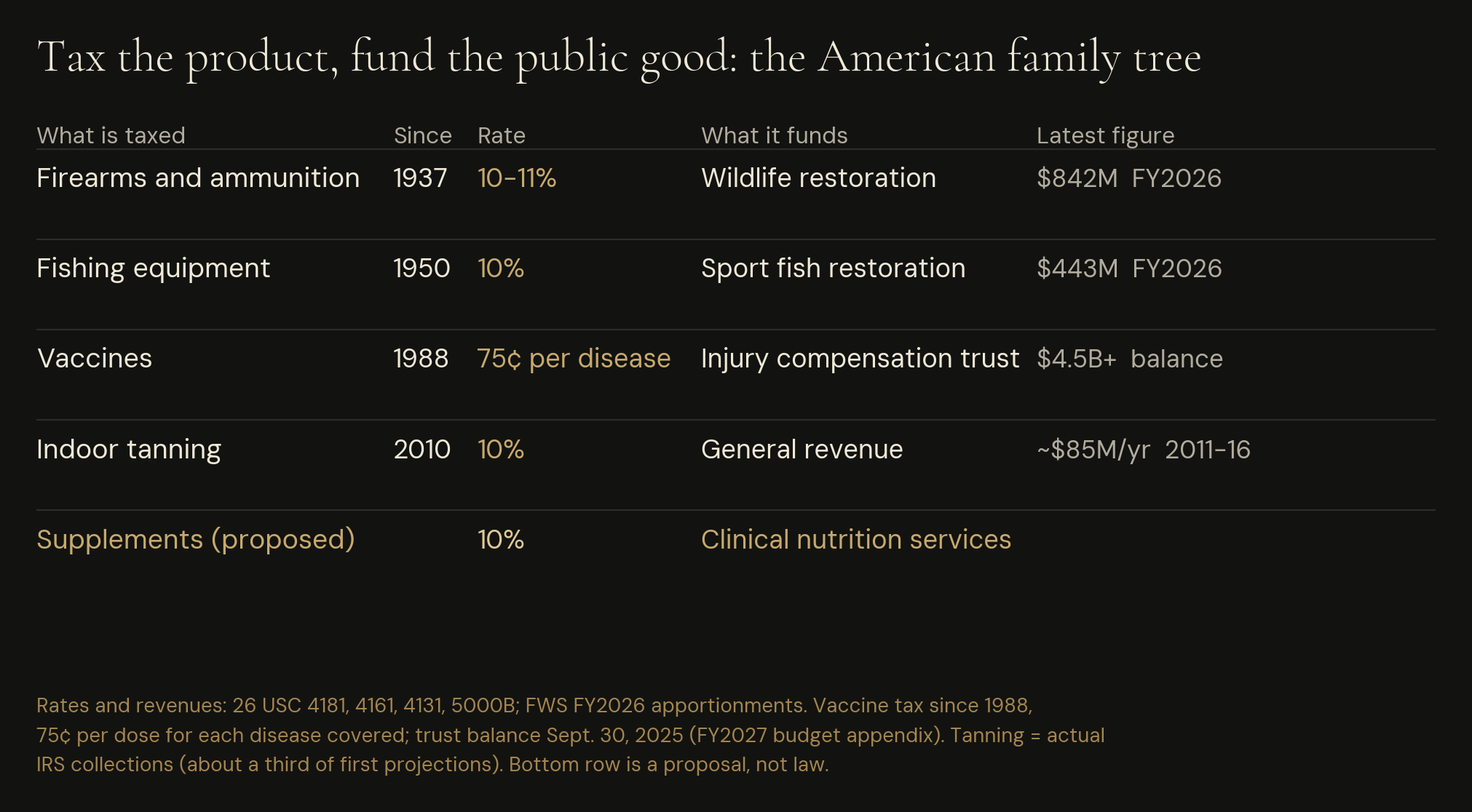
Under the Pittman-Robertson Act, the taxes on firearms and ammunition have gone to the states for wildlife since 1937, and on archery since 1972, at 10 to 11 percent. The fiscal 2026 apportionment to the states from those taxes was $842 million. It is the rare federal tax Ron Swanson of Parks and Recreation could love. It ends in more wildlife.
Under Dingell-Johnson, the 10 percent tax on most fishing equipment has gone to fish restoration since 1950. Its fiscal 2026 apportionment was $443 million.
Every dose of covered vaccine sold in this country carries a 75-cent excise for each disease it covers, which funds the federal injury-compensation trust. That trust held more than $4.5 billion on September 30, 2025. America already taxes a health product to pay for the rare person it harms.
Set the wildlife money beside the supplement referee and the country’s priorities show up in the ledger. For fiscal 2026, the wildlife taxes sent the states $842 million. In 2023, by two senators’ count, the office that polices the supplement aisle had a little more than $13 million. I will come to their letter. Those are different years and different jobs, so I will not build a ratio out of them. I will only point out which one has the endowment.
The structure is settled law, run daily, and politically durable for generations. Nothing about the supplement aisle is exotic to it.
The family also has a black sheep. The Affordable Care Act put 10 percent on indoor tanning in 2010. Those were the Jersey Shore years on MTV, when gym, tan, laundry passed for a daily schedule. The tans were real. The revenue was spray-on. Congress’s scorekeepers at the Joint Committee on Taxation projected about $1.6 billion for fiscal 2011 through 2016. The IRS collected $507 million, about 32 percent.
The tan kept fading after that. IRS collections were $86.3 million in fiscal 2011 and peaked at $91.7 million in fiscal 2013. They fell to $75.1 million by fiscal 2016 and $65.1 million in fiscal 2024. My take: an excise can shrink the thing it taxes faster than anyone budgets for. The tanning tax comes back in the arithmetic below.
The honest arithmetic
The supplement industry booked $74.15 billion in 2025 sales, by its own flagship accounting. Ten percent of retail would be seven billion dollars a year. I will not claim that number. The firearm and fishing excises tax at the manufacturer level, not retail. That shrinks the base before a single bottle is counted. The tanning tax is the family’s cautionary tale. It collected roughly a third of what was first projected. So call it a range with a real floor: on the order of a billion dollars a year or more. I would rather defend a small true figure than a large false one.
Now set my estimate against a profession whose entire national payroll is about six billion dollars a year. That is the 77,570 dietitian and nutritionist jobs in the Bureau of Labor Statistics May 2025 wage survey multiplied by their mean wage of $77,130. And set it against a Medicare nutrition benefit that has covered the same diagnoses at 85 percent of the physician fee schedule since 2002. By my arithmetic, a billion dollars is about a sixth of that whole national payroll. That is the scale of what one modest tax on one aisle could route to care.
The more important number here belongs to the referee, the federal office that polices supplements. Senators Durbin and Blumenthal wrote to FDA in 2023. They noted that the office responsible for policing dietary supplements was working with a little more than $13 million in funding. That was set against what they then described as a $50 billion market. That is about three ten-thousandths: the referee’s budget was three ten-thousandths of the game.
Jurassic Park (1993) had real fences until Dennis Nedry switched them off. The supplement aisle got a fence budget measured in ten-thousandths. In a household, that sum is a fortune. Beside the market it was meant to watch, it was a rounding error with a staff.

Later in that same scene, after Number Two tells him a million dollars is not much money anymore, he raises the ransom to one hundred billion. The real aisle reached $74.15 billion in 2025 without a ransom note. Nutrition Business Journal projects it will approach $100 billion by 2029, with no laser on the moon. Dr. Evil needed a hostage. The aisle needed only a 1994 law and a referee with a little more than $13 million.
My read: with a referee that small in 2023, much of the checking fell to the shopper. The shopper had a label and a price tag. The label was the seller’s own account of the product. The market figure at the top of this section is the industry’s own count, not the senators’. I will not turn the two into a growth rate.
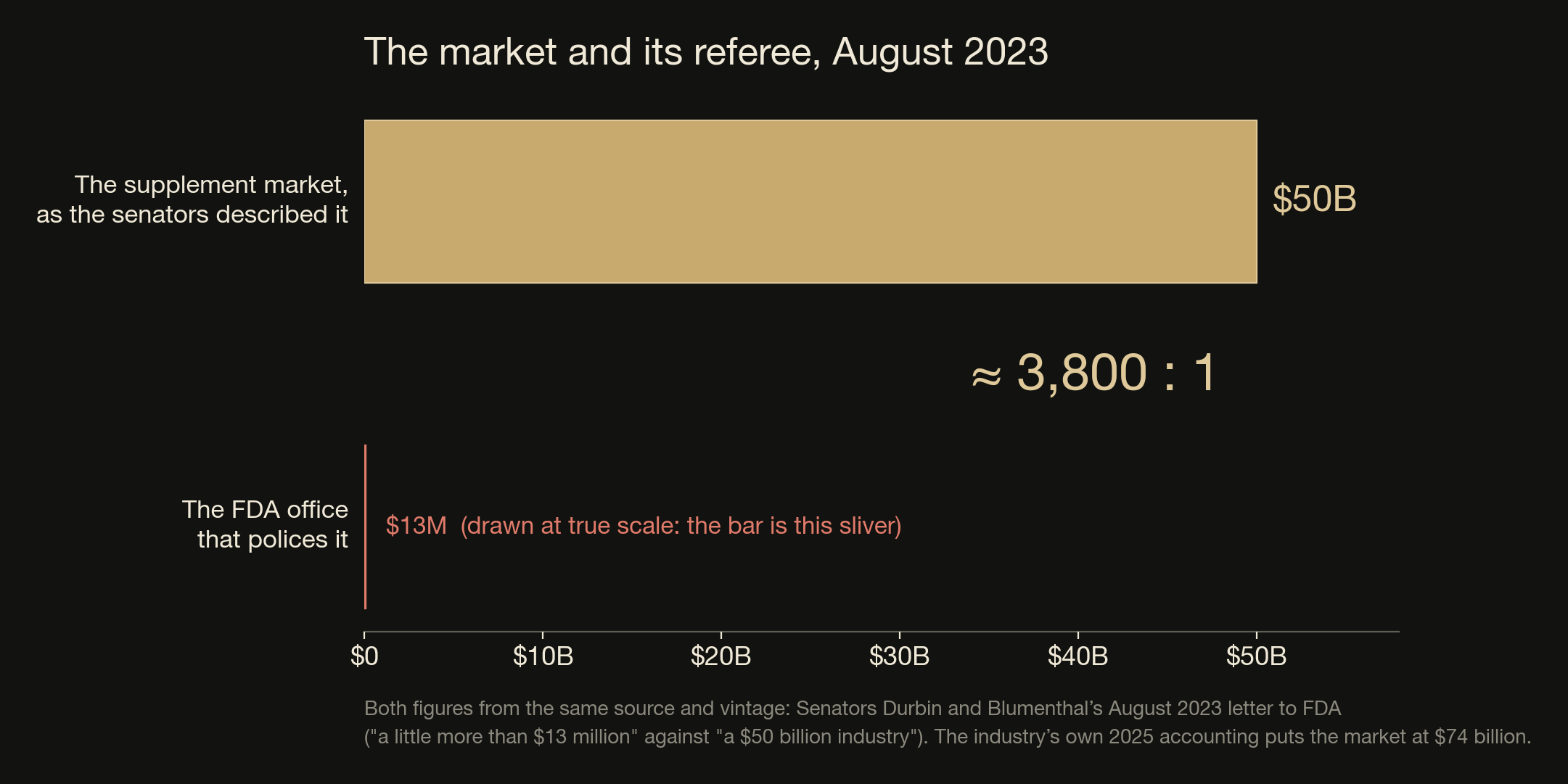
Then the referee moved offices. According to the same 2023 letter, FDA announced on June 27, 2023, that the Office of Dietary Supplement Programs would be “merged into the ‘Office of Food Chemical Safety, Dietary Supplements, and Innovation.’” The senators saw the risk in writing. They wrote that the changes “could divert resources, funding, and attention from the supplement market at a time when it is needed more than ever.”
The merger happened. FDA’s page for the combined office, current as of October 1, 2026, lists the supplement office as one of its parts. The office got three roommates, a longer mailing address and, as far as I can tell, a new cover sheet for its TPS reports. Office Space (1999) would recognize the org chart.
Then I went looking for its money. On October 14, 2026, I searched FDA’s budget justifications for fiscal 2026 and 2027 and found no mention of the Office of Dietary Supplement Programs. The referee had been a bargain since at least 2023. Now it lives inside an office that FDA’s own page says is “also referred to as the Chemical Safety Office.” The supplements did not make the nickname. In the two budget requests I searched, the office policing a $74.15 billion aisle does not appear by name.
Why the design matters more than the rate
Three choices separate a serious version of this from a caricature.
Tax the product, not the person selling it. There is no statute that can define “grifter.” There is a statute that can define “dietary supplement”; Congress wrote it in 1994. That definition is the one sturdy thing in the whole law. It tells a tax collector exactly what to tax, and it asks nobody to judge a seller’s character. That is just as well, because Congress has a mixed record at judging anyone’s character, including its own.
Fund services, never salaries. Pittman-Robertson pays for wildlife restoration and hunter education, not hunters’ paychecks. The supplement excise should fund covered nutrition visits, shortage-area loan repayment, and public programs, not a wage line for my profession. The economics reach the clinic either way. The difference is whether the proposal can be caricatured as dietitians taxing your vitamins to pay themselves. Design it so that sentence is false, and keep the receipts.
Make the clinical channel cheaper. Exempt or rebate supplements dispensed through clinical assessment, the way tax law routinely distinguishes prescription products from over-the-counter. A vitamin D capsule after a deficiency shows up in labs and a vitamin D capsule sold by an influencer with a discount code are not the same economic object. One comes with a lab report. The other comes with a ring light. Today the second capsule’s dose is, by FDA’s own account, the manufacturer’s decision. Price them differently and the tax does quietly what a label cannot: it makes evidence the cheaper path.
The 1994 fight never ended. Some of its staff changed desks.
The supplement industry beat back regulation in 1994 with a letter-writing campaign that people involved in the fight still recount. The result was the Dietary Supplement Health and Education Act, the law that still governs the aisle. One of those people is Patricia Knight, a former chief of staff to Senator Orrin Hatch, who was in his office during that fight. She wrote in 2019 as a senior political advisor to the United Natural Products Alliance, an industry trade group. She said Congress received more letters than at any time after the Vietnam War (Knight, Natural Products Insider, 2019). She credited that claim to the Alliance. The industry’s own account of 1994 is a story about mail.
The mail is still coming, now with a federal filing attached. Lobbying disclosure reports list Knight as the Alliance’s lobbyist, and her firm reported $20,000 from the group in seven of the eight quarters of 2024 and 2025. Her covered position reads “Chief of Staff, Sen. Orrin G. Hatch.” Her firm filed a termination report for the first quarter of 2026.
The cosponsor’s side has a filing too. Peter Reinecke lists his covered position as “LD, CoS, Sr. Advisor, Senator Tom Harkin.” His firm reported $10,000 a quarter from the same group through the third quarter of 2026. That report was posted October 8, 2026. Its issue line reads: “Issues related to full and effective implementation of the Dietary Supplement Health and Education Act.”
This is legal and disclosed lobbying, and I allege nothing else about either person. I note the structure. The law’s sponsor and one of its cosponsors each had a former top aide who later lobbied for the same trade group. One of those aides was still filing on the law’s “full and effective implementation” as of October 8, 2026. Thirty-two years on, the law ships with its own customer support. The filings are public. The public part is the unsettling part.
Three trade groups in this story reported about $860,000 in federal lobbying for 2024, by my sum of the filings made for them. The Council for Responsible Nutrition reported $340,000. The Natural Products Association reported $400,000. The Alliance’s two outside lobbyists reported $120,000. For scale, the senators put the referee’s whole 2023 budget at a little more than $13 million. Persuasion, it turns out, is cheaper than policing.
The machine has not retired either. A mandatory product-listing bill, requiring supplements to at least tell FDA they exist, is on its third trip through Congress. In 2024, when it came back, the Natural Products Association wrote that its grassroots effort against the proposal “produced over 85,000 emails to Congress in opposition.” In 1994 it was letters. By 2024, the trade group was counting emails. The medium changes. The mail keeps coming. Anyone proposing an excise should expect that machine to restart, and should expect to lose the first several rounds.
The current Senate bill and its House companion were both pending in committee as of October 14, 2026. As of October 14, 2026, the House bill had one subcommittee hearing, on April 29, 2026, alongside more than two dozen other bills. A third trip makes it the legislative Groundhog Day (1993). The alarm goes off. The bill wakes up in committee again.
The industry is split on it, and the split is on the record. The Council for Responsible Nutrition supports the bill. Its January 15, 2026, release said “a well-designed product listing system will help FDA focus enforcement on bad actors and potentially unsafe or illegal products, rather than companies that are already complying with the law.” Credit where the record earns it. The Council’s own survey, released October 7, 2026, found that 76 percent of adults said FDA product listing would raise their confidence at least somewhat. That is three in four adults telling the industry’s own pollster that a list would help. Part of the industry wants the list. The bill that would create one has not left committee.
The Natural Products Association opposes it. Its April 21, 2026, release said the House bill “is premised on a false narrative that the agency operates in the dark.” I will let FDA answer that one in its own words, from its page updated August 27, 2026. The agency “often does not know when new products come on the market.” Somebody should tell the agency.
The agency did try telling Congress. In its budget requests for fiscal 2024 and fiscal 2025, FDA asked for authority to “require all dietary supplements to be listed with FDA.” In the two requests since, the ones I searched, that ask is gone. The referee asked for a roster in two budgets running. In the next two budgets, under the department Kennedy now runs, it did not ask in writing.
My read: both trade groups invoke bad actors. The Council says a listing system would help FDA find them. The Association says FDA already has the tools. Only one of them supports telling the referee who is on the field. Distinction has a price. A listing requirement is the door; a user fee would be the hallway; the excise is the room at the end. The listing bill deserves to pass on its own terms. A registry compels no tax.
Congress’s other supplement bills run the other way: call the aisle medical care
While the listing bill waits in committee, a different supplement bill has been collecting cosponsors. It would not tax the aisle. It would let your health-account dollars pay for it.
The bill is S. 4587. Senator Kevin Cramer introduced it on May 20, 2026, “for himself and Mr. Curtis.” The sentence that matters reads: “amounts paid for dietary supplements shall be treated as medical care to the extent that such amounts do not exceed $500 ($250 in the case of a married individual filing a separate return) for any taxable year.” The House companion, H.R. 8933, came the same day from Representative LaHood, with Representatives Gottheimer, Tenney and Boyle. By October 14, 2026, it had eight cosponsors. Both bills were still at the committee referral stage that day.
Read that again with FDA’s page open. Up to $500 a year of products the agency cannot approve before sale would count as “medical care” for health-account purposes. In Idiocracy (2006), the company behind Brawndo had to buy the FDA outright. The supplement aisle only needs Congress to rename it. The Senate bill does draw one line: anything “marketed, labeled, or commonly understood to be an energy drink, soft drink, or soda” does not count. Brawndo would have to buy something else. Meanwhile “medical care” from a dietitian, under Medicare, is still paid at 85 percent of the physician fee schedule. Same words, different discount.

Remember the rule from the gun counter: tax the product, fund the public good standing next to it. This bill runs it backwards. Untax the product, and call the shelf a clinic.
The bill’s only Senate cosponsor sits in a seat with a history. Senator John Curtis holds Utah’s Class 1 seat. Orrin Hatch held that seat from 1977 to 2019 and introduced DSHEA from it; Mitt Romney held it between them. In 1994 the seat wrote the law that gave the agency no power to approve these products. In 2026 it cosponsored the bill that would let your health account buy them as medical care. The seat has range.
A third bill would set a ceiling for every state. H.R. 7366, introduced February 4, 2026, by Representative Nick Langworthy, says “No State (or political subdivision thereof) may establish or continue in effect any requirement concerning a dietary supplement which is different from, or in addition to” the federal rules. A state could apply to the Department of Health and Human Services for an exemption, granted by regulation after notice and a chance for a hearing. Without one, the federal rulebook becomes the ceiling. That rulebook is the one with no approval, no complete list and no dose cap. Its referee had a little more than $13 million in 2023, by the senators’ count. It got the same April 29, 2026, subcommittee hearing as the listing bill. As of October 14, 2026, neither had moved past referral.
All of this is lobbied for in the open. The Council for Responsible Nutrition’s second-quarter 2026 filing lists “All efforts related to the inclusion of dietary supplement purchases within tax-deductible Health Savings Accounts and Flexible Spending Accounts (HSAs/FSAs), including S. 4587 and H.R. 8933.” The Natural Products Association’s lobbyists reported that they “Lobbied in support of H.R. 7366.” A second-quarter 2025 filing by the United Natural Products Alliance’s lobbyist listed “Inclusion of multi-vitamins and related supplements expenses for health savings accounts and flexible spending accounts and SNAP purchases.” SNAP is the food assistance program that feeds the country’s lowest-income households.
Here is where I land on this part. The oldest American funding device says tax the product and fund the public good standing next to it. In 2026, the other supplement bills I found would untax the product and shield the shelf from the states. The registry that would merely tell the referee who is on the field is in committee for a third time. The House tax break went from three cosponsors to eight between May and September.
Kennedy promised to end the “suppression” of vitamins. His own agency says it cannot keep a complete list of them
Into the quiet around the referee’s budget walked a promise. On October 25, 2024, Robert F. Kennedy Jr. posted on X that “FDA’s war on public health is about to end.” His list of products under the agency’s “aggressive suppression” included “vitamins” and “nutraceuticals.” He closed with two messages for anyone at FDA who was “part of this corrupt system.” The second was “Pack your bags.” He held no federal office that day. By March 27, 2025, his department’s own release called him “HHS Secretary,” and on October 14, 2026, the department’s leadership page still listed him as Secretary.
Now read his regulator’s page beside his post. FDA “does not have the authority to approve dietary supplements before they are marketed.” It is “not able to keep a complete list” of them. No law limits the dose; “This decision is made by the manufacturer.” And in court, the statute puts the burden of proof on the United States. As to vitamins, I call his claim of “aggressive suppression” unsupported by that record. Most of that record is his own department’s website, describing a law in force since 1994. I have no document showing what he knew, so I will not say more than the record does.
For vitamins and minerals, the law goes further than silence. Since 1976, federal law has said the government “may not establish” any “maximum limits on the potency of any synthetic or natural vitamin or mineral” in most of these products. The exceptions are products for children under twelve, for pregnant or nursing women, and for treating disease. Congress did not just forget to cap the vitamin dose. It wrote down that the regulator may not.
If that is suppression, it is the gentlest suppression in the history of force.
“Pack your bags” arrived after the moving truck had left. The supplement office had already packed. On October 1, 2024, twenty-four days before his post, FDA folded it into a bigger office with a longer name.

His department did announce cuts, though. On March 27, 2025, HHS said it would shrink “from 82,000 to 62,000 full-time employees.” FDA, it said, “will decrease its workforce by approximately 3,500 full-time employees.” HHS promised: “This reduction will not affect drug, medical device, or food reviewers, nor will it impact inspectors.” Kennedy promised more “at a lower cost to the taxpayer.” I looked on October 14, 2026, for a primary source on what the cuts did to the supplement office’s staff, and found none. I will not guess. If the goal was lower cost, the supplement office had been meeting it since at least 2023.
Then there is the movement with “Healthy” in its name. The White House’s Make America Healthy Again report of May 2025 used the phrase “ultra-processed” at least forty times, by my count of its text on October 14, 2026. In the same search, “supplement” appeared only in program names and the reference list. I found no sentence about the aisle three in four adults use.
The follow-up MAHA Strategy of September 2025 does reach the aisle, twice. It lists research into “potential health benefits of select high-quality supplements” among new research initiatives. Four pages later, it says: “FDA will also take action against unapproved products, often marketed as supplements.” I print both, because both are there. Benefits get a research program. Enforcement gets one sentence, filed under the heading “Water Quality, Fluoride, and PFAS.” The vitamin aisle’s police powers share a paragraph with the tap water. On October 14, 2026, I searched the strategy for the 1994 law and did not find it.
My take: this administration talks loudly about what Americans swallow. Its regulator’s page, updated August 27, 2026, still says the dose in the bottle is a decision “made by the manufacturer and does not require FDA approval.”
The objections I owe you
“It is regressive.” Partly true. Three in four American adults use supplements, by the industry’s own 2024 survey, and excise taxes bite hardest at the bottom. Two answers. The earmark routes the money back to care for the same population, which is what distinguishes this from a sin tax that disappears into the Treasury. And the clinical-channel exemption means the supplement a low-income patient actually needs gets cheaper under this design, not dearer. It is the one indicated by labs and dispensed through care Medicare covers.
“You would profit from this.” My profession would, and my own supplement store could. The design answer is the services trust. The personal answer is that my name and my disclosure are on it. I am also, so far, the least threatening supplement seller in America.
“The administration would run the trust.” A newer objection, and a fair one. The money would flow through a department whose current Secretary, before he took office, promised to end the “suppression” of vitamins. That is exactly why the earmark belongs in statute, the way Pittman-Robertson’s does. A statutory trust keeps paying for care whoever runs the building.
“The industry will never allow it.” Probably not this year. Neither did the tobacco industry allow the taxes that paid for the 2009 expansion of children’s health insurance, until it did. The products are not comparable. The lobbying playbooks are. I am a dietitian proposing a tax on the industry that won 1994 and still tells the story. My optimism has no evidence base, and I am aware of the irony.
The near-term moves are modest. Pass the listing bill, which is already in motion, if committee counts as motion. Fund the referee the way FDA funds drug review, with user fees. That is my suggestion. As of October 14, 2026, I found no FDA budget request for fiscal 2024 through 2027 that asks for a user fee on supplement makers generally. The fiscal 2027 request does propose a fee on foreign food facilities, noted below.
My take: a market this size with a referee this small is a problem a serious country eventually taxes its way out of.
The room at the end
In August I wrote that America does not have a nutrition apathy problem; it has a nutrition routing problem. A routing problem is an infrastructure problem. This is what nutrition infrastructure funding would look like. Nobody conjures new money from nowhere. A new pipe gets attached to money Americans are already spending in nutrition’s name.
America taxes ammunition to restore the wildlife it is fired at. It taxes fishing gear for the fish. It taxes every dose of covered vaccine to compensate the rare person harmed. The precedent is nearly a century old and none of it was radical for long.
The supplement aisle got the opposite deal in 1994. No approval before sale. No complete list. No cap on the dose. The burden of proof sits with the public. Since then the referee has acquired three roommates, a longer address and no line of its own in the budget requests I searched. And in 2026 the other supplement bills I found were a tax break for the aisle and a ceiling on the states. The listing bill sat in committee for a third time.
Here is where I land. I would tax the aisle and route the money to care, and I expect to lose the first several rounds. The industry that won in 1994 was still telling the story of the letters in 2019. On October 8, 2026, a lobbyist for one of its trade groups filed again on that law’s “full and effective implementation.”
The figure I would hand Congress is one the senators already handed FDA. In 2023, the office that polices the supplement aisle was working with a budget about three ten-thousandths the size of the market it was meant to watch.
Excise rates and revenues are from statute and agency documents (26 U.S.C. 4181, 4161, 4131, 5000B). Also cited: Fish and Wildlife Service fiscal 2026 apportionments, and tanning collections per IRS Statistics of Income historical table 20 (fiscal 2011 to 2016 and fiscal 2024). The tanning projection is the Joint Committee on Taxation’s (JCX-61-09 and JCX-17-10). The vaccine trust balance is as of September 30, 2025, the start of fiscal 2026 (Budget of the U.S. Government, fiscal 2027, Appendix). The supplement market figure and the 2029 projection are the industry’s own (Nutrition Business Journal, 2026 report, 2025 sales, release of June 2, 2026). Supplement use is the Council for Responsible Nutrition’s 2024 survey. The dietitian payroll is a rough multiplication of BLS OEWS May 2025 employment by the May 2025 mean wage, not a payroll survey. The FDA budget figures, the 1994 and 2023 product counts and the 2023 merger are as stated in Senators Durbin and Blumenthal’s August 24, 2023, letter. FDA’s own statements are from its “Questions and Answers on Dietary Supplements” page (content current as of August 27, 2026). The combined office is described on FDA’s page for the Office of Food Chemical Safety, Dietary Supplements, and Innovation (current as of October 1, 2026). FDA says it implemented the reorganization on October 1, 2024 (FDA, “FDA Modernization Efforts for Establishing a Unified Human Foods Program”). FDA’s requests for supplement listing authority are in its fiscal 2024 Justification of Estimates and its fiscal 2025 legislative proposals; I searched its fiscal 2026 and 2027 requests on October 14, 2026. Statute: 21 U.S.C. 342, 343(r)(6), 350 (vitamin and mineral potency, since 1976) and 350b. DSHEA history: S. 784, 103rd Congress, Public Law 103-417, per congress.gov. Harm estimates: New England Journal of Medicine, October 15, 2015 (CDC and FDA authors, 2004 to 2013 data; doi 10.1056/NEJMsa1504267); JAMA Network Open, 2018 (doi 10.1001/jamanetworkopen.2018.3337). Bills: S. 4587 and H.R. 8933 (introduced May 20, 2026) and H.R. 7366 (introduced February 4, 2026), text per govinfo, status and cosponsor counts per congress.gov, October 14, 2026. Utah’s Senate seat history is per senate.gov. Lobbying figures, covered positions and quotations are from Senate Lobbying Disclosure Act filings, retrieved October 14, 2026; the 2024 total is my addition; under Senate and House guidance, a group’s own expense figure includes what it pays outside lobbying firms, so those firms’ reports are not added again. Knight’s firm reported less than $5,000 for the third quarter of 2025. Kennedy’s post is on X, October 25, 2024. HHS restructuring: HHS press release and fact sheet, March 27, 2025; leadership page, October 14, 2026. MAHA Report, May 2025 (the revised file posted May 29, 2025), and MAHA Strategy, September 2025, per whitehouse.gov; word counts are my searches of their text, October 14, 2026. The listing bill is S.3677, the Dietary Supplement Listing Act of 2026 (introduced and referred to the Senate HELP Committee January 15, 2026). Its House companion is H.R. 8370 (referred to House Energy and Commerce April 20, 2026; heard by its Health Subcommittee April 29, 2026). H.R. 7366 was on the same April 29, 2026, hearing list (House Energy and Commerce Committee). Status is per congress.gov, October 14, 2026. Trade-group positions are quoted from their own releases: Council for Responsible Nutrition, January 15, 2026, and October 7, 2026; Natural Products Association, April 21, 2026, and August 1, 2024. The Council’s October 7, 2026, survey was conducted by Morning Consult (3,005 adults, September 11 to 13, 2026). The excise proposal itself is mine. On October 14, 2026, I searched the text of 119th Congress bills on govinfo and found no bill that taxes supplement sales to pay for nutrition care. FDA’s fiscal 2027 budget request does propose a registration fee on all foreign food facilities, which would reach foreign supplement makers (FDA, Justification of Estimates for Appropriations Committees, fiscal 2027).
This article is general nutrition education, not individualized medical or nutrition advice, and it does not create a dietitian–client relationship. Medications and their side effects should be managed with your prescribing clinician. See the full disclaimer.