Summary
This piece follows federal school meal policy from January 2025 to October 14, 2026. In spring 2025 the Department of Agriculture ended the 2025 money it had promised schools and child care centers to buy local food. That September it also announced the end of its yearly report on households short of food. Health Secretary Robert F. Kennedy Jr. presents a change to 30 million school lunches a day as settled, and I call that claim misleading. The rule that would require it is still an unpublished proposal under review. My grade is a D, for now.
Federal spending records show 40 school and child care food agreements with the states and the District of Columbia. By my sum, about $558 million was taken back in May 2025. They show no payments.
The whole milk law was signed in January 2026. The department’s milk rule followed in under four months, with no proposal first, which federal rulemaking law allows for benefit programs.
Added sugar limits for school cereal, yogurt and flavored milk took effect in July 2025, on schedule. A sodium cut waits until July 2027, the date Congress allowed.
The rewrite has been with the White House office that reviews rules since July 20, 2026, still pending on October 14. Its log listed nineteen outside meeting requests. It shows who asked, not what anyone decided.
The federal government counted the food as saved before its own books said the food was gone. DOGE, the Department of Government Efficiency, lists 40 school and child care food agreements among its savings, dated March 17, 2025. Its total is about $558 million. USDA’s own spending records say those agreements ended on May 6, 2025, seven weeks later.
The records show no payments on any of them. So the efficiency office booked a saving on money that had never been paid out, ahead of the agency’s own ledger. In Minority Report, PreCrime at least had three psychics. DOGE had a date field.
That money was meant for lunch trays. The Department of Agriculture, USDA for short, counted an average of about 30 million children a day in school lunch in fiscal year 2025. It counted 15.7 million in school breakfast. Nearly three in four of those lunches were free or reduced price. If you have a kid in a public school, this is your kid’s tray. If you do not, it is your taxes and your neighbor’s kid.
Now listen to how the people in charge describe the tray. “Last week we made an announcement with Brooke Rollins at USDA that we’re going to change 30 million school lunches a day in this country and 15 million school breakfasts to align them with the food pyramid,” Health Secretary Robert F. Kennedy Jr. said. He said it in an episode of The Real Food Show, his video series, posted on September 30, 2026. Brooke Rollins is the Agriculture Secretary.
The episode’s title begins “No Dinner Plan? Make This $3 One-Skillet Meal.” A promise to change 30 million lunches a day arrived as a side dish to a skillet recipe. I have no notes on the skillet. I have a lot of notes on the side dish.
His participation numbers are close to USDA’s own. The rule is the part the public cannot read yet. I call Kennedy’s claim misleading. The sentence presents the change as settled. What it leaves out is that the rule that would require it is still a proposal under White House review, and no school or parent can read it yet. A trailer can show you every explosion in a movie that has not been finished. You still cannot buy a ticket.
Kennedy did not name the rule. USDA also announced a school meals plan and pledge in August, and I asked his department, the Department of Health and Human Services (HHS), which he meant.
Here is where the rule actually is. In my Federal Register search on October 6, 2026, the only rule issued since January 2025 that changes what can go on a school tray was the milk rule. Congress passed the milk law first. The rewrite went to the White House Office of Information and Regulatory Affairs on July 20, 2026. That office reviews significant rules before they appear.
On October 14, 2026, it was still there, listed as pending. By my count that was day 86, and day 90 is October 18, the day after this piece publishes. Thirty million lunches a day are riding on a document that has spent most of a season in a federal inbox.
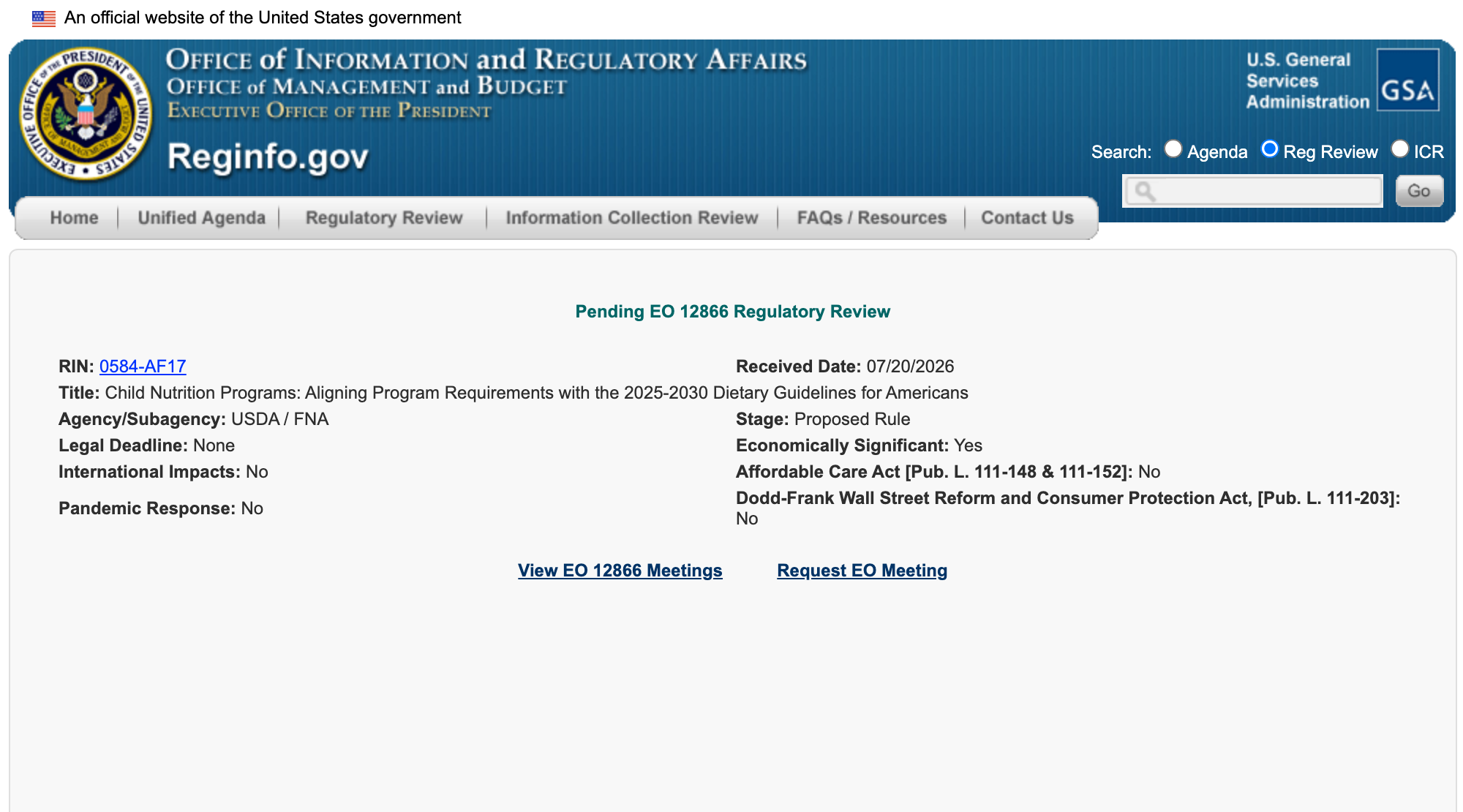
The Office of Information and Regulatory Affairs’ review page for USDA’s school meal proposal, read on reginfo.gov on October 14, 2026. Ninety days from July 20, 2026, is October 18, by my count. The order that sets the clock allows extensions.
One warning before the rest. Nothing I read ties the local-food cuts to Kennedy or his commission. They came from USDA, months before the commission’s strategy. The two stories share a tray, and I keep them apart on purpose.
My take, stated once so you can check me against it as you go: the largest binding act in this record is a subtraction. USDA took back about $558 million in promised school and child care food, by my sum of its own spending records. Vermont’s termination notices arrived nine days after a presidential order told agency heads to review grants with their DOGE team leads. The record shows that timing. It does not show who decided. Everything since is smaller or softer. There is a law Congress wrote, a rule that skipped the proposal stage and the end of a federal food security report. Then come grants with a pledge, a pilot, and a text no parent can read.
Kennedy still belongs in the story, because the paper puts him there. School meals belong to USDA, which Rollins runs. His department does not write these rules, and I will not pretend it does. President Trump’s order of February 13, 2025, made the Health Secretary chair of the President’s Make America Healthy Again Commission, with the Agriculture Secretary as a member. In September 2025 the commission’s strategy promised, on page 12, to “Remove restrictions on whole milk sales in schools,” with full-fat dairy offered “alongside reduced-fat alternatives.” On page 18 it said five departments “will work to improve access to whole, healthy foods in government-funded nutrition programs and meals, including in school meals,” as well as prisons and veterans’ hospitals. School lunch shares that clause with prison trays and veterans’ hospital trays.
The guidelines carry the number this story keeps bumping into: a limit on saturated fat at 10 percent of daily calories. The new Dietary Guidelines, the federal government’s advice on what to eat, were published January 7, 2026, and Kennedy and Rollins signed the opening message. The same pages tell readers to “Prioritize Protein Foods at Every Meal” and, “When consuming dairy, include full-fat dairy with no added sugars.” A week later USDA said: “USDA will now undergo a rewrite of Child Nutrition Programs to ensure school meals are aligned with the Dietary Guidelines for Americans 2025-2030.”
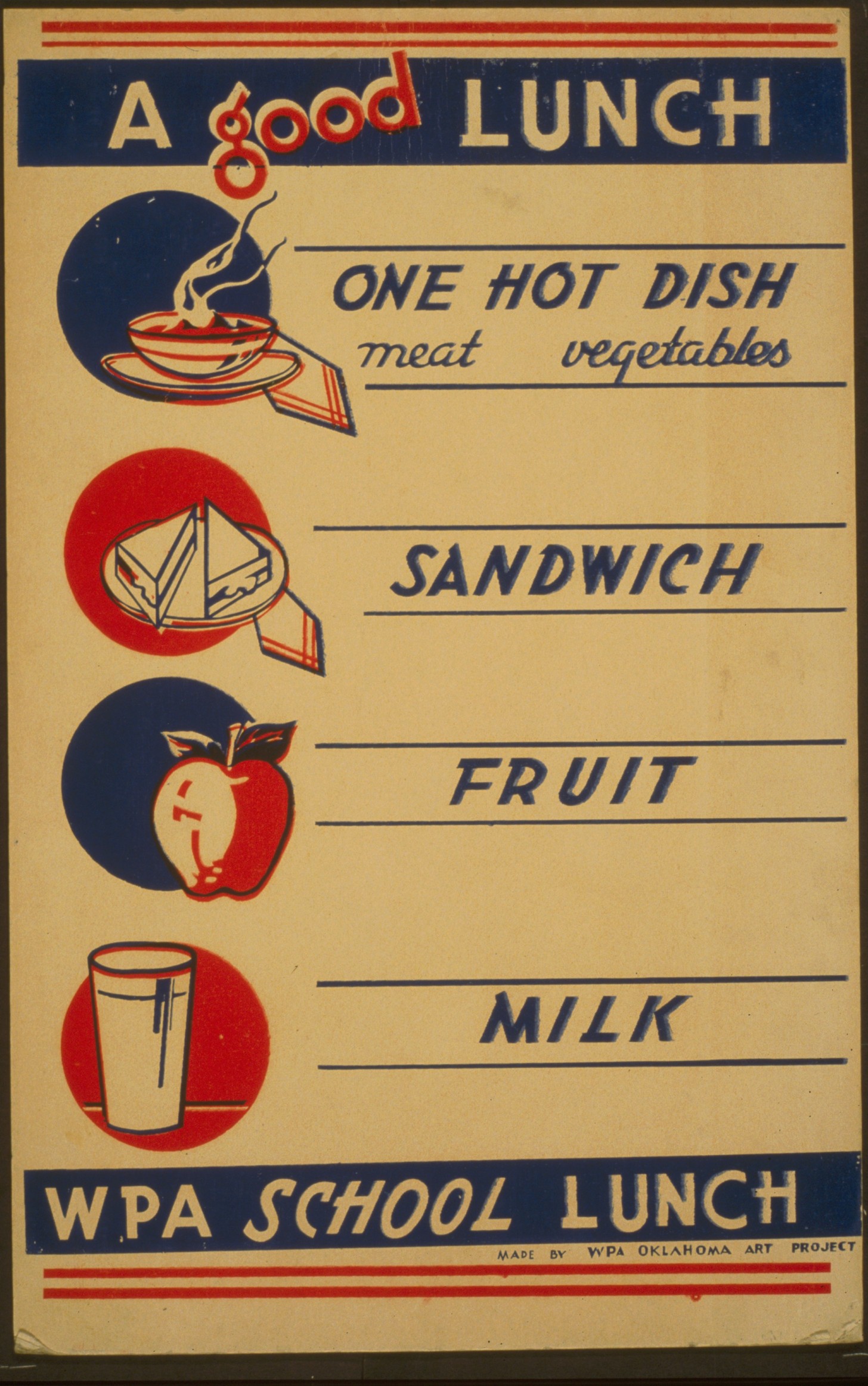
“A good lunch,” a school lunch poster made by the WPA Oklahoma Art Project between 1936 and 1941. Work Projects Administration Poster Collection, Library of Congress. No known restrictions on publication. This poster was printed by 1941. The 2026 rewrite of school meal rules was still unpublished on October 14.
The poster took a federal art project and one sheet of paper. The 2026 rewrite has drawn a USDA press release, a cooking video and nineteen meeting requests, and the public still has not seen a page of it.
This piece is part of my series grading the Make America Healthy Again (MAHA) record.
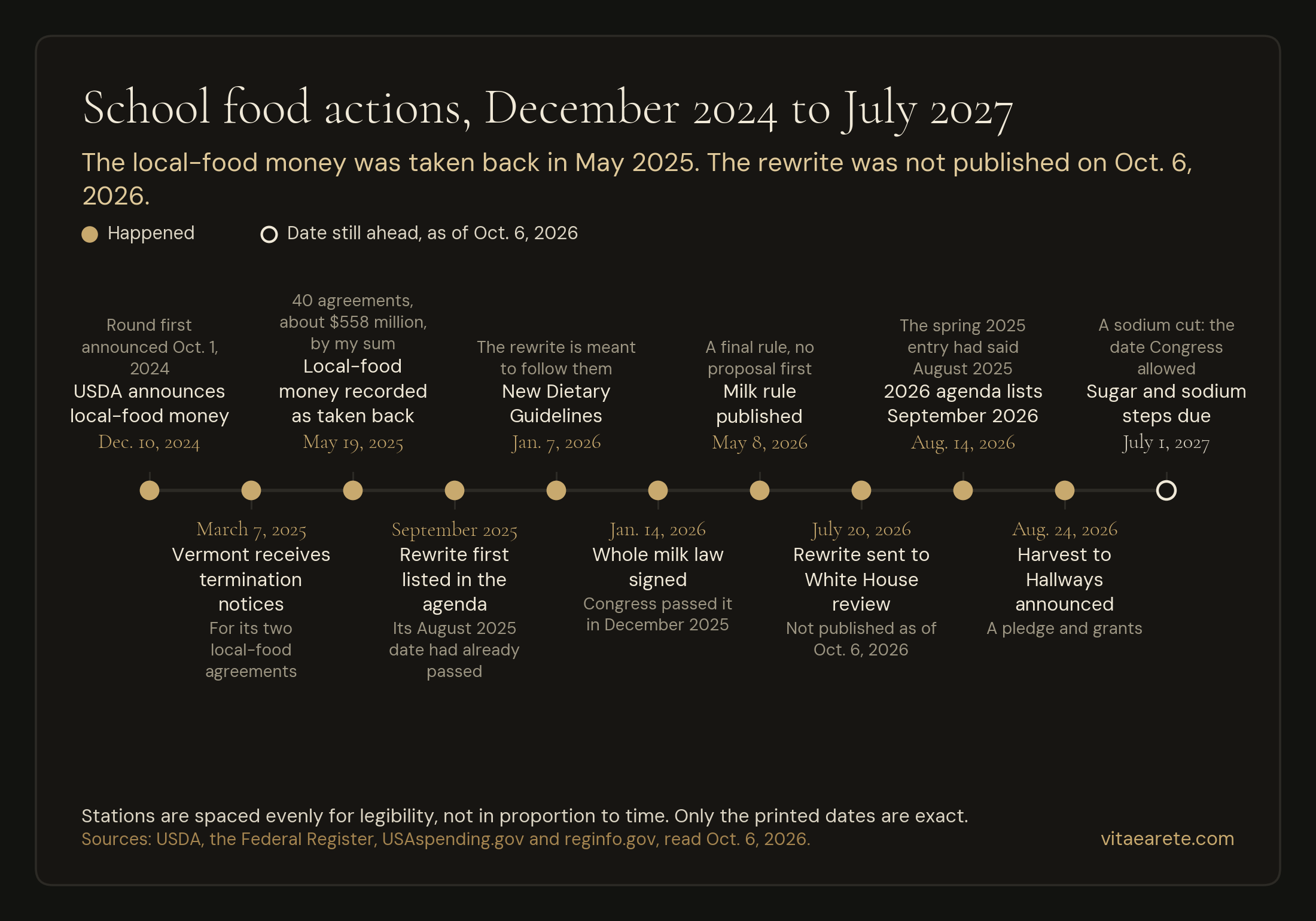
School food actions from December 2024 to July 2027. Sources: USDA, the Federal Register, USAspending.gov and reginfo.gov, read October 6, 2026.
USDA promised schools local food in December and took it back by May
Federal spending records list 40 local-food agreements for schools and child care in 2025, and every one of them ends the same way. The money was taken back. The records show no payments. On the federal ledger, it was food promised and never paid for.
Congress wrote the reason this program exists into the school lunch law’s declaration of policy in 1946. The law declares it the policy of Congress, “as a measure of national security, to safeguard the health and well-being of the Nation’s children and to encourage the domestic consumption of nutritious agricultural commodities and other food.” Kids and farmers, in one breath. The local-food money was that sentence with a budget attached.
The money was an inheritance. On December 10, 2024, USDA announced “a $1.13 billion investment” in local food. Up to $471.5 million was for states to buy “local, unprocessed, or minimally processed domestic foods” for schools. Up to $188.6 million more was for child care centers. Together, that is up to $660.1 million, by my addition. “USDA believes that a healthier future for our country starts with our children,” a USDA official said that day.
Here is what the same kind of money did the last time it ran. A farm group, the Northeast Organic Farming Association of Vermont, told a Vermont House committee on March 20, 2025, what Vermont’s first round bought. It was a $333,763 agreement, received in September 2022 and used in the 2023-2024 school year. The group said it “helped 147 local farms (90 from Vermont and 57 from neighboring states) access school markets.” And: “66 of these farms made their first-ever sales to schools.”
Sixty-six farms got a school as a customer for the first time, on about a third of a million dollars. That is the program working. The next round was built to repeat it, at more than three times the size.
States signed the next round’s agreements in January 2025. Vermont signed two, worth about $1.7 million in all; one, for schools and child care, was worth about $1.2 million. On March 7, 2025, Vermont’s agriculture agency received termination notices. “AMS has determined this agreement no longer effectuates agency priorities and that termination of the award is appropriate,” they read in part. AMS is USDA’s Agricultural Marketing Service.
By my count, that is 87 days from “a healthier future for our country starts with our children” to “no longer effectuates agency priorities.” Same department, different management. I have read that termination sentence more times than I want to admit. It still does not say which priority a Vermont carrot violated.
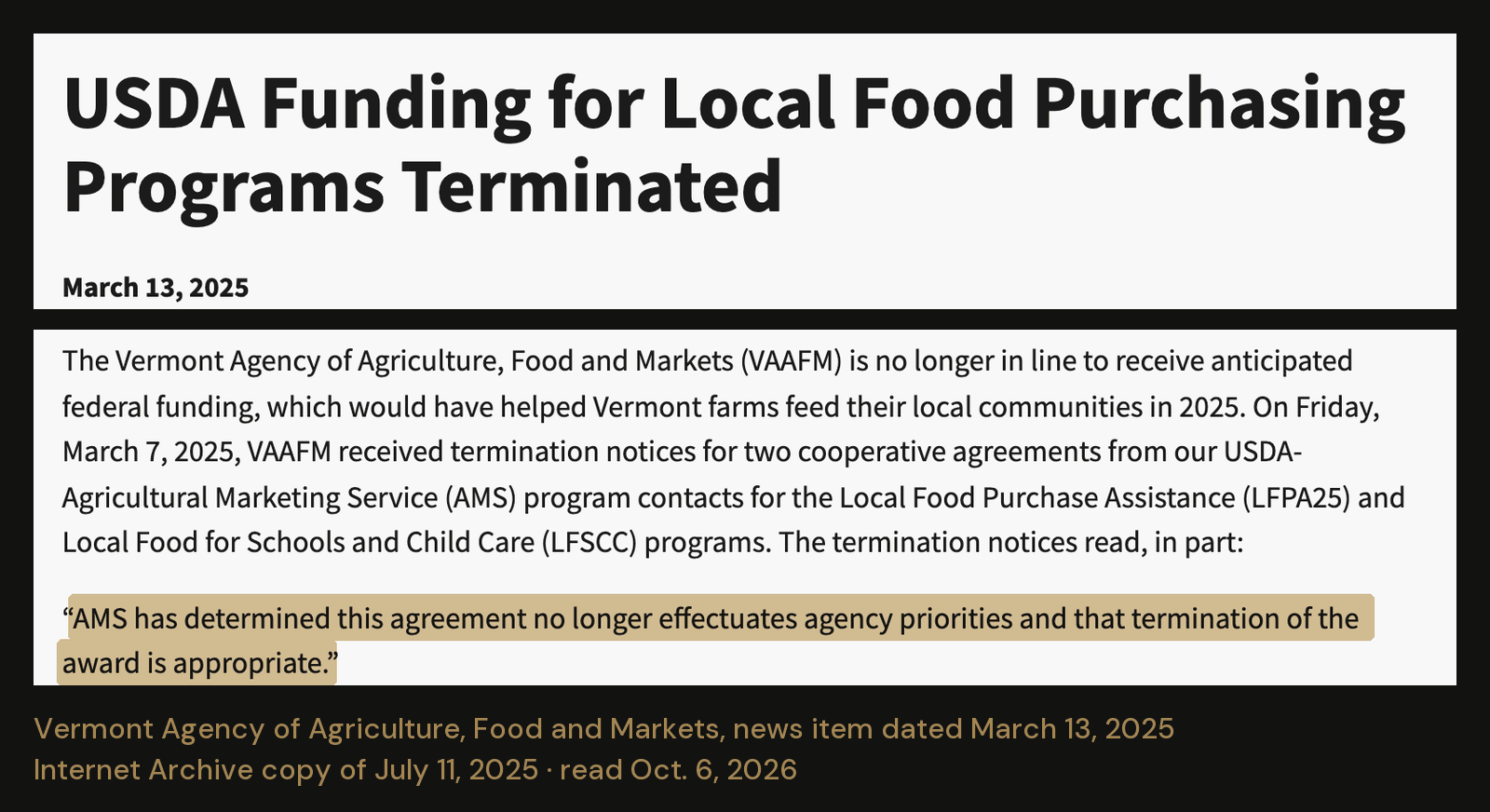
Vermont Agency of Agriculture, Food and Markets, March 13, 2025, in the Internet Archive’s copy of July 11, 2025.
Vermont said the school and child care money would have reached about 83,000 children in its schools and 4,000 in early childhood settings. That is the state’s own estimate. The farm group told lawmakers that “100% of the $1.2M that would have gone directly into the hands of Vermont farmers and producers is now lost.”
Massachusetts got the same sentence. In a release dated March 10, 2025, the state said USDA had told it the agreement “no longer effectuates agency priorities and that termination of the award is appropriate.” By the state’s account, its “$12.2 million award” was meant “to provide local healthy food to child care programs and schools, and to create new procurement relationships with local farmers and small businesses.”
On March 28, 2025, Massachusetts said USDA had also cancelled the fiscal 2025 Patrick Leahy Farm to School State Agency Grant Program. The state had applied for $384,446. “There was no reason for the cancellation provided,” the state wrote. That is the state’s account, and I did not check it against a USDA notice. Hold onto the name Leahy. It comes back.
The national picture comes from those self-reported spending records. USAspending.gov lists 40 agreements under the 2025 local food program for schools and child care, with 39 states and the District of Columbia. Vermont’s second agreement was under a different program and is not among them. The records show every one ending on May 6, 2025, sixty days after Vermont’s notices. For all 40, they show the money taken back on May 19, 2025. By my sum that is about $558 million. The records show no payments on any of them, so what was taken back was money promised, not money already paid out.
Thirty-nine states and the District of Columbia are in those records, and this was not a blue-state haircut. By my sum, counting each deobligation once, Texas lost the most, about $72.6 million, through its own agriculture department. California lost about $71.5 million. Florida’s agriculture department lost about $42.6 million, New York about $39 million, Illinois about $26.3 million and Georgia about $23.6 million. Texas and Florida alone account for about $115 million. The cut was bipartisan, the way a hailstorm is bipartisan.
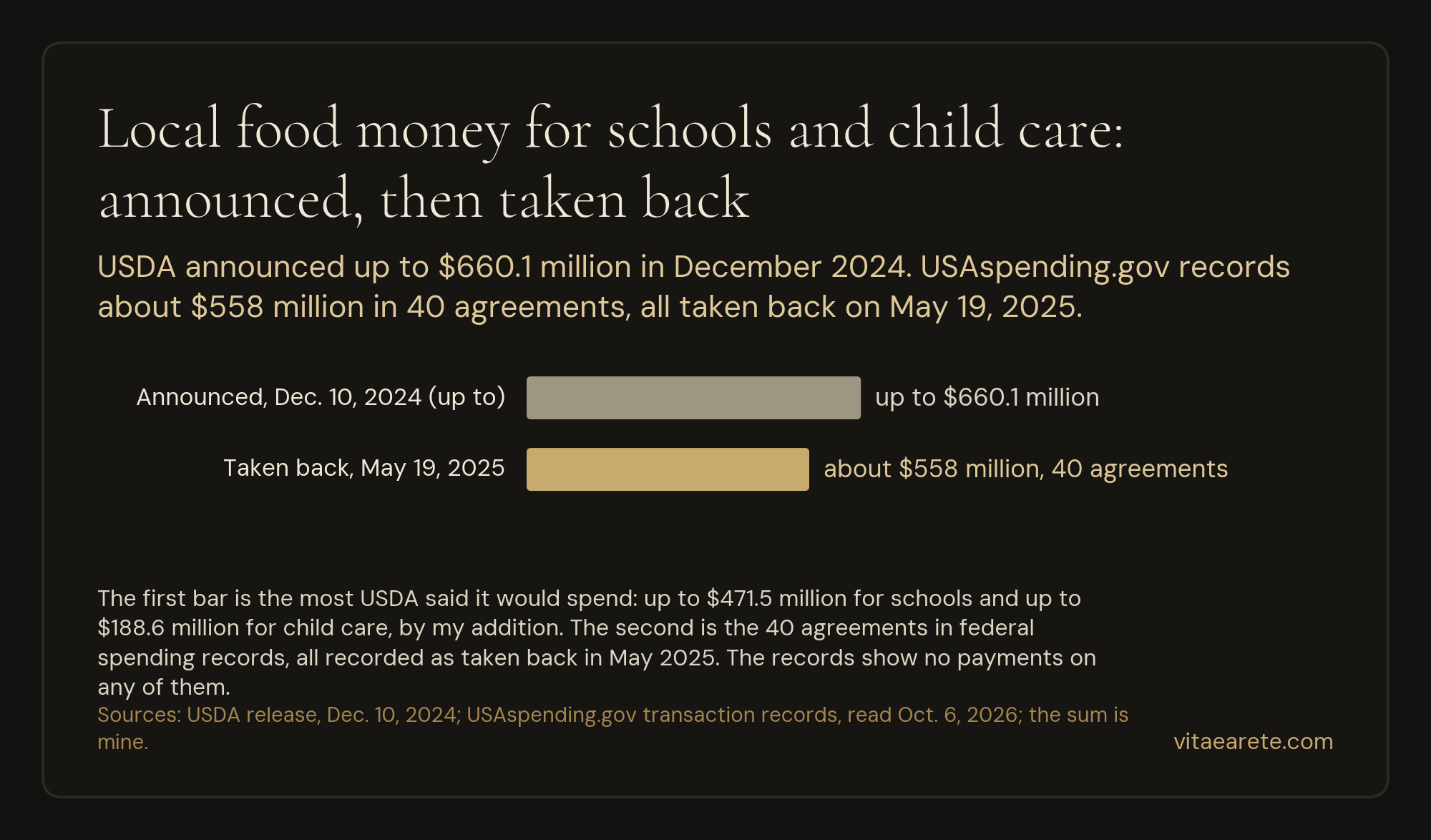
The first bar is the most USDA said it would spend. The second is the 40 agreements in federal spending records, all recorded as taken back in May 2025. Sources: USDA release, December 10, 2024; USAspending.gov transaction records, read October 6, 2026; the sum is mine.
Four months after the money went, the commission had a plan. Its September 2025 strategy promised to “Improve the farm-to-school grants application process to better connect local producers to schools.” Farm-to-school grants are a separate program. On my search of the strategy’s text, it never mentions the local-food money for schools and child care, taken back that spring.
So the money went, and the strategy offered a better form. It is Seinfeld’s “The Yada Yada” in a federal binder: there was a program, yada yada yada, there is an application process. The yada yada is about $558 million.
A better application process does not buy a single apple. The strategy says nothing about the money that had already gone, and the money that had already gone was food for children.
Vermont’s notices came nine days after an order to review grants with DOGE
Before the notices, the Secretary who runs school meals welcomed DOGE into her department. “I welcome DOGE’s efforts at USDA because we know that its work makes us better, stronger, faster, and more efficient,” Rollins said on February 14, 2025. “I will expect full access and transparency to DOGE in the days and weeks to come.” The same release said USDA had already “terminated 78 contracts, which totaled more than $132 million.”
Vermont’s notices came twenty-one days after that welcome, by my count. For forty school food agreements, the record supports “faster.” It cannot tell me whose hand was on the clock.
DOGE’s paperwork is stranger than its date field. The President created it by executive order on his first day in office. On my search, the order does not name Elon Musk. In February and March 2025 the President said Musk headed it. A White House official told a federal court on February 17, 2025, that Musk had “no actual or formal authority to make government decisions himself.” The boss of the thing, according to the President. No formal authority, according to the court filing. Both statements came from the same White House, two days apart at their closest.
On February 26, 2025, the President ordered each agency head, “in consultation with the agency’s DOGE Team Lead,” to review “covered contracts and grants.” Agencies were to “terminate or modify” them “where appropriate and consistent with applicable law.” The order gave agencies 30 days. Vermont’s notices came nine days later.
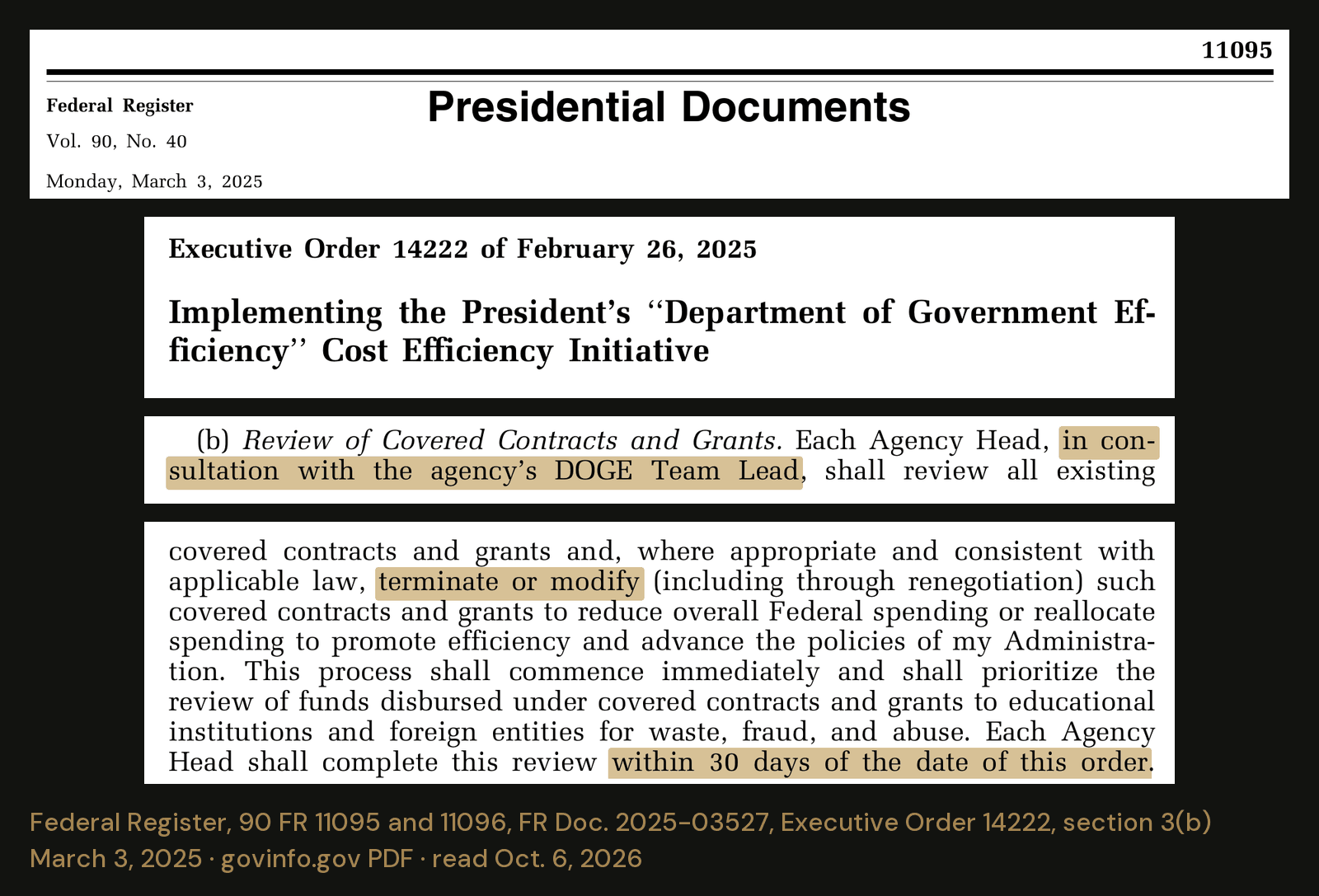
Executive Order 14222 of February 26, 2025, section 3(b), Federal Register, March 3, 2025, read October 6, 2026.
Then DOGE took a bow. Its own website lists all 40 school and child care agreements among its savings, dated March 17, 2025, with the same total of about $558 million. USDA’s own spending records say the agreements ended on May 6, 2025, seven weeks later. DOGE dated the savings first. The records show no payments, so what DOGE counted as saved was food money USDA never paid out.

GIF: Brooklyn Nine-Nine (NBC, 2020), via GIPHY.
Picture cancelling a yacht order and booking the savings weeks before the cancellation clears. The difference is that nobody was going to eat the yacht.
That listing is DOGE claiming the savings, and it is a hell of a way to keep score. Nothing I read shows who at USDA decided these terminations, or that DOGE staff or the Health Secretary took part. Rollins’s welcome is a dated statement, not proof of who signed what. I include the order for its timing only: Vermont’s notices came within the 30 days it gave agencies.
USDA also ended the report that counts households that run short of food
Four months after the local-food money went back, USDA went after the government’s yardstick for households that run short of food. Release No. USDA 0219.25, dated September 20, 2025, announced “the termination of future Household Food Security Reports.” For 30 years, by the release’s own count, that report had said how many American households could not always afford enough food.
The release did not go quietly. It called the reports “redundant, costly, politicized, and extraneous studies” that “do nothing more than fear monger.” It said the study, begun under “the Clinton administration,” had “failed to present anything more than subjective, liberal fodder.” USDA fired the thermometer, and the pink slip called it a liberal.
Then came the sentence I am calling false. The release said: “Trends in the prevalence of food insecurity have remained virtually unchanged, regardless of an over 87% increase in SNAP spending between 2019 - 2023.” The sentence names its own years, 2019 to 2023. USDA’s own Economic Research Service had already measured those years. It put food insecurity at 10.5 percent of households in 2019 and 13.5 percent in 2023. Its report on 2023 called that year’s rate “statistically significantly higher” than 2022, 2021 and “the 10.5 percent in 2020.” That is a statement about the past, and the department’s own numbers contradict it. I did not check the 87 percent SNAP figure, and I am not repeating it as true. The department fact-checked itself and lost.
USDA still published one more report, on 2024, dated December 30, 2025. Here is what it says. “Children were food insecure at times during 2024 in 9.1 percent of U.S. households with children (3.3 million households).” In 318,000 of those households, families reported that “at times in 2024, children were hungry, skipped a meal, or did not eat for a whole day because there was not enough money for food.” The research service’s own summary page counts 7.3 million children in 2024 living in households where children, along with adults, were food insecure.
Nearly three in four school lunches are free or reduced price, so I would expect many of those children to be in those lunch lines. In the same year USDA was taking back money meant for their trays, it announced it would stop publishing the count of how many of them go without. That is the effect I see in the documents. The release gives its own reasons, quoted above, and I am not claiming to know any others. As of October 14, 2026, I found no report on 2025 data on the research service’s pages. USDA announced in September 2025 that it was ending future reports.
Whole milk came back through a law and a rule that skipped a step
Children 6 to 19 already get about 12 percent of their calories from saturated fat on average, in the federal food survey for 2021 to 2023, by my arithmetic. The guidelines keep a 10 percent limit. That is the number Congress walked into when it changed what counts at school.
The milk change is the only part of the promise that became binding, and Congress did most of the work. It passed the Whole Milk for Healthy Kids Act with sponsors from both parties. The Senate passed it on November 20, 2025, and the House on December 15. The President signed it on January 14, 2026. USDA’s account of the signing lists Kennedy and Rollins beside him.
The law lets schools offer whole and 2 percent milk at lunch. It also says the fat in that milk “shall not be considered saturated fat” when a school checks its lunches against the federal limit. That limit keeps saturated fat under 10 percent of a school lunch’s calories, averaged over the week. Without the clause, the fat in whole milk would count toward it. The fat stays in the carton. It just stops counting.
I am a dietitian, and saturated fat is one of the numbers my profession counts. Congress has now told me one carton of it does not exist for scoring purposes. It feels like refereeing a game where the left half of the field has been declared imaginary. The game still happens there. The scoreboard just stops noticing. Congress has run this kind of accounting on school trays before, and I will get to the tomato paste.
Then came the rule. USDA’s release on signing day said “a proposed rulemaking will soon commence.” A proposed rule is the step where the public reads the plan and comments before anything takes effect. On May 8, 2026, USDA published a final rule, effective June 8. It took comments until June 8, 2026, the day the rule took effect. USDA said a proposal would come. It issued a final rule instead.
GIF: Friends (NBC, 1999), via GIPHY.
A comment period that closes the day the rule takes effect is a comment period the way a doorbell on a bank vault is a welcome mat. To be fair, and I am trying to be, USDA gave its reasons in the rule. It said school meal programs “are not required to undergo notice-and-comment rulemaking,” because federal rulemaking law exempts “matters relating to benefits.” It said a final rule was “optimal in this instance” to carry out the law quickly and to keep the programs consistent. That exemption is real, and the choice was USDA’s to make.
What the rule did with that choice goes further than the law. The law changed the school lunch rules. The rule also covers school breakfast, child care centers and adult day care, and a separate milk program. It extends the saturated fat exclusion from lunch to breakfast, on other authority USDA cites.
For child care, USDA points to another section of the same school lunch law. That section says those programs must provide milk “in accordance with the most recent version of the Dietary Guidelines.” The new guidelines tell readers to include full-fat dairy, so for child care the law and the rule point the same way.
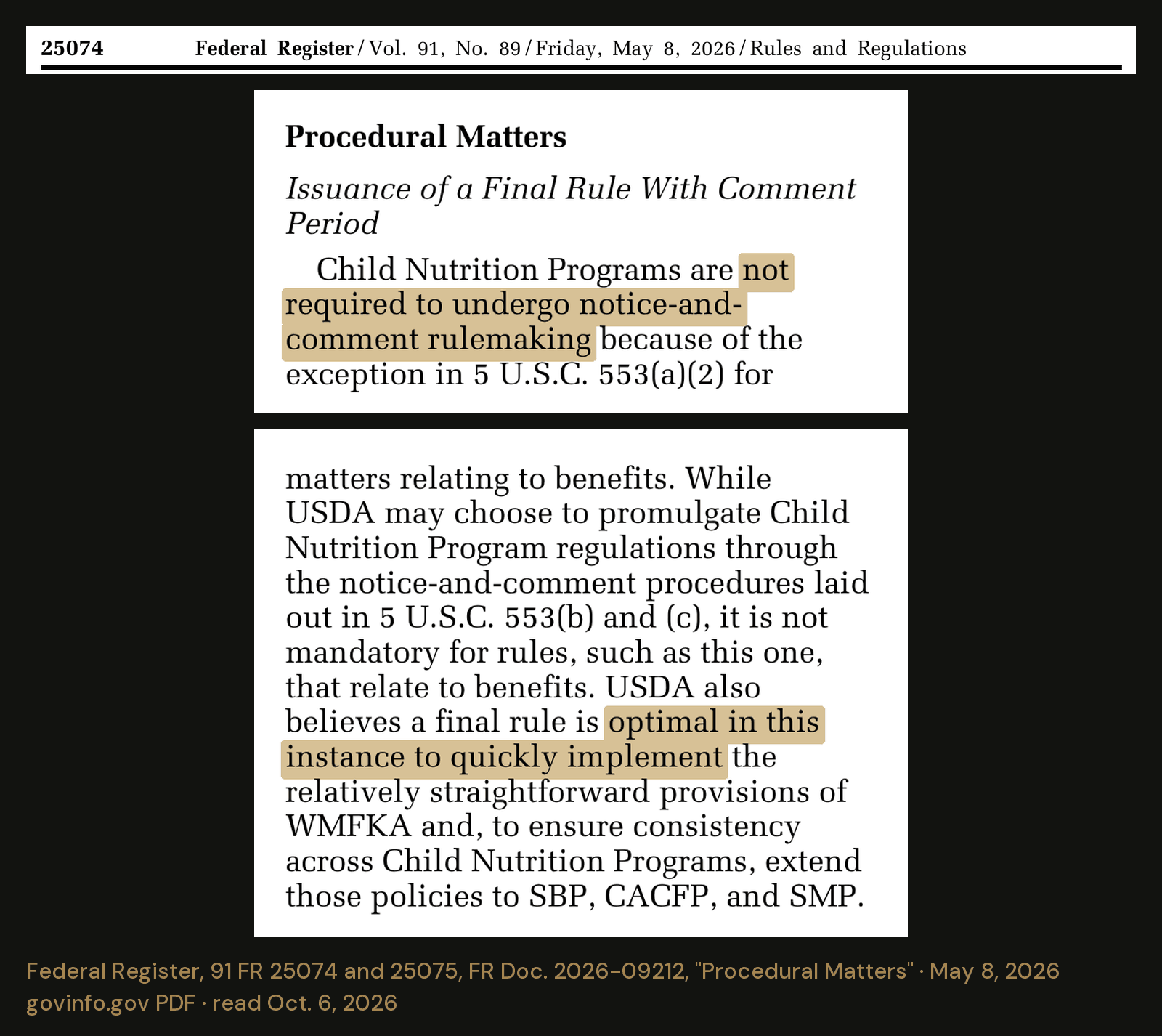
USDA’s milk rule, Federal Register, May 8, 2026, the section headed “Issuance of a Final Rule With Comment Period.”
From law to final rule took 114 days, by my count. The strategy promised this change, and it is now binding. The count now has a blind spot exactly where the fat sits.
USDA left the 2024 sugar and salt limits in place
This is the section where I give the administration credit, and I do not hand it out like gold stars. USDA issued its current school meal rule in April 2024, before this administration. Its first limits on added sugars began on July 1, 2025. Breakfast cereals may have no more than 6 grams of added sugars per dry ounce. Yogurt may have no more than 12 grams per 6 ounces. Flavored milk may have no more than 10 grams per 8 ounces.
Those limits took effect on schedule. On my search of the Federal Register, I found no change to the 2024 rule’s sugar or sodium limits since January 20, 2025. The same administration that took back about $558 million in school food left a finished rule alone, and that counts. In this record, leaving a good thing alone is the heroic act.
USDA’s own page explains why the limits matter. It says that “about 17 percent of calories in school breakfasts and 11 percent of calories in school lunches are from added sugars.” The guidelines it cites recommend less than 10 percent. By USDA’s own numbers, breakfast is the bigger sugar problem, and it is the meal the School Nutrition Association expects the rewrite to add protein to.
The next steps are due on July 1, 2027. Weekly menus must then get less than 10 percent of calories from added sugars. Sodium limits at lunch drop by about 15 percent. For the youngest grades, the weekly average cap on a lunch falls from 1,110 milligrams to 935.
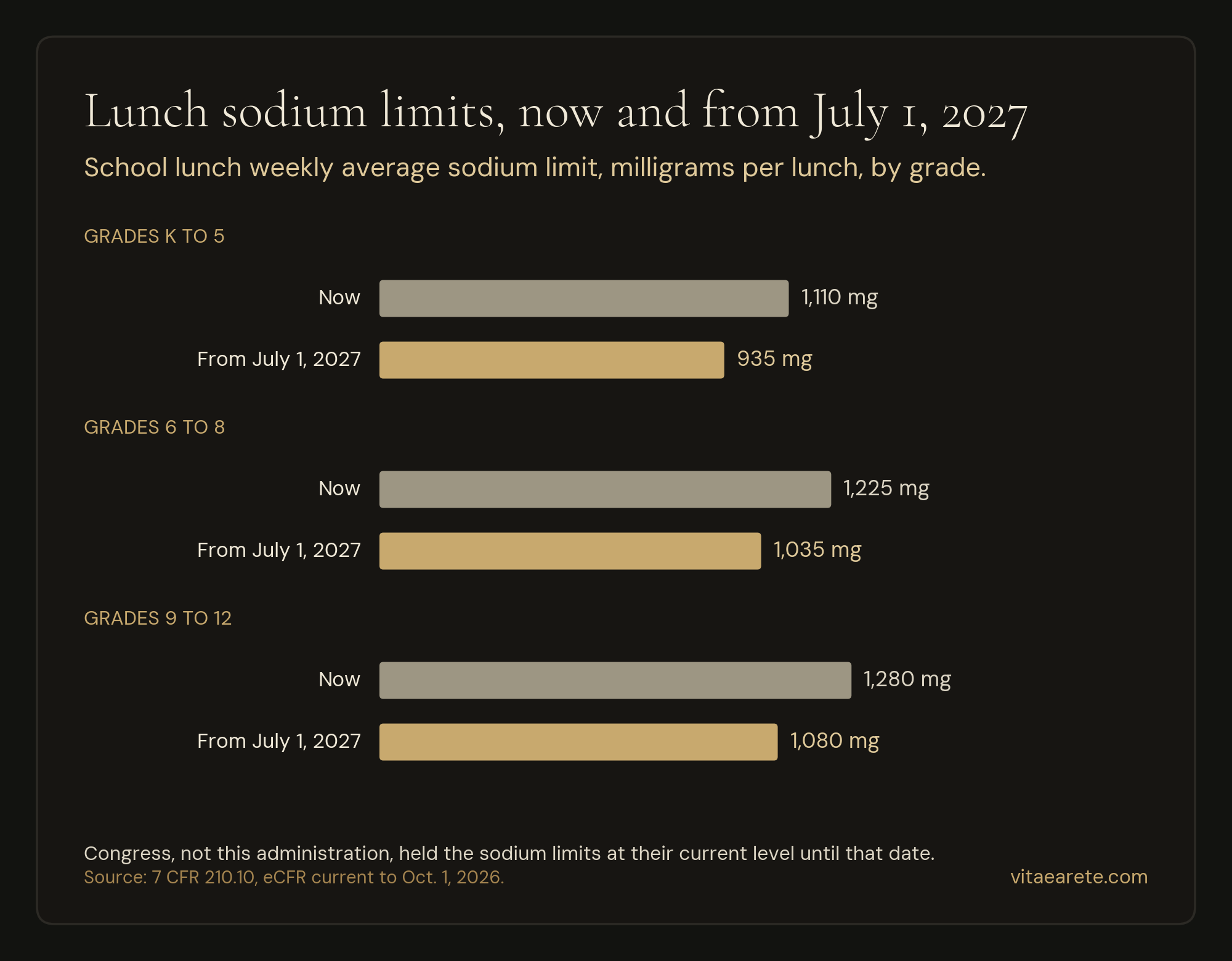
Weekly average sodium limits for school lunch, now and from July 1, 2027. Source: 7 CFR 210.10, eCFR current to October 1, 2026.
The credit has a co-signer. Congress, not this administration, held the sodium limits at their current level until that date. A spending law signed in March 2024 held school sodium at its 2023-24 limits “through School Year 2026-2027.” It also said later limits in that rulemaking may not be stricter than a target USDA set in 2012. USDA’s page says the 2027 limits match that target exactly.
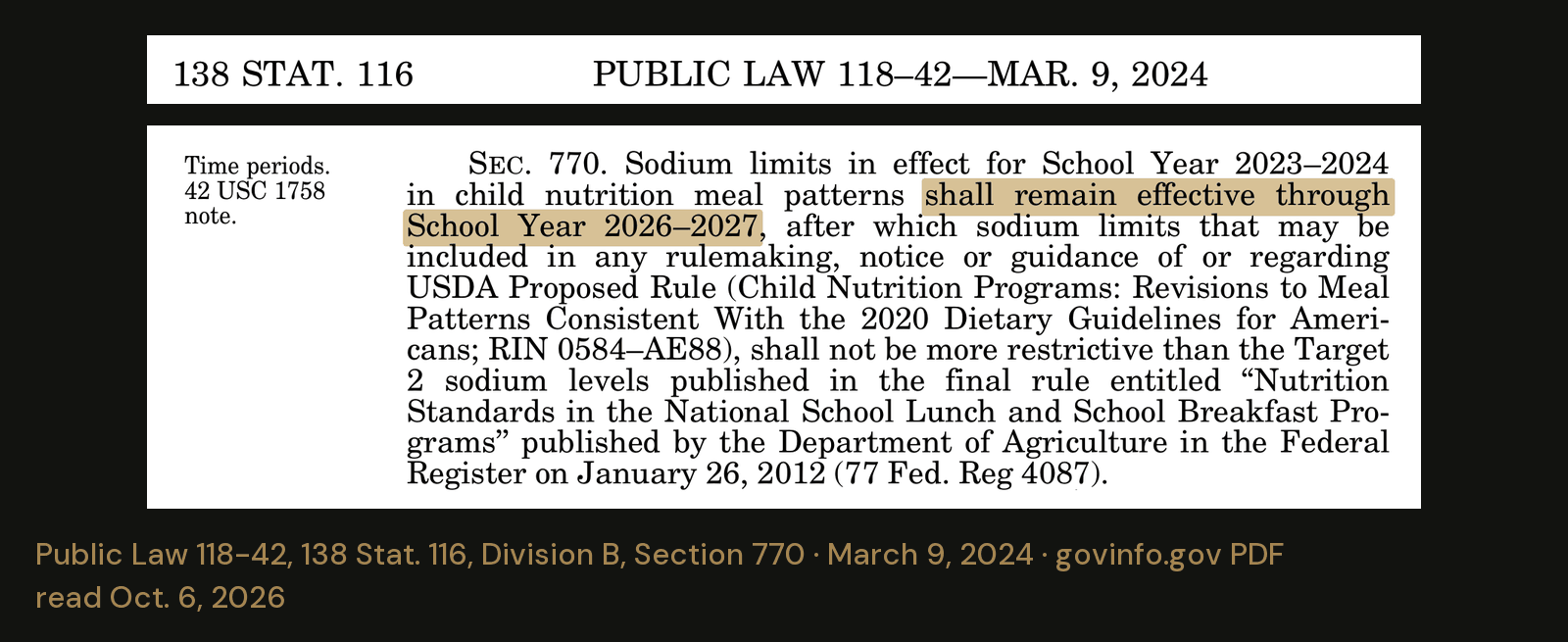
Consolidated Appropriations Act, 2024, Public Law 118-42, Division B, Section 770, from GovInfo, read October 6, 2026.
Now the tomato paste. A spending law approved on November 18, 2011, barred USDA from using its money on a school meal rule that “requires crediting of tomato paste and puree based on volume.” The same section blocked any sodium cut “beyond Target I” until the Secretary certified a review of “relevant scientific studies.” Another section of the same law barred any rule that “sets any maximum limits on the serving of vegetables in school meal programs.”
So Congress has been doing the arithmetic on lunch trays by statute for fifteen years. Tomato paste and sodium came in 2011, sodium again in spending laws from 2014 to 2024, milk fat in 2026. It is Groundhog Day with a sneeze guard. My read is that the fight over school food has always been a fight over what counts, and lawmakers keep moving the lines while the food stays on the plate. The sodium cut Congress paused is now set for July 1, 2027, at the 2012 target, and not a milligram lower.
No proposal had appeared by either of USDA’s agenda dates, as of October 6, 2026
The rule that would change what goes on 30 million trays a day is tagged “Deregulatory.” Both of its entries in the government’s agenda of planned rules file it that way, under the President’s January 2025 order. That order says at least ten old regulations should be identified for elimination for each new one. For counting purposes, the rule meant to change 30 million trays a day is listed as a subtraction. The paperwork is on a diet. The public has not seen the menu.
The rewrite first appeared in that agenda in September 2025, in the edition labeled spring 2025. That entry gave August 2025 as the date for a proposal, a date already past when the agenda came out. Meeting it would have taken the inverted bullets of Tenet, Christopher Nolan’s 2020 film about moving backward through time. August 2025 was also five months before the new Dietary Guidelines, and the entry did not mention them. It described the goal as helping state and local programs “overcome operational challenges.”
The next edition, labeled 2026, came out in August 2026, after the proposal had gone to White House review. It added a clause: the changes would “ensure meal patterns are aligned with the goals of the Dietary Guidelines for Americans 2025-2030.” It moved the target to September 2026.
Both entries keep the original title, “Reducing Complexity and Food Waste in the Child Nutrition Programs.” Both say “Legal Deadline: None,” meaning USDA listed no deadline set by a law or a court. The title promises less complexity. The review office cannot even agree with itself about how big the rule is.
On the evening of October 14, 2026, the office’s review page for the rule said “Economically Significant: Yes.” The office’s own data file, the list of rules under review, said “No” for the same rule, with the same received date, July 20. Under the 1993 order that governs review, the significant category includes a rule likely to “Have an annual effect on the economy of $100 million or more” or to “adversely affect in a material way” public health or “State, local, or tribal governments or communities.” Same office, same rule, same night, two answers.
Call it Schrödinger’s lunch, with apologies to Sheldon Cooper: significant and not significant until somebody opens the box. I am not telling you which record is right, and I am not telling you the rule will cost $100 million. I am telling you the public cannot tell from the government’s own records.
As of October 6, 2026, no proposal had appeared in the Federal Register by either date. USDA’s notice for its 2026 agenda says the dates “are estimated and are not commitments to act on or by the date shown.” Under the 1993 executive order that governs White House review, the office has 90 calendar days, which can be extended. For scale, recall the milk rule: 114 days from law to final rule.
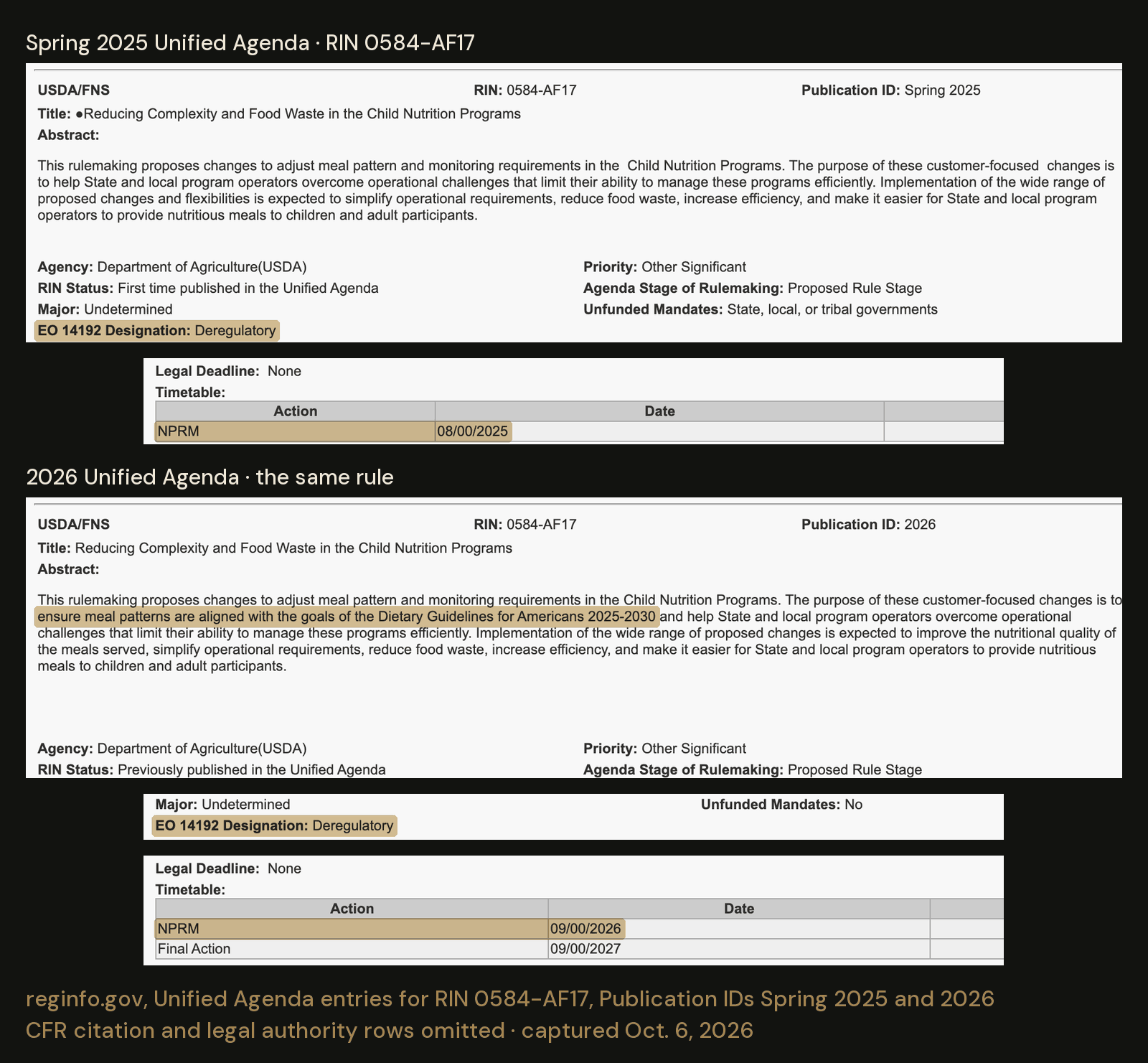
The school meal rule in the government’s regulatory agenda, editions labeled spring 2025 and 2026, read on reginfo.gov on October 6, 2026.
Here is why a parent should care about a paperwork tag. The rewrite would set what a school has to put on a tray to be paid for it, for about 30 million children a day. It has no legal deadline, a “Deregulatory” tag and two answers on its own size. Until the text is published, none of the people who cook that food, pay for it or eat it can read a word.
By my count, eleven of the nineteen meeting requests came from the food industry or commodity groups
The review office meets “with any interested party” about a rule under review. It logs who asked, who attended and what they filed. It does not record what was said. When I first read the log on October 6, it held fifteen meetings on this rule, from August 10 to September 22, 2026.
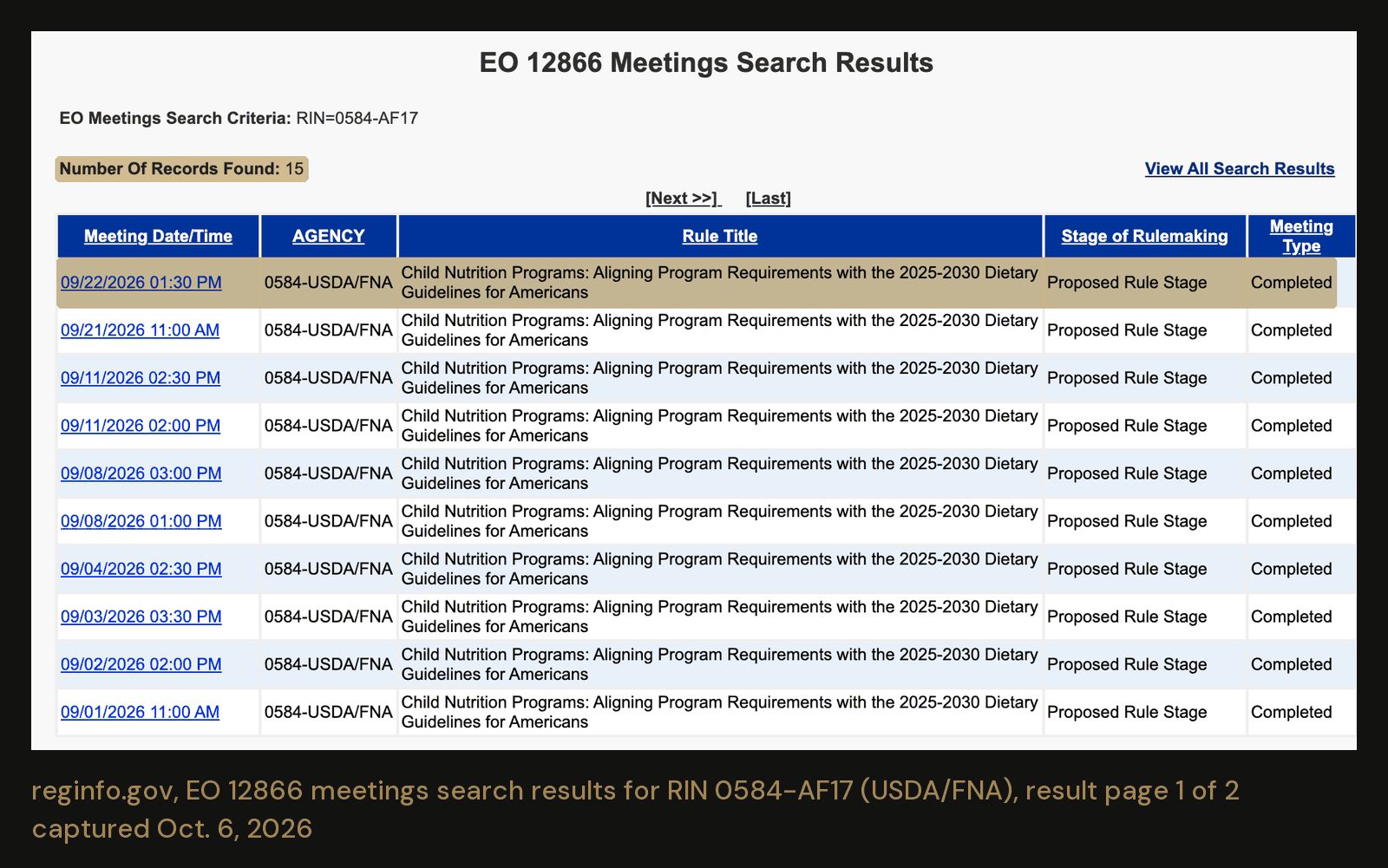
The Office of Information and Regulatory Affairs’ log of meetings on USDA’s school meal proposal, read on reginfo.gov on October 6, 2026.
I sorted them into my own classes, the way Janis maps the cafeteria tables in Mean Girls. Eight came from food industry or farm commodity groups, four from school and child care groups and three from health, anti-hunger or plant-based groups. Picture that map with most of the chairs pulled up to the industry table.
The paperwork was uneven, too. SNAC International came with PepsiCo. USA Rice filed a 21-page slide deck for enriched grains, such as white rice. The frozen food group filed a fact sheet defending frozen foods in school meals, from vegetables and fruit smoothies to pizza and fries. Napoleon Dynamite kept tater tots in his pocket in 2004 and never needed a fact sheet.
By October 14 the log listed nineteen. The four new ones were scheduled for October 13 to 19: the firm Invariant for Danone U.S., General Mills, J.T.M. Food Group, and one requester the page lists by name only. The last falls on October 19, the day after day 90; the order allows the review to be extended. Counted the same way, eleven of the nineteen came from the food industry or commodity groups, one of them through a lobbying firm.
That firm has a paper trail of its own. Its lobbying disclosure filings report $80,000 from Danone’s U.S. company in each of the first two quarters of 2026. That is $160,000, by my sum. The second-quarter filing lists, among many other things, “other nutrition programs for students and children” and “Monitor the development of the Dietary Guidelines for Americans, 2025-2030.” USDA is among the agencies listed. I monitored the same Dietary Guidelines for free, which in hindsight was a billing error on my part.
Now the part that keeps this honest. The filings do not name this rule or the October 13 meeting, and the $160,000 covers every issue listed, from the farm bill to labeling. “Industry” does not mean one position, and most groups filed nothing. The log cannot show what the office or USDA did with what it heard. What it shows is how a children’s meal rule gets heard in 2026: by appointment. At least one appointment came through a firm that has reported income from Danone’s U.S. company in every quarter since mid-2019, by its own filings.
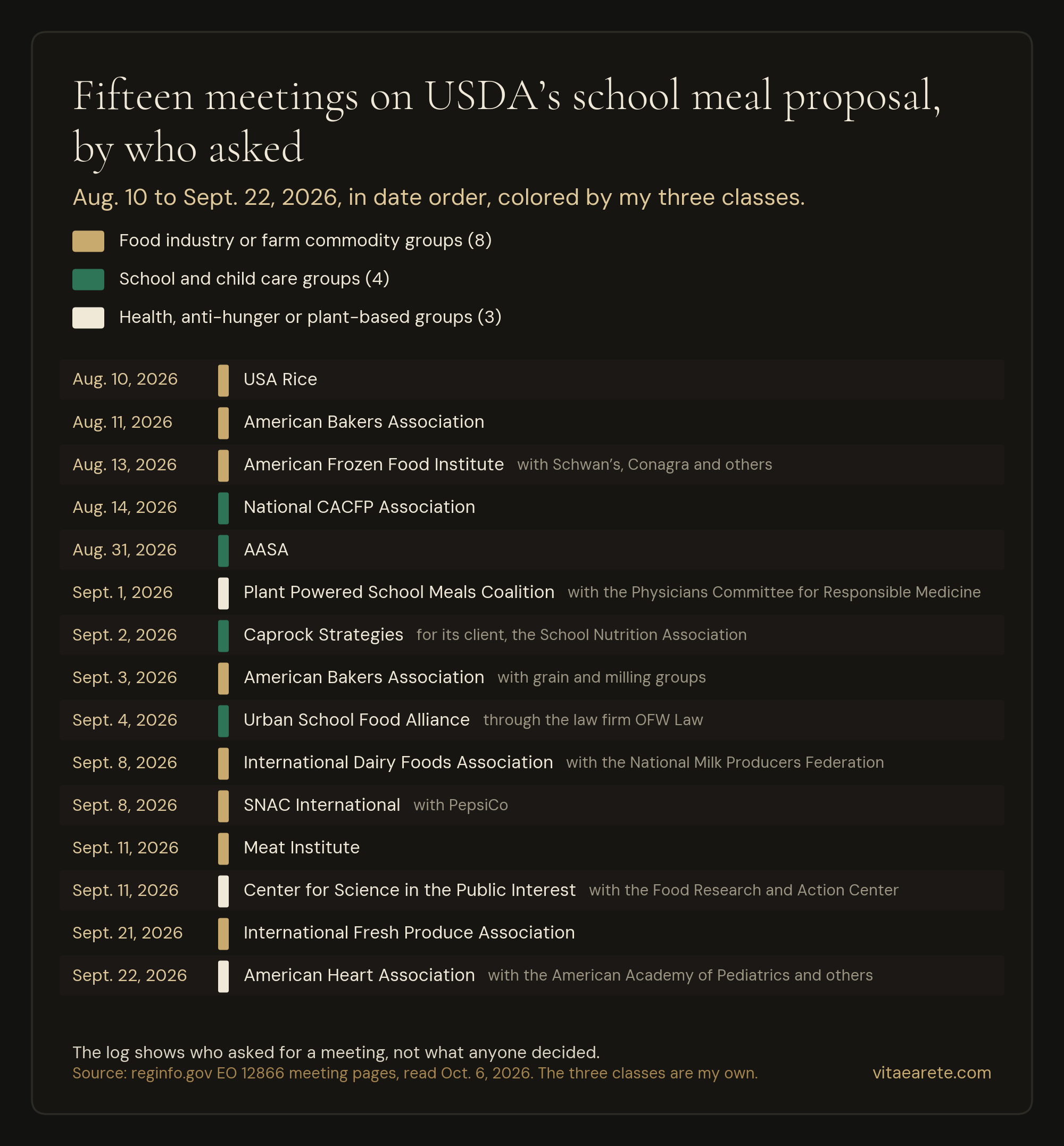
Meetings logged on USDA’s school meal proposal, August 10 to September 22, 2026. Source: reginfo.gov meeting pages, read October 6, 2026. The three classes are my own. Four more meetings were listed by October 14.
The sharpest document in the whole file came from the people who run school kitchens. A letter to Rollins dated March 9, 2026, came from “900+ undersigned school districts, school nutrition professionals, and school nutrition organizations,” by its own count. It urged USDA “not to increase the Meat/Meat Alternate (M/MA) requirement.” That part of the meal covers meat, eggs, beans and similar foods.
The letter says students already get “as much or more protein than is recommended” by the new guidelines, citing a USDA study of school meals. It calls that part of the meal “typically the most expensive” one. A plant-based coalition filed the letter with the review office in September.
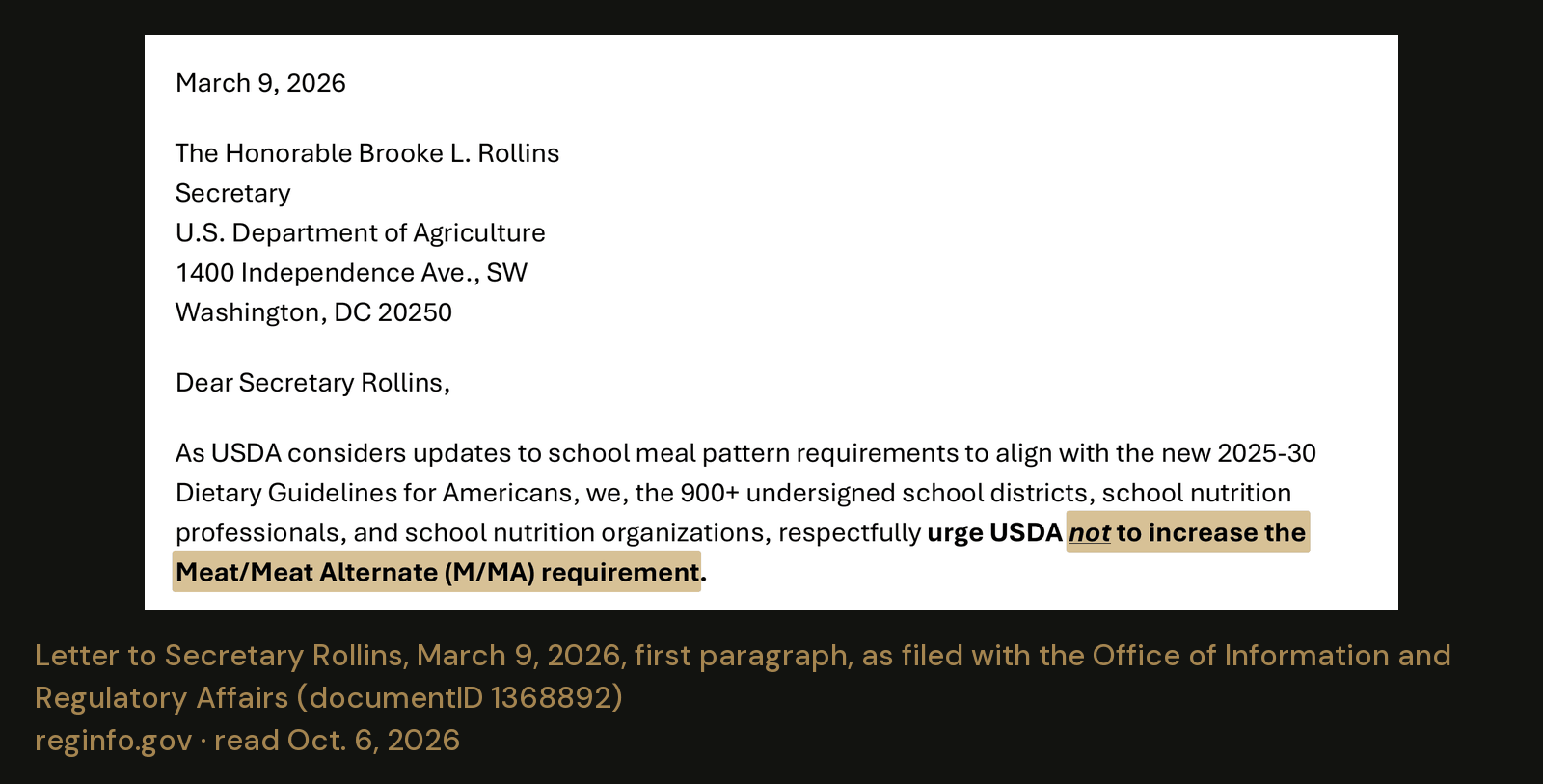
The districts’ letter of March 9, 2026, as filed with the Office of Information and Regulatory Affairs, read on reginfo.gov on October 6, 2026.
USA Rice brought twenty-one slides. The people holding the ladles sent one letter, and it reached the room in somebody else’s folder. One of those documents was designed. The other was signed.
The guidelines Kennedy and Rollins signed say “Prioritize Protein Foods at Every Meal.” The School Nutrition Association, which represents school food directors, expects the rule “to require that protein be offered at breakfast.”
GIF: Parks and Recreation (NBC, 2011), via GIPHY.
The association estimates that would add about $1.3 billion a year, and that current payments already fall about $2.9 billion a year short of what meals cost. Those are the association’s own estimates. The breakfast figure rests on one cost comparison of a grain breakfast and a protein breakfast.
If those estimates hold, the schools would start a new requirement already about $2.9 billion a year in the hole. Somebody pays that gap: the district budget, the property tax bill or the portion on the tray.
The August plan offers money and a pledge, and less new money than it says
About fifteen months after USDA took back the local-food money, Kennedy joined Rollins at USDA, and she said this: “We are connecting schools with the farmers and ranchers in their own communities, investing in the kitchens and equipment school nutrition professionals need to prepare real food, and cutting through barriers that have made it too difficult to serve healthy, American-grown food.” That was August 24, 2026, release No. USDA 0111.26. The release lists the room: “farmers, students, school nutrition leaders, athletes, chefs, and parents.” On my search of its text, it does not mention a rule.
In 2025 USDA ended the agreements whose whole purpose was “local, unprocessed, or minimally processed domestic foods” for schools, in 39 states and the District of Columbia. In 2026 its Secretary described connecting schools with local farmers as the new plan. Both statements are USDA’s. Only one of them came with $558 million attached, and it went the other way.
Kennedy added: “Every school meal should make a child healthier.” He also said the administration was “giving schools the tools to serve it affordably.” Every school meal also has to be paid for, and the School Nutrition Association says payments already run about $2.9 billion a year short.
USDA’s page for “Harvest to Hallways” calls it “A new school meals policy plan.” Don Draper could not have named it better, and Mad Men taught me to check what is inside a nice name. The page dates the announcement to August 24, 2026, and names both Rollins and Kennedy. It lists “Up to $70 million” in school kitchen equipment grants, $30 million in research through two of Kennedy’s agencies, and “Up to $25M” in farm-to-school grants. It totals these as “$125M+ New Federal Investment.”
I call that total misleading. Two of its three items are ceilings, so as listed the three add up to at most $125 million, spread across equipment, research and farm-to-school grants. The page calls them “An initial list of investments being announced on August 24, 2026, and built upon in the months ahead,” so the plus sign may stand for money still to come. The plus sign points up, and the page’s own “up to” points down.
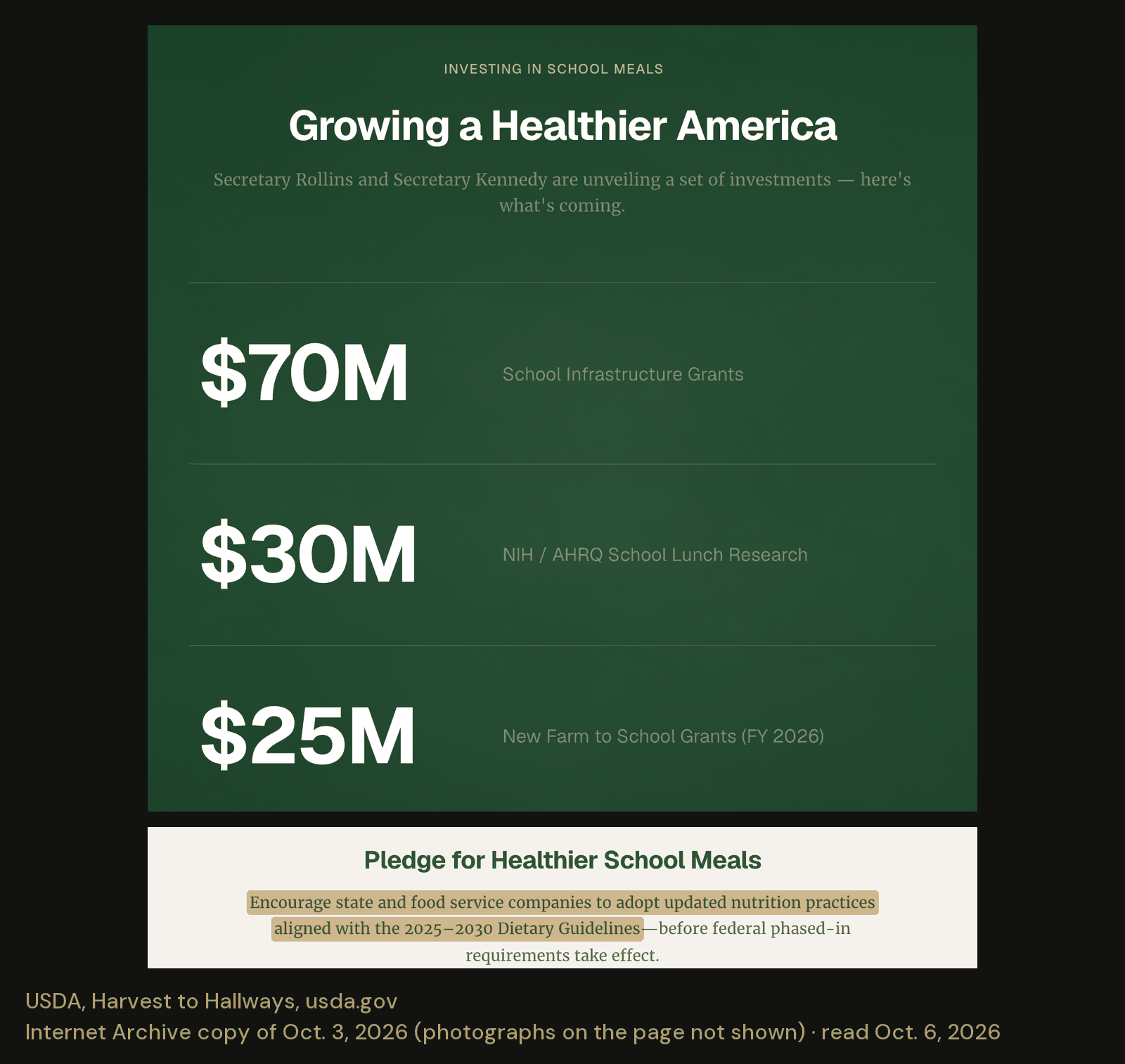
USDA’s Harvest to Hallways page, in the Internet Archive’s copy of October 3, 2026. The copy of October 14, 2026, keeps the same “Up to” wording and the “$125M+” total. usda.gov returned an “Access Denied” error to the tools I used.
There is a second reason, and it comes from USDA’s own release. It says “USDA will make a new $50 million investment in school cafeteria infrastructure.” Then: “The investment builds on recently announced National School Lunch Program Equipment Assistance Grants totaling $20 million.” Fifty new plus twenty already announced is the “up to $70 million” on the page. So by the release’s own description, at most $105 million of the “$125M+” is new, by my arithmetic.
GIF: Seinfeld (NBC, 1989 to 1998), via GIPHY.
Twenty million dollars of “New Federal Investment” is leftovers with a fresh label, which is also how my refrigerator works.
The local-food money taken back in May 2025 was about $558 million. And at most $125 million, a one-time total, is less than a tenth of the $1.3 billion a year the School Nutrition Association estimates protein at breakfast would add. Most of it is for equipment and research.
Remember Leahy. The release calls the farm-to-school line “up to $25 million in new, additional Patrick Leahy Farm to School Grants for FY 2026.” Massachusetts says USDA cancelled the 2025 Leahy state agency grant program it had applied to, and gave no reason. The year-one cut and the year-two brochure share a name. That is Massachusetts’s account, not a national finding; I did not check it against a USDA notice.
The page also lists a “Pledge for Healthier School Meals.” Its aim, in the page’s words, is to “Encourage state and food service companies to adopt updated nutrition practices aligned with the 2025-2030 Dietary Guidelines” before federal requirements take effect. In the copies of October 3 and October 14, 2026, I found no count of who has signed. The operative verb is “Encourage.” A pledge with no count of signers is a mood board.
The model tray lists “Beef, chicken, and fish” for protein. Among the farm-to-school grants the page highlights is $199,870 to the Pennsylvania Beef Council. USDA says that council will partner with 175 local schools to benefit nearly 300,000 students with “locally raised beef.” That is USDA’s choice of spotlight. The 900+ signers who run school kitchens had already told USDA, in March, that students get “as much or more protein than is recommended.”
I found no comparison group in FDA’s funding notice for school meals
Kennedy’s department went looking for heavy metals in school meals with a funding notice that, on my search, names no comparison group. As written, the study cannot tell you whether any change it makes caused anything. In June 2025 its Food and Drug Administration (FDA) offered $20 million for “A Research Study of Contaminants in School Meals.” Its first goal was to “Identify contaminants (e.g., heavy metals) present in school meals.” Another was to “Promote whole food offerings and minimize the use of foods commonly considered ultra-processed.”
Sixteen districts and schools received awards in August 2025, worth $16,960,808 in all by my sum. That is real money for school kitchens, and I would not hand it back.
The notice uses “foods commonly considered ultra-processed” three times and, on my search of its text, never defines it. The government did get around to a sentence for the opposite, seven months later. Its realfood.gov site, live by January 7, 2026, says: “Eating real food means choosing foods that are whole or minimally processed and recognizable as food.” The same site now says its call to avoid highly processed food is not “a legal definition.” A federal grant built around a term it never pins down is a dartboard with no rings.
The notice measures contaminants and nutrition before and after the change. On the same search, I found no comparison group of schools that did not change.
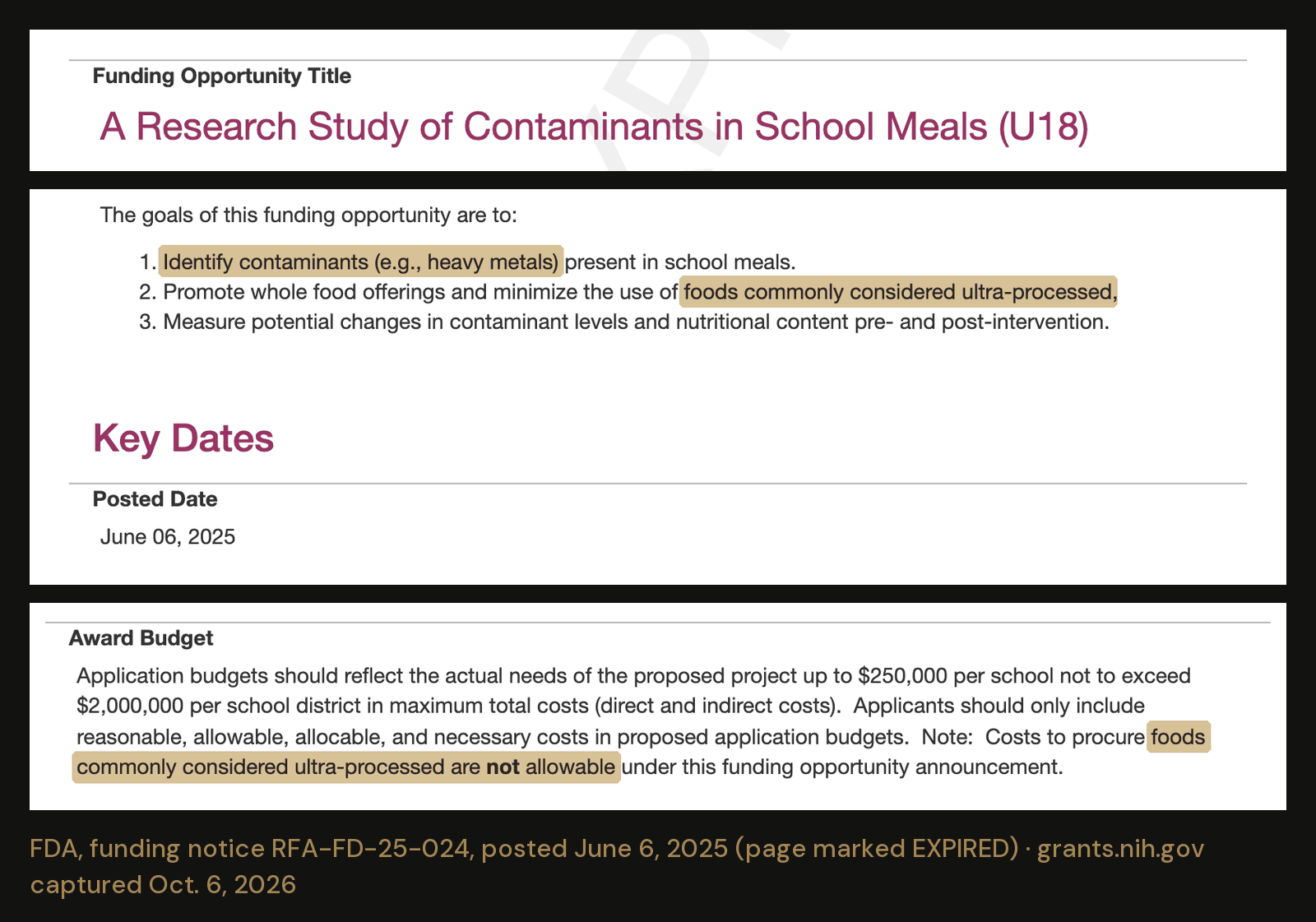
FDA’s funding notice RFA-FD-25-024, posted June 6, 2025, read October 6, 2026.
The President’s own standard says that is not enough. His May 2025 order on “Gold Standard Science” defines it by nine traits. One is “structured for falsifiability of hypotheses.” A before-and-after design without a comparison group cannot tell its result apart from changes that would have happened anyway. That is the logic of a late-night diet ad: a before photo, an after photo, and no one asking what happened to the people who skipped the shakes. This one has a federal grant number.
The order asks for science that can be proven wrong. The notice, as written, names no schools left unchanged to check the results against. That limit holds for its contaminant measures too. If the pilot reports fewer heavy metals after the menu change, the design as written cannot say whether the menu did it.
What the research says
The sections above are about paperwork. This one asks what the evidence says about each change, in both directions, and some of it cuts against the case I am making. The short version: the strongest evidence here sits behind the rules this administration inherited and kept. On the record I read, the protein push has the least.
School meal standards are linked to lower obesity in the children most at risk. A 2020 study used national survey data on 173,013 young people from 2003 to 2018, before and after the 2010 law that tightened school meal standards. It found no significant link to obesity trends overall. For children in poverty, the authors’ model put obesity in 2018 at about 21 percent, against about 31 percent if the earlier trend had continued. The authors’ manuscript describes the difference as 47 percent higher without the law.
A 2022 study of 5,958 low-income children compared two groups of kindergartners. Before the law, children in free or reduced-price lunch moved toward high body weight faster than those not in it. After the law, that gap was no longer seen. Both studies are natural experiments and cohort data, not trials. The 2024 sugar and sodium limits are the newest layer of those standards, and keeping them fits the direction of that evidence.
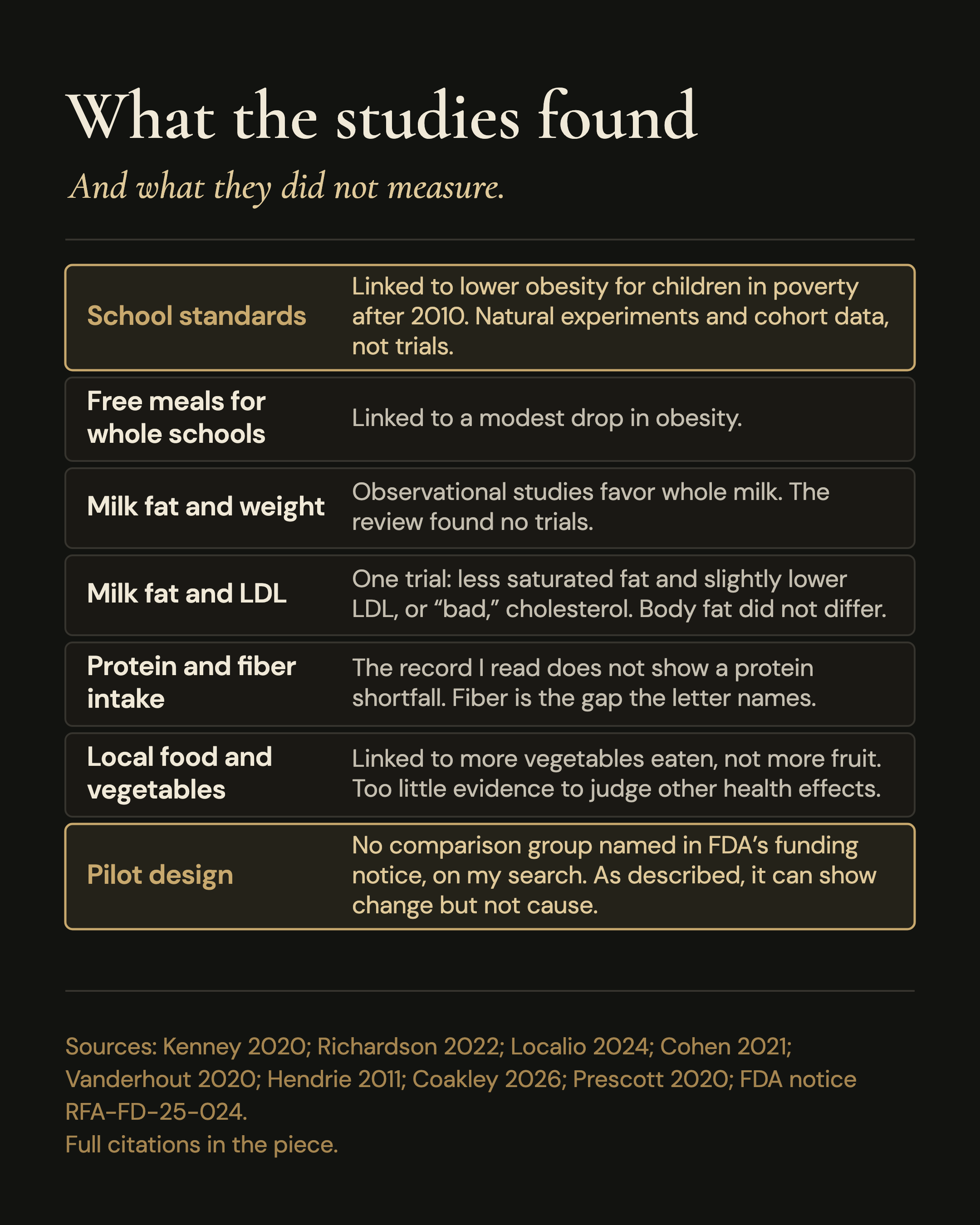
What the studies found, and what they did not measure. LDL is often called “bad” cholesterol. Sources are listed at the end.
On whole milk, the weight evidence does not show harm, and the one trial I found cuts the other way, modestly. This is the part where the administration’s side has a point, and I am going to give it the floor before I check its work. A 2020 review of observational studies found children who drank whole milk had lower odds of overweight. That finding is real. So are its two holes. The review found no trials, and heavier children may have been switched to lower-fat milk. In that case the scale picked the carton, not the other way around.
In a trial published in 2011, 93 Australian families with 145 children were assigned advice to switch to reduced-fat dairy or a comparison program. After 24 weeks, the reduced-fat group ate less saturated fat and had slightly lower LDL cholesterol. Body fat did not differ. So the one trial I found says the milk switch did not move the waistline, and it did move the blood work, slightly. Each side gets a point, and the tiebreaker has not shown up. A trial of whole versus 1 percent milk in young children had an estimated primary completion date of December 2024. On October 6, 2026, I found no published results in PubMed or on ClinicalTrials.gov. The milk law did not wait for it. It passed with sponsors from both parties anyway.
The saturated fat question is real, and it is where I would put my worry as a dietitian. In the federal food survey for 2021 to 2023, children 6 to 19 got about 12 percent of their calories from saturated fat on average, by my arithmetic. The guidelines keep a 10 percent limit. The law now leaves milk fat out of the school count.
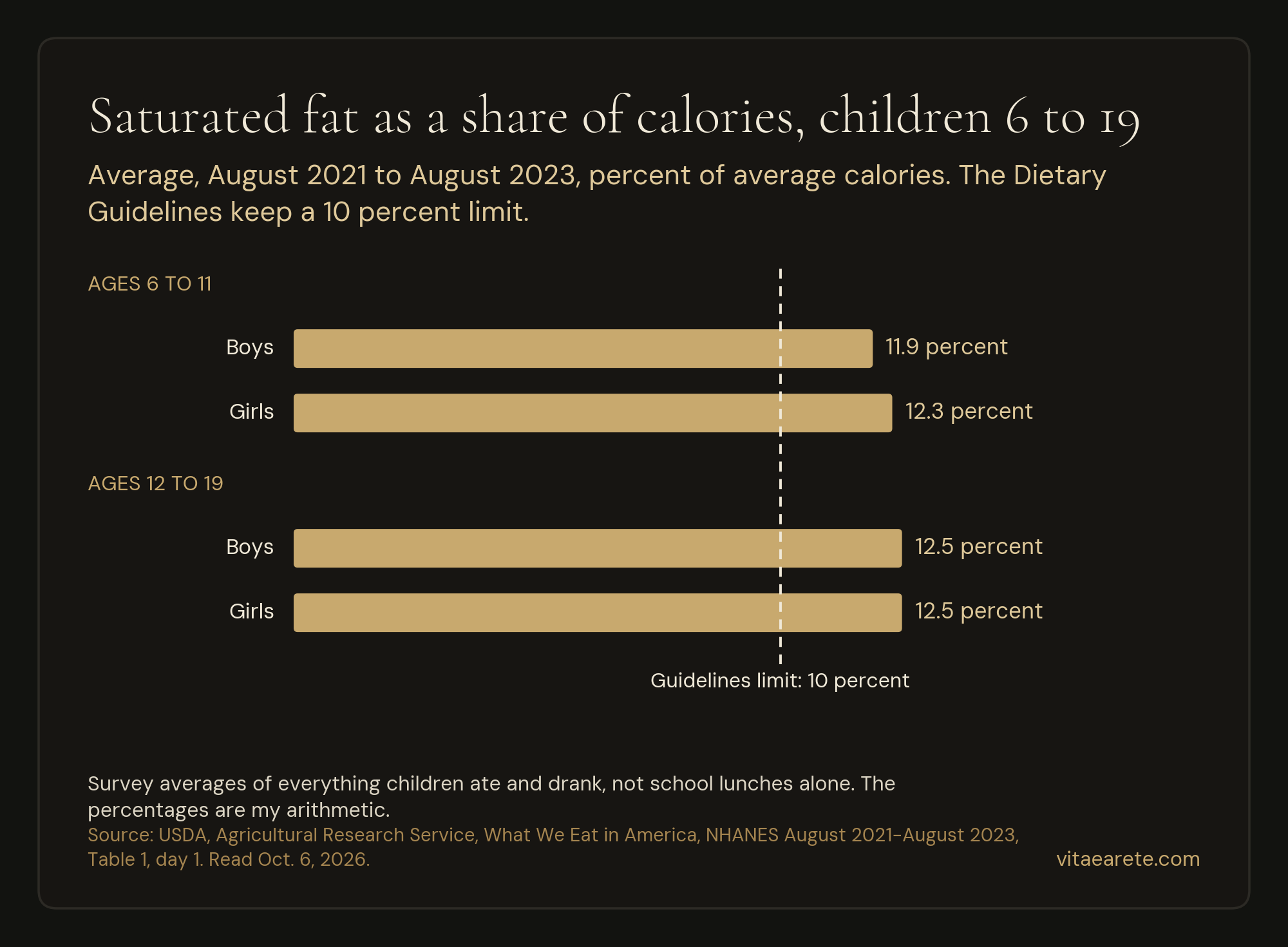
Average saturated fat as a share of average calories, by age and sex, August 2021 to August 2023. Source: USDA, What We Eat in America, NHANES, Table 1, day 1; the percentages are my arithmetic.
On protein, the record I read does not show a shortfall. The same survey puts average protein at about 60 to 63 grams a day for children 6 to 11. At ages 12 to 19 it runs from about 58 grams for girls to 84 for boys. The districts’ letter reads USDA’s own meal study as showing students already meet the new protein guidance. I did not compare intakes with a reference amount myself.
Fiber is the gap the letter names; the survey puts it at about 14 to 17 grams a day for school-age children. I found nothing in the record showing that children need more meat at school. Ron Swanson would disagree, and Ron Swanson is not a peer-reviewed source. If the rewrite adds meat anyway, it adds the part of the tray the districts call “typically the most expensive,” for a gap the record does not show. The gap it does show is fiber.
Local food in schools helps a little. A 2026 review of nine studies found local buying linked to children eating more vegetables, not more fruit, with too little evidence to judge other health effects. An earlier review found gains in what children know about food. Modest is still more than a pledge measures. The surest loss from the 2025 cuts is the food the money would have bought.
What could have been done instead
Each step below was within USDA’s or the health department’s existing power, unless marked as Congress’s. None of it needed a press event.
Keep the local-food money, or replace it with food money of the same size. The strategy promised whole foods in school meals and help for farm-to-school. The evidence for local buying is modest, and it is evidence for vegetables. About $558 million was taken back, and the August plan lists less than a quarter of that, mostly for equipment and research. A child in a lunch line cannot eat a pledge or a study. The money taken back was meant to buy food.
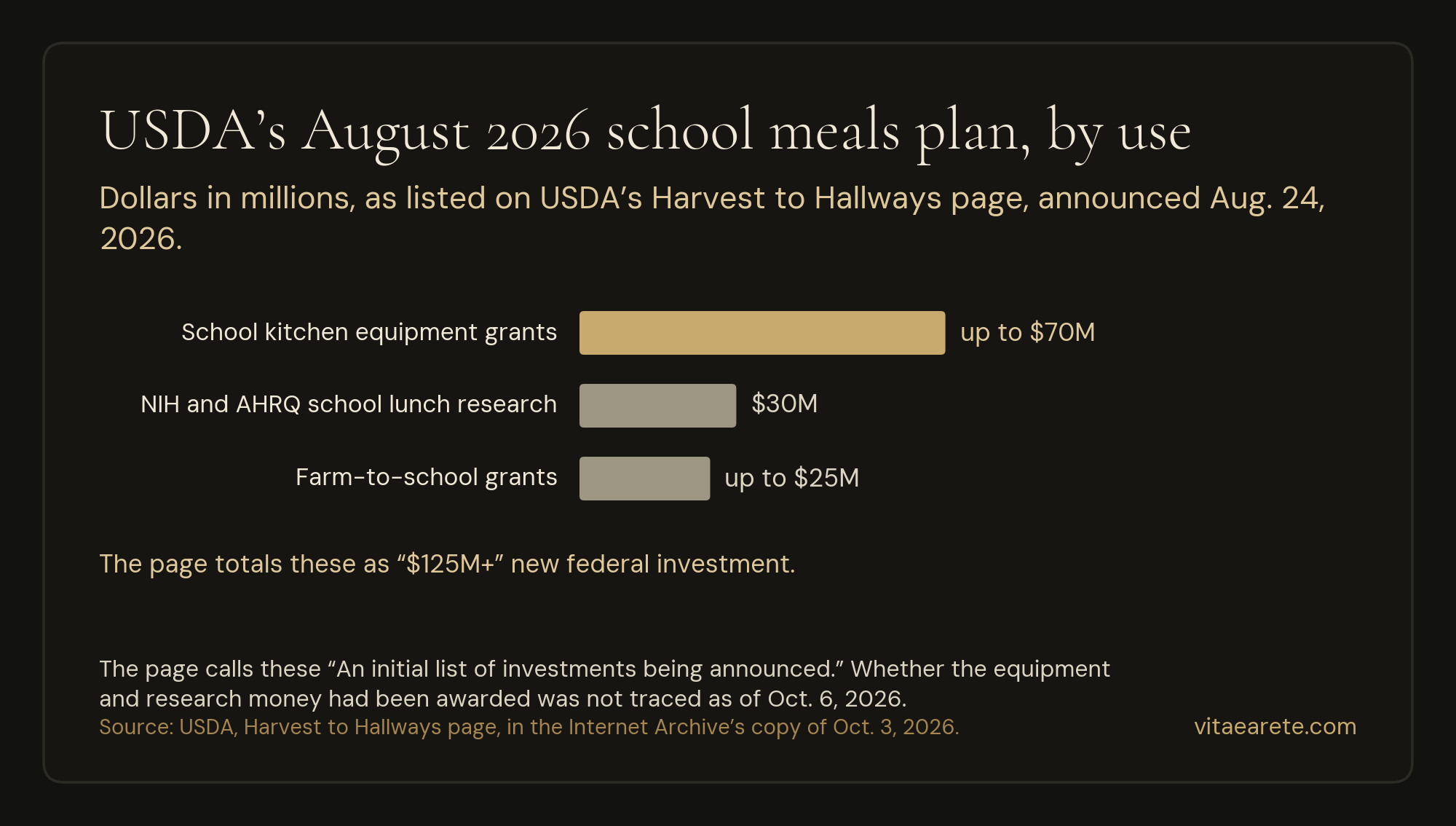
What the Harvest to Hallways page lists, by use. Source: USDA’s Harvest to Hallways page, in the Internet Archive’s copy of October 3, 2026.
Publish the rewrite with its evidence and its cost. A proposal would let school districts, parents and researchers see the changes and comment. Until the text is published, there is nothing for schools to follow and nothing for anyone to check. The rewrite USDA announced in January 2026 was, as of October 6, a text no parent could read.
Aim the rewrite at the documented gaps. The record names fiber, added sugars and sodium. The 2024 limits already address two of them, and USDA kept them. A protein increase would need evidence the record I read does not show, and money the school groups say they lack.
Pay for new requirements. Congress sets meal payments, but the administration writes the budget request. If the rule adds protein at breakfast, the School Nutrition Association’s own estimate puts the cost at about $1.3 billion a year. Schools already run about $2.9 billion a year short, by the same association’s estimate. Adding a requirement to that hole without money is the “This is fine” dog from KC Green’s 2013 Gunshow comic, sitting in the burning room with a coffee. The coffee would be whole milk now.
Widen free meals for whole schools. A federal option lets schools in poorer areas serve free meals to every student, and the evidence for it is modest but consistent. In 3,531 California schools, joining was linked to a net drop in obesity prevalence of 0.60 percentage points, a 2.4 percent relative drop from a starting level of 25 percent. A 2021 review of 47 studies found universal free meals linked to higher participation in nearly every study. Most of the studies that included free lunch found better diets and food security. USDA sets the threshold by rule. In September 2023 it lowered the minimum share of students already certified through programs such as food stamps from 40 percent to 25 percent. On my search of the Federal Register, I found no action since January 2025.
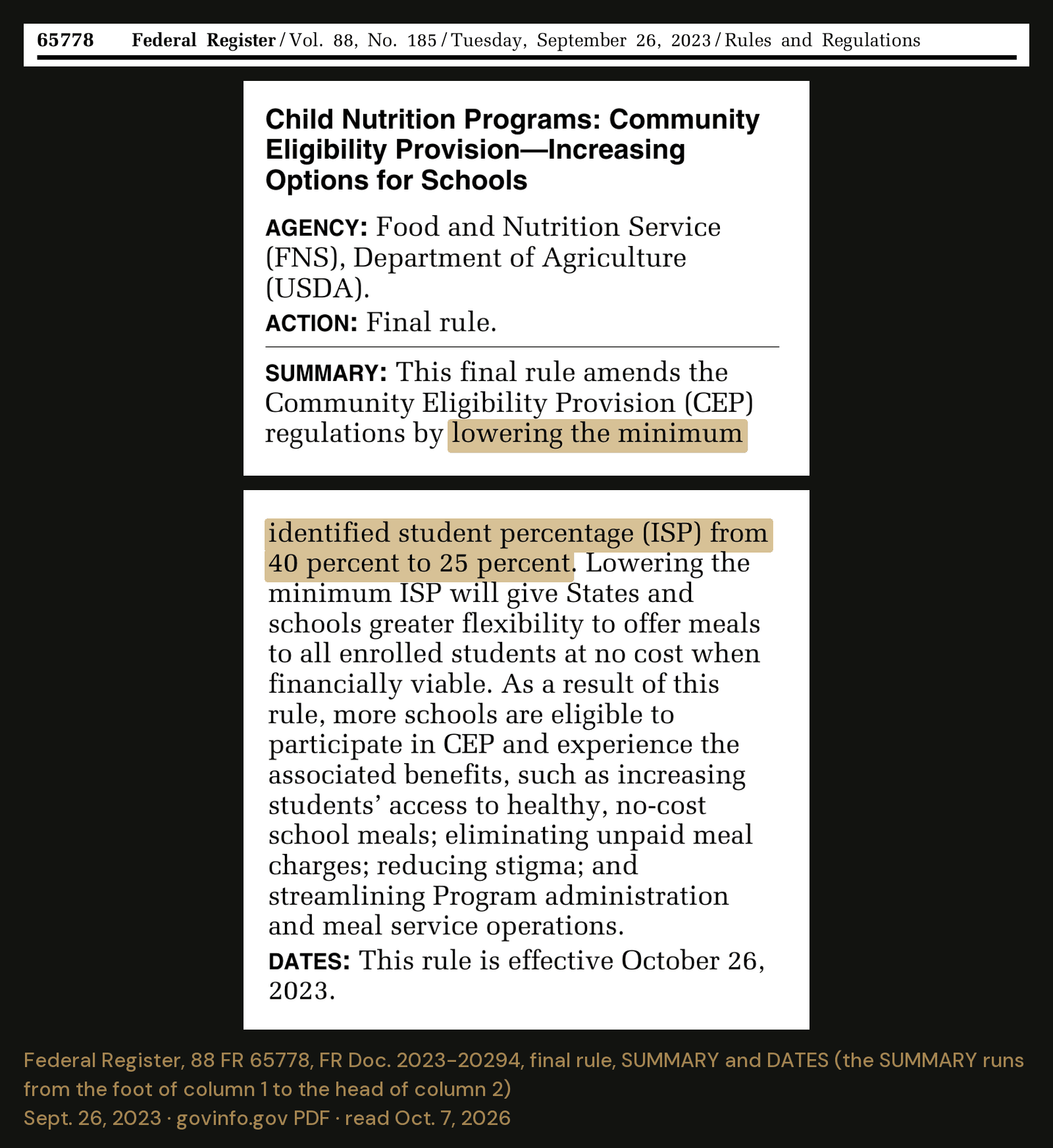
USDA’s final rule on free meals for whole schools, summary and effective date, Federal Register, September 26, 2023, from GovInfo, read October 7, 2026.
Build evaluation into the pilots. FDA’s school pilot and the $30 million research line could compare schools that change with schools that do not. That fits the standard the President’s own order sets. It would also let the government find out whether its own idea works, which is usually the point of research.
Keep counting the households that run short of food. USDA’s own release says the household food security study ran for 30 years before the department ended future reports in September 2025. A school meal policy aimed at children who go without needs the number that says how many there are. USDA ended the reports by its own announcement, so USDA can restart them. The last count it published found 318,000 households where, at times in 2024, children were hungry, skipped a meal or did not eat for a whole day.
What I checked, and what I cannot tell you
On October 6, 2026, I searched the Federal Register by rule number, by agency and by the sections of federal regulations that hold the school meal rules. I read the White House review office’s lists of rules under review and of completed reviews. I read the rewrite’s two agenda entries, all fifteen meeting pages then posted and the main documents filed with them. I read the milk law, the milk rule, the 2024 and 2026 spending laws, and the current school meal regulations. I read USAspending records for all 40 of the 2025 school and child care agreements, and DOGE’s public savings data. usda.gov returned an “Access Denied” error to the tools I used, so I read its press releases and the Harvest to Hallways page through the Internet Archive. The pages of its Food and Nutrition Administration did answer. Each source is listed at the end.
On October 14, 2026, I checked again. The Federal Register returned no document for the rewrite’s rule number. The review office’s list still showed the rule as received July 20, 2026, and its review page called it pending. The meeting log listed nineteen meetings. USAspending and DOGE’s data showed the same 40 agreements, and I found no payments. I searched the commission’s strategy for “Local Food for Schools”, “cooperative agreement”, “terminat”, “local food” and “660” and found none of them.
That evening I re-read the review page and the office’s data file, the Federal Register and the meeting log, with the same results, plus the two conflicting “Economically Significant” entries. I re-read the USAspending records for Texas, California, Florida, New York, Illinois, Georgia and Vermont. I read USDA’s releases of February 14, 2025, September 20, 2025, and August 24, 2026. I read the Economic Research Service’s food security pages and report summaries, Invariant’s 2026 lobbying filings, the Vermont testimony and the two Massachusetts releases. I read the 1946 school lunch law, the 2011 spending law, the 1993 executive order’s definition of a significant rule and realfood.gov. The state figures are my halves of the spending records’ doubled lines, as with the national total.
I searched the Federal Register for any change to the school lunch and breakfast meal rules (7 CFR parts 210 and 220) since January 20, 2025. I found two documents. One is the milk rule. The other is a September 2026 rule on local buying that USDA says does not “change the meaning of the regulations.” Neither touches sugar or sodium. A June 2025 interim rule also dropped a state reporting requirement on checking families’ eligibility; it does not touch what is served. I also searched the Federal Register for any USDA action on the rule for free meals in whole schools since January 2025 and found none.
I found no other 2025 agreements under the local food program for schools and child care on USAspending.
The spending records list most of these deobligations (the entries that take money back) twice, so their own totals read double. My $558 million counts each one once, and so do my state figures. The payment figures are also the agencies’ own reports.
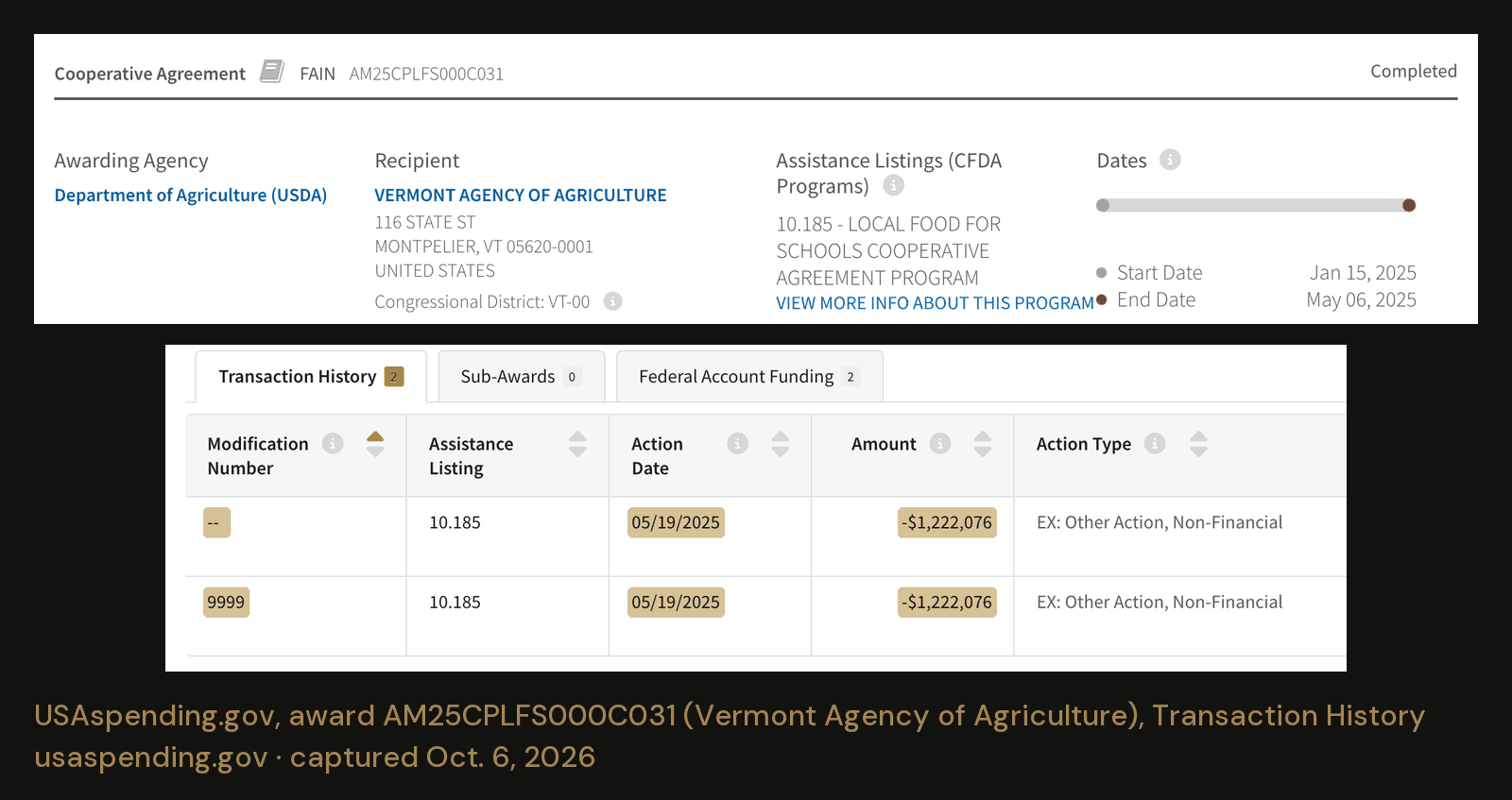
USAspending.gov, award AM25CPLFS000C031 (Vermont), transaction history, read October 6, 2026. Thirty-nine of the 40 records show the deobligation on two lines. My sum counts it once.
I could not find USDA’s own statement of a national total. As noted above, usda.gov returned an “Access Denied” error to my tools. News accounts of what USDA said at the time are not something I can check against the source. USDA can correct me, and my questions to it, below, ask for its own total.
I cannot tell you what the rewrite says. Its text is not public. The meeting documents show what groups asked for, not what USDA wrote.
I cannot tell you who decided to end the local-food agreements, or why, beyond the notices’ line about “agency priorities.” I cannot tell you whether any of that money was later restored. USAspending showed no new money on those agreements when I read it, and that is the only check I made.
The Vermont farm figures come from a nonprofit’s testimony to the legislature, not from the state or USDA. The Massachusetts figures and the cancelled Leahy grant program are the state’s account. I did not check them against a USDA notice. I did not check USDA’s figure for SNAP spending.
I did not trace whether the August plan’s equipment or research money had been awarded by October 6, 2026.
Kennedy’s words run from 13:47 to 14:05 of the episode. The channel marks its segment on schools at 13:50.
My grade
This grade is my judgment on the documents cited here. It uses the four lines set out in the piece that opened this series on October 3, 2026: Substance, Evidence, Health and Integrity. The local-food program and the 2024 rule began before January 2025, so each is graded only on what was done with it afterward. Each line answers only what these documents show. It is not a finding about anyone’s motive. I will revise it in a dated note if the record changes, and I will grade the rewrite again when it is published.
D, for now. The largest binding act in this record was a subtraction. USDA took back about $558 million in 2025 food money for schools and child care, by my sum of its spending records. The records show no payments on any of it. That round was announced before the change of administration, and USDA’s marketing service ended it in spring 2025, months before the commission’s strategy. Nothing I read ties that decision to Kennedy or the commission, so I count it against USDA’s record. The plan that followed lists less than a quarter of that sum, mostly for equipment and research. My comparison is with that plan only. USDA also buys food for schools through other programs, which I did not total.
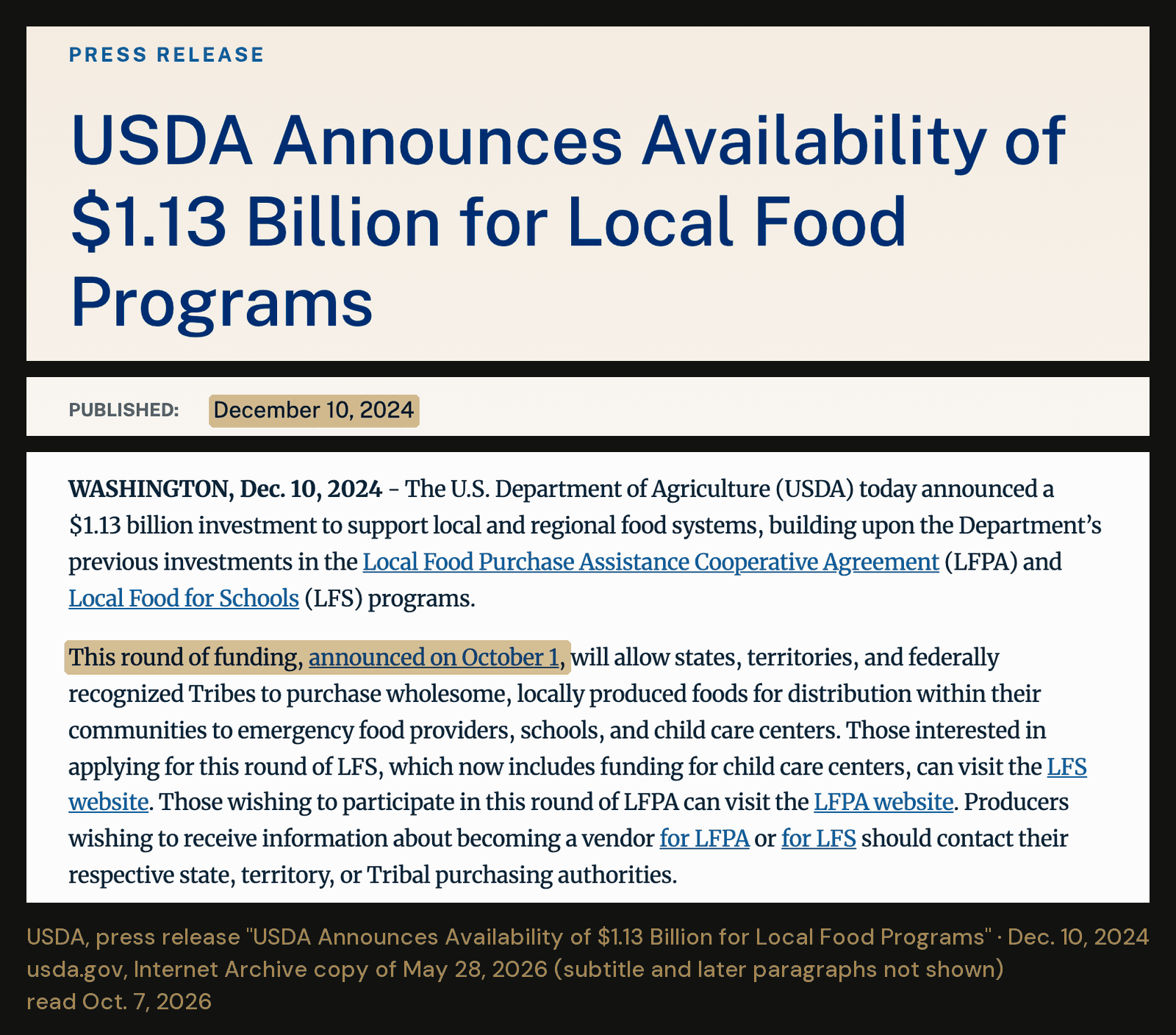
USDA’s press release of December 10, 2024, in the Internet Archive’s copy of May 28, 2026, read October 7, 2026. The $1.13 billion covers more than the school and child care money, which was up to $660.1 million by my addition.
Whole milk became binding, as the strategy promised, through a law both parties passed and a rule USDA published 114 days later. The rule skipped a proposal, which federal rulemaking law allows for benefit programs. The rewrite on USDA’s agenda has passed both dates the agenda gave, which USDA calls estimates, and is not public. The credits are real. On my search of the Federal Register, I found no change to the 2024 sugar limits, and they took effect on schedule. The review office’s log is public, with the filed documents attached. The FDA pilot awarded about $17 million to schools and school districts.
The thread through all of it is counting. DOGE counted savings before USDA’s ledger closed. A statute stopped counting fat that is still in the carton. USDA announced it would stop publishing its count of households that run short of food and called the count “politicized.” Its own economists had called the 2023 rate “statistically significantly higher” than 2020, 2021 and 2022. Only one of those two phrases comes with a margin of error. None of that changes the grade’s arithmetic, which rests on the money, but it is the pattern I will be watching when the rewrite comes out.
I can see the case for a C. The rewrite’s content is unknown and could be good. The milk change has a fair evidence case on weight, and the sugar limits survived. The D rests mostly on a termination that came months before the strategy, and the record does not tie it to Kennedy or the commission. I am giving a D because the largest thing this record took away was money for children’s food. On the records I read, the food is the part that did not come back. I will look again when the rewrite is published.
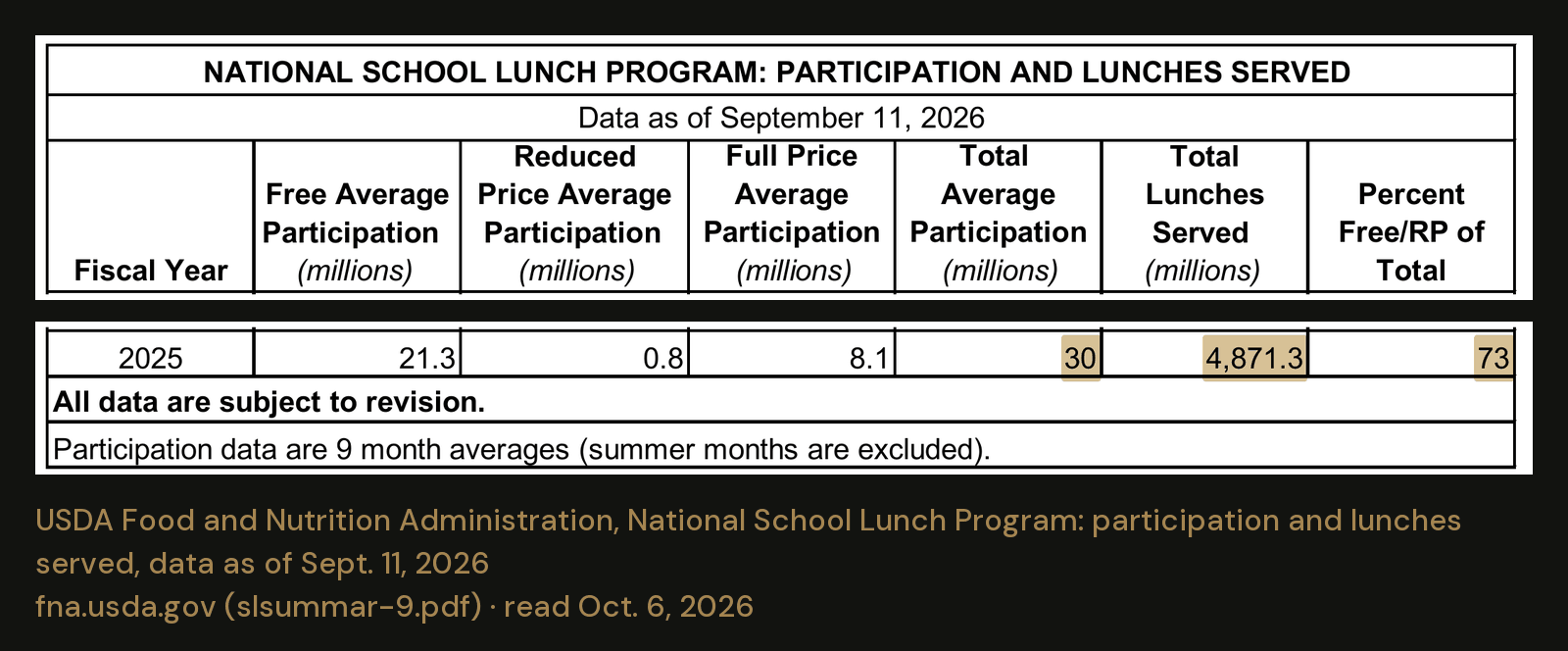
USDA Food and Nutrition Administration, National School Lunch Program summary, fiscal year 2025, data as of September 11, 2026. Participation is a nine-month average.
Substance: Two binding acts. The 2025 local-food agreements for schools and child care ended. The milk law and its rule took effect. The 2024 sugar limits, inherited, took effect untouched. The rewrite is not published, and the pledge is not a rule. Kennedy says school lunches will change; the rule under review has not been published.
Evidence: The standards the administration kept have the best evidence behind them. The weight evidence on whole milk does not show harm, and one small trial shows modestly lower saturated fat and LDL with reduced-fat dairy. The districts’ letter, citing USDA’s own meal study, says students already meet the new protein guidance. I found nothing in the record showing they fall short. The evidence for local food is modest and covers vegetables. FDA’s funding notice names no comparison group, on my search of its text.
Health: School lunch reaches about 30 million children a day, and most of those lunches are free or reduced price. The sugar limits now in force fit the strongest evidence here. The loss of local-food money is measured in food not bought, not in health. The rewrite’s effect cannot be judged until its text is public.
Integrity: The meetings on the rewrite are logged and public, with the filed documents attached. The log shows who asked to meet, not what anyone decided. The milk rule skipped a proposal, which federal rulemaking law allows for benefit programs. It reached beyond the new law, on other authority USDA cites, without first taking comment. USDA ended its own report on households that run short of food with a claim its own economists’ numbers contradict.
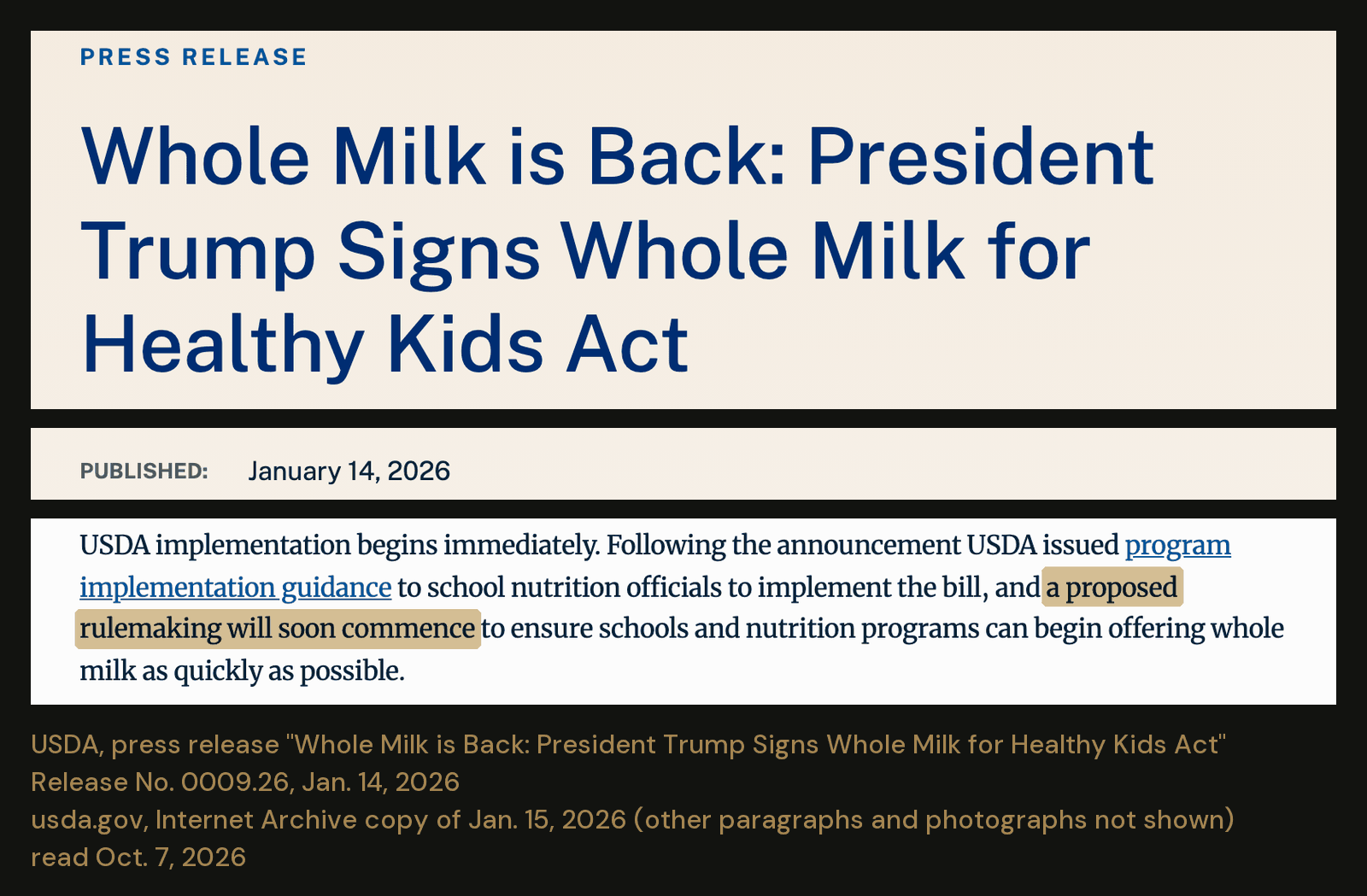
USDA’s press release of January 14, 2026, in the Internet Archive’s copy of January 15, 2026, read October 7, 2026.
I asked USDA and HHS
On October 6, 2026, I sent questions to USDA’s press office. I said I am not credentialed media.
I gave USDA my count from its spending records, 40 agreements and about $558 million, and asked it to confirm or correct it. I asked whether any of that money has been restored or replaced. I asked who at USDA decided to end the agreements and why, and whether the agency’s DOGE team lead was consulted under the February 2025 order. I asked why USDA issued the milk rule as a final rule rather than the proposal its January release described, and why it reaches breakfast and child and adult care. I asked when USDA expects to publish the school meal proposal, given the two dates in its agenda. I asked whether it will change the meat and meat alternate requirement, the added-sugar limits or the 2027 sodium step, and whether it will require protein at breakfast. I also asked USDA to confirm that the 2024 spending law cited above is the provision that holds school sodium at current limits, and whether any later provision matters.
On October 6, 2026, I sent questions to the Department of Health and Human Services through its request-for-comment form. I asked whether Secretary Kennedy’s remark, in the episode posted on September 30, 2026, described the proposed rule, the Harvest to Hallways pledge, both, or something else. I asked whether FDA’s school pilot and the $30 million research line include comparison schools, and how the pilot defines “foods commonly considered ultra-processed.”
I asked both for a reply by 5 p.m. Eastern on Wednesday, October 14, 2026, and offered to print it whole or summarized. By 8:20 a.m. Eastern on Saturday, October 17, 2026, I had received no reply. If an answer arrives, it will go here, with the date it arrived.
This is general education and a reading of public documents. It is not medical or legal advice.
References
U.S. Department of Agriculture, Food and Nutrition Administration. School meal proposal under review: “Child Nutrition Programs: Aligning Program Requirements with the 2025-2030 Dietary Guidelines for Americans,” RIN 0584-AF17, received July 20, 2026. Office of Information and Regulatory Affairs, EO_RULES_UNDER_REVIEW.xml and EO_RULE_COMPLETED_YTD.xml, run date October 6, 2026. https://www.reginfo.gov/public/do/XMLReportList (accessed October 6, 2026)
Office of Information and Regulatory Affairs. EO 12866 meetings, RIN 0584-AF17: fifteen records, August 10 to September 22, 2026, with each meeting page and filed document. https://www.reginfo.gov/public/do/eom12866SearchResults?pubId=202510&rin=0584-AF17&viewRule=true (accessed October 6, 2026); and “Schedule an E.O. 12866 Meeting” (“OIRA meets on regulatory actions with any interested party”). https://www.reginfo.gov/public/do/eo/neweomeeting (accessed October 6, 2026)
Office of Information and Regulatory Affairs. Unified Agenda entries for RIN 0584-AF17, “Reducing Complexity and Food Waste in the Child Nutrition Programs,” spring 2025 and 2026. https://www.reginfo.gov/public/do/eAgendaViewRule?pubId=202504&RIN=0584-AF17 and https://www.reginfo.gov/public/do/eAgendaViewRule?pubId=202510&RIN=0584-AF17 (accessed October 6, 2026)
Regulatory Information Service Center. Introduction to the Unified Agenda of Federal Regulatory and Deregulatory Actions, Spring 2025. Federal Register, September 22, 2025. FR Doc. 2025-18323. https://www.federalregister.gov/documents/2025/09/22/2025-18323 (accessed October 6, 2026)
U.S. Department of Agriculture. 2026 Unified Agenda. Federal Register, August 14, 2026. FR Doc. 2026-16604. https://www.federalregister.gov/documents/2026/08/14/2026-16604 (accessed October 6, 2026; “the dates shown for the steps of each action are estimated and are not commitments”)
Executive Order 14192 of January 31, 2025, Unleashing Prosperity Through Deregulation. Federal Register, February 6, 2025. 90 FR 9065, FR Doc. 2025-02345. https://www.federalregister.gov/documents/2025/02/06/2025-02345 (accessed October 6, 2026)
Letter to Secretary Brooke L. Rollins from “900+ undersigned school districts, school nutrition professionals, and school nutrition organizations,” March 9, 2026, filed at the September 1, 2026, meeting. https://www.reginfo.gov/public/do/eoDownloadDocument?pubId=&eodoc=true&documentID=1368892 (accessed October 6, 2026)
School Nutrition Association. “Estimated Funding Requirements Following Updated Nutrition Standards” and “Protein at Breakfast,” filed at the September 2, 2026, meeting. https://www.reginfo.gov/public/do/eoDownloadDocument?pubId=&eodoc=true&documentID=1371844 and https://www.reginfo.gov/public/do/eoDownloadDocument?pubId=&eodoc=true&documentID=1371846 (accessed October 6, 2026)
American Frozen Food Institute. “Serving More Than Meals: The Essential Role of Frozen Foods in School Nutrition,” filed at the August 13, 2026, meeting. https://www.reginfo.gov/public/do/eoDownloadDocument?pubId=&eodoc=true&documentID=1348744 (accessed October 6, 2026)
USA Rice Federation. “Alignment of Child Nutrition Program Meal Standards with the 2025-2030 DGA,” filed at the August 10, 2026, meeting. https://www.reginfo.gov/public/do/eoDownloadDocument?pubId=&eodoc=true&documentID=1338892 (accessed October 6, 2026)
Executive Office of the President. Executive Order 12866 of September 30, 1993, Regulatory Planning and Review, section 6(b)(2). https://www.archives.gov/files/federal-register/executive-orders/pdf/12866.pdf (accessed October 6, 2026)
U.S. Department of Agriculture. USDA Announces Availability of $1.13 Billion for Local Food Programs. Press release, December 10, 2024, in the Internet Archive’s copy of May 28, 2026. https://web.archive.org/web/20260528110250/https://www.usda.gov/about-usda/news/press-releases/2024/12/10/usda-announces-availability-113-billion-local-food-programs (accessed October 6, 2026)
Vermont Agency of Agriculture, Food and Markets. USDA Funding for Local Food Purchasing Programs Terminated. March 13, 2025, in the Internet Archive’s copy of July 11, 2025. https://web.archive.org/web/20250711121149/https://agriculture.vermont.gov/agency-agriculture-food-markets-news/usda-funding-local-food-purchasing-programs-terminated (accessed October 6, 2026)
USAspending.gov. Local Food for Schools Cooperative Agreement Program (assistance listing 10.185), FY2025 agreements AM25CPLFS000C001 to C040, award records, outlays and transactions. https://api.usaspending.gov/ (accessed October 6, 2026; sum of 40 deobligations, counted once each, is the author’s)
Department of Government Efficiency. Savings data, grants (public data feed). https://api.doge.gov/savings/grants (accessed October 6, 2026; 40 Local Food for Schools agreements dated March 17, 2025)
Executive Order 14158 of January 20, 2025, Establishing and Implementing the President’s “Department of Government Efficiency.” Federal Register, January 29, 2025. 90 FR 8441, FR Doc. 2025-02005. https://www.federalregister.gov/documents/2025/01/29/2025-02005 (accessed October 6, 2026)
Executive Order 14222 of February 26, 2025, Implementing the President’s “Department of Government Efficiency” Cost Efficiency Initiative. Federal Register, March 3, 2025. 90 FR 11095, FR Doc. 2025-03527, section 3(b). https://www.federalregister.gov/documents/2025/03/03/2025-03527 (accessed October 6, 2026)
President Donald J. Trump. Remarks at the Future Investment Initiative Institute Priority Summit, Miami Beach, February 19, 2025, DCPD-202500280; Address Before a Joint Session of the Congress, March 4, 2025, DCPD-202500325. https://www.govinfo.gov/content/pkg/DCPD-202500280/html/DCPD-202500280.htm and https://www.govinfo.gov/content/pkg/DCPD-202500325/html/DCPD-202500325.htm (accessed October 6, 2026)
U.S. District Court for the District of Columbia. New Mexico v. Musk, No. 1:25-cv-00429. Declaration of the Director, Office of Administration, ECF No. 24-1, February 17, 2025. https://storage.courtlistener.com/recap/gov.uscourts.dcd.277463/gov.uscourts.dcd.277463.24.1.pdf (accessed October 6, 2026)
Executive Order 14212 of February 13, 2025, Establishing the President’s Make America Healthy Again Commission. Federal Register, February 19, 2025. 90 FR 9833, FR Doc. 2025-02871, section 3. https://www.federalregister.gov/documents/2025/02/19/2025-02871 (accessed October 6, 2026)
President’s Make America Healthy Again Commission. Make Our Children Healthy Again Strategy. September 2025. Pages 12 and 18. https://www.whitehouse.gov/wp-content/uploads/2025/09/The-MAHA-Strategy-WH.pdf (accessed October 6, 2026)
U.S. Department of Health and Human Services and U.S. Department of Agriculture. Dietary Guidelines for Americans, 2025-2030. January 2026. Message from the Secretaries; protein, dairy, healthy fats and whole grains. https://cdn.realfood.gov/DGA.pdf (accessed October 6, 2026)
U.S. Congress. Whole Milk for Healthy Kids Act of 2025, Public Law 119-69, January 14, 2026 (S. 222). https://www.govinfo.gov/link/plaw/119/public/69?link-type=html (accessed October 6, 2026)
U.S. Department of Agriculture. Whole Milk is Back: President Trump Signs Whole Milk for Healthy Kids Act. Release No. 0009.26, January 14, 2026, in the Internet Archive’s copy of January 15, 2026. https://web.archive.org/web/20260115040544/https://www.usda.gov/about-usda/news/press-releases/2026/01/14/whole-milk-back-president-trump-signs-whole-milk-healthy-kids-act (accessed October 6, 2026)
U.S. Department of Agriculture, Food and Nutrition Service. Expanding Fluid Milk Options in Child Nutrition Programs. Final rule with comment period. Federal Register, May 8, 2026. 91 FR 25073, FR Doc. 2026-09212, RIN 0584-AF28, Docket FNS-2026-0067. https://www.federalregister.gov/documents/2026/05/08/2026-09212/expanding-fluid-milk-options-in-child-nutrition-programs (accessed October 6, 2026; “Issuance of a Final Rule With Comment Period”; section 17 of the National School Lunch Act, 42 U.S.C. 1766(g)(4)(A))
U.S. Department of Agriculture, Food and Nutrition Service. Child Nutrition Programs: Meal Patterns Consistent With the 2020-2025 Dietary Guidelines for Americans. Final rule. Federal Register, April 25, 2024. FR Doc. 2024-08098. https://www.federalregister.gov/documents/2024/04/25/2024-08098 (accessed October 6, 2026)
Code of Federal Regulations. 7 CFR 210.10, Meal requirements for lunches and requirements for afterschool snacks. eCFR, current to October 1, 2026. https://www.ecfr.gov/current/title-7/section-210.10 (accessed October 6, 2026)
U.S. Department of Agriculture, Food and Nutrition Administration. Updates to the School Nutrition Standards. Web page, updated September 2, 2026. https://www.fna.usda.gov/cn/school-nutrition-standards-updates (accessed October 6, 2026)
U.S. Congress. Consolidated Appropriations Act, 2024, Public Law 118-42, Division B, Section 770. March 9, 2024. https://www.govinfo.gov/link/plaw/118/public/42?link-type=html (accessed October 6, 2026)
U.S. Department of Agriculture, Food and Nutrition Administration. Child Nutrition Tables: National School Lunch Program and School Breakfast Program, participation and meals served, data as of September 11, 2026. https://www.fna.usda.gov/pd/child-nutrition-tables (accessed October 6, 2026)
U.S. Department of Agriculture, Food and Nutrition Administration. USDA Foods in Schools. Web page, updated April 18, 2025. https://www.fna.usda.gov/usda-fis (accessed October 6, 2026)
U.S. Department of Agriculture. Harvest to Hallways. Web page, in the Internet Archive’s copy of October 3, 2026. https://web.archive.org/web/20261003202250/https://www.usda.gov/harvest-to-hallways (accessed October 6, 2026)
Secretary Robert F. Kennedy, Jr. (YouTube channel). “No Dinner Plan? Make This $3 One-Skillet Meal | The Produce Mom,” an episode of The Real Food Show, posted September 30, 2026, chapter “REAL Food in Our Schools” from 13:50; quoted words 13:47 to 14:05 in the uploaded captions. https://www.youtube.com/watch?v=14uVcLs1mYs (accessed October 6, 2026)
U.S. Food and Drug Administration. A Research Study of Contaminants in School Meals (U18), RFA-FD-25-024. Posted June 6, 2025. https://grants.nih.gov/grants/guide/rfa-files/RFA-FD-25-024.html (accessed October 6, 2026); awards U18FD008659 to U18FD008674, USAspending.gov (accessed October 6, 2026; total is the author’s sum)
Executive Order 14303 of May 23, 2025, Restoring Gold Standard Science. Federal Register, May 29, 2025. 90 FR 22601, FR Doc. 2025-09802, section 3(a). https://www.federalregister.gov/documents/2025/05/29/2025-09802 (accessed October 6, 2026)
U.S. Department of Agriculture, Agricultural Research Service. What We Eat in America, NHANES August 2021-August 2023, Table 1: Nutrient Intakes from Food and Beverages, by sex and age, day 1. https://www.ars.usda.gov/ARSUserFiles/80400530/pdf/2123/Table_1_NIN_MaleFemale_2123.pdf (accessed October 6, 2026)
Kenney EL, Barrett JL, Bleich SN, Ward ZJ, Cradock AL, Gortmaker SL. Impact of the Healthy, Hunger-Free Kids Act on Obesity Trends. Health Affairs, 2020;39(7):1122-1129. https://doi.org/10.1377/hlthaff.2020.00133 (erratum 2020;39(9):1650; figures as given in the authors’ manuscript, PMC7961790; accessed October 6, 2026)
Richardson AS, Weden MM, Cabreros I, Datar A. Association of the Healthy, Hunger-Free Kids Act of 2010 With Body Mass Trajectories of Children in Low-Income Families. JAMA Network Open, 2022;5(5):e2210480. https://doi.org/10.1001/jamanetworkopen.2022.10480 (accessed October 6, 2026)
Localio AM, Knox MA, Basu A, Lindman T, Walkinshaw LP, Jones-Smith JC. Universal Free School Meals Policy and Childhood Obesity. Pediatrics, 2024;153(4):e2023063749. https://doi.org/10.1542/peds.2023-063749 (accessed October 6, 2026)
Cohen JFW, Hecht AA, McLoughlin GM, Turner L, Schwartz MB. Universal School Meals and Associations with Student Participation, Attendance, Academic Performance, Diet Quality, Food Security, and Body Mass Index: A Systematic Review. Nutrients, 2021;13(3):911. https://doi.org/10.3390/nu13030911 (accessed October 6, 2026)
U.S. Department of Agriculture, Food and Nutrition Service. Child Nutrition Programs: Community Eligibility Provision-Increasing Options for Schools. Final rule. Federal Register, September 26, 2023. FR Doc. 2023-20294. https://www.federalregister.gov/documents/2023/09/26/2023-20294 (accessed October 6, 2026)
Vanderhout SM, Aglipay M, Torabi N, Jüni P, da Costa BR, Birken CS, et al. Whole milk compared with reduced-fat milk and childhood overweight: a systematic review and meta-analysis. American Journal of Clinical Nutrition, 2020;111(2):266-279. https://doi.org/10.1093/ajcn/nqz276 (accessed October 6, 2026)
Hendrie GA, Golley RK. Changing from regular-fat to low-fat dairy foods reduces saturated fat intake but not energy intake in 4-13-y-old children. American Journal of Clinical Nutrition, 2011;93(5):1117-1127. https://doi.org/10.3945/ajcn.110.010694 (accessed October 6, 2026)
Cow Milk Fat Obesity pRevention Trial (CoMFORT). ClinicalTrials.gov NCT03914807, record read October 6, 2026; protocol in BMJ Open, 2020. https://clinicaltrials.gov/study/NCT03914807 (estimated primary completion December 2024; no results found in PubMed or ClinicalTrials.gov, October 6, 2026)
Coakley KE, Lin L, Gonzales-Pacheco D, Thompson OM, Eldredge JD, Jimenez EY, Prescott MP. Multi-Level Health Outcomes of Local Food Procurement in United States Farm-to-School Programs: a Systematic Review. Advances in Nutrition, 2026;17(2):100580. https://doi.org/10.1016/j.advnut.2025.100580 (accessed October 6, 2026)
Prescott MP, Cleary R, Bonanno A, Costanigro M, Jablonski BBR, Long AB. Farm to School Activities and Student Outcomes: A Systematic Review. Advances in Nutrition, 2020;11(2):357-374. https://doi.org/10.1093/advances/nmz094 (accessed October 6, 2026)
Office of Information and Regulatory Affairs. Pending EO 12866 Regulatory Review, RIN 0584-AF17 (received date 07/20/2026; stage Proposed Rule; legal deadline None). https://www.reginfo.gov/public/do/eoDetails?rrid=1470212 (accessed October 14, 2026, 12:34 p.m. ET); EO_RULES_UNDER_REVIEW.xml, run date October 14, 2026; EO 12866 meetings, RIN 0584-AF17, nineteen records, including meetings scheduled for October 13, 15, 16 and 19, 2026. https://www.reginfo.gov/public/do/eom12866SearchResults?pubId=202510&rin=0584-AF17&viewRule=true (accessed October 14, 2026)
U.S. Department of Agriculture. Harvest to Hallways. Web page, in the Internet Archive’s copy of October 14, 2026. https://web.archive.org/web/20261014102729/https://www.usda.gov/harvest-to-hallways (accessed October 14, 2026)
U.S. Department of Agriculture. Secretary Rollins Takes Bold Action to Stop Wasteful Spending and Optimize USDA to Better Serve American Agriculture. Press release, February 14, 2025, in the Internet Archive’s copy of January 28, 2026. https://web.archive.org/web/20260128041449/https://www.usda.gov/about-usda/news/press-releases/2025/02/14/secretary-rollins-takes-bold-action-stop-wasteful-spending-and-optimize-usda-better-serve-american (accessed October 14, 2026, 9:11 p.m. ET)
U.S. Department of Agriculture. USDA Terminates Redundant Food Insecurity Survey. Release No. USDA 0219.25, September 20, 2025. https://www.fna.usda.gov/newsroom/usda-0219.25 (accessed October 14, 2026, 9:11 p.m. ET)
U.S. Department of Agriculture, Economic Research Service. Food Security in the U.S.: Key Statistics and Graphics; and Food Security in the U.S. (topic page). https://www.ers.usda.gov/topics/food-nutrition-assistance/food-security-in-the-us/key-statistics-graphics and https://www.ers.usda.gov/topics/food-nutrition-assistance/food-security-in-the-us (accessed October 14, 2026, 9:11 and 9:15 p.m. ET)
U.S. Department of Agriculture, Economic Research Service. Definitions of Food Security (“hunger is not adequately assessed in the food security survey”). https://www.ers.usda.gov/topics/food-nutrition-assistance/food-security-in-the-us/definitions-of-food-security (accessed October 14, 2026, 9:55 and 10:12 p.m. ET)
Rabbitt MP, Reed-Jones M, Hales LJ, Suttles S, Burke MP. Household Food Security in the United States in 2024. U.S. Department of Agriculture, Economic Research Service, ERR-358, December 30, 2025, and its report summary. https://www.ers.usda.gov/publications/pub-details?pubid=113622 and https://www.ers.usda.gov/media/7746/err-358-report-summary.pdf (accessed October 14, 2026, 9:11 and 9:12 p.m. ET)
U.S. Department of Agriculture, Economic Research Service. Household Food Security in the United States in 2023, ERR-337, report summary. https://www.ers.usda.gov/media/7712/err-337-report-summary.pdf (accessed October 14, 2026, 9:12 p.m. ET)
U.S. Department of Agriculture. USDA Announces Harvest to Hallways Initiative to Invest in Child Nutrition Programs. Release No. USDA 0111.26, August 24, 2026. https://www.fna.usda.gov/newsroom/usda-0111.26 (accessed October 14, 2026, 9:11 p.m. ET)
Strom K, Northeast Organic Farming Association of Vermont. Termination of Local Food for Schools and Child Care. Memorandum to the Vermont House Committee on Agriculture, March 20, 2025. https://legislature.vermont.gov/Documents/2026/Workgroups/House%20Agriculture/Food%20Resiliency/Federal%20Funding%20Cuts/W~Kayla%20Strom~Termination%20of%20Local%20Food%20for%20Schools%20and%20Child%20Care~3-20-2025.pdf (accessed October 14, 2026, 9:11 p.m. ET)
Commonwealth of Massachusetts. Governor Healey Denounces President Trump’s Decision to Cut $12 Million in Federal Funding to Feed Children, Support Local Farmers in Massachusetts. March 10, 2025. https://www.mass.gov/news/governor-healey-denounces-president-trumps-decision-to-cut-12-million-in-federal-funding-to-feed-children-support-local-farmers-in-massachusetts (accessed October 14, 2026, 9:11 p.m. ET)
Commonwealth of Massachusetts. Trump Administration Continues to Take Away Food from Massachusetts Families and Students. March 28, 2025. https://www.mass.gov/news/trump-administration-continues-to-take-away-food-from-massachusetts-families-and-students (accessed October 14, 2026, 9:11 p.m. ET)
USAspending.gov. Award records for AM25CPLFS000C024 (Texas), C002 (California), C004 (Florida), C033 (New York), C014 (Illinois) and C018 (Georgia). https://api.usaspending.gov/api/v2/awards/ (accessed October 14, 2026, 9:11 and 9:13 p.m. ET; state figures are the author’s halves of each doubled deobligation)
Lobbying Disclosure Act filings. Invariant LLC for Danone USA Public Benefit Corporation, first and second quarters of 2026. https://lda.gov/filings/public/filing/cfac0542-61fe-4cbf-ac70-494cae08cb57/print/ and https://lda.gov/filings/public/filing/367f9f94-b776-485a-9cc9-5dc2ff1d53a9/print/ (accessed October 14, 2026, 9:11 p.m. ET; $160,000 is the author’s sum and covers every issue listed; the filings do not name the school meal proposal); and all 30 Invariant LLC filings for that client, second quarter of 2019 through second quarter of 2026. https://lda.gov/api/v1/filings/?registrant_name=Invariant&client_name=Danone (accessed October 14, 2026, 9:56 and 10:13 p.m. ET)
U.S. Code. 42 U.S.C. 1751, Congressional declaration of policy (June 4, 1946, ch. 281, section 2, 60 Stat. 230). https://www.govinfo.gov/content/pkg/USCODE-2023-title42/html/USCODE-2023-title42-chap13-sec1751.htm (accessed October 14, 2026, 9:13 p.m. ET)
U.S. Congress. Consolidated and Further Continuing Appropriations Act, 2012, Public Law 112-55, Sections 743 and 746. Approved November 18, 2011. https://www.govinfo.gov/content/pkg/PLAW-112publ55/html/PLAW-112publ55.htm (accessed October 14, 2026, 9:11 p.m. ET)
U.S. Congress. Consolidated and Further Continuing Appropriations Act, 2015, Public Law 113-235, Section 752, approved December 16, 2014; Consolidated Appropriations Act, 2016, Public Law 114-113; Consolidated Appropriations Act, 2017, Public Law 115-31 (school sodium “below Target 1”). https://www.govinfo.gov/content/pkg/PLAW-113publ235/html/PLAW-113publ235.htm, https://www.govinfo.gov/app/details/PLAW-114publ113 and https://www.govinfo.gov/app/details/PLAW-115publ31 (accessed October 14, 2026, 10:00 and 10:13 p.m. ET)
Executive Office of the President. Executive Order 12866 of September 30, 1993, Regulatory Planning and Review, section 3(f)(1). https://www.archives.gov/files/federal-register/executive-orders/pdf/12866.pdf (accessed October 14, 2026, 9:11 p.m. ET); Office of Information and Regulatory Affairs, review page for RIN 0584-AF17 (“Economically Significant: Yes”) and EO_RULES_UNDER_REVIEW.xml (“No”), both read October 14, 2026, 9:11 p.m. ET. https://www.reginfo.gov/public/do/eoDetails?rrid=1470212 and https://www.reginfo.gov/public/do/XMLViewFileAction?f=EO_RULES_UNDER_REVIEW.xml
Eat Real Food (realfood.gov), official U.S. government site carrying the Dietary Guidelines for Americans, 2025-2030, home page. https://realfood.gov (accessed October 14, 2026, 9:57 p.m. ET, re-read 10:12 p.m. ET; earliest Internet Archive capture January 7, 2026, https://web.archive.org/web/20260107163625/https://realfood.gov/)
This article is general nutrition education, not individualized medical or nutrition advice, and it does not create a dietitian–client relationship. Medications and their side effects should be managed with your prescribing clinician. See the full disclaimer.