Summary
Cancer biologists describe cancer by ten behaviors, not by where it grows. I am an outpatient oncology dietitian, and I write here for myself, not for the health system I work for. I sit with people while chemotherapy runs into their veins, some of them on experimental trials after everything standard has failed. I have watched those ten behaviors take people apart for years. This essay runs the same checklist on the United States in October 2026 and asks whether the country’s own reports will be acted on before it runs out of swings. I do not argue that growth is bad, and I do not call any group of people a cancer.
Healthy tissue grows and then stops. A tumor grows until it has used up the body. The essay argues that a promise of growth without end is the clearest symptom.
Tariffs the Supreme Court later ruled unlawful raised about $166 billion. The Congressional Budget Office estimates consumers faced price increases equal to 95 percent of the cost. By October 2, 2026, about $126 billion in refunds, interest included, had been certified, to the importers. Shoppers have no refund path through Customs.
The starved tissue gets sick first. The richest 1 percent of Americans had a life expectancy at forty 14.6 years longer than the poorest 1 percent for men, on 2001 to 2014 records. For women the gap was 10.1 years.
The country’s immune system is now run by a lawyer who founded what the Associated Press calls an anti-vaccine nonprofit. Measles, declared eliminated in 2000, has its highest count since 1991.
Dietitians are a preventive layer of medicine, and this essay shows that layer being starved. My own pay report has gone up the chain at work. The essay ends on whether the country reads its own.
I. The jury is seated in the infusion room
Before the checklist: the infusion room.
The infusion room is a row of recliners, a stand of poles, and clear bags that empty a drop at a time into a vein. People sit there for hours. People fight for their lives sitting down. Some are on a first cycle and think it will be a short war. Some are on a trial, because the first line failed, and then the next one did.
I am the registered dietitian in that room. My job is to keep bodies fed while cancer tries to starve them: labs, protein math, negotiations with appetites that have quit. Patients do not get meal trays at the infusion center, so they bring snacks, and we keep snacks on hand. I am happy whenever I see someone with food. The patient who worries me is the one holding nothing.
So I explain what a body spends just staying a body, and how a hypermetabolic state, inflammation or an injury raises the bill while the appetite goes the other way. Pain cuts appetite. So do constipation and a recliner where a whole day of moving used to be, and nausea is on the American Cancer Society’s list. Then the scale drops, which is discouraging, and discouragement is one more reason not to eat. Almost every system in the body is voting against lunch. The vote is not close.
Then we start talking, and sooner or later I hear it, from the internet, an AI chatbot, an influencer, a loved one or somebody who also went through cancer. Sugar makes the cancer worse. Processed food makes it worse, and so does anything that is not organic. That frustrates me more than any Uncrustable or bag of Cheez-Its ever has. By that math the Cheez-Its are an accomplice, the Uncrustable is the getaway driver, and the only safe snack in the building is the air in the waiting room. I have a license and a calculator. The influencer who taught the internet to fear a cracker probably had a ring light and a discount code. I would rather see you eat the goddamn cracker.
The man in chair four had lost eleven pounds since his last scan, and the same scan showed that his tumor had gained. The muscle over his temples had hollowed. The fat on his arms had thinned, and his grip had gone soft. Every standard treatment had failed him, one line after another. The bag running into his port that afternoon was a clinical trial, a drug still being tested.*
A trial is often what medicine offers when it has run out of things it can promise. It is the swing you take when the textbook has run out of pages, and he took it anyway. The line ran from the bag down to his port, and the eleven pounds were not in the bag. They had left his temples and his arms and his hands, and the thing growing inside him had fed on what they gave up. Nothing had broken into him. Everything taking him apart was his.
Cancer is the body’s own cells, carrying the body’s own DNA, walking out on the arrangement that made them part of a body. It does not break in from outside, the way a virus or a bacterium does, and the cells still draw from the same blood.
If tumors held earnings calls, every one would report record growth, with the host as its only supplier. The patient is the only one not invited to the call. I see the same pattern in my country now, and I call it a diagnosis, built from behaviors anyone can check. The clearest symptom is the one we were trained to applaud. After the last two years, I am not sure how many swings this country has left.
So this is a case, built from dated documents, and I am the expert witness. I will disclose my stake before the case rests. I have sat in a jury box once, looking at a figure I knew was wrong, in a seat where you do not get to object. This time you are the jury, and the objection is yours.
II. The contract every cell keeps, and how cancer breaks it from the inside
The rules healthy cells follow, and what breaking them is called.
You are made of tens of trillions of cells, and every one of them keeps an unwritten contract whose terms it knows by heart. That puts your cells ahead of Kyle on South Park, who accepted the iTunes terms unread in “HumancentiPad” (2011) and got surgically attached to a product launch. Your liver read every clause, including the penalty.
The contract is the statute in this case, and it is the harshest law you will ever live under. A cell divides only when the tissue asks, through growth signals that arrive from outside, and it does not get to ask itself. It stops when it touches its neighbors. That is contact inhibition, and it is why a scrape fills in and then stops, instead of creeping down your shin like ivy. If its DNA is damaged beyond repair, it self-destructs. That is apoptosis, programmed cell death, and healthy cells do it by the billions, without a grievance, a lawyer or a last meal. You did not feel a thing. Every cell also carries a countdown, because the telomeres, the caps on your chromosomes, shorten with every copy. After roughly fifty rounds in a dish, a normal cell stops dividing, and it does not appeal.
It stays in the tissue it was born in. It takes only the fuel its work requires, which is why your earlobe is not sitting on a strategic glucose reserve in case of a bad quarter. And it tells the immune system the truth about what it is, because the immune system checks all day, and what it finds that does not belong, it kills. Bodies have run on rules like these for hundreds of millions of years without a committee or a lobbyist. A cell’s growth serves the body, not the cell. A liver cell’s job is to be liver, and it does not want a podcast. Hand those terms to a board of directors, and the stop clause would not survive the first meeting.
Every cell complete. Every cell stopping where the next one starts.
Cancer breaks the contract clause by clause and lives through the breach. It usually takes several mutations, not one. Oncogenes, the genes that say go, get stuck on. Tumor suppressors, the genes that say stop, get disabled by mutation, deletion or silencing, and the most famous of them is p53, nicknamed the guardian of the genome. Once the guardian goes down, the bad paperwork gets stamped, copied and stamped again. The cell loses its brakes, then its off switch, then its sense of where it belongs.
What it never loses is your face. It carries your DNA and drinks from your blood, so the immune system, built to attack whatever is not self, hesitates. In Mike Flanagan’s The Haunting of Hill House, the ghost that had terrified Nell since childhood turned out to be Nell. Cancer is an inside job. It was already in the house, wearing your face, and the guards let it walk past.
A country runs on a contract like that. Grow when the work calls for it, stop at the limits the law sets, take what the work requires, and tell the inspectors the truth. The tumor in chair four was built from his own cells. The defendant in this case is built the same way, from our own laws, our own offices and our own money. It breaks the contract the way a cell does, one clause at a time, from the inside, and it runs on our blood. The immune system hesitated. It knew the face.
III. Ten counts, one profile, and a motion to dismiss
The ten hallmarks of cancer, run on the United States.
In 2000, two cancer biologists, Douglas Hanahan and Robert Weinberg, set aside where hundreds of cancers grow. They asked what every cancer has to do to exist. They found six behaviors. The 2011 update listed ten, eight hallmarks and two enabling characteristics that make the others easier to acquire (Hanahan and Weinberg, Cell, 2011). It is one of the most cited papers in biology, and Hanahan has revised it twice since, most recently in January 2026. You do not need the suspect’s name if you know what the suspect does.
So I ran the profile on the United States as of October 2026, one instance per row, each dated and sourced. Row one is the highest wealth share since the Federal Reserve series began in 1989. Row three is about $126 billion in refunds certified to importers, and for shoppers, no path through Customs. I filled all ten rows. I had to leave things out.
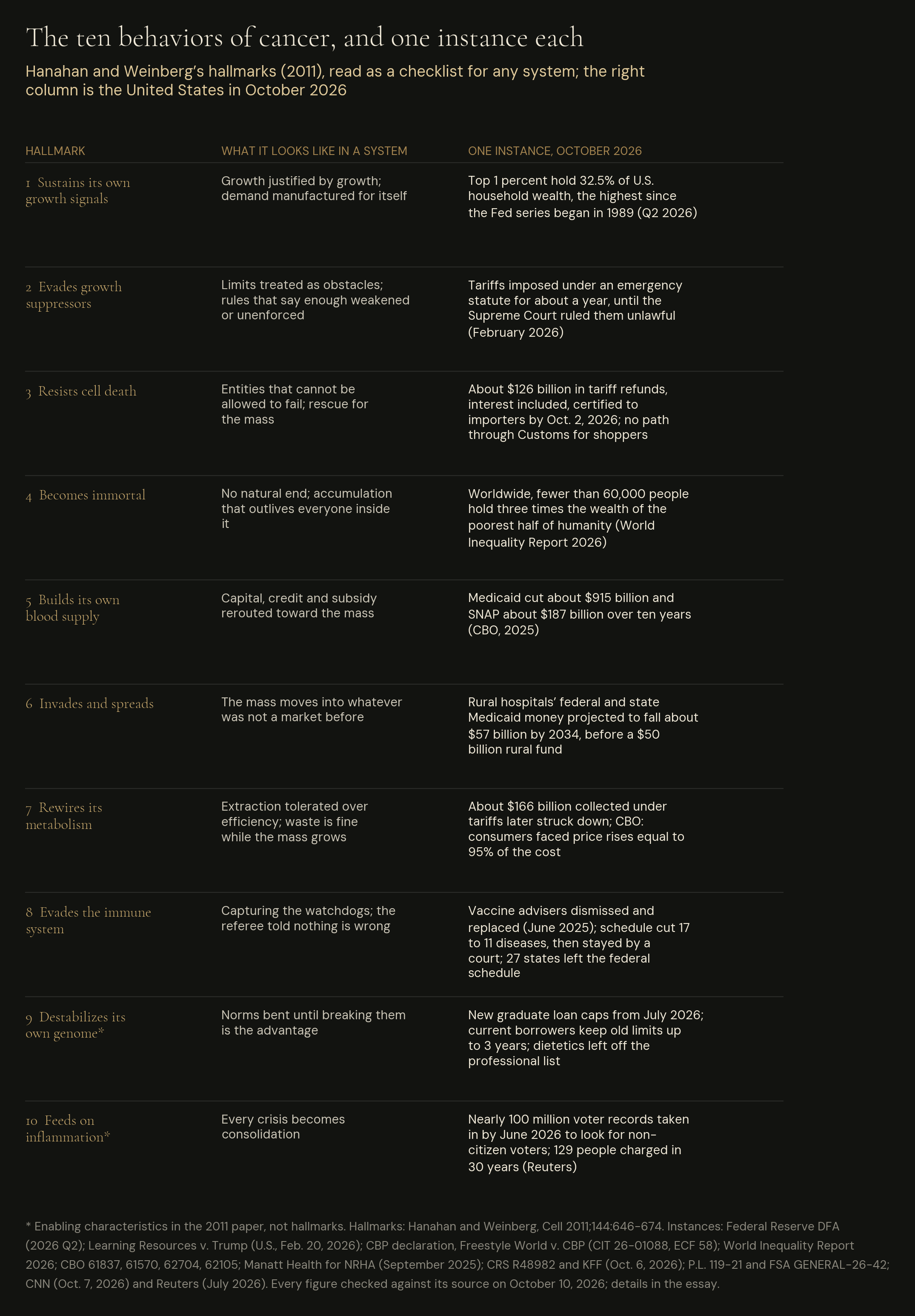
The checklist. Hallmarks from Hanahan and Weinberg (2011), the two enabling characteristics marked with an asterisk; every instance checked against its source on October 10, 2026.
Most of it came from the Federal Reserve, the Congressional Budget Office, a Customs declaration, court records, federal agencies’ own pages and published research. One row rests on two news reports, from CNN and Reuters. I did not need a leak. Several rows are behaviors we were taught to admire: disruption, scale, too big to fail, growth at all costs. We gave them keynote slots and case studies. A pathologist gives them a line under findings.
The defense will object that fast growth is no crime. Sustained. No single hallmark makes a cancer. A healing wound divides fast every day and stays healthy. One good quarter is a good quarter, and one yacht is a hobby. The diagnosis comes when the behaviors stack: a thing drives its own growth, ignores stop signals, reroutes the blood and quiets the immune response. A pattern across ten rows is a diagnosis. All four in the same tissue is a referral to my building.
So the right-hand column names offices, laws and dollar figures, not a villain, because the checklist reads behavior the way a pathologist reads a slide. The pathologist does not ask the slide who it voted for. In 1871 Thomas Nast drew a man in a good suit whose head was a bag of money. Harper’s Weekly readers needed no footnote.
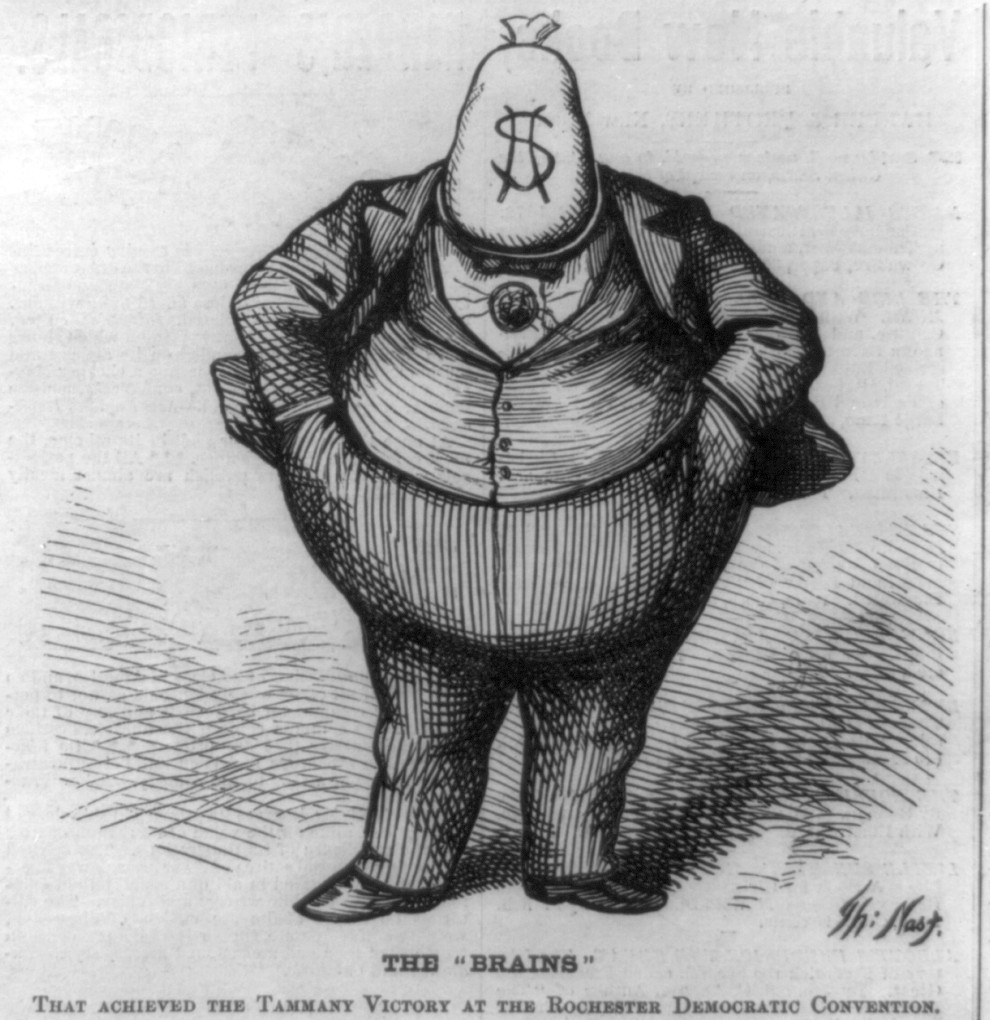
Thomas Nast, The “Brains,” Harper’s Weekly, October 21, 1871. Library of Congress via Wikimedia Commons, public domain. The checklist has looked like this before. The hat changes.
The defense has one serious motion left: throw the whole case out as an illegitimate metaphor. In Illness as Metaphor (1978), Susan Sontag argued that cancer is a dangerous political metaphor, because calling anything a cancer invites violence against it. She was right about the danger, and she is the reason for this case’s first rule. No group of people and no patient is the cancer here. When I say the mass, I mean wealth and power piling up and the behaviors that feed it, not the people who hold them. The diagnosis is of behaviors and the offices that perform them, dated and sourced, and behaviors can be voted out, struck down in court or written out of a statute. That is the entire treatment plan. Motion denied, with precedent: John McMurtry made the case at book length in The Cancer Stage of Capitalism (Pluto Press, 1999), and a second edition followed in 2013.
IV. The tumor holds its earnings call, and the host is not on the line
Hallmarks one, two and four: sustains its own growth signals, evades growth suppressors, becomes immortal.
Growth itself is not the problem. Remove two-thirds of a healthy liver and the remaining third grows quickly, reaches about the size the body needs, most of it within weeks, and stops. A child grows for eighteen years, then holds. A wound closes. Healthy growth is acceleration plus a stop signal, and the stop signal is what makes it healthy. A startup meeting a real need is a wound healing. No tissue exists to keep growing.
Hallmark one is the cell that makes its own grow signal instead of waiting to be asked. It writes its own permission slip and signs the parent’s name. Hallmark four is immortality: a healthy cell retires after about fifty divisions in a dish, and the mass has no retirement age. If the mass held an earnings call, it would sound like this. The call is invented. The arithmetic is the textbook’s.
OPERATOR: Good afternoon, and welcome to the quarterly earnings call for the Mass. All lines are in listen-only mode, and the host has not been invited.
CEO OF THE MASS: We doubled again this quarter, which is what we did last quarter and what we will do next quarter, because doubling is the only thing we do. We began as one cell in a tissue that had not asked for us, so we made our own growth signal in house.
CFO: One cell became two, then four, then eight. After thirty doublings we were roughly a billion cells, about a gram, near the smallest lump a scan reliably finds. The host did not notice. So today we are raising guidance: ten more doublings, roughly a kilogram, close to the most a body can carry. Some observers say the first thirty go unnoticed and the last ten kill you. We prefer to call that a strong second half.
ANALYST, BLOODSTREAM PARTNERS: Can you speak to succession planning?
CEO: We do not have a retirement age. Our cells stopped counting a long time ago. Immortality is a core competency.
ANALYST, LYMPH NODE CAPITAL: Two of your stop genes flagged you last quarter. What happened to them?
CEO: We disabled them. We treat the rest as speed bumps, and our lawyers agree.
ANALYST, BLOODSTREAM PARTNERS: Where is the growth coming from, and has the host been consulted?
CFO: From the host, same as every quarter, at no cost to us. The liver rebuilds our fuel from our own waste, at its own expense. The liver is our unpaid intern.
OPERATOR: The host will be paying for it.
ANALYST, LYMPH NODE CAPITAL: Last question. What is your guidance for the quarter after the host?
CEO: We do not issue guidance past the host. When the host goes, we go with it, and the board considers that a long-term alignment of interests.
OPERATOR: That concludes today’s call, and you may now disconnect.
The mass cannot disconnect. It is plugged into the same blood as the host, and it reports a record quarter every quarter. Tumors grow exponentially at first and then slow, as the mass outruns its blood supply and more cells die than divide (Laird, British Journal of Cancer, 1964). The center of a large tumor is often dead, like a mall whose anchor store closed years ago while the parking lot kept growing. The mass stops because it has used up what it can take. The host has paid for every doubling.
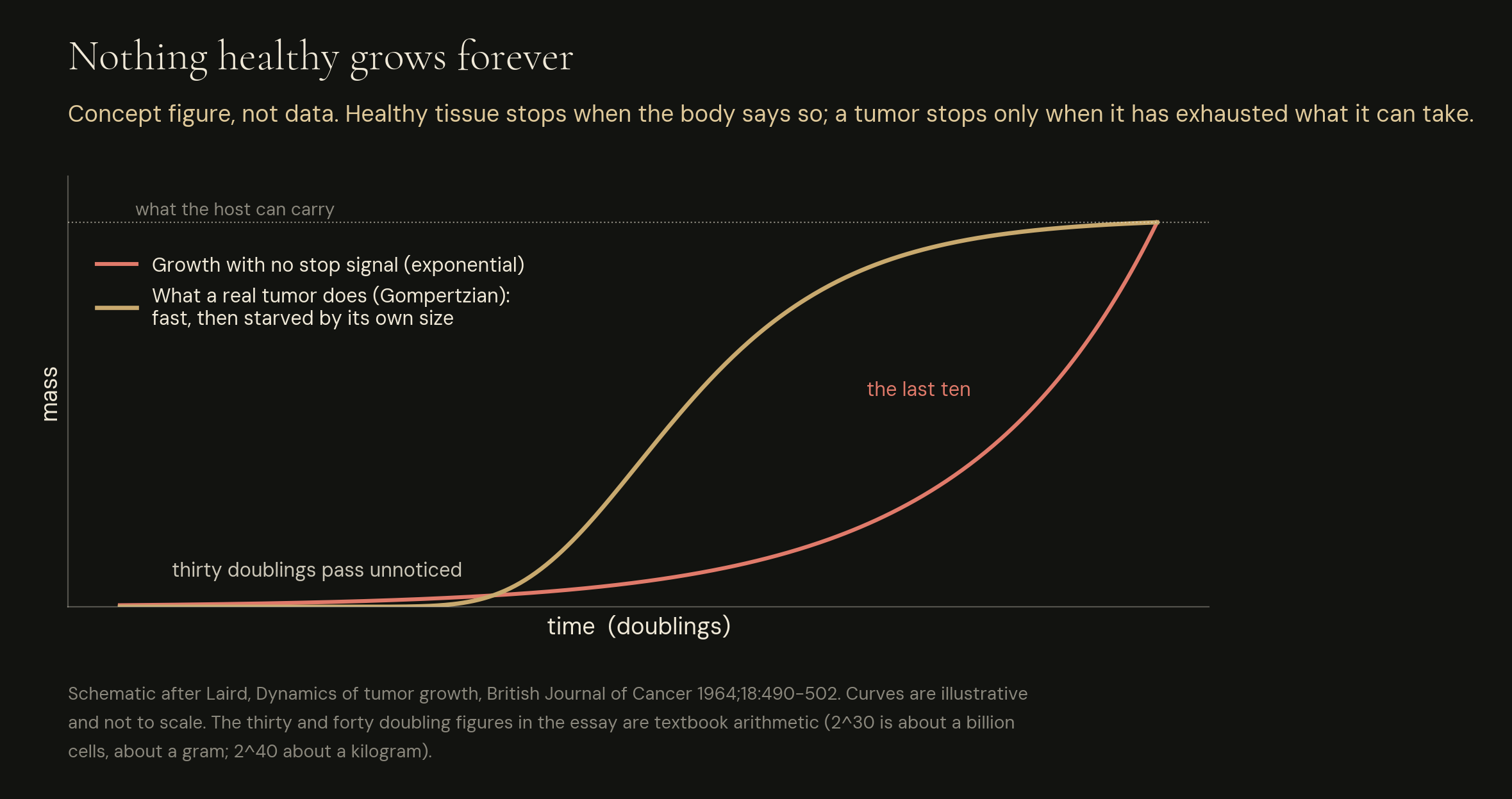
Concept figure, not data. Healthy tissue stops when the body says so. A tumor stops only when it has exhausted what it can take. Schematic after Laird, British Journal of Cancer, 1964.
Every pitch deck ends on a hockey stick. In oncology we have a name for a hockey stick. We treat it. In 2019 a company that sublet desks was valued at $47 billion on the strength of its curve. The curve now has its own documentary. We were taught to hear growth of a fixed percentage every quarter, forever, on a finite host, as a strategy. I hear a cell with no stop signal reporting its quarterly results.
The call was invented. The next number was not. In the second quarter of 2026, the wealthiest 1 percent of households held 32.5 percent of household wealth, about $60.3 trillion, by the Federal Reserve’s quarterly accounts. That is the highest share since the series began in 1989. The bottom 90 percent, nine households in every ten, held about $57.7 trillion. Line up a hundred households. One of them holds more than the ninety at the bottom combined.
A share is not a body mass, and the country is richer than it was in 1989. Both conceded. The chart does not show a starving host. It shows a direction, and no stop, and no stop is the entire charge in this case. Worldwide, fewer than 60,000 people hold three times the wealth of the poorest half of humanity (World Inequality Report, 2026).
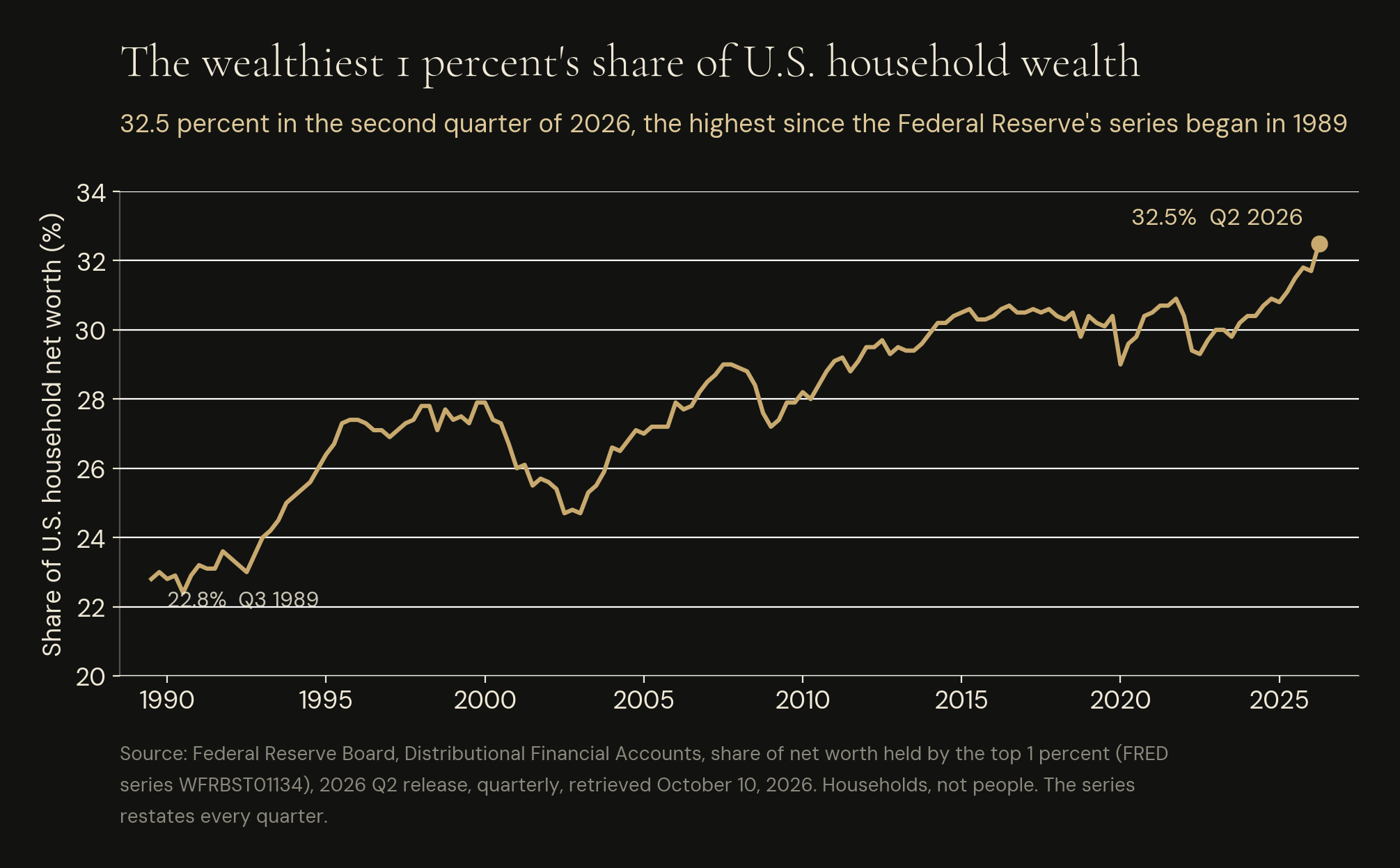
The mass, measured. Share of U.S. household net worth held by the wealthiest 1 percent, quarterly, 1989 to 2026. Federal Reserve Distributional Financial Accounts, 2026 Q2 release.
On January 15, 2025, the outgoing president used his farewell address to warn that “an oligarchy is taking shape in America.” In the same breath he named what it was made of: extreme wealth, power and influence. Five days later, Elon Musk, Jeff Bezos and Mark Zuckerberg, three of the richest men on earth, sat in the Capitol Rotunda ahead of several of the new cabinet nominees. A carton of milk lasts longer than that warning did.
Musk had spent more than $290 million on the 2024 election, much of it to help the new president win, according to year-end federal filings. Two weeks into the term, he posted that he had spent the weekend “feeding USAID into the wood chipper.” In Fargo, for anyone who missed 1996, the wood chipper is not where the paperwork goes. It is where the body goes. On February 20, 2025, at CPAC, he held up a chainsaw and called it a chainsaw for bureaucracy.
Run the timeline once, slowly. On January 15, 2025, a president warns the country about an oligarchy on his way out the door. Five days later, three of the richest men on earth have better seats than several incoming cabinet nominees. Two weeks into the term, the man with the $290 million posts that he spent the weekend feeding USAID into the wood chipper. On February 20, he stands on a stage with a chainsaw. I am supposed to be explaining tumor biology, and the record keeps handing me props. The guidance got raised, and the host was still not on the fucking call.
Hallmark two treats every limit as an obstacle. On the card, row two is the emergency tariffs: the stop signal of the law, treated as a speed bump. The Supreme Court struck them down on February 20, 2026. The bill is still in your drawer.
V. Follow the money the way we follow contrast dye
Hallmarks three, five and seven: resists cell death, builds its own blood supply, rewires its metabolism.
A tumor the size of a pinhead lives on whatever diffuses in. Past that size it signals for new blood vessels pointed at itself, and the best-known signal is called VEGF. The body complies as it would for a healing wound, because it cannot tell the difference. That is angiogenesis, hallmark five, and the moment a lump becomes a disease. The new vessels are shoddy, leaky and chaotic. Blood that would have fed working muscle goes to a growth that produces nothing the body can use.
Cachexia is why the man in chair four lost eleven pounds while his tumor gained. In cachexia, the body does not merely go hungry. It is instructed to consume itself. Inflammatory signals released by the tumor, molecules like interleukin-6 and tumor necrosis factor, tell the muscles to break down. Skeletal muscle is taken apart into amino acids and released into the blood, and the fuel goes to the tumor. His own muscle was being dismantled and shipped to the thing that was killing him, and every signal in his body said the shipment was approved.
Hallmark seven is the metabolism. Otto Warburg described it a century ago. Cancer cells burn glucose the wasteful way a cell uses when short of oxygen, even with oxygen plentiful. They get a fraction of the energy and dump the rest as lactate. The liver then spends more energy turning that lactate back into glucose, which the tumor eats again. That loop is the Cori cycle. The host pays twice. In one small study, the meter ran faster in the patients who were wasting, several times faster than in patients who were not (Holroyde, Cancer Research, 1975).
You cannot fix cachexia by feeding the patient more. Dietitians try anyway, because feeding still helps: we calculate, we supplement, and we start tube feeding when we have to. But the signals that decide where the input goes have been captured, so the tumor takes its share first. The international definition calls it a wasting that conventional nutrition cannot fully reverse (Fearon, Lancet Oncology, 2011). Controlling the cancer is the most reliable thing that does. As of October 2026, I found no cachexia drug approved by the Food and Drug Administration, and I looked.
The sugar post on your phone has a plan to starve exactly one party in this arrangement, and it picked the wrong one. Cutting sugar or the snack has not been shown to starve the tumor in people, according to guidance from the American Cancer Society and the National Cancer Institute. The tumor eats first, the liver rebuilds glucose from lactate, the muscle gives up its amino acids, and the patient is the one who goes hungry. Cutting the snack to starve a tumor is like skipping lunch to punish the IRS. It takes its cut first.
Money can be followed with contrast dye too, so run a tariff dollar through the same scan. It goes in at the register, folded into a shelf price, from a tariff imposed under an emergency-powers statute. From early 2025, those tariffs raised about $166 billion, by the Congressional Budget Office’s count (August 2026). The same office estimates importers passed about 70 percent of the cost on at first and absorbed the rest. Once domestic rivals raised their prices too, consumers faced increases equal to 95 percent of the tariffs’ cost. Most of it went in through you.
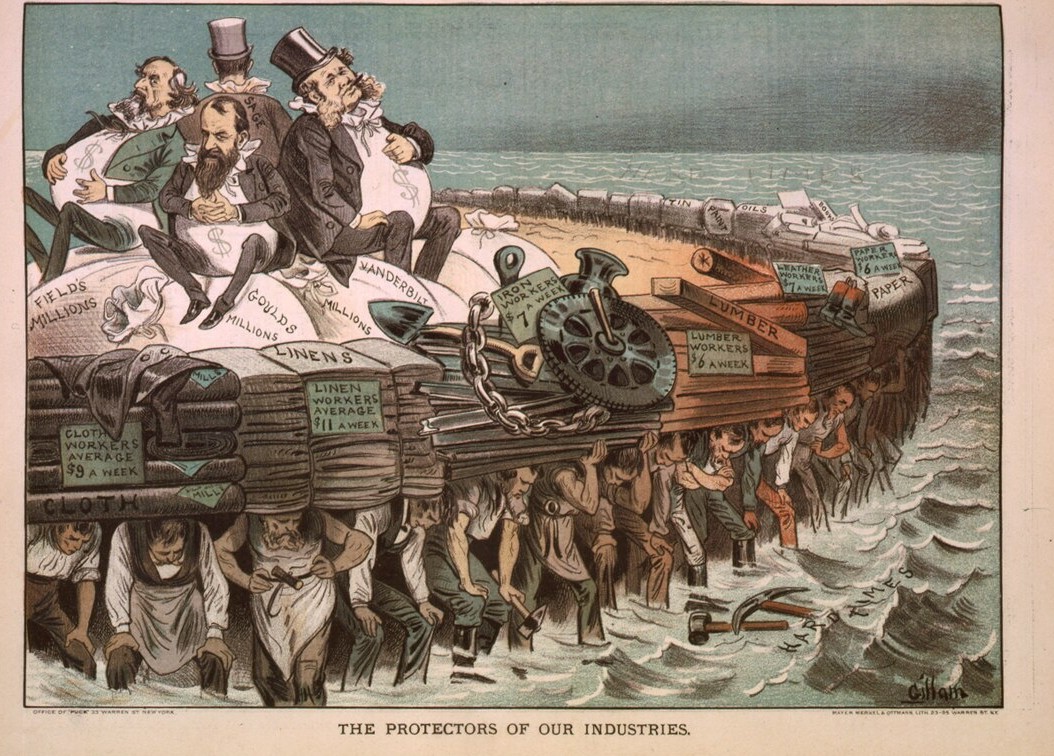
Bernhard Gillam, The Protectors of Our Industries, Puck, February 7, 1883. Library of Congress via Wikimedia Commons, public domain. It was drawn about tariffs. The men on top are seated on their millions; the raft is labeled with what the men underneath earned in a week.
On February 20, 2026, the Supreme Court ruled that the statute did not authorize the tariffs, and most of the money had to go back. That is the body pushing back. Back is a direction, not an address. By October 2, 2026, Customs had certified about $126 billion in refunds, interest included, sent to the Treasury for payment to the companies that filed the paperwork. That is from a declaration by Brandon Lord of Customs and Border Protection, filed in the Court of International Trade on October 6, 2026. Walmart alone received about $2.9 billion in a single quarter, and it says a significant portion went to customer-focused initiatives, mainly what it calls price investment and other cost mitigation. A significant portion is a phrase, not a number. If a patient told me he ate a significant portion of his lunch, I would ask a follow-up question.
The scan goes dark at the shopper, so cross-examine the record. Who paid most of the tariff? You did, at the register, one shelf price at a time. Who gets the refund? The importer of record, because that is how customs refunds work, and people who paid at the register have no refund path through Customs. The importer gets paid back, with interest. The shopper gets a receipt, and the suits against retailers are still pending. The rules did all of that, which is my whole point.
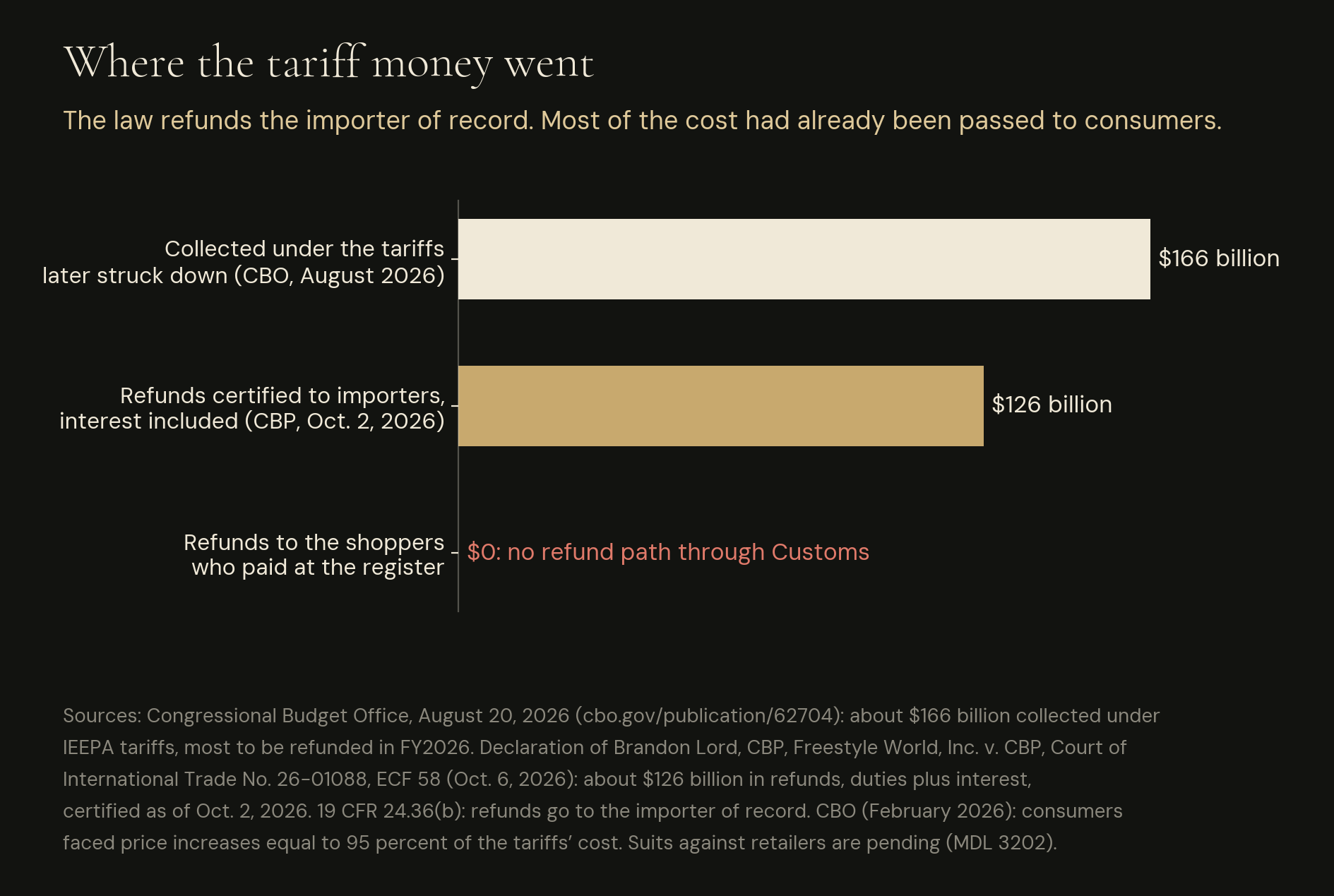
Where the tariff money went. The amount collected is the Congressional Budget Office’s (August 2026). The refunds, interest included, are from a Customs declaration filed October 6, 2026. Who gets them is 19 CFR 24.36(b).
Somewhere in your kitchen there is a drawer of receipts, with the takeout menus and the dead batteries. One of those receipts records a price that carried part of a tariff the Supreme Court said the statute did not authorize. Nothing printed on it says so. It sits there folded, with a date and a total, and it will look like every other receipt in the drawer until the ink fades.
It is the only part of the refund you get to keep, so frame it. On the day of the ruling, the president proclaimed a temporary surcharge under a different statute to replace the tariffs. The Court closed one door, and the replacement came in through another the same day. The emergency tariffs died in court, and the losses still landed downstream: rescue for the mass, consequences for everyone else. In oncology, that is hallmark three. In Washington, it was a Friday.
The next exhibit is the budget law signed July 4, 2025, which is a hell of a day to sign a food cut. It cut federal Medicaid spending by about $915 billion over ten years and SNAP, the food benefit, by about $187 billion (Congressional Budget Office estimates). The law’s Medicaid work requirements do not begin until the end of 2026, and the Medicaid rolls were already thinning. By April 2026, Medicaid and the children’s program had about 4.5 million fewer people enrolled than a year earlier. By July 2026, SNAP was serving about 5.1 million fewer people than in September 2025, on the agencies’ preliminary counts. The defense will say the counts do not prove why the rolls fell. They do not. They do prove when. Whatever the cause, the working tissue was still thinning when the refunds began in May 2026.
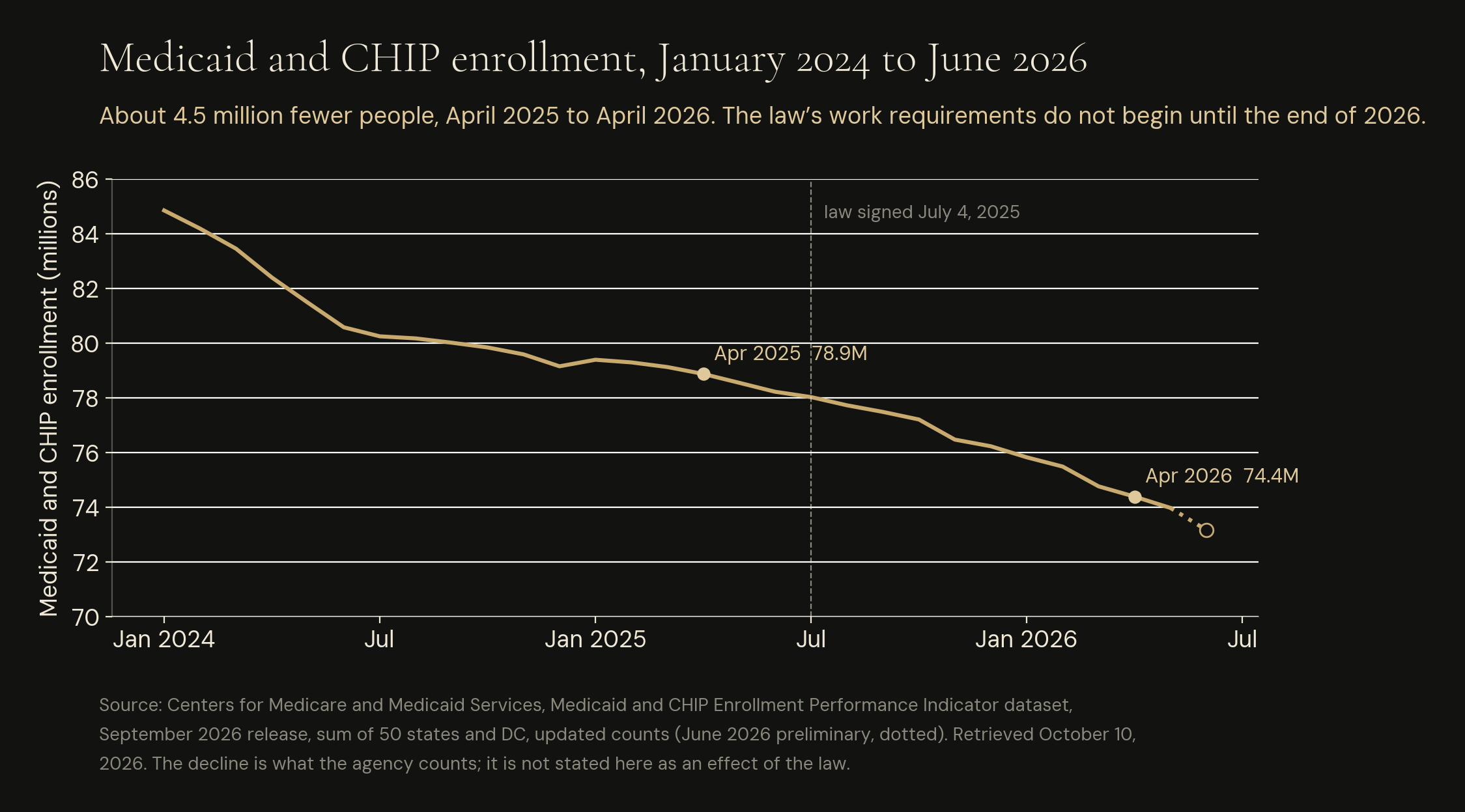
Medicaid and CHIP enrollment, January 2024 to June 2026, from the Centers for Medicare and Medicaid Services performance indicator data (September 2026 release). The decline is what the agency counts. The law’s Medicaid work requirements do not begin until the end of 2026.
The benefit card in somebody’s wallet looks the same the day before it stops working as the day after. Somewhere it gets handed over with the groceries on the belt, and the screen says declined in the same flat font it uses for everything. The line behind goes quiet. The person holding it has to decide, right there, what goes back on the shelf. Nothing in the wallet changed. Something changed in Washington months earlier, in a document that person was not handed, and the card is how the news arrives.
Under the same law, households in the poorest tenth lose about $1,200 a year on average from 2026 to 2034, most of it through the Medicaid and SNAP cuts. Households in the richest tenth gain about $13,600 a year, by the Congressional Budget Office’s estimate. That is the Cori cycle with a signing ceremony. The host rebuilds the fuel. The mass eats it again. The prescription handed to working people is usually some version of work harder, produce more and pour more in. In my building, that is feeding a cachectic patient and wondering why the weight will not stay on.
VI. The starved tissue dies a decade or more early
Hallmark six: invades and spreads.
Hallmark six is invasion and spread. Metastatic cancer commonly reaches the liver, bone or brain, among other organs, and on the card it is the mass moving into whatever was not a market before.
Starved cells malfunction. Muscle cells stop responding properly to insulin, a liver crowded with the wrong fuel becomes inflamed, and vessels bathed in stress hormones stiffen. In a cachectic patient that takes weeks. In a population it takes decades, and we call the result chronic disease: type 2 diabetes, hypertension, fatty liver and heart failure. On the 2024 figures, the country’s yearly health spending was $5.3 trillion. Of that, 90 percent goes to care for people with at least one chronic or mental health condition (Centers for Disease Control and Prevention, 2026). We have built a $5.3 trillion mop, and we keep it parked next to a faucet we leave running.
The first witnesses are British civil servants, men with the same employer and the same national health service, followed for ten years. Death rates tracked rank. The lowest grade died at about three times the rate of senior administrators. Smoking and the usual risk factors explained only part of the gap (Marmot, Lancet, 1984). The org chart was also a life table. For half a century, research has found the gradient: the lower your income and the less control over your work, the sicker you get and the younger you die. I call it the staircase, and every step down costs you time.
The next witness is this country. On 2001 to 2014 records, men in the richest 1 percent of Americans had a life expectancy at forty 14.6 years longer than men in the poorest 1 percent. For women the gap was 10.1 years (Chetty, JAMA, 2016). Read the rest of the study into evidence, because it cuts against me. The same study found the poor lived longer where habits were healthier, not where inequality was lower. And the British gradient existed inside a national health service. So none of this is uniquely American. It is also American, and somebody measured it to the decimal.
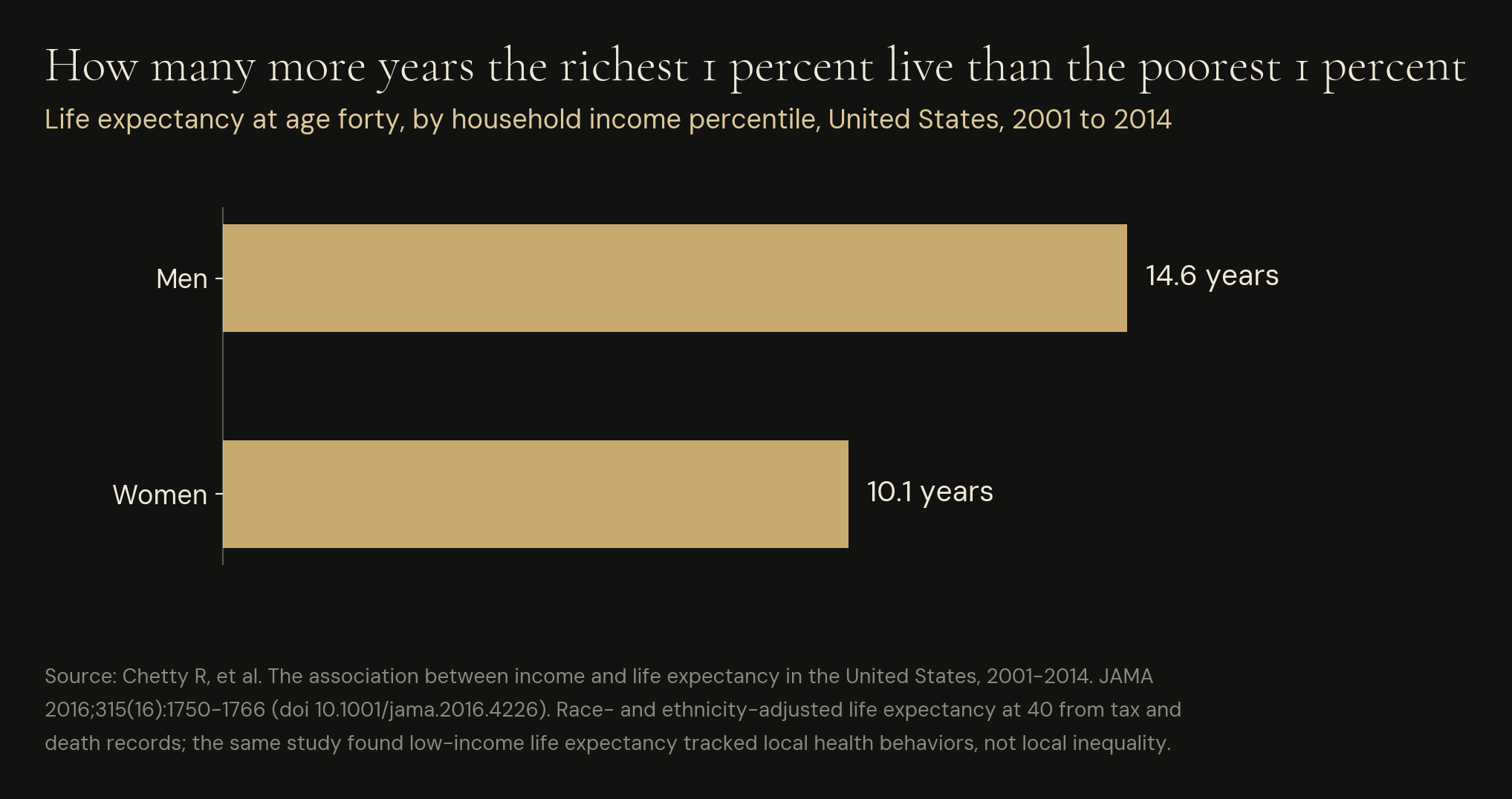
Years of life expectancy at forty separating the richest 1 percent from the poorest 1 percent, by household income, 2001 to 2014. Chetty and colleagues, JAMA, 2016.
Between the longest-lived and shortest-lived counties, the gap in 2014 was 20.1 years (Dwyer-Lindgren, JAMA Internal Medicine, 2017). That is a gap between two counties in the same country. A whole childhood fits inside it.
A hospital is where a county’s blood supply arrives, so read the July 2025 budget law from the county’s end first. Under it, federal Medicaid spending in rural areas is projected to fall by about $137 billion over ten years (KFF, 2025). An analysis for the National Rural Health Association puts rural hospitals’ loss of federal and state Medicaid money at about $57 billion over ten years (Manatt Health, 2025). The same law carries a $50 billion rural fund, and the same analysis says the fund could offset most of the loss if all of it reached hospitals. That “if” is carrying a county’s emergency room on its back. Twenty-two rural hospitals in Texas alone have closed or stopped inpatient care since 2010 (Sheps Center, 2026). That is one state.
Read from the top, the same law hands the richest tenth of households about $13,600 a year, by the Congressional Budget Office’s estimate. There is no “if” in that sentence. The top of the law got a figure. The county got a minus sign, a fund and an “if.” If a discharge plan could stop most of the bleeding only if all the medicine reached the patient, I would page somebody. In Washington, that plan was signed into law on the Fourth of July.
After the inpatient beds close, the sign stays up and the lot stays lit. From the road it still looks like a hospital. What leaves is the bed upstairs and the nurse beside it at three in the morning. The county gets a longer drive, taken at the worst hour of somebody’s life, with the hazards on and the mile markers going by too slowly. Someone you love is in the back seat.
The people who do worst in my infusion chairs are disproportionately the ones who spent their lives in the jobs that keep everything running: kitchens, warehouses, night shifts, second jobs. They arrive with the diseases of depletion stacked on the cancer and less muscle in reserve, and they tolerate treatment worse. Their diets were shaped by what was cheap, fast and shelf-stable, because that is what the food supply offers people with no time and no margin. The gas-station shelf on the way home from a night shift is a policy document. It just has no signature line.
If you work one of those jobs and you are reading this on your break, none of this is your fault. You cooked the food and packed the orders and worked the shift the rest of us slept through. I would be glad to see you with a snack.
A country can be told its wealth is at a record high while its poorest 1 percent die more than a decade before its richest. A tumor can be at record size while the patient is dying. The earnings call and the life table are describing the same body.
VII. Taking the history of the man in charge of the guards
Hallmark eight: evades the immune system.
Immunologists think your immune system finds and destroys many early cancers before anyone knows they were there. Natural killer cells and cytotoxic T cells patrol the body and kill what does not belong. A surviving tumor has learned a password.
Some healthy cells carry a surface protein called PD-L1, which tells a passing T cell, “I belong here, keep moving.” Tumors display it in enormous quantities (Pardoll, Nature Reviews Cancer, 2012). The tumor presses the T cell’s own off switch, and the T cell, neither killed nor overpowered, moves along. A lanyard, a clipboard and a confident walk will get you past most security desks. The tumor wears lanyards on every inch of itself.
Then it recruits. Signals such as TGF-beta and interleukin-10 call immune cells in. Macrophages are reprogrammed into tumor-associated macrophages that help it grow, regulatory T cells become its bodyguards, and fibroblasts build its scaffolding. The tumor does not fire the guards. It hands them a new org chart. Then it drives inflammation everywhere, and the body reads the messages as legitimate.
A country has an immune system too. Ours used to make posters.

Illinois WPA Art Project poster for the Chicago Department of Health, between 1936 and 1941. Library of Congress via Wikimedia Commons, public domain.
The man who runs it now is Robert F. Kennedy Jr., the Secretary of Health and Human Services. I take a history the same way every time: in order, in the speaker’s own words, with the verdict held until the end. He is a lawyer by training, neither a physician nor a scientist. He founded Children’s Health Defense, which the Associated Press describes as an anti-vaccine nonprofit, and he told the Associated Press he had resigned from it by December 2024.
In a 2012 deposition, he said a doctor had told him a worm got into his brain, ate part of it and died.
On The Shawn Ryan Show #117, released June 17, 2024, he said he did “very, very poorly in school” until he started doing narcotics. Of heroin, he said, “It worked for me.” He called it self-medication. His recovery is to his credit, and I mean that without a punchline.
In August 2024 he posted a video confessing that in 2014 he had left a dead bear cub in Central Park with an old bicycle, staged as a bike accident. The cub, for the record, did not ride.
On August 7, 2024, at a courthouse in Albany, he told reporters he had picked up roadkill his “whole life” and had once had a “freezer full of it.” His campaign said he fed it to his birds, and he is a falconer, according to the Associated Press. The freezer stays in the sentence either way.
In May 2025 he posted about a swim with his grandchildren in Rock Creek, where the National Park Service says swimming is not allowed because of high bacteria levels. The Park Service posted the rule. The Secretary posted the swim.
In February 2026 he told a podcast host he was not scared of germs, and he said why: “I used to snort cocaine off of toilet seats.” A healthy respect for germs is more or less the founding premise of public health. The Secretary of Health and Human Services entered toilet seats into evidence. His view of germs is the problem, because germs are the job.
That is his whole history, in his own words. I read that record and I literally just sit there. What the fuck. This is the man running the department that is supposed to lead the country’s health. It takes Olympic-level mental gymnastics to read that record and hear a health expert.
I take histories for a living. If a patient handed me that one, I would not be taking health advice from him. I would be writing a referral.
Then the paper trail. In March 2025 his department announced layoffs, buyouts and early retirements to take it from about 82,000 employees to about 62,000. In May 2025 the commission he chairs published the MAHA Report on children’s health, which cited at least seven sources that did not appear to exist. The White House press secretary called them formatting issues. If I cited seven sources that did not appear to exist, my licensing board would have a word for it. The word would not be formatting.
On June 9, 2025, Kennedy fired all seventeen members of the CDC’s vaccine advisory committee, and two days later he named replacements. In the Wall Street Journal, he called the old committee “little more than a rubber stamp for any vaccine.” He wrote, “A clean sweep is needed to re-establish public confidence in vaccine science.” In August 2025, the CDC director he had sworn in four weeks earlier was removed. Her lawyers said she had refused to “rubber-stamp unscientific, reckless directives.” Four senior CDC officials resigned. She later testified that he told her to approve the vaccine panel’s recommendations in advance or resign. He denies it.
Both phrases are in the record: his “rubber stamp” in June, and her lawyers’ “rubber-stamp” in August. So is his denial, and you are allowed to hold all three at once. The scorecard so far: the farewell warning lasted five days. The CDC director lasted four weeks. At this rate, the carton of milk is the most stable goddamn institution in Washington.
In September 2025 he stood beside the president while the president told pregnant women not to take Tylenol. The president said it again and again. “Fight like hell not to take it,” the president said, as reported by the Associated Press. The same day, the president of the American College of Obstetricians and Gynecologists said the announcement was “not backed by the full body of scientific evidence.”
That sentence lands somewhere. It lands in a medicine cabinet, on any pregnant woman with a fever late at night, holding the bottle and reading the label twice. The pills did not change. The podium did.
On vaccines, Kennedy has been detached from the evidence for decades. In November 2025, the CDC’s own page on autism and vaccines was rewritten to say that “the claim ‘vaccines do not cause autism’ is not an evidence-based claim.” It still said so when I read it on October 20, 2026. The page waved off the large Danish studies as possibly unreliable for American children, naming one from 2002. A later Danish study of 657,461 children found no link between the measles, mumps and rubella vaccine and autism (Hviid, Annals of Internal Medicine, 2019). That is a nationwide cohort with a comparison group. It would not fit in a freezer.
If you are a parent awake at two in the morning, typing those words into a search bar, that is the sentence your government hands you. Somebody wrote it, and then it was left that way, in a clean font.
On January 5, 2026, Jim O’Neill, then the deputy secretary of Health and Human Services, signed a memo cutting the childhood immunization schedule from seventeen diseases to eleven. He signed it in his second job, as the CDC’s acting director. The paper trail ends at a signature, and the signature belonged to the Secretary’s own deputy, wearing the agency’s hat. On March 16, 2026, a federal judge stayed the memo and the replacement appointments. As of October 9, 2026, the committee that sets the schedule had a schedule of its own on the CDC’s meeting page. Its March, June and October 2026 meetings all said cancelled, because of the litigation.
By August 2026, twenty-seven states had stopped following the federal recommendations for all childhood vaccines (KFF, 2026). They relied instead on prior federal recommendations, their own, or groups such as the American Academy of Pediatrics. That is tissue routing around its own compromised organ, and the court that stayed the memo is the body holding the line.
Measles was declared eliminated from the United States in 2000. In 2025 two unvaccinated children in Texas and an unvaccinated adult in New Mexico died of measles, the first American measles deaths since 2015, on the CDC’s count. While that outbreak spread, the Secretary said treatments that included cod liver oil were working, and a Lubbock children’s hospital treated fewer than ten children for vitamin A toxicity. Vitamin A is my field, and it has a role in measles care. It is not a vaccine.
As of October 8, 2026, the CDC counted 4,080 confirmed cases this year, the most in any year since 1991. Pennsylvania alone had confirmed 1,078 cases and five deaths by October 7, on the state’s count. On October 5, the governor of New York declared a state disaster emergency. The defense will point out that the resurgence began in early 2025, before the committee was dismissed, and that the memo left measles on the list. Both true. I do not claim one caused the other. The alarm went off in the same year the organ in charge of it was taken apart and rebuilt.
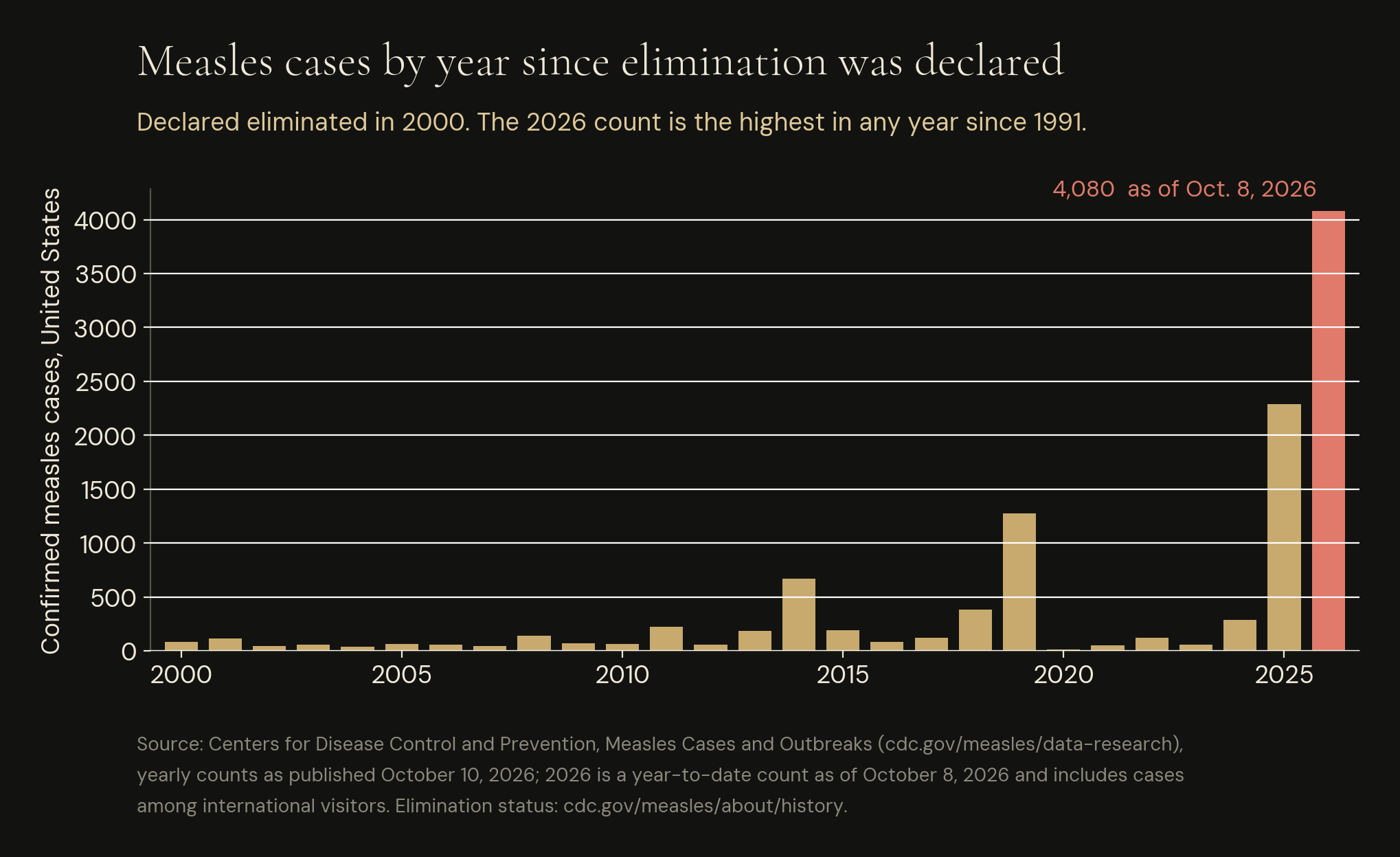
Confirmed measles cases in the United States by year since elimination was declared in 2000. Centers for Disease Control and Prevention, counts as published October 10, 2026; 2026 is a year-to-date count as of October 8.
A tumor’s password is a protein. A country’s password is a slogan: a rising tide lifts all boats, job creators, what is good for the market is good for everyone, Make America Healthy Again. Some are real arguments that economists defend with data, and I am describing what slogans do, not whether anyone means them. Trickle-down has been promised since the 1980s, and I am still waiting at the bottom of the hill.
The movement’s own strategy, released in September 2025, carried no mandates to reduce ultra-processed foods or curb chemical use, NPR reported. In Idiocracy (2006), a whole country pours a sports drink called Brawndo on its crops because the label says it is good for them. The crops die. That got filed under comedy. Twenty years later, the label reads Make America Healthy Again.
One dose of hope. In the last fifteen years, oncology learned that blocking the password lets the immune system do its job. Checkpoint inhibitors physically prevent PD-L1 from reaching the T cell, and in a minority of patients they have produced durable remissions in cancers that used to be death sentences. The price is an immune system that sometimes turns on the body (Ribas and Wolchok, Science, 2018). They are approved for many cancers, melanoma and lung cancer among them. The drug did not have to build a new army. It released a brake the tumor had learned to press.
VIII. The body files its reports, and Washington files them away
Hallmark ten: feeds on inflammation, an enabling trait.
Your body is a snitch. Before every division, p53 inspects the DNA, and when it finds damage it halts the division and orders a repair, or orders the cell to die. Immune cells inspect from outside, and the whole person reports in symptoms: fatigue, unexplained weight loss, pain, fever, night sweats. The message is always the same. Something is growing that should not be, so reinforce the healthy tissue and stop feeding this.
A country reports too, in data like the wealth chart, the county life tables, the measles count and the enrollment figures. It also reports in symptoms: strikes, resignations, audits, hearings, court rulings. All of it says what p53 says.

Filed. The lamp is the only thing in the room still paying attention.
Immunologists describe three phases in a body’s fight with a tumor (Dunn, Old and Schreiber, Annual Review of Immunology, 2004). In elimination, the immune system kills abnormal cells without your ever knowing. In equilibrium, it holds the mass in check, sometimes for years, because the report is heard and acted on. In escape, the tumor has learned the passwords, recruited the guards and silenced the reporting. Much of immunotherapy is dragging a patient from the third phase back to the second.
In hallmark ten, the tumor keeps the tissue around it inflamed, because inflammation is a growth signal and the body cannot tell a wound from a weapon. It manufactures the damage it feeds on. It is an arsonist selling smoke detectors.
In October 2026, four weeks before a national election, internal records released by Democracy Forward and reported by CNN showed what Homeland Security Investigations had done. It had pulled two voter datasets, of about 50 million and 48 million records, and reviewed dozens of voter-registration nonprofits, searching for non-citizen voters. A Reuters review published in July found federal prosecutors had charged 129 people under the relevant statute in the thirty years it has existed. So the count, as of July, was 129 people in thirty years.
The same week, CNN reported orders for a thousand more immigration arrests a day, toward a goal of three thousand. The department says there are no quotas. Both statements are in the record, and you are allowed to do the arithmetic, so run the dose calculation. Against that count, the response was nearly 100 million voter records plus orders for a thousand more immigration arrests a day. In medicine, that is a paper cut treated with a fucking house fire.
Hallmark five has a public version: vessels that run straight to the top. Three days before he took the oath, the incoming president launched a memecoin bearing his name, $TRUMP. On May 22, 2025, he hosted its 220 biggest holders at a dinner at Trump National Golf Club in Sterling, Virginia. That month, the Pentagon accepted a jumbo jet from Qatar, reported to be worth about $400 million, for use as Air Force One. By September, Forbes estimated his net worth had grown by $3 billion in a year.
Say it back slowly, the way a nurse reads back an order. A coin with his own name on it, launched before the oath. A dinner for its biggest holders, at a golf club with his own name on it. A jet from Qatar that month, accepted by the Pentagon for use as Air Force One. Then the Forbes estimate in September. The coin, the club and the net worth all carry his name. The jet gets his job title.
My dictated notes called these backroom deals, and the record corrected me. They do not bother with the back room anymore. They send out invitations. On the earnings call, the host was not on the line. At that dinner, the host was not on the list.
In June 2025 the president federalized California’s National Guard over its governor’s objection and sent about 4,000 Guard troops and about 700 Marines into Los Angeles. A federal judge later found the deployment violated the Posse Comitatus Act, a ruling on hold on appeal.
There is an older word for a system in which private power and state power work as one. In that system the enemy is manufactured on demand, troops go into a city over its governor’s objection, and the institutions that would report it are told to look away. That description is mine, not a historian’s. The historian Robert Paxton argued that the word should be judged by what a movement does, not what it says (Paxton, The Anatomy of Fascism, 2004). Judged that way, against the dated acts in this case, from the fired vaccine committee to the troops in Los Angeles, the word is fascism. In a clinician’s vocabulary, it is the attempt at the third phase.
That is a judgment, not a lab value, and the record is there for you to check. A court struck down the tariffs, and another stayed the vaccine memo. The alarms are still ringing. This is the second phase, not yet the third.
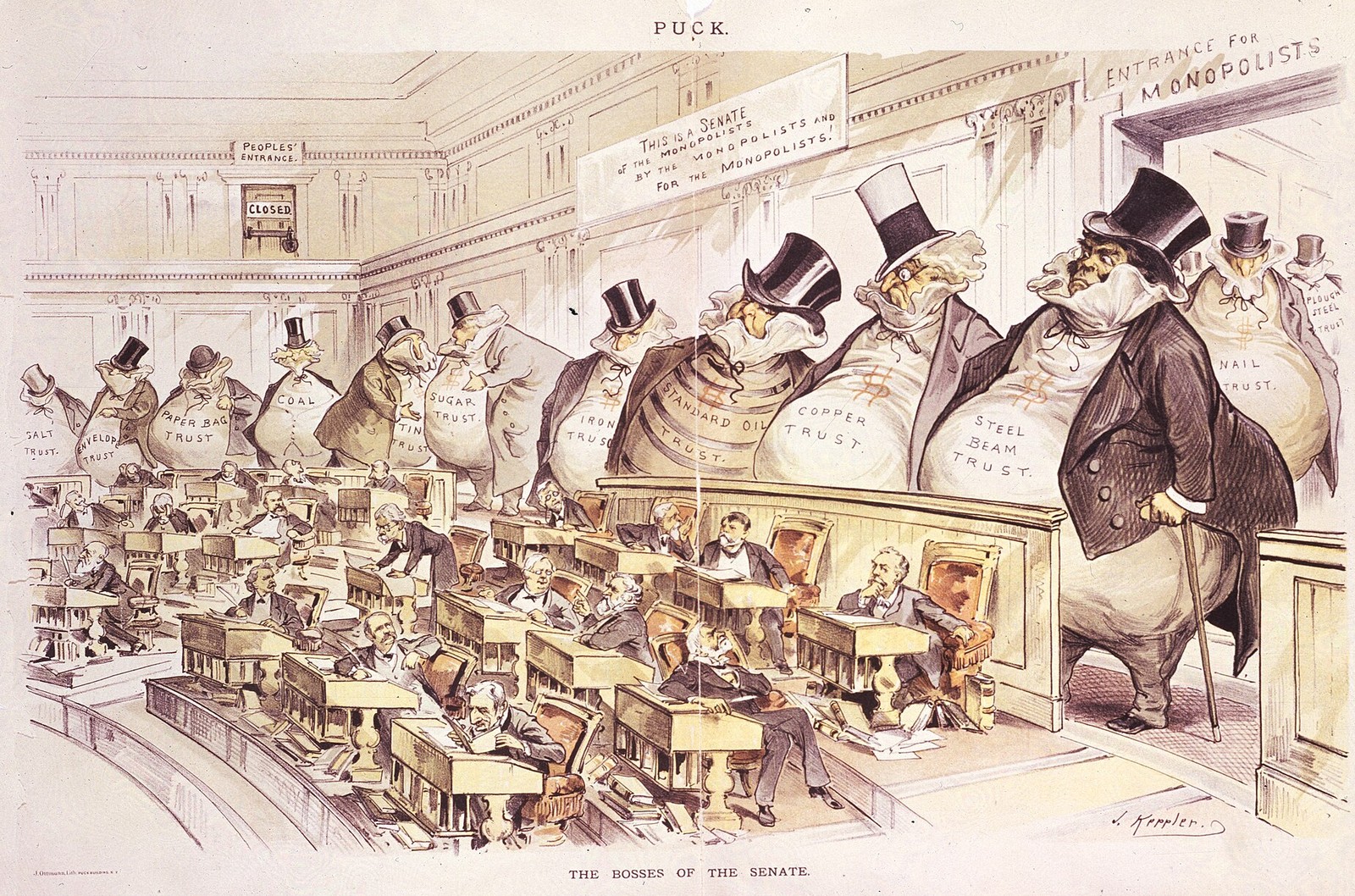
Joseph Keppler, The Bosses of the Senate, Puck, January 23, 1889. U.S. Senate collection via Wikimedia Commons, public domain. The door on the right is marked Entrance for Monopolists. The people’s entrance is marked closed. Neither sign looks dated.
I will not call a party the tumor, because a tumor is not a party. It is a set of behaviors and the offices that perform them, and right now I can read you the names on the doors. Every dated row on the card comes from the last two years, most from the second Trump administration, because that is when the chart was drawn. The pattern is older. In 2023 the same Supreme Court struck down a student-loan cancellation built on a national-emergency law, and a reader of either party can fill the rows from their own decade.
The jury will want to know whether we stay in the second phase, and equilibrium is currently the best outcome on offer. If we slip into escape, the report still arrives, and it is read, and then it is filed, by the part of the body that works for the tumor. In Don’t Look Up, the astronomers had the data, and the comet hit anyway. It was billed as a satire. Some days it reads like a procedure manual. The country votes on November 3, 2026, and I will not predict how. I know what the third phase looks like from the next chair over.
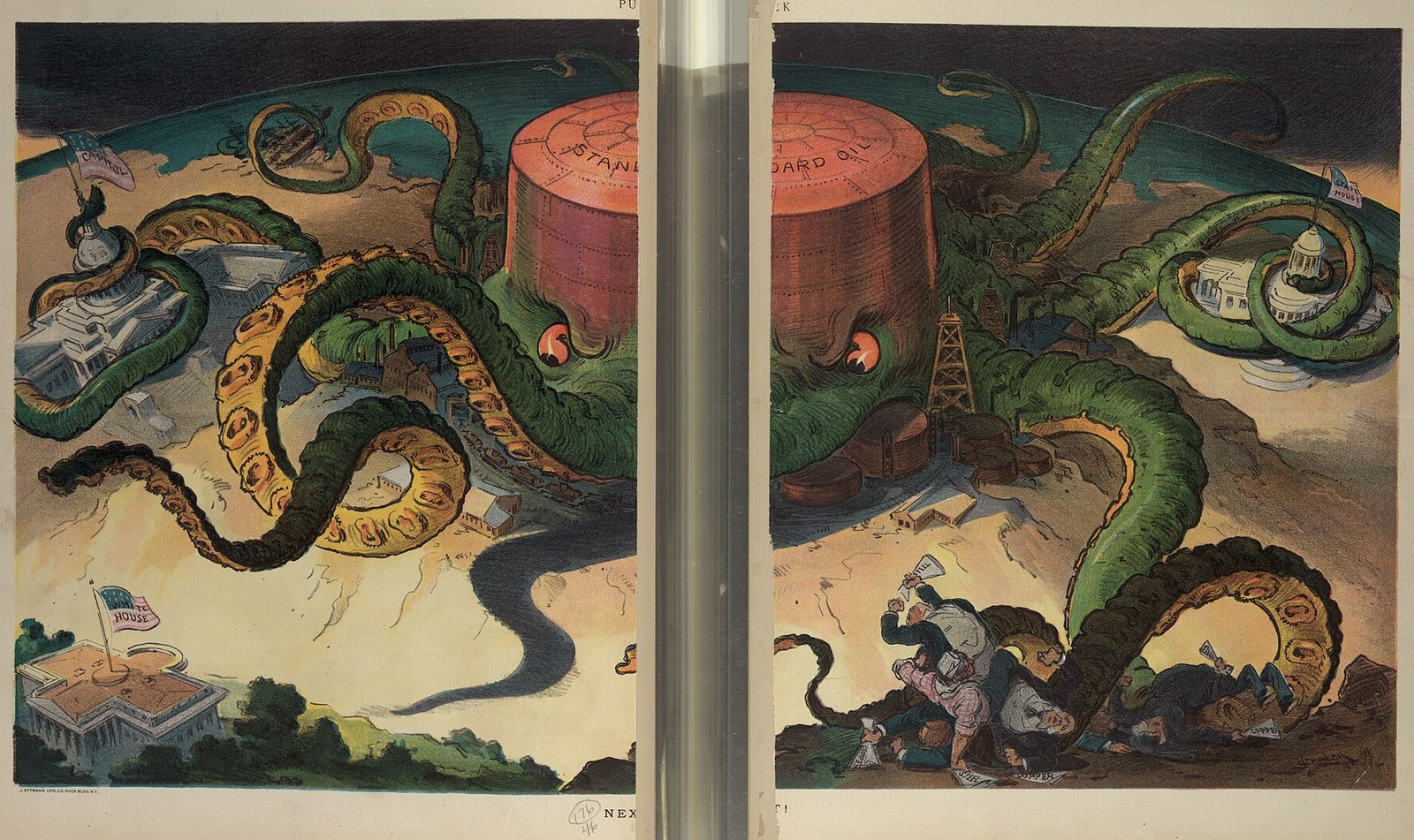
Udo Keppler, Next!, Puck, September 7, 1904. Library of Congress via Wikimedia Commons, public domain. The tentacles are on the Capitol and a statehouse, and one is reaching for the White House. The crease down the middle is the original centerfold. So is the question in the title.
IX. The expert witness discloses his stake
Hallmarks five and nine: builds its own blood supply; destabilizes its own genome, an enabling trait.
In the body, cachexia takes muscle first, and in a system the tissue that loses its blood supply early is often the one whose job is keeping the organism healthy. Its product is a disaster that does not happen, and a ledger has no column for that. To something that measures everything in growth, prevention is overhead. In American medicine, that tissue is my profession. I am one of the cells, and an expert witness should disclose before he testifies.
I work as an outpatient oncology dietitian, and this piece is my own work, not my employer’s. I also run a small nutrition practice, Vitae Arete, which offers consulting to health systems and, as of October 2026, has no clients.
Registered dietitians keep the patient with diabetes off dialysis, the heart patient out of the cath lab and the cancer patient strong enough to finish treatment. Medicare pays for medical nutrition therapy only for diabetes and kidney disease, and for everything else it pays nothing for a dietitian’s time. Where it does pay, the statute sets the rate at 85 percent of what it would pay a physician for the same service. The physician amount is the benchmark. The dietitian gets the discount version, and Congress printed the coupon in the statute.
Under the 2026 fee schedule, fifteen minutes of follow-up nutrition therapy in a hospital clinic nets $18.36. That is after the 85 percent, and after the 2 percent sequester first applied in 2013. It is a little less than a month of the streaming service that will eventually make a documentary about all this. Fifteen minutes is long enough to check a weight trend, recalculate a protein target and talk through why the appetite left. It is not long enough to explain to anyone why it pays $18.36.
If the man in chair four is on Medicare, Medicare pays nothing for a dietitian’s time with him. His diagnosis is cancer. You can read the list as many times as you want, and cancer is still not on it.
Since January 1, 2024, a graduate degree has been required to sit for the dietitian exam. The pay did not get the memo. In May 2025 the Bureau of Labor Statistics put the mean dietitian wage at $77,130 nationally. A respiratory therapist, an associate’s degree job, earned $87,300 the same year, in the same survey. Good for the respiratory therapists, who earn every dollar. I just think the degree chart and the pay chart should be on speaking terms.
Enrollment across accredited dietetics programs fell from 24,423 in 2014 to 14,336 in 2025, a drop of 41 percent, with a small uptick from 2024 to 2025. The numbers do not say the pay caused the drop.
Then the loan rules. From July 1, 2026, federal graduate borrowing was capped at $100,000, with a higher cap of $200,000 for professional degrees. After a court stay in June 2026, the Education Department published an interim list of professional programs. Physical therapy, occupational therapy, speech pathology, graduate nursing and physician assistant programs qualify. Dietetics does not, as of the July 10, 2026, update, and the Department’s May 2026 rule did not list it either. Put the May rule beside the July list, and the answer is plain, for now: the degree you need for the exam does not count as professional. In the eyes of the federal loan office, I am a very expensive hobby.
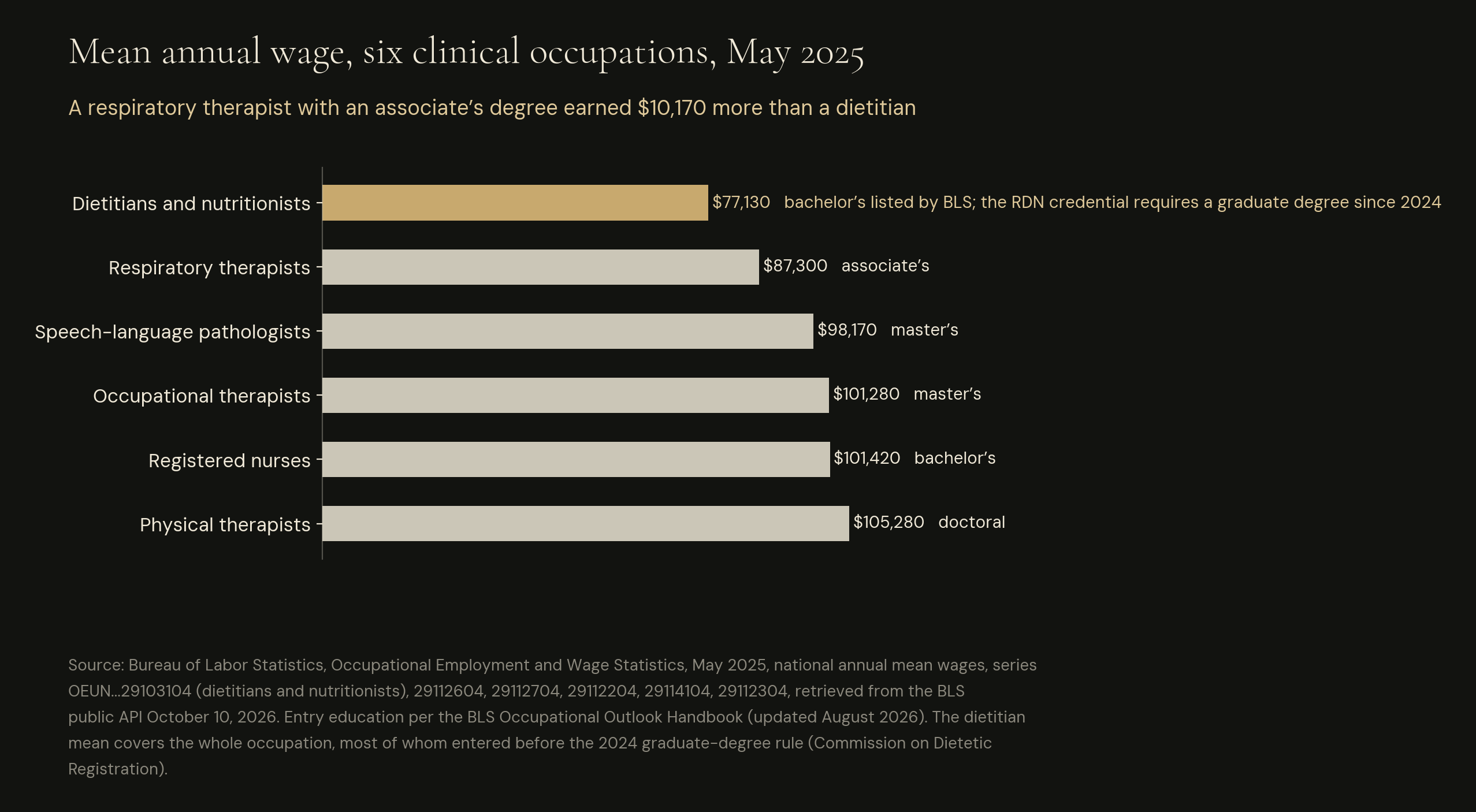
Mean annual wage, six clinical occupations, Bureau of Labor Statistics Occupational Employment and Wage Statistics, May 2025, with the typical entry education per the Occupational Outlook Handbook. The dietitian figure covers the whole occupation, most of whom entered before the 2024 graduate-degree rule.
Hallmark nine is genome instability, where the rules bend until breaking them is the advantage. The credential now requires a graduate degree, and the loan rules left that degree on the lower cap. I wrote about this in Health Affairs Forefront in July, under the title The Slow Collapse Of The US’s Clinical Nutrition Workforce. I meant the title as a measurement.
Hallmark five shows up here in its purest form, as blood rerouted away from a tissue that does not grow. In the same law and the rule that carried it out, Washington cut the food benefit and the clinician who teaches people how to eat. It did that during a chronic-disease epidemic, while measles came back, under a health secretary whose movement is named for making America healthy. Brawndo was subtler.
I once sat on a jury in a long trial, and the case is not the point. One exhibit is. It was a poster board of appointment costs, broken out by specialty, meant to show the jury what care is worth. Dietitians were listed at the top. The figure beside them was one I knew from my own work to be wrong.
I felt sick. It was one of those things only you know. As far as I could tell, nobody else in the room could see it. It does not get any less wrong when you seem to be the only one who can tell. It felt like being misinformed, officially, with an exhibit sticker on it. For once, dietitians were at the top of a list, and it was the wrong list.
I was in the jury box, where you do not get to object, looking at my own profession priced wrong in public. The number went up in front of the jury. The need behind it did not.
Outside the jury box, a healthy cell files a report, so I filed one. I built a compensation analysis that set the pay ranges in my employer’s public job postings beside the federal wage data. I sent it up through the ordinary channels at work and was asked to develop it further. That is an immune response working as designed. But the price list hospitals work from was written in Washington, and that is where I object. Dietitians keep providing the evidence to the people who make the decisions. Washington keeps filing it.
It is demoralizing to be a dietitian right now. You scrape by, and you take a second job, and the yearly raise, when it comes, does not catch you up, because you were underpaid before it arrived. Minimum wage might be going up, which is good, but that just compresses you in the middle. A lot of people are afraid of being laid off. A lot of people cannot afford to go into this field at all, because the cost and the pay do not add up. Then someone online tells you to find your niche. That advice assumes a cushion to land on, and a niche does not make rent. It is honestly scary.
If you are a student doing that math on a dietetics degree, none of it is your fault. The wrong list is a thing somebody can rewrite.
What I am watching for is whether the resource flow changes and the starving tissue gets its supply back, or whether the report sits there, acknowledged and filed. Dietitians are healthy cells. Whether anyone reads the report is the same question as whether the patient lives.
X. Closing argument, back in the infusion room
Back in the infusion room.
The bags are still on the poles.
The tumor in chair four did not hate him. It had no plan, and it did not know it was killing him. It grew, and it took, and it signaled to every system in his body that everything was fine. It would have grown until it could not, and then it would have died with him, in the same body. That is where unchecked growth ends. A system with no stop signal gets there at the speed the arithmetic predicts. It goes slowly for thirty doublings, from one cell to the gram a scan can barely find. Then fast.
A trial is rarely offered because things are going well. He knew what the bag on the pole meant. He took the swing anyway.
The country is in the chair now, and its earnings calls sound terrific. The best quarter a tumor ever reports is usually its last one. The country’s next line of treatment is on the ballot on November 3. Food in the hand means the body still gets a vote. A ballot in the hand means the country does.
This is the closing argument, and you are the jury. In my jury box I could not object. You can, and the record is dated, sourced and in front of you. So object. Call your representative, and write your senator. The person who answers is a worker too, so be kind to them and relentless about the name on the door. Bring the numbers: 4,080 confirmed measles cases this year, and about $126 billion in refunds certified to importers. Then call again next week. If you are a dietitian, object in writing to Washington, which wrote the price list, through every channel you have, the Academy of Nutrition and Dietetics included.
Being vocal about injustice can change things. It can change them when it gets loud enough and eyes start to focus on the people doing the injustice. I know it does not feel that way right now, with deals that no longer bother with a back room. People need to remember that we are many.
If you are in one of those recliners while you read this, eat what you can keep down, and do not let anyone shame the snack. The Uncrustable is fine. I am on your side.
The reports are in, and I have filed mine.
Is the host going to listen?
I was in the room when the answer came back for chair four. I am still waiting on ours.
Chair four, marked above with an asterisk, is a composite. He is drawn from patients I have cared for over several years in outpatient oncology, with details changed and combined so that no one of them can be identified. The moments with him in this essay, including the last one, are drawn from several patients. Everything the essay says about what cachexia does to a body is what it does.
What I checked, and what I cannot tell you
The biology in this essay is standard oncology. The ten behaviors are Hanahan and Weinberg’s 2011 list, which set two enabling characteristics, genome instability and tumor-promoting inflammation, beside eight hallmarks, two of them new in 2011. Hanahan revised the list in 2022 and again in January 2026; the newer additions are not used here. The ninety percent of health spending figure is the CDC’s, and it counts spending on people who have a chronic or mental health condition, not spending on those conditions alone. The growth arithmetic (thirty doublings to about a gram, forty to about a kilogram) is a teaching approximation. Real tumors lose cells as they grow and slow as they outrun their blood supply, which is the Gompertzian point the essay makes. Cachexia is defined by the 2011 international consensus (Fearon, Lancet Oncology, 2011). The consensus defines all cancer cachexia as wasting that conventional nutritional support cannot fully reverse; that is the sense in which the essay says feeding alone does not fix it.
Every current-events figure in the first draft was checked against its source between September 24 and October 10, 2026 (the Medicare rate on September 24, everything else on October 10). Wealth shares come from the Federal Reserve’s Distributional Financial Accounts. The Medicaid, SNAP and tariff estimates come from the Congressional Budget Office. The tariff ruling is the Supreme Court’s opinion, the refund total is a Customs declaration filed in the Court of International Trade, and Walmart’s refund is in its quarterly filing. The measles count is the CDC’s. Wages are the Bureau of Labor Statistics’. Dietetics enrollment is the Accreditation Council for Education in Nutrition and Dietetics’; the Medicaid and SNAP counts are the agencies’ own. The loan rules are in the Federal Register and Federal Student Aid’s announcements. Two of those figures come from news reports rather than an issuing agency: the prosecution count (Reuters) and the voter-record search (CNN).
The political record in sections IV, VII and VIII was checked on October 13 and 15, 2026. I used the issuing agency where one exists, and the Associated Press, CNN, NPR and other outlets where none does. Kennedy’s stories about himself are his own accounts, from a 2012 deposition reported by The New York Times, his own posts and video, two podcast interviews and remarks to reporters. The Qatar jet’s $400 million is a press estimate; the government has published no valuation. Musk’s spending is the year-end total from federal filings as CNN reported it. The CDC’s page on autism and vaccines was read on October 20, 2026. A federal judge’s finding on the Los Angeles deployment is on hold on appeal, and the essay says so.
Figures first seen in advocacy or partisan summaries were replaced with the primary source’s number wherever the two differed. Three did not survive. A $231 billion tariff cost, with a per-household figure, applied a pass-through rate to all customs receipts, including lawful tariffs. A $155 billion rural hospital figure was a superseded estimate of rural Medicaid spending, not hospital losses. A Texas closure count of 26 is 22 on the Sheps Center’s list. The Medicaid and SNAP enrollment drops are stated as what the agencies count, not as effects of the law. Most of the law’s Medicaid provisions had not taken effect when the rolls fell.
Three more figures I had carried from an earlier draft did not survive the check. A county life-expectancy pair (81.6 and 71.7 years) turned out to be model predictions for hypothetical counties rather than observed averages. A claim that the childhood vaccine schedule “now” covers eleven diseases ignored the court stay of March 2026. The measles comparison year is 1991, not 1990.
What I cannot tell you is whether the report is heeded. I do not know how the midterms end, and I do not know what will come of the pay analysis I sent up at work. Neither is mine to call.
References
Accreditation Council for Education in Nutrition and Dietetics. Dietetics Education Program Statistics 2000-2025. PDF, March 2026. https://www.eatrightpro.org/acend/about-acend/acend-data
American Cancer Society. Common questions about causes of cancer, including sugar. https://www.cancer.org/
American College of Obstetricians and Gynecologists. ACOG affirms safety and benefits of acetaminophen during pregnancy. September 22, 2025.
Associated Press. Billionaires, tech titans, presidents: a guide to who stood where at Trump’s inauguration. January 20, 2025.
Associated Press. Defense Department accepts luxury jet from Qatar for Trump’s use. May 21, 2025. https://www.pbs.org/newshour/politics/defense-department-accepts-luxury-jet-from-qatar-for-trumps-use
Associated Press. Asked about bear carcass prank, RFK Jr. says he once had a freezer full of roadkill meat. August 7, 2024. https://www.wsls.com/news/politics/2024/08/07/rfk-jr-grilled-again-about-moving-to-california-while-listing-new-york-address-on-ballot-petition/
Associated Press. RFK Jr. says he dumped a dead bear cub in Central Park. August 4, 2024.
Associated Press. RFK Jr. says he’s resigned from anti-vaccine nonprofit as he seeks nation’s top health job. January 23, 2025.
Biden v. Nebraska, 600 U.S. 477 (2023).
Bureau of Labor Statistics. Occupational Employment and Wage Statistics: dietitians and nutritionists (SOC 29-1031) and respiratory therapists (SOC 29-1126). May 2025. https://www.bls.gov/oes/
Cecil G. Sheps Center for Health Services Research. Rural hospital closures, 2010 to present. https://www.shepscenter.unc.edu/programs-projects/rural-health/rural-hospital-closures/
Centers for Disease Control and Prevention. Advisory Committee on Immunization Practices meetings page. As of October 9, 2026.
Centers for Disease Control and Prevention. Autism and vaccines. Page dated July 22, 2026; read October 13, 2026. https://www.cdc.gov/vaccine-safety/about/autism.html
Centers for Disease Control and Prevention. Fast facts: health and economic costs of chronic conditions. Page dated May 26, 2026. https://www.cdc.gov/chronic-disease/data-research/facts-stats/
Centers for Disease Control and Prevention. Measles cases and outbreaks. As of October 8, 2026. https://www.cdc.gov/measles/data-research/index.html
Centers for Disease Control and Prevention. Measles history. Elimination declared 2000. https://www.cdc.gov/measles/about/history.html
Centers for Medicare and Medicaid Services. Medicaid and CHIP enrollment, performance indicator dataset, September 2026 release.
Centers for Medicare and Medicaid Services. Medicare Physician Fee Schedule, CY 2026 final rule, 90 FR 49266. November 5, 2025. Relative value file RVU26D. August 26, 2026. 42 U.S.C. 1395l(a)(1)(T); 42 CFR 410.130-410.132.
Chetty R, et al. The association between income and life expectancy in the United States, 2001-2014. JAMA. 2016;315(16):1750-1766.
CIDRAP. Texas announces second measles death in unvaccinated child. April 2025. https://www.cidrap.umn.edu/measles/texas-announces-second-measles-death-unvaccinated-child
CNBC. Top Trump memecoin holders head to dinner with the president. May 22, 2025.
CNN. Elon Musk spent more than $290 million on the 2024 election, year-end FEC filings show. February 1, 2025.
CNN. Exclusive: ICE agents told to ramp up arrests. October 8, 2026.
CNN. ICE reviewed tens of millions of voter records looking for noncitizen voters, records show. October 7, 2026.
Commission on Dietetic Registration. Graduate degree eligibility requirement. Effective January 1, 2024. https://www.cdrnet.org/graduatedegree
Congressional Budget Office. Blog post on IEEPA tariff revenue and refunds. August 20, 2026. https://www.cbo.gov/publication/62704
Congressional Budget Office. The Budget and Economic Outlook: 2026 to 2036. February 11, 2026. Tariff pass-through. https://www.cbo.gov/publication/62105
Congressional Budget Office. Cost estimate, Medicaid provisions of Public Law 119-21. October 28, 2025. https://www.cbo.gov/publication/61837
Congressional Budget Office. Distributional Effects of Public Law 119-21. August 11, 2025. https://www.cbo.gov/publication/61367
Congressional Budget Office. Estimated Budgetary Effects of Public Law 119-21, to Provide for Reconciliation Pursuant to Title II of H. Con. Res. 14, Relative to CBO’s January 2025 Baseline. July 21, 2025. https://www.cbo.gov/publication/61570
Congressional Research Service. R48982, on the Advisory Committee on Immunization Practices. 2026. https://www.everycrsreport.com/reports/R48982.html
Declaration of Brandon Lord, U.S. Customs and Border Protection, in Freestyle World, Inc. v. U.S. Customs and Border Protection, Court of International Trade No. 26-01088, ECF 58. October 6, 2026.
Dunn GP, Old LJ, Schreiber RD. The three Es of cancer immunoediting. Annual Review of Immunology. 2004;22:329-360.
Dwyer-Lindgren L, et al. Inequalities in life expectancy among US counties, 1980 to 2014. JAMA Internal Medicine. 2017;177(7):1003-1011.
FactCheck.org. The Trump administration’s problematic claims on Tylenol and autism. September 23, 2025. https://www.factcheck.org/2025/09/trump-administrations-problematic-claims-on-tylenol-and-autism
Fearon K, et al. Definition and classification of cancer cachexia: an international consensus. Lancet Oncology. 2011;12(5):489-495.
Federal Reserve Board. Distributional Financial Accounts, 2026 Q2. Released September 2026. https://www.federalreserve.gov/releases/z1/dataviz/dfa/ and FRED series WFRBST01134.
Federal Student Aid. Electronic Announcement GENERAL-26-42, Update to list of professional degree programs due to court order. June 29, 2026, updated July 10, 2026.
Fee J. The Slow Collapse Of The US’s Clinical Nutrition Workforce. Health Affairs Forefront. July 16, 2026. https://www.healthaffairs.org/content/forefront/slow-collapse-us-s-clinical-nutrition-workforce
Forbes. The Forbes 400. September 9, 2025.
Hanahan D. Hallmarks of cancer: new dimensions. Cancer Discovery. 2022;12(1):31-46.
Hanahan D. Hallmarks of cancer: then and now, and beyond. Cell. 2026;189(8):2254-2277. Online January 29, 2026. doi:10.1016/j.cell.2025.12.049
Hanahan D, Weinberg RA. Hallmarks of cancer: the next generation. Cell. 2011;144(5):646-674.
Hanahan D, Weinberg RA. The hallmarks of cancer. Cell. 2000;100(1):57-70.
Healio. White House says Monarez fired as CDC director. August 28, 2025. https://www.healio.com/news/infectious-disease/20250828/white-house-says-monarez-fired-as-cdc-director
Holroyde CP, et al. Altered glucose metabolism in metastatic carcinoma. Cancer Research. 1975;35(12):3710-3714.
Hviid A, Hansen JV, Frisch M, Melbye M. Measles, mumps, rubella vaccination and autism: a nationwide cohort study. Annals of Internal Medicine. 2019;170(8):513-520.
Kennedy RF Jr. Op-ed on the removal of the members of the Advisory Committee on Immunization Practices. The Wall Street Journal. June 2025.
KFF. How might federal Medicaid cuts in the enacted reconciliation package affect rural areas? July 24, 2025. https://www.kff.org/medicaid/how-might-federal-medicaid-cuts-in-the-enacted-reconciliation-package-affect-rural-areas/
KFF. Midterm election update: vaccines. October 6, 2026. https://kff.org/elections/midterm-election-update-vaccines
Laird AK. Dynamics of tumor growth. British Journal of Cancer. 1964;18(3):490-502.
Learning Resources, Inc. v. Trump, No. 24-1287 (U.S. February 20, 2026). https://www.supremecourt.gov/opinions/slipopinion/25
Manatt Health for the National Rural Health Association. Impact of H.R. 1 on Rural Medicaid Hospital Expenditures (Total Computable). Updated September 4, 2025.
Marmot MG, Shipley MJ, Rose G. Inequalities in death: specific explanations of a general pattern? Lancet. 1984;1(8384):1003-1006.
McMurtry J. The Cancer Stage of Capitalism. London: Pluto Press; 1999.
McMurtry J. The Cancer Stage of Capitalism: From Crisis to Cure. 2nd ed. London: Pluto Press; 2013.
Musk E. Post on X. February 3, 2025. https://x.com/elonmusk/status/1886307316804263979
National Park Service. Rock Creek Park: Stay dry, stay safe. https://www.nps.gov/rocr/planyourvisit/stay-dry-stay-safe.htm
Neergaard L. A glimpse at Trump’s false claims around pregnancy, Tylenol and autism. Associated Press. September 23, 2025.
New York State. Executive Order No. 65, State Disaster Emergency. October 5, 2026. https://www.governor.ny.gov/news/governor-hochul-declares-state-disaster-emergency-response-ongoing-measles-outbreak
The New York Times. Report on Robert F. Kennedy Jr.’s 2012 deposition. May 8, 2024.
Newsom v. Trump, U.S. District Court for the Northern District of California. June 2025 federalization of the California National Guard; Posse Comitatus ruling after an August 2025 trial, stayed on appeal.
NOTUS. White House MAHA report citations. May 29, 2025. https://www.notus.org/health-science/white-house-maha-report-citation-formatting-issues
NPR. MAHA strategy. September 10, 2025. https://www.wusf.org/2025-09-10/maha-strategy-flip-flops-on-pesticides
One Big Beautiful Bill Act. Public Law 119-21, section 81001. July 4, 2025. https://www.govinfo.gov/app/details/PLAW-119publ21
Pardoll DM. The blockade of immune checkpoints in cancer immunotherapy. Nature Reviews Cancer. 2012;12(4):252-264.
Paxton RO. The Anatomy of Fascism. New York: Knopf; 2004.
Pennsylvania Department of Health. Statewide update on measles outbreak. October 7, 2026.
Proclamation 11012, Imposing a Temporary Import Surcharge to Address Fundamental International Payments Problems. Federal Register. February 20, 2026. https://www.federalregister.gov/documents/2026/02/25/2026-03824/imposing-a-temporary-import-surcharge-to-address-fundamental-international-payments-problems
Reuters. Trump claims non-US citizen voting is rampant; the numbers tell another story. July 2026.
Ribas A, Wolchok JD. Cancer immunotherapy using checkpoint blockade. Science. 2018;359(6382):1350-1355.
Scripps News. “I used to snort cocaine off toilet seats,” RFK Jr. tells podcast. February 2026. https://www.scrippsnews.com/health/i-used-to-snort-cocaine-off-toilet-seats-rfk-jr-tells-podcast
Shawn Ryan Show. Episode 117, Robert F. Kennedy Jr. June 17, 2024.
Sontag S. Illness as Metaphor. New York: Farrar, Straus and Giroux; 1978.
Texas Public Radio via Texas Standard. West Texas children treated for vitamin A toxicity. April 1, 2025. https://texasstandard.org/stories/west-texas-measles-outbreak-children-treated-vitamin-a-medical-disinformation/
U.S. Department of Agriculture, Food and Nutrition Service. SNAP participation, national view summary. Data as of October 9, 2026.
U.S. Department of Education. Final rule, 91 FR 23768: professional degree definition at 34 CFR 685.102. May 1, 2026.
U.S. Department of Health and Human Services. HHS announces transformation to make America healthy again. March 27, 2025. https://www.hhs.gov/press-room/hhs-restructuring-doge.html
U.S. Department of Health and Human Services. Release on the revised childhood immunization schedule, signed by acting CDC director Jim O’Neill. January 5, 2026. Archived copy: https://web.archive.org/web/20260105202406/https://www.hhs.gov/press-room/cdc-acts-presidential-memorandum-update-childhood-immunization-schedule.html
U.S. Senate Committee on Finance. Hearing with Secretary Robert F. Kennedy Jr. September 4, 2025.
U.S. Senate Committee on Health, Education, Labor and Pensions. Hearing with former CDC Director Susan Monarez. September 17, 2025.
Walmart Inc. Form 10-Q for the quarter ended July 31, 2026. Filed August 28, 2026. https://www.sec.gov/
The White House. Remarks by President Biden in a farewell address to the nation. January 15, 2025. https://bidenwhitehouse.archives.gov/
World Inequality Lab. World Inequality Report 2026. December 2025. https://wir2026.wid.world/
Vitae Arete provides nutrition education and does not diagnose, treat, or manage cancer, nor prescribe or manage medication. This article is general information, not individualized medical or nutrition advice, and does not create a dietitian–client relationship. See the full disclaimer.